
Red Cross CPR: Certification, Classes, and Cost (2026 October)
❓ Everything about Red Cross CPR certification. Covers BLS and Heartsaver courses, class format, cost, how to find classes near you, and how long the
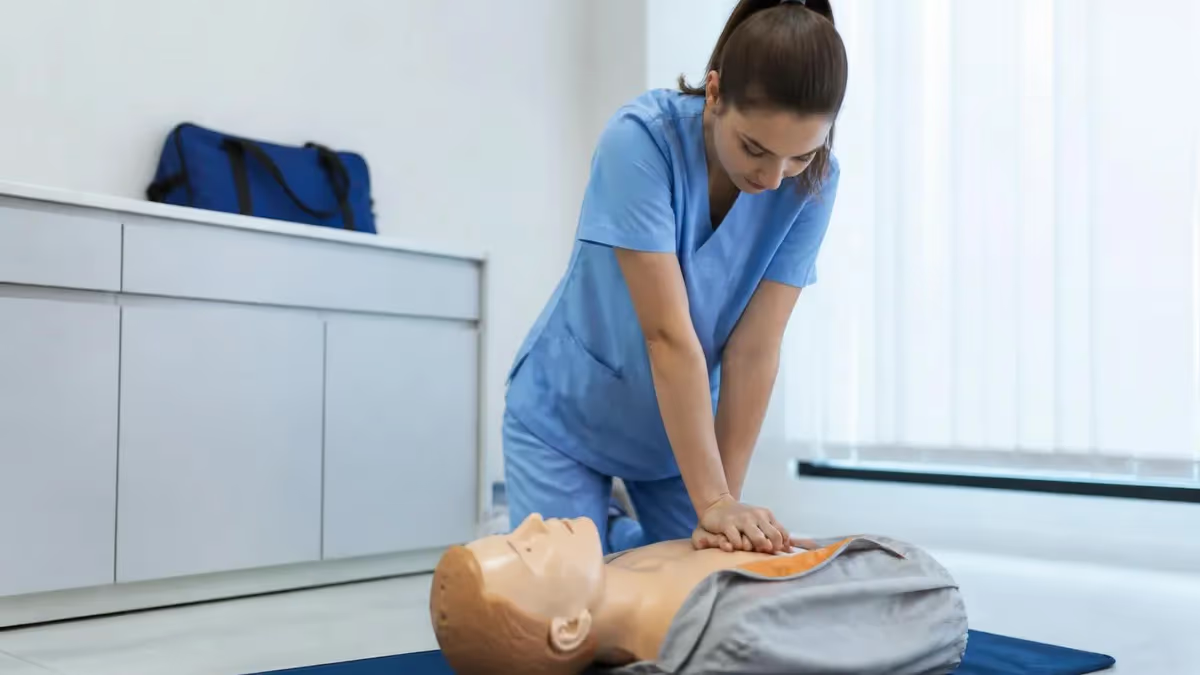
What Is Red Cross CPR Certification?
The American Red Cross is one of the two nationally recognised CPR certification providers in the United States, alongside the American Heart Association. Red Cross CPR certification is accepted by hospitals, schools, gyms, childcare facilities, and most employers that require CPR training. Whether you need CPR certification for a healthcare job, workplace compliance, a coaching position, or personal preparedness, the Red Cross offers courses at multiple levels to match different professional settings and experience levels.
The Red Cross has been training people in emergency response since 1910 and issues CPR certifications through thousands of authorised instructors and training sites across the US. Its courses are built on the same science — the American Heart Association guidelines updated every five years — as AHA courses, making Red Cross and AHA certifications functionally equivalent for most employer requirements. When a job posting says 'AHA or Red Cross BLS required,' both are accepted without distinction.
Red Cross CPR training covers the same core skills regardless of course level: how to recognise cardiac arrest, when to call emergency services, how to perform chest compressions and rescue breaths on adults, children, and infants, and how to operate an AED (automated external defibrillator). The specific depth and scope — and the audience each course targets — varies by course type. BLS (Basic Life Support) is the clinical-grade certification for healthcare workers; Heartsaver CPR AED and related courses are designed for non-medical workplaces and the general public.
Red Cross courses are available in three formats: traditional in-person classroom learning, Simulation Learning (a blended format that combines an online home-learning portion with an in-person skills session), and online-only self-paced courses for CPR/AED awareness.
Most employer-required certifications mandate the Simulation Learning or traditional in-person format — the online-only awareness courses do not provide the hands-on skills validation required for clinical or most professional certification needs. Understanding which format satisfies your specific requirement before registering prevents having to retake a course. For a full comparison of certification paths, the guide to getting CPR certified covers both Red Cross and AHA options side by side.
- Validity period: 2 years for all Red Cross CPR certifications (BLS and Heartsaver)
- Accepted by: Hospitals, nursing boards, schools, gyms, childcare facilities, and most employers specifying 'AHA or Red Cross'
- Main courses: BLS for Healthcare Providers, Adult and Pediatric First Aid/CPR/AED, Heartsaver First Aid CPR AED
- Formats: Traditional in-person, Simulation Learning (blended), and online-only (awareness only — not for employment certification)
- Digital certificate: Available immediately after class completion through the Red Cross training portal
- Cost range: $45-$120 depending on course type and location
- Find classes: redcross.org course finder by zip code, course type, and date
- Group training: Available for workplaces, schools, and organisations — Red Cross sends an instructor to your site
How to Get Red Cross CPR Certified: Step by Step
Step 1: Identify the Right Course Level
Step 2: Find a Class Near You
Step 3: Register and Pay
Step 4: Complete the Course
Step 5: Receive Your Digital Certificate
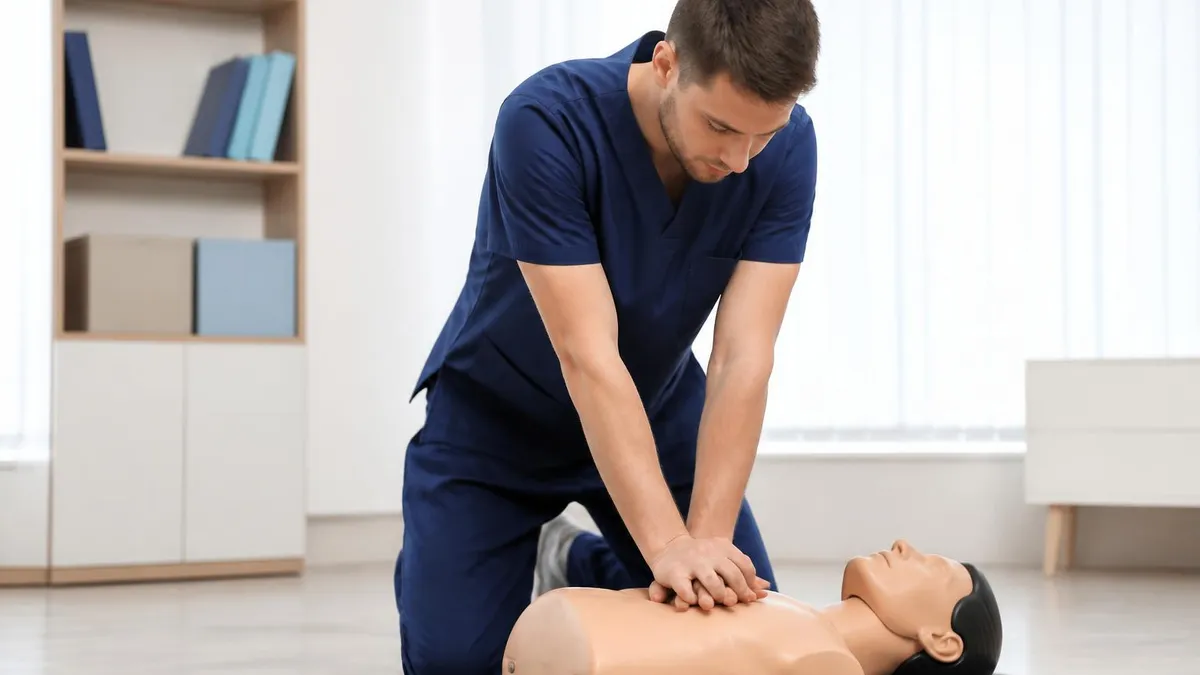
Red Cross CPR Course Types Explained
The American Red Cross offers several CPR-related courses for different audiences and certification needs. Selecting the right course level matters — completing Heartsaver when your employer requires BLS means repeating the training at the correct level.
BLS for Healthcare Providers is the Red Cross's clinical-grade CPR certification for nurses, doctors, EMTs, dental hygienists, respiratory therapists, medical assistants, and any other licensed healthcare professional whose job requires BLS certification. It covers single-rescuer and two-rescuer CPR for adults, children, and infants; AED use; relief of choking in adults and infants; and the team-based resuscitation dynamics relevant to clinical settings. Initial certification runs approximately 4.5 hours in the traditional format or 2.5-3 hours with Simulation Learning. BLS certification from the Red Cross is accepted at virtually all US hospitals and clinical employers that specify 'AHA or Red Cross BLS.'
Adult and Pediatric First Aid/CPR/AED is Red Cross's main course for non-medical professionals and the general public. It covers CPR for adults, children, and infants; AED use; and first aid for common emergencies including bleeding, burns, choking, and sudden illness. This course is appropriate for teachers, coaches, childcare workers, gym staff, lifeguards, and workplace designated first responders. The course runs 3.5-4.5 hours in the traditional format. If you only need CPR and AED (no first aid), the Red Cross Heartsaver CPR AED course covers just those components in a shorter class.
Simulation Learning is Red Cross's blended learning format — not a separate course, but an alternative delivery method for BLS and most Heartsaver courses. You complete a self-paced online home-learning module (roughly 60-90 minutes) that covers the knowledge content through videos and interactive scenarios. You then attend a skills session with a Red Cross instructor to demonstrate your physical CPR and AED competency.
The combined time is similar to a traditional class but offers scheduling flexibility — complete the knowledge portion whenever you have time, then book a skills session at a convenient date. Simulation Learning results in the same Red Cross certification card as traditional classes and is accepted equivalently by employers.
Online-only Red Cross courses (available through redcross.org's e-learning section) teach CPR/AED awareness and are suitable for general education or refreshing knowledge, but they do not satisfy employer requirements for CPR certification because they include no hands-on skills validation. These are not equivalent to Simulation Learning, which does include a required in-person skills session.
If you see a very short Red Cross online CPR course at a low price, confirm whether it includes a skills session before purchasing — it may be an awareness course only. For more on course types and what to expect, the CPR classes guide breaks down all course formats and what distinguishes them.
Red Cross CPR Courses at a Glance
For clinical professionals — nurses, EMTs, dental hygienists, medical assistants. Covers single and two-rescuer CPR for adults, children, and infants, AED use, and team resuscitation. Required by hospitals and clinical employers. Duration: 4.5 hrs (traditional) or 2.5-3 hrs (Simulation Learning).
For non-medical workplaces and general public — teachers, coaches, childcare workers, gym staff. Covers CPR and AED plus first aid for bleeding, burns, choking, and sudden illness. Most complete non-clinical certification. Duration: 3.5-4.5 hrs.
For workplaces and individuals who need CPR and AED training without the full first aid component. Covers adult and pediatric CPR, AED use, and relief of choking. Shorter than the combined First Aid/CPR/AED course. Accepted for most non-clinical employer requirements.
Blended delivery option for BLS and Heartsaver courses. Complete 60-90 minutes of online home learning, then attend a 1.5-2 hour in-person skills session. Same certification as traditional classes. Ideal for people with inflexible schedules who can't block 4+ hours for a single class.
Red Cross CPR Training Formats Compared
Traditional Red Cross classes are conducted entirely in person with a Red Cross instructor.
- Duration: 3.5-4.5 hours (BLS) or 3-4 hours (Heartsaver)
- Format: Video demonstrations followed by manikin practice and knowledge assessment
- Scheduling: Fixed class times at Red Cross chapters, hospitals, community centres, and authorised training sites
- Best for: People who prefer all instruction in one session and learn best with immediate instructor feedback
- Certificate: Digital certificate available immediately after class via Red Cross portal
Traditional classes offer the most hands-on instruction time and are appropriate for anyone who wants thorough skills practice under direct instructor supervision. Instructors can correct compression depth, rate, and technique in real time.
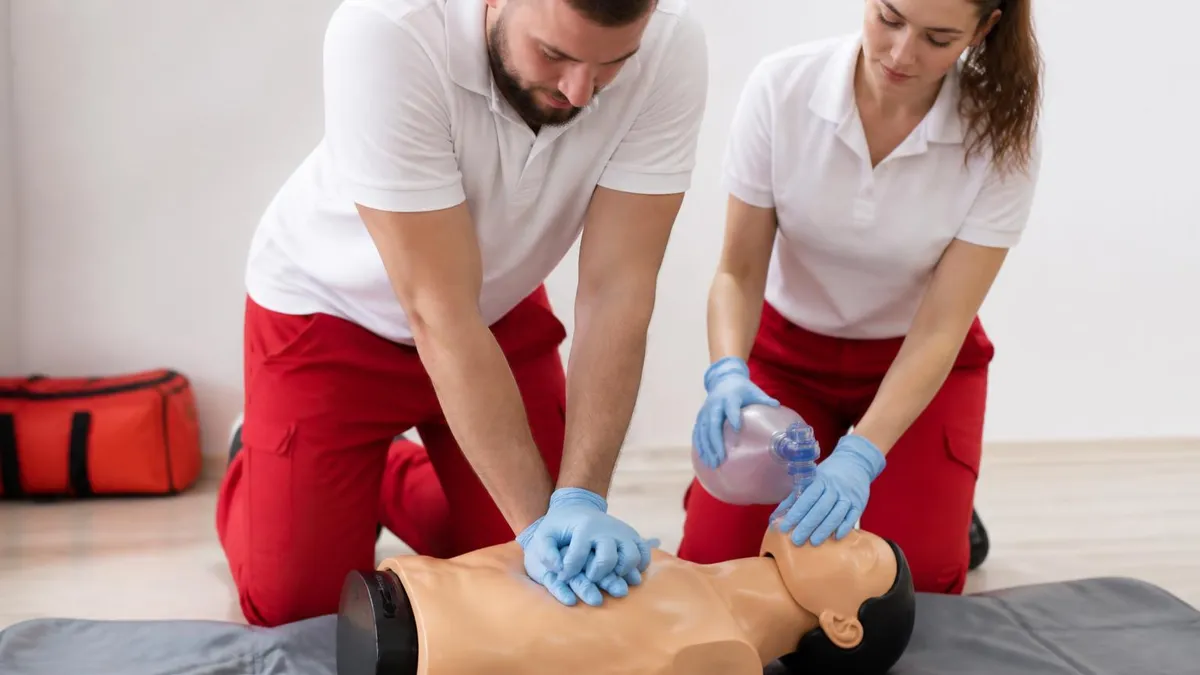
Red Cross CPR Certification Cost and Finding Classes
Red Cross CPR certification costs vary depending on the course type, delivery format, and location. Heartsaver CPR AED courses typically run $45-$75 through Red Cross chapters and authorised training sites. The more comprehensive Adult and Pediatric First Aid/CPR/AED course typically runs $55-$90. BLS for Healthcare Providers courses run $75-$120 depending on the Training Center. Simulation Learning courses are generally priced comparably to traditional classes — the convenience of the split format doesn't come at a premium in most cases.
Group and on-site pricing is significantly more cost-effective for organisations certifying multiple employees. Red Cross On-Site Training brings a certified instructor to your workplace, school, or organisation. For groups of ten or more, per-person costs can drop to $30-$50. Many employers — hospitals, schools, gyms, construction companies — coordinate annual on-site Red Cross training sessions to certify staff as a group, covering the cost as a workplace compliance expense. If your employer requires CPR certification, always check whether they offer on-site or sponsored training before registering and paying individually.
Finding a Red Cross CPR class near you is straightforward through the Red Cross course finder at redcross.org. Search by zip code, course type (BLS, Heartsaver, First Aid/CPR/AED), and preferred date range. Results show all available classes within your search radius including Red Cross chapter classes, hospital-based classes, and community site classes. Most metropolitan areas have multiple class dates each week; rural areas may have fewer options but Simulation Learning's online-plus-skills-session format can reduce travel needs since skills sessions may be offered at more varied locations than full in-person classes.
Red Cross CPR classes are also available through many hospitals, fire departments, community centres, and YMCA locations that host authorised Red Cross instructors. These classes may be listed on the Red Cross course finder or on the hosting organisation's website directly. For CPR training options beyond individual class registration — including employer programs, community classes, and what different formats cost — the training guide covers the full landscape of ways to get certified. The American Red Cross CPR certification guide covers the full range of Red Cross courses including pricing, formats, and what each level covers in more detail.
What to Expect in a Red Cross CPR Class
- ✓Brief registration check-in — bring a photo ID and your confirmation email or receipt
- ✓Video-based demonstration of CPR technique before you practise on manikins
- ✓Hands-on manikin practice for adult, child, and infant CPR (all covered in BLS and most Heartsaver courses)
- ✓AED demonstration and hands-on practice — standard in all Red Cross CPR courses
- ✓Choking relief (Heimlich manoeuvre equivalent) for conscious adults and infants
- ✓Written or online knowledge assessment — multiple choice, covering core CPR and AED concepts
- ✓Skills evaluation by the Red Cross instructor — you must demonstrate correct compression depth, rate, and AED operation
- ✓Digital certificate available immediately after passing — accessible via your Red Cross online account
Red Cross vs. AHA CPR Certification
- +Red Cross and AHA certifications are accepted equivalently by most employers that specify either provider — no practical difference for most people
- +Red Cross Simulation Learning format offers scheduling flexibility — complete the knowledge portion at home, attend just a skills session in person
- +Red Cross digital certificates are available immediately after class — no waiting for a physical card in the mail
- +Red Cross offers broader community class access in some regions where their chapter network is stronger than AHA Training Center presence
- +AHA is specified more often in hospital job postings — safer default for clinical healthcare workers where the posting specifies AHA
- −AHA BLS is specified more frequently than Red Cross BLS in hospital job postings — when in doubt about clinical employer preference, AHA is the default
- −Red Cross Simulation Learning availability varies by location — not all regions have convenient skills sessions for blended learning
- −Both providers charge comparable prices — there's no significant cost advantage to choosing one over the other for in-person certification
- −Some independent course finders and healthcare system internal training programs use only AHA materials — Red Cross certification may not satisfy these specific system-based requirements
- −Red Cross physical wallet cards are being phased out — digital certificates are standard, which some older employers may not be familiar with verifying
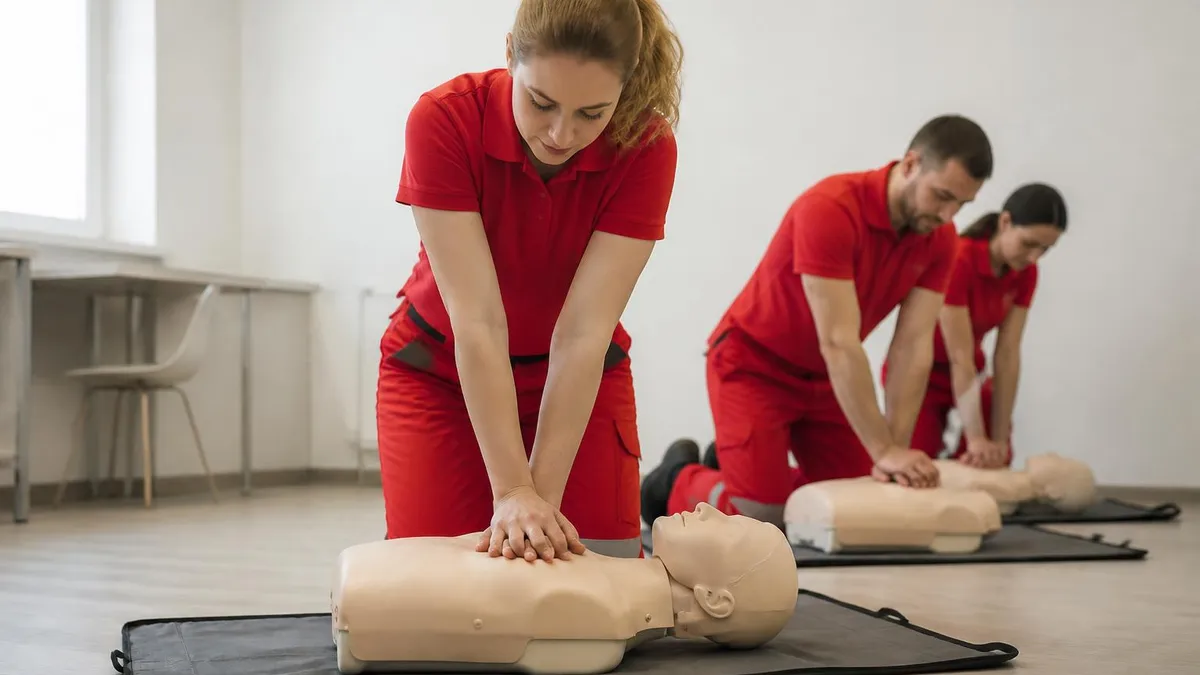
How Long Does Red Cross CPR Certification Last?
Red Cross CPR certification is valid for two years from the date of completion. This applies to all Red Cross CPR courses — BLS for Healthcare Providers, Adult and Pediatric First Aid/CPR/AED, Heartsaver CPR AED, and their Simulation Learning equivalents. After two years, the certification expires and cannot be used to satisfy employer or licensing compliance requirements. You'll need to complete a Red Cross CPR recertification course to renew.
The two-year validity reflects the periodic updating of CPR guidelines. The American Heart Association (whose guidelines Red Cross follows) issues major CPR and ECC guideline updates every five years, with interim updates as new evidence emerges. Recertification courses incorporate any changes to compression rates, depth recommendations, or AED protocols since your last training, ensuring certified individuals always have training based on current science.
Red Cross digital certificates show the certification date and expiration date. You can log in to your Red Cross account at redcross.org to verify your current certification status. Many employers and licensing boards can verify Red Cross certification through the portal as well — if an employer asks for verification, direct them to the Red Cross digital certificate rather than a physical card.
For details on exactly what the two-year clock means for your specific employer or licensing situation — including what happens if your certification lapses briefly — the full article on how long CPR certification lasts covers expiration scenarios and what to do if you let your card lapse.
If your certification expires, most Red Cross chapters will still accept you in a renewal course rather than requiring the full initial certification process again, though this varies by location. Renewing before expiration is always easier than renewing after. Set a calendar reminder 60 days before your expiration date — enough time to find a convenient class without any risk of your certification lapsing if a class is full or delayed. For healthcare workers whose employer tracks certification expiration dates in an HR system, proactive renewal prevents the administrative complication of being flagged as non-compliant during a credentialing audit.
Red Cross CPR Certification: Key Numbers
Key Facts at a Glance
| Item | Value | Details |
|---|---|---|
| Red Cross CPR certification validity — renew before expiration with a shorter recertification course | 2 years | |
| Cost range for Red Cross CPR certification depending on course type and location — BLS costs more than Heartsaver | $45-$120 | |
| Typical in-person Red Cross CPR class duration — Simulation Learning splits this into an online portion plus a shorter skills session | 3.5-4.5 hrs | |
| Time to receive your Red Cross digital certificate after passing — available immediately via your Red Cross online account | Instant |
Who Accepts Red Cross CPR Certification?
Red Cross CPR certification is accepted by the vast majority of employers, licensing boards, and organisations that require CPR training in the United States. Hospitals, clinics, dental offices, nursing homes, and other clinical settings that specify 'AHA or Red Cross BLS' accept Red Cross BLS for Healthcare Providers without distinction from AHA BLS. State nursing boards in most states accept Red Cross BLS for RN, LPN, and allied health licence renewal requirements. EMS agencies typically accept both providers as well, though some specify AHA — verify with your specific agency before registering.
Non-clinical employers — schools, gyms, daycare centres, summer camps, construction companies, security firms, and corporate workplaces — almost universally accept Red Cross CPR certification. Many workplace safety programs and OSHA-aligned first responder requirements are satisfied by any nationally recognised CPR training, and Red Cross fully qualifies. If you're a teacher in a state that requires CPR certification for licensure renewal, Red Cross certification satisfies the requirement in all states that have this requirement.
Where Red Cross acceptance becomes a question is when an employer specifically says 'AHA only' rather than 'AHA or Red Cross.' This is relatively uncommon but does occur — some hospital systems that use AHA training materials internally for their code response programs specify AHA for consistency. Before registering for any CPR course, confirm with your employer exactly which provider they accept. A single phone call to HR or the credentialing department resolves any ambiguity and prevents wasted time and money on a course that doesn't satisfy your specific requirement.
The American Heart Association CPR guide covers AHA-specific certification details for those whose employers require AHA specifically. For most people, though, Red Cross and AHA are interchangeable — choose based on class availability, schedule convenience, and cost in your area. The online CPR certification guide covers when online-only providers are a legitimate alternative to Red Cross or AHA and what to verify before using them.
Most employers accept either Red Cross or AHA CPR certification — but some specify one provider, and a few hospital systems require AHA exclusively. Before paying for any CPR course, call your HR department or check your job offer paperwork for the exact certification requirement. If the requirement says 'BLS required' without specifying a provider, ask which providers are accepted — Red Cross BLS is almost always acceptable. If it says 'AHA BLS required,' you need the AHA course specifically. Taking the wrong course means repeating the certification at additional cost, which is an avoidable mistake with a quick phone call.
Red Cross CPR Renewal: How to Recertify
Red Cross CPR renewal courses are shorter and less expensive than initial certification courses. The renewal format is designed for people who already have foundational CPR knowledge and need to update their skills, confirm competency, and receive a fresh two-year certification card. Red Cross offers dedicated renewal courses for both BLS and Heartsaver certifications that can typically be completed in 2-3 hours rather than the 3.5-4.5 hours of an initial certification class.
For BLS recertification, the Red Cross BLS Renewal course covers any updated guidelines since your previous certification, team CPR dynamics refresher, and a skills check covering adult, child, and infant CPR and AED operation. Heartsaver renewal courses similarly focus on skills refresher practice and updated content rather than teaching everything from scratch. Both are available in traditional in-person and Simulation Learning formats — the Simulation Learning renewal is particularly efficient, with a short online refresh module followed by a brief skills session.
Renewal is available up to 30 days before your certification expires without affecting the new expiration date. If you renew early, your new certification is typically dated from your original expiration date rather than the renewal date — so you don't lose any time on your current certification by renewing early. If your certification has already expired, most Red Cross chapters will still place you in a renewal course rather than requiring the full initial course again, though this is at the Training Center's discretion and policies vary.
The most straightforward renewal approach is the same as initial certification: use the Red Cross course finder at redcross.org, filter for renewal/recertification courses at your level (BLS or Heartsaver), and register 30-60 days before your card expires.
If your workplace offers on-site Red Cross training, check whether they schedule renewal sessions in addition to initial certification classes — many hospital and school training programs include renewal options as part of their annual compliance calendar. For questions specific to Red Cross CPR certification including what the renewal course covers and how to access your renewal history through your Red Cross account, the Red Cross certification guide has the full detail.
Red Cross CPR Questions and Answers
About the Author

Registered Nurse & Healthcare Educator
Johns Hopkins University School of NursingDr. Sarah Mitchell is a board-certified registered nurse with over 15 years of clinical and academic experience. She completed her PhD in Nursing Science at Johns Hopkins University and has taught NCLEX preparation and clinical skills courses for nursing students across the United States. Her research focuses on evidence-based exam preparation strategies for healthcare certification candidates.