
AHA CPR Certification: American Heart Association Course Guide 2026 October
📚 Everything you need to know about AHA CPR certification: course types, costs, in-person vs. blended learning, renewal, and how to find a class near you.
What Is AHA CPR Certification?
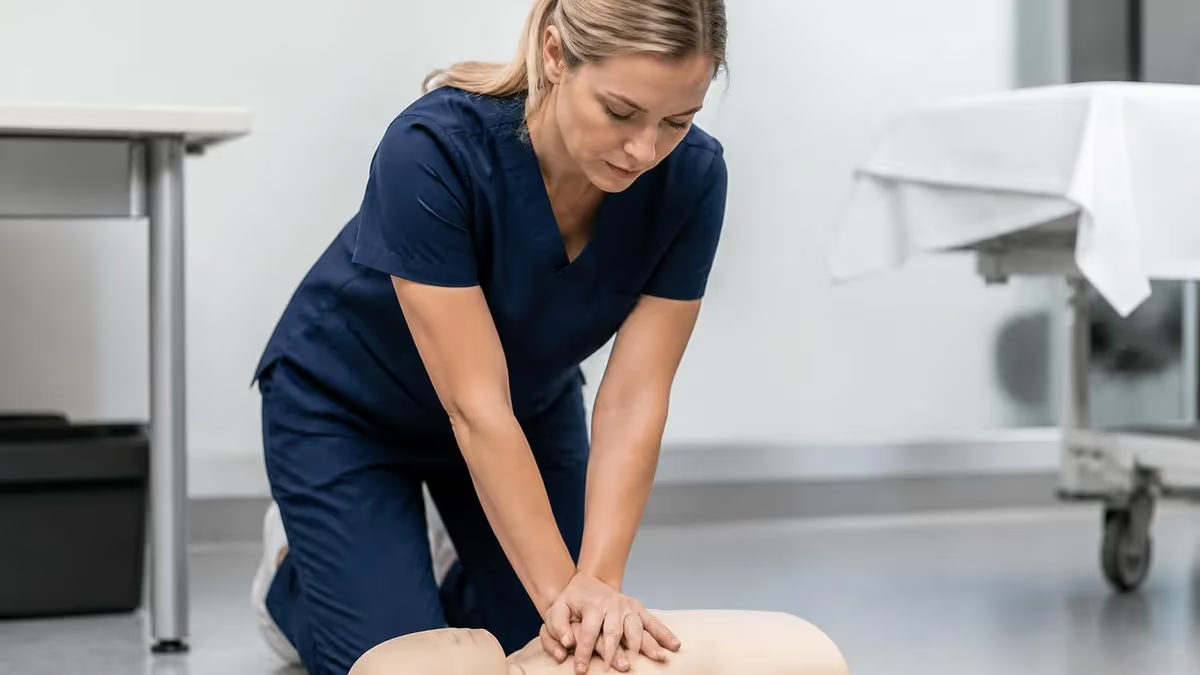
AHA CPR certification refers to a cardiopulmonary resuscitation training course offered by the American Heart Association (AHA), one of the most widely recognized CPR certification providers in the United States. AHA certification programs teach lifesaving skills including chest compressions, rescue breathing, and AED use, and they're required by many healthcare employers, schools, and professional licensing boards as proof of current CPR training.
The AHA develops the scientific guidelines that define CPR technique — the organization's Guidelines for CPR and Emergency Cardiovascular Care are updated every five years and represent the gold standard for resuscitation science worldwide. When you take an AHA course, you're learning technique based on the most current evidence-based protocols. This is why many healthcare employers specifically require AHA certification rather than accepting certification from any provider.
AHA offers several distinct certification courses targeting different audiences and skill levels. Basic Life Support (BLS) is the healthcare-provider standard. Heartsaver CPR/AED is designed for the general public and non-medical first responders. ACLS (Advanced Cardiovascular Life Support) and PALS (Pediatric Advanced Life Support) are advanced courses for clinical professionals. Knowing which course you need before you register saves time and ensures you get the right credential for your situation. Check the American Heart Association CPR overview for a full breakdown of which certifications apply to which professions.
AHA certification is not interchangeable with every other CPR provider. While the Red Cross and other organizations offer excellent CPR training, many hospital systems, nursing programs, and state licensing boards specifically require AHA certification. If your employer or school specifies "AHA BLS," a Red Cross card won't satisfy that requirement. Before you register for any CPR course, confirm exactly which certification your employer or licensing board accepts — this saves you from completing a course and then having to retake it from a different provider.
The AHA also licenses its materials to Authorized Training Centers rather than directly teaching most courses. This means the quality and style of teaching can vary by Training Center, though the content and certification standards remain consistent. If you take BLS at a hospital, a fire station, a gym, or a community college, you'll be using the same AHA materials and earning the same AHA certification — the setting changes, but the credential is identical.
The AHA updates its CPR guidelines roughly every 5 years based on new resuscitation science. The most recent updates have refined compression rates (100-120 per minute), compression depth (at least 2 inches for adults), and emphasized minimizing interruptions to compressions. When you take BLS or renew, you'll learn the current guideline recommendations — and if you took BLS several years ago, you may notice subtle but scientifically meaningful differences from what you learned in a previous certification cycle.
- Provider: American Heart Association (heart.org)
- Main healthcare course: BLS (Basic Life Support)
- Main public course: Heartsaver CPR/AED
- Certification validity: 2 years
- Renewal: Required every 2 years (renewal course available)
- BLS format: In-person skills practice + optional HeartCode online portion
- BLS cost: Varies by training center (~$50-$80 typical)
- Card: eCard issued digitally; also available as printed card
How to Get AHA CPR Certified
Choose Your Course
Find a Training Center
Complete the Course
Pass the Skills Test
Receive Your eCard

AHA Course Types and Who Needs Each One
The BLS (Basic Life Support) course is the standard for healthcare providers — nurses, medical assistants, paramedics, dental hygienists, and anyone else who works in a clinical setting where CPR may be required. BLS teaches high-quality CPR for adults, children, and infants; team-based resuscitation; AED use; and relief of foreign body airway obstruction. Most hospitals and healthcare employers require current BLS certification, and many nursing programs require it before clinical rotations begin.
Heartsaver CPR/AED is the AHA's course for non-healthcare lay rescuers. This includes teachers, coaches, daycare workers, office safety officers, lifeguards, and anyone who wants to be prepared to respond to a cardiac emergency. The Heartsaver course covers adult CPR/AED, with optional modules for child and infant CPR and first aid. It's less clinically detailed than BLS and more focused on the simple, effective skills a bystander needs in an emergency.
For licensed clinical professionals in advanced roles, ACLS (Advanced Cardiovascular Life Support) extends beyond basic CPR to cover cardiac rhythm recognition, medication protocols, and team leadership in resuscitation emergencies. ACLS is typically required for nurses working in emergency departments, ICUs, cardiac care units, and perioperative settings. PALS (Pediatric Advanced Life Support) covers the same territory but focused on pediatric patients — it's required for many pediatric nurses, emergency providers, and transport teams. Your Red Cross CPR certification comparison guide explains how the AHA and Red Cross courses differ if you're deciding between the two providers.
BLS certification requirements extend beyond hospitals. Emergency medical technicians (EMTs), paramedics, dental professionals, physical therapists, occupational therapists, respiratory therapists, and many other allied health providers must maintain current BLS. Fitness professionals working in clinical exercise settings (cardiac rehab, medical fitness facilities) often need BLS as well. The scope of who needs BLS has expanded as healthcare has moved into community settings and as employers have raised baseline safety standards for any role that involves patient contact.
Hands-only CPR — chest compressions without rescue breaths — is now the AHA's recommendation for untrained bystanders and for adult cardiac arrest victims. For healthcare providers with BLS certification, rescue breaths remain part of the protocol. Understanding this distinction helps you navigate situations where you're providing CPR in a professional capacity versus coaching an untrained bystander through dispatcher-guided CPR over the phone.
AHA Course Comparison
For healthcare providers. Covers adult, child, and infant CPR; AED use; team-based resuscitation. Required by most hospitals and clinical employers. 2-year certification.
For the general public and non-clinical staff. Covers adult CPR and AED use (optional child/infant and first aid modules). Good for teachers, coaches, and workplace safety programs.
For licensed healthcare providers (RNs, MDs, PAs, paramedics). Covers rhythm recognition, ACLS pharmacology, and team leadership. Required in emergency, ICU, and cardiac settings.
For providers who care for pediatric patients. Covers pediatric assessment, CPR, and team-based resuscitation of infants and children. Required in pediatric and pediatric emergency settings.
Combined course for workplaces and community responders. Covers wound care, illness response, and CPR. Available in-person and as blended HeartCode format.
Blended learning format: self-paced online portion (HeartCode) followed by a skills check with an AHA instructor. Available for BLS, ACLS, and PALS.
In-Person vs. Online AHA Certification
Traditional AHA courses are conducted entirely in person at an AHA-authorized Training Center or through an employer's in-house training program. For BLS, you'll work with a manikin and practice compressions, rescue breaths, and AED use under an instructor's direct supervision. The in-person format typically takes 4-5 hours for the full BLS course or about 2 hours for a renewal (BLS renewal is called the "BLS Renewal" course).
In-person training is generally preferred by employers because it ensures direct skills verification. Some states and employers require fully in-person certification even if the AHA offers blended options.
AHA CPR Certification Cost and Duration
The cost of AHA CPR certification varies depending on the course type, format, and where you take the class. For BLS, typical in-person rates range from $40 to $80 at independent AHA Training Centers. Hospital-sponsored or employer-sponsored BLS courses may be offered free or at reduced cost to employees. HeartCode (blended) BLS usually costs more — $80 to $130 for the online component, plus any fee the skills-check instructor charges.
Duration is another variable. A full in-person BLS course takes approximately 4-5 hours from start to finish, including instruction time, practice stations, and skills testing. BLS Renewal (for recertifying before your card expires) runs shorter — about 2-3 hours. ACLS is a significantly longer commitment: a full initial ACLS course typically runs 12-16 hours over 1-2 days, while ACLS renewal takes about 8 hours.
If your employer pays for CPR certification, ask your HR or education department about approved training centers and reimbursement procedures before you register. Many hospital systems have in-house AHA Training Centers where employees can complete BLS at no cost during working hours. Paying out of pocket when your employer covers it is an unnecessary expense. For CPR training options including online resources, our CPR certification online guide explains what's available and what to watch out for in online-only certificates.
Group discounts are available from many AHA Training Centers for organizations sending multiple employees through BLS at the same time. If you're coordinating CPR certification for a team, department, or school, contacting Training Centers directly about group rates can reduce per-person costs significantly. Some Training Centers also offer on-site training, where an instructor comes to your location — which can be cost-effective and convenient when you have 15 or more people to certify at once.
AHA CPR Certification Checklist
- ✓Identify which AHA course you need: BLS (healthcare), Heartsaver (public), ACLS, or PALS
- ✓Find an AHA-authorized Training Center at heart.org (only authorized centers issue real AHA cards)
- ✓Confirm whether your employer accepts HeartCode blended format or requires fully in-person
- ✓Check if your employer offers free or subsidized BLS training in-house
- ✓Register at least 1-2 weeks before your certification expires to avoid a gap
- ✓Bring valid photo ID to the class
- ✓After completing, verify your eCard was issued in the AHA's online system
- ✓Keep a digital copy of your eCard and add the expiration date to your calendar
AHA vs. Other CPR Providers
- +AHA certification widely accepted by hospitals and healthcare employers across the U.S.
- +AHA develops the scientific CPR guidelines used worldwide — course content is gold standard
- +eCard system allows employer verification of certification status online
- +Multiple course options (BLS, ACLS, PALS, Heartsaver) for different professional needs
- +HeartCode blended format reduces in-person time while maintaining skills verification
- −Fully online certification not available — always requires in-person skills check
- −More expensive than some competitors (Red Cross, American Safety & Health Institute)
- −Finding authorized Training Centers can be difficult in rural areas
- −HeartCode online component must be purchased separately from skills-check fees
- −Some specialized employers accept only in-person BLS, not HeartCode blended format

AHA CPR Certification Renewal
AHA certification is valid for 2 years from the date of issuance. You must renew before your card expires to maintain continuous certification — most employers and licensing boards don't accept expired certification, even by a day. The AHA offers a BLS Renewal course (sometimes called BLS Recertification) that's shorter than the initial course, typically running 2-3 hours instead of 4-5 hours. The renewal course assumes you already know the basic content and focuses on skills refresher and updates to the guidelines if any changes have occurred.
You can track your certification expiration date through the AHA's website using the email address associated with your eCard. The AHA also has a card lookup tool where employers can verify your certification — this is the same tool your employer's HR department will use when asking for proof of current BLS. Treat your AHA eCard confirmation email like a document and save it to a secure folder.
If your certification has already expired, you'll need to complete the full initial course again rather than the shorter renewal course. Most AHA Training Centers will tell you this upfront when you register — giving them your current card's expiration date lets them enroll you in the correct course. Don't let your card lapse by more than a few months; some employers may require additional documentation or a skills competency check if your certification gap is extended. The CPR training guide covers how to prepare for your renewal session and what's typically reviewed in the refresher course.
Renewal reminders are worth setting up proactively. The AHA will send email reminders before your certification expires, but these can get lost in spam or cluttered inboxes. Put your BLS expiration date in your work calendar with a 3-month advance reminder — that gives you enough time to find an available class, register, and complete renewal before the expiration date. Last-minute renewal scrambles are common and often result in unnecessary stress or temporary gaps in certification if classes are fully booked.
ACLS and PALS renewal courses are longer than BLS renewal but still shorter than initial certification. ACLS renewal typically takes 8-10 hours and may include new megacode scenarios or updated algorithm content. Many hospital education departments offer regular ACLS renewal classes during off-peak shifts — check with your unit educator about the schedule if you're renewing ACLS through your employer.
AHA CPR By the Numbers
Key Facts at a Glance
| Item | Value | Details |
|---|---|---|
| Certification Valid | 2 Years | |
| BLS Course Duration | 4-5 Hours | |
| BLS Renewal Duration | 2-3 Hours | |
| Typical BLS Cost | $40-$80 |
Verifying AHA Certification and Avoiding Fake Cards
The AHA's eCard system allows anyone to verify a certification by entering the cardholder's name and card ID at ecard.heart.org. This lookup tool is how hospitals, nursing boards, and employers confirm that the BLS card you submit is genuine. When your employer asks to see your BLS certification, they're checking this system — not just accepting a printout.
Fake CPR cards are a real problem in the healthcare industry. Some websites sell certificates for courses taken entirely online, without any manikin skills practice, and brand them as "CPR certification" using logos designed to look official. These cards often appear cheap ($10-$20) and are available without any instructor interaction. They're not recognized by healthcare employers and are not verifiable in the AHA's system. If your nursing board or hospital HR department looks you up and finds nothing, a fake card is worse than no card — it raises an integrity concern.
Always verify that you're booking through an AHA Training Center by finding your class at heart.org's Training Center locator. Third-party booking sites sometimes resell AHA course spots legitimately, but if you're ever unsure, contact the training center directly to confirm their AHA authorization status. Your certification card should have an AHA logo, a unique card number, and a QR code — and it should appear in the eCard lookup tool within a few days of completing your course. Review the National CPR Foundation comparison if you're evaluating non-AHA providers for workplace or community programs.
Employers increasingly verify CPR certification electronically at the time of hire and at annual performance reviews. Some larger health systems have integrated the AHA's eCard verification system into their HR software, automatically flagging employees whose certification is approaching expiration. If you're a travel nurse or agency worker moving between facilities, each new facility may verify your card independently — having a digital copy of your eCard confirmation email and knowing your card ID number speeds up this process significantly.
AHA CPR Certification for Nurses and Healthcare Students
For nursing students, BLS certification is typically required before clinical placements begin. Your nursing program will specify whether they require AHA BLS specifically or whether Red Cross or another provider's certification is acceptable. Most programs require AHA BLS, and many school of nursing offices maintain a list of recommended local Training Centers or offer in-house BLS days for students.
Nurses working in acute care settings need to maintain current BLS at minimum, and many unit specialties require additional credentials — ACLS for emergency and ICU nurses, PALS for pediatric nurses, and sometimes NRP (Neonatal Resuscitation Program, offered by the AAP/AHA jointly) for labor and delivery or NICU nurses. These advanced credentials are typically required as a condition of employment in their respective specialties, and employers usually provide time and funding for staff to complete them.
For nurses transitioning to a new specialty, renewing or upgrading your AHA credentials before starting a new position signals professional readiness. If you're moving from a med-surg role to an ICU, completing ACLS before your start date (or immediately after) shows initiative. Many travelers and agency nurses maintain both BLS and ACLS current as a standard practice, since different facility contracts may require different certification levels. Practice with our CPR Techniques questions and CPR Chest Compressions and Defibrillation practice set to reinforce the technical knowledge behind the skills.
Employer-provided CPR training typically happens during orientation for new hires and through periodic renewal sessions offered by the hospital's education department. At many hospitals, BLS renewal sessions run several times per month in multiple time slots to accommodate staff on all shifts. If you're a night shift nurse, look for BLS classes scheduled for overnight or early morning — many hospitals specifically offer these sessions for off-shift staff. Missing renewal deadlines because you couldn't find a class is avoidable with advance planning.
Some state nursing boards are beginning to accept online learning components (like HeartCode) as part of CPR renewal documentation, while others still require fully in-person certification. If you're a nurse renewing your state license, check your board's CPR certification requirements specifically — not just your employer's requirements, since the two may differ.
CPR Questions and Answers
About the Author

Registered Nurse & Healthcare Educator
Johns Hopkins University School of NursingDr. Sarah Mitchell is a board-certified registered nurse with over 15 years of clinical and academic experience. She completed her PhD in Nursing Science at Johns Hopkins University and has taught NCLEX preparation and clinical skills courses for nursing students across the United States. Her research focuses on evidence-based exam preparation strategies for healthcare certification candidates.