
AHA CPR Classes: American Heart Association Certification Guide 2026 October
AHA CPR classes from the American Heart Association offer BLS, Heartsaver, ACLS, and PALS certification. 🟢 Find classes near you, learn costs, and
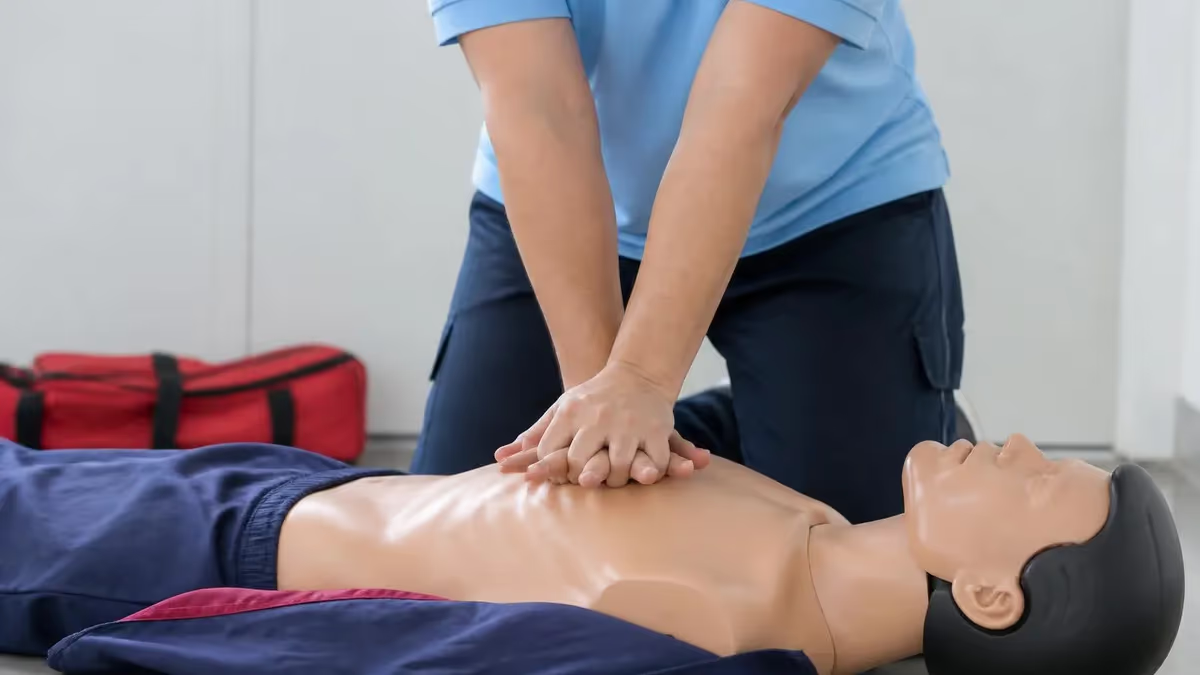
AHA CPR classes — courses offered through the American Heart Association — are the most widely recognized CPR and emergency cardiovascular care training programs in the United States. Healthcare employers, hospitals, schools, and many workplaces require AHA certification specifically because the AHA's curricula are based on its own evidence-based resuscitation guidelines, updated every five years through the International Liaison Committee on Resuscitation (ILCOR) process. When someone asks for proof of CPR certification, an AHA card — particularly the Basic Life Support (BLS) Provider card — is what most employers in healthcare and education have in mind.
The AHA doesn't operate training centers directly. Instead, it trains and certifies instructors and training centers that offer AHA courses under its brand. This distributed model means AHA CPR classes are available through hospitals, fire departments, community colleges, Red Cross chapters (which offer their own separate certification), YMCA branches, and private training companies across the country. The quality of instruction is standardized through the AHA's training center oversight system, though the individual instructor's skill and teaching style still affect the learning experience.
Choosing the right AHA CPR class depends on who you are and why you need certification. Healthcare professionals — nurses, EMTs, medical assistants, respiratory therapists — typically need BLS for Healthcare Providers, the AHA's gold-standard course for clinical staff. The general public seeking basic first aid and CPR skills usually takes Heartsaver CPR AED.
Parents, grandparents, and caregivers with young children often add the pediatric first aid component. Anyone in a supervisory or instructional healthcare role may need ACLS (Advanced Cardiovascular Life Support) or PALS (Pediatric Advanced Life Support). Choosing the wrong level can result in a certificate your employer doesn't accept, requiring you to retake the right course.
Finding heart association cpr classes in your area starts at the AHA's official training center locator at heart.org. Enter your zip code to see certified training centers near you, filter by course type, and contact them directly for scheduling and pricing. Many hospital systems offer BLS classes on-site for their staff and the public. Community education programs at community colleges often have Heartsaver courses at lower cost than private training companies. Pricing varies considerably: BLS classes typically range from $50 to $80; Heartsaver courses from $30 to $60; ACLS and PALS courses from $150 to $250 each.
The AHA's training center model also means that quality is more variable than the AHA brand recognition might suggest. Training centers must meet AHA standards and use AHA-approved materials, but the physical facilities, class sizes, and instructor experience levels vary. A community hospital training center staffed by experienced emergency nurses will provide a different learning experience than a commercial training company running back-to-back classes with maximum enrollment. For clinical staff who need BLS as part of their job, the quality of the training matters practically — you may actually use these skills. Seeking out training centers with smaller class sizes and instructors with hands-on resuscitation experience is worth the extra effort even if it means paying a slightly higher price or traveling a bit further. Bystander CPR rates have improved significantly in communities where public training programs are widespread. Studies show that communities with high rates of CPR-trained bystanders have survival rates from out-of-hospital cardiac arrest substantially higher than communities without accessible training. This public health impact is why the AHA and many municipalities subsidize community CPR training programs, offer free Heartsaver courses through libraries and community centers, and promote programs like CPR in Schools that train high school students as part of health education curricula.The AHA BLS for Healthcare Providers course is the foundation certification for clinical staff. It covers adult, child, and infant CPR using the C-A-B sequence (Compressions-Airway-Breathing), AED use, relieving foreign body airway obstruction, and two-rescuer CPR techniques used in healthcare settings.
The course includes both a knowledge component and a hands-on skills test where a certified AHA instructor observes and evaluates your technique. BLS certification is valid for two years. Most hospitals require all direct patient care staff to maintain current BLS certification as a condition of employment, and many require staff to renew proactively before the card expires rather than waiting until expiration.
The Heartsaver courses are designed for lay rescuers and workplaces. Heartsaver CPR AED teaches adult CPR and AED operation. Heartsaver First Aid CPR AED adds basic first aid skills including wound care, allergic reactions, and choking. Heartsaver Pediatric First Aid CPR AED includes child and infant CPR with pediatric first aid. These courses are appropriate for teachers, coaches, office workers, parents, fitness instructors, and anyone who wants CPR skills but doesn't work in a clinical healthcare role. Certification is valid for two years. Many workplaces that require CPR certification for non-clinical staff accept Heartsaver certification.
ACLS (Advanced Cardiovascular Life Support) builds on BLS skills to cover management of adult cardiac arrest, acute coronary syndromes, stroke, and arrhythmias. It's required for physicians, nurse practitioners, nurses working in ICUs, emergency departments, and cardiac care units, and many hospital leadership positions. ACLS involves case simulations that test the ability to lead a code team through resuscitation scenarios with pharmacological interventions, airway management, and team communication. The AHA offers ACLS in-person and in hybrid online/hands-on formats. PALS (Pediatric Advanced Life Support) is the pediatric equivalent, required for providers who care for critically ill children.
How how long does cpr certification last is one of the most common questions about AHA certification. For all AHA provider-level certifications (BLS, ACLS, PALS, and Heartsaver), the certification is valid for two years from the issue date on the card. The AHA does not send renewal reminders; tracking your own expiration date is your responsibility. Letting your certification lapse can create problems with employment verification, clinical privileges, and facility credentialing. Many healthcare professionals set calendar reminders 60 days before expiration to ensure they have time to find and schedule a renewal course.
The distinction between an AHA course and a CPR course from an online-only provider has become increasingly important as online training has proliferated. Organizations like ProCPR, CPR Savers, and many others offer entirely online certification that looks convincing but doesn't involve hands-on skills assessment. The AHA specifically does not recognize these certifications as meeting the requirements for AHA-branded courses. Healthcare employers routinely reject online-only certifications during credential verification. If you're in doubt about whether a certification will be accepted by your employer, ask HR specifically whether AHA BLS certification is required and confirm before enrolling in any course. Dispatcher-assisted CPR (also called telephone CPR or T-CPR) is a specific protocol where 911 dispatchers guide callers through CPR while emergency services respond. The 2020 AHA guidelines strengthen the recommendation for emergency dispatch systems to provide T-CPR, recognizing that bystander intervention before paramedics arrive significantly improves outcomes. Understanding this protocol — and the fact that 911 dispatchers can provide real-time instruction even to people without formal CPR training — is part of why formal training emphasizes calling 911 first rather than attempting CPR without support.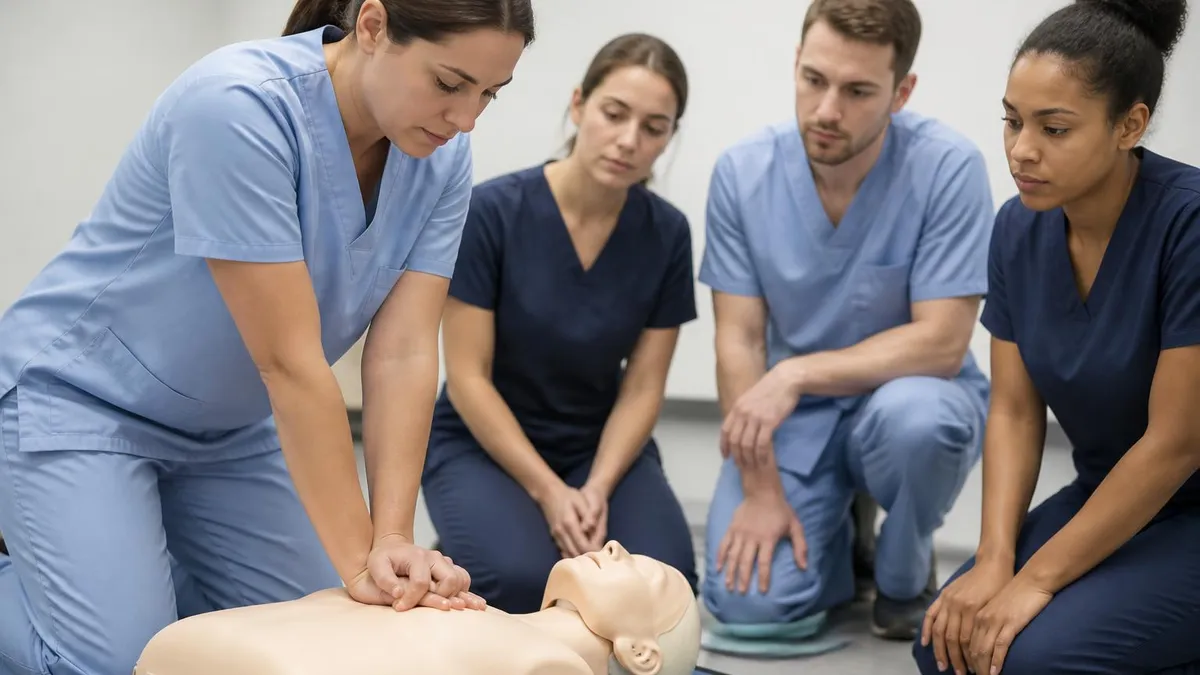
AHA Course Types
For clinical staff: nurses, EMTs, medical assistants, physicians. Covers adult/child/infant CPR, AED, two-rescuer techniques. Hands-on skills check required. Valid 2 years. Cost: $50-$80. Required by most hospitals as a condition of employment.
For lay rescuers and workplace staff. Covers adult CPR and AED operation. Pediatric and first aid add-ons available. Hands-on skills component required. Valid 2 years. Cost: $30-$60. Accepted by schools, gyms, offices, and non-clinical employers.
For ED nurses, ICU staff, physicians, advanced practice providers. Covers cardiac arrest management, arrhythmia recognition, ACS, and stroke. Simulation-based. Valid 2 years. Cost: $150-$250. Required for many hospital leadership and clinical privilege positions.
Pediatric equivalent of ACLS. For providers caring for critically ill children: PICU nurses, pediatric ED, neonatology. Covers pediatric arrest, respiratory failure, shock, arrhythmias. Valid 2 years. Cost: $150-$250. Often required alongside ACLS for pediatric facilities.
AHA renewal courses are shorter than initial certification courses and designed for people who already hold current or recently expired AHA certification. The BLS renewal (called BLS Renewal or BLS Renewal for Healthcare Providers) covers the same content as initial certification but is condensed because it assumes familiarity with the skills.
Renewal courses typically run 1.5 to 2 hours versus 3 to 4 hours for the initial course. The AHA allows renewal up to 90 days before the expiration date without losing the 2-year certification period — so renewing 3 months early extends the next expiration by the full 2 years from the current card's issue date, not the early renewal date.
Online-only CPR certification is a common source of confusion. Several providers offer entirely online courses with no hands-on skills component, claiming AHA certification or using AHA-affiliated language. The AHA does offer an online portion for some courses (HeartCode BLS, HeartCode ACLS, HeartCode PALS), but these require completion of a hands-on skills session with an AHA-certified instructor to receive the actual certification card.
A completion certificate from an online-only course without a skills check is not an AHA BLS or Heartsaver card and is not accepted by healthcare employers. This distinction is critical — online completion alone does not satisfy most employment certification requirements.
Understanding how long is cpr certification good for also matters in the context of employer verification. The AHA issues physical certification cards with the completion date and expiration date printed on them. Employers typically collect copies of these cards or verify them through the AHA's eCard system (accessible via ecards.heart.org with the card number). Some employers accept photographs of the card; others require the original or a specific verification method. If you lose your AHA card, replacement cards can be ordered through the training center that issued your certification or through the AHA's eCard portal.
For individuals who need CPR certification for childcare, early childhood education, or build care licensing purposes, the specific certification required varies by state regulation. Some states accept any recognized provider; others specifically require AHA or Red Cross certification. Checking the specific requirement in your state — typically found through the state's child care licensing office — before enrolling saves time and potential course duplication. The AHA's Heartsaver Pediatric First Aid CPR AED is commonly specified in childcare requirements because it covers both infant CPR and pediatric first aid in a single course. Compression-only CPR (hands-only CPR) has emerged as a simplified alternative for lay rescuers witnessing adult cardiac arrest in non-hospital settings. The AHA's position is that for untrained bystanders, hands-only CPR (compressions at 100-120 per minute without rescue breaths) is better than no CPR and produces outcomes comparable to conventional CPR in adult out-of-hospital cardiac arrest. This doesn't change the formal AHA course content, which still teaches compression-and-ventilation CPR, but it provides context for why widespread public awareness of hands-only CPR has public health value independent of formal certification.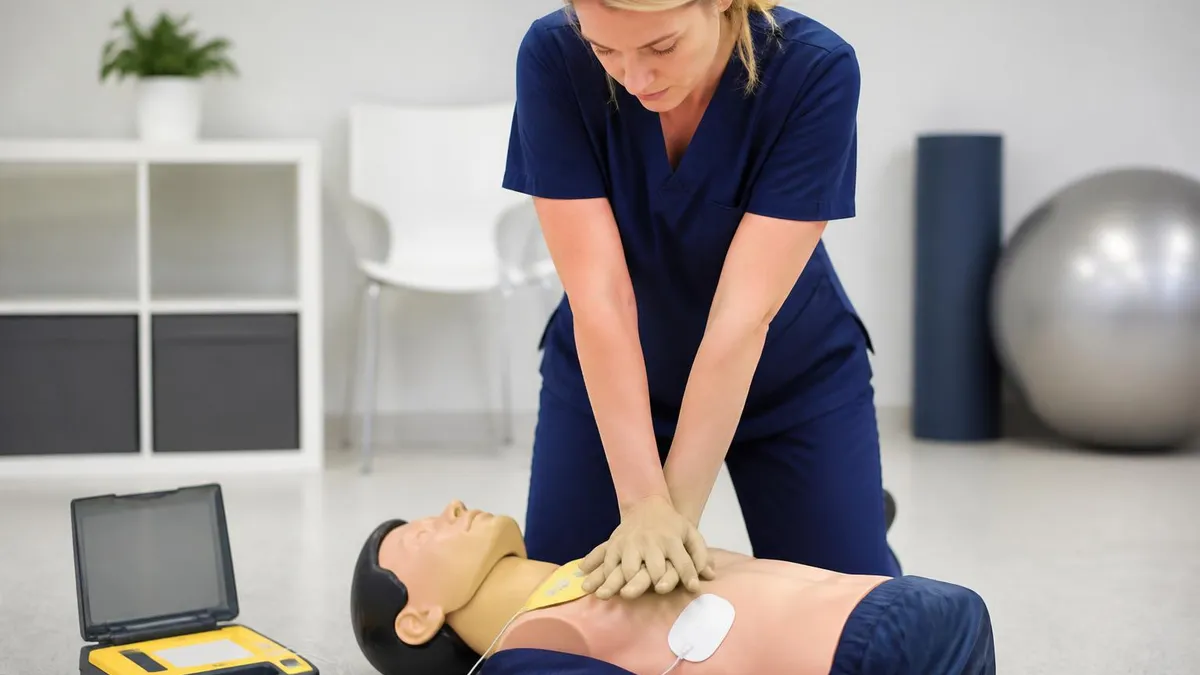
Course Comparison
The choice between Heartsaver CPR AED and BLS for Healthcare Providers comes down to your professional context. Heartsaver is designed for lay rescuers — people without a clinical role who want CPR skills for workplace safety, personal preparedness, or community training requirements. Coaches, teachers, fitness professionals, childcare workers, and office first-aid designees are the typical Heartsaver audience. It covers adult CPR and AED use, with optional modules for child/infant CPR and first aid. BLS for Healthcare Providers is designed for clinical staff who may need to perform CPR in a medical setting with equipment, team members, and advanced airway management available. It covers both single-rescuer and two-rescuer techniques (the second rescuer manages the airway while the first performs compressions), which reflects real-world hospital code scenarios. BLS also covers BVM (bag-valve-mask) ventilation, which is not covered in Heartsaver. Most healthcare employers specifically require BLS, not Heartsaver, because the two-rescuer and BVM content is directly relevant to clinical practice. If your employer requires BLS, Heartsaver doesn't substitute regardless of the scenario coverage similarities.
AHA CPR Quick Facts
Key Facts at a Glance
| Item | Value | Details |
|---|---|---|
| Certification Valid | 2 Years | |
| BLS Course Length | 3-4 Hours | |
| Early Renewal | 90 Days |
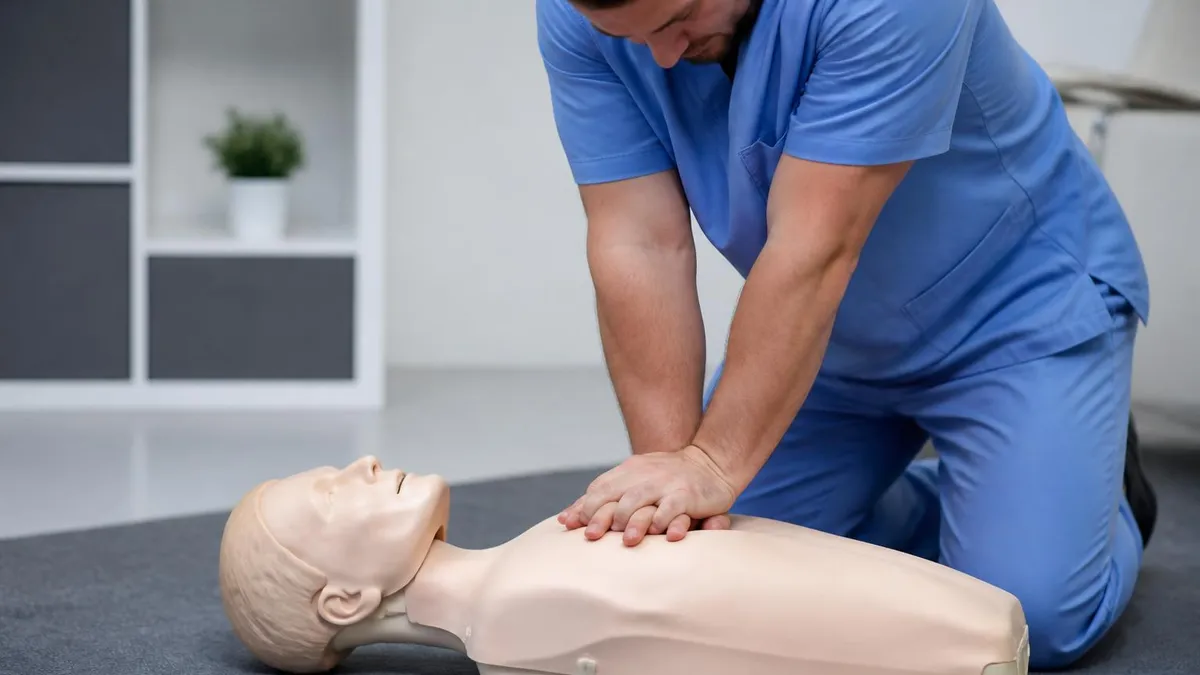
The AHA updates its resuscitation guidelines approximately every five years based on systematic review of the scientific literature. The 2020 guidelines (published in October 2020) introduced several updates including strengthened recommendations for dispatcher-assisted CPR, updated drug dosing for ACLS, and enhanced focus on post-cardiac arrest care.
Training centers update their curricula after each guideline revision, so courses taken after the update reflect current best practice. If you received certification before a major guideline update, the skills themselves are likely still valid — compression rates, depth, and ratios haven't changed dramatically in recent cycles — but renewal courses will incorporate any updates that affect technique or protocol.
Choosing an AHA training center involves more than just finding the nearest location. Class size matters: smaller classes provide more individual practice time and more personalized feedback from the instructor. Instructor experience matters: an instructor who has performed CPR in real emergencies and can contextualize the skills with clinical experience provides substantially richer training than one reading directly from the instructor manual. For BLS, look for training centers affiliated with hospitals or EMS agencies where instructors have hands-on clinical context. Reviews on Google and Yelp can help identify training centers where the instruction quality meets the standard the AHA intends.
For healthcare professionals seeking cpr classes how long information, the typical schedule looks like: BLS initial course 3-4 hours, BLS renewal 1.5-2 hours, ACLS initial 2 days (12-16 hours), ACLS renewal 1 day (7-9 hours). Many healthcare employers subsidize or fully fund required certifications as part of their HR benefits, particularly for ACLS and PALS which can cost $150-$250 each. Check your employer's education benefit or HR department before paying out of pocket — this is a commonly underused benefit.
Verifying certification before applying for a clinical position makes a strong impression. Arriving at a job interview or first day with a current national cpr foundation or AHA card already in hand eliminates the most common administrative delay in new hire onboarding and demonstrates the kind of proactive attention to detail that employers value in clinical staff. If your current card is close to expiration — within three months — renewing before applying ensures your certification remains valid through the initial orientation and training period of a new position.
The cost of AHA CPR certification for healthcare professionals is frequently covered by employers as a job requirement, but the timing of reimbursement and the allowable providers vary by institution. Some hospital systems require staff to attend their own on-site training sessions at no cost to the employee; others reimburse receipts from external training centers up to a set amount. If your employer requires certification as a condition of your job, ask HR about the reimbursement or training benefit before paying out of pocket. This is an employee benefit that many staff don't know about until they've already paid for certification independently. After completing an AHA CPR class, the most important thing is maintaining the skills through periodic review. Research consistently shows that CPR skills degrade within months of training without reinforcement. The 2-year certification cycle is a minimum floor, not an optimal maintenance schedule. Healthcare professionals who work in environments where CPR is used occasionally — not daily — benefit from periodic skill refreshers between certification cycles, whether through informal practice on manikins, simulation training programs, or participation in code team drills. Retaining the muscle memory for correct compression depth and rate is more important than retaining the theoretical content of the guidelines.AHA Pros and Cons
- +AHA certification is recognized by employers as verified competency
- +Provides a structured knowledge framework beyond just the credential
- +Certified professionals report 10–20% salary increases on average
- +Maintenance requirements create ongoing professional development
- +Differentiates candidates in competitive hiring and promotion decisions
- −Certification fees, materials, and renewal costs add up over a career
- −Requirements change — delaying may mean facing updated content
- −Salary ROI varies significantly by geography and industry
- −Preparation requires significant time alongside existing responsibilities
- −Validates knowledge at a point in time, not ongoing real-world performance
CPR Questions and Answers
About the Author

Registered Nurse & Healthcare Educator
Johns Hopkins University School of NursingDr. Sarah Mitchell is a board-certified registered nurse with over 15 years of clinical and academic experience. She completed her PhD in Nursing Science at Johns Hopkins University and has taught NCLEX preparation and clinical skills courses for nursing students across the United States. Her research focuses on evidence-based exam preparation strategies for healthcare certification candidates.