
American Red Cross CPR Training: Courses, Cost, and Certification 2026 October
American Red Cross CPR training offers in-person and blended courses for BLS, Heartsaver, and infant CPR. ✍🏼 Learn course types, costs, and how to sign up.
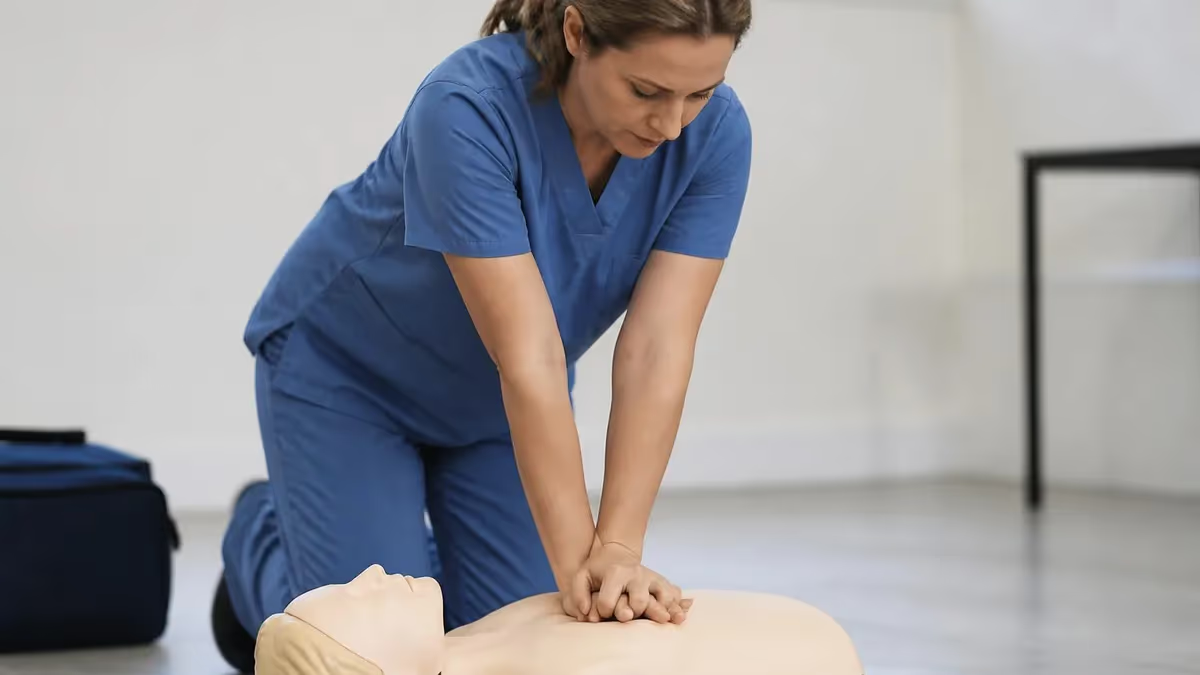
American Red Cross CPR Training: What You Need to Know
American Red Cross CPR training is the route tens of millions of people take every year to learn a skill that can genuinely save a life. Cardiac arrest is one of the leading causes of death in the United States — the American Heart Association estimates roughly 350,000 out-of-hospital cardiac arrests occur annually, and immediate CPR from a bystander can double or triple survival odds before emergency services arrive.
Getting certified through the Red Cross doesn't just check an employment box; it builds the muscle memory and confidence to act in the moments that matter most. The difference between a person who has practised chest compressions on a manikin and one who hasn't is the difference between a confident rescuer and a frozen bystander.
The American Red Cross is one of the two most widely-recognised CPR certification providers in the United States — the other being the American Heart Association (AHA). Red Cross CPR training covers the same core life-saving skills: chest compressions, rescue breathing, and AED use. But the specific course names, delivery formats, certification card appearance, and training materials differ between the two organisations, and some employers specify which certification they accept. Understanding what Red Cross CPR training offers helps you choose the right course for your situation.
Red Cross CPR courses are designed for two broad audiences: lay rescuers (general public, workplace safety responders, childcare workers, teachers) and healthcare providers (nurses, paramedics, doctors, medical assistants, and others with clinical roles). These two audiences need different certification types with different skill sets, and the Red Cross offers distinct courses for each. Taking the wrong course — for example, a lay rescuer course when a healthcare provider BLS card is required — means you'll need to retake training, so it's worth confirming your certification requirement before registering.
One of the most significant things to understand about how long does cpr certification last is that Red Cross CPR certifications are valid for two years from the date of completion. After two years, you need to recertify through a renewal course. This two-year validity applies to all Red Cross CPR and AED certifications, including BLS and Heartsaver courses. Some employers require annual refresher training in addition to the two-year certification, so check your employer's specific policy alongside the certification validity period.
- Main courses: Heartsaver CPR/AED (lay rescuers), BLS for Healthcare Providers (clinical staff), Pediatric First Aid CPR AED (childcare workers)
- Delivery formats: In-person (classroom only), Blended Learning (online + in-person skills session), Online-only (awareness, no certification card)
- Certification validity: 2 years for all CPR/AED certifications
- Typical cost: $25–$80+ depending on course type and provider; prices vary by training location
- Course length: 2–4 hours for in-person Heartsaver; 4–8 hours for BLS; shorter skills session for Blended Learning
- Employer recognition: Red Cross certifications are widely accepted by healthcare facilities, employers, and schools — always confirm with your specific employer
- How to sign up: redcross.org course finder, or through an authorised Red Cross training partner in your area
Red Cross CPR Training Course Types
Heartsaver CPR/AED
Heartsaver First Aid CPR AED
BLS (Basic Life Support) for Healthcare Providers
Pediatric First Aid CPR AED
CPR/AED for School and Community (CPR in Schools)
Red Cross CPR Training Delivery Formats
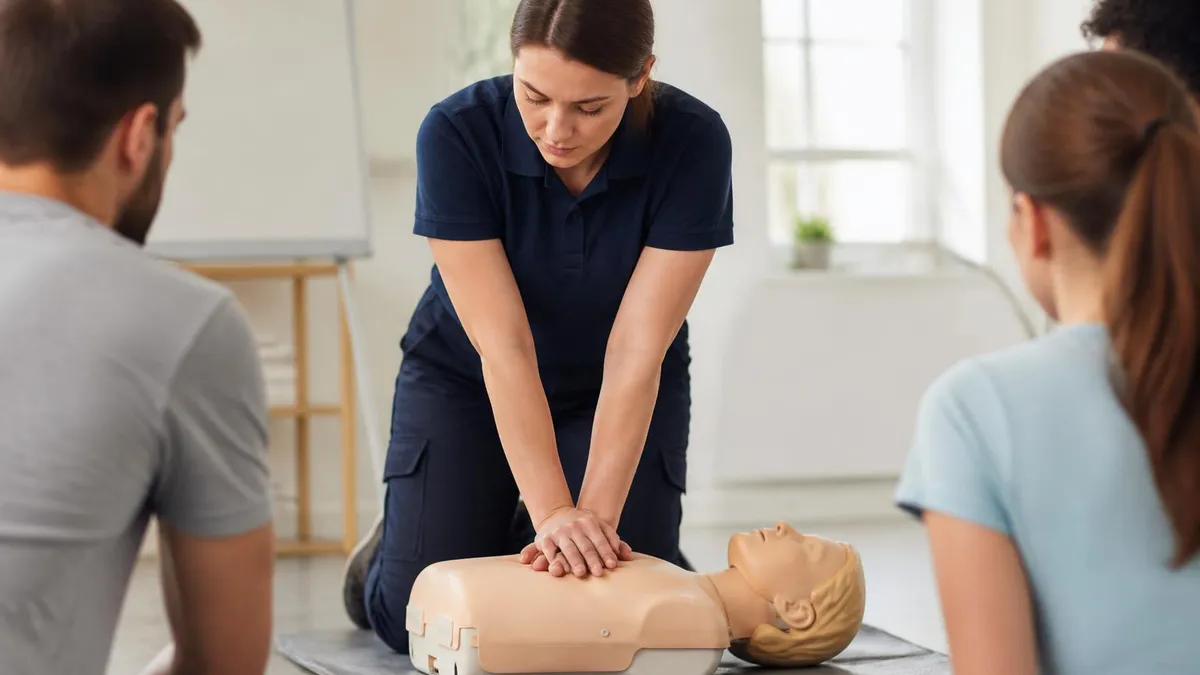
The American Red Cross offers three distinct delivery formats for CPR training, each suited to different learning preferences, schedule constraints, and certification requirements. Choosing the right format affects how much in-person time you need, what the total cost looks like, and how quickly you can complete the course.
In-person (classroom) training is the traditional format: you attend a scheduled class at a Red Cross training centre or an authorised training partner location, complete all skills practice and testing in the classroom, and receive your certification card either immediately or within days of completion. In-person courses run 2–8 hours depending on the course type. This format is often preferred by employers who want to verify that hands-on skills were demonstrated in a supervised setting.
Blended Learning — Red Cross's hybrid format — splits the course into an online knowledge portion and a brief in-person skills session. You complete the online portion at your own pace (typically 1–2 hours) and then attend a shorter in-person session (usually 30–90 minutes) focused entirely on hands-on skills practice and evaluation with a certified instructor. Many people prefer Blended Learning for its scheduling flexibility and shorter in-person commitment, while still meeting the same certification standards as a full classroom course. The certification card earned is identical to that earned through in-person training.
Online-only CPR 'training' is available from various sources including the Red Cross website, but online-only completion does not earn a certification card that meets employer requirements in most healthcare and childcare settings. Online-only courses are appropriate for general awareness and refresher knowledge, but for occupational certification purposes — nursing, childcare, workplace safety roles — an in-person skills session is required. Be cautious of providers offering purely online CPR 'certification' without any hands-on component; many employers explicitly reject these. If you need a card for employment, confirm the format meets your employer's specific requirements before registering.
For those who've completed Red Cross training before and wonder whether their prior experience speeds things up, the answer is yes — renewal courses are shorter than initial certification courses specifically because they assume prior knowledge and focus on skills refresher and guideline updates rather than starting from scratch.
If you're a healthcare professional whose certification lapsed during a career break or a parent whose previous Heartsaver card expired, you don't need to approach the renewal course as a beginner. The material will feel familiar, the manikin practice reinforces muscle memory you already have, and you'll likely find the session less intensive than your first time.
Red Cross also offers group and corporate training programmes where a certified instructor comes to your workplace or facility to train a team. These are popular for businesses, schools, and healthcare facilities that need to certify multiple staff members at once. Pricing for group training is typically negotiated based on group size and training duration.
Red Cross authorised training partners — independent organisations certified to teach Red Cross courses — can also provide group training and often have more flexible scheduling than Red Cross training centres directly. Some authorised partners specialise in specific industries, such as healthcare-focused training organisations that configure their class schedules around hospital shift patterns or childcare-focused providers that align with licensing renewal cycles, making it easier to get a team certified without disrupting operations.
Red Cross CPR Certification: Who Needs Which Course
Heartsaver CPR/AED is appropriate for community members, fitness instructors, coaches, teachers without childcare roles, workplace safety officers, and anyone seeking CPR certification for personal preparedness. Many workplaces that have AED devices on-site require employees near those devices to hold a current Heartsaver or equivalent CPR/AED certification. The Heartsaver course is widely accepted for these workplace safety roles.
Childcare workers, daycare centre employees, school teachers (especially at lower grades), after-school programme staff, babysitters seeking professional certification, and camp counsellors typically need the Pediatric First Aid CPR AED course. State childcare licensing regulations often specify that all staff must hold a current paediatric first aid and CPR certification. Check your state's specific requirements — some accept Heartsaver with infant CPR coverage, others require the full Pediatric First Aid CPR AED course.
Nurses, nursing assistants, medical assistants, paramedics, EMTs, doctors, physician assistants, dental hygienists, radiologic technologists, respiratory therapists, and other licensed or certified clinical staff need BLS for Healthcare Providers rather than Heartsaver. Healthcare employers and licensing boards typically specify BLS — not Heartsaver — as the acceptable certification. Confirm with your employer or licensing board which is required before registering.
Students in nursing programmes, medical assistant training, dental hygiene, respiratory therapy, and other allied health programmes almost universally need BLS certification before clinical rotations. Most programmes specify either Red Cross BLS or AHA BLS — both are acceptable at most facilities. Students should confirm with their programme which provider is required, as some clinical rotation sites have vendor preferences. Get certified before your first clinical placement — not after you've already been required to show it.
Red Cross vs AHA CPR Training: Key Differences
The American Red Cross and American Heart Association (AHA) offer functionally equivalent CPR courses under different names. Understanding the equivalences helps when an employer specifies one provider but you've been trained by the other:
- Lay rescuer (general public): Red Cross Heartsaver CPR/AED ≈ AHA Heartsave CPR/AED
- Healthcare providers: Red Cross BLS for Healthcare Providers ≈ AHA BLS
- Paediatric focus: Red Cross Pediatric First Aid CPR AED ≈ AHA Pediatric First Aid, CPR & AED
- Online component: Red Cross Blended Learning ≈ AHA HeartCode (both use online + skills session format)
Most major hospital systems and healthcare employers accept both Red Cross and AHA certifications for BLS. Some facilities have a stated preference — verify before registering if you're uncertain.

How to Register for Red Cross CPR Training
The simplest way to find and register for Red Cross CPR training is through the course finder on redcross.org. Enter your zip code and the course type you need, and the finder displays available in-person courses at nearby Red Cross training centres and authorised partner locations. You can filter by date, course type, and format (in-person or Blended Learning). Registration is completed online and accepts major credit cards. Many courses fill quickly, particularly BLS courses in areas with high demand from nursing programmes and healthcare employers — register early rather than waiting for a convenient last-minute slot.
Red Cross authorised training partners — independent organisations certified to deliver Red Cross courses — often offer more scheduling flexibility than Red Cross-operated centres, including weekend courses, early morning sessions, and on-site corporate training. Authorised partners are listed on the Red Cross website and their certifications are identical to those issued directly by Red Cross. When registering through a partner, confirm they are listed as an authorised Red Cross training provider to ensure your certification card will be recognised.
For infant cpr classes specifically, the Pediatric First Aid CPR AED course covers infant CPR techniques as part of a broader curriculum, but standalone infant CPR instruction is also available through some providers. Parents and caregivers who want focused infant CPR training without the full paediatric certification course should check what local hospitals, paediatric clinics, and Red Cross training centres offer as dedicated infant CPR workshops — these are often shorter and more focused than the full certification course.
Group and corporate registrations are handled through the Red Cross's national accounts team or through local chapters. If you're coordinating training for a team of 10 or more, contact your local Red Cross chapter directly rather than using the public online registration — group pricing and scheduling assistance are available and make the logistics considerably simpler. Heart association cpr classes and Red Cross courses can sometimes be arranged through the same authorised training partners who hold credentials with both organisations, which simplifies vendor management for organisations needing multiple certifications.
Before You Register for Red Cross CPR Training
- ✓Confirm which specific course your employer, school, or licensing board requires — Heartsaver, BLS, or Pediatric First Aid CPR AED
- ✓Confirm whether your employer accepts Red Cross certification or requires AHA specifically — most accept both, but verify
- ✓Decide whether in-person or Blended Learning format fits your schedule — both earn the same certification
- ✓Check whether your employer will reimburse the training cost before paying out of pocket
- ✓Bring a valid photo ID to your training session — required for certification card issuance
- ✓Wear comfortable clothes for hands-on skills practice — you'll be kneeling on the floor for chest compression practice
- ✓Confirm the certification card format your employer needs — digital card, physical card, or printable PDF — as options vary by registration method
Red Cross CPR Training: Pros and Cons
- +One of the two most widely-recognised CPR certification providers in the US — Red Cross certifications are accepted at most hospitals, healthcare facilities, schools, and employers that require CPR certification
- +Multiple formats including Blended Learning reduce the in-person time commitment while maintaining the same certification standard as full classroom courses
- +Comprehensive course catalogue from lay rescuer (Heartsaver) to healthcare provider (BLS) to paediatric-focused (Pediatric First Aid CPR AED) — all course types available from one provider
- +Digital certification management — the Red Cross provides digital access to your certification records, making it easy to share proof of certification with employers
- +Trusted brand with over 140 years of history in emergency response and humanitarian service — Red Cross certification carries strong name recognition with employers and the public
- −Some healthcare facilities have a stated preference for AHA BLS over Red Cross BLS — while most accept both, confirm with your specific employer before registering to avoid needing to recertify
- −Course availability varies significantly by location — rural areas may have limited Red Cross training centre access and fewer authorised partner options than urban markets
- −Online-only 'certification' offered by some providers can be confused with legitimate Red Cross Blended Learning — the in-person skills session is required for valid certification, not just the online knowledge portion
- −Certification cards take several days to arrive by mail in some cases — if you need proof of certification immediately, ask about digital certification options when registering
Comparing Red Cross Training to Other CPR Providers
Beyond the Red Cross and AHA, there are several other CPR training organisations worth knowing about. The national cpr foundation offers online-focused CPR certifications that are accepted in some contexts — particularly for non-clinical workplace requirements — but may not be accepted by healthcare employers that specifically require AHA or Red Cross. Before completing any CPR certification through a provider other than Red Cross or AHA, verify with your employer that the specific organisation is on their list of accepted providers.
ProCPR, the National Safety Council (NSC), and the American Safety and Health Institute (ASHI) are additional providers whose certifications are accepted by some — but not all — healthcare and childcare employers. The recognition landscape is simpler than it appears: for any clinical healthcare role, Red Cross BLS or AHA BLS are the two certifications that essentially all employers accept without question. For non-clinical workplace and community roles, a wider range of providers is typically acceptable, but the Red Cross and AHA remain the most universally recognised options.
How long is cpr training valid differs slightly between providers. Red Cross and AHA both use a two-year validity period for their CPR certifications. Some other providers offer certifications with different validity periods — some as short as one year, which means more frequent and potentially more expensive renewal. The Red Cross two-year validity is a practical advantage when certification is a recurring employment requirement.
Cost is another differentiator. Online-focused providers often advertise lower prices — sometimes as low as $15–$20 — but the certification's acceptability at your target employer is the factor that matters most. A $20 certification that your employer won't accept is effectively worthless for employment purposes and costs more in total than a $60 Red Cross or AHA course that meets the requirement the first time. Always confirm employer acceptance before choosing based on price alone.
Red Cross CPR Training: Key Facts
Key Facts at a Glance
| Item | Value | Details |
|---|---|---|
| Validity period for all Red Cross CPR and AED certifications — after two years, renewal training is required to maintain current certification status | 2 yrs | |
| Typical cost range for Red Cross CPR courses — Heartsaver courses start around $30; BLS for Healthcare Providers typically runs $50–$90 depending on location and provider | $30–$90 | |
| Years the American Red Cross has operated in the United States — founded in 1881, making it one of the oldest and most trusted emergency response organisations in the country | 140+ |
Red Cross CPR Renewal and Recertification
When your Red Cross CPR certification approaches its two-year expiration, you'll need to complete a renewal course to maintain active certification. Red Cross renewal courses cover the same skills as initial certification courses but are often shorter — some providers offer renewal-specific sessions that assume familiarity with the material and focus on skills refresher and updates to guidelines. If CPR guidelines have been updated since your last certification (the American Heart Association and International Liaison Committee on Resuscitation periodically update guidelines based on new research), renewal training incorporates those changes.
You don't need to wait until your certification has expired to renew. Many healthcare employers encourage or require renewal before expiration to avoid any gap in certified status. Renewing two to four weeks before your card expires is common practice and ensures continuous certification without any administrative complications. Some employers track certification expiry dates and will send reminder notices to employees approaching renewal — check your employer's HR system or ask your manager about how certification tracking is handled at your workplace.
It's also worth understanding that CPR guidelines do evolve over time based on research. The most significant recent changes — such as the shift from the ABC (Airway, Breathing, Compressions) sequence to the CAB (Compressions, Airway, Breathing) sequence in 2010 for adult cardiac arrest — have been incorporated into all courses since then. Staying current with your certification ensures you're practising the most evidence-based technique available rather than an older version that may have been superseded. This is another practical reason to renew before expiry rather than letting a certification go stale — in emergency medicine, outdated technique can matter.
If your certification has already expired, you don't need to take a course designed for people with no prior training — a standard certification course covers the material you need, and you'll likely find the skills come back quickly given prior training. There's no formal distinction between 'renewal' and 'new certification' in terms of the card you receive — the card shows your completion date and is valid for two years regardless of whether it was your first certification or your fifth.
Be cautious of CPR 'certification' offered entirely online with no in-person component. The Red Cross's legitimate Blended Learning format requires an in-person skills session — the online portion alone doesn't certify you. Fully online CPR programmes from any provider typically produce a 'certificate of completion' rather than a true CPR certification card, and most healthcare employers, childcare licensing agencies, and safety-critical workplaces won't accept them. If you see a CPR course advertised as fully online at a very low price, check the fine print about employer acceptance before purchasing. The in-person hands-on component is what validates that you can actually perform CPR — and it's what employers are certifying when they require a current CPR card.
What Red Cross CPR Training Covers: Skills You'll Learn
Across Red Cross CPR courses, the core skills are consistent even as the specific content varies by audience. Every adult CPR course covers: recognition of cardiac arrest (unresponsive person, no normal breathing), calling for emergency help (activating 911), hands-only CPR technique (compression rate of 100–120 per minute, compression depth of at least 2 inches for adults), rescue breathing when trained and willing, and AED operation — including turning the device on, applying pads, following voice prompts, and safely delivering a shock when indicated.
The two-rescuer CPR component — covered in BLS courses — adds coordination between two trained responders: one performing compressions while the other manages the airway and ventilation, then switching off to prevent fatigue. This is the standard approach in clinical settings where multiple trained staff respond to a cardiac arrest, making the two-rescuer technique specifically relevant for healthcare providers who'll use CPR in team-based environments.
Infant and child CPR differs from adult CPR in technique. Infant compressions use two fingers rather than two hands, with a shallower compression depth (approximately 1.5 inches). The infant head-tilt chin-lift is more gentle than for adults to avoid excessive neck extension. For infants, the compression-to-ventilation ratio changes when a second rescuer is present. Paediatric courses cover these technique variations in detail, while adult-only courses don't — which is why the Pediatric First Aid CPR AED course is specifically designed for those working with children.
American Red Cross CPR Training Questions and Answers
About the Author

Registered Nurse & Healthcare Educator
Johns Hopkins University School of NursingDr. Sarah Mitchell is a board-certified registered nurse with over 15 years of clinical and academic experience. She completed her PhD in Nursing Science at Johns Hopkins University and has taught NCLEX preparation and clinical skills courses for nursing students across the United States. Her research focuses on evidence-based exam preparation strategies for healthcare certification candidates.