
American Heart Association CPR Certification Guide (2026 October)
Get American Heart Association CPR certification. Covers BLS, Heartsaver CPR+AED, class costs, validity period, renewal, and how to find a course near you. 🧠
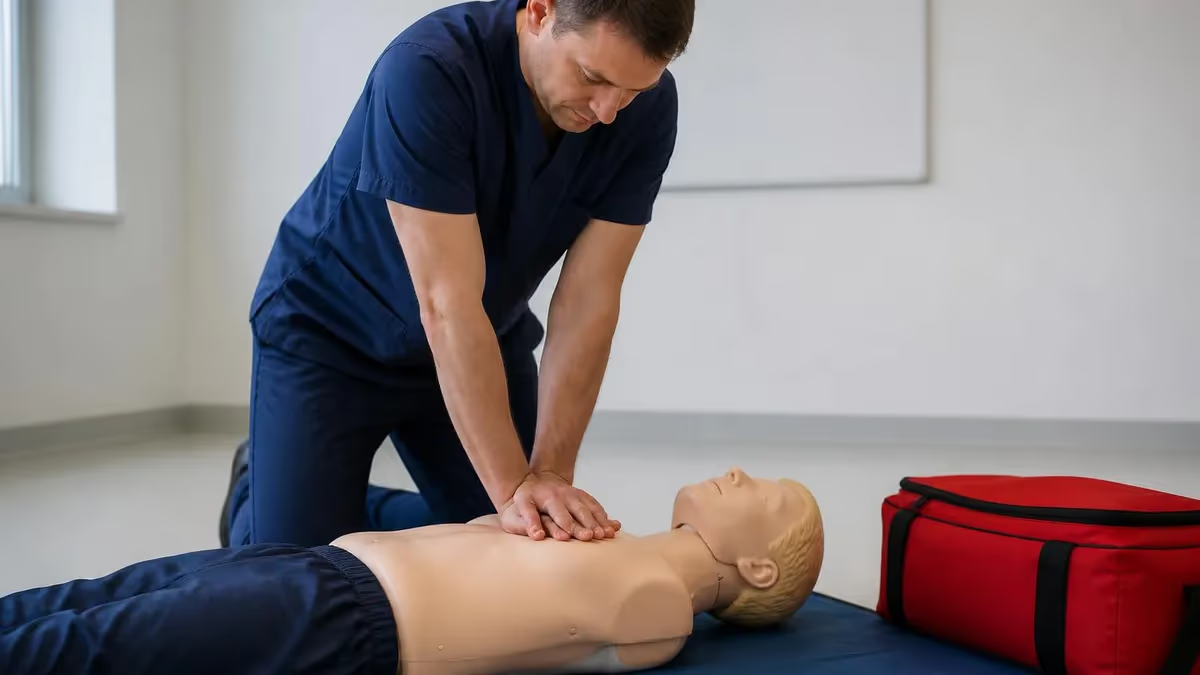
American Heart Association CPR Certification
The American Heart Association (AHA) is the most recognized name in CPR certification in the United States. AHA-certified courses are accepted by hospitals, schools, EMS agencies, daycares, and virtually every healthcare employer that requires CPR as a job condition. The AHA sets the guidelines for CPR technique that the rest of the healthcare world follows — when those guidelines update (typically every five years), all AHA courses update to match the current evidence-based standards.
AHA CPR certification comes in several course types, and choosing the right one matters. Healthcare professionals — nurses, paramedics, medical assistants, respiratory therapists, and others — need the BLS (Basic Life Support) certification, which is the clinical-grade course taught to hands-on medical providers. Non-clinical professionals, teachers, coaches, and general public learners typically need the Heartsaver CPR+AED course, which covers the same core skills but is designed for lay rescuers rather than clinical providers.
Certification is valid for two years and must be renewed before expiration to remain compliant with employer or licensing requirements. The renewal process is essentially the same as the initial certification — a skills check and knowledge update rather than a completely separate course. Most AHA training centers offer renewal as a shorter class than the initial certification for experienced learners who only need a skills refresh.
The AHA operates through a network of authorized Training Centers that offer in-person and blended (online + in-person skills session) courses. You can find a training center near you through the AHA's official course locator at heart.org. Course availability, scheduling, and pricing vary by training center — the AHA sets training standards but individual centers set their own schedules and fees. More context on the AHA's CPR programs specifically is in the AHA CPR overview guide.
One thing that distinguishes AHA from competing certification providers is its eCard system — a digital certification card issued by email after course completion. eCards can be verified online by employers through AHA's lookup tool, which reduces paperwork and makes credential verification faster for both employees and HR teams. Some older AHA training centers still issue physical laminated cards, but the eCard has become the standard for most AHA-authorized courses since its introduction and is widely preferred for its recoverability if lost.
- Most recognized: AHA certification is accepted by virtually all US healthcare employers, hospitals, and licensing bodies
- Two main course types: BLS (for healthcare providers) and Heartsaver CPR+AED (for general public and non-clinical workers)
- Valid for: 2 years from date of completion
- Cost: Typically $50–$90 for in-person classes; blended learning (online + skills session) varies by training center
- Class length: BLS: approximately 3–4 hours; Heartsaver: approximately 2–3 hours
- Format options: Instructor-led in person, blended (HeartCode online + in-person skills check), or employer-arranged group classes
- Renewal: Every 2 years — renewal classes are shorter than initial certification
How to Get AHA CPR Certification
Determine Which Course You Need
Find an AHA Training Center
Register and Attend the Course
Pass the Skills Test and Written Assessment
Receive Your AHA Certification Card

AHA BLS vs Heartsaver: Which Course Do You Need?
BLS (Basic Life Support) is the AHA's CPR course designed for healthcare professionals — people who provide medical care as part of their job and may need to perform CPR in a clinical environment, including during codes on hospital floors, in ambulances, or in clinical outpatient settings. BLS covers adult, child, and infant CPR, AED use, bag-mask ventilation, and two-rescuer CPR with coordinated team roles. It's taught at a higher intensity and clinical depth than the lay rescuer course.
Heartsaver CPR+AED is the AHA's lay rescuer course — designed for teachers, coaches, workplace safety personnel, childcare workers, fitness instructors, and anyone who wants to be prepared to respond to a cardiac emergency outside a clinical setting. It covers adult and child CPR, AED use, and basic first aid. The course is slightly shorter than BLS and doesn't cover bag-mask ventilation or two-rescuer techniques, since lay rescuers typically respond alone while waiting for EMS.
A common mistake is taking the wrong course and then needing to retake it. If your job requires BLS specifically — nursing, EMT, medical assisting, respiratory therapy, dental assisting, phlebotomy — a Heartsaver card won't satisfy the requirement even though both are AHA-certified courses. Employers and licensing boards that specify BLS are requiring the healthcare provider-level course, not the general public version. When in doubt, ask your employer or licensing board exactly which AHA course they require before registering.
The CPR training guide and the online CPR certification guide both have additional detail on how online and in-person certification options compare across providers. For comparing AHA specifically against Red Cross programs, see the Red Cross CPR certification guide — the comparison matters for employers that accept one but not the other, though most large health systems accept both.
If you hold both a current BLS card and a Heartsaver card, the BLS certification satisfies requirements for clinical employers in virtually all cases where Heartsaver would also be accepted — you don't need to hold both simultaneously. BLS is the more comprehensive certification, so clinical workers who already have BLS don't need to separately obtain Heartsaver for non-clinical roles they also fill. One active BLS card is sufficient for all CPR-requiring contexts where AHA certification is accepted.
AHA CPR Course Types
For healthcare providers. Covers adult/child/infant CPR, AED, bag-mask ventilation, 2-rescuer CPR. ~3–4 hours in person. Required by hospitals, nursing boards, EMS, and most clinical employers. Most widely required clinical CPR credential in the US.
For non-clinical workers and general public. Covers adult/child CPR, AED, choking relief. ~2–3 hours. Accepted for school staff, coaches, childcare workers, gym staff, workplace safety roles, and personal readiness.
Online self-paced learning component paired with an in-person skills check session. Complete the online portion at your own pace, then schedule a skills session with an AHA instructor to demonstrate competency. Blended format — final skills check is still required in person.
Advanced course for healthcare providers who respond to pediatric emergencies — ER nurses, PICU staff, pediatricians, paramedics. Requires active BLS certification as a prerequisite. More advanced than standard BLS with pediatric-specific algorithms.
AHA Certification by Learner Type
Nurses, EMTs, paramedics, medical assistants, respiratory therapists, dental assistants, phlebotomists, and other hands-on clinical workers need BLS certification. BLS cards are required for most clinical employment and are a condition of licensure in many states for nurses and other licensed clinicians. Renewal is required every 2 years — most hospital systems track employee CPR expiration dates and require renewal before the card expires, not after.
ACLS (Advanced Cardiac Life Support) is a separate advanced course for nurses, physicians, and respiratory therapists who manage acute cardiac emergencies. ACLS requires current BLS as a prerequisite. If your hospital position requires ACLS, you need BLS first, then ACLS on top of it. Don't confuse BLS with ACLS — they're sequential, not interchangeable.

AHA CPR Certification Cost and Renewal
In-person AHA CPR certification classes typically cost between $50 and $90 per person, though prices vary by training center, course type, and location. Hospitals and healthcare systems that host AHA Training Centers sometimes offer reduced-cost or employer-subsidized classes for employees. Community organizations, fire departments, and some nonprofits offer lower-cost community CPR classes using AHA materials. Group rates are available for workplace teams booking multiple seats at once.
Blended learning (HeartCode online + in-person skills session) costs vary more widely. The HeartCode online portion is purchased through the AHA's website or through a training center, and the in-person skills session fee is set separately by the training center providing it. Total cost for the blended format is typically comparable to in-person class pricing or slightly higher in some markets, though the flexibility of completing the knowledge portion online before attending a shorter skills session appeals to many working professionals.
AHA CPR certification is valid for exactly two years from the date of completion as shown on your card. Renewal must happen before your card expires — employers and licensing boards consider an expired card as no certification, not as 'recently expired but close enough.' Set a calendar reminder three months before your expiration date to allow time to schedule a renewal class without last-minute scrambling.
Renewal classes (sometimes called 'recertification') follow the same format as initial certification but are often slightly shorter since experienced providers already know the foundational content. The AHA's HeartCode blended option is particularly popular for renewals because it allows flexible scheduling of the online portion while keeping the in-person skills check brief. For questions about how long your current card is valid and what renewal options exist, the CPR certification validity guide breaks down timing and renewal rules in detail.
Emergency cardiovascular care research continues to refine CPR protocols — the AHA publishes updated guidelines every five years, with the most recent major update in 2020. Key changes from 2020 guidelines include updated compression-to-ventilation ratios for lay rescuers and revised recommendations for dispatcher-assisted CPR. Taking a renewal class every two years keeps your technique current with whatever the most recent evidence supports, rather than practicing technique you learned five or ten years ago that may no longer reflect best practice.
Before and After Your AHA CPR Class: Checklist
- ✓Confirm which AHA course type your employer or licensing board requires: BLS (healthcare providers) or Heartsaver CPR+AED (non-clinical)
- ✓Use heart.org's class locator to find an AHA-authorized Training Center — not just any CPR class that claims to be AHA
- ✓Bring a government-issued photo ID to your class session
- ✓Wear comfortable clothing — you'll be kneeling and leaning over manikins during skills practice
- ✓For HeartCode blended format: complete the online portion before attending the in-person skills session
- ✓After passing, save your AHA eCard email and card number — you may need it for employer verification or replacement if the card is lost
- ✓Store a copy of your certification card in your work file or HR system — employers often need to see proof at hire
- ✓Set a calendar reminder at least 2 months before your 2-year expiration date to schedule renewal
- ✓If you change jobs, verify whether your new employer accepts your current certification or requires their own in-house course
- ✓Keep the physical card if issued — some credentialing bodies and employers require original documentation rather than a printed copy
AHA CPR Certification vs Other Providers
- +AHA certification is the most universally accepted credential — virtually all healthcare employers, nursing boards, and clinical settings recognize it
- +AHA guidelines are the gold standard for CPR protocol — the evidence-based standards all other providers reference
- +Wide availability of AHA Training Centers nationally — courses available in most cities and towns
- +eCard system allows quick verification by employers through the AHA's online card lookup system
- +HeartCode blended learning option allows flexible scheduling for busy professionals
- −AHA classes tend to cost slightly more than some competing providers (Red Cross, National CPR Foundation, etc.)
- −AHA-authorized classes require an in-person skills session — fully online certification is not valid for employer requirements
- −Training center quality varies — some AHA Training Centers run high-quality instruction while others rush through skills checks
- −AHA certification doesn't include first aid by default — a separate Heartsaver First Aid+CPR+AED course or add-on module is needed for combined CPR+first aid certification
- −Red Cross CPR+AED courses are accepted in most of the same settings as AHA — AHA isn't universally required even when employers specify 'AHA preferred'

Verifying, Replacing, and Managing Your AHA Card
AHA eCards can be looked up and verified through the AHA's official eCard lookup tool at heart.org. Employers and licensing boards can enter your card number to verify your certification status without requiring the physical card. This system eliminates the problem of lost physical cards being unverifiable — as long as your eCard is registered in the AHA system, the credential can be confirmed digitally.
If you lose your physical card or delete the eCard email, contact your training center first — they have records of all certifications they issued and can resend your eCard or provide a replacement. If the training center is no longer operating, contact AHA customer service with your full name, date of birth, and approximate certification date to locate your records. AHA eCards issued from 2012 onward are in the digital system and recoverable; older physical-only cards may not be retrievable from AHA records.
Employers who require AHA certification for employment often verify cards during onboarding and again before renewal dates. Some hospital systems integrate with the AHA's verification system to automate expiration tracking for large staff populations. If your card is approaching expiration and you haven't renewed yet, your employer's HR or compliance team may flag it before you do — staying ahead of your renewal date avoids compliance gaps that can temporarily affect your eligibility to work in clinical areas until certification is renewed.
One nuance worth knowing: your certification date on the AHA card reflects when you attended the skills session, not when you completed an online portion (for blended courses). If you completed HeartCode online in January but attended the skills session in March, your certification date is March — and your expiration is two years from March. Plan your skills session completion date accordingly if your employer tracks expiration dates based on the card issue date. More on the CPR class landscape is in the CPR classes guide covering format options and what to expect in your first session.
AHA CPR Certification: Key Numbers
Key Facts at a Glance
| Item | Value | Details |
|---|---|---|
| AHA CPR certification validity period — must be renewed before expiration, not after | 2 yrs | |
| Typical in-person AHA CPR class cost — varies by training center, course type, and location | $50–$90 | |
| BLS in-person class length — Heartsaver CPR+AED is slightly shorter at approximately 2–3 hours | 3–4 hrs | |
| Course required by healthcare providers: nurses, EMTs, medical assistants, dental assistants, phlebotomists | BLS | |
| Time for AHA eCard delivery by email after completing certification — check spam folder if not received | 24–48hr |
AHA CPR Certification for Employers and Group Training
Employers who need to certify multiple employees can work with AHA Training Centers to arrange onsite group classes. A certified AHA instructor travels to your workplace with manikins and training equipment, and your team completes the course in a group setting. Group classes are often more cost-effective per person than individual enrollment and eliminate travel time for employees. Training centers can typically accommodate groups of 6 to 30+ learners depending on instructor capacity and available manikins.
For large organizations with ongoing CPR compliance needs (hospitals, EMS agencies, large corporate campuses), becoming an AHA Training Center or working with a dedicated Training Center partner allows more scheduling flexibility and potentially lower per-person costs at volume. Healthcare employers with nursing staff numbering in the hundreds or thousands often negotiate institutional rates with specific Training Center partners.
Healthcare employers should be aware that some state nursing boards and accreditation bodies (like The Joint Commission) have specific documentation requirements for CPR certification records. eCard numbers and expiration dates must be logged in employee records and may be subject to audit. Establishing a clear internal tracking system for CPR expiration dates — whether via HR software, a simple spreadsheet, or integration with the AHA's verification system — prevents compliance gaps that can become regulatory issues during accreditation surveys.
For employers uncertain whether their required CPR course aligns with current AHA guidelines, the AHA publishes its current guidelines freely at heart.org — the 2020 guidelines are the current standard as of 2026. Any AHA-authorized class taught within the past two to three years follows current guidelines. Older classes or certifications from non-authorized providers may not reflect current compression rate and depth recommendations, which is why AHA authorization and the recency of the certification both matter for clinical settings. Check the AHA CPR guide for details on current 2020 guideline recommendations and how they differ from older CPR protocols.
The AHA does not offer a fully online CPR certification. Any website claiming to offer AHA-certified CPR certification that doesn't include an in-person skills check session is not a legitimate AHA certification. The AHA requires a hands-on skills demonstration with a certified instructor for all courses — including the HeartCode blended format, which still requires an in-person skills session to complete. Healthcare employers, nursing boards, and most institutional settings do not accept online-only CPR certificates as meeting AHA certification requirements. If your employer specifically requires AHA CPR, verify that your chosen course includes a physical skills session at an AHA-authorized Training Center.
AHA CPR Certification FAQs: Practical Answers
One question that comes up frequently: can you take an AHA class in one state and have it accepted by an employer or licensing board in another state? Yes — AHA certification is nationally standardized and recognized across all 50 states. Your AHA BLS or Heartsaver card issued in Texas is accepted in California, New York, or any other state. The certification is tied to the AHA's national program, not to any state's specific licensing system.
Another common question: what if your certification expires during a job application process? An expired AHA card means your certification has lapsed — you'll need to renew before your employer can verify active certification. Some employers provisionally hire with the understanding that you'll complete renewal within a specific window (often 30 days of start date), but this is employer-discretion, not a standard AHA or regulatory provision. It's always better to renew before your card expires rather than relying on employer flexibility after the fact.
For those who took CPR training through their employer's in-house program rather than through an AHA Training Center: verify whether that training is AHA-authorized. Some employers use AHA materials but deliver training through non-authorized instructors, which produces a certificate that's not valid as AHA certification with external licensing boards or other employers. If you're unsure whether your in-house training qualifies, ask HR whether the instructor was an AHA-certified instructor and whether the training center is AHA-authorized. If not, you may need to complete a separate AHA-authorized course for external credentialing purposes.
For healthcare students preparing for clinical rotations, AHA BLS certification is almost universally required before starting patient-facing clinical hours — nursing programs, PA programs, medical schools, and allied health programs typically require BLS certification as a prerequisite. Get certified early in your program, track your expiration date across the academic year, and renew proactively rather than waiting for your program coordinator to remind you. Keeping CPR current alongside your understanding of validity periods prevents disruptions to your clinical placement schedule.
One final practical note: the AHA's eCard lookup tool allows anyone with your card number to verify your certification. If your employer or clinical site has a credentialing system that pulls from AHA's lookup, your certification appears automatically once your training center submits your completion record — typically within 24 hours of your class. If it doesn't appear and your class was more than 48 hours ago, contact your training center rather than the AHA directly, since training centers are responsible for submitting completion records to the AHA database.
CPR Questions and Answers
About the Author

Registered Nurse & Healthcare Educator
Johns Hopkins University School of NursingDr. Sarah Mitchell is a board-certified registered nurse with over 15 years of clinical and academic experience. She completed her PhD in Nursing Science at Johns Hopkins University and has taught NCLEX preparation and clinical skills courses for nursing students across the United States. Her research focuses on evidence-based exam preparation strategies for healthcare certification candidates.