
Red Cross CPR Training: Courses, Costs, and Certification Guide 2026 October
Complete guide to American Red Cross CPR training: course types, costs, what to expect, how long certification lasts, and who should take it. 💯
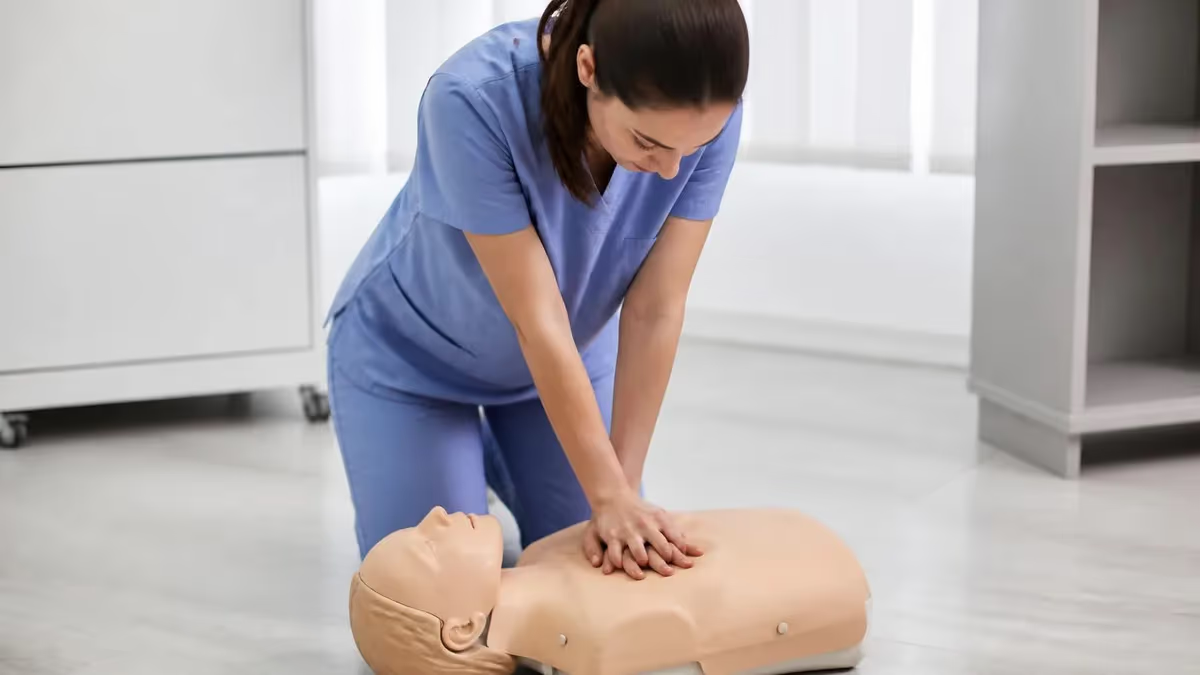
The American Red Cross is one of the two most recognized CPR training providers in the United States, alongside the American Heart Association. Red Cross CPR certification is accepted by employers, healthcare facilities, schools, childcare centers, fitness facilities, and most other organizations that require staff to demonstrate CPR competency. The organization has trained tens of millions of Americans since its first aid programs began over a century ago, and its CPR curricula are regularly updated to align with the latest guidelines from the International Liaison Committee on Resuscitation (ILCOR), which reviews and revises CPR science on a five-year cycle.
Choosing the Red Cross for CPR training gives you access to a nationwide network of authorized training providers, a strong online learning platform, and a blended learning format that lets you complete most of the course content at your own pace before attending a shorter in-person skills session.
The Red Cross's online learning model has made CPR training significantly more accessible — where traditional in-person-only formats required committing a full day, the blended format typically requires 60-90 minutes of online modules followed by a 60-90 minute in-person skills check. This shorter in-person commitment makes it easier for working adults, healthcare students, and busy parents to complete CPR training without major schedule disruption. The American Red Cross CPR certification is valid for two years from the date of completion.
The Red Cross's training infrastructure spans the entire country. Over 30,000 authorized training providers deliver Red Cross CPR courses in traditional classroom settings, healthcare facilities, schools, community centers, and corporate offices. This density of providers means that in most urban and suburban areas, you can find a class within a 10-15 mile radius on nearly any day of the week.
The Red Cross also runs its own training centers in major cities for learners who prefer to train directly with Red Cross-employed instructors rather than authorized providers. All authorized providers use the same Red Cross curriculum and are held to the same instructor standards, so certification quality is consistent regardless of where you train.
Digital certification records have made credential management significantly easier for both employees and employers. Red Cross now issues digital certification cards that are immediately accessible from your phone or email after completing training. These digital cards are accepted by virtually all employers and can be shared instantly. Paper card alternatives are still available for those who prefer them, but the digital format eliminates the common problem of misplaced or expired physical cards that previously caused compliance headaches for HR departments managing large numbers of credentialed staff.

Red Cross CPR Course Options at a Glance
- CPR/AED for Adults — covers adult CPR, AED use, and choking relief
- CPR/AED for Infants and Children — pediatric-specific techniques for parents and caregivers
- Adult and Pediatric CPR/AED — comprehensive combination course
- BLS for Healthcare Providers — professional-level two-rescuer CPR, bag-mask ventilation
- Pediatric First Aid/CPR/AED — required for childcare workers in most states
- Heartsaver CPR/AED — workplace-oriented, meets most employment requirements
- All courses available in blended learning (online + in-person skills) or fully in-person formats
Red Cross CPR courses are divided into lay responder courses, which are designed for the general public, and professional-level courses designed for healthcare workers and first responders. The most common lay responder courses include Adult and Pediatric CPR/AED, which covers rescue breathing and chest compressions for adults, children, and infants, plus AED (automated external defibrillator) operation, and relief of conscious and unconscious choking victims. This course is appropriate for parents, teachers, coaches, fitness instructors, office workers, and anyone who wants foundational life-saving skills without a clinical credential requirement.
Healthcare providers — nurses, medical assistants, respiratory therapists, EMTs, and others — typically need Basic Life Support (BLS) certification rather than a standard lay responder CPR card. Red Cross offers BLS for Healthcare Providers, which covers two-rescuer CPR, bag-mask ventilation, team dynamics, and scenarios reflecting clinical environments.
BLS certification meets Joint Commission requirements and is accepted by virtually all US hospitals and healthcare employers. If you are unsure which certification level your employer or licensing board requires, BLS is the safer default — it exceeds lay responder CPR certification in scope and is never the wrong choice for a healthcare setting.
Pediatric-specific training is required for childcare workers, teachers, and babysitters in most states. The Red Cross Pediatric First Aid/CPR/AED course covers infant and child CPR with rescue breaths, child and infant choking response, and first aid for common childhood emergencies. Many states mandate this specific course (or an equivalent) for daycare center staff to maintain licensure.
Red Cross offers this course in both standalone format and as a combined adult-and-pediatric course that satisfies both lay responder and childcare requirements in a single training. Using Red Cross CPR classes near you is the fastest way to find the right course for your specific situation.
Instructor certification is another career path that Red Cross CPR training opens up. Becoming a Red Cross authorized instructor allows you to teach CPR courses to others, issue certifications, and earn income through instruction. The Red Cross Instructor Candidate Training (ICT) program requires holding current certification in the course you want to teach, completing an online instructor fundamentals module, and participating in a live instructor candidate training session.
Many healthcare professionals, fitness trainers, corporate safety officers, and community health workers add instructor credentials to their professional toolkit, creating a sustainable side income while filling a genuine community need for accessible CPR training. Instructor renewal follows a similar pattern to participant renewal: instructors must teach a minimum number of courses per cycle and complete instructor update training to remain authorized.
CPR training has a documented community health impact beyond the individuals who complete classes. Research published in the Journal of the American Heart Association found that communities with higher rates of CPR-trained bystanders have significantly better out-of-hospital cardiac arrest survival rates. This is why Red Cross invests in community training programs targeting schools, faith communities, underserved neighborhoods, and workplaces with high exposure to cardiac risk factors — the cumulative effect of widespread lay responder training is measurable in lives saved at the population level.
Who Needs Red Cross CPR Certification
Nurses, medical assistants, EMTs, and other clinical staff typically need BLS certification, which goes beyond standard CPR to include two-rescuer techniques and bag-mask ventilation. BLS certification meets Joint Commission and most hospital credentialing requirements.
Daycare center staff, preschool teachers, and in-home childcare providers are required by most state licensing agencies to hold current Pediatric First Aid/CPR/AED certification. Requirements vary by state — check your state's childcare licensing rules.
Personal trainers, group fitness instructors, coaches, and gym staff typically need CPR/AED certification that covers adults and often infants and children. ACSM, NSCA, and most other fitness certifications require current CPR/AED as a condition of credentialing.
OSHA encourages — and some state laws require — that workplace first responders hold current CPR certification. Many businesses require CPR for front desk staff, security personnel, and anyone designated as a workplace first responder.
Parents, grandparents, babysitters, and home health aides benefit from CPR training even without employer requirements. Cardiac arrest and choking are leading causes of preventable death in infants and young children, and bystander CPR before emergency services arrive dramatically improves survival.
Many school districts require or encourage teachers, coaches, and administrators to hold current CPR/AED certification. School-based AED programs are most effective when a critical mass of staff can use them before emergency responders arrive.

Red Cross CPR certification typically costs $20-$60 for lay responder courses and $50-$85 for BLS certification, with prices varying by location, provider, and format. Blended learning courses (online plus in-person skills) tend to be slightly cheaper than fully in-person courses because they require less instructor time. Employers, schools, and community organizations sometimes negotiate group rates that bring individual costs down to $15-$30 per person. Nonprofit organizations, libraries, and community centers periodically offer free or heavily subsidized CPR training funded by grants or community health initiatives — worth checking if cost is a barrier.
The blended learning format works as follows: you register online, purchase the course, and complete the online learning modules at your own pace on any device. The modules typically take 60-90 minutes and cover the science of CPR, step-by-step procedures for adults, children, and infants, AED operation, and choking response.
After completing the online portion, you schedule an in-person skills session with a local authorized provider — typically lasting 60-90 minutes — where an instructor observes and evaluates your technique hands-on using a CPR manikin. If your technique is correct, you receive your certification card on the spot or digitally within 24 hours.
Quality of technique matters more than most lay responders realize. CPR is only effective when performed correctly: chest compressions must reach 2-2.4 inches of depth for adults, the compression rate must be 100-120 per minute, full chest recoil must occur between compressions, and interruptions must be kept under 10 seconds. Rescue breaths, when included, must produce visible chest rise without excessive volume.
Studies of lay rescuer CPR consistently find that many people who have taken CPR classes perform suboptimal compressions in real events — either too shallow, too fast, or with excessive leaning that prevents full recoil. This is why the hands-on skills evaluation component is critical and why refresher training at the two-year certification interval is not just a formality. Knowing how CPR certification compares across providers helps you choose the right training for your specific needs.
The science behind CPR continues to evolve, and Red Cross courses are updated accordingly. The 2020 ILCOR guidelines introduced minor changes to compression depth, rate, and the emphasis on hands-only CPR as a viable option for bystanders. The 2025 guidelines cycle was underway at the time of writing, with potential changes to recommended compression fraction targets and opioid overdose CPR protocols being studied.
Red Cross typically incorporates guideline changes into its courses within 12-18 months of the guideline publication date. If your certification was issued more than 18 months ago and you want to confirm your technique aligns with current guidelines, the Red Cross online learning platform offers updated skill refresher content between formal renewal cycles.
The role of hands-only CPR deserves careful attention. For adult cardiac arrest caused by primary cardiac events, hands-only CPR (no breaths) started immediately by a bystander is nearly as effective as full CPR with breaths for the first several minutes, because the blood is still adequately oxygenated when the arrest begins.
However, for pediatric cardiac arrest, submersion drowning, drug overdose, and respiratory arrest preceding cardiac arrest, rescue breaths remain important because the oxygen content of the blood may already be depleted. Red Cross courses teach the full protocol including rescue breaths so that you are prepared for all scenarios, even if hands-only technique is emphasized as the floor for bystander action.
Blended learning (online + skills session) is typically 60-90 minutes online plus 60-90 minutes in person. Fully in-person courses run 3-4 hours. Both formats result in identical certification; the blended format is more convenient for adults with schedule constraints, while fully in-person suits those who prefer structured classroom environments.
Skills evaluation is required in all formats — there is no fully online CPR certification from Red Cross that meets employer requirements. Any certification claiming full validity without any in-person component should be viewed with skepticism by prospective employers and credentialing bodies.

AED training is integrated into all Red Cross CPR courses rather than offered as a separate add-on. This integration reflects the critical role of AEDs in surviving sudden cardiac arrest: when an AED is used within 3-5 minutes of collapse, survival rates jump from under 10% to 40-70%. AEDs are now present in airports, schools, gyms, shopping centers, and many workplaces.
Knowing how to use one — power on, apply pads following the diagram, clear before shock delivery — is a straightforward skill that takes less than 15 minutes to learn but can make an outcome-defining difference in a real event. Red Cross AED training covers recognizing shockable versus non-shockable rhythms (at a conceptual level — the machine makes the shock decision), proper pad placement, and continuing compressions between AED prompts.
Hands-only CPR is increasingly emphasized in public health campaigns as an alternative for lay rescuers who are uncomfortable with rescue breaths. The American Heart Association and Red Cross both teach that for adult cardiac arrest witnessed by a bystander, high-quality chest compressions without rescue breaths are nearly as effective as CPR with breaths for the first few minutes.
Red Cross courses still teach rescue breaths as part of full CPR — particularly for pediatric cases, submersion incidents, and drug overdose situations where oxygen depletion rather than cardiac electrical failure is the cause — but students are taught that starting compressions immediately, even without perfect technique, is far better than hesitating or doing nothing.
Post-cardiac arrest care begins the moment a pulse returns — something Red Cross courses address conceptually even though it falls outside the lay responder's clinical scope. Students learn to call 911 immediately, continue monitoring consciousness and breathing while waiting for EMS, and place the recovered person in the recovery position if breathing returns spontaneously but they remain unconscious.
These post-resuscitation steps are as important as the CPR itself: a person who recovers a pulse during bystander CPR can deteriorate again before EMS arrives if not properly positioned and monitored. Understanding the full emergency response sequence — call, CPR, AED, recovery position, handover to EMS — gives lay responders a clear mental model of their role from the moment of collapse to the moment professional help takes over.
For parents, the infant CPR component of Red Cross training deserves extra preparation. Infant CPR technique differs significantly from adult CPR: compression depth is only 1.5 inches (two fingertips on the lower sternum), rescue breaths require covering both the mouth and nose simultaneously, and the head tilt for opening the airway is much gentler. Many parents who take adult CPR courses feel underprepared for infant emergencies because they did not specifically request a course that covers infant technique. When registering, always verify that the course you select explicitly covers infant CPR if you have or care for infants.
Is Red Cross or American Heart Association CPR better? Both are equally valid and recognized by employers and licensing bodies. Choose based on convenience — whichever has more available classes in your area. If your employer specifies one, follow their requirement.
Can I get certified fully online? No. Any CPR certification that claims full validity without an in-person skills component does not meet employer or licensing requirements. Red Cross requires in-person skills evaluation for all certifications.
Does CPR certification expire? Yes — all Red Cross CPR and BLS certifications expire after two years. Plan to renew before the expiration date; most employers require a current (unexpired) card.
Does my previous training count if it expired? Expired CPR certification does not meet current requirements, but prior training helps you complete renewal faster because the techniques are familiar. There is no grace period — once expired, you need a full renewal course.
Good Samaritan laws provide important legal protection that everyone should understand before performing CPR on a stranger. All 50 US states have Good Samaritan laws that provide immunity from civil liability for bystanders who provide emergency assistance in good faith. This means that if you perform CPR on a stranger who is in cardiac arrest and they are injured (broken ribs from compressions are common) or do not survive, you cannot be sued for damages.
The purpose of these laws is to remove legal fear as a barrier to bystander action — research consistently finds that bystander CPR roughly doubles survival from out-of-hospital cardiac arrest. If you witness a cardiac arrest in a public place, the law is on your side to act. The question is whether you have the training and confidence to do so.
First aid training is a valuable companion to CPR certification. Red Cross offers combined First Aid/CPR/AED courses that cover not just cardiac arrest response but also wound care, burns, fractures, allergic reactions, diabetic emergencies, and seizure management. The combined course costs only marginally more than CPR alone and prepares you to respond to a much wider range of emergencies.
For parents, teachers, coaches, and workplace first responders, the combined First Aid/CPR/AED credential represents the most practical single investment in emergency preparedness available. Many employers who require CPR certification appreciate first aid training in addition and some specifically require the combined credential for designated workplace first responders.
CPR certification is increasingly being positioned as a life skill rather than a professional compliance requirement, and this cultural shift is supported by public health campaigns, school CPR legislation (26 states now require CPR training before high school graduation), and the growing visibility of public access AED programs.
The Red Cross Teen CPR campaign specifically targets youth audiences, recognizing that teenagers who learn CPR are more likely to use it and are more likely to be present in home settings where most cardiac arrests involving children occur. The democratization of CPR training — through school curricula, community health programs, and accessible blended learning formats — is one of the most impactful public health initiatives of the past decade, and the trajectory is toward a future where CPR competency is as universal as knowing how to call 911.
Whatever your reason for seeking CPR training — a job requirement, a child's safety, a personal commitment to community preparedness — the Red Cross makes it accessible, credible, and continuously updated with the latest evidence. Schedule your training, complete the skills session, and renew on time every two years. The investment is measured in hours; the return is the capacity to save a life.
Key Facts at a Glance
| Item | Value | Details |
|---|---|---|
| Red Cross CPR certification validity | 2 years | |
| Target chest compressions per minute | 100-120 | |
| Time to learn AED operation in training | 10 min |
- +Both are equally recognized by employers and licensing boards nationwide
- +Red Cross blended learning is often more schedule-flexible than AHA options
- +AHA's BLS course is the standard in many hospital systems
- +Red Cross has more community-based class locations in many areas
- +AHA's Heartsaver course is well-suited for non-healthcare workplaces
- −Some hospital employers specifically require AHA BLS — check before choosing
- −Red Cross and AHA use slightly different manikins and classroom styles
- −Pricing is similar; neither is consistently cheaper in all markets
- −Both require in-person skills session — no fully online option exists for either
- −Renewal for one provider does not automatically satisfy the other's requirements
CPR Questions and Answers
About the Author

Registered Nurse & Healthcare Educator
Johns Hopkins University School of NursingDr. Sarah Mitchell is a board-certified registered nurse with over 15 years of clinical and academic experience. She completed her PhD in Nursing Science at Johns Hopkins University and has taught NCLEX preparation and clinical skills courses for nursing students across the United States. Her research focuses on evidence-based exam preparation strategies for healthcare certification candidates.