
First Aid CPR Training Online: OSHA-Approved Options and How to Choose
Find online first aid and CPR training courses, certification options, and learn what to expect from accredited CPR training programs available online. 🟢
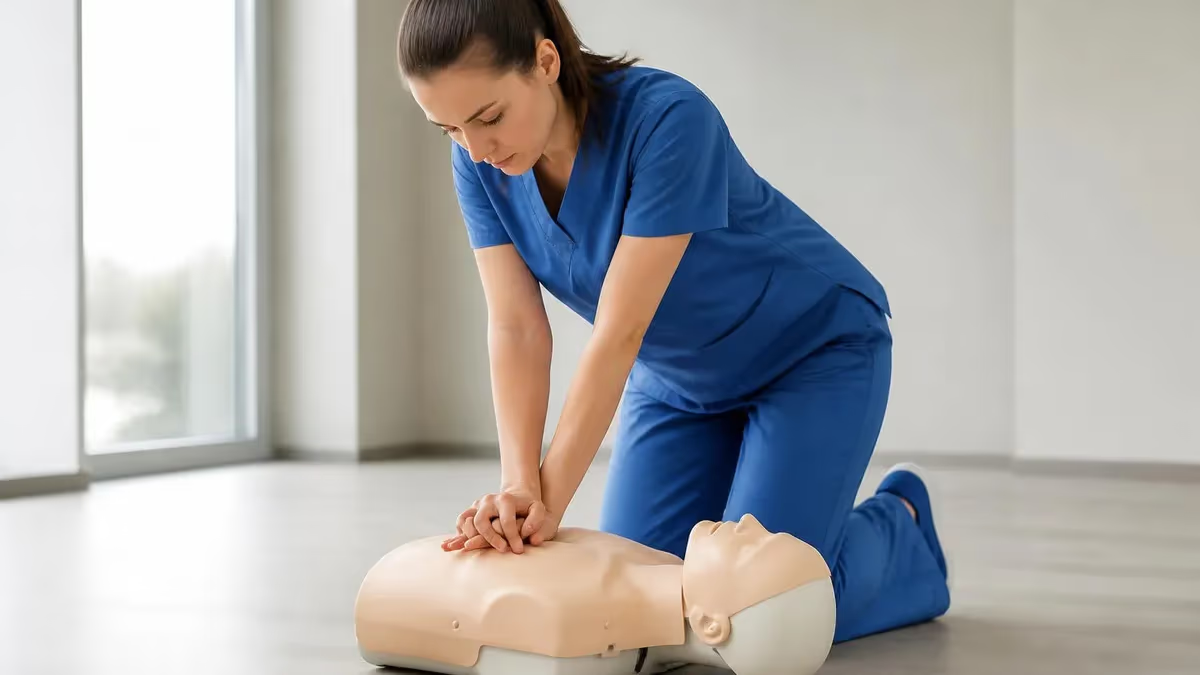
What Online First Aid CPR Training Covers
You can earn a combined first aid and CPR certification entirely online — or through a blended course that pairs digital coursework with a short hands-on skills session. Either way, you'll walk away prepared to respond in real emergencies, and depending on the provider, your cert may satisfy your employer's OSHA requirements without ever stepping foot in a classroom.
First aid CPR online class programs have expanded significantly in the past few years. What once required a full-day classroom commitment now fits into a weekend afternoon. The online component typically runs 2–4 hours, covering videos, interactive scenarios, and knowledge checks. If you're doing blended format, a 1–2 hour in-person skills session with a certified instructor wraps things up. Fully online courses skip that last step entirely.
The combination of first aid and CPR training in a single course makes practical sense. Emergencies rarely happen in isolation. A choking child may need abdominal thrusts followed by rescue breaths. A construction worker with a severe laceration might also go into shock minutes later. Training both skill sets together means you're thinking through realistic sequences — not switching between two separate mental frameworks mid-emergency.
Combined courses are designed for anyone who needs certification for work or community responsibilities. Teachers, coaches, childcare staff, construction workers, gym employees, and camp counselors are all common enrollees. If your job description involves supervising people or working in environments where emergencies are plausible, a combined first aid and CPR cert is often exactly what your employer or licensing board requires.
The skills you'll cover in a combined course go well beyond chest compressions. Most programs include adult, child, and infant CPR with two-rescuer techniques, AED operation with hands-on or video-based pad placement practice, choking response using the Heimlich maneuver and infant back blows, severe bleeding control via direct pressure and wound packing, burn care for thermal and chemical exposures, fracture and sprain immobilization basics, shock recognition and proper positioning, and recognition of strokes, heart attacks, and diabetic emergencies. Some longer courses add anaphylaxis response with epinephrine auto-injector use.
Online formats deliver this content through video demonstrations, animated walkthroughs, and scenario-based decision trees. You'll pause, answer questions, and move at your own pace. Most platforms track your progress and let you revisit modules as many times as you need before the knowledge exam. That flexibility is one of the main reasons people prefer online training to scheduled classroom sessions — you can fit it around work schedules and complete modules in short bursts rather than committing an entire day.
It's also worth noting that combined training certification is typically the same cost as getting CPR-only certification, since most providers bundle the curriculum at one price point. If you're going to recertify anyway, the combined first aid and CPR course gives you a significantly broader skill set for essentially no additional cost or time. It's an easy upgrade that makes your cert more useful across more situations.

- OSHA compliance: OSHA doesn't approve specific courses — it requires training meet 29 CFR 1910.151 standards. Most programs from Red Cross, AHA, and ASHI qualify.
- Certification validity: 2 years for most providers.
- Blended format (online study + in-person skills check) is the most widely accepted by employers and state licensing boards.
- Fully online certification is accepted by many employers but may not satisfy OSHA-regulated workplaces or state childcare licensing.
- Cost range: $35–$80 for blended; $15–$40 for fully online-only.
OSHA Compliance — What It Actually Means
Here's something that trips people up: OSHA doesn't maintain a list of approved courses. There's no government stamp, no federal registry of certified training programs. What OSHA does is set a performance standard. Under 29 CFR 1910.151, employers in general industry must ensure a person trained in first aid is available when access to a medical facility is not reasonably accessible. The training must be adequate — but OSHA leaves the definition of adequate to the employer's reasonable judgment.
So when you see phrases like "first aid CPR training online OSHA approved" or "1st aid CPR training online OSHA compliant," that's marketing language. It means the provider believes their curriculum aligns with OSHA's content expectations — CPR, AED use, bleeding control, choking response, shock management. Nationally recognized organizations like the American Red Cross, American Heart Association, ASHI, and MEDIC First Aid design their courses to meet those expectations. That's why employers and inspectors generally accept their cards without question.
The sticking point is hands-on skills evaluation. OSHA's standard doesn't just mean someone watched videos — it implies workers can actually perform the skills when needed. A fully online course with no physical manikin practice is harder to defend during an OSHA inspection, particularly in higher-risk environments like construction, manufacturing, warehousing, or maritime work. The agency isn't primarily auditing the certificate itself; it's asking whether a genuinely trained person is present on site and whether that training was realistic enough to produce a competent responder in a real emergency.
For most office environments, retail settings, and lower-risk workplaces, a blended online course — or even a fully online cert from a nationally recognized organization — satisfies the standard without issue. Many HR departments accept them routinely. But if your job site falls under OSHA 29 CFR 1926 (construction industry standard), the expectation generally leans toward more hands-on verification. The safest path in those environments is always the blended format.
State licensing boards add another layer. Teachers, childcare workers, and school nurses in many states must hold a current first aid and CPR cert, and those boards sometimes specify the training format. California often requires a skills component for childcare licensing. New York has its own requirements for school employees. Before enrolling in any online course, it's worth a quick check with your specific licensing authority to confirm what format they accept. Ten minutes of research now saves the frustration of completing a course that doesn't count.
Who Needs Combined First Aid and CPR Certification
- ✓Teachers and school staff — most states require current CPR and first aid cert for licensure renewal
- ✓Childcare workers — state licensing boards often mandate blended or in-person format
- ✓Construction workers on OSHA-regulated job sites where medical help is not immediately accessible
- ✓Coaches, personal trainers, and fitness instructors
- ✓Camp counselors and youth program leaders
- ✓Lifeguards and aquatics staff
- ✓Security officers and building safety wardens
- ✓Gym staff and recreation center employees
- ✓Flight attendants and hospitality workers in remote venues
For how to get CPR certification in a combined format, the process is straightforward: pick a nationally recognized provider, complete the online modules at your own pace, schedule a skills session if required, and save your digital card. Most providers email the card immediately after the skills session is verified. Some offer a wallet-sized physical card by mail for an additional fee, which some employers prefer for on-site display.
Before you start, take five minutes to check your state's specific requirements for your profession. Teachers in California face different rules than teachers in Texas. Childcare workers in Florida operate under different licensing standards than those in New York. Getting this right upfront means you enroll in a course that actually counts — not one you'll need to repeat because it wasn't the format your licensing board wanted. Most state licensing board websites list accepted training formats directly on their renewal or certification pages.
Once you've confirmed the format requirements, registration is simple. Most providers let you enroll online in under 5 minutes, with immediate access to the course modules. If you're doing blended format, skills session slots can be searched by zip code directly from the provider's site, and many locations offer weekend availability. The total time from clicking "enroll" to holding a valid cert card can be as short as a few days.

Top Online First Aid CPR Training Providers
Format: Blended (online modules + in-person skills check). Cost: ~$35–$65. Certification: 2 years. Widely recognized by employers, state licensing boards, and OSHA-regulated workplaces. The Heartsaver First Aid CPR AED course covers the full skill set. Skills sessions available at Red Cross chapters and partner training sites nationwide.
Format: Blended (HeartCode online + in-person skills check). Cost: ~$40–$80. Certification: 2 years. Industry gold standard for healthcare-adjacent roles; accepted by hospitals, clinics, schools, and most employers. The Heartsaver First Aid CPR AED course is ideal for non-healthcare workers who need a credible, broadly recognized card.
Format: Fully online (no in-person skills session required). Cost: ~$15–$40. Certification: 2 years. Accepted by many employers, fitness certifying bodies (NASM, ACE), and childcare programs in most states. Practical option when an in-person session isn't feasible. Verify acceptance with your specific employer or licensing board before enrolling.
Format: Blended (online study + skills evaluation). Cost: ~$30–$60. Certification: 2 years. OSHA-aligned curriculum recognized across industrial and workplace settings. Common in manufacturing, construction, and maritime environments. ASHI instructors are widely available in regions where Red Cross or AHA coverage is limited.
Format: Fully online with video skills verification option. Cost: ~$15–$30. Certification: 2 years. Accepted by many employers. Best suited for individuals in non-regulated jobs who need a quick, affordable cert. Digital card typically issued the same day as course completion.
First Aid CPR Training: Format Comparison
Online coursework + in-person skills session with a certified instructor. Most widely accepted by employers, state licensing boards, and OSHA-regulated workplaces. You practice compressions on a manikin, use an AED trainer, and demonstrate first aid techniques. Instructor signs off and issues your cert. Cost: $35–$80. Duration: 3–6 hours total. Best for: teachers, childcare workers, construction, healthcare-adjacent roles.
Blended vs Fully Online — Which Format Is Right for You?
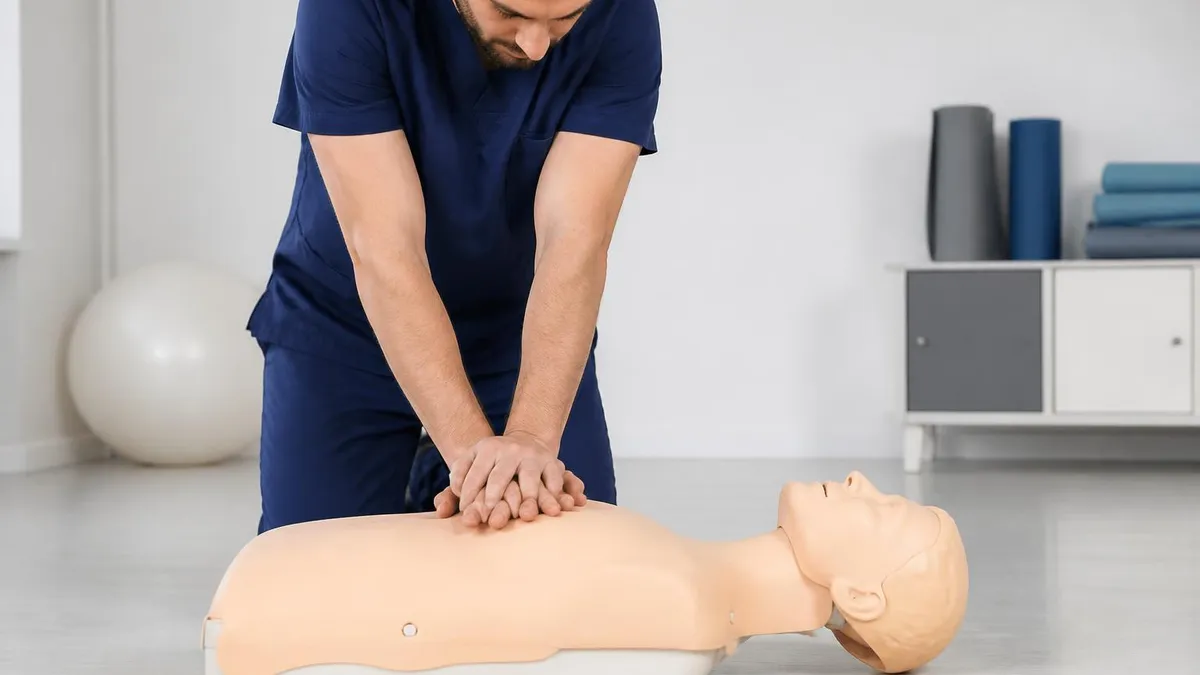
The blended format pairs self-paced online coursework with a hands-on skills session conducted by a certified instructor. You practice chest compressions on a manikin until your depth and rate are consistent, run through AED scenarios with actual pads, and demonstrate first aid techniques on a practice partner. The instructor evaluates your performance, signs off, and you receive your cert. That's the model Red Cross and AHA use, and it's the safest default if you're unsure what your employer or licensing board will accept.
Fully online courses cut out the in-person component entirely. You work through videos, answer scenario-based questions, and self-verify that you've practiced the physical skills. Some providers — including a growing number of platforms — offer a video-submission middle ground where you record yourself performing compressions or demonstrating a bleeding control technique and submit it for instructor review. It's not the same as in-person feedback, but it's a meaningful step up from purely theoretical assessment.
The honest reality is that manikin practice develops better physical technique than video alone. Compression depth and rate are difficult to internalize without tactile feedback — you need to feel resistance to know if you're pushing hard enough. That's why OSHA inspectors and licensing boards in regulated industries lean toward blended. But for individuals who've already been certified before and are doing a renewal, who work in low-risk office environments, or who need certification for personal preparedness, fully online is a legitimate and practical option.
If you're buying a cert for a job requirement, ask your HR department or supervisor before enrolling. A 5-minute email exchange could save you from completing a fully online course that your employer won't accept — and then having to retake a blended version anyway. Don't assume. Policies vary more than you'd expect, even within the same industry sector.
Skills decay faster than most people realize. Studies on CPR retention show that compression quality drops noticeably within 6–12 months without reinforcement. Many organizations recommend annual refreshers even when the 2-year cert hasn't expired. Some employers in healthcare and public safety build in annual skills practice days where staff work on manikins without going through full recertification. If your workplace doesn't, consider using free resources — both the Red Cross and AHA maintain video libraries with technique reminders — to keep the physical patterns fresh between cert cycles.

First Aid CPR Training at a Glance
Cost Breakdown
Pricing varies by provider, format, and enrollment type. Here's what you can expect:
- Blended courses: $35–$80 total. The online module is usually $20–$40; the in-person skills session adds $15–$40 depending on instructor fees in your area. Skills sessions in major metro areas tend to cost more than in smaller markets.
- Fully online only: $15–$40. Faster turnaround and lower cost, but verify acceptance with your employer first.
- Group rates: Most major providers offer volume discounts for teams of five or more. Red Cross, ASHI, and ProTrainings all have group pricing options for workplace training. On-site sessions — where an instructor comes to your location — are available at higher cost but eliminate the need to send employees offsite.
- Employer-sponsored: Many employers in OSHA-regulated industries cover the cost entirely. Ask your HR department before paying out of pocket — you may not owe anything.
For CPR renewal online, pricing is comparable. Some providers offer a discounted renewal rate if you've previously certified with them. Renewal courses are often shorter — 2–3 hours online plus a skills refresher — because they assume baseline familiarity with the material. If you let your cert lapse entirely and have to restart from scratch, you'll pay full price again, which is one more reason to set that 90-day renewal reminder.
If you're managing a team, there's also the question of coordinating renewal dates. Staggered expirations mean you're handling individual renewals year-round rather than renewing everyone at once. Some HR platforms integrate directly with training provider databases and auto-track completion dates, which helps for teams larger than a handful of employees.
How to Choose the Right Course
Start with your employer or licensing board. Ask specifically whether they accept fully online certifications or require a blended format with hands-on skills verification. If they have no preference or no official policy, go with a nationally recognized provider — Red Cross, AHA, or ASHI — because those cards are universally recognized and you won't run into credibility questions later.
If you need a combined first aid and CPR certification renewal and you work in healthcare, education, or childcare, the AHA Heartsaver blended course is the standard recommendation. It's the most broadly recognized card in those sectors, and it tends to satisfy both employer requirements and state licensing board mandates in a single enrollment.
For non-regulated jobs, freelancers, personal trainers, or anyone pursuing certification for personal preparedness, a fully online course from ProTrainings or the National CPR Foundation is practical and affordable. You get solid content, a valid digital card, and a much shorter time commitment than a blended course.
Before you finalize your choice, confirm what the certificate looks like and how it's delivered. Some employers want a physical card mailed to them. Others want a PDF with the provider's logo, your name, completion date, and expiration date. A few HR departments require that the card show a specific format for OSHA record-keeping purposes. Clarify this before you pay — it's a detail that seems minor until it causes a problem on your first day at a new job.
Certification is valid for 2 years under most programs. Build a reminder into your calendar 60–90 days before the expiration date, not on the date itself. In-person skills sessions at busy training sites — especially in fall and January — fill up weeks in advance, when teachers, coaches, and construction workers rush to recertify before their cards expire. Starting the renewal process early gives you real flexibility on timing and location.
If your first aid & CPR training online needs align with a specific industry — healthcare, construction, childcare, fitness — mention that to the provider when you enroll. Some organizations offer industry-specific versions with scenarios and skills checks calibrated to those environments. It makes the training more applicable to what you'll actually face on the job, and it's the same time investment as a generic course. The difference shows up when you're standing in front of an actual emergency and the scenario from your training clicks into place.
What to Look for in an Online First Aid CPR Course
- ✓Nationally recognized provider (Red Cross, AHA, ASHI, MEDIC First Aid, or National CPR Foundation)
- ✓Covers adult, child, AND infant CPR — not just adult
- ✓Includes AED training as part of the curriculum
- ✓First aid content: bleeding, burns, choking, shock, fractures
- ✓OSHA 29 CFR 1910.151 alignment noted in course description
- ✓2-year certification validity
- ✓Blended format available if your employer or licensing board requires hands-on skills verification
- ✓Digital card issued immediately upon completion
- ✓Provider accepted by your specific employer or licensing board — confirm before enrolling
- ✓Clear refund or reschedule policy for in-person skills sessions
CPR Pros and Cons
- +CPR has a publicly available content blueprint — you know exactly what to prepare for
- +Multiple preparation pathways accommodate different schedules and budgets
- +Clear score reporting shows specific strengths and weaknesses
- +Study communities share current insights from recent test-takers
- +Retake policies allow recovery from a difficult first attempt
- −Tested content scope requires substantial preparation time
- −No single resource covers everything optimally
- −Exam-day performance can differ from practice test performance
- −Registration, prep, and retake costs accumulate significantly
- −Content changes between versions can make older materials less reliable
CPR Questions and Answers
About the Author

Registered Nurse & Healthcare Educator
Johns Hopkins University School of NursingDr. Sarah Mitchell is a board-certified registered nurse with over 15 years of clinical and academic experience. She completed her PhD in Nursing Science at Johns Hopkins University and has taught NCLEX preparation and clinical skills courses for nursing students across the United States. Her research focuses on evidence-based exam preparation strategies for healthcare certification candidates.
Join the Discussion
Connect with other students preparing for this exam. Share tips, ask questions, and get advice from people who have been there.
View discussion (5 replies)