
CPR Test: Complete Guide to Certification Exams, Practice Questions, and Passing Strategies in 2026 October
📝 Master the CPR test with our complete 2026 October guide. Practice questions, ACLS algorithm review, exam format, scoring, and proven study strategies to pass.
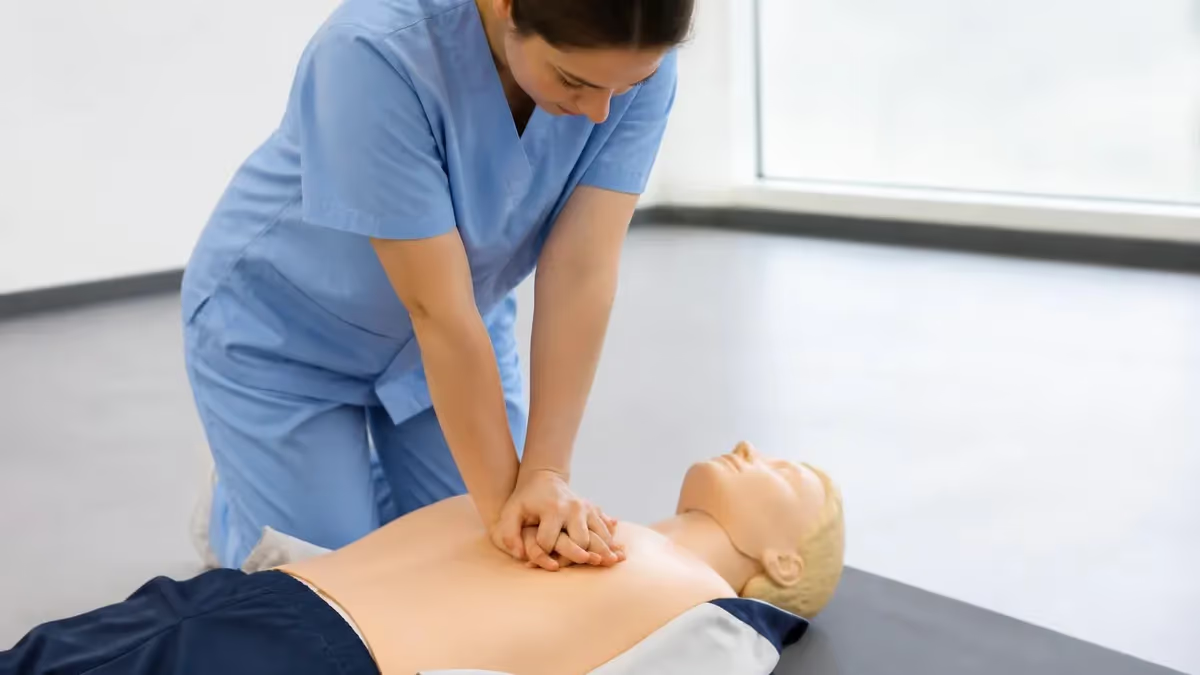
The cpr test is the standardized assessment used by certifying bodies to verify that a candidate can perform cardiopulmonary resuscitation safely, accurately, and confidently in a real emergency. Whether you are renewing a healthcare provider card, taking your first basic life support course, or preparing for an advanced clinical exam, the structure of the test follows a predictable pattern: a written multiple-choice section followed by a hands-on skills check on a manikin. Understanding both halves of the exam is the difference between passing on your first attempt and scheduling an expensive retake.
Modern CPR testing has evolved significantly since the American Heart Association updated its guidelines in late 2020 and again with focused updates in 2023 and 2025. Compression depth, rate, ventilation timing, and AED integration are all scored more strictly than they were a decade ago. Examiners watch for specific behaviors—proper hand placement, full chest recoil, minimal interruptions, and clear communication with bystanders—and a single critical-fail error can require remediation regardless of how well you scored on the written portion.
The written portion typically contains between 25 and 50 multiple-choice questions depending on the certification level. Basic Life Support exams lean heavily on the adult chain of survival, while Advanced Cardiac Life Support adds rhythm interpretation, drug dosing, and team dynamics. Pediatric Advanced Life Support introduces age-based modifications, weight-based dosing, and the unique physiology of children and infants. Each tier builds on the previous one, so a strong foundation in BLS makes ACLS and PALS dramatically easier to master.
The skills portion is where most candidates feel the pressure. You will be asked to demonstrate one- and two-rescuer CPR, bag-mask ventilation, AED use, and choking response on adult, child, and infant manikins depending on your course. Examiners use a checklist, and you must hit every critical action within the allotted time. Knowing the cadence of a real cpr machine can help you internalize the rhythm of 100 to 120 compressions per minute that the test requires.
Cost is another factor that catches new candidates off guard. A standard BLS course runs between 60 and 110 dollars, while ACLS and PALS sit between 200 and 300 dollars. Online-only options exist but are not accepted by most hospitals for clinical roles, so blended learning—online theory plus in-person skills—has become the dominant model. Budgeting for the right course up front saves money compared to discovering your certificate is not accepted at orientation.
This guide walks through every section of the cpr test from registration to passing score, with practice question samples, study schedules, and the most common mistakes candidates make. By the end you will know exactly what to expect, how to prepare efficiently, and how to handle the high-stress moments that derail otherwise well-prepared students. Whether your test is tomorrow or three months away, the strategies below are proven to lift first-attempt pass rates above the national average.
We also address the practical questions that rarely appear in textbooks: what to wear, how examiners handle nervous candidates, what happens if you fail one station, and how long your certification actually lasts in different states and clinical settings. These details matter because passing the test is only the first step—keeping your card current and accepted by your employer requires planning years in advance.
CPR Test by the Numbers

CPR Test Format and Structure
Contains 25 to 50 questions covering recognition of cardiac arrest, compression standards, ventilation ratios, AED operation, and special circumstances. Most providers require 84% or higher to pass, and you typically have 90 minutes to complete it.
A pass-fail station where you demonstrate one- and two-rescuer CPR on a manikin, AED placement, and rescue breathing. Examiners score against a strict checklist, and any critical-fail action requires immediate remediation before retesting.
Required for ACLS and PALS exams, this simulation puts you in charge of a resuscitation team managing a deteriorating patient. You must lead, delegate, and apply the correct acls algorithm while communicating clearly under realistic time pressure.
Failing one station does not automatically end the course. Most instructors allow one immediate remediation attempt with coaching, followed by a single retest scheduled within 30 days. Beyond that, candidates must repeat the entire course at additional cost.
The written portion of the cpr test is built around the chain of survival, and every question maps to a learning objective published by the certifying body. For Basic Life Support, expect heavy coverage of compression depth (at least 2 inches for adults, about 2 inches for children, and 1.5 inches for infants), the compression-to-ventilation ratio (30:2 for single rescuer, 15:2 for two rescuers on a child or infant), and the importance of allowing full chest recoil between compressions. These numbers appear in multiple questions, often in scenarios where one variable is wrong.
AED knowledge accounts for roughly 20 percent of BLS questions. You should know what does aed stand for—automated external defibrillator—and exactly when to deploy one: as soon as it is available, with minimal interruption to compressions. Questions often test pad placement on small children, what to do when the chest is wet or hairy, and how to respond when the device advises no shock. The national cpr foundation and the American Heart Association publish slightly different question wording, but the underlying clinical answers are identical.
Adult, child, and infant CPR are tested as separate skill sets because the physiology and technique differ meaningfully. Adults receive two-handed compressions at 100 to 120 per minute, children get one- or two-handed compressions depending on size, and infant cpr uses two fingers (single rescuer) or the two-thumb encircling technique (two rescuers). The respiratory rate for rescue breathing without compressions is one breath every 6 seconds for adults and one every 2 to 3 seconds for children and infants.
For ACLS candidates, the written exam expands dramatically. You must memorize the acls algorithm for ventricular fibrillation, pulseless ventricular tachycardia, asystole, pulseless electrical activity, bradycardia, and the tachycardias. Drug dosing for epinephrine, amiodarone, lidocaine, atropine, and adenosine appears repeatedly, and you must know both the dose and the timing relative to defibrillation attempts. Reversible causes—the Hs and Ts—are tested in nearly every ACLS exam, often hidden inside a longer clinical vignette.
Pals certification adds pediatric-specific content including weight-based drug calculations, recognition of compensated versus decompensated shock, and respiratory failure as the primary path to pediatric cardiac arrest. Knowing the normal respiratory rate for adults compared to children and infants is foundational because deviations from baseline trigger the entire pediatric assessment cascade. The pals exam also emphasizes the systematic approach: initial impression, primary assessment, secondary assessment, and tertiary diagnostics.
Test writers love to include distractors that sound plausible. A question might ask the correct compression depth for an adult and offer four answers ranging from 1.5 to 3 inches. The correct answer is at least 2 inches but not more than 2.4. Knowing the exact range, not just the minimum, separates students who pass comfortably from those who guess. Similarly, questions about life support termination criteria require knowing both the clinical and ethical standards that govern when resuscitation efforts can stop.
Reading question stems carefully is half the battle. Watch for absolute words like always, never, only, and immediately—they often signal a trick. When two answers seem correct, the more specific one is usually right. When time pressure mounts, flag difficult questions and return to them, because clarity often comes after answering five or ten easier items that refresh related concepts in your memory.

CPR Practice Test Questions
Prepare for the CPR Cardiopulmonary Resuscitation Practice exam with our free practice test modules. Each quiz covers key topics to help you pass on your first try.
CPR Basic CPR
CPR Exam Questions covering Basic CPR. Master CPR Test concepts for certification prep.
CPR and First Aid
Free CPR Practice Test featuring and First Aid. Improve your CPR Exam score with mock test prep.
CPR (Cardiopulmonary Resuscitation) Adult ...
CPR Mock Exam on (Cardiopulmonary Resuscitation) Adult CPR and AED Usage. CPR Study Guide questions to pass on your first try.
CPR (Cardiopulmonary Resuscitation) Airway...
CPR Test Prep for (Cardiopulmonary Resuscitation) Airway Obstruction and Choking. Practice CPR Quiz questions and boost your score.
CPR (Cardiopulmonary Resuscitation) Cardio...
CPR Questions and Answers on (Cardiopulmonary Resuscitation) Cardiopulmonary Emergency Recognition. Free CPR practice for exam readiness.
CPR (Cardiopulmonary Resuscitation) Child ...
CPR Mock Test covering (Cardiopulmonary Resuscitation) Child and Infant CPR. Online CPR Test practice with instant feedback.
CPR (Cardiopulmonary Resuscitation) High-P...
Free CPR Quiz on (Cardiopulmonary Resuscitation) High-Performance Team Dynamics. CPR Exam prep questions with detailed explanations.
CPR (Cardiopulmonary Resuscitation) Legal ...
CPR Practice Questions for (Cardiopulmonary Resuscitation) Legal and Ethical Considerations. Build confidence for your CPR certification exam.
CPR for Specific Populations
CPR Test Online for for Specific Populations. Free practice with instant results and feedback.
CPR Airway & Breathing Management
CPR Exam Questions covering Airway & Breathing Management. Master CPR Test concepts for certification prep.
CPR Assessment & Recognition of Cardiac Ar...
Free CPR Practice Test featuring Assessment & Recognition of Cardiac Arrest. Improve your CPR Exam score with mock test prep.
CPR Chest Compressions & Defibrillation
CPR Mock Exam on Chest Compressions & Defibrillation. CPR Study Guide questions to pass on your first try.
CPR Post-Resuscitation Care & Recovery
CPR Test Prep for Post-Resuscitation Care & Recovery. Practice CPR Quiz questions and boost your score.
Skills Test by Certification Level
The Basic Life Support skills test focuses on adult, child, and infant CPR with bag-mask ventilation and AED use. You will perform a 2-minute cycle of one-rescuer adult CPR, then transition to two-rescuer with a partner or examiner. Compression depth, rate, recoil, and minimal interruptions are scored continuously. Examiners use a real-time feedback manikin in most testing centers, so the device itself tells you when you are too shallow or too slow.
The choking station tests abdominal thrusts on a conscious adult and the modified technique for unresponsive victims. You must also demonstrate the correct sequence when transitioning from a witnessed collapse to AED deployment. Infant cpr involves the two-thumb encircling technique for two-rescuer scenarios and back blows plus chest thrusts for choking. The entire BLS skills test typically takes 20 to 30 minutes per candidate.
Online vs. In-Person CPR Testing: Which Is Right for You?
- +In-person courses provide direct examiner feedback on hand placement and compression depth
- +Hospital and clinical employers almost universally accept AHA in-person certifications
- +Hands-on practice with high-fidelity manikins builds muscle memory you cannot get from video
- +Group scenarios simulate real team dynamics that solo online learning cannot replicate
- +Immediate remediation lets you correct errors before the formal skills check
- +Networking with healthcare peers often leads to job referrals and continuing education tips
- −In-person classes require travel and a full-day commitment that disrupts work schedules
- −Online-only certifications are rejected by most hospitals for clinical staff positions
- −Course availability in rural areas can mean waitlists of four to eight weeks
- −Costs run 30 to 50 percent higher than purely online alternatives
- −Recertification still requires periodic in-person skills checks despite online theory completion
- −Some instructors run rushed classes that leave slower learners feeling unprepared for the test

Pre-Test Preparation Checklist for CPR Test Success
- ✓Review the latest AHA or Red Cross guidelines published within the past 12 months
- ✓Memorize compression depth and rate standards for adult, child, and infant victims
- ✓Practice the 30:2 single-rescuer ratio until it becomes automatic muscle memory
- ✓Watch official skills videos at least three times before your scheduled exam date
- ✓Complete a minimum of 100 practice questions across multiple question banks
- ✓Time yourself on a 2-minute compression cycle to build cardiovascular endurance
- ✓Bring a government-issued photo ID and your course completion materials to the test
- ✓Wear comfortable clothing and closed-toe shoes that allow kneeling on the floor
- ✓Eat a balanced meal and hydrate well at least 90 minutes before your test slot
- ✓Arrive 20 minutes early to settle nerves, locate restrooms, and review notes one final time
Compression Quality Beats Speed Every Time
Examiners would rather see 100 perfect compressions per minute with full recoil than 130 shallow, rushed ones. Modern feedback manikins flag depth and recoil errors instantly, and these errors are the single most common reason candidates fail the skills check. Slow down, count out loud, and let your hands fully release between compressions.
Even well-prepared candidates make predictable mistakes on test day, and recognizing these patterns ahead of time can save you from joining the 15 to 20 percent who require remediation. The most common error across all certification levels is leaning on the chest between compressions. Full recoil allows the heart to refill with blood, and incomplete recoil cuts cardiac output dramatically. Examiners watch for this specifically, and feedback manikins now flash a warning the moment your hands fail to lift fully off the sternum.
The second most common mistake is compression rate drift. Candidates either start too fast and slow down as they tire, or start too slow and never reach the 100 per minute minimum. Practicing with a metronome app set to 110 beats per minute or a familiar song with the right tempo trains your body to stay in the correct range without conscious counting. Remember that knowing the adult normal respiration rate also matters because rescue breath delivery affects overall cycle timing.
Ventilation errors come in two flavors: over-ventilating and under-ventilating. Giving breaths too forcefully causes gastric inflation, which leads to vomiting and aspiration in real patients. Giving breaths too quickly cuts into compression time. The correct technique is a one-second breath that produces visible chest rise, no more. Practice this on a manikin until you can feel the right volume without thinking about it. The same principle applies to bag-mask ventilation when used in two-rescuer scenarios.
AED errors are surprisingly common despite the device's simplicity. Candidates forget to clear the patient before delivering the shock, place pads incorrectly on small children, or attempt to use adult pads on infants when pediatric pads are available. The cardinal rule is straightforward: turn it on, follow the voice prompts, clear before shocking, and resume compressions immediately after the shock is delivered. Do not waste time checking a pulse between cycles unless prompted by the device.
Communication failures hurt ACLS and PALS candidates more than technical errors do. The mega code simulation is scored heavily on closed-loop communication, which means the team leader gives a specific order to a named team member, the team member repeats the order back, performs it, and reports completion. Skipping any step of this loop creates ambiguity in real codes and costs you points on the exam. Practice with study partners until the language becomes automatic.
Time management on the written exam also trips up otherwise prepared candidates. With 90 minutes for 50 questions, you have less than two minutes per item, but most questions can be answered in under 45 seconds. The trap is spending five minutes on a single difficult question and running out of time at the end. Mark hard questions, move on, and return after completing everything you know. Most certifying bodies allow you to revise answers until you submit the entire exam.
Finally, test anxiety derails candidates who actually know the material. Deep breathing for 60 seconds before entering the testing room, reviewing one or two key concepts rather than cramming, and reminding yourself that remediation is available all reduce the physiological stress response. Examiners are not trying to fail you—they want competent rescuers in the community, and they will give you every reasonable opportunity to demonstrate that competence within the structure of the test.
Certain errors result in automatic failure regardless of overall performance: compressions consistently shallower than 2 inches on an adult, rate consistently below 100 or above 120, failure to deploy an available AED, or improper handling that endangers the manikin or simulated patient. If you commit a critical-fail action, you will be offered remediation training and a single retest. A second critical-fail typically requires repeating the full course.
Strategic preparation in the final week before your cpr test makes the difference between a stressful pass and a comfortable one. Start by taking a full-length practice exam under timed conditions to identify your weakest content areas. Track every question you miss, look up the correct answer in your provider manual, and re-test the same topic 48 hours later to confirm the concept has stuck. This spaced-repetition approach is dramatically more effective than passive re-reading.
Build a personal cheat sheet of the numbers you must memorize: compression depths, rates, ventilation ratios, AED energy levels (though most modern devices select these automatically), drug doses for ACLS and PALS, and the time intervals between rhythm checks. Limit this sheet to one page so you can review it in five minutes the morning of your exam. The act of writing it out by hand reinforces memory far better than typing or printing.
For the skills portion, recruit a study partner and run through scenarios out loud. One person plays the rescuer while the other plays examiner with a checklist. Switch roles every five minutes. The verbal practice cements the sequence in long-term memory, and hearing yourself narrate the steps reveals gaps you would not notice during silent practice. If you do not have a partner, record yourself and watch the playback critically.
Sleep matters more than last-minute cramming. Cognitive performance drops measurably with fewer than seven hours of sleep, and motor coordination for the skills check suffers as well. Plan your final two nights to include eight hours of rest, and avoid heavy meals or alcohol the evening before. A short walk and a light review the night before your test produce better results than three hours of frantic studying that leaves you anxious and exhausted.
On test day, dress in comfortable layers because testing centers vary in temperature, and you will be kneeling on the floor for extended periods. Avoid jewelry that could catch on equipment or interfere with hand placement. Bring water, a snack for between stations, and your photo ID. If you wear glasses, bring a backup pair or contacts, because you cannot adjust prescriptions mid-exam. The smallest practical details often determine whether you feel in control or off-balance during the test.
Approach the examiner with confidence and a brief greeting. Listen carefully to the scenario setup before starting, because rushing into compressions before identifying the situation can cost you points for skipped assessment steps. The full sequence—scene safety, responsiveness check, call for help, breathing and pulse check, then compressions—takes 10 seconds and is scored on every BLS exam. The malibu cpr approach to scene assessment offers a useful mental framework for staying systematic under pressure.
After your test, regardless of outcome, request feedback from your examiner. Passing candidates benefit from knowing where they were marginal so they can strengthen those areas before recertification. Candidates who require remediation get specific guidance on what to practice during the brief coaching window before retesting. This feedback is the most valuable part of the test experience, and many candidates leave without asking for it.
Beyond the test itself, planning for recertification before your card even expires keeps you continuously qualified and avoids the awkward gap where employers ask for proof you cannot produce. Most certifications are valid for two years from the date of issue, not the date of testing, so mark your calendar 90 days before expiration. Recertification courses are typically shorter than initial courses but still require both written and skills components, and the same critical-fail rules apply.
Healthcare employers increasingly require American Heart Association BLS for Healthcare Providers specifically, even when other equivalent certifications exist. If you took your initial course through a different provider, verify with your hiring manager or human resources department that they will accept the certification before scheduling your test. Discovering this mismatch on the first day of orientation has forced many new hires to retake an entire course at their own expense.
Continuing education between certifications keeps your skills sharp and reduces the anxiety of recertification testing. Free refresher videos from AHA, Red Cross, and the national cpr foundation cover updated guidelines, new device features, and case studies of real resuscitations. Watching one short video every month maintains your familiarity with the material and prevents the steep knowledge decay that occurs in the first six months after certification.
Consider stacking certifications strategically if your career path requires them. Many healthcare professionals complete BLS, ACLS, and PALS within the same 12-month window because the content reinforces itself and the testing centers often discount bundled enrollments. Nurses, paramedics, respiratory therapists, and emergency physicians benefit most from this approach. Sales reps for medical devices and corporate first-aid responders typically only need BLS or heartsaver-level credentials.
Always verify you are registering with a recognized medical training provider such as AHA, Red Cross, or the national cpr foundation rather than a retail repair store.
Position recovery technique, sometimes searched as recovery position, is another commonly tested skill that candidates sometimes overlook. The recovery position is used for unresponsive victims who are breathing normally and have no suspected spinal injury. Rolling the victim onto their side with the lower arm extended and the upper leg bent for stability keeps the airway open and reduces aspiration risk. Knowing when to use this position—and when not to—appears on most BLS written exams.
Finally, treat your CPR certification as a living credential rather than a one-time hurdle. The skills you learn save lives, and the test is simply the mechanism for confirming you can apply them. Approaching the exam with this mindset reduces anxiety, sharpens focus during practice, and produces rescuers who can perform under the real pressure of a cardiac arrest. Your certification card is proof of competence, but your monthly self-review is what keeps that competence current between official tests.
CPR Questions and Answers
CPR Card Lookup: How to Verify, Replace, and Access Your CPR Certification in 2026
AHA CPR: What It Is, Which Course You Need, and How to Get Certified
Adult CPR: Complete Step-by-Step Guide to Hands-Only and Standard CPR in 2026
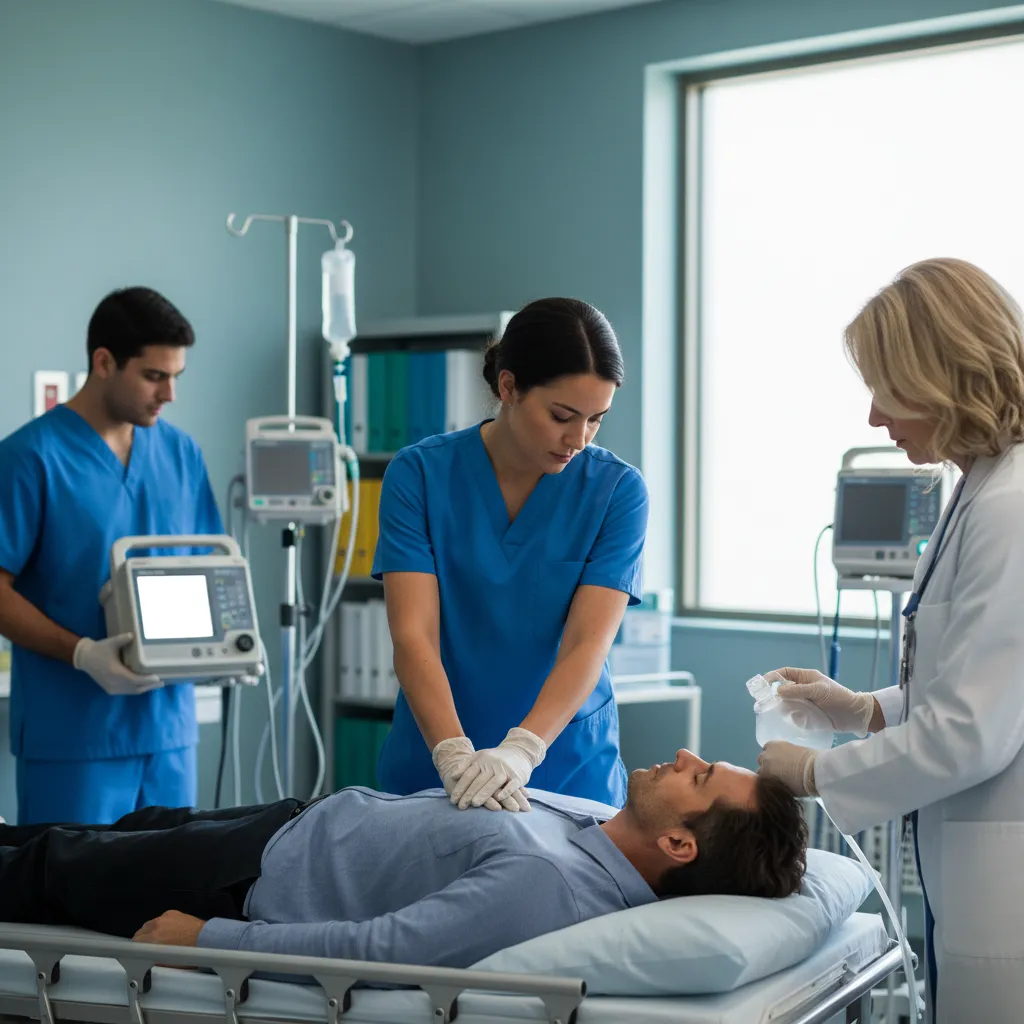
CPR - Cardiopulmonary Resuscitation: Complete Study Guide 2026
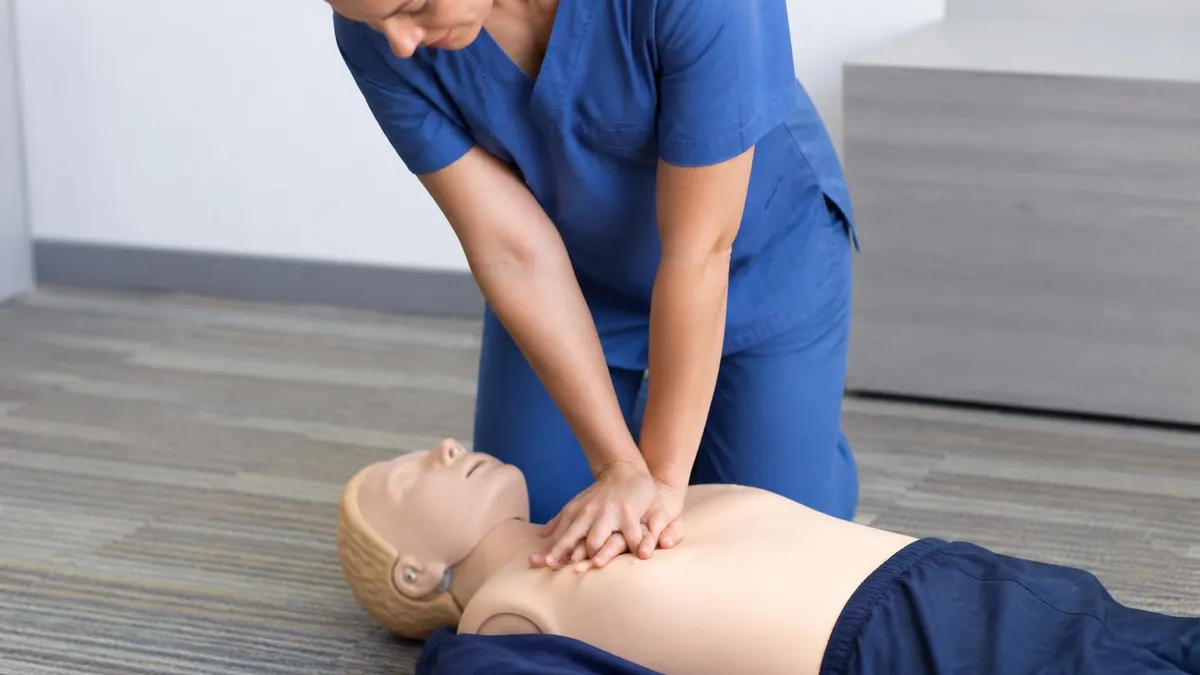
Inappropriate CPR Songs: What Not to Play, Why It Matters, and Better Beat-Per-Minute Alternatives
About the Author

Registered Nurse & Healthcare Educator
Johns Hopkins University School of NursingDr. Sarah Mitchell is a board-certified registered nurse with over 15 years of clinical and academic experience. She completed her PhD in Nursing Science at Johns Hopkins University and has taught NCLEX preparation and clinical skills courses for nursing students across the United States. Her research focuses on evidence-based exam preparation strategies for healthcare certification candidates.
Join the Discussion
Connect with other students preparing for this exam. Share tips, ask questions, and get advice from people who have been there.
View discussion (5 replies)