
CPR Cheat Sheet: Step-by-Step Quick Reference for Adult, Child, and Infant Resuscitation in 2026 September
Printable CPR cheat sheet covering adult, child, and infant compressions, 📝 AED use, ACLS algorithm steps, and recovery position for fast 2026 September review.
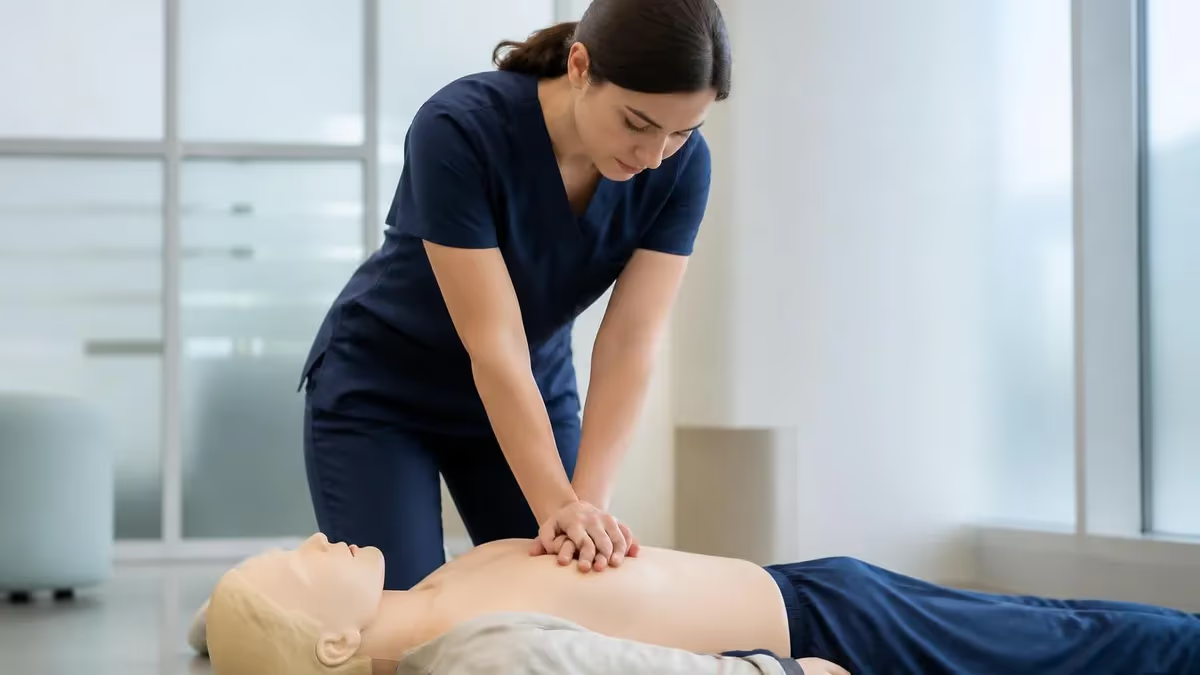
A reliable cpr cheat sheet is the single most useful study tool you can keep in your wallet, on your phone lock screen, or taped to the inside of your locker before a recertification exam. It compresses the entire chain of survival — recognition, compressions, ventilation, defibrillation, and post-arrest care — into a glance-friendly format. Whether you are a new lifeguard, a nursing student preparing for clinicals, or a parent who wants to feel ready, a strong reference card eliminates the panic of forgetting a number under pressure.
This guide doubles as that cheat sheet and as a learning resource. We will walk through the 2020 American Heart Association guidelines that remain in force for 2026, the BLS sequence for every age group, AED operation, choking response, and the basics of the acls algorithm so you understand how layperson CPR transitions into advanced cardiac life support when paramedics arrive. Every number you need — rate, depth, ratio, pause length — appears in one place.
The data behind these numbers is sobering. Roughly 350,000 out-of-hospital cardiac arrests happen in the United States each year, and survival hovers near 10 percent. When a bystander starts compressions within the first minute, survival can double or triple. That is why the national cpr foundation and the American Heart Association emphasize early, hard, and fast chest compressions over almost any other intervention. A good cheat sheet keeps those priorities front and center when adrenaline is wiping your memory clean.
We will also separate adult, child, and infant cpr because the mechanics shift in important ways. Compression depth changes from at least two inches in adults to about one and a half inches in infants. Two-rescuer ratios change from 30:2 to 15:2 in pediatrics. Hand placement, breath volume, and even the order of operations differ for unwitnessed pediatric arrest. Memorizing these distinctions is the difference between a passing score and a failing one on most BLS and pals certification practical exams.
Beyond the technical numbers, the cheat sheet must include soft skills: how to call 911 clearly, how to direct a bystander to fetch an AED, and how to coordinate compressions with breaths once a second rescuer arrives. We will cover scripts you can rehearse out loud so the words come automatically. Drilling the verbal cues matters as much as drilling the physical motions because freezing on what to say wastes the same precious seconds as forgetting where to put your hands.
Finally, expect this guide to demystify common acronyms. You will learn exactly what does aed stand for, the meaning of CAB versus the older ABC, the difference between BLS and life support at the advanced level, and how the recovery position fits into post-arrest care when a pulse returns. By the end, you should be able to teach a friend the basics in under ten minutes — the truest test of whether you have actually mastered a cheat sheet rather than just memorized it.
Pair this article with the CPR - Cardiopulmonary Resuscitation: Complete Study Guide 2026 for deeper context, and use the practice quizzes linked throughout to convert passive reading into active recall. Cheat sheets work best when they trigger memories you have already encoded — not when they try to teach you something brand new at the moment of crisis.
CPR Cheat Sheet by the Numbers

BLS Quick Reference Card: The Five Core Numbers
Push at 100 to 120 compressions per minute for every age group. The classic Bee Gees song Stayin' Alive runs at 103 beats per minute and makes an excellent mental metronome during a real arrest.
Adults need at least two inches but no more than 2.4 inches. Children need about two inches or one third the chest depth. Infants need 1.5 inches or one third of the chest.
Adults use two hands on the lower half of the sternum. Children use one or two hands depending on size. Infants use two fingers (single rescuer) or two thumbs encircling (two rescuer).
Single rescuer uses 30:2 for every age. Two rescuers stay at 30:2 for adults but shift to 15:2 for children and infants. Switch compressors every two minutes to prevent fatigue.
Each rescue breath lasts about one second and should produce visible chest rise. Avoid over-ventilation, which raises intrathoracic pressure and reduces venous return to the heart.
Adult CPR begins the moment you confirm an unresponsive person is not breathing normally. Agonal gasps — short, irregular, snorting breaths — do not count as breathing and should trigger immediate compressions. Tap the shoulder, shout, scan the chest for ten seconds, and if nothing looks right, commit to the sequence. Hesitation is the most common reason laypersons fail to act, and a cheat sheet that opens with permission to start fast saves more lives than one packed with technical detail.
Call 911 or direct a specific bystander to call by pointing and naming them. Vague instructions like "someone call 911" produce the bystander effect, where everyone assumes someone else is acting. Say, "You in the red jacket, call 911 and put it on speaker. You in the blue shirt, find an AED." Then drop to your knees beside the victim's chest and begin compressions without waiting for the dispatcher to finish their script.
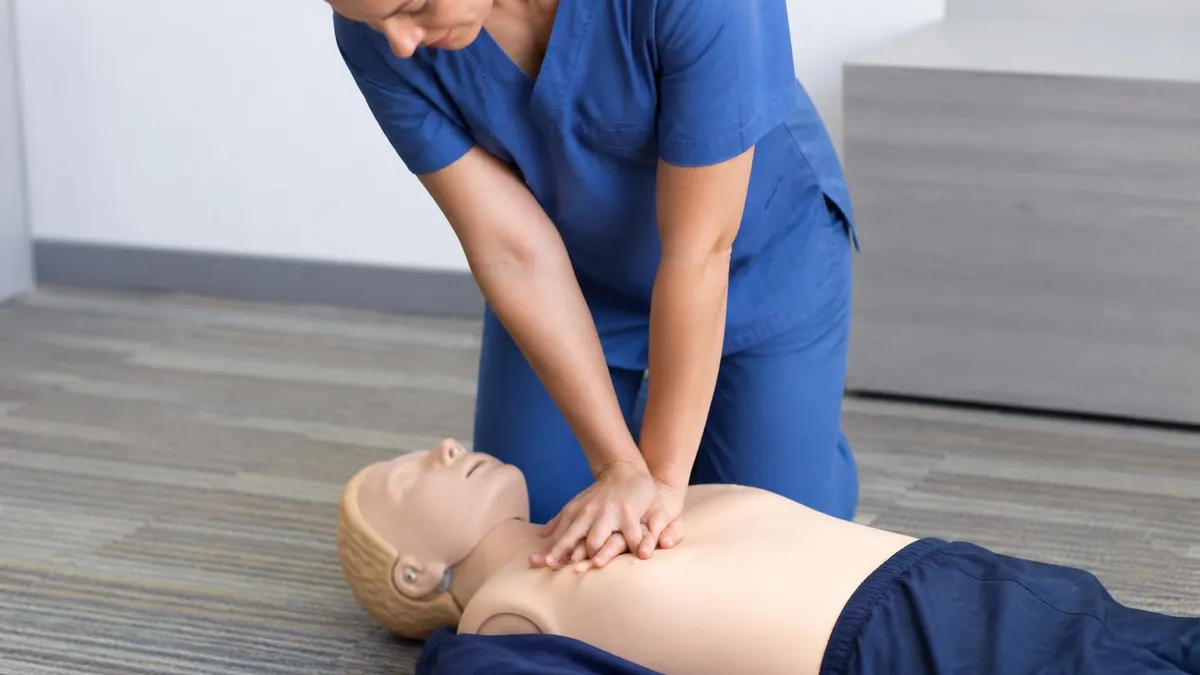
Place the heel of your dominant hand on the lower half of the sternum, between the nipples. Stack the other hand on top and interlace your fingers, lifting them off the chest. Lock your elbows, position your shoulders directly above your hands, and use your body weight rather than your arms. Push hard — at least two inches — and push fast at 100 to 120 per minute. Let the chest recoil fully between compressions; leaning prevents the heart from refilling.
After 30 compressions, deliver two rescue breaths if you are trained and willing. Tilt the head back, lift the chin, pinch the nose shut, and seal your mouth over the victim's. Blow for one second, watch for chest rise, and deliver the second breath. If you are not trained or are uncomfortable with mouth-to-mouth, perform hands-only CPR — continuous compressions with no breaths. Hands-only is nearly as effective for the first several minutes of adult cardiac arrest.
Continue cycles of 30:2 until an AED arrives, professional rescuers take over, the victim moves or breathes normally, or you are physically unable to continue. Switch compressors every two minutes to keep quality high; fatigue degrades depth and rate faster than most people realize. A rotating two-rescuer team can sustain effective CPR almost indefinitely, while a solo rescuer often loses meaningful depth within four to five minutes.
Once an AED arrives, power it on and follow the voice prompts exactly. The pads tell you where to place them with a picture, and the device analyzes the rhythm automatically. If a shock is advised, ensure no one is touching the patient, deliver the shock, and resume compressions immediately. Do not pause to check a pulse between shocks; the AED will prompt another rhythm check after two minutes of CPR. This minimal-pause strategy is the cornerstone of modern resuscitation.
For a deeper walkthrough of the adult sequence, including hand position photos and rescue breath troubleshooting, see Adult CPR: Complete Step-by-Step Guide to Hands-Only and Standard CPR in 2026. The article also covers special situations like pregnancy, obesity, and drowning where the standard cheat sheet needs minor adjustments to remain effective.

CPR Practice Test Questions
Prepare for the CPR Cardiopulmonary Resuscitation Practice exam with our free practice test modules. Each quiz covers key topics to help you pass on your first try.
CPR Basic CPR
CPR Exam Questions covering Basic CPR. Master CPR Test concepts for certification prep.
CPR and First Aid
Free CPR Practice Test featuring and First Aid. Improve your CPR Exam score with mock test prep.
CPR (Cardiopulmonary Resuscitation) Adult ...
CPR Mock Exam on (Cardiopulmonary Resuscitation) Adult CPR and AED Usage. CPR Study Guide questions to pass on your first try.
CPR (Cardiopulmonary Resuscitation) Airway...
CPR Test Prep for (Cardiopulmonary Resuscitation) Airway Obstruction and Choking. Practice CPR Quiz questions and boost your score.
CPR (Cardiopulmonary Resuscitation) Cardio...
CPR Questions and Answers on (Cardiopulmonary Resuscitation) Cardiopulmonary Emergency Recognition. Free CPR practice for exam readiness.
CPR (Cardiopulmonary Resuscitation) Child ...
CPR Mock Test covering (Cardiopulmonary Resuscitation) Child and Infant CPR. Online CPR Test practice with instant feedback.
CPR (Cardiopulmonary Resuscitation) High-P...
Free CPR Quiz on (Cardiopulmonary Resuscitation) High-Performance Team Dynamics. CPR Exam prep questions with detailed explanations.
CPR (Cardiopulmonary Resuscitation) Legal ...
CPR Practice Questions for (Cardiopulmonary Resuscitation) Legal and Ethical Considerations. Build confidence for your CPR certification exam.
CPR for Specific Populations
CPR Test Online for for Specific Populations. Free practice with instant results and feedback.
CPR Airway & Breathing Management
CPR Exam Questions covering Airway & Breathing Management. Master CPR Test concepts for certification prep.
CPR Assessment & Recognition of Cardiac Ar...
Free CPR Practice Test featuring Assessment & Recognition of Cardiac Arrest. Improve your CPR Exam score with mock test prep.
CPR Chest Compressions & Defibrillation
CPR Mock Exam on Chest Compressions & Defibrillation. CPR Study Guide questions to pass on your first try.
CPR Post-Resuscitation Care & Recovery
CPR Test Prep for Post-Resuscitation Care & Recovery. Practice CPR Quiz questions and boost your score.
Infant CPR, Child CPR, and Pediatric Respiratory Rate
Infant cpr uses two fingers placed just below the nipple line for single-rescuer compressions, or the two-thumb encircling technique when a second rescuer is present. Push to a depth of about one and a half inches — roughly one third of the chest depth — at 100 to 120 per minute. The compression-to-breath ratio is 30:2 for single rescuer and 15:2 for two rescuers, reflecting how quickly infant arrests respond to ventilation.
Because most pediatric arrests are respiratory in origin rather than cardiac, an unwitnessed infant collapse calls for two minutes of CPR before leaving to call 911 if you are alone. Cover the infant's mouth and nose with your mouth for rescue breaths, and deliver only small puffs — just enough for visible chest rise. Over-inflation can damage tiny lungs and force air into the stomach, increasing the risk of vomiting and aspiration.
Using a Physical Cheat Sheet vs. Memorizing Everything
- +Eliminates panic recall failure when adrenaline spikes during a real arrest
- +Provides instant confirmation of pediatric depth, rate, and ratio differences
- +Works as a quick study tool for BLS recertification every two years
- +Can be laminated and clipped to a badge, locker, or first aid kit
- +Helps coach untrained bystanders verbally during a real emergency
- +Reinforces visual memory through repeated exposure to numbers and steps
- −Can become a crutch that prevents true mastery of the sequence
- −Outdated cheat sheets may reflect old ABC order or 15:2 adult ratios
- −Reading mid-arrest wastes seconds that should go to compressions
- −Some workplaces prohibit personal reference cards during competencies
- −Generic online cheat sheets sometimes mix AHA and ERC guidelines
- −Cannot substitute for hands-on manikin practice and timing drills

AED Operation Cheat Sheet: 10 Critical Steps
- ✓Confirm the scene is dry and safe before turning on the AED
- ✓Power on the device and follow voice prompts without skipping ahead
- ✓Expose the chest completely; cut clothing if necessary with the kit shears
- ✓Wipe the chest dry and shave excessive hair only if it prevents pad contact
- ✓Place one pad on the upper right chest below the collarbone
- ✓Place the second pad on the lower left side below the armpit
- ✓Plug in the pad connector if not already attached at the factory
- ✓Clear all rescuers and announce "I'm clear, you're clear, everyone clear" before analysis
- ✓Deliver the shock by pressing the flashing button when prompted
- ✓Resume compressions immediately after the shock without checking pulse
Automated External Defibrillator
AED stands for Automated External Defibrillator — a portable device that analyzes heart rhythm and delivers an electrical shock to restart a normal heartbeat in cases of ventricular fibrillation or pulseless ventricular tachycardia. Every minute without defibrillation drops survival by roughly 10 percent, which is why public-access AEDs in airports, gyms, and schools have transformed sudden cardiac arrest outcomes since the early 2000s.
Choking response sits next to CPR on every reputable cheat sheet because the two skills often run back to back. A conscious choking victim with a severe airway obstruction cannot cough, speak, or breathe, and may clutch the throat in the universal sign. Ask, "Are you choking?" and if they nod or cannot answer, get permission with "I'm trained, can I help?" before stepping behind them and beginning abdominal thrusts. Speed matters — most obstructions clear within five thrusts when delivered with proper technique.
For abdominal thrusts on an adult or child older than one year, make a fist with your thumb tucked in and place it just above the navel, well below the xiphoid process. Grab the fist with your other hand and deliver quick inward and upward thrusts. Repeat until the object dislodges or the victim becomes unresponsive. If they collapse, lower them gently, call 911, and begin CPR — but each time you open the airway to deliver breaths, look inside the mouth and remove visible objects with a finger sweep.
Infants under one year cannot tolerate abdominal thrusts because the liver and spleen sit high in the abdomen and are vulnerable to injury. Instead, support the infant face down along your forearm with the head lower than the chest, and deliver five firm back blows between the shoulder blades with the heel of your hand. Then flip the infant face up and deliver five chest thrusts using two fingers on the lower sternum. Alternate back blows and chest thrusts until the obstruction clears.
Once a pulse and breathing return after any arrest or near-arrest, the recovery position protects the airway from vomit, blood, and tongue obstruction while you wait for EMS. Roll the patient onto their side with the lower arm extended forward, the upper arm bent under the head as a pillow, and the upper leg bent at the knee to prevent rolling. The position recovery sequence keeps the mouth angled downward so fluids drain rather than pool in the throat.
Do not use the recovery position on anyone with suspected spinal injury unless their airway is actively threatened. If you must move them, use a log-roll technique that keeps the head, neck, and spine aligned, and ideally use a second rescuer to support the head. Reassess breathing every two minutes — if it stops, roll the patient onto their back and resume CPR immediately. Time spent in the recovery position should never delay restarting compressions when needed.
Document everything you remember once EMS takes over. Witness accounts of timing — when the patient collapsed, when CPR started, how many shocks were delivered, and any medications administered — feed directly into the hospital's post-arrest care plan. If you have access to an AED with rhythm recording, hand the device or its data card to the paramedics. This continuity of information is part of what separates trained life support from improvised rescue.
A related practical note: avoid playing music during a real arrest even if a track at 100 to 120 BPM matches the target tempo. See Inappropriate CPR Songs: What Not to Play, Why It Matters, and Better Beat-Per-Minute Alternatives for the etiquette and clinical reasoning. Mental rhythm cues work fine without amplifying audio that distresses bystanders and family members at the scene.
Search results for cpr phone repair and cpr cell phone repair refer to the retail chain of mobile device repair stores — not cardiopulmonary resuscitation. If you are studying for a BLS or ACLS recertification, double-check that your bookmarked references and cheat sheets come from medical sources like the American Heart Association, the Red Cross, or the national cpr foundation rather than electronics repair pages with similar acronyms.
The acls algorithm extends BLS into the realm of advanced cardiac life support, which is what paramedics, nurses, and physicians use once they arrive on scene with monitors, medications, and advanced airway equipment. The cheat sheet version of ACLS centers on two parallel pathways: the shockable rhythms (ventricular fibrillation and pulseless ventricular tachycardia) and the non-shockable rhythms (asystole and pulseless electrical activity). Every two minutes, the team pauses briefly to assess the rhythm and decide which pathway applies.
For shockable rhythms, the sequence is defibrillate, resume CPR for two minutes, give epinephrine 1 mg every three to five minutes, defibrillate again, resume CPR, and consider amiodarone 300 mg or lidocaine after the third shock. The emphasis remains on minimal pauses — pre-charging the defibrillator during compressions and clearing the patient only at the moment of shock delivery keeps hands-off time under ten seconds per cycle. High-quality CPR is the foundation that all medications and shocks build upon.
For non-shockable rhythms, defibrillation is not indicated. The team gives epinephrine 1 mg every three to five minutes, continues high-quality CPR, and searches aggressively for reversible causes — the famous H's and T's. Hypoxia, hypovolemia, hydrogen ion (acidosis), hypo/hyperkalemia, and hypothermia represent the H's. Tension pneumothorax, tamponade, toxins, thrombosis (pulmonary), and thrombosis (coronary) represent the T's. Treating the underlying cause is often the only path to return of spontaneous circulation.
Airway management during ACLS escalates from bag-valve-mask ventilation to supraglottic devices like the i-gel or King LT, and finally to endotracheal intubation when indicated. Once an advanced airway is in place, the compression-to-breath ratio dissolves: compressions become continuous at 100 to 120 per minute, and breaths are delivered at one every six seconds (10 per minute). End-tidal CO2 monitoring confirms tube placement and gives real-time feedback on compression quality and return of circulation.
Vascular access for ACLS medications should be peripheral IV first, with intraosseous access as a rapid backup when IVs fail. Central lines are rarely placed during active arrest because they take too long and pause compressions. Once medications are flowing, the team leader calls out the time remaining in each two-minute cycle, the next planned action, and the differential diagnosis for reversible causes. This closed-loop communication prevents the chaos that derails most resuscitations.
Post-arrest care begins the moment a pulse returns. The cheat sheet priorities are targeted temperature management between 32 and 36 degrees Celsius for at least 24 hours, blood pressure support to maintain mean arterial pressure above 65, glucose control, and urgent cardiac catheterization if a STEMI is identified on the 12-lead ECG. Neurologic prognostication waits at least 72 hours, and family communication should emphasize uncertainty rather than premature optimism or pessimism.
To connect ACLS back to the lay-rescuer cheat sheet, remember that every advanced intervention rests on the bystander's first two minutes of compressions. Without that bridge, the algorithm has nothing to build on. Whether you are pursuing pals certification, ACLS provider status, or just personal preparedness, the simple cheat sheet numbers — push hard, push fast, allow recoil, minimize pauses — are the same numbers that drive outcomes when the full life support team arrives.
Printing and using your cheat sheet effectively comes down to a few practical habits. Laminate the card or slide it into a clear sleeve so sweat, blood, and water do not destroy it during a real event. Keep one copy in your work bag, one in your vehicle's glove box, and one inside any home first aid kit. Replace the card every two years when guidelines refresh, and write the date of the last update directly on the card so you never accidentally rely on an obsolete version.
Rehearse out loud, not just in your head. Stand in your kitchen, look at an imaginary victim on the floor, and say the script: "Are you okay? Hey, can you hear me? You in the blue shirt, call 911 and put it on speaker. You in the red jacket, find an AED." Then drop to your knees and count compressions aloud — "one and two and three" — to 30. This kind of physical rehearsal builds muscle memory and verbal fluency in ways that silent reading cannot match.
Drill with a partner whenever possible. Take turns being the victim, the lead rescuer, and the bystander. Practice the two-minute compressor swap by tapping the active rescuer's shoulder, taking over without losing more than five seconds, and continuing the rhythm. Trade roles every cycle until both of you can switch smoothly under fatigue. Real-world arrests almost always involve handoffs, so the swap should feel as natural as the compressions themselves.
Test your knowledge regularly with short quizzes rather than long study marathons. Spaced repetition — five minutes a day for two weeks before recertification — beats one three-hour cram session by a wide margin. Use the quiz tiles throughout this article to drill specific weak spots: choking, AED operation, pediatric ratios, or recovery position mechanics. When you miss a question, write the correct answer on a sticky note and attach it to your cheat sheet for a week of forced re-exposure.
Stay current with guideline updates by subscribing to the American Heart Association and Red Cross newsletters. Major guideline revisions happen every five years, but interim updates and focused recommendations appear more often. The 2020 guidelines remain the operational standard for 2026, with the next major refresh expected later in the decade. A cheat sheet that reflects the most recent evidence is one of the cheapest forms of continuing education available.
If you certify through an employer, ask about the renewal interval — most BLS, ACLS, and PALS cards expire after two years. Plan recertification at least 90 days before expiration to avoid a lapse that could affect credentialing or employment. Keep digital and physical copies of your certification card. For lost cards, see CPR Card Lookup: How to Verify, Replace, and Access Your CPR Certification in 2026 to navigate replacement through AHA, Red Cross, and other major providers.
Finally, remember that the goal of a cheat sheet is not to make you a perfect rescuer — it is to remove the friction that stops good rescuers from acting. Imperfect CPR delivered confidently saves more lives than perfect CPR delivered too late. If you remember nothing else, remember to push hard, push fast in the center of the chest at the tempo of Stayin' Alive, and let the AED do its job. Everything else on the cheat sheet is refinement around that single, life-saving habit.
CPR Questions and Answers
CPR Card Lookup: How to Verify, Replace, and Access Your CPR Certification in 2026
AHA CPR: What It Is, Which Course You Need, and How to Get Certified
Adult CPR: Complete Step-by-Step Guide to Hands-Only and Standard CPR in 2026

CPR - Cardiopulmonary Resuscitation: Complete Study Guide 2026
Inappropriate CPR Songs: What Not to Play, Why It Matters, and Better Beat-Per-Minute Alternatives
About the Author

Registered Nurse & Healthcare Educator
Johns Hopkins University School of NursingDr. Sarah Mitchell is a board-certified registered nurse with over 15 years of clinical and academic experience. She completed her PhD in Nursing Science at Johns Hopkins University and has taught NCLEX preparation and clinical skills courses for nursing students across the United States. Her research focuses on evidence-based exam preparation strategies for healthcare certification candidates.
Join the Discussion
Connect with other students preparing for this exam. Share tips, ask questions, and get advice from people who have been there.
View discussion (5 replies)