
Danbury CT High School Coach CPR/AED Training: Complete Guide 2026 October
Danbury CT high school coach CPR/AED training guide — ACLS algorithm basics, AED use, infant CPR, certification steps and practice questions for 2026 October. 📚
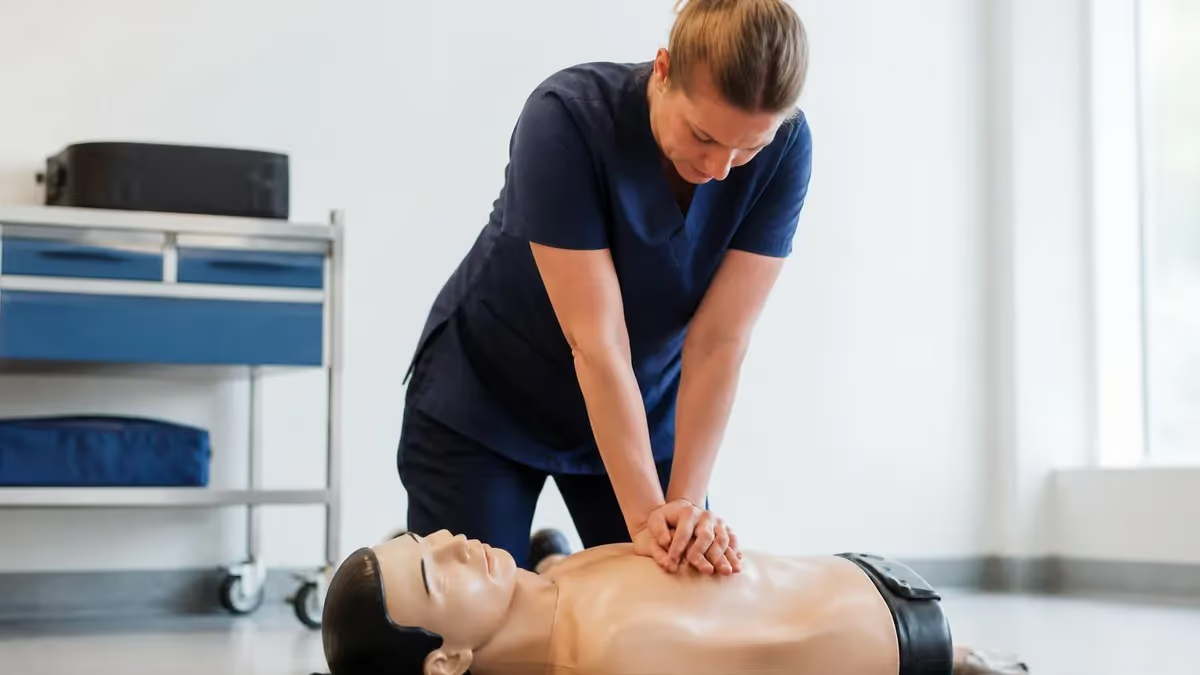
Danbury CT high school coach CPR/AED training is now a non-negotiable part of athletic coaching across Connecticut, and the curriculum has expanded dramatically since the state tightened its sudden cardiac arrest mandates. Every varsity, JV, and freshman coach in the Danbury Public Schools athletic department must hold current CPR/AED certification before stepping on a field, court, or pool deck. The training pulls together the basic acls algorithm framework, hands-on AED practice, and scenario-based drills that mirror real sideline emergencies coaches may face during fall, winter, or spring seasons.
The course is built around a simple truth: when an athlete collapses, the first three minutes decide everything. Coaches are almost always the first responders, arriving before athletic trainers, school nurses, or EMS. That window is when chest compressions and a shock from an automated external defibrillator can mean the difference between a teenager walking off the field and a tragedy. Danbury High School, Henry Abbott Technical High School, and Immaculate High School all require coaches to drill these skills annually.
Training in Danbury is delivered through a mix of American Heart Association BLS Provider courses, American Red Cross CPR/AED for Professional Rescuers, and approved national cpr foundation programs. Each option meets Connecticut Department of Education standards under Public Act 14-93 and 17-173, which require coaches of competitive sports to complete cardiopulmonary resuscitation and AED training before being assigned to teach, supervise, or coach. Understanding the difference between heart attack vs cardiac arrest is one of the first concepts instructors teach.
Beyond the legal mandate, Danbury coaches see CPR/AED training as part of their professional identity. The Connecticut Interscholastic Athletic Conference (CIAC) bylaws and the National Federation of State High School Associations (NFHS) coach education modules reinforce that emergency action plans must be reviewed, signed, and practiced before the first practice of every season. Schools that fail to document training risk losing eligibility, insurance coverage, and parental trust.
This guide walks through every layer of the Danbury coach CPR/AED training requirement — what the law says, how to register, what the course actually covers, what the AED looks like when you open it, and how to keep your certification current. It also includes practice scenarios drawn from real Connecticut high school cases, free quiz links, and downloadable checklists you can hand to your athletic director.
Whether you are a first-year volunteer wrestling coach or a 30-year football veteran renewing for the tenth time, the content is structured so you can skip to the section you need. Coaches who train siblings, run summer camps, or supervise youth leagues will also find the infant cpr and child rescue breathing sections useful, since the AHA and Red Cross curricula now bundle pediatric content into the standard BLS course.
By the end of this article, you will know exactly what to expect on training day, how to pass the skills test on the first attempt, and how to lead your team through a cardiac emergency with confidence. The stakes are real, the science is settled, and the training is straightforward — once you understand the system.
Danbury Coach CPR/AED Training by the Numbers
Connecticut Coach Training Requirements
Every coach of an intramural or interscholastic athletic activity must complete a course in cardiopulmonary resuscitation and the use of an automated external defibrillator before the first day of practice each season.
Public Act 14-93 also requires coaches to complete an annual sudden cardiac arrest awareness program. The module covers warning signs like fainting during exercise, family history, and chest pain in young athletes.
Most Danbury schools combine CPR/AED training with concussion management and heat illness modules in one annual coach clearance packet submitted to the athletic director before the season starts.
CIAC and Danbury Public Schools require each venue to have a written emergency action plan that coaches rehearse with athletic trainers at least once per season, including AED location and 911 access points.
Coaches must submit a copy of their CPR/AED card to the athletic department. Cards expire every two years and renewal courses must be completed before the expiration date to avoid coaching restrictions.
When a coach in Danbury opens an automated external defibrillator on the sideline, the device walks them through the entire rescue with voice prompts. Modern AEDs from manufacturers like Philips HeartStart, ZOLL AED Plus, and Cardiac Science Powerheart are deployed across Danbury High School, Rogers Park Middle School athletic fields, and the WestConn turf complex. Each unit costs the district roughly $1,200 to $2,400, and Connecticut law requires public schools to maintain at least one accessible AED on every campus that hosts interscholastic athletics.
The first question every new trainee asks is what does aed stand for. AED stands for Automated External Defibrillator — a portable device that analyzes a person's heart rhythm and delivers an electrical shock when it detects ventricular fibrillation or pulseless ventricular tachycardia. The device will not shock a person whose heart is beating normally, which is why coaches are taught to apply it on any unresponsive collapse without hesitation. The machine makes the diagnosis; the rescuer does not.
Pad placement is drilled until it becomes muscle memory. One pad goes on the upper right chest below the collarbone, the other on the lower left side below the armpit. For children under eight or weighing less than 55 pounds, pediatric pads are used or the pads are placed front-and-back on the torso. Coaches practicing baby cpr learn that infant chest compressions use two fingers at 1.5 inches deep, while AED use on infants follows the same pediatric pad protocol when pediatric pads are available.
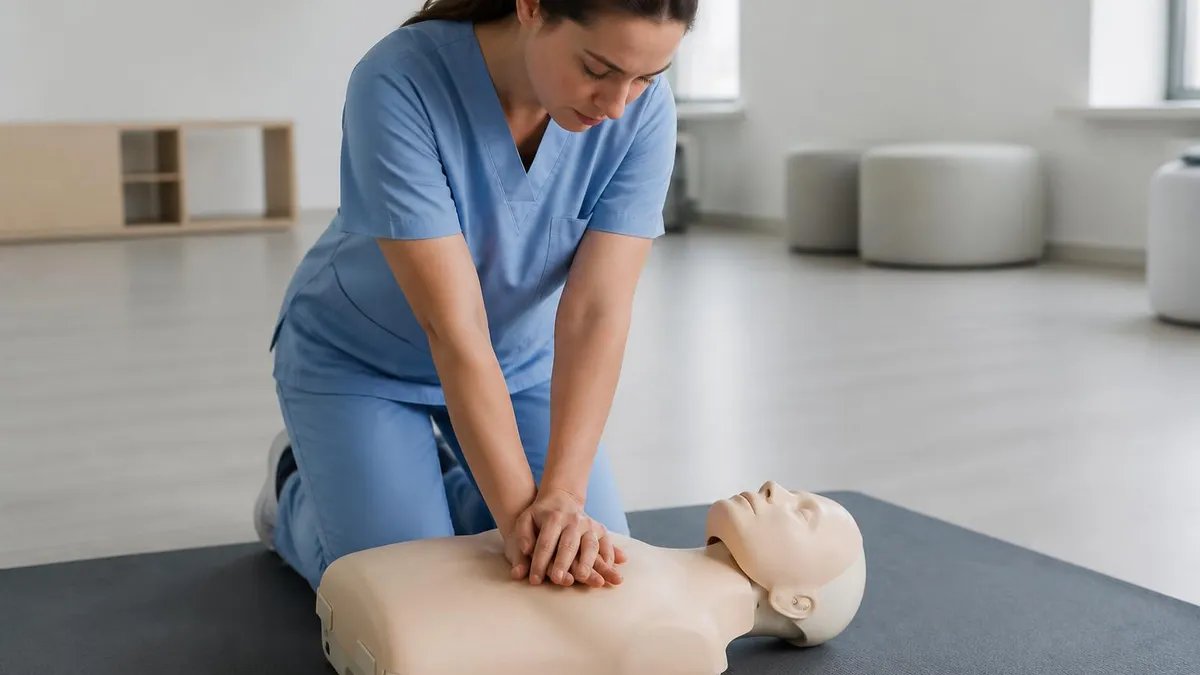
Compressions continue until the AED says "analyzing — do not touch the patient." That phrase is the cue to step back and let the device read the rhythm. If a shock is advised, the AED charges, prompts the rescuer to ensure no one is touching the victim, and delivers the shock when the button is pressed. Compressions resume immediately afterward at 100 to 120 per minute, two inches deep, allowing full chest recoil between each push.
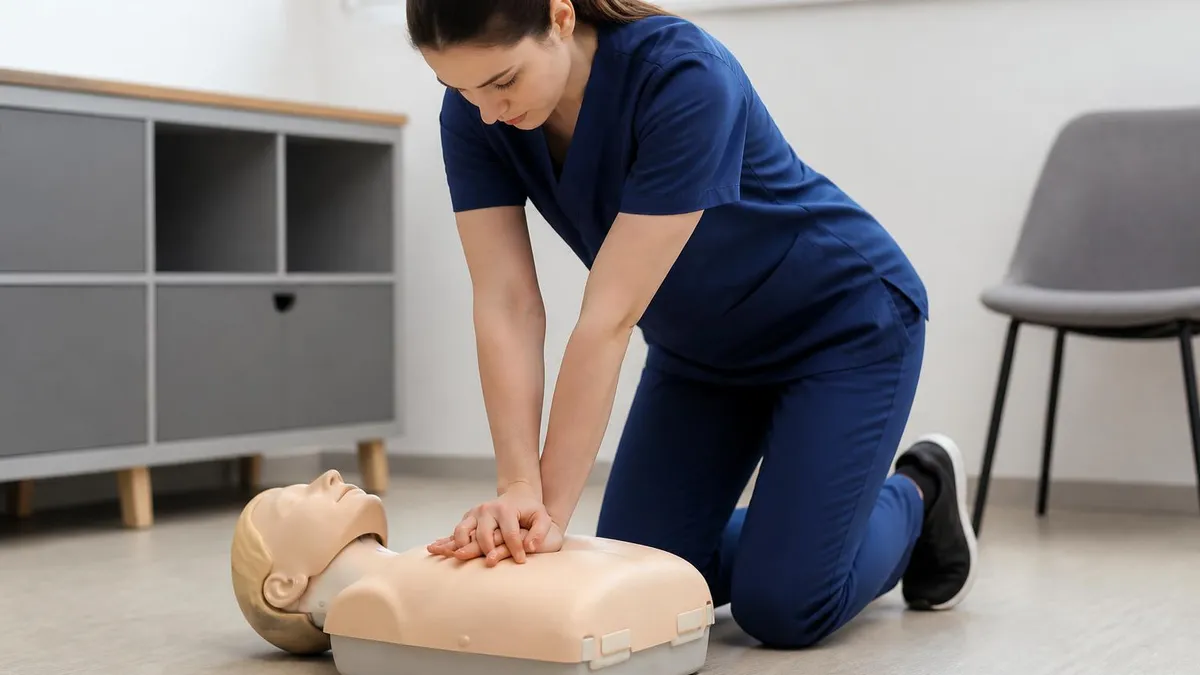
Coaches learn that the AED never replaces CPR — it complements it. High-quality chest compressions keep blood flowing to the brain and coronary arteries during the seconds the AED takes to analyze. The 2025 American Heart Association guidelines emphasize minimizing pauses, and Danbury instructors time their students on a CPR mannequin with a feedback device that displays depth, rate, and recoil in real time.
Common mistakes include forgetting to dry the chest before applying pads, leaving a medication patch under a pad, or failing to remove a sports bra wire that interferes with the shock. Instructors at Danbury Hospital's training center cover each of these scenarios with athletic-specific props — football pads, wrestling singlets, and turf footwear — because the real-world environment for a coach is never a clean classroom.
Finally, coaches are taught to assign roles in advance. The standard sideline drill uses three people: one starts compressions, one retrieves the AED, and one calls 911 while flagging EMS toward the gate. Practicing this choreography during preseason builds confidence so that when the real moment arrives, no one freezes, no one duplicates a task, and no second is wasted.

CPR Practice Test Questions
Prepare for the CPR Cardiopulmonary Resuscitation Practice exam with our free practice test modules. Each quiz covers key topics to help you pass on your first try.
CPR Basic CPR
CPR Exam Questions covering Basic CPR. Master CPR Test concepts for certification prep.
CPR and First Aid
Free CPR Practice Test featuring and First Aid. Improve your CPR Exam score with mock test prep.
CPR (Cardiopulmonary Resuscitation) Adult ...
CPR Mock Exam on (Cardiopulmonary Resuscitation) Adult CPR and AED Usage. CPR Study Guide questions to pass on your first try.
CPR (Cardiopulmonary Resuscitation) Airway...
CPR Test Prep for (Cardiopulmonary Resuscitation) Airway Obstruction and Choking. Practice CPR Quiz questions and boost your score.
CPR (Cardiopulmonary Resuscitation) Cardio...
CPR Questions and Answers on (Cardiopulmonary Resuscitation) Cardiopulmonary Emergency Recognition. Free CPR practice for exam readiness.
CPR (Cardiopulmonary Resuscitation) Child ...
CPR Mock Test covering (Cardiopulmonary Resuscitation) Child and Infant CPR. Online CPR Test practice with instant feedback.
CPR (Cardiopulmonary Resuscitation) High-P...
Free CPR Quiz on (Cardiopulmonary Resuscitation) High-Performance Team Dynamics. CPR Exam prep questions with detailed explanations.
CPR (Cardiopulmonary Resuscitation) Legal ...
CPR Practice Questions for (Cardiopulmonary Resuscitation) Legal and Ethical Considerations. Build confidence for your CPR certification exam.
CPR for Specific Populations
CPR Test Online for for Specific Populations. Free practice with instant results and feedback.
CPR Airway & Breathing Management
CPR Exam Questions covering Airway & Breathing Management. Master CPR Test concepts for certification prep.
CPR Assessment & Recognition of Cardiac Ar...
Free CPR Practice Test featuring Assessment & Recognition of Cardiac Arrest. Improve your CPR Exam score with mock test prep.
CPR Chest Compressions & Defibrillation
CPR Mock Exam on Chest Compressions & Defibrillation. CPR Study Guide questions to pass on your first try.
CPR Post-Resuscitation Care & Recovery
CPR Test Prep for Post-Resuscitation Care & Recovery. Practice CPR Quiz questions and boost your score.
ACLS Algorithm vs BLS for Coaches
Basic Life Support is the level every Danbury coach must reach. BLS focuses on high-quality chest compressions, rescue breaths, AED use, and recognizing cardiac arrest in adults, children, and infants. The course covers the chain of survival, foreign-body airway obstruction, and team-based resuscitation for two-rescuer scenarios on a field or pool deck.
BLS providers do not push medications or interpret cardiac rhythms beyond what the AED announces. The curriculum is taught by certified instructors using AHA or Red Cross materials and ends with a written test plus a hands-on skills check. Danbury coaches typically complete BLS in a single 4.5-hour session including check-in, testing, and card issuance.
Is In-Person or Online CPR/AED Training Better for Coaches?
- +Hands-on mannequin practice catches compression depth errors instantly
- +Instructors give real-time feedback on pad placement and ventilation rate
- +Group drills mirror sideline team dynamics with assigned roles
- +Certification is universally accepted by Danbury Public Schools and CIAC
- +Skills retention is measurably higher with in-person practice
- +Networking with athletic trainers and other coaches strengthens emergency action plans
- +Skills check is completed same-day with card issued on the spot
- −Costs more than blended-learning online options
- −Requires 4-5 hours of in-person time on a Saturday or weekday evening
- −Class sizes can fill quickly before fall and spring sports start
- −Travel to Danbury Hospital or AHA training center is required
- −Less schedule flexibility than self-paced online modules
- −Childcare during weekend classes is a barrier for some coaching parents
Pros and Cons at a Glance
| Pros | Cons |
|---|---|
| Hands-on mannequin practice catches compression depth errors instantly | Costs more than blended-learning online options |
| Instructors give real-time feedback on pad placement and ventilation rate | Class sizes can fill quickly before fall and spring sports start |
| Group drills mirror sideline team dynamics with assigned roles | Travel to Danbury Hospital or AHA training center is required |
| Certification is universally accepted by Danbury Public Schools and CIAC | Less schedule flexibility than self-paced online modules |
| Skills retention is measurably higher with in-person practice | Childcare during weekend classes is a barrier for some coaching parents |

Danbury Coach CPR/AED Certification Checklist
- ✓Confirm with your athletic director which provider (AHA, Red Cross, or national cpr foundation approved) the district accepts
- ✓Register for an in-person BLS Provider course at least 30 days before the first practice
- ✓Complete any pre-course online module and print the certificate of completion
- ✓Bring a photo ID and the pre-course confirmation email to class
- ✓Wear loose athletic clothing — you will be kneeling on the floor for skills practice
- ✓Practice 30:2 compression-to-breath ratio at home using a chair cushion before class
- ✓Review the AED pad placement diagram for adult, child, and infant patients
- ✓Pass the 25-question written test with at least 84 percent
- ✓Demonstrate the skills check on adult, child, and infant mannequins
- ✓Submit your two-year certification card to the athletic department within 7 days
- ✓Add the renewal date to your calendar with a 60-day advance reminder
- ✓Review your school's emergency action plan with the athletic trainer before season
Brain cells start dying within 4 minutes of cardiac arrest
Danbury EMS averages a 6-8 minute response time to athletic facilities. That gap is exactly why your CPR/AED training matters. Begin compressions within 10 seconds of recognizing arrest, attach the AED within 90 seconds, and deliver a shock if advised within 3 minutes — survival rates climb above 70 percent when this sequence happens reliably.
Danbury coaches have several high-quality training providers to choose from, and each meets the state's coach education standards. Danbury Hospital's Center for Education runs AHA BLS Provider classes year-round, typically priced around $75 with the certification card included. WestConn's School of Professional Studies hosts evening courses oriented to coaches and educators, and the local YMCA partners with Red Cross instructors for weekend sessions that include infant cpr drills relevant to youth coaches and parent volunteers.
The national cpr foundation offers a fully online option that some coaches use for renewal, though Danbury Public Schools currently requires the hands-on skills check for initial certification. Coaches considering the online route should confirm acceptance with their athletic director in writing before enrolling. Online-only certifications that lack a skills demonstration are not universally accepted under CIAC bylaws or Public Act 14-93 compliance documentation, so the in-person component remains the safest path.
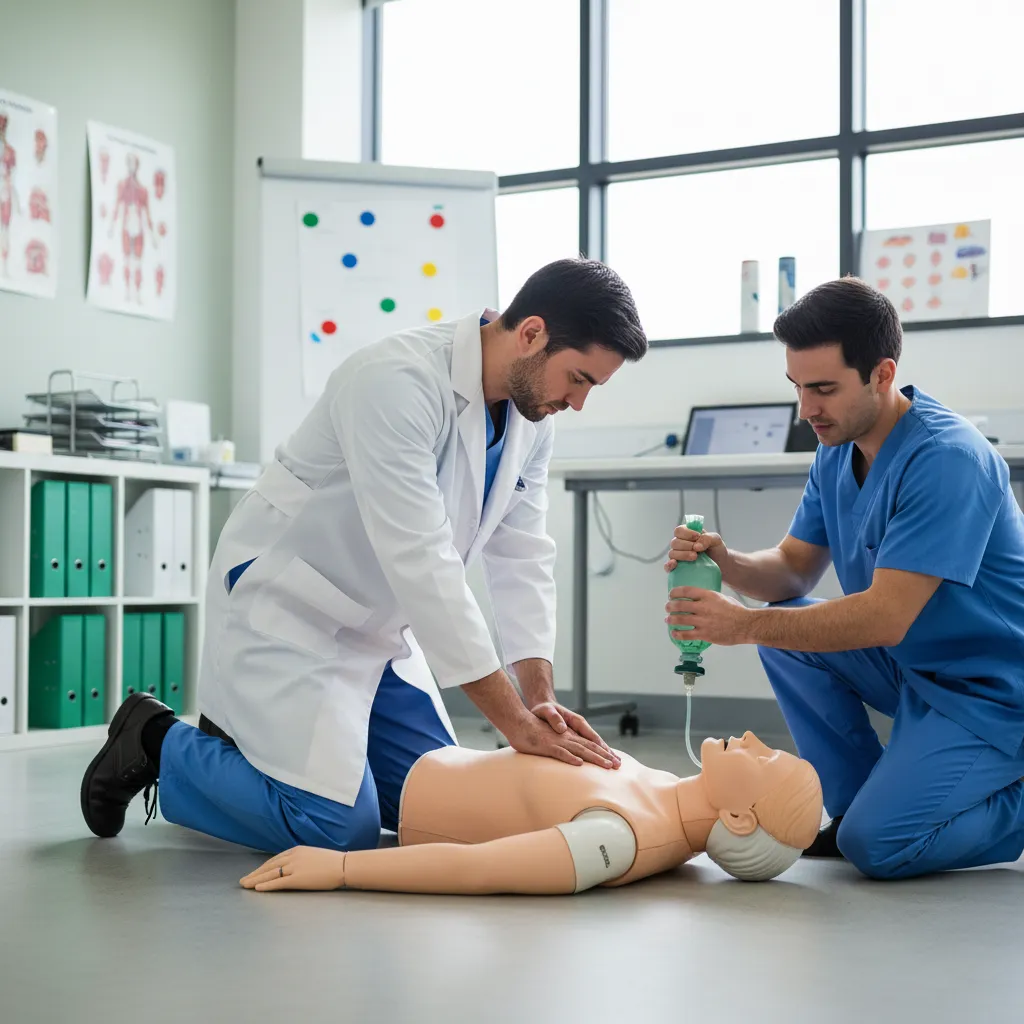
Course materials cover the full BLS scope: adult, child, and infant CPR, two-rescuer team dynamics, bag-valve-mask ventilation, AED use including special situations like wet surfaces or implanted pacemakers, and relief of foreign-body airway obstruction. Coaches also learn to recognize respiratory distress — counting respiratory rate, watching for retractions, listening for wheeze or stridor — which often precedes cardiac arrest in younger athletes, especially those with asthma or allergic anaphylaxis triggered by bee stings on outdoor fields.
The position recovery technique, sometimes called the recovery position, is taught for breathing but unresponsive victims. Coaches roll the athlete onto their side with the lower arm extended, the upper hand cushioning the head, and the upper leg bent for stability. This position keeps the airway open and prevents aspiration if the athlete vomits, which is common after near-drowning incidents at swim meets or heat-related collapse during August football practice.
Heat illness is a parallel curriculum increasingly bundled with CPR/AED in Connecticut. Coaches learn to monitor wet-bulb globe temperature, mandate hydration breaks, and recognize exertional heat stroke, which can present with cardiac arrest symptoms. The Korey Stringer Institute at UConn provides Connecticut-specific guidance and has trained Danbury athletic trainers in cold-water immersion protocols — a treatment that has reduced exertional heat stroke mortality to near zero when applied within 10 minutes.
Coaches who hold credentials from other states moving into Danbury can usually transfer certification if it comes from an AHA, Red Cross, or ASHI-affiliated program. The athletic department's compliance officer verifies the card number against the issuing organization's database. Out-of-state online-only cards that lack a skills component generally require a Connecticut bridge course before the coach can be cleared.
Cost-conscious coaches should check whether their school reimburses certification fees. Many Danbury head coaches receive a small stipend or full reimbursement when they submit receipts to the athletic director. Volunteer coaches may need to pay out of pocket but can often join a school-organized group class at a discounted rate. The investment is modest compared to the lifelong skill — and the legal protection that comes with documented training under Good Samaritan statutes.
Danbury Public Schools and CIAC explicitly require valid CPR/AED certification on file before a coach steps on the field. Coaching with an expired card can void district liability coverage and expose you personally in the event of an emergency. Renew at least 30 days before expiration to avoid gaps that could sideline you mid-season.
Practice scenarios are where Danbury coaches separate textbook knowledge from real readiness. Athletic trainers run preseason drills that simulate a collapse during a football scrimmage, a swimmer pulled from the pool, a wrestler with a head injury, or a basketball player who suddenly drops at the free-throw line. Each scenario forces coaches to recognize arrest, activate the emergency action plan, retrieve the AED, and start compressions within the three-minute window. The drills are timed and reviewed on video for continuous improvement.
Renewal training every two years is shorter than the initial course — typically 2.5 to 3 hours — but Danbury instructors use the time to introduce updates from the latest American Heart Association guidelines. The 2025 guideline cycle reinforced minimal interruption to compressions, expanded the role of bystander CPR education, and clarified pediatric AED use. Coaches who treat renewal as a refresher rather than a rubber stamp consistently outperform peers in skills testing and real emergencies.
One concept Danbury instructors return to often is the difference between cardiac arrest and other emergencies. A student athlete who collapses but is still breathing normally needs the recovery position and EMS, not chest compressions. A student who collapses and is gasping or has agonal breathing is in cardiac arrest and needs immediate compressions. Coaches learn that agonal breathing — irregular, slow, gasping — is a sign of arrest, not a sign of breathing, and is one of the most commonly misread cues in real events.
Studying with peers improves retention. Some Danbury coaching staffs run monthly 15-minute "flash drills" during the season, picking a random sideline scenario and walking through the response without slowing practice. Apps with leather cpr demos and the AHA's Resuscitation Quality Improvement modules give coaches access to short video refreshers between formal renewals. Quick repetition keeps the skill sharp without requiring another full course.
Pediatric considerations matter for coaches who work summer camps, freshman teams, or youth feeder programs. Infant CPR uses two fingers in the center of the chest, child CPR uses one or two hands depending on size, and adult CPR uses both hands stacked. Compression depth scales with body size — about one-third the depth of the chest in children and infants. The 30:2 ratio holds for single-rescuer CPR across all ages, while two-rescuer pediatric CPR uses a 15:2 ratio.
Mental rehearsal is a tool elite coaches borrow from sport psychology. Walking through the emergency action plan in your head — picturing the AED location, the access gate, the parking lot where EMS will arrive — primes the brain to act without hesitation. Danbury athletic trainers encourage coaches to do a 30-second mental rehearsal at the start of every practice and game, paired with a quick check that the AED is in place and the gate is unlocked.
Finally, coaches should never carry the emotional weight of a cardiac emergency alone. Danbury Public Schools provides Employee Assistance Program counseling for staff involved in critical incidents. After any real cardiac event — successful or not — the athletic department holds a debrief with the response team, identifying what worked and what could be improved. This culture of learning, not blame, is what makes Danbury's coach training program a model for Connecticut.
Final preparation for the Danbury coach CPR/AED skills test comes down to three things: muscle memory, sequence memory, and confidence under pressure. The week before class, practice the 30:2 ratio on a firm pillow or a CPR practice mannequin if you can borrow one. Count out loud — "one and two and three" — at the speed of the Bee Gees' "Stayin' Alive" or any song at 100-120 BPM. The classic cpr songs list still works for keeping rhythm under stress.
Memorize the order: scene safety, check responsiveness, call 911 and get the AED, check breathing and pulse, start compressions if no normal breathing, attach the AED as soon as it arrives, follow the prompts. Saying it aloud three times before bed in the week leading up to the class plants the sequence so deeply that the testing pressure cannot dislodge it. Instructors care less about perfect form than about an unbroken, correct sequence.
For the written test, focus on numbers that matter: compression rate 100-120 per minute, compression depth 2 inches for adults, 1.5 inches for infants, 30:2 ratio for single rescuer, 15:2 for two-rescuer pediatric, AED pads applied without delay, shock followed immediately by two minutes of CPR before reanalyzing. These are the most-tested facts and the most clinically important.
On test day, eat a real meal beforehand, arrive 15 minutes early, and bring water. The skills check feels harder than the real thing because the instructor is watching every move. Take a breath before kneeling at the mannequin, announce the scene safety check, and begin. If you make a small mistake, instructors usually allow you to correct it mid-scenario as long as the overall sequence is sound.
After certification, post your card photo to your phone for quick access and store the original with your athletic department paperwork. Set a calendar alert 60 days before expiration. Many coaches also add the AED location and emergency action plan PDF to a dedicated folder on their phone, so the information is reachable even if Wi-Fi fails on the field. Preparation today is the gift you give to a future athlete who needs you.
Beyond the certification itself, treat every season as a chance to reinforce the skill. Practice with your assistant coaches, walk the AED route with new staff, and run an emergency action plan tabletop drill with your athletic trainer at the start of fall, winter, and spring. The drills take 20 minutes but pay back enormously when seconds count.
Confidence comes from competence, and competence comes from repetition. Danbury coaches who train with intention — not just to check a compliance box — are the ones who walk onto the field every day with the quiet certainty that if the worst happens, they will know exactly what to do. That readiness is the foundation of every successful athletic program in the city.
CPR Questions and Answers

About the Author

Registered Nurse & Healthcare Educator
Johns Hopkins University School of NursingDr. Sarah Mitchell is a board-certified registered nurse with over 15 years of clinical and academic experience. She completed her PhD in Nursing Science at Johns Hopkins University and has taught NCLEX preparation and clinical skills courses for nursing students across the United States. Her research focuses on evidence-based exam preparation strategies for healthcare certification candidates.
Join the Discussion
Connect with other students preparing for this exam. Share tips, ask questions, and get advice from people who have been there.
View discussion (5 replies)