
Cough CPR: What It Is, When It Works, and Why It's Almost Always a Myth
✅ Cough CPR explained — when forceful coughing helps, when it's dangerous, and how it fits into ACLS algorithm protocols for cardiac emergencies.
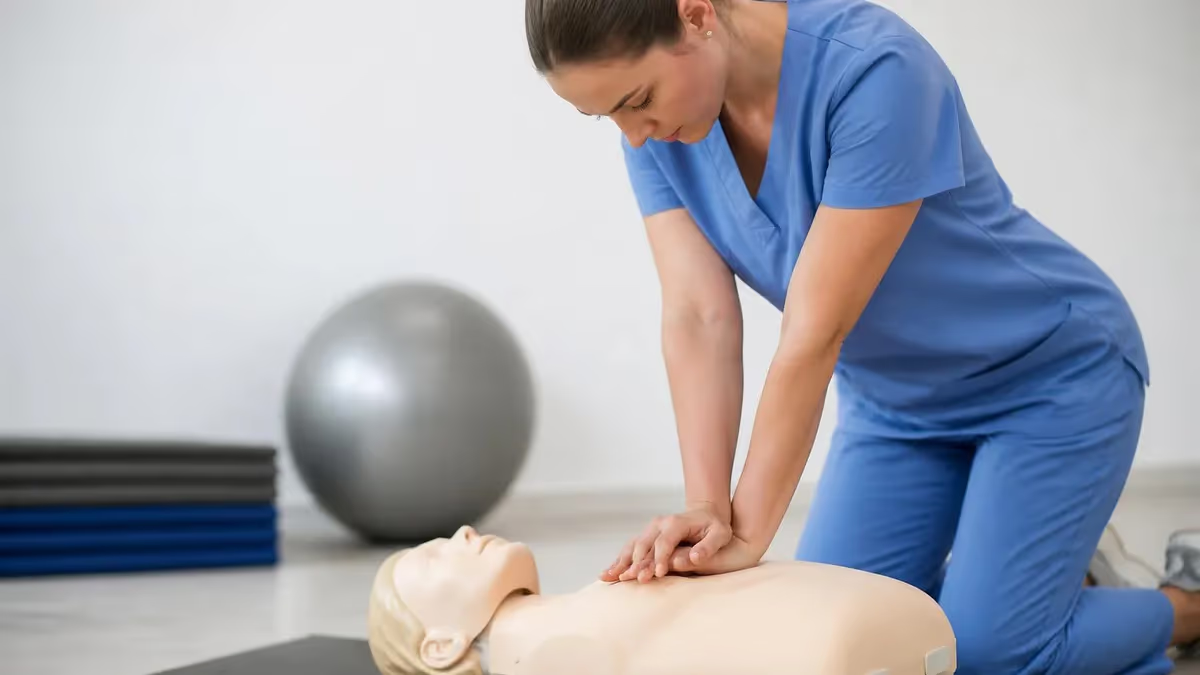
Cough CPR is one of the most persistent and misunderstood concepts in cardiac first aid, often shared in viral emails and social media posts claiming you can save your own life during a heart attack by coughing forcefully. The technique is real in a very narrow clinical context, but the public version circulating online is largely a myth that the American Heart Association and the national cpr foundation have publicly debunked for more than two decades. Understanding the difference matters.
The phrase "cough cpr" technically refers to cough-induced cardiopulmonary resuscitation, a maneuver where rhythmic, forceful coughing temporarily raises intrathoracic pressure to maintain blood flow to the brain. It was first described in cardiac catheterization labs in the 1970s, when monitored patients suddenly went into ventricular tachycardia or fibrillation. In that controlled setting, a trained cardiologist could coach a conscious patient to cough every one to two seconds, buying seconds before defibrillation.
That is the entire legitimate use case. Outside the cath lab, with no continuous EKG monitoring, no defibrillator at arm's reach, and no physician coaching the rhythm, the technique offers no proven benefit and can actually delay a 911 call. A person experiencing a real heart attack who tries to self-treat with coughing is gambling with seconds that should be spent dialing emergency services and chewing aspirin if available.
The confusion exists because viral chain emails — some still forwarded today — present cough CPR as a survival skill for anyone alone in a car or at home. These messages misrepresent the source studies and ignore the published warnings from the AHA, the Red Cross, and the acls algorithm guidelines that govern advanced cardiac life support. The result is a dangerous folk remedy dressed up in medical language.
This guide unpacks the real science behind cough CPR, the narrow circumstances where it has clinical value, why it doesn't work for heart attacks, and what you should actually do during a cardiac emergency. We'll also cover how this myth intersects with broader CPR education — including infant cpr, pals certification standards, and the role of respiratory rate monitoring in arrest recognition.
If you're studying for a BLS, ACLS, or PALS exam, this article will help you answer the inevitable test question about cough CPR correctly. If you're a layperson who saw the viral post and wondered if it's true, you'll leave with a clear, evidence-based answer. Either way, the takeaway is simple: don't substitute coughing for calling 911.
By the end of this article you'll understand exactly when cough CPR is a legitimate medical maneuver, when it's outright dangerous, and how the surrounding ecosystem of life support training — from hands-only CPR to AED use — has evolved to make real cardiac arrest survival possible outside the hospital.
Cough CPR by the Numbers

Origins and Real Clinical Use of Cough CPR
Dr. J. Michael Criley published the first case series describing cough-induced CPR in cardiac catheterization patients who developed sudden ventricular fibrillation while still conscious on the procedure table.
The technique only works when continuous EKG monitoring, IV access, a crash cart, and an emergency physician are all within arm's reach — conditions that exist almost exclusively in hospital procedure suites.
Cough CPR is never a definitive treatment. At best it buys 30 to 90 seconds of cerebral perfusion until a defibrillator can deliver a shock and restore a normal rhythm, which is what truly saves the patient.
No version of the American Heart Association BLS, ACLS, or PALS guidelines recommends teaching cough CPR to laypeople. It remains a physician-coached, in-hospital-only intervention with extremely narrow indications.
Viral emails since the late 1990s have stripped the technique from its hospital context and presented it as a self-rescue tool, which medical organizations have repeatedly and publicly refuted in patient education materials.
The single biggest misconception about cough CPR is that it can save someone from a heart attack. It cannot, and the reason is anatomical and physiological. A heart attack — clinically called a myocardial infarction — happens when a coronary artery becomes blocked and the heart muscle starts to die from lack of oxygen. The heart is usually still pumping during a heart attack. What's failing is the muscle tissue itself, and no amount of coughing can reopen a clogged artery.
Cough CPR was designed for a completely different problem: sudden cardiac arrest caused by a shockable arrhythmia such as ventricular fibrillation or pulseless ventricular tachycardia. In those rhythms the heart's electrical system has gone haywire and effective pumping has stopped entirely. The patient becomes unconscious within seconds. That's the precise moment when coughing is useless — you can't cough when you're unconscious, and an unconscious patient cannot generate the chest pressure required.
So the viral advice contains a fatal logical flaw. By the time someone is in the rhythm where cough CPR could theoretically help, they are already losing consciousness and physically incapable of performing it. And during the symptom phase of a heart attack — chest pain, jaw pain, shortness of breath, nausea — the heart is still beating, so the maneuver has no mechanism by which to help. It addresses the wrong problem.
There is also the issue of delay. Every minute that passes between cardiac arrest and defibrillation reduces survival by roughly 7 to 10 percent. If a person feels chest pain and spends two or three minutes trying to cough themselves better instead of calling 911, they have just consumed 20 to 30 percent of their survival probability. The opportunity cost is enormous and irreversible. This is why every major resuscitation council recommends against teaching the technique to the public.
Bystanders sometimes ask whether they should instruct a person having chest pain to cough. The answer is no. Tell them to sit down, loosen tight clothing, chew an adult aspirin if they're not allergic, and stay still while you call emergency services. Movement and forceful coughing both increase myocardial oxygen demand, which is exactly the opposite of what an ischemic heart needs. Calm and stillness preserve the most heart muscle.
Even in the rare scenario where someone is alone, feels palpitations, and suspects a true arrhythmia, the right response is to call 911 immediately, unlock the door so paramedics can enter, and remain conscious as long as possible. If they have a known history of arrhythmia and a cardiologist has specifically taught them a cough technique for personal use, that is between them and their physician — but it is not generalizable advice.
The bottom line is unambiguous. Cough CPR has no role in the out-of-hospital management of heart attacks or suspected cardiac arrest. It is a hospital-only, physician-supervised, briefly useful bridge in a very specific monitored setting. Treat any viral message that says otherwise as misinformation, and share that correction with the people who forwarded it to you.
CPR Practice Test Questions
Prepare for the CPR Cardiopulmonary Resuscitation Practice exam with our free practice test modules. Each quiz covers key topics to help you pass on your first try.
CPR Basic CPR
CPR Exam Questions covering Basic CPR. Master CPR Test concepts for certification prep.
CPR and First Aid
Free CPR Practice Test featuring and First Aid. Improve your CPR Exam score with mock test prep.
CPR (Cardiopulmonary Resuscitation) Adult ...
CPR Mock Exam on (Cardiopulmonary Resuscitation) Adult CPR and AED Usage. CPR Study Guide questions to pass on your first try.
CPR (Cardiopulmonary Resuscitation) Airway...
CPR Test Prep for (Cardiopulmonary Resuscitation) Airway Obstruction and Choking. Practice CPR Quiz questions and boost your score.
CPR (Cardiopulmonary Resuscitation) Cardio...
CPR Questions and Answers on (Cardiopulmonary Resuscitation) Cardiopulmonary Emergency Recognition. Free CPR practice for exam readiness.
CPR (Cardiopulmonary Resuscitation) Child ...
CPR Mock Test covering (Cardiopulmonary Resuscitation) Child and Infant CPR. Online CPR Test practice with instant feedback.
CPR (Cardiopulmonary Resuscitation) High-P...
Free CPR Quiz on (Cardiopulmonary Resuscitation) High-Performance Team Dynamics. CPR Exam prep questions with detailed explanations.
CPR (Cardiopulmonary Resuscitation) Legal ...
CPR Practice Questions for (Cardiopulmonary Resuscitation) Legal and Ethical Considerations. Build confidence for your CPR certification exam.
CPR for Specific Populations
CPR Test Online for for Specific Populations. Free practice with instant results and feedback.
CPR Airway & Breathing Management
CPR Exam Questions covering Airway & Breathing Management. Master CPR Test concepts for certification prep.
CPR Assessment & Recognition of Cardiac Ar...
Free CPR Practice Test featuring Assessment & Recognition of Cardiac Arrest. Improve your CPR Exam score with mock test prep.
CPR Chest Compressions & Defibrillation
CPR Mock Exam on Chest Compressions & Defibrillation. CPR Study Guide questions to pass on your first try.
CPR Post-Resuscitation Care & Recovery
CPR Test Prep for Post-Resuscitation Care & Recovery. Practice CPR Quiz questions and boost your score.
The Science of Intrathoracic Pressure and Respiratory Rate
A forceful cough briefly raises pressure inside the chest cavity to roughly 100 to 140 mmHg. That pressure spike compresses the heart and great vessels, squeezing oxygenated blood out of the thorax toward the brain. In a person whose heart has just stopped pumping effectively, this can transiently maintain enough cerebral perfusion to keep them conscious for a handful of seconds.
The mechanism is identical in principle to closed-chest compressions, which is why some early researchers called it "self-administered CPR." The key difference is that closed-chest compressions work regardless of patient effort, while cough CPR requires a conscious, cooperative, and coachable patient — three conditions that vanish almost immediately in real arrest.

Cough CPR: When (Rarely) It Helps vs Why It's Usually Harmful
- +Useful in monitored cath labs during witnessed ventricular tachycardia
- +Can briefly maintain cerebral perfusion for 30-90 seconds
- +Provides time bridge to defibrillation in supervised settings
- +Documented in peer-reviewed cardiology literature since 1976
- +Costs nothing and requires no equipment when conditions are right
- +Can be coached effectively by a trained cardiologist in real time
- −Useless during the symptomatic phase of a heart attack
- −Impossible to perform once the patient loses consciousness
- −Delays calling 911 and starting real bystander CPR
- −Increases myocardial oxygen demand in ischemic patients
- −Can trigger dangerous rhythm changes in unmonitored settings
- −Spread by viral misinformation that misrepresents the original research
What to Actually Do During a Cardiac Emergency (Cough CPR Replacement Checklist)
- ✓Call 911 immediately — do not wait to see if symptoms pass
- ✓Unlock the front door so paramedics can enter without delay
- ✓Chew one regular adult aspirin (325 mg) unless you are allergic
- ✓Sit or lie down in a comfortable position and stay still
- ✓Loosen tight clothing around the neck, chest, and waist
- ✓Tell anyone nearby what's happening and where your medications are
- ✓If you become unresponsive, a bystander should start hands-only CPR
- ✓Have someone retrieve the nearest AED and follow voice prompts
- ✓Do not drive yourself to the hospital — wait for EMS
- ✓Stay on the phone with the dispatcher until help arrives
Cough CPR is not a self-rescue technique
If you ever feel chest pain, pressure, jaw discomfort, or sudden shortness of breath, your first and only priority is to call 911. Coughing will not open a blocked artery, and any time spent attempting it is time stolen from the only interventions — aspirin, EMS, and rapid defibrillation — that actually save lives.
The persistence of cough CPR as a viral myth tells us something important about how medical information spreads online. The original 1976 paper was a small case series in a highly specific clinical setting, but by the time it had been forwarded through email chains, retold on morning talk shows, and reposted on Facebook for two decades, it had morphed into a universal survival hack. Each retelling stripped away another piece of context until almost nothing recognizable remained.
This pattern repeats across CPR education. Misinformation about chest compression depth, rescue breath ratios, and AED safety circulates alongside cough CPR claims. People learn from social media memes rather than from authoritative sources like the American Heart Association, the Red Cross, or accredited bls and pals certification courses. The cost of that learning gap is measured in lives, because cardiac arrest survival depends on bystanders doing the right thing in the first four minutes.
One particularly damaging variant of the cough CPR myth tells readers that a single cough every two seconds can reverse a heart attack "long enough to drive to the hospital." This is doubly dangerous. First, it suggests driving yourself, which is contraindicated because you may lose consciousness behind the wheel. Second, it implies that coughing addresses the underlying problem, which it does not. Both pieces of advice can kill.
Another variant claims that cough CPR works for any "irregular heartbeat" or palpitation. In reality, most palpitations are benign premature beats that need no intervention at all, and the few that are dangerous — such as ventricular tachycardia — require professional evaluation and often medication or defibrillation. Self-treating palpitations with forceful coughing risks triggering a worse rhythm and definitely risks delaying proper diagnosis.
Healthcare providers have a role to play in countering this misinformation. When patients ask about cough CPR during checkups, clinicians should take the question seriously, explain the narrow clinical context, and reinforce the call-911-first message. Bls, acls, and pals certification courses now explicitly address the myth so that new providers can answer patient questions confidently. The national cpr foundation and similar bodies have produced position statements that providers can share directly.
The general public can help too. When you see the cough CPR email or post, reply with a link to the AHA's official statement debunking it. Don't argue, just share the source. Most people who forward the message are genuinely trying to help — they just inherited bad information. Replacing it with accurate information is the most useful thing you can do.
Finally, remember that the antidote to medical misinformation is not just correction but capability. The single best thing any adult can do to prepare for a cardiac emergency is to take a hands-only CPR class, learn where the AEDs are in their workplace and gym, and practice the steps until they feel automatic. Real skills crowd out fake hacks, and confident bystanders are what truly save lives during cardiac arrest.

Forceful coughing during chest pain increases myocardial oxygen demand and can worsen ischemia. It also delays the only interventions proven to save heart attack victims: calling 911, chewing aspirin, and getting to a cath lab fast. If you feel cardiac symptoms, sit down, stay calm, and call emergency services immediately.
Cough CPR appears on virtually every standardized cardiac life support exam, including the bls provider test, the acls algorithm review, and pals certification assessments. The reason is simple: instructors want to confirm that new providers can distinguish a niche, in-hospital, physician-coached intervention from a generalizable lay rescue technique. Getting this question wrong on an exam is usually a sign that a candidate has been studying from outdated or non-authoritative sources.
The most common test question framing presents a scenario in which a conscious patient in a monitored bed develops sudden ventricular tachycardia and asks what the appropriate immediate response is. The correct answer often involves a brief instruction to cough while preparing for defibrillation. The wrong-answer foils typically describe an unconscious patient or an out-of-hospital cardiac arrest, where cough CPR is never appropriate.
On infant cpr exams, cough CPR essentially never appears as a correct answer because infants cannot follow cough commands and the technique was never validated in pediatric populations. Test writers sometimes use infant scenarios specifically to make sure candidates aren't applying the technique inappropriately. The right answer for an unresponsive infant is always to begin compressions and rescue breaths at a 30:2 ratio (or 15:2 with two rescuers).
Respiratory rate and pulse assessment questions also intersect with cough CPR myths. Some students confuse cough CPR with the Valsalva maneuver used to terminate supraventricular tachycardia, which is a legitimate first-line intervention coached by emergency physicians. The two are physiologically related but clinically distinct. The Valsalva is for stable SVT in conscious patients; cough CPR is for witnessed VT/VF in monitored patients about to be defibrillated.
Exam writers also test understanding of what aed stands for and how AEDs interact with arrhythmia management. Knowing that AED means automated external defibrillator — and that it analyzes the rhythm and shocks only when appropriate — reinforces that defibrillation, not coughing, is the definitive treatment for shockable rhythms outside the cath lab. AEDs are now standard in airports, gyms, schools, and most workplaces.
For candidates preparing for any life support certification, the practical takeaway is to memorize the narrow indication for cough CPR and otherwise default to the standard chain of survival: recognition, activation of EMS, high-quality CPR, rapid defibrillation, and post-arrest care. If a test question mentions cough CPR outside a cath lab context, it's almost certainly a distractor and not the correct answer.
If you're studying for recertification, make sure your course materials come from a reputable provider such as the American Heart Association, the Red Cross, or an accredited national cpr foundation affiliate. Beware of providers offering instant online cards without skill verification, because they often perpetuate the same myths their students are being tested on. A proper course will explicitly address cough CPR misinformation and ensure you can correct patients and colleagues confidently.
Practical preparation for a real cardiac emergency starts long before symptoms appear. The single most valuable habit is taking a hands-only CPR class, which most communities offer for free or under twenty dollars through fire departments, hospitals, and the Red Cross. These classes take about an hour and teach you the only two skills you really need as a bystander: pushing hard and fast in the center of the chest, and turning on an AED.
Beyond CPR class, take a few minutes to map the AEDs in the places you spend the most time. Most workplaces, gyms, schools, airports, and large retail stores now have at least one AED, usually mounted on a wall in a brightly colored cabinet near the main entrance or restrooms. Free apps like PulsePoint AED show registered devices on a map and can save critical seconds when every second counts.
Keep a current list of household medications, allergies, and emergency contacts somewhere visible — taped to the fridge works well. Paramedics arriving at your home will look there first. If you or a family member has a known cardiac condition, make sure responders can find that information immediately rather than having to interview a panicked relative during the first minutes of an emergency.
Teach the basics to children too. Kids as young as nine can dial 911, recite their address, and start chest compressions on a manikin. Many elementary schools now include hands-only CPR in their health curriculum, and the position recovery rate for witnessed pediatric and adult arrests improves dramatically when bystanders — including young ones — act quickly and confidently.
For caregivers of infants and small children, take a separate infant cpr class that covers back blows, chest thrusts, and the 30:2 compression-to-breath ratio specific to pediatric resuscitation. The mechanics are different enough from adult CPR that adult-only training is not sufficient. Many hospitals offer infant CPR classes as part of prenatal education or new-parent support groups, often at no charge.
If you work in healthcare, food service, education, or any public-facing role, consider going beyond hands-only CPR to a full bls certification. The skills carry over to your personal life and make you the most useful person in the room during any cardiac emergency. Renewal every two years keeps the skills sharp and ensures you stay current with guideline updates from the AHA and similar bodies.
Finally, remember the cultural piece. Talk about cardiac emergencies with your family the way you talk about fire safety. Where is the nearest AED? Who calls 911? Who unlocks the front door? Who starts compressions? Five minutes of conversation around the dinner table can shave critical seconds off a real response and dramatically increase the odds that everyone walks away from the event. That preparation, not coughing, is what genuinely saves lives.
CPR Questions and Answers
CPR Card Lookup: How to Verify, Replace, and Access Your CPR Certification in 2026
AHA CPR: What It Is, Which Course You Need, and How to Get Certified
BLS CPR Course: Complete Guide to Basic Life Support Certification in 2026
Adult CPR: Complete Step-by-Step Guide to Hands-Only and Standard CPR in 2026
CPR - Cardiopulmonary Resuscitation: Complete Study Guide 2026
About the Author

Registered Nurse & Healthcare Educator
Johns Hopkins University School of NursingDr. Sarah Mitchell is a board-certified registered nurse with over 15 years of clinical and academic experience. She completed her PhD in Nursing Science at Johns Hopkins University and has taught NCLEX preparation and clinical skills courses for nursing students across the United States. Her research focuses on evidence-based exam preparation strategies for healthcare certification candidates.
Join the Discussion
Connect with other students preparing for this exam. Share tips, ask questions, and get advice from people who have been there.
View discussion (5 replies)