
What Is a CDL? Commercial Driver's License Complete Explanation 2026 September
A CDL is the federal license required to drive commercial trucks, buses, and hazmat vehicles. Learn the three classes, requirements, and how to get one. ❓
What Is a CDL? A Plain-English Definition
A CDL is a Commercial Driver's License — the federal credential you need to legally operate large trucks, buses, and certain specialty vehicles on public roads in the United States. If a vehicle weighs more than 26,000 pounds, carries 16 or more passengers including the driver, or hauls hazardous materials in placardable quantities, the person behind the wheel must hold a CDL. A regular driver's license simply doesn't cover those vehicles, no matter how skilled the driver is or how long they've been driving cars.
The reason the CDL exists comes down to physics and public safety. A loaded tractor-trailer can weigh 80,000 pounds — roughly 20 times the weight of a typical passenger car. Stopping distances are longer, blind spots are larger, and a single bad decision can cause a multi-vehicle pileup or a hazardous-materials spill. The CDL system exists so that anyone driving these vehicles has proven, through standardized testing, that they understand the equipment, the rules, and the real-world consequences of getting it wrong. It's not a formality. It's a national safety filter.
The CDL is issued by your state's department of motor vehicles, but the standards are federal. The Federal Motor Carrier Safety Administration (FMCSA) sets the minimum requirements every state must meet, which is why a CDL earned in Texas is recognized in California, Florida, and every other state. The credential travels with you. Your driving record travels with you too — there's a national database (the Commercial Driver's License Information System, or CDLIS) that tracks every CDL holder across all 50 states, so a suspension in one state follows you everywhere.
People often confuse a CDL with a chauffeur's license, a livery permit, or various commercial endorsements added to a regular license. Those are different credentials with different purposes — a CDL is specifically the federal license for vehicles over a certain weight or carrying specific cargo.
If you drive a small delivery van under 26,000 pounds, you don't need a CDL. If you drive a school bus, a Greyhound, or a fuel tanker, you do. This guide walks through exactly which vehicles require a CDL, how the three classes differ, what the license lets you do, and the four-step process to get one.
CDL at a Glance
Key Facts at a Glance
| Item | Value | Details |
|---|---|---|
| Weight threshold above which a Class A or Class B CDL is required — the federal cutoff that separates commercial from non-commercial vehicles | 26,001 lbs | |
| Passenger count (including driver) above which a CDL is required for the vehicle, regardless of weight — covers buses and large vans | 16+ | |
| Federal minimum age for interstate CDL driving — intrastate (within one state only) can start at 18 in most states | 21 |
Why the CDL Exists: The 1986 Commercial Motor Vehicle Safety Act
Before 1986, cdl a licensing in the United States was a patchwork. Every state set its own rules, its own tests, and its own standards. A truck driver could legitimately fail the commercial driving test in one state on a Friday and be licensed in a neighboring state by the following Monday.
Some states didn't even require a separate test for commercial vehicles — anyone with a regular driver's license could legally operate a tractor-trailer. The result was predictable: a small percentage of professional truck drivers held multiple licenses across multiple states, accumulating violations on each, and continuing to drive even after serious infractions.
The Commercial Motor Vehicle Safety Act of 1986 fixed that. Signed into law by President Ronald Reagan, the law created the federal CDL framework: one driver, one license, one driving record, recognized across all 50 states. Every state had to issue a CDL meeting federal minimum standards by 1992. The CDLIS database was built so that if you applied for a CDL in Ohio, the system would automatically check whether you held one in any other state — and if your license had been suspended somewhere else, Ohio would see it instantly. The era of license-shopping ended.
The act also standardized testing. Today, every CDL applicant takes essentially the same knowledge tests (general knowledge, air brakes if applicable, combination vehicles if applicable) and the same three-part skills test (pre-trip inspection, basic vehicle control, and road test). States can add requirements above the federal minimum, but they can't go below it. This is why CDL training in California is structurally identical to CDL training in Alabama, even if the road conditions and traffic are vastly different. The credential means the same thing everywhere.
The safety case for the CDL was made by data. In the years following the act's implementation, fatal crashes involving large trucks declined relative to total vehicle miles driven, even as overall freight tonnage on U.S. roads grew. The CDL wasn't the only factor — improvements in vehicle technology, hours-of-service rules, and electronic logging devices also contributed — but the standardized licensing system is widely credited with raising the average skill level of commercial drivers and removing chronically unsafe operators from the road. Today, the CDL is one of the most consequential federal safety programs in transportation.
- Any single vehicle with a GVWR of 26,001 lbs or more: Most box trucks, dump trucks, cement mixers, and large delivery vehicles — Class B CDL territory
- Any combination of vehicles with a GCWR of 26,001 lbs or more where the towed vehicle exceeds 10,000 lbs: Tractor-trailers, semis, and big rigs — Class A CDL territory
- Any vehicle designed to carry 16 or more passengers including the driver: School buses, transit buses, charter buses, and large airport shuttles — regardless of vehicle weight
- Any vehicle transporting hazardous materials in quantities requiring placarding: Fuel tankers, chemical trucks, and explosives transport — even if the vehicle itself is small
- What does NOT require a CDL: Pickup trucks, regular delivery vans under 26,001 lbs, RVs used for personal travel, farm vehicles within a limited radius of the farm, military vehicles operated by active-duty personnel, and emergency response vehicles operated by trained firefighters or paramedics
The Three CDL Classes: A, B, and C Explained Simply
The CDL comes in three classes, distinguished by vehicle weight and the type of cargo or passengers transported. The class you need depends entirely on what you plan to drive. Choosing the wrong class — or paying for training that doesn't lead to the class you actually need — is a common and expensive mistake among new commercial drivers. Understanding the differences upfront saves time and money.
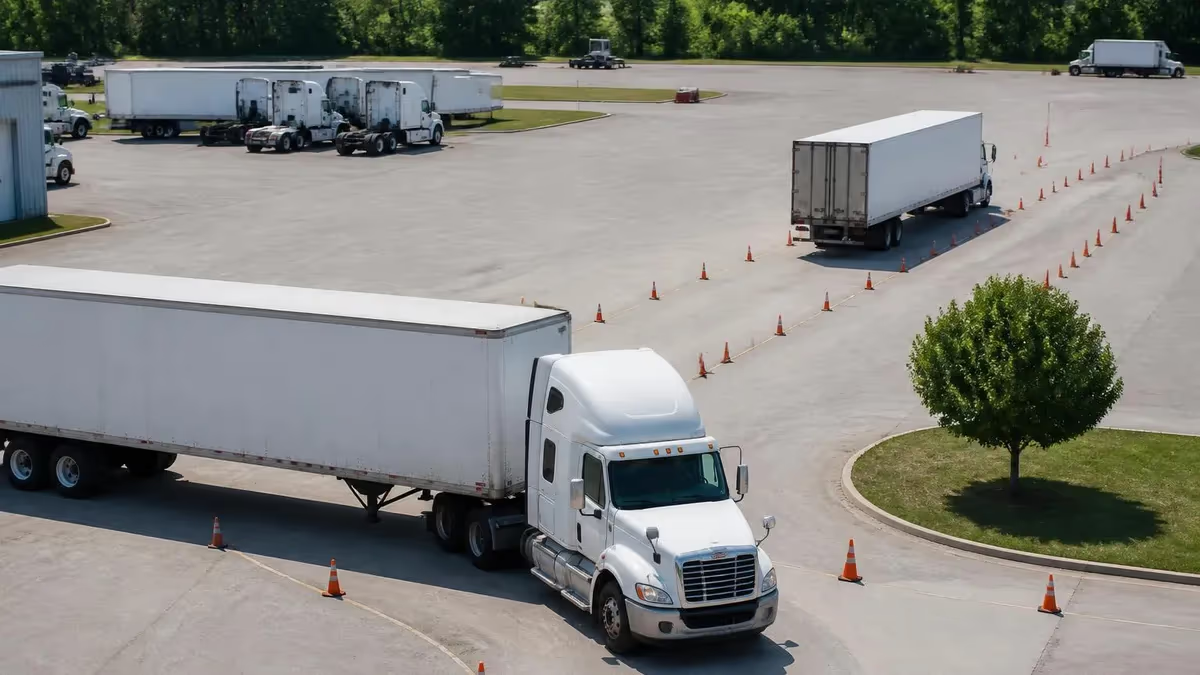
A Class A CDL is the broadest credential. It authorizes you to drive any combination of vehicles with a combined weight rating of 26,001 pounds or more, provided the vehicle being towed weighs more than 10,000 pounds. In plain English: a Class A lets you drive a tractor-trailer, also called a semi or big rig — the kind of truck that hauls freight on interstate highways.
The Class A also covers everything a Class B and Class C CDL covers, which is why most aspiring truck drivers train for Class A. It's the most flexible license and qualifies you for the highest-paying long-haul trucking jobs.
A Class B CDL authorizes you to drive a single vehicle weighing 26,001 pounds or more — but not a combination vehicle where the trailer exceeds 10,000 pounds. Class B drivers operate straight trucks: box trucks, dump trucks, garbage trucks, cement mixers, large delivery vehicles, and city buses. The Class B also covers most school buses and transit buses (with the appropriate passenger endorsement). It does not cover tractor-trailers. Class B is a faster path to a CDL because the training is shorter and the road test is somewhat simpler, but it limits your job options compared to Class A.
A Class C CDL is the narrowest of the three. It covers vehicles that don't meet the weight thresholds for Class A or Class B but that still require a CDL because of what they carry — specifically, 16 or more passengers (including the driver) or hazardous materials in placardable quantities. A Class C is what you need to drive a small school bus or a small hazmat delivery vehicle. It's the least common CDL class and is typically pursued only by drivers in specialized roles.
Endorsements are additional certifications added to any of the three classes to authorize specific types of cargo or vehicles. The most common endorsements are H (hazardous materials), N (tank vehicles), T (doubles and triples — towing more than one trailer), P (passenger transport), and S (school bus). Each requires an additional knowledge test, and some — like the H endorsement — also require a federal background check and fingerprinting. A driver can hold multiple endorsements on a single CDL.
Class A, B, and C: What Each Lets You Drive
Authorizes combination vehicles with a GCWR of 26,001+ lbs where the towed unit exceeds 10,000 lbs. Covers tractor-trailers, big rigs, doubles, triples, and tankers (with endorsements). Includes Class B and Class C privileges. Best for over-the-road trucking, freight hauling, and the highest-paying commercial driving jobs. Most CDL training programs target Class A because of its broad utility.
Authorizes single vehicles with a GVWR of 26,001+ lbs. Covers straight trucks: box trucks, dump trucks, garbage trucks, cement mixers, and large delivery trucks. With a passenger endorsement, also covers buses (city transit, school, charter). Does not cover tractor-trailers. Suitable for local and regional driving jobs that don't involve long-haul interstate freight.
Authorizes vehicles below Class A/B weight thresholds that still require a CDL because of cargo or passengers. Covers small passenger vans carrying 16+ people, small hazmat vehicles, and certain specialty vehicles. The least common CDL class. Required mainly for specialized roles like short-route shuttle drivers and small-vehicle hazmat couriers.
Add-ons that authorize specific cargo or vehicles on top of your base class. Common ones: H (hazmat), N (tanker), T (doubles/triples), P (passenger), S (school bus). Each requires a knowledge test; H requires a TSA background check. Endorsements significantly expand your job options and earning potential. Many drivers add 2–3 endorsements over their careers.
What a CDL Allows You to Do: Career Pathways
A CDL doesn't just authorize you to drive specific vehicles — it opens an entire job market that simply isn't accessible to drivers with only a regular license. The American Trucking Associations estimates that commercial drivers move roughly 72 percent of the freight tonnage moved in the United States each year. Every grocery store shelf, every gas pump, every Amazon package, every construction site, and every school depends on commercial drivers. A CDL is the entry credential for a workforce of more than three million professional drivers in the U.S. alone.
The most visible CDL career is over-the-road (OTR) trucking — driving tractor-trailers across the country, hauling freight between distribution centers and customers. OTR drivers typically earn $50,000 to $80,000 in their first few years, with experienced drivers and owner-operators earning significantly more. The trade-off is time away from home: OTR drivers may be on the road for weeks at a time, sleeping in their truck's sleeper cab between deliveries. It's a lifestyle as much as a job, and it requires a Class A CDL.
Regional and local truck driving offers more home time at slightly lower pay. Regional drivers cover a multi-state area and are home weekly. Local drivers stay within a single metro area and are home every night. Local jobs include city delivery (large packages, building materials, beverages), waste management (garbage trucks, recycling trucks), and construction (dump trucks, cement mixers, fuel delivery to job sites). These jobs typically pay $45,000 to $70,000 and require either a Class A or Class B CDL depending on the vehicle.
Bus driving is another major CDL career. School bus drivers, transit bus drivers, charter bus drivers, and motorcoach operators all need a CDL with a passenger endorsement (and school bus drivers also need the S endorsement). The work is more predictable than long-haul trucking — fixed routes, regular hours, home every night — but the pay is generally lower, with most positions in the $35,000 to $55,000 range. Many bus driving jobs are part-time or seasonal, which appeals to retirees and people looking for supplemental income.
Hazmat driving is the highest-paid specialty within commercial driving. Drivers transporting fuel, chemicals, explosives, or radioactive materials with the H endorsement earn premium pay because of the additional training, the background check requirement, and the heightened responsibility. Experienced hazmat drivers can earn $70,000 to $100,000 or more, with the highest pay going to those transporting the most regulated cargo. The H endorsement requires renewal every five years with a fresh TSA background check.

How a CDL Differs from a Regular License
CDL holders are held to stricter driving standards than non-commercial drivers — both on and off the job.
- Lower BAC limit: The blood alcohol concentration limit for CDL drivers is 0.04% — half the 0.08% limit for regular drivers. This applies whenever you're operating a commercial vehicle
- Stricter medical requirements: CDL holders must pass a Department of Transportation (DOT) physical every 1–2 years to maintain a valid medical certificate. Conditions like uncontrolled diabetes, certain heart conditions, or vision below specific standards can disqualify you
- Disqualification for off-duty offenses: A DUI conviction in your personal vehicle — not the commercial one — can still disqualify your CDL for a year or more. The CDL is one credential covering all your driving
- Hours-of-service rules: Federal regulations limit how many hours you can drive per day and per week, with mandatory rest periods. Electronic logging devices track compliance automatically
How to Get a CDL: The Four-Step Process
Getting a CDL is more structured than getting a regular driver's license. Federal regulations require specific steps in a specific order, and you can't skip any of them. The process typically takes 3 to 8 weeks from start to finish, depending on the training program you choose and how quickly you can schedule your tests. Here's the four-step path that every new CDL holder follows.
Step 1: Get your Commercial Learner's Permit (CLP). The CLP is the commercial equivalent of a regular learner's permit — it lets you legally practice driving a commercial vehicle on public roads, but only with a fully licensed CDL holder in the passenger seat. To get a CLP, you visit your state DMV with proof of identity, proof of residency, proof of medical fitness (a DOT medical card from a certified medical examiner), and your regular driver's license.
You then take the general knowledge written test, plus any endorsement-specific tests you want. The CLP is typically valid for 180 days and can be renewed once. You must hold a CLP for at least 14 days before you're eligible to take the CDL skills test.
Step 2: Complete Entry-Level Driver Training (ELDT). Since February 7, 2022, all new CDL applicants must complete federally compliant Entry-Level Driver Training from a training provider listed on the FMCSA's Training Provider Registry. ELDT covers required theory topics (mostly classroom-based) and behind-the-wheel training on a range and on public roads. There's no minimum hours requirement at the federal level for theory or BTW — the standard is proficiency-based — but most quality programs include 120–200 hours of instruction. ELDT is not free; it's where most of the CDL cost comes in, typically $3,000 to $10,000 at a private training school.
Step 3: Pass the CDL knowledge tests. Most applicants take the general knowledge, air brakes, and combination vehicles knowledge tests at the DMV when they get their CLP, but you can also retake or add endorsement tests later. Each test is multiple-choice. The CDL manual published by your state DMV is the authoritative study source — it contains essentially every question you'll see on the tests. Study materials, practice tests, and ELDT theory training all draw from this manual. Each test must be passed with at least 80% to qualify.
Step 4: Pass the CDL skills test. The skills test is the final hurdle. It has three parts: the pre-trip inspection (you walk around the vehicle and verbally demonstrate knowledge of every safety component), the basic control skills test (backing maneuvers and parking in a closed course), and the road test (driving in actual traffic with an examiner). The skills test is administered by your state DMV or, in many states, a state-approved third-party tester (often your training school). You provide the vehicle.
Pass rates are typically 70% to 85% on the first attempt for well-prepared students. Pass the skills test and your CLP is upgraded to a full CDL, which is mailed to you within a few weeks.
Federal age requirements depend on whether you'll drive intrastate or interstate. To drive a commercial vehicle across state lines (interstate commerce), federal law requires you to be at least 21 years old. To drive only within your home state (intrastate commerce), most states allow CDL holders as young as 18. Hazmat endorsements require age 21 regardless of intrastate or interstate driving. The FMCSA launched a Safe Driver Apprenticeship Pilot program in 2022 that allows certain 18–20-year-olds to drive interstate under controlled conditions with an experienced mentor — but participation is limited and the program is still pilot-phase. If you're under 21, talk to your training school about which carriers in your state will hire intrastate drivers your age before paying for training, since most major OTR carriers will not.
What Does a CDL Cost?
The total cost of getting a CDL varies enormously depending on the path you choose, but most new CDL holders spend somewhere between $0 (with full sponsorship) and $10,000 (with full self-pay at a private school) to get fully licensed. Understanding the cost components helps you plan and identify which expenses are negotiable.
The largest cost is Entry-Level Driver Training. Private CDL schools typically charge $3,000 to $7,000 for a 3-to-8-week Class A program. Community colleges often offer similar programs for $2,000 to $5,000, and some include the training within a transportation associate degree that's eligible for federal financial aid. Company-sponsored training through carriers like Schneider, Werner, or Swift can be free in exchange for a 1-to-2-year employment commitment after graduation — though the wages during that commitment period are usually below market rate, so the training isn't truly free, just deferred.
Smaller costs add up quickly. The DOT physical typically costs $80 to $150. The CLP application fee is usually $20 to $60 depending on the state. The full CDL license itself costs $50 to $200 depending on the state. Endorsement application fees range from $5 to $50 each, plus a one-time TSA background check fee of $87 for the hazmat endorsement. Books and practice test access are usually under $50 if you don't get them through your training school. Skills test fees, if administered by a third-party tester, can be $100 to $300.
Hidden costs include time and lost wages. ELDT is full-time or near full-time for several weeks — during that period, you're not earning at your previous job. Many students take out personal loans or use savings to cover both tuition and living expenses during training. Federal financial aid (Pell Grants) is available for CDL programs at accredited community colleges, and the GI Bill covers CDL training at approved schools for eligible veterans. Workforce development grants under the Workforce Innovation and Opportunity Act (WIOA) cover training for qualifying unemployed or underemployed workers in many states.
Before You Start CDL Training: Pre-Enrollment Checklist
- ✓Verify you can pass a DOT physical — uncontrolled diabetes, certain heart conditions, severe sleep apnea, or vision below federal standards can disqualify you before you spend a dollar on training
- ✓Check your driving record for the past 3–5 years — DUIs, reckless driving convictions, and excessive points can disqualify you from CDL training programs and from being hired afterward
- ✓Confirm your age qualifies you for the kind of driving you want to do — interstate (21+) versus intrastate (18+ in most states) — and verify what carriers in your area will hire your age group
- ✓Make sure you can pass a federal drug test — most employers and training programs require a clean test before enrollment and random testing throughout your career
- ✓Decide between Class A, Class B, and Class C based on what you actually want to drive — most trucking jobs require Class A, but local and bus driving may only need Class B
- ✓Research training programs in your area and verify they're on the FMCSA Training Provider Registry — only ELDT from a registered provider qualifies you for the CDL skills test
- ✓Compare costs and funding options: self-pay, company-sponsored, community college with financial aid, WIOA grants, or GI Bill benefits if you're a veteran
Who Shouldn't Pursue a CDL?
A CDL is a serious commitment with serious responsibilities, and it's not the right career path for everyone. Being honest about the demands before you spend thousands of dollars on training saves time, money, and disappointment. Here are the situations where pursuing a CDL is likely a poor decision.
If you have a recent DUI, a felony involving a vehicle, or a pattern of moving violations, CDL training may be a financial dead end. Most carriers will not hire drivers with a DUI in the past 3 to 5 years, and many require a perfectly clean record for the past 5 to 10 years for premium freight or hazmat work.
Spending $7,000 on training only to find that no carrier will hire you is a real risk if your driving record has serious issues. Pull your motor vehicle record from your state DMV before enrolling and ask training schools or carriers directly whether your record disqualifies you.
If you have a chronic medical condition that prevents you from passing the DOT physical, the CDL is not accessible. Conditions that commonly disqualify applicants include insulin-dependent diabetes without an exemption, severe uncontrolled hypertension, recent serious cardiac events, epilepsy, and certain vision impairments. The DOT physical is required every 1 to 2 years, so a condition that develops mid-career can also end a CDL career. If you have a borderline condition, get the DOT physical done before paying for training to confirm you'll pass.
If you have a personal life that requires you to be home every night, OTR trucking is likely not for you. Long-haul drivers are away from home for weeks at a time, sleeping in their trucks and missing family events. Local and regional CDL jobs exist and offer better home time, but they pay less and are more competitive to land as a new driver.
Most new CDL holders start with OTR jobs because that's where the jobs are most plentiful for inexperienced drivers. If being home every night is non-negotiable, research whether your area has enough local CDL jobs to absorb new drivers before committing to training.
If you don't enjoy driving for long stretches, or you find highway driving stressful, the CDL job market is not for you. Professional driving involves spending 8 to 11 hours a day, day after day, behind the wheel. You're alone, the music plays the same songs, and the scenery often repeats. Some people find this peaceful and meditative; others find it grinding and isolating. Before committing to CDL training, ride along with a working commercial driver for a day if you can — many carriers offer ride-along programs precisely so prospects can experience the work before committing.
CDL Career: Pros and Cons at a Glance
- +Strong job demand — the U.S. has a persistent commercial driver shortage estimated at 60,000 to 80,000 drivers, meaning licensed CDL holders rarely struggle to find work
- +Decent starting pay with real upside — first-year OTR drivers earn $50K–$80K, experienced drivers and owner-operators can earn $90K–$150K+ in premium roles
- +No college degree required — a CDL is one of the highest-paying credentials you can earn without a four-year degree, and training takes weeks, not years
- +Career mobility — the CDL is recognized in all 50 states, and experienced drivers can move between carriers, regions, and specialties throughout their careers
- −Time away from home — OTR drivers are gone for weeks at a stretch, missing birthdays, holidays, and the daily rhythm of family life. Marriages and friendships strain under this
- −Physical and mental toll — long hours of sitting, irregular sleep, truck-stop food, and isolation are hard on health. Obesity, sleep apnea, and depression are above-average among long-haul drivers
- −Strict regulation — hours-of-service rules, mandatory rest periods, electronic logging, drug testing, and DOT physicals govern your work in ways most jobs don't. A single mistake can cost you your license
- −Heavy responsibility — you're operating an 80,000-pound vehicle in traffic. Mistakes can be catastrophic, and the legal and career consequences of a serious accident are severe
Related Credentials and Common Confusions
Several credentials are sometimes confused with the CDL, and it helps to know the differences so you don't waste time pursuing the wrong one. Each of these credentials authorizes a specific kind of driving or transportation work, and they don't substitute for each other.
A chauffeur's license is a state-level credential that some states require for drivers of taxis, limos, and small passenger-for-hire vehicles. It's not a CDL — it doesn't authorize commercial trucking, and it's typically obtained with just a paper application and small fee. Some states have phased out the chauffeur's license entirely in favor of the CDL and Transportation Network Company (TNC) registrations for rideshare drivers. If you want to drive a Lyft or Uber, you don't need a CDL or a chauffeur's license — you need a regular license and to meet the TNC's onboarding requirements.
A DOT medical card is the federal medical certificate every CDL holder must hold to operate commercially. It's issued by a certified medical examiner after a DOT physical. The card itself is not a license — it's a certification that you meet the medical standards required to hold a CDL. The medical card must be renewed every 1 to 2 years depending on your health status, and it's required for both interstate and intrastate commercial driving.
A commercial learner's permit (CLP) is the precursor to the CDL. It allows supervised practice driving in a commercial vehicle and is valid for 180 days (renewable once). The CLP is what you get after passing the CDL knowledge tests but before you've taken the skills test. You cannot drive commercially with passengers (other than your supervising CDL holder) or cargo for hire with a CLP — it's strictly for training.
An endorsement is not a separate license. It's an add-on to your CDL that authorizes you to drive specific vehicles or carry specific cargo. Endorsements are codes added to your CDL: H for hazmat, N for tankers, T for doubles and triples, P for passengers, S for school bus. You can hold multiple endorsements on a single CDL, and they're earned by passing additional knowledge tests (and in the case of H, a TSA background check).
Putting It All Together: Is a CDL Right for You?
A CDL is the federal credential that unlocks the entire commercial driving job market — over three million driving jobs in the United States, from local box-truck delivery to cross-country tractor-trailer hauling, from school buses to hazmat tankers. It exists because moving heavy and dangerous vehicles requires demonstrated skill, and the federal CDL system standardizes that demonstration across all 50 states. The credential is the same in Texas as it is in Maine — your training, your testing, and your record all live under one federal framework.
The three classes — A, B, and C — exist to match license privileges to the vehicles being driven. Class A covers tractor-trailers and is the broadest, most flexible, and most common credential among professional drivers. Class B covers straight trucks and most buses. Class C is the narrow specialty for small-passenger and small-hazmat vehicles. Endorsements layer on top to authorize specific cargo or vehicle types like hazmat, tankers, doubles, and passenger transport.
The four-step process — CLP, ELDT, knowledge tests, skills test — typically takes 3 to 8 weeks and costs anywhere from $0 (with company sponsorship) to $10,000 (with full self-pay). Funding options include company sponsorship, community college financial aid, WIOA workforce grants, and GI Bill benefits for veterans. Age requirements are 21 for interstate driving and 18 for intrastate driving in most states, with hazmat endorsements requiring 21 regardless.
The CDL isn't right for everyone. It demands a clean driving record, the ability to pass a DOT physical, tolerance for long hours behind the wheel, and (for OTR work) acceptance of significant time away from home. For those it fits, it's one of the highest-paying credentials available without a four-year degree, with strong job demand and a career path from entry-level driving to specialty hauling to owner-operator. If you've read this far and the trade-offs sound acceptable rather than discouraging, the next step is finding an FMCSA-registered training provider in your area and getting started on the CLP.
CDL Questions and Answers
About the Author

Licensed Driving Instructor & DMV Test Specialist
Penn State UniversityRobert J. Williams graduated from Penn State University with a degree in Transportation Management and has spent 20 years as a certified driving instructor and DMV examiner consultant. He has personally coached thousands of applicants through written knowledge tests, skills assessments, and commercial driver licensing programs across more than 30 states.
Join the Discussion
Connect with other students preparing for this exam. Share tips, ask questions, and get advice from people who have been there.
View discussion (7 replies)