
Non-CDL: When You Don't Need a Commercial License to Drive 2026 September
🎓 Non-CDL driving means GVWR under 26,001 lbs, fewer than 16 passengers, and no placardable hazmat. See vehicles, DOT rules, jobs, and CDL upgrade tips.
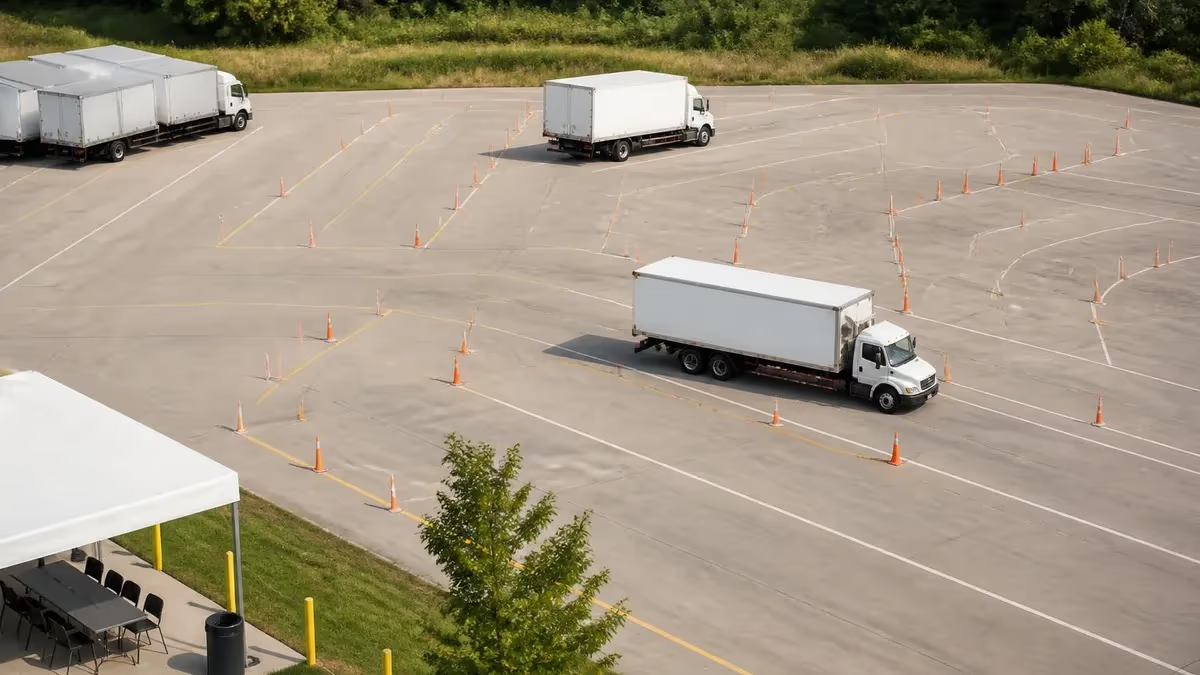
Non-CDL: When You Don't Need a Commercial License to Drive
The term non-CDL covers every vehicle that falls below the federal commercial driver's license thresholds. If a truck weighs less, carries fewer passengers, or hauls fewer hazardous materials than the federal cut-offs, the driver does not need a CDL. That single distinction opens up an entire side of the trucking industry that runs on standard Class C or Class D driver's licenses.
Plenty of people assume any box truck or dual-axle pickup automatically needs a CDL. It doesn't. The Federal Motor Carrier Safety Administration draws three bright lines, and only vehicles that cross at least one of them require a CDL. Stay under all three, and you can drive commercially with the license already in your wallet.
The Federal CDL Thresholds (and Why They Matter)
Federal regulation 49 CFR Part 383 defines a Commercial Motor Vehicle (CMV) for CDL purposes. A driver only needs a CDL when the vehicle meets one of these criteria.
First, the weight rule: a Gross Vehicle Weight Rating (GVWR) of 26,001 pounds or more, or any combination with a Gross Combination Weight Rating (GCWR) of 26,001 pounds or more where the trailer alone exceeds 10,000 pounds. The rating on the door jamb is what counts, not what the truck happens to weigh on a given day.
Second, the passenger rule: any vehicle designed to transport 16 or more passengers including the driver. A 15-passenger van skirts the line; one extra seat tips it over.
Third, the hazmat rule: any vehicle hauling a quantity of hazardous material that requires a Department of Transportation placard. Small shipments under the reportable threshold do not trigger a CDL even when the material itself is technically hazardous.
Stay under all three, and the vehicle is non-CDL. That's the whole test.
Non-CDL Thresholds at a Glance

Vehicles You Can Drive Without a CDL
Most people picture a tractor-trailer when they hear truck driver, but the non-CDL category is much broader. Some of the busiest commercial routes in the country run on rigs that any standard license holder can legally operate.
Sprinter vans and cargo vans sit at the small end. A Mercedes Sprinter, Ford Transit, or RAM ProMaster typically rates between 8,550 and 11,030 pounds GVWR — nowhere near the CDL cut-off. These vans dominate last-mile delivery, courier work, and small expediting routes.
Dual-axle pickup trucks like a Ford F-450 or Chevy 4500 rate around 14,000–16,500 pounds. Hook one to a gooseneck trailer rated below 10,000 pounds and the whole combination still falls under non-CDL. That's the heart of the hot shot business.
Class 5 and Class 6 box trucks cover the 16,001–26,000 pound range. A standard 26-foot Isuzu NPR or Hino 268 with a 25,950-pound GVWR is the largest non-CDL box truck available, and rental fleets like Penske, Ryder, and U-Haul stock them by the thousands. Drivers move freight, furniture, and parcels in these every day with a regular driver's license.
Dump trucks under 26,001 pounds GVWR exist, mostly in the Class 5 range. Smaller landscaping, roofing, and snow-removal operations run them precisely because they don't need to hire CDL drivers.
You'll also find tow trucks, utility trucks, bucket trucks, and service vehicles across that same Class 5–6 range. If you've ever seen a Comcast truck or a small flatbed tow rig, that operator almost certainly does not hold a CDL.
Why do so many box trucks rate exactly 25,950 pounds? Because manufacturers and fleets deliberately spec them just under the 26,001 federal cut-off. That single design choice lets companies hire from a much larger labor pool, skip the CDL training reimbursement, and avoid the federal drug-and-alcohol testing program that applies to CDL holders. The result is a clear engineering line drawn around the regulation.
If you see a 26-foot rental truck on the road, check the door sticker. It almost certainly reads 25,950 or 25,999 lbs GVWR — the largest legal non-CDL configuration available.
DOT Rules That Still Apply to Non-CDL Drivers
Skipping the CDL doesn't mean skipping every federal regulation. Once you cross 10,000 pounds GVWR and drive in interstate commerce, the FMCSA treats you as a commercial driver for several rules even without a CDL.
A DOT medical card is required if the vehicle is rated over 10,000 pounds GVWR and operates across state lines for hire. The exam is the same DOT physical CDL drivers complete, performed by a certified medical examiner from the National Registry. It costs $80–$150 and the certification lasts up to 24 months. Many non-CDL drivers don't realize the requirement applies until they get pulled over at a weigh station.
Hours of Service (HOS) rules also apply to interstate non-CDL drivers when the vehicle exceeds 10,001 pounds. The 11-hour daily driving limit, 14-hour duty window, and 60/70-hour weekly cap are identical to those for CDL drivers. The catch is that under 10,000 pounds, the rules typically don't apply — which is one reason Sprinter van expediters are popular with drivers who want flexible schedules.
Drug and alcohol testing applies only to CDL holders. Non-CDL drivers are exempt from the federal Clearinghouse, though carriers can run their own internal testing programs voluntarily.
USDOT numbers are required for any vehicle over 10,001 pounds operating in interstate commerce for hire, regardless of CDL status. Roadside inspectors check for the number on the cab door, and operating without one carries fines that easily exceed $1,000.
State rules vary. Some states require a Class B or commercial license for vehicles between 16,000 and 26,000 pounds even where federal law does not. California, Hawaii, and a handful of others have their own thresholds. Always check the state where you'll be registered before assuming non-CDL means no special license.
Non-CDL Vehicle Classes Explained
Heavy pickups and small box trucks. F-350, Ram 3500, Silverado 3500. Common for last-mile delivery and contractor service vehicles.
- ▸GVWR range: 10,001–14,000 lb
- ▸Examples: F-350, Ram 3500, Silverado 3500
- ▸Common use: contractor service, light delivery
- ▸Standard driver's license fully sufficient
Dual-axle pickups and large utility trucks. F-450, Ram 4500, smaller dump trucks. Frequent hot-shot trucking choice.
- ▸GVWR range: 14,001–16,000 lb
- ▸Examples: F-450, Ram 4500, small dumps
- ▸Common use: hot shot, towing, utility
- ▸Trailer must stay under 10,000 lb GVWR for non-CDL
Walk-in delivery trucks, large utility bodies, smaller box trucks. F-550, International CV, Isuzu NPR base models.
- ▸GVWR range: 16,001–19,500 lb
- ▸Examples: F-550, Isuzu NPR-HD, International CV
- ▸Common use: walk-in delivery, bucket trucks
- ▸Still non-CDL but DOT medical card likely needed
Largest non-CDL category. 26-foot rental box trucks, beverage delivery, smaller dump trucks. The 25,950 lb design point.
- ▸GVWR range: 19,501–26,000 lb
- ▸Examples: Isuzu NRR, Hino 268, Freightliner M2-106 (de-rated)
- ▸Common use: rental fleets, regional delivery
- ▸DOT medical card and HOS rules apply interstate
Hazmat Without a CDL: The Placard Test
Hazardous materials are not automatically off-limits for non-CDL drivers. The rule comes down to one question: does the shipment require a DOT placard? If yes, the driver needs a CDL with the hazmat (H) endorsement. If no, the driver can move the material with a standard license.
Placardable quantities are defined in 49 CFR 172.504. For most Table 2 materials, the threshold is 1,001 pounds gross weight of hazardous material on the vehicle. Below that, no placard is required and no CDL hazmat endorsement applies. Drivers can legally move small quantities of paint, propane cylinders, lithium batteries, gasoline cans, and similar items in a non-CDL truck.
Table 1 materials are stricter — any quantity of explosives, poison gas, or radioactive material requires placarding regardless of weight. These are essentially never legal for non-CDL transport.
The most common non-CDL hazmat use case is parcel delivery. Amazon, FedEx Ground, and UPS routinely move limited-quantity (LTD QTY) shipments — hairspray, perfume, small batteries, household cleaners — in Sprinter vans and small box trucks. Drivers don't need a hazmat endorsement because the shipments fall under limited-quantity or small-quantity exemptions.
The practical line: if your load needs orange diamond placards on the trailer, you need a CDL. If it ships in regular boxes with limited-quantity markings, you don't.

Common Non-CDL Driving Jobs
Amazon's Delivery Service Partner (DSP) program is the largest single non-CDL employer in the country. Drivers operate Amazon-branded Mercedes Sprinter, Ram ProMaster, or Rivian electric vans on residential routes.
Typical pay: $18–$22 per hour, plus benefits when employed directly by the DSP (not Amazon itself). Routes run 8–10 hours with 150–250 stops depending on density.
Requirements: standard driver's license, clean MVR for the last three years, ability to lift 50 pounds, smartphone for the Amazon Flex/Mentor app. DOT medical card not typically required — vans stay under 10,000 lb GVWR.
How to Grow Earnings Without Getting a CDL
The standard assumption is that getting a CDL is the only path to higher pay in trucking. It isn't. Plenty of non-CDL drivers earn six figures without ever sitting through Class B training. The route looks different than the CDL track — it's more entrepreneurial and less about hours behind the wheel.
The biggest earnings jump comes from moving off W-2 hourly work and onto contract or owner-operator status. An Amazon DSP driver who earns $20 an hour grosses around $42,000 per year. The same driver running an independent box truck for FedEx Ground or a hot-shot lane often grosses $120,000–$180,000 — though after expenses, the net is closer to $60,000–$90,000.
Adding a trailer is the second use point. A solo Sprinter van caps out around $1,500–$2,200 per week. A dual-axle pickup with a 40-foot gooseneck doubles the load capacity, opens the door to oilfield and machinery freight, and easily doubles weekly gross revenue.
Specialization pays. Generic last-mile work is low-margin. Niche lanes — medical courier (organ transport, pharmacy), high-value freight (jewelry, art), urgent automotive parts, expedited oilfield equipment — pay 2–3x standard cargo van rates because the customer can't afford a missed delivery.
Running your own authority instead of leasing to a carrier is the final step. With your own MC number, you keep the full freight bill instead of paying a 20–30% cut to a carrier. The trade-off is dealing with insurance, IFTA filings, factoring, and load boards directly.
None of this requires a CDL. It requires capital for the truck and trailer, discipline to run a small business, and a network of customers or load-board accounts.
If your loads are routinely topping out at the 26,000-pound weight limit, you're losing money. A CDL Class A driver with a 53-foot trailer hauls 45,000+ pounds per trip — nearly double what a non-CDL hot shot can legally carry. On long lanes, that capacity gap translates directly into revenue.
Other signs it's time to upgrade: customers asking for full-truckload service you keep turning down, paying a partner with a CDL to take overflow freight, or running short-haul routes where you'd rather pull a dry van. At that point, a $4,000–$8,000 investment in CDL Class A training pays back inside the first quarter.
Setting Up a Non-CDL Trucking Business
Going from W-2 driver to owner-operator on the non-CDL side involves a real but manageable list of registrations. Most drivers complete the paperwork in 30–60 days.
The first step is forming an LLC or sole proprietorship and getting an EIN from the IRS. The LLC route costs $50–$500 depending on state, and shields personal assets if a truck is ever involved in a serious accident.
Next, apply for a USDOT number through the FMCSA's Unified Registration System. The number itself is free but mandatory for any interstate operation over 10,001 pounds. Add MC operating authority ($300 fee) if you'll haul freight for hire across state lines.
Commercial auto liability insurance is the largest startup expense after the truck itself. Federal minimum is $750,000 for general freight and $1,000,000 for some hazmat or specialty freight. Annual premiums for a non-CDL hot shot operation typically run $9,000–$15,000 — cheaper than CDL Class A insurance but still significant.
File a BOC-3 process agent ($25–$75 per year), register with UCR (Unified Carrier Registration, $59–$1,000+ depending on fleet size), and set up IFTA if you'll cross state lines for fuel tax reporting.
Once paperwork clears, get the truck inspected to FMCSA standards, install ELD if running over 10,001 pounds interstate, and start posting on load boards or signing direct customer contracts.
Non-CDL Compliance Checklist
- ✓Verify GVWR on door sticker is under 26,001 lb (and trailer under 10,001 lb if applicable)
- ✓Obtain DOT medical card if vehicle is over 10,000 lb GVWR and operates interstate
- ✓Apply for USDOT number through FMCSA Unified Registration System
- ✓Obtain MC operating authority if hauling for hire across state lines
- ✓Carry minimum $750,000 commercial auto liability insurance
- ✓File BOC-3 process agent designation with FMCSA
- ✓Register for UCR (Unified Carrier Registration) annually
- ✓Set up IFTA reporting if crossing state lines
- ✓Install ELD device if vehicle exceeds 10,001 lb GVWR interstate
- ✓Track Hours of Service if vehicle exceeds 10,001 lb GVWR interstate
- ✓Maintain logbooks and vehicle inspection reports for 6 months
- ✓Confirm state-specific licensing requirements (some require Class B under 26,001 lb)
The Real Trade-Offs Between Non-CDL and CDL
Choosing between a non-CDL career and the CDL route is mostly about how much capital, time, and risk you want to take on. The non-CDL path costs less to enter, lets you start sooner, and works well as a side hustle or stepping stone. The CDL path opens larger loads, regulated rates, and a clearer career ladder — but with higher training costs, stricter testing, and longer hours away from home.
Neither is automatically better. The right pick depends on the customer base in your area, the lanes you can cover from home, and whether you actually want to be away on multi-day OTR routes. A lot of drivers run non-CDL for two to three years, learn the business side, then upgrade to a CDL only after they have a customer pipeline already established.
Non-CDL Driving Pros and Cons
- +No CDL training cost or testing burden — start driving immediately with a regular license
- +Lower barrier to entry for owner-operators (used Sprinter van $25k vs. used semi $60k+)
- +Local and regional routes mean nightly home time instead of weeks on the road
- +Cheaper insurance premiums than CDL Class A operations
- +Exempt from federal drug-and-alcohol Clearinghouse and pre-employment testing
- +Massive demand from last-mile and parcel carriers — Amazon DSP, FedEx Ground, OnTrac always hiring
- −Weight ceiling caps revenue per load at roughly half of what a Class A driver can haul
- −DOT medical card and Hours of Service still apply over 10,001 lb interstate
- −State rules vary — California, Hawaii, and others require commercial licenses below the federal threshold
- −Customer pool is smaller for specialized freight that requires placarding or 53-foot trailers
- −Career ceiling on hourly W-2 work is lower than CDL line-haul or OTR positions
- −Insurance and authority costs still apply even though the truck is smaller
Pros and Cons at a Glance
| Pros | Cons |
|---|---|
| No CDL training cost or testing burden — start driving immediately with a regular license | Weight ceiling caps revenue per load at roughly half of what a Class A driver can haul |
| Local and regional routes mean nightly home time instead of weeks on the road | State rules vary — California, Hawaii, and others require commercial licenses below the federal threshold |
| Cheaper insurance premiums than CDL Class A operations | Insurance and authority costs still apply even though the truck is smaller |
When to Upgrade to a CDL
The decision to add a CDL on top of an existing non-CDL operation usually comes down to three signals.
First, you're turning down loads regularly because of weight. If brokers are calling with 35,000–45,000 pound loads on lanes you already run, and you have to refer the freight elsewhere, the CDL pays for itself in a few months.
Second, you want OTR (over-the-road) or dedicated lane work. The longest non-CDL runs cap at regional routes — a CDL Class A opens cross-country lanes paying $0.55–$0.75 per loaded mile, which adds up fast at 2,500–3,000 miles per week.
Third, your customers ask for it. Some shippers won't contract anyone without a CDL Class A regardless of vehicle size — they want the DOT compliance record that comes with the licensed-driver designation. If you're losing bids on that basis alone, the upgrade is a defensive move.
CDL Class A training costs $4,000–$8,000 and takes 3–7 weeks. Most schools include hands-on hours, the written tests for each endorsement, and the road test. Many carriers reimburse the cost in exchange for a 12-month commitment. If you go that route, prepare with the CDL General Knowledge practice test and the CDL Air Brakes practice test before you ever step into a classroom — the written exams are where most candidates fail first, and they're cheap to retake but slow down the whole training timeline.
The Bottom Line on Non-CDL Driving
Non-CDL is not a consolation prize. It's a legitimate segment of the commercial driving industry that runs on a different economic model than the CDL world. The trucks are smaller, the routes are shorter, the loads are lighter, and the regulatory burden is lower — but the demand is enormous, especially with the explosion of e-commerce parcel delivery over the past decade.
The federal definition is simple: under 26,001 pounds GVWR, fewer than 16 passengers, and no placardable hazmat. Everything else — the medical card, the USDOT number, the insurance — follows from the weight class and whether you're crossing state lines. The state where you register the truck adds another layer worth checking before you start a business.
If the goal is a quick start with low capital and home every night, non-CDL is the obvious entry point. If the goal is maximum revenue per mile and the highest available freight rates, the CDL Class A still wins. Plenty of drivers run both at different points in their career, and the non-CDL years are where most of them learn how the trucking business actually works.
Myths About Non-CDL Driving That Cost People Money
A few persistent myths trip up new drivers. The first is that any box truck needs a CDL. It doesn't. The 26-foot moving truck you rented for your last move was non-CDL, and the driver behind every Amazon Prime van is non-CDL too.
The second myth is that non-CDL drivers don't have to follow federal trucking rules. They do, just a smaller subset. The DOT medical card, USDOT number, Hours of Service for vehicles over 10,001 lb interstate, and FMCSA inspection standards still apply.
The third myth is that non-CDL pay is always lower than CDL pay. On an hourly W-2 basis, that's broadly true. As an owner-operator running specialty freight, the comparison flips — niche non-CDL operators in medical courier, expedited freight, or oilfield hot shot routinely earn more per hour worked than entry-level CDL Class A company drivers.
The fourth myth is that insurance is cheap for non-CDL operations. It's cheaper than a CDL Class A semi, but a hot shot owner-operator still pays $9,000–$15,000 per year for commercial auto liability. Bobtail and physical-damage coverage adds another $2,000–$4,000. Plan for $12,000–$20,000 in annual insurance before profit.
CDL Questions and Answers
About the Author

Licensed Driving Instructor & DMV Test Specialist
Penn State UniversityRobert J. Williams graduated from Penn State University with a degree in Transportation Management and has spent 20 years as a certified driving instructor and DMV examiner consultant. He has personally coached thousands of applicants through written knowledge tests, skills assessments, and commercial driver licensing programs across more than 30 states.
Join the Discussion
Connect with other students preparing for this exam. Share tips, ask questions, and get advice from people who have been there.
View discussion (7 replies)