
Non-CDL Box Truck: Driving Without a Commercial License Guide 2026 September
Drive a non-CDL box truck under 26,001 lb GVWR — ❓ DOT medical, USDOT number, HOS rules, and best non-CDL freight jobs explained.
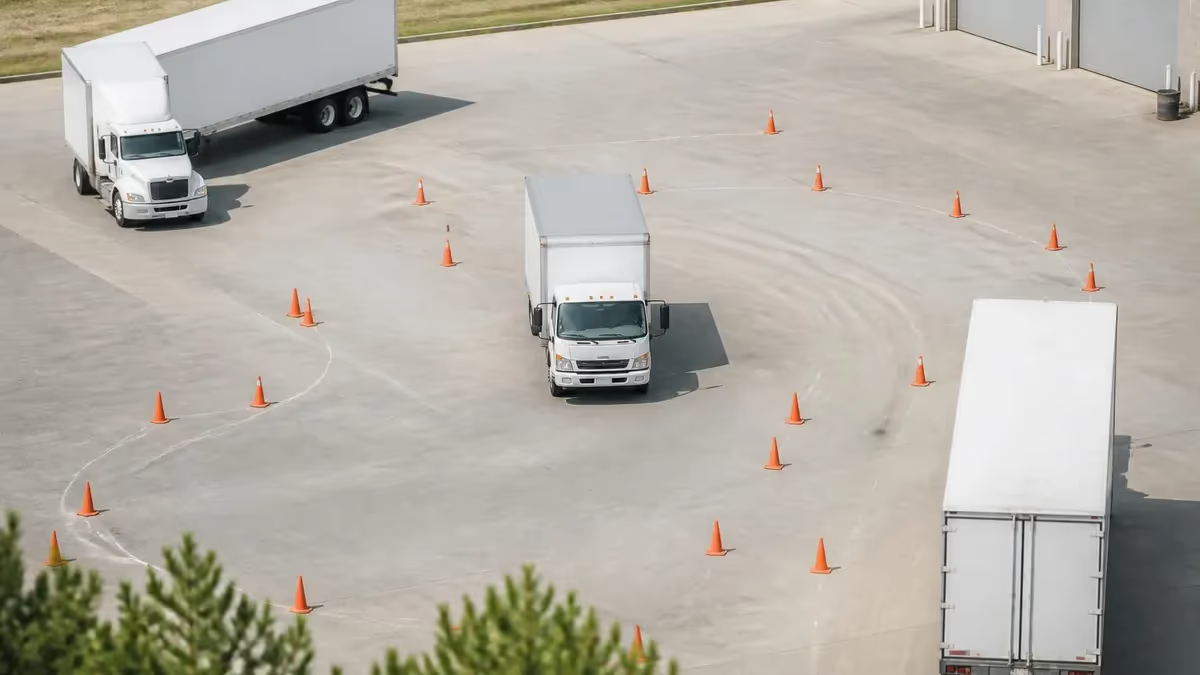
A non-CDL box truck is any straight truck with a gross vehicle weight rating (GVWR) at or below 26,000 pounds — and tens of thousands of drivers earn full-time income hauling freight in these trucks without ever holding a commercial driver's license.
The 26,001-pound line drawn by the Federal Motor Carrier Safety Administration (FMCSA) is the single most important number in this niche: stay under it, and you skip the CDL skills test, the air-brake endorsement, and most state CDL fees. Cross it, and you enter the world of Class B (or Class A, if you tow heavy enough trailers) commercial licensing.
The non-CDL space exists because federal law only requires a CDL for vehicles above that 26,001-pound threshold, vehicles carrying placardable amounts of hazardous materials, or buses designed for 16+ passengers. Box trucks like the Ford E-350 cutaway, the Isuzu NPR, the Hino 155, and the Mercedes-Benz Sprinter chassis cab are intentionally built right at or just under 26,000 pounds GVWR so fleets and owner-operators can hire drivers with a standard Class C (passenger car) license. That keeps the labor pool wide and the wages competitive.
This guide walks through every requirement that actually applies to non-CDL drivers — DOT medical card, USDOT numbers, hours of service, and the real-world employer rules — plus the freight networks (Amazon Relay, FedEx Custom Critical, hot-shot brokers) where you can plug in a non-CDL truck and start moving loads. If you eventually want to upgrade, our CDL license overview and CDL permit walkthrough cover the next steps.
Non-CDL Box Truck Quick Numbers
The 26,000-pound GVWR ceiling is a regulatory cutoff, not a curb-weight measurement. GVWR is what the manufacturer says the truck can safely weigh fully loaded — chassis, body, fuel, driver, passengers, and cargo combined. You'll find it on the door-jamb sticker, and it does not change based on how you load the truck. A 26,000-pound GVWR truck that is only carrying 4,000 pounds of freight is still rated 26,000 pounds for licensing purposes, so you stay in the non-CDL category.
The combination weight rule matters too. If you tow a trailer, the total Gross Combination Weight Rating (GCWR) determines your license class. Two key thresholds: a GCWR over 26,001 pounds with a trailer over 10,000 pounds GVWR pushes you into CDL Class A territory. Stay under either of those, and you're still operating non-CDL. That's why many hot-shot drivers run a 1-ton dually pickup with a 9,990-pound GVWR trailer — deliberately engineered to land one pound below the line.
Common non-CDL box trucks include the 14-foot and 16-foot Isuzu NPR (14,500–17,950 lb GVWR), the Hino 155 (14,500 lb), the Ford E-350 and E-450 cutaway box vans (10,050–14,500 lb), the Freightliner MT45 walk-in (also under 26k in non-CDL trim), and the Sprinter 3500/4500 cab chassis (11,030–14,000 lb). U-Haul's entire 26-foot rental fleet is rated 25,999 lb GVWR for the same reason — so any driver with a Class C license can rent one for a household move.
This is the only number that matters for licensing. Federal law (49 CFR 383.5) requires a CDL for any single vehicle with a GVWR over 26,001 pounds, any combination over 26,001 GCWR where the trailer exceeds 10,000 GVWR, vehicles carrying 16+ passengers, or vehicles transporting placardable hazmat quantities. Stay below all four lines and you operate non-CDL.
Driving a non-CDL box truck only requires the standard state-issued driver's license you already use for your car — that's a Class C, Class D, or "regular operator" license depending on which state you live in. There is no upgrade, no separate written test, and no behind-the-wheel skills exam at the DMV for the truck itself. New York, Texas, California, and Florida all confirm in their commercial driver manuals that vehicles 26,000 lb GVWR and under do not require a CDL.
What changes when you start hauling freight commercially is the federal layer that stacks on top of your state license. The FMCSA classifies you as a commercial motor vehicle (CMV) driver the moment you cross state lines for compensation, operate any vehicle over 10,001 lb GVWR for business, or move regulated freight. That triggers DOT medical card requirements, USDOT registration for your operating authority, and hours-of-service compliance — even though you don't need a CDL.
This split confuses new drivers. The shorthand version: state DMV cares about license class, FMCSA cares about commercial operation. You can pass state law with just your Class C license, then independently fall under federal CMV rules the second your truck weighs over 10,001 lb GVWR and you're driving it for business. Most non-CDL box trucks fall squarely in that 10,001–26,000 lb sweet spot, so almost every commercial non-CDL driver carries a DOT medical card and runs under a USDOT number.
Common Non-CDL Box Trucks
The workhorse of urban delivery. 14-ft to 20-ft body, 14,500–17,950 lb GVWR, hydraulic brakes, diesel or gas. Used by every major last-mile fleet.
Toyota-owned Japanese cab-over, 14,500 lb GVWR, common with appliance and furniture delivery. Strong dealer support and parts availability.
American cutaway van chassis, 10,050–14,500 lb GVWR, available with 12-ft to 16-ft box bodies. Easy to service, low ownership cost.
Premium expedited freight choice, 11,030–14,000 lb GVWR, used by FedEx Custom Critical owner-operators and medical courier services.
Walk-in delivery van chassis used by UPS-style local routes. Under 26,001 lb in MT45 trim, hydraulic brakes, automatic transmission.
Rated 25,999 lb GVWR — exactly one pound under the CDL line. The largest moving truck anyone can rent with a regular Class C license.

The DOT medical card (officially the Medical Examiner's Certificate, form MCSA-5876) is non-negotiable for non-CDL commercial drivers operating vehicles over 10,001 lb GVWR in interstate commerce. You get the exam from any FMCSA-certified medical examiner — listed on the National Registry — and the cost typically runs $80–$150 out of pocket. The card lasts up to 24 months for healthy drivers; conditions like controlled hypertension, diabetes on insulin, or sleep apnea may shorten that to one year or require waivers.
The exam checks vision (20/40 corrected in each eye, peripheral field of 70° per side), hearing (whisper test at 5 feet), blood pressure (under 140/90 for the full two-year card), and a urinalysis for diabetes and kidney function. Many disqualifying conditions are manageable with treatment and documentation — read FMCSA's medical handbook before assuming you can't qualify. The same medical standards apply whether you drive a CDL truck or a non-CDL box truck.
Hours of Service (HOS) rules apply to every CMV driver, CDL or not. The federal HOS framework caps you at 11 driving hours within a 14-hour on-duty window, requires a 30-minute break before 8 cumulative driving hours, and sets a 60/70-hour weekly maximum across 7 or 8 days. Short-haul exemption: if you stay within a 150 air-mile radius of your home terminal and return within 14 hours, you can use a timecard instead of an Electronic Logging Device (ELD). Most local non-CDL delivery routes qualify for short-haul.
DOT Medical vs Hours of Service
Required for all non-CDL CMV drivers operating over 10,001 lb GVWR in interstate commerce. Get the exam from any examiner listed on the FMCSA National Registry.
- Vision: 20/40 corrected in each eye, 70° peripheral
- Hearing: whisper test at 5 feet, no hearing aids needed
- Blood pressure: under 140/90 for the full 24-month card
- Urinalysis screens diabetes and kidney function
- Card validity: up to 24 months for healthy drivers, 12 months with managed conditions
- Cost: $80–$150 depending on region, paid out of pocket
A USDOT number is your federal registration as a commercial motor carrier. You need one if you operate any vehicle over 10,001 lb GVWR in interstate commerce, transport more than 8 passengers for compensation, or move hazardous materials in a placardable quantity. Most non-CDL box trucks engaged in for-hire freight need a USDOT number — and many also need operating authority (an MC number) on top.
Getting a USDOT is free and takes about 30 minutes online through the FMCSA Unified Registration System. Operating authority (MC number) costs $300 in filing fees, and brokers will require both before they'll release a load. You'll also need:
- Commercial auto insurance with $750,000–$1,000,000 in liability coverage (BIPD) for general freight under 10,000 lb cargo per load, more for specialty haulers
- BOC-3 process agent filing in every state you operate in (around $50 one-time)
- UCR (Unified Carrier Registration) annual fee — $59 for fleets of 0–2 vehicles
- Heavy Vehicle Use Tax (HVUT, Form 2290) only if your truck is rated 55,000 lb GVWR or higher — which most non-CDL box trucks are not
The full setup — DOT number, MC authority, insurance binders, and BOC-3 — typically runs $4,000–$8,000 in year-one costs for an owner-operator. That is genuinely lower than the CDL Class A path largely because the truck itself is cheaper and the insurance pool is smaller.
If your non-CDL box truck weighs more than 10,001 pounds GVWR and crosses state lines for compensation, you need a USDOT number — and if you haul for-hire freight (not just your own goods), you also need MC operating authority. Driving without proper registration triggers federal fines of $1,000 per day and impoundment risk at scale weigh stations.
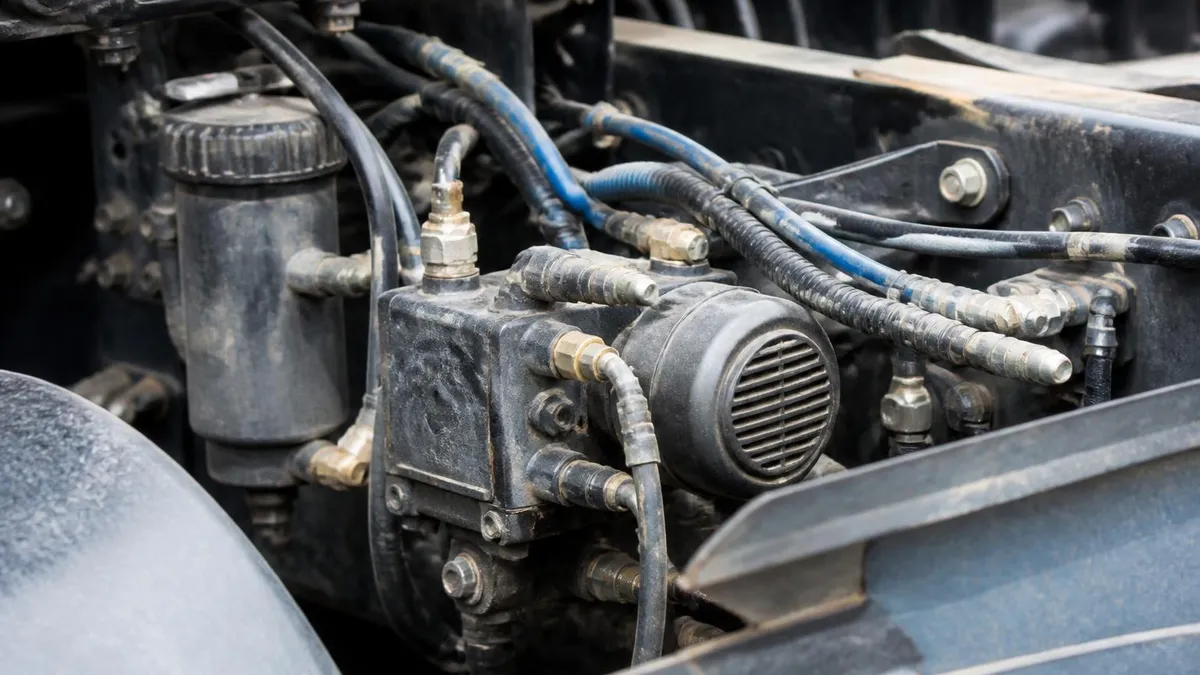
One of the practical reasons non-CDL box trucks dominate the under-26k market: they run hydraulic brakes, not air brakes. Air brake systems are heavier, more complex, and require a specific air-brake endorsement on a CDL plus a separate written and skills test. Manufacturers building trucks for the non-CDL class deliberately spec hydraulic disc or drum brakes — Isuzu NPR, Hino 155, Mercedes Sprinter, and Ford F-450/F-550 chassis are all hydraulic. If you want to study the air-brake material anyway in case you upgrade, our CDL air brakes practice test covers the same material the DMV tests.
No air brakes means no endorsement, no separate inspection, and no air-brake annual recertification. That removes a meaningful training and testing barrier — many CDL candidates fail the air-brake portion of their road test on the first try. For a non-CDL driver, you just service the brakes like you would on any heavy-duty pickup.
Annual DOT inspections are still required for any truck over 10,001 lb GVWR engaged in interstate commerce, but those go through a standard certified mechanic, not a specialized commercial vehicle inspector. Brake fade on long descents remains a real risk in any hydraulic-brake commercial truck — engine braking and lower-gear technique still matter.
Non-CDL Box Truck Startup Checklist
- ✓Confirm truck GVWR is at or below 26,000 lb (check the door-jamb sticker)
- ✓Pass DOT physical and obtain the MCSA-5876 medical certificate
- ✓Register for a free USDOT number via FMCSA Unified Registration System
- ✓Apply for MC operating authority if hauling for-hire freight ($300 fee)
- ✓Bind commercial auto insurance with $750K–$1M liability minimum
- ✓File BOC-3 process agent designation in every state of operation
- ✓Pay the annual UCR (Unified Carrier Registration) fee — $59 for 0–2 trucks
- ✓Set up IFTA fuel tax account if crossing state lines
- ✓Install an ELD or qualify for 150 air-mile short-haul exemption
- ✓Get on broker load boards (DAT, Truckstop, 123Loadboard) or platform accounts (Amazon Relay, FedEx CC)
Hot-shot trucking is the most popular non-CDL freight niche, and it's where many independent operators get their start. The basic setup is a 1-ton or 1.5-ton dually pickup (Ford F-350/F-450, Ram 3500/4500, Chevy Silverado 3500) towing a 30–40 foot gooseneck flatbed trailer. As long as the truck stays under 26,001 GVWR and the trailer stays under 10,001 GVWR, you operate the entire combination on a Class C license.
Hot-shot loads are typically expedited LTL (less-than-truckload) freight — equipment for oilfields, construction job sites, agricultural pickups, last-mile machinery delivery. Pay structure runs $1.50–$3.50 per loaded mile for owner-operators on load boards like DAT, Truckstop, and 123Loadboard. Realistic gross revenue for a busy single hot-shot operator is $150,000–$220,000 per year, with $60,000–$110,000 in net after fuel, insurance, maintenance, and depreciation.
Box truck hot-shot — using an Isuzu NPR or similar — works for sealed-cargo freight where weather protection matters. Less common than flatbed hot-shot, but a growing niche for medical equipment, art transport, IT/server moves, and small-quantity retail replenishment. Margins are tighter because deadheading without a trailer to drop is harder, but the loads pay premium rates.
Non-CDL Box Truck Pros and Cons
- +No CDL school tuition required — saves $4,000–$7,500 and 3–6 weeks of training
- +No air-brake endorsement, no skills test, no separate state CDL fees
- +Lower commercial insurance premiums versus CDL Class A operations
- +Most routes are regional or local — sleep in your own bed most nights
- +Strong demand from Amazon Relay, FedEx Custom Critical, and last-mile retail
- +Entry-level path to test the trucking industry before committing to a CDL
- −Earnings ceiling is lower than CDL Class A (typically $60K–$130K net for owner-operators)
- −Smaller payload — limits which freight you can haul profitably
- −Still subject to full FMCSA HOS, DOT medical, and USDOT rules over 10,001 lb
- −Insurance and authority costs scale with the same broker requirements as CDL fleets
- −Limited cross-country opportunities — most loads are short and medium haul
- −Brokers and shippers sometimes prefer CDL carriers, narrowing the load pool
Pros and Cons at a Glance
| Pros | Cons |
|---|---|
| No air-brake endorsement, no skills test, no separate state CDL fees | Smaller payload — limits which freight you can haul profitably |
| Lower commercial insurance premiums versus CDL Class A operations | Insurance and authority costs scale with the same broker requirements as CDL fleets |
| Most routes are regional or local — sleep in your own bed most nights | Limited cross-country opportunities — most loads are short and medium haul |
| Strong demand from Amazon Relay, FedEx Custom Critical, and last-mile retail | Brokers and shippers sometimes prefer CDL carriers, narrowing the load pool |
Amazon Relay runs a non-CDL segment specifically for box trucks rated 14,000–26,000 lb GVWR. The Relay platform lists prebooked loads — fixed origin, fixed destination, fixed rate — that you accept through the Amazon Relay app. Most non-CDL Relay loads are middle-mile (warehouse to delivery station, 100–400 mile routes), pay $1.10–$1.80 per mile, and let you stay regional. You need a USDOT number, MC authority, the standard insurance package, and a clean Relay carrier scorecard to maintain access.
FedEx Custom Critical contracts owner-operators for time-critical surface and air freight, and they explicitly accept non-CDL box trucks and cargo vans in their fleet. The pay is typically higher per mile than general freight (often $2.50+ for time-sensitive moves) but the work pattern is on-call: you need to be ready to roll within a few hours. Most Custom Critical drivers spec out a sleeper-equipped Sprinter or a 22-foot Isuzu NPR with a sleeping compartment so they can take cross-country expedited runs.
Other non-CDL freight platforms worth knowing: Convoy (now wound down but the platform model is widely copied), Uship for furniture and oversize household, GoShare for local moves, and Roadie for last-mile retail. Each has different onboarding documentation; most require the USDOT number plus a clean MVR (Motor Vehicle Record) and commercial insurance.
Beyond the load-board and platform routes, traditional employers hire non-CDL box truck drivers in volume. Penske, Ryder, and U-Haul all have local non-CDL delivery fleets. Furniture retailers like Ashley HomeStore, IKEA, and Restoration Hardware run their own last-mile delivery — these jobs pay $19–$28 per hour W-2 and include benefits. Appliance delivery (Home Depot Pro, Lowe's, GE Appliances) similarly hires non-CDL drivers for white-glove residential delivery.
Common employer requirements: 21 years old (sometimes 23 for interstate insurance), at least one year of driving experience, clean MVR with no DUI/major moving violations in the last 3–5 years, ability to pass a DOT physical, and basic English fluency for federal compliance. A few employers also require a clean criminal background — typical for last-mile residential delivery into customer homes. Some niches (medical courier, alcohol delivery, courthouse runners) require specific endorsements or licensing beyond the federal CMV layer.
If you're trying to break in, our CDL career overview covers the broader commercial driving landscape, and the what is a CDL primer explains when you might want to upgrade. For test prep on the CDL upgrade path, our Class A practice test and general knowledge practice test mirror the real DMV question format.
The non-CDL box truck path makes the most sense for drivers who want to start earning fast without committing 3–6 weeks of CDL school plus $4,000–$7,500 in tuition. With a clean driving record and a DOT physical, you can be moving freight legally in a week. Earnings ceilings are lower than long-haul CDL Class A (most non-CDL owner-operators top out around $130,000 net), but the work-life balance is materially better — most routes are regional or local, you sleep in your own bed most nights, and you skip the air-brake, sleeper-berth, and 70-hour-clock complexities of OTR trucking.
The biggest mistakes new non-CDL operators make: underinsuring (skimping below $1M liability so brokers won't book them), missing the USDOT renewal every two years (it's free but mandatory), and overlooking the IFTA fuel tax if they cross state lines. A simple compliance calendar with the MCS-150 update, IFTA quarterly filing, DOT medical card renewal, and annual UCR fee will keep you legal and bookable.
Looking ahead, the non-CDL truck segment is the fastest-growing slice of US freight. E-commerce middle-mile and last-mile volume keeps expanding, FedEx and Amazon both publicly target non-CDL drivers in their carrier acquisition programs, and the residential bulky-goods market (mattresses, appliances, furniture, fitness equipment) continues to shift away from common-carrier LTL toward dedicated white-glove fleets. That demand creates pricing power for drivers and carriers who treat the work professionally — keep your truck clean, keep your service scores high, keep your insurance current, and brokers will return your calls.
If your long-term plan is a CDL, run the non-CDL route for 6–12 months first. You'll build the operating-side skills (load booking, broker negotiation, insurance, IRP/IFTA, ELD discipline) that no CDL school teaches but every successful Class A owner-operator depends on. When you do upgrade, you'll know exactly which truck spec, which load board, and which insurance carrier fits your business model — instead of guessing in your first month on the road. The CDL guide walks through that upgrade path step by step.
CDL Questions and Answers
About the Author

Licensed Driving Instructor & DMV Test Specialist
Penn State UniversityRobert J. Williams graduated from Penn State University with a degree in Transportation Management and has spent 20 years as a certified driving instructor and DMV examiner consultant. He has personally coached thousands of applicants through written knowledge tests, skills assessments, and commercial driver licensing programs across more than 30 states.
Join the Discussion
Connect with other students preparing for this exam. Share tips, ask questions, and get advice from people who have been there.
View discussion (7 replies)