
CDL: Complete Commercial Driver License Guide 2026 September
CDL guide: Class A vs B vs C, endorsements (H, N, P, S, T, X), CLP, skills test, DOT medical, ELDT rules, state variations, and career pay. ✅
CDL: What the Commercial Driver License Actually Covers
The Commercial Driver License (CDL) is the federal credential required to legally operate large trucks, buses, and other commercial motor vehicles on US roads. It exists because driving a 26,001-pound vehicle through traffic is meaningfully different from driving a sedan, and the Federal Motor Carrier Safety Administration (FMCSA) decided in 1986 that drivers behind those wheels need uniform, tested, federally backed credentials. Every state issues its own CDL, but the underlying knowledge and skills standards come from federal regulations, so a CDL earned in Texas means the same thing in Ohio.
This guide walks through everything that actually matters about earning and keeping a CDL: the difference between Class A, Class B, and Class C, the endorsements you can add (H, N, P, S, T, X), the Commercial Learner's Permit (CLP) that comes first, the skills test you take in an actual truck, the medical card you have to carry, the new Entry-Level Driver Training (ELDT) requirements that took effect in 2022, the state-specific quirks that still matter despite federal harmonization, and what the career actually looks like in terms of pay, lifestyle, and job availability.
If you are starting from zero, the path looks roughly like this. You decide which class of CDL fits the job you want. You get your medical card from a certified examiner. You complete federally required ELDT theory training from a registered provider. You pass written knowledge tests at your state DMV and get your CLP. You hold the CLP for at least 14 days.
You complete behind-the-wheel ELDT training. You schedule and pass your skills test in an appropriate vehicle. You walk out with a CDL. Reviewing the CDL General Knowledge practice test builds the broad foundation that every CDL applicant needs regardless of class, because the general knowledge section appears on every state's written exam.
The whole process typically runs 4 to 12 weeks depending on whether you train through a private CDL school, a community college program, or an employer-sponsored paid training program. Costs range from essentially free (employer-sponsored) to about $7,000 for a full private school program. Working through the CDL Class A practice test covers the combination-vehicle knowledge that Class A applicants need beyond general knowledge, and the CDL Class B practice test covers the single-vehicle straight-truck and bus content that Class B applicants face.
CDL Snapshot by the Numbers
Class A vs Class B vs Class C: Which CDL Do You Actually Need?
The class of CDL is determined by the vehicle and what it tows, not by what cargo is inside. Class A is the broadest. It authorizes any combination of vehicles with a Gross Combination Weight Rating (GCWR) of 26,001 pounds or more, provided the towed unit weighs more than 10,000 pounds. In practice that means tractor-trailers, doubles, triples, tankers, and most over-the-road freight setups. A Class A holder can also operate Class B and Class C vehicles, which is why most career drivers default to Class A even when their first job uses a straight truck.
Class B authorizes single vehicles with a Gross Vehicle Weight Rating (GVWR) of 26,001 pounds or more, plus those same vehicles towing a trailer up to 10,000 pounds. Dump trucks, garbage trucks, large delivery trucks, city buses, school buses (with the right endorsement), and most straight cement mixers fall under Class B. A Class B holder can operate Class C vehicles but not Class A combinations.
Class C covers vehicles that do not meet Class A or Class B size thresholds but require a CDL because of what they carry or how many passengers fit. A 15-passenger van that hauls schoolchildren needs a Class C with the right passenger and school bus endorsements. A 20,000-pound truck carrying placarded hazardous materials needs a Class C with the hazmat endorsement. The class is small but real, and several roles in airport shuttle, hotel transport, and small-bus operations are Class C jobs.
Pick your class based on the job you want, not the easiest test. Trucking employers overwhelmingly hire Class A drivers because the combination authorization opens nearly every freight job. School bus operators specifically need Class B or C with passenger and school bus endorsements. Municipal sanitation departments hire Class B. Choose deliberately. Practicing with the CDL Combination Vehicles practice test covers the coupling, uncoupling, and combination-specific knowledge that Class A applicants face on the written exam.
Bottom Line on Class Selection
If you are unsure which class to pursue, default to Class A. It opens the broadest set of trucking jobs, automatically authorizes Class B and Class C operation, and is what nearly every freight carrier hires for. Choose Class B only when your specific target job (city bus, school bus, dump truck, sanitation) is a single-vehicle operation. Choose Class C only when the role specifically requires it — small passenger van operations and certain placarded hazmat positions in light trucks.
The Commercial Learner's Permit (CLP) Comes First
Before you can take a CDL skills test, you must hold a Commercial Learner's Permit (CLP) for a minimum of 14 days. The CLP lets you operate a commercial motor vehicle on public roads only when accompanied by a CDL holder of the same or higher class who is seated next to you. You cannot drive solo, you cannot transport passengers (except training personnel and authorized employees), and you cannot carry hazardous materials requiring placards.
Getting the CLP requires passing the written knowledge tests for your target class and any endorsements you want, providing proof of identity and residency, showing a valid US DOT medical examiner's certificate, and paying state fees that typically run $20 to $60. You also need to self-certify your type of commercial driving (interstate non-excepted, intrastate non-excepted, interstate excepted, or intrastate excepted) because that determines which medical standards apply to you.
The 14-day holding period is a federal floor. Some states allow you to schedule your skills test on day 15. Others have practical limits because of testing center backlogs. Plan your timeline to allow at least 30 to 60 days from CLP issuance to skills test in most metro areas.
The CLP is valid for 180 days. If you do not complete your skills test in that window you must reapply, and many states require retaking the written tests. Build a study and training schedule that gets you to skills test readiness comfortably within the permit window.
CLP to CDL Step Sequence
Get certified by an FMCSA-registered medical examiner. Bring eyeglasses, medication list, and any specialist records for managed conditions. Cost $75-$150. Schedule 60-90 days before CLP application to allow time to resolve any treatable issues.
Complete federally required theory training from a TPR-registered provider. Covers 31 federal topics across basic operation, safe operating procedures, advanced practices, vehicle systems, and reporting. Typically 40-60 hours, often online or hybrid.
Pass general knowledge, air brakes (if applicable), combination vehicles (Class A), and any endorsement written tests at your state DMV. Bring identity, residency, and medical card documents. Pay $20-$60 in state fees.
Federal minimum holding period before skills test. Use this time for behind-the-wheel ELDT training. CLP is valid 180 days total — plan your timeline accordingly.
Complete in-person range and road training at a TPR-registered provider. No federal hour minimum — proficiency-based completion. Quality programs run 80-160 hours behind the wheel.
Three parts: vehicle inspection oral exam, basic control skills (backing maneuvers), and road test. Conducted in a vehicle matching your target class and endorsements. Most state DMVs or third-party examiners schedule 1-4 weeks out.
After passing all three skills sections, your state DMV issues the CDL. Photo, fingerprint (some states), payment of license fee ($40-$100), and you walk out with the credential. H endorsement may delay issuance pending TSA assessment completion.
CDL Endorsements: H, N, P, S, T, and X Explained
Endorsements add specific authorizations to a CDL beyond the base class. Each endorsement requires passing its own written knowledge test and, in two cases, additional federal vetting or skills testing. Endorsements appear as single letter codes on the physical CDL card.
H is Hazardous Materials. The H endorsement allows the holder to transport hazardous materials in quantities that require placarding under federal hazmat regulations. It is the only endorsement that requires a Transportation Security Administration (TSA) background check, fingerprinting, and a security threat assessment. The full TSA process typically takes 30 to 60 days and costs about $87. The H endorsement also requires periodic renewal of the TSA assessment, usually every 5 years.
N is Tank Vehicles. The N endorsement covers driving any vehicle with a permanently mounted tank or with a portable tank rated 1,000 gallons or more carrying liquid or gaseous materials. Fuel haulers, milk haulers, water tankers, and chemical tankers all need N. The endorsement is a single written test with no separate federal vetting.
P is Passenger. The P endorsement is required to drive a vehicle designed to carry 16 or more passengers including the driver. City buses, charter buses, and many shuttle operations fall under P. A skills test in a passenger-carrying vehicle is required in addition to the written exam.
S is School Bus. The S endorsement is the most heavily regulated. It requires the P endorsement as a prerequisite, a separate written test, a separate skills test in a school bus, additional state background checks, and in most states additional state-specific training. Pass the CDL Hazmat practice test before scheduling the TSA process, because failing the written test after starting fingerprinting wastes time and money.
T is Double or Triple Trailers. The T endorsement covers operating combinations with two or three trailers. It is a written test only with no separate skills component. It is more common on the West Coast and in long-haul LTL operations than in the East.
X is the combined Tank and Hazmat endorsement. It appears as a single code on some state licenses when both N and H are held, simplifying card display. Functionally, X is N plus H. Reviewing the CDL Passenger Transport practice test covers the loading, securement, and passenger-management content that the P endorsement test covers, and the CDL School Bus practice test covers the additional student-loading, railroad-crossing, and emergency-evacuation content unique to the S endorsement.

Endorsements at a Glance
Required for transporting placarded hazardous materials. Written knowledge test plus TSA background check, fingerprinting, and security threat assessment. TSA fee approximately $87. Renewal of TSA assessment every 5 years. Total timeline to fully activate H endorsement is typically 30-60 days. Drivers earn 5-15 percent pay premium for hazmat-qualified routes.
The CDL Skills Test: Three Parts in One Day
The skills test is the practical exam that follows the CLP and ELDT requirements. It has three sequential parts, conducted in a commercial vehicle appropriate to the class and endorsements being tested. Failing any part typically ends the day, and you must reschedule the remaining sections.
The vehicle inspection test is first. The examiner asks you to identify and verbalize the condition of components on the vehicle: engine compartment items, in-cab items, lights and reflectors, brake system components, tires and wheels, suspension, coupling system for combination vehicles, and trailer-specific items. You must demonstrate that you know what to inspect and how to recognize defects. Memorizing the inspection script word-for-word is common practice and effective.
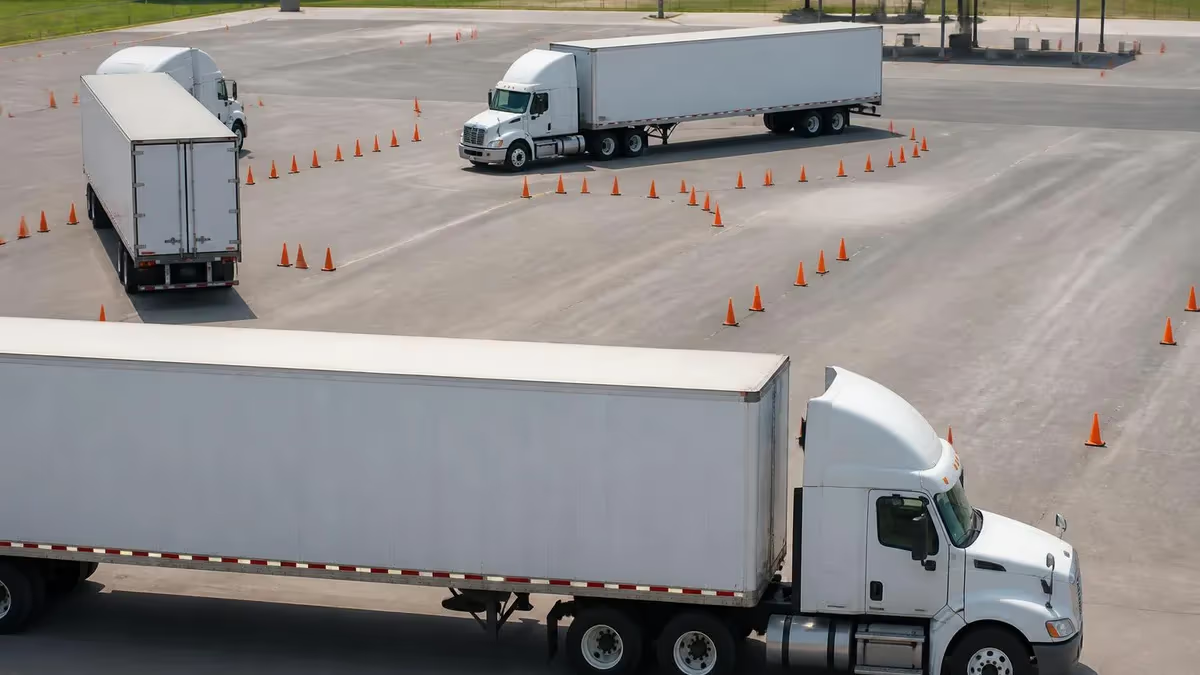
The basic control skills test is second. The examiner directs you through maneuvers in a controlled area: straight-line backing, offset backing left or right, parallel parking on the driver side or sight side, and alley docking. You are scored on encroachment of boundary lines, pull-ups (forward corrections during a backing maneuver), and final position accuracy. Backing a 53-foot trailer accurately is a skill that takes practice; expect this to be the section where most candidates need the most training time.
The road test is third. The examiner accompanies you on a predefined route covering urban driving, highway driving, intersections, lane changes, turns, railroad crossings, and bridges. You are graded on traffic checks, signal use, speed management, space management, and overall safe operation. Errors that disqualify you immediately include unsafe lane changes, hitting curbs, failing to stop completely at stop signs, and any incident requiring examiner intervention. Most candidates pass the road test on first attempt if they have completed quality behind-the-wheel training.
Federal Entry-Level Driver Training (ELDT) regulations took effect February 7, 2022. Any new CDL applicant seeking a Class A, Class B, or the P, S, or H endorsement must complete theory and behind-the-wheel training from a provider listed on the FMCSA Training Provider Registry (TPR) before taking the skills test. Training completed at an unregistered school does not satisfy ELDT, even if the school is otherwise legitimate. Confirm TPR registration before enrolling in any CDL school.
The DOT Medical Card and Self-Certification
Every CDL applicant must be certified medically fit to operate a commercial motor vehicle by a medical examiner listed on the FMCSA National Registry of Certified Medical Examiners. The exam itself, which costs $75 to $150 in most markets, evaluates vision, hearing, blood pressure, cardiovascular health, neurological status, mental health, and any condition that could impair safe operation. Common disqualifiers include uncontrolled diabetes, severe sleep apnea without effective treatment, recent seizures, and certain cardiovascular conditions. Many conditions allow continued certification with documentation, treatment compliance, or shorter certificate periods.
The DOT medical card is typically valid for 24 months. Drivers with certain managed conditions receive shorter periods (3, 6, 12 months) requiring more frequent recertification. The card must be carried while operating commercially in interstate commerce, and most states require it on file with the licensing authority for the CDL itself to remain valid. Letting the medical certificate lapse downgrades the CDL until certification is restored.
CDL Application Checklist
- ✓Decide target class (A, B, or C) based on the specific job you want
- ✓Decide target endorsements (H, N, P, S, T, X) based on cargo or passenger plans
- ✓Schedule DOT medical exam with a National Registry certified examiner 60-90 days before CLP application
- ✓Verify your prospective CDL school is on the FMCSA Training Provider Registry before paying tuition
- ✓Complete federal ELDT theory training (typically 40-60 hours)
- ✓Gather identity, residency, Social Security, and citizenship/legal residence documents required by your state DMV
- ✓Self-certify your commercial driving type (interstate non-excepted, intrastate non-excepted, interstate excepted, intrastate excepted)
- ✓Pass CLP written tests at state DMV — general knowledge plus air brakes plus class-specific plus endorsement tests
- ✓Complete ELDT behind-the-wheel training (proficiency-based, typically 80-160 hours)
- ✓Start TSA hazmat threat assessment immediately after CLP issuance if pursuing H endorsement
- ✓Practice backing maneuvers at least 30-50 repetitions before scheduling skills test
- ✓Schedule skills test in vehicle appropriate to target class and endorsements

ELDT and State-by-State Variations
The ELDT mandate harmonized theory training nationally but did not create a single national CDL school standard. Each TPR-registered provider designs its own curriculum within the federal theory framework. The federal theory portion covers 31 specific topics including basic operation, safe operating procedures, advanced operating practices, vehicle systems, and reporting incidents. Theory courses are typically 40 to 60 hours and increasingly offered online or hybrid.
Behind-the-wheel training is delivered in person at the registered provider's range and on public roads. There is no minimum federal hour requirement for behind-the-wheel training — instead, the candidate must demonstrate proficiency on each required skill before the provider certifies completion. In practice, most quality programs run 80 to 160 hours behind the wheel. Cheap programs that rush behind-the-wheel hours produce candidates who fail skills tests; this is one area where price often correlates with outcome.
State-by-state variations still matter even with federal ELDT. Some states require additional state-specific knowledge tests beyond federal content. Some states require longer CLP holding periods than the 14-day federal minimum. School bus endorsement requirements vary substantially state to state — some states require 20+ hours of state-specific S endorsement training in addition to federal ELDT. Check your specific state's DMV CDL page before assuming the federal baseline is sufficient.
Reciprocity between states is generally good for the base CDL. If you move from Florida to Georgia, you transfer your CDL by surrendering the Florida card and applying for the Georgia equivalent within the state's required window (typically 30 days). Endorsements transfer with the base license in most cases. The medical card transfers automatically because it is federal. Working through the CDL Doubles and Triples practice test covers the T endorsement content for drivers planning LTL or long-haul work where double trailers are routine.
CDL Career: Pros and Cons
- +Strong and persistent job demand across nearly every US market
- +Pay grows quickly with experience — first-year OTR drivers reach journeyman pay within 12-24 months
- +Specialty endorsements (H, N, X) and operations (oversize, heavy haul) command meaningful pay premiums
- +Credential is portable nationally — CDL transfers cleanly between states
- +Multiple lifestyle options — OTR, regional, dedicated, local — to match home time preferences
- +Path to owner-operator ownership for drivers willing to handle business operations and capital
- +Stable career across economic cycles — freight moves regardless of broader economy
- −OTR lifestyle requires 200-300 nights per year away from home
- −Medical requirements rule out candidates with uncontrolled diabetes, severe sleep apnea, or recent seizures
- −Skills test failure rate at lower-quality CDL schools is meaningful — choose programs carefully
- −Hours-of-service regulations limit daily and weekly driving time, capping income on a per-trip basis
- −Physical demands include long sitting, vehicle inspection bending and lifting, and freight handling at some accounts
- −Owner-operator path requires significant capital ($20K-$100K+) and business-management skills
- −ELDT mandate has increased training costs and reduced the easiest historical paths into the industry
CDL Career Outlook: Pay, Lifestyle, and Job Availability
Truck driving is one of the largest single-occupation employment categories in the United States, with roughly 3.5 million CDL holders working in over-the-road, regional, local, and specialty operations. Demand has been persistently strong, and the American Trucking Associations has estimated industry shortages of 60,000 to 80,000 drivers in recent years. Job availability is rarely a barrier for CDL holders willing to work over-the-road for a major carrier; local and regional positions are competitive but accessible after initial OTR experience.
Pay varies dramatically by sector. Entry-level over-the-road drivers at major carriers typically earn $50,000 to $65,000 in their first year. Experienced regional and dedicated route drivers commonly earn $70,000 to $90,000. Specialty operations like oversize, heavy haul, tanker, and hazmat add premiums of 15 to 40 percent over standard rates. Owner-operators with their own authority can earn $100,000 to $200,000+ gross but bear all operating costs. School bus drivers and city transit drivers earn $35,000 to $65,000 with benefits and predictable schedules that many drivers prefer over over-the-road pay.
Lifestyle is the major lifestyle decision in trucking. Over-the-road drivers spend 200 to 300 nights per year away from home, sleeping in truck sleeper berths or short hotel stays. Regional drivers are typically home weekends with a 5-day road, 2-day home pattern. Dedicated route drivers may be home nightly on consistent routes. Local drivers — delivery, sanitation, school bus, and city transit — are home every night. Pay generally correlates inversely with home time, so the highest-paying jobs typically require the most time away.
Career progression includes specialty operations (tanker, hazmat, oversize, heavy haul, refrigerated, auto transport), trainer or fleet manager positions, and ownership paths from company driver to lease-purchase to owner-operator. The CDL itself is a stable credential that holds value across employers and geographies, and the skills transfer cleanly between trucking sectors. Practicing with the CDL Tanker practice test covers the surge management and tank-specific content that drivers entering fuel, milk, or chemical hauling face on the N endorsement exam.
Choosing a CDL Training Program
The three main paths to a CDL are private CDL schools, community college CDL programs, and employer-sponsored paid training programs. Each has tradeoffs in cost, training quality, and post-completion obligations.
Private CDL schools charge $3,000 to $7,000 for complete programs covering theory, behind-the-wheel training, and skills test preparation. Quality varies enormously. The good schools have low student-to-truck ratios, experienced instructors, modern equipment, and high pass rates on first-attempt skills tests. The bad schools rush students through behind-the-wheel hours, use poorly maintained equipment, and have first-attempt pass rates below 60 percent. Always check TPR registration, ask for first-attempt pass rate data, and visit the facility before enrolling.
Community college CDL programs typically cost $1,500 to $4,000 and often qualify for state workforce funding, Pell Grants, or veteran benefits that further reduce out-of-pocket cost. Programs run 8 to 16 weeks and tend to be slower-paced than private schools, which suits adult learners but extends time-to-license. Quality is generally consistent because community colleges are accredited and audited.
Employer-sponsored programs cost zero up front, with carriers like Schneider, Werner, Roehl, and Stevens Transport covering training cost in exchange for a contractual commitment to drive for the carrier for 6 to 12 months after licensing. The contractual obligation is enforceable — leaving early typically triggers repayment of training costs ranging from $4,000 to $7,000. Pay during training is lower than journeyman pay (often $500 to $700 per week during the initial training period). For candidates without savings, employer-sponsored programs are often the only viable path; the post-training pay then catches up to industry standards quickly.
Common Pitfalls and How to Avoid Them
The most common reason CDL candidates fail their skills test is insufficient backing practice. Backing a long combination vehicle accurately requires significant repetition and feel for trailer pivot points that no amount of theory study can replace. If you have not personally backed a 53-foot trailer at least 30 to 50 times during training, you are likely under-prepared for the basic control portion of the skills test. Push your training program for more backing time, even if you have to pay for additional hours.
The second most common issue is the vehicle inspection oral exam. Candidates who treat inspection as memorization without practical understanding fail when examiners ask follow-up questions outside the rote script. Combine memorization of the inspection sequence with hands-on understanding of why each component is checked and what failure looks like. Examiners reward demonstrated understanding over recited lines.
The third pitfall is medical card timing. Some candidates schedule the DOT physical at the last minute and discover a treatable condition (high blood pressure, vision issue) that delays certification by weeks. Get your DOT physical 60 to 90 days before you plan to start CLP testing so any treatable issues have time to resolve.
Finally, candidates underestimate the time commitment of the H endorsement TSA process. If you want H from day one, start the TSA Hazardous Materials Endorsement Threat Assessment process as soon as you have your CLP — typically within the first week. Otherwise the TSA timeline becomes the bottleneck that delays your full license issuance by a month or more after the skills test passes.
CDL Questions and Answers
About the Author

Licensed Driving Instructor & DMV Test Specialist
Penn State UniversityRobert J. Williams graduated from Penn State University with a degree in Transportation Management and has spent 20 years as a certified driving instructor and DMV examiner consultant. He has personally coached thousands of applicants through written knowledge tests, skills assessments, and commercial driver licensing programs across more than 30 states.
Join the Discussion
Connect with other students preparing for this exam. Share tips, ask questions, and get advice from people who have been there.
View discussion (7 replies)