
CDL Refresher Course: Return to Trucking Driver Retraining Guide 2026 September
A CDL refresher course rebuilds skills for drivers out 3+ years. Costs, free funding options, top carriers, ELDT rules, and HOS updates. 🏆
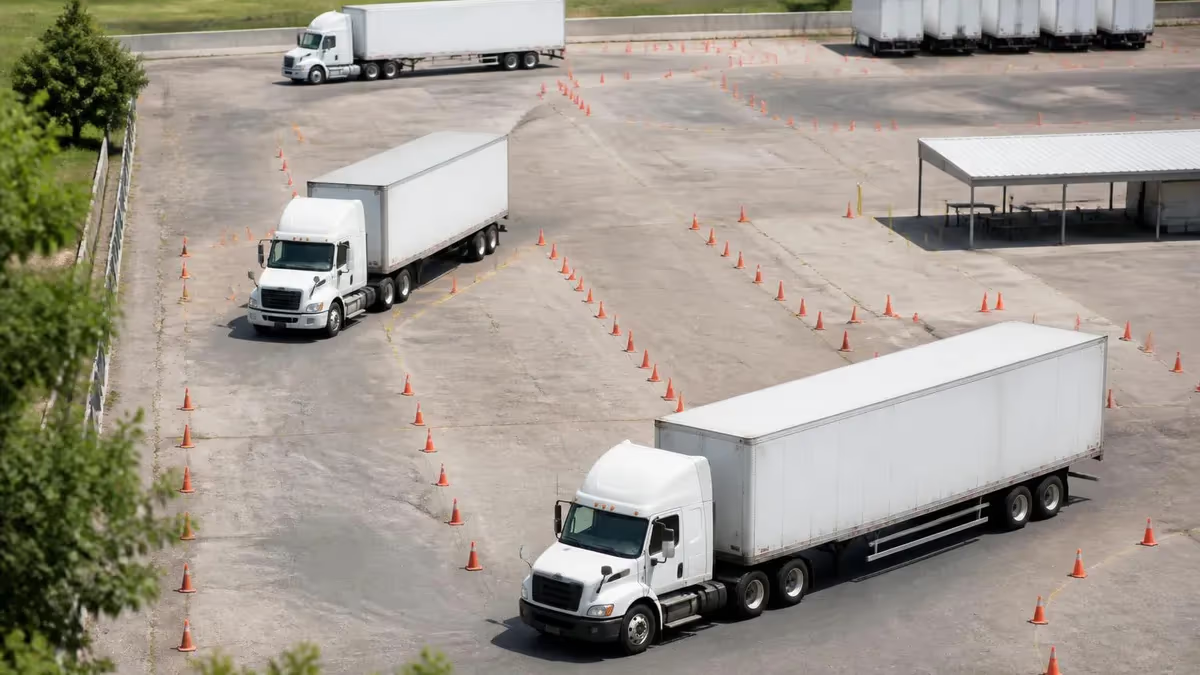
You earned a CDL, drove a truck, and then life pulled you off the road. Maybe a family situation, a back injury, a different career, or a stint in another industry kept you out of the cab for three, five, or even ten years. Now you're ready to come back. The trucking world you left is not the one you're stepping into.
ELDT, mandatory electronic logs, new HOS split-sleeper options, automated transmissions, lane cameras, speed limiters, and carriers pushing 14-day pre-hire courses — it's a lot. A CDL refresher course closes that gap fast.
This guide walks through everything a returning driver should know before signing up. Who actually qualifies as a refresher candidate versus needing a full ELDT theory course. What skills get covered in a typical one-week or two-week format. Realistic 2026 pricing. The funding pots most schools won't mention. The carriers paying drivers to retrain.
By the end you should walk into an enrollment office knowing what to ask, what to refuse, and what your timeline back to a paycheck really looks like.
CDL Refresher Course at a Glance
The refresher market in 2026 looks nothing like it did before the ELDT rule went live on February 7, 2022. Up until then a returning driver could call any local CDL school, pay a few hundred dollars for a half-day yard session, and head straight into orientation at a fleet.
That backdoor still works in narrow cases. The FMCSA's Training Provider Registry now controls who is allowed to deliver training that counts toward upgrades, downgrades, or reinstatement. If your CDL is current and clean, your refresher is a skills-only program. If your CDL has lapsed, was downgraded, or you added time off the road that triggered retesting, you may need a hybrid course that mixes ELDT theory with practical re-skilling.
Knowing which bucket you fall into changes the price by thousands.
If your CDL is current and you've simply been out of the seat, you need a skills-only refresher. If your CDL has lapsed beyond your state's grace period, been downgraded, or canceled, you may need a hybrid course with ELDT theory hours. Call your state DMV before paying any school a deposit.
Who actually needs a refresher
The textbook answer is anyone out of the seat three years or more. The real-world answer is messier. Carriers set their own re-entry windows. The cutoff you'll see most often in 2026 is a verifiable 12 months of solo OTR or regional driving in the last three years.
Below that threshold, most major fleets — Schneider, Werner, Knight-Swift, CRST, Marten, US Xpress — will not put you in a truck without a documented refresher. Your CDL can hang on the wall in pristine condition. It does not matter.
Beyond the three-year rule, there are five situations that almost always require a refresher. Any DOT-recordable accident in the prior 24 months, even one without a citation. An at-fault preventable in the previous 12 months. More than one moving violation in 36 months. Any DUI, DWI, or controlled-substance refusal that pushed you into a return-to-duty SAP process. Drivers leaving military service whose CDL stayed current under the SCRA but who weren't actually driving commercial equipment.
Owner-operators sometimes skip refreshers and just buy more insurance. With commercial auto premiums up 32% since 2022, that math no longer works. Underwriters now offer 10-18% discounts on year-one premiums for drivers who complete a refresher from a CVTA or PTDI-accredited school. That discount typically pays for the course inside six months.
Six Skill Blocks in a Standard CDL Refresher
Full inspection routine to state-examiner standard, plus digital DVIR practice on Samsara and Motive.
Straight-line, offset right, offset left, parallel parking, and alley dock — all timed under examiner conditions.
Manual recovery on 10-speed or 13-speed; automated transmission familiarization for newer fleet specs.
Fifth wheel inspection, glad-hand connection, brake-line routing, and trailer release sequence.
City and highway segments, defensive driving, lane discipline, and following-distance practice.
Electronic logs, HOS trip planning, malfunction handling, and roadside-inspection paperwork.
What a real refresher covers
Curricula vary wildly between schools, so compare syllabi line by line before paying anything. A solid program covers six skill blocks. Each one matters.
Pre-trip and post-trip inspection is the first and most-failed module. Instructors retest you on the full interior, engine compartment, in-cab brake check, and walk-around at the same precision a state examiner uses. Backing comes next: straight-line, offset right, offset left, parallel, alley dock.
Shifting recovers if you ever drove a 10-speed or 13-speed manual. Many fleets now spec automatics, but FMCSA puts a manual-transmission restriction on the license of anyone who tests in an auto. That restriction blocks most flatbed and tanker jobs.
Coupling and uncoupling — what most drivers forget first — gets its own afternoon. On-road operation, ideally with one shift of city driving and one of highway, finishes the in-cab portion. The final block is paperwork and electronics: e-log operation on Samsara, Motive, or Omnitracs, plus trip planning with current HOS rules.

Three Refresher Formats Compared
Five days, eight to ten hours each. Day-by-day: pre-trip, yard maneuvers, road, mock DOT, final evaluation. Best for drivers out of the seat under five years with a current CDL and clean MVR. Tuition $1,500-$3,500.
How the refresher week unfolds
Day one usually starts in a classroom with paperwork, an MVR pull, and a 50-question diagnostic that tells the instructor what you remember versus what your CDL says you should. From there you move to a tractor for an instructor-led pre-trip.
By day two you're in the yard with cones and parking blocks. Expect to do every backing pattern at least four times under timed conditions. Day three pushes you onto secondary roads, then onto a controlled-access highway for at least one hour of cruise.
Day four introduces a mock DOT inspection — a roadside scene with a clipboard, a fake officer, and a real ECM download. Day five is the final evaluation, graded the way a third-party examiner would: pre-trip, basic skills, road, with a hard pass or fail. A reputable school sends you home with a written evaluation, scoresheet copies, and a CVTA completion certificate.
Any "free refresher" tied to an owner-operator lease commitment instead of a W-2 seat is almost always a financial trap. Legitimate carrier-paid programs come with W-2 employment, health benefits, and a sign-on bonus — not weekly truck payments deducted from your settlement.
Pricing in 2026
Refresher tuition in 2026 lands between $1,500 and $3,500 for the one-week format. The two-week format runs $2,800 to $5,200. Three factors drive the price up. Equipment quality matters — a 2023 Cascadia with a DT12 costs the school more than a 2015 Volvo manual. One-on-one instructor time matters. Adding endorsements like hazmat or tanker matters.
A few markets are outliers. Los Angeles, Seattle, and the Northeast corridor can hit $4,800 for a single week. Those metros are also where carrier-sponsored programs cluster, so few drivers pay full freight.
Beyond tuition, plan for a DOT physical of $85-$150, a hair or urine drug screen of $55-$220, MVR pulls of $8-$25 per state, and a medical card update. If your CDL has lapsed under two years, most states charge a reinstatement fee of $20-$60. Lapses beyond two years usually trigger a full retest, which is its own line item.
Free funding that almost nobody talks about
Paying out of pocket should be the last resort. Five funding streams cover refresher tuition for most eligible drivers, and you can stack two or three of them.
The Post-9/11 GI Bill and Montgomery GI Bill both cover CDL training, including refreshers at VA-approved schools. The VA pays tuition direct to the school plus a monthly housing allowance based on the school's ZIP code. For many returning veterans, that allowance is more cash during training week than a slow OTR week used to pay. Search the VA's WEAMS Public Search for approved programs.
VR&E (Chapter 31) covers refreshers for any veteran with a service-connected disability rating, even at 0%. VR&E pays tuition, books, equipment, and a subsistence allowance. Approval takes 30-45 days, so file early.
WIOA funds refreshers through state and local workforce boards. Coverage averages 100% of tuition up to $7,000. No income cap applies for dislocated workers. Walk into any American Job Center, request an Individual Training Account, and bring a school selection from the state's ETPL.
State trade adjustment programs cover refreshers when a driver's last employer was certified TAA — common for warehouse and manufacturing workers laid off by import competition. Pell Grants from the Department of Education will cover CDL refresher tuition at any Title-IV school. The list keeps growing since the FY2024 expansion of short-term Pell to programs as short as 150 clock hours.
Bring This to Day One
- ✓Current CDL and DOT medical card
- ✓Social Security card and a second photo ID
- ✓Ten years of work history with dates and supervisor contacts
- ✓MVR pulls from every state you have been licensed in
- ✓Last three years of address history
- ✓Two pairs of work boots and weather-appropriate gloves
- ✓Headlamp for pre-dawn pre-trip inspections
- ✓Notebook for jotting instructor tips and ELD codes
- ✓Funding paperwork: VA Certificate of Eligibility, WIOA ITA, or Pell award letter

Carriers that pay you to retrain
The fastest path back to a paycheck is a refresher paid for and delivered by the carrier itself. Schneider, Werner, Knight-Swift, US Xpress, Marten, CRST, and TransAm all run formal paid-refresher programs in 2026.
Schneider's program is the most polished — a 10-day course at training centers in Indianapolis, Charlotte, Dallas, or Phoenix. Weekly pay during training (about $700 in 2026), free lodging, and a guaranteed solo seat with a sign-on bonus of $4,000 to $8,000.
Werner pays drivers during training and offers sliding-scale tuition reimbursement for drivers who completed an outside refresher within the prior 90 days. Knight-Swift runs a 7-day refresher out of Phoenix and Atlanta with similar pay-during-training. CRST's program is shorter (typically 5 days) but requires a team-driving contract for the first six to eight months. Marten operates regional refreshers and is one of the few carriers that hires returning drivers directly into dedicated lanes.
A carrier-paid refresher always comes with a contract — usually 9 to 12 months of employment with prorated tuition repayment if you quit early. Read the contract before training day one, not after. Most repayment amounts are $4,000-$7,000, prorated month by month, and enforceable as a wage advance.
Carrier-Paid Refresher Pros and Cons
- +Tuition fully covered by the carrier — zero out-of-pocket
- +Pay during training week, usually around $700 weekly
- +Guaranteed seat with sign-on bonus at completion
- +Free lodging at the training facility
- +Direct path into orientation with no schedule gap
- −9-12 month employment contract with prorated repayment clause
- −Less choice of fleet, lane, and home-time pattern
- −Some carriers use older training equipment than independent schools
- −Orientation pace can feel rushed for drivers out of the seat over five years
- −Sign-on bonuses are typically paid out over the contract, not upfront
Pros and Cons at a Glance
| Pros | Cons |
|---|---|
| Tuition fully covered by the carrier — zero out-of-pocket | Less choice of fleet, lane, and home-time pattern |
| Guaranteed seat with sign-on bonus at completion | Some carriers use older training equipment than independent schools |
| Free lodging at the training facility | Orientation pace can feel rushed for drivers out of the seat over five years |
| Direct path into orientation with no schedule gap | Sign-on bonuses are typically paid out over the contract, not upfront |
ELDT and what it changes for re-entries
Entry-Level Driver Training rules took effect February 7, 2022. Re-entries have spent four years untangling whether the rule applies to them.
Short version: ELDT applies to anyone obtaining a CDL for the first time, upgrading from Class B to Class A, or adding a hazmat, school bus, or passenger endorsement after February 2022. ELDT does not apply to a driver who already holds the credential and is renewing it on schedule.
The wrinkle is what happens when your CDL has been downgraded or canceled for any reason — non-payment of renewal, failure to update medical, an out-of-state move without timely transfer. In those cases, the state may treat reinstatement as a new issuance, which loops ELDT back into the picture. Always check with your state DMV before assuming a refresher is sufficient. The answer varies by state and sometimes by examiner.
Hours of Service: what's changed
The HOS rules you memorized for your original test have been revised twice since 2020. A third round of FMCSA tweaks is on the table for 2026.
The biggest changes from a pre-2020 driver's perspective: the 30-minute break is now triggered by 8 hours of driving rather than 8 hours on duty. The split-sleeper-berth provision now allows a 7/3 split alongside the original 8/2. The short-haul exception extended from 12 to 14 hours and from 100 to 150 air miles. The adverse-driving-conditions exemption expanded to include the 14-hour driving window.
Equally important is the shift from AOBRD to ELD. AOBRD devices were grandfathered until December 2019. By 2020 every interstate carrier had to be on a registered ELD. Refresher instructors walk you through ELD edit certifications, annotation versus driver edit, malfunction code handling, and the eight-day display requirement at roadside. If your last drive was in an AOBRD truck, this is the section to study hardest.
Picking the right school
Accreditation matters more than marketing. Look for CVTA membership, PTDI certification, or both. Confirm the school appears on the FMCSA Training Provider Registry.
Ask for the school's first-attempt pass rate on state skills exams. Anything below 85% is a red flag. Visit before you pay. Equipment age tells a story. If every yard tractor is over a decade old, the school is under-investing.
Talk to a current student in week two or three. Ask about instructor turnover. A school burning through instructors every quarter cannot deliver consistent training. Get the refund policy in writing. Reputable schools offer prorated refunds through day three. Predatory operations bury non-refund clauses in the orientation packet.
After the refresher: your first 90 days
Most drivers come out of refresher with two to four job offers in hand. The smart move is to accept a dedicated or regional position rather than long-haul OTR for the first 90 days. Dedicated runs give you predictable home time, the same lanes day after day, and faster skill rebuild.
You'll also build a clean 90-day employment record that recruiters can verify. That opens up better lanes and pay grades from month four onward. Expect to log more pre-trip time than you did in your first stint behind the wheel — newer trucks have more sensors and more potential fault codes.
Expect at least one rough night where everything goes wrong: a clogged DEF line, a clogged toilet at the truck stop, a dispatcher routing you into a low bridge. Those are normal, not signs you made the wrong move.
Drivers who succeed in their return treat the refresher as the start of the job, not a hurdle. Show up curious. Re-read the CDL manual the night before each training day. Ask the instructor what they would do differently in your shoes. Practice backing in your hotel parking lot with a rental sedan if you have to. The miles will come back. So will the paycheck.
Realistic pay expectations after the refresher
Returning drivers in 2026 should expect first-year pay of $58,000 to $72,000 on solo OTR with a major fleet, $62,000 to $80,000 on regional dedicated, and $75,000 to $95,000 on tanker, doubles-triples, or hazmat lanes. Sign-on bonuses pay out over the first 6 to 12 months, often in three or four installments tied to clean inspections and on-time delivery metrics.
Per-mile rates for solo drivers range from $0.55 to $0.72 CPM, with detention, layover, and stop pay layered on top. Watch the fine print on accessorial pay — some carriers advertise $25 detention starting at the second hour, while others wait until the fourth. The difference adds up to thousands per year for a regional driver who sees frequent shipper delays during peak season. Always confirm the trigger hour and the cap before signing.
CDL Questions and Answers
About the Author

Licensed Driving Instructor & DMV Test Specialist
Penn State UniversityRobert J. Williams graduated from Penn State University with a degree in Transportation Management and has spent 20 years as a certified driving instructor and DMV examiner consultant. He has personally coached thousands of applicants through written knowledge tests, skills assessments, and commercial driver licensing programs across more than 30 states.
Join the Discussion
Connect with other students preparing for this exam. Share tips, ask questions, and get advice from people who have been there.
View discussion (7 replies)