
RQI BLS: Complete Guide to Resuscitation Quality Improvement Basic Life Support Certification
RQI BLS explained: 🏆 what is a BLS certification, how RQI differs from traditional AHA BLS, costs, renewal process, and exam tips for healthcare providers.
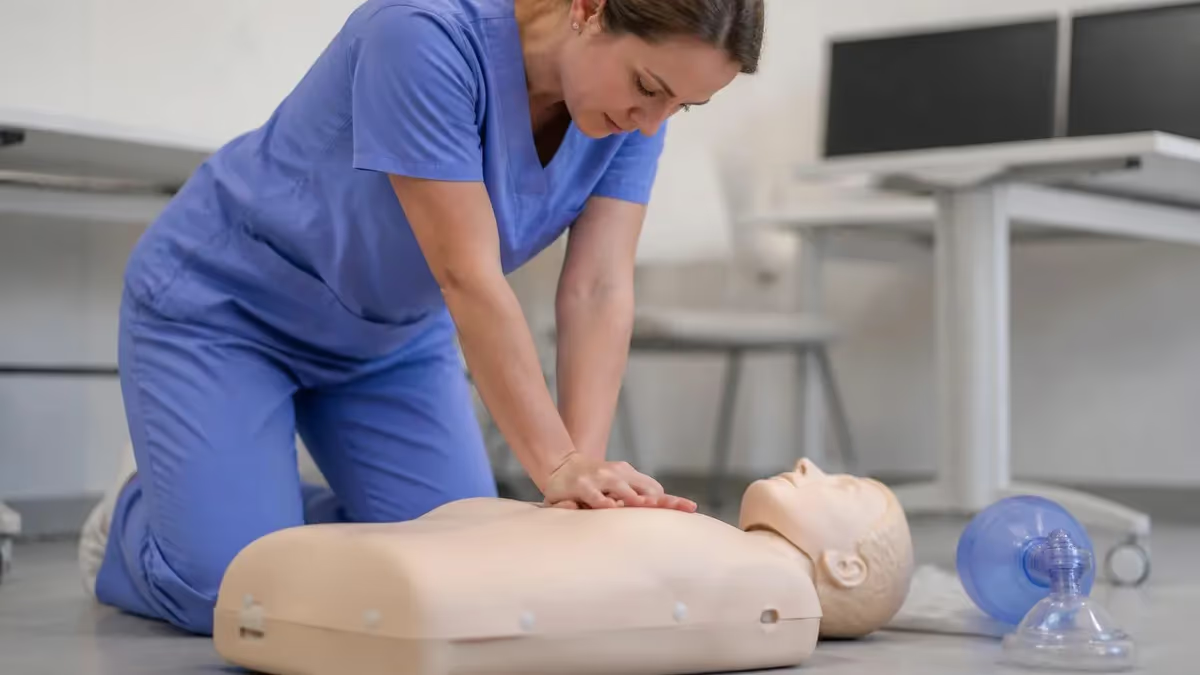
If you've been wondering what is a BLS certification and how the RQI BLS program fits into modern healthcare training, you're in the right place. RQI BLS stands for Resuscitation Quality Improvement Basic Life Support, a program co-developed by the American Heart Association and Laerdal Medical that replaces the traditional two-year renewal cycle with quarterly skills sessions. It's now the dominant credentialing pathway in most U.S. hospital systems, and understanding how it works is essential for nurses, respiratory therapists, paramedics, and physicians.
The RQI BLS program was designed around a simple insight backed by decades of research: psychomotor skills decay within three to six months after a traditional CPR class. By the time a typical provider's two-year card expires, their compression depth, rate, and recoil performance have often degraded well below the thresholds that produce neurologically intact survival. RQI addresses that decay by requiring short, focused skill verifications every 90 days using feedback-equipped manikins that measure performance in real time.
For many providers, the transition to RQI feels like a significant shift from the classroom-based BLS courses they took earlier in their careers. Instead of a single high-stakes day every other year, RQI BLS distributes learning across the year with cognitive modules online and hands-on sessions at simulation stations located in your facility. The result is a credential that many hospital administrators argue is more rigorous than legacy BLS, even though the underlying skill set, compressions, ventilations, AED use, and team dynamics, is identical.
This guide walks you through every meaningful aspect of RQI BLS, including how it compares to traditional American Heart Association courses, what the quarterly sessions actually involve, how passing thresholds are calculated, what employers expect, and how to prepare for the cognitive portion. We'll also look at how RQI compares to American Red Cross programs and whether your existing certification card transfers to a hospital using RQI.
You'll also learn how RQI integrates with broader resuscitation training, including ACLS and PALS variations of the same program. The Resuscitation Quality Improvement framework has spread well beyond BLS, and once you understand how the BLS component works, the others follow the same model. We'll also clarify the common confusion around whether is bls and cpr the same, since RQI uses the AHA's BLS guidelines as its foundation.
By the end of this article, you'll know exactly what RQI BLS requires, how to pass each quarterly session on the first attempt, what to do if you fail a measurement, and how to navigate the transition if your employer is moving from traditional AHA BLS to the RQI model. Whether you're a brand-new provider or a 20-year veteran adjusting to the new system, you'll find practical, current information that reflects how the program actually runs in 2026.
Let's start with the fundamentals, because before you can master RQI BLS, you need a clear picture of what BLS certification means in general and how the AHA's quality-improvement model changes the way that credential is earned and maintained.
RQI BLS by the Numbers

How the RQI BLS Program Is Structured
A short online learning activity, usually 10-20 minutes, covering one focused topic such as adult compressions, AED use, infant CPR, or team dynamics. Completed at your own pace before the skills session.
A 5-10 minute hands-on verification at a simulation cart installed in your facility. Adult, child, and infant manikins measure your compression depth, rate, recoil, and ventilation volume in real time and give immediate feedback.
After completing all four quarters of cognitive and skills work, the system issues a continuously refreshed credential equivalent to traditional BLS Provider status, accepted by hospitals, EMS agencies, and credentialing boards.
If you miss the threshold on any measured skill, the cart guides you through targeted micro-practice. You retry until you meet the standard, and your record reflects mastery rather than a binary pass or fail.
Upon successful completion of cognitive and skills components, the AHA issues a digital BLS Provider eCard valid for your verification cycle, accessible through your AHA Atlas profile and shareable with employers.
To answer the core question, what is a BLS certification, BLS stands for Basic Life Support, and the certification verifies that a provider can recognize cardiac arrest, perform high-quality CPR on adults, children, and infants, use an automated external defibrillator, and integrate as part of a resuscitation team. The credential is issued by training organizations approved to teach the American Heart Association curriculum, the American Red Cross curriculum, or programs recognized by state licensing boards. Most U.S. healthcare employers require AHA-aligned BLS as a condition of clinical privileges.
People often ask what does BLS stand for in different contexts, and the answer is the same across medicine, nursing, dentistry, and EMS, although the specific scope of practice differs. A nurse uses BLS skills to initiate a code while the rapid response team arrives. A paramedic uses them as the foundation upon which ALS interventions are layered. A dental assistant uses them to manage a syncopal patient in the chair. The basic life support for healthcare providers credential covers all of these settings because the underlying skill set is identical.
The American Heart Association basic life support exam, often referred to as the AHA basic life support exam, is the gold standard cognitive assessment. It includes a 25-question multiple-choice test administered after the classroom or online didactic component and a separate hands-on skills test. The cognitive portion requires 84 percent to pass, and the skills test is a binary competency demonstration. Under RQI, the cognitive content is broken into smaller quarterly modules instead of a single comprehensive exam, but the same evidence-based content is covered annually.
Many learners ask whether is BLS the same as CPR, and the short answer is that BLS includes CPR but adds team-based response elements, two-rescuer techniques, bag-valve-mask ventilation, choking management, and the use of AEDs in healthcare settings. CPR for laypersons covers compressions and breaths, while BLS layers on the equipment and teamwork that a clinical environment demands. If you're certified in BLS, you are certified in CPR, but the reverse is not true.
The American Red Cross also offers a basic life support program that is functionally equivalent to AHA BLS for most employer credentialing purposes. The Red Cross basic life support course covers the same skills, follows ILCOR guidelines, and produces a two-year card. RQI is currently an AHA-and-Laerdal product, so providers at hospitals using RQI typically carry the AHA credential, while Red Cross BLS remains common at outpatient clinics, dental offices, schools, and EMS agencies that prefer the traditional renewal model.
Understanding which credential your employer accepts matters enormously when you change jobs. Most hospital systems accept either AHA or Red Cross BLS for the initial hire, but once you're inside, you'll be enrolled in whichever program the organization uses, frequently RQI. If you're researching american red cross basic life support as an alternative, verify acceptance with the specific employer before paying for a course that may not meet their internal policy.
Finally, a basic life support renewal class can mean different things depending on the issuing organization. Under traditional AHA, a renewal is a shortened classroom course taken every two years before your card expires. Under RQI, there is no renewal class because verification happens continuously every 90 days. Under Red Cross, renewal follows the traditional model. Knowing which model applies to you determines whether you should be scheduling a course or logging into a simulation cart.
BLS Practice Test Questions
Prepare for the BLS - Basic Life Support exam with our free practice test modules. Each quiz covers key topics to help you pass on your first try.
BLS High-Quality CPR & Provider Skills
BLS Exam Questions covering BLS High-Quality CPR & Provider Skills. Master BLS Test concepts for certification prep.
BLS Special Situations & Scenarios
Free BLS Practice Test featuring BLS Special Situations & Scenarios. Improve your BLS Exam score with mock test prep.
BLS Adult, Child & Infant Resuscitation
BLS Mock Exam on Adult, Child & Infant Resuscitation. BLS Study Guide questions to pass on your first try.
BLS Airway Management & Ventilation
BLS Test Prep for Airway Management & Ventilation. Practice BLS Quiz questions and boost your score.
BLS Automated External Defibrillator (AED)...
BLS Questions and Answers on Automated External Defibrillator (AED) Use. Free BLS practice for exam readiness.
BLS Certification: Cardiac Arrest
BLS Mock Test covering Certification: Cardiac Arrest. Online BLS Test practice with instant feedback.
BLS Certification: Choking
Free BLS Quiz on Certification: Choking. BLS Exam prep questions with detailed explanations.
BLS Certification: Respiratory Arrest
BLS Practice Questions for Certification: Respiratory Arrest. Build confidence for your BLS certification exam.
BLS Chain of Survival
BLS Test Online for Chain of Survival. Free practice with instant results and feedback.
BLS CPR Techniques & Procedures
BLS Study Material on CPR Techniques & Procedures. Prepare effectively with real exam-style questions.
BLS Legal & Ethical Considerations
Free BLS Test covering Legal & Ethical Considerations. Practice and track your BLS exam readiness.
BLS Post-Resuscitation Care
BLS Exam Questions covering Post-Resuscitation Care. Master BLS Test concepts for certification prep.
RQI BLS vs Traditional AHA Basic Life Support Exam
Traditional AHA BLS uses a two-year renewal cycle. You take a full course, pass the AHA basic life support exam, demonstrate skills, and receive a card valid for 24 months. Toward the end of that period, you take a renewal class, usually condensed to four hours, and receive a new card. The model is convenient but contributes to documented skills decay during the long gaps between assessments.
RQI BLS replaces the two-year cycle with quarterly micro-assessments. Every 90 days you log in, complete a short cognitive module, and visit the simulation cart for a brief hands-on verification. Your credential stays continuously current as long as you complete each quarter on time. There is no renewal class because the program never lets your skills lapse to the point that one is needed.

Is RQI BLS Better Than a Traditional Basic Life Support Renewal Class?
- +Skills are measured objectively by feedback manikins, removing instructor variability
- +Quarterly cadence prevents the 6-month skills decay that traditional courses allow
- +Most providers complete a quarter in under 30 minutes including the cognitive module
- +Carts are typically on-site, so you don't lose a workday to a classroom course
- +Performance data is logged and viewable, useful for self-improvement and audits
- +Employer-funded in most hospital systems, eliminating out-of-pocket cost
- +Credential stays continuously current with no renewal-day stress or scheduling rush
- −Requires reliable access to an RQI cart, which excludes providers at smaller facilities
- −Quarterly deadlines can feel relentless compared to a two-year cycle
- −Missing a quarter can suspend privileges until you catch up
- −Cognitive modules are short but mandatory and can feel repetitive over time
- −Limited instructor interaction means less coaching for nuanced team-dynamics questions
- −AHA Atlas account management can be confusing during job transitions
- −Not yet universally accepted by every credentialing body outside major hospital systems
RQI BLS Quarterly Session Checklist
- ✓Log into your AHA Atlas account 7-10 days before your due date to check your status
- ✓Complete the assigned cognitive module on your phone or computer before visiting the cart
- ✓Wear shoes you can comfortably perform compressions in, not heels or clogs without straps
- ✓Bring or borrow a pocket mask if your facility tests barrier device use that quarter
- ✓Warm up your hands and shoulders briefly if you have not done compressions recently
- ✓Review the AHA's current compression depth (2-2.4 inches adult) and rate (100-120/min) targets
- ✓Perform a 30-second practice round at the cart before starting the recorded measurement
- ✓Take the recorded skills check immediately after practice while your technique is calibrated
- ✓Review your real-time feedback graph and identify any single metric you fell short on
- ✓Repeat any failed component until you meet threshold, then confirm completion in Atlas
The 90-Day Window Is Non-Negotiable
Hospitals using RQI typically configure the system to suspend clinical privileges 14 days after a missed quarterly deadline. Setting a recurring calendar reminder 7 days before your due date prevents the suspension and protects your ability to work, since reinstatement usually requires manager approval and remediation documentation.
The cognitive component of RQI BLS replaces the traditional 25-question end-of-course exam with a series of shorter modules, each focused on a single topic. Over the course of a year, you'll see modules covering adult high-quality CPR, child and infant CPR, AED use, choking management, opioid-associated emergencies, team dynamics, and recognition of cardiac arrest. Each module ends with a short quiz, and you must pass to move on. The total annual cognitive load is roughly equivalent to the legacy AHA basic life support exam, just delivered in smaller doses.
Modules are delivered through the HeartCode or RQI platform, depending on which version your employer licenses. Both systems track your progress, lock content sequentially, and remember where you left off if you have to step away. Average time per module is 15-20 minutes, and the platforms work on laptops, tablets, and most smartphones. Audio narration is available, which makes the modules accessible during a commute or break, though the embedded quizzes obviously require visual interaction.
The skills station portion happens at a dedicated cart, usually a Resusci Anne QCPR for adult skills and Resusci Baby QCPR for infant skills. The cart includes a touchscreen, the manikin, a barrier device, and an AED trainer. You log in with your badge or credentials, the system loads your specific quarter's scenarios, and the touchscreen guides you through each measured task. There is no instructor present, which initially feels strange to providers used to traditional courses but quickly becomes routine.
Real-time feedback is the defining feature of the skills station. As you compress, a graph shows your depth in inches, your rate in compressions per minute, your recoil quality, and your hand position. As you ventilate, the system measures tidal volume and rate. After each cycle, the screen shows your aggregate score and highlights any metric that fell short. You can practice unlimited times before recording the official attempt, which is unusual in healthcare credentialing and significantly reduces test anxiety.
Passing thresholds are set by the AHA and applied uniformly. For adult compressions, you must achieve at least 75 percent of compressions within target depth, at least 75 percent within target rate, and at least 75 percent with full recoil. For ventilations, you must deliver appropriate tidal volume without gastric inflation in at least 75 percent of breaths. These thresholds are based on outcomes research linking compression quality to neurologically intact survival, and they are higher than what most providers achieve on their first attempt without practice.
If you fail a component, the cart immediately offers targeted micro-practice. For example, if your rate was too fast, the screen will display a metronome and walk you through a 30-second drill at exactly 110 compressions per minute. Once you complete the drill, you retry the failed component. Most providers pass on the second attempt, and the system records the eventual passing score, not the number of attempts, on your transcript.
The combined annual time investment for RQI BLS is roughly 2 to 3 hours, spread across four quarters of about 30-45 minutes each. Compared to the 4-8 hours required for a traditional initial BLS course plus the 4 hours for a renewal class every two years, the time burden per year is similar, but the distribution is far more manageable. For more on how the renewal models differ, the AHA publishes detailed comparison guides.

RQI is enforced by your employer's credentialing system, not the AHA. Missing a quarterly deadline can trigger an automatic privilege suspension, removing you from the clinical schedule until you complete the overdue session. Suspensions sometimes require manager sign-off, education department approval, and documentation of remediation, a process that can take days to resolve.
Passing RQI BLS depends on consistently hitting measured thresholds rather than passing a single exam. Most providers find the adult compression component the most challenging in the first quarter, primarily because real-time feedback exposes how shallow or fast their compressions had become under the legacy model. Within two or three quarters, the same providers usually exceed thresholds comfortably and stop needing remediation drills. The program is designed to produce that learning curve and is one of the reasons hospitals tolerate the up-front friction.
If you fail a component repeatedly, the cart escalates to a remediation module that includes video review of optimal technique, a guided practice block, and a final measured attempt. If you still cannot meet threshold, the system flags your record for the education department, which usually arranges one-on-one coaching with an RQI champion or instructor. Failure rates at this stage are extremely low because the prior practice opportunities are so generous, but the safety net exists for providers who need it.
For providers transitioning from a traditional basic life support renewal class to RQI, the first quarter is the steepest part of the curve. You're learning a new platform, a new device, and a new measurement framework all at once. Tips from veteran RQI users include arriving with a pocket mask if your facility requires barrier-device verification, practicing compressions on a pillow at home for a few days before your first session to recalibrate depth, and watching the AHA's high-quality CPR video the night before your initial cart visit.
Question categories you'll see on the cognitive modules include recognition of arrest, activation of the emergency response system, compression-to-ventilation ratios, AED pad placement, special situations like pregnancy or opioid overdose, and team-based resuscitation. The basic life support for healthcare providers content is identical to the legacy AHA course, so any current AHA BLS Provider Manual is valid study material. If you want a structured online refresher, the red cross basic life support course covers the same fundamentals from a different vendor.
Many providers ask how the RQI BLS credential is documented for licensure boards. The AHA issues a standard BLS Provider eCard through its Atlas system once your annual cycle is complete, and that card is identical to the one issued through traditional courses. State boards of nursing, EMS regulatory agencies, and hospital credentialing departments accept the eCard without any indication that you obtained it through the RQI pathway. There is no separate RQI card or designation visible to outside reviewers.
One frequent question concerns job changes. If you leave a hospital that uses RQI and your annual cycle is incomplete, your eCard reflects whatever your last full annual completion was. New employers using RQI will enroll you in their own quarterly cadence, while employers using traditional renewal cycles will accept your eCard until its expiration date. The transition is usually seamless, but you should download a PDF of your current card before leaving any employer so you can present it during onboarding.
Finally, a note on RQI ACLS and PALS variations: once you understand the BLS version, the advanced versions follow the same quarterly cadence with additional rhythm recognition, pharmacology, and team leadership content. Many providers maintain RQI BLS, ACLS, and PALS simultaneously through a single facility license, which streamlines scheduling considerably. For more on how these differ from one another, see resources comparing scope and content.
Practical preparation for RQI BLS comes down to three habits: completing cognitive modules without rushing, practicing compressions on a manikin or firm pillow before each quarterly cart visit, and knowing your facility's specific RQI policies. Modules that you click through without engaging tend to leave you underprepared for the integrated team-dynamics questions, which require recall of specific algorithm steps. Spending the full 15-20 minutes on each module pays off in cumulative knowledge retention.
Compression rehearsal matters because the cart's feedback is unforgiving in a productive way. A pillow placed on a hard surface is a reasonable proxy for the manikin chest, and 30 seconds of practice once or twice in the week before your session is enough to recalibrate your arms and shoulders. Pay attention to depth, which most providers underestimate. The 2-2.4 inch target requires committed compression, especially for taller or larger-framed adult manikins, and learners often default to a shallower depth that feels adequate but fails the threshold.
Knowing your facility's policies prevents avoidable problems. Some hospitals require completion 14 days before the due date to allow time for remediation; others give you until the last day of the quarter. Some allow you to use any cart in any building; others restrict you to your home unit. Some integrate RQI completion data into your annual evaluation; others treat it as a simple credential. Asking your education department for the local policy document during onboarding saves you from learning these rules the hard way.
For nurses, the most common RQI pitfall is letting busy shifts crowd out the quarterly session until the deadline is days away. Setting a recurring calendar reminder for the first week of each quarter and treating the cart visit as a non-negotiable 30-minute appointment, the same way you'd treat a vaccination or annual fit test, virtually eliminates the missed-deadline problem. The few minutes of friction you save by procrastinating are not worth the risk of privilege suspension.
For respiratory therapists and EMS personnel, RQI BLS often runs alongside RQI ACLS and sometimes PALS or NRP. Sequencing matters: complete the BLS quarter first because it grounds the muscle memory that ACLS relies on. The compression and ventilation skills measured in BLS are prerequisites for ACLS scenarios, so polishing them first makes the ACLS cart session faster. Most providers can complete BLS and ACLS quarters in a single 45-60 minute visit if scheduled together.
For new graduates entering RQI for the first time, the most useful preparation is a traditional AHA BLS Provider course or an equivalent online course with hands-on verification. RQI is designed to maintain skills, not to teach them from scratch, so showing up at your first cart session without prior instruction will produce poor results. Most hospitals enroll new hires in an initial BLS course before transitioning them into the RQI program for ongoing maintenance, and you should not bypass that step even if it feels redundant.
A quick word about how long does bls certification last in the RQI context: the eCard is issued for a defined period, typically aligned with your facility's annual cycle, but the underlying skills verification is continuous. As long as you complete each quarter, your card never expires in a meaningful way. If you stop completing quarters, you revert to the standard two-year expiration from your last full annual completion, after which you'd need a traditional renewal class to regain certification.
BLS Questions and Answers
Pediatric BLS Algorithm: Complete 2026 Guide for Healthcare Providers
American Heart Association BLS: Certification, Renewal, Cost & What to Expect
Online BLS Renewal: Complete 2026 Guide to Recertifying Your Basic Life Support Card
BLS vs ALS: Complete Comparison of Basic and Advanced Life Support
Are CPR and BLS the Same? Complete 2026 Guide to Differences, Certification & Training
About the Author

Registered Nurse & Healthcare Educator
Johns Hopkins University School of NursingDr. Sarah Mitchell is a board-certified registered nurse with over 15 years of clinical and academic experience. She completed her PhD in Nursing Science at Johns Hopkins University and has taught NCLEX preparation and clinical skills courses for nursing students across the United States. Her research focuses on evidence-based exam preparation strategies for healthcare certification candidates.
Join the Discussion
Connect with other students preparing for this exam. Share tips, ask questions, and get advice from people who have been there.
View discussion (8 replies)