
Free Online BLS Certification AHA Approved: Complete 2026 October Guide
Free online BLS certification AHA approved: learn what BLS is, exam format, study tips, renewal options, and how to pass on your first try. 🏆
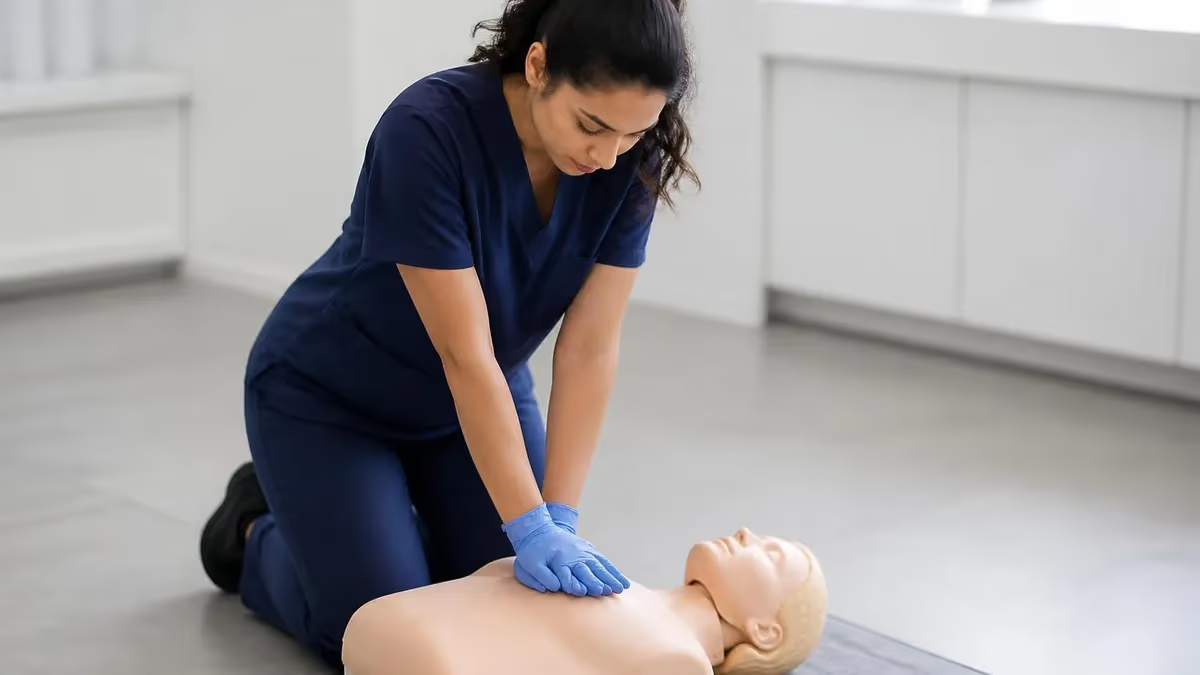
Searching for a free online BLS certification AHA approved program is one of the most common questions healthcare workers, students, and lay rescuers ask each year. The honest answer is nuanced: the American Heart Association does not currently offer a fully free, fully online certification that ends in a printable card, but you can absolutely study every single skill, algorithm, and exam topic at no cost using high-quality online resources. This guide walks you through exactly what is realistic, what is marketing, and how to prepare for the official exam without wasting money on questionable providers.
So what is a bls certification? It is a credential proving you can recognize cardiac arrest, deliver high-quality CPR, use an automated external defibrillator, perform rescue breathing, and work as part of a resuscitation team. The certification is required for nurses, paramedics, dental staff, medical students, lifeguards, and many allied health professionals. Cards are issued after you pass both a written exam and a hands-on skills evaluation conducted by an authorized instructor.
What does bls stand for? Basic Life Support. The term refers to the foundational layer of resuscitation that anyone, with proper training, can deliver before advanced providers arrive with medications and airway equipment. The 2020 and 2023 AHA guidelines emphasize that early, high-quality BLS is the single biggest predictor of survival from sudden cardiac arrest, more important than any drug, device, or hospital intervention that comes later.
Is bls the same as cpr? Not exactly. CPR (cardiopulmonary resuscitation) is a single skill within BLS. BLS includes CPR plus AED use, choking relief, team-based resuscitation, ventilation with a bag-mask device, and recognition of stroke and opioid overdose. If you are a layperson, a Heartsaver CPR card may be enough. If you are a healthcare provider, you almost certainly need a full BLS Provider card. Confusion between the two costs many learners time and money each year.
The phrase "free online BLS certification" usually means one of three things on the internet: a free practice course with a paid exam at the end, a non-AHA provider that no employer will accept, or a legitimate AHA blended-learning course where part one is online and part two is an in-person skills check that you pay for. Understanding which type you're looking at saves frustration and rejected applications at hospital onboarding desks.
This article also clarifies why some learners confuse pediatric and adult algorithms — and whether is bls and cpr the same question gets asked so often. We'll cover renewal timelines, exam format, study schedules, and the real costs you should budget for. By the end, you'll know exactly how to get certified for the lowest legitimate price possible while still holding a card your employer will actually accept on day one of your job.
Whether you're a new nursing student, a returning RN looking at a basic life support renewal class, or a layperson preparing to respond in an emergency, the next twenty minutes will save you hours of research. We'll also point you toward free practice questions that mirror the actual aha basic life support exam, so by the time you sit for skills testing, the multiple-choice section feels like review rather than a surprise.
Free Online BLS Certification by the Numbers
Key Facts at a Glance
| Item | Value | Details |
|---|---|---|
| Realistic Cost Range | $0–$80 | Study free, pay for skills check |
| Card Validity | 2 years | AHA standard |
| Exam Questions | 25 | Multiple choice, 84% to pass |

What a Full BLS Course Actually Covers
Compression depth of 2–2.4 inches, rate of 100–120 per minute, full chest recoil, and minimizing interruptions to less than 10 seconds. This is the single most heavily tested skill on the exam and the foundation of every algorithm.
Turning on the defibrillator, attaching pads correctly on adults and children, clearing the patient, delivering shocks safely, and resuming compressions within 5 seconds of shock delivery without delay or hesitation.
Closed-loop communication, clear role assignment, switching compressors every two minutes to prevent fatigue, and constructive intervention when a team member makes an error during resuscitation efforts.
Recognizing mild versus severe airway obstruction, performing abdominal thrusts on responsive adults and children, back blows and chest thrusts on infants, and CPR if the victim becomes unresponsive.
Opioid-associated emergencies with naloxone, drowning resuscitation starting with rescue breaths, pregnancy considerations including manual uterine displacement, and recognition of acute stroke and heart attack symptoms.
What is a bls certification, formally? It is a credential issued by an approved training organization — most commonly the American Heart Association, the American Red Cross, or the American Safety and Health Institute — that certifies the holder has demonstrated both cognitive knowledge and psychomotor skills in basic life support. The card is valid for two years and must list the issuing organization, the student's name, the issue date, and the expiration date. Employers verify this card before allowing clinical work.
The aha basic life support exam consists of approximately 25 multiple-choice questions covering adult, child, and infant resuscitation, AED use, choking, and team dynamics. The passing score is 84%, which means you can miss only four questions. The exam is not designed to be tricky, but it does require precision: knowing that compressions are "at least 2 inches" rather than "at least 1.5 inches" matters, and confusing the compression-to-ventilation ratio for one rescuer versus two rescuers with an advanced airway is a common failure point.
The basic life support exam american heart association also includes a hands-on skills test. You will perform one-rescuer adult CPR with AED, two-rescuer adult CPR with bag-mask ventilation, infant CPR, adult and infant choking relief, and demonstrate proper switching of compressor roles. The instructor scores you on a checklist; any critical fail — such as failing to check the scene for safety or not pushing hard enough — requires remediation before you can earn the card.
For healthcare workers, the standard course is basic life support for healthcare providers, often abbreviated as BLS Provider or BLS-HCP. This is different from Heartsaver CPR AED, which is designed for laypeople, security guards, teachers, and corporate first responders who do not need to manage two-rescuer scenarios or bag-mask ventilation. Make sure you enroll in the right course — registering for Heartsaver when your hospital requires BLS Provider means repeating the entire process.
A common myth is that you can earn a fully valid card from a website that issues a PDF after a 10-minute quiz with no skills check. These cards exist, and they are not accepted by hospitals, nursing schools, EMS agencies, or licensing boards in any US state. The AHA and Red Cross both publish lists of approved providers, and any legitimate BLS card will trace back to an instructor with a documented training site. If a course costs $15 and ends with no in-person component, it is not a real certification.
The legitimate "free" pathway is this: study the entire curriculum online using free resources (this article, AHA's free study materials, free practice quizzes), then pay only for the in-person skills check, which typically runs $30 to $80 at community colleges, fire departments, and independent instructors. This is dramatically cheaper than the $110 to $150 full-course price at corporate training centers, and the card is identical in validity. Many learners do not realize this option exists.
Some employers — particularly large hospital systems — pay for BLS certification entirely as part of employee onboarding. If you have a job offer pending, ask the human resources department before paying anything yourself. Nursing schools often include BLS in tuition or offer it at cost to enrolled students. Military members, veterans, and active first responders frequently have access to free certification through their agency or VA-affiliated programs.
BLS Practice Test Questions
Prepare for the BLS - Basic Life Support exam with our free practice test modules. Each quiz covers key topics to help you pass on your first try.
BLS High-Quality CPR & Provider Skills
BLS Exam Questions covering BLS High-Quality CPR & Provider Skills. Master BLS Test concepts for certification prep.
BLS Special Situations & Scenarios
Free BLS Practice Test featuring BLS Special Situations & Scenarios. Improve your BLS Exam score with mock test prep.
BLS Adult, Child & Infant Resuscitation
BLS Mock Exam on Adult, Child & Infant Resuscitation. BLS Study Guide questions to pass on your first try.
BLS Airway Management & Ventilation
BLS Test Prep for Airway Management & Ventilation. Practice BLS Quiz questions and boost your score.
BLS Automated External Defibrillator (AED)...
BLS Questions and Answers on Automated External Defibrillator (AED) Use. Free BLS practice for exam readiness.
BLS Certification: Cardiac Arrest
BLS Mock Test covering Certification: Cardiac Arrest. Online BLS Test practice with instant feedback.
BLS Certification: Choking
Free BLS Quiz on Certification: Choking. BLS Exam prep questions with detailed explanations.
BLS Certification: Respiratory Arrest
BLS Practice Questions for Certification: Respiratory Arrest. Build confidence for your BLS certification exam.
BLS Chain of Survival
BLS Test Online for Chain of Survival. Free practice with instant results and feedback.
BLS CPR Techniques & Procedures
BLS Study Material on CPR Techniques & Procedures. Prepare effectively with real exam-style questions.
BLS Legal & Ethical Considerations
Free BLS Test covering Legal & Ethical Considerations. Practice and track your BLS exam readiness.
BLS Post-Resuscitation Care
BLS Exam Questions covering Post-Resuscitation Care. Master BLS Test concepts for certification prep.
AHA vs American Red Cross Basic Life Support
The American Heart Association is the most widely recognized certifying body in US healthcare. AHA BLS cards are accepted at virtually every hospital, nursing school, EMS agency, and dental office in the country. The course follows the most recent ECC guidelines, currently the 2020 update with 2023 focused recommendations, and is taught by AHA-certified instructors at training centers worldwide.
The AHA offers a blended option called HeartCode BLS, where students complete the cognitive portion online at their own pace, then attend an in-person skills session. This is the closest thing to a "free online BLS certification AHA approved" experience — though the skills check still requires a fee. Total time investment is roughly 4 to 6 hours, including approximately 2 hours of online work and a 1 to 2 hour skills session.
Free Online BLS Study: Honest Pros and Cons
- +Save $30–$100 versus full traditional in-person classroom courses
- +Study at your own pace on nights, weekends, or commutes
- +Repeat difficult modules without instructor pressure or embarrassment
- +Access unlimited free practice questions that mirror the real exam
- +No travel required for the cognitive portion of the course
- +Mobile-friendly learning lets you review anywhere with a smartphone
- +Builds deeper understanding by allowing time to research unclear concepts
- −You still need an in-person skills check to receive a valid card
- −Self-discipline is required to finish modules without an instructor
- −No real-time feedback on compression depth or ventilation technique
- −Some employers prefer fully instructor-led courses for new hires
- −"Fully free" certification cards from online-only sites are not accepted
- −Skills practice requires a manikin, which most homes don't have access to

Free Resources to Pass the AHA Basic Life Support Exam
- ✓Download the current AHA BLS Provider Manual PDF from your library or borrow from a coworker
- ✓Watch the official AHA high-quality CPR videos available free on YouTube
- ✓Memorize the adult, child, and infant compression depth and rate values
- ✓Complete at least 100 free practice questions covering all algorithm scenarios
- ✓Review the 2020 AHA guidelines summary document published on the AHA website
- ✓Practice the chain of survival sequence for both in-hospital and out-of-hospital arrest
- ✓Drill the differences between one-rescuer and two-rescuer compression-to-ventilation ratios
- ✓Memorize naloxone dosing and administration for opioid-associated emergencies
- ✓Study the choking algorithm for responsive and unresponsive adults, children, and infants
- ✓Time yourself completing a full 25-question practice exam in under 30 minutes
You can only miss 4 questions on the AHA BLS exam.
The passing score is 84%, which means out of 25 multiple-choice questions, you can miss a maximum of four. Most failures happen on compression-to-ventilation ratios, ventilation rates with an advanced airway, and infant-versus-child age cutoffs. Drill these three areas relentlessly with practice quizzes until you score 100% three times in a row before sitting for the real exam.
The aha basic life support exam is structured to test both knowledge recall and clinical judgment. Roughly half the questions are factual — what is the correct compression rate, how deep should compressions go on an infant, what is the ventilation rate with an advanced airway in place. The other half are scenario-based: you walk into a room, find an unresponsive adult, what do you do next? Strong test-takers memorize the factual answers cold so they can spend their thinking time on the scenarios.
The skills evaluation happens in person and is non-negotiable for a real card. You'll be observed performing one-rescuer adult CPR with an AED, two-rescuer adult CPR with bag-mask ventilation and switching, infant CPR, infant choking relief, and adult choking relief. The instructor uses a checklist; you must demonstrate every critical action correctly. If you forget to check the scene for safety, fail to verify unresponsiveness, or push too shallow, the instructor will pause you and ask you to repeat the sequence.
Compression quality is now measured objectively with feedback manikins at most AHA training centers. These devices display real-time depth, rate, and recoil data, which means "close enough" no longer passes. You either compress to at least 2 inches at 100–120 per minute with full recoil, or you don't. Practicing on a manikin before your skills check — even just for 15 minutes at an open lab — dramatically improves first-attempt pass rates and reduces test-day anxiety.
Many training centers offer a "challenge" option for experienced providers who feel confident with the material. In a challenge format, you skip the lecture and go straight to the skills check and exam. This typically costs the same as the full course but takes only 1 to 2 hours instead of 4 to 6. It is ideal for nurses recertifying for the third or fourth time who already know the material cold and just need the updated card.
Time management on exam day matters more than people expect. You have approximately 45 minutes to complete the 25-question written exam, which is plenty of time if you've practiced. Read every question carefully — AHA writers often include qualifiers like "unresponsive," "alone," "witnessed," or "with an advanced airway in place" that completely change the correct answer. Highlighting these qualifiers mentally before scanning the answer choices prevents the most common avoidable errors.
If you fail the written exam, most training centers allow a free retake within 30 days. You typically retake only the cognitive portion, not the skills evaluation, assuming you passed skills. If you fail skills, you'll need to schedule remediation with the instructor and re-test, sometimes for a small additional fee. Failing both is uncommon for prepared students but does happen — and it's not the end of the world, just a delay of a week or two.
Healthcare students often ask whether the BLS card transfers between states. The answer is yes — AHA, Red Cross, and ASHI cards are nationally valid and recognized in all 50 states. A card earned in Texas is accepted in New York, California, or Florida without any additional testing. The only caveat is that some state nursing boards require the card to be issued by a specific organization (most commonly AHA), so verify the requirement before enrolling if you plan to work in multiple states.
Dozens of websites claim to offer "AHA approved" or "AHA aligned" 100% online certifications for $15 to $40. The American Heart Association does not currently endorse any fully online certification without an in-person skills check. If a website promises a printable card immediately after a quiz with no skills evaluation, the card will not be accepted by hospitals, nursing schools, or licensing boards. Always verify your training provider against the official AHA training center locator.
A basic life support renewal class is the most cost-effective path for anyone whose card is still valid. Renewal courses are shorter than initial certification because the curriculum assumes you already know the fundamentals. You'll typically complete a brief refresher (60–90 minutes online), then attend a 1-hour skills check. Total time is roughly half the initial course, and pricing reflects that — usually $60 to $90 for the full renewal versus $110+ for first-time certification.
Timing matters enormously for renewal. If your card has already expired, most providers require you to take the full initial course rather than the abbreviated renewal. The AHA technically allows renewal up to 30 days past expiration in some regions, but this varies by training center. The safest strategy is to schedule your renewal 4 to 6 weeks before your card expires. This buffer prevents lapses that could pause your clinical privileges or delay a job start date.
The red cross basic life support course renewal pathway works similarly. Both organizations issue a new card valid for two years from the renewal date, not from the original expiration date. So renewing 30 days early does not cost you 30 days of validity — your new card still gives you a full 24 months from when you complete the renewal class. This is a common misconception that causes nurses to wait until the last minute and then scramble.
For healthcare providers who certify every two years for their entire career, the cumulative cost adds up. A nurse working 40 years will need 20 BLS renewals, totaling roughly $1,500 to $2,000 in personal expense if employers don't cover it. Joining a professional organization like the American Nurses Association sometimes includes discounted or covered BLS renewals as a member benefit. Hospital-employed nurses almost always have BLS covered as part of mandatory annual training.
Some specialty roles require BLS plus additional certifications. Emergency department nurses typically also need ACLS and PALS. ICU nurses need ACLS. Pediatric and neonatal staff need PALS or NRP. Each of these advanced certifications has BLS as a prerequisite, which is why maintaining your BLS card on time matters so much — letting it lapse can cascade and require you to retake multiple courses in sequence to get back into compliance.
The 2020 AHA guideline update introduced changes that all current BLS providers should know, even if you certified before the update. Key changes include emphasis on telecommunicator CPR, formal recognition of opioid-associated emergencies with naloxone administration during arrest, and refined recommendations on chest compression fraction. These updates are tested on current renewal exams, so don't rely on memory from a 2018 certification class — the material has genuinely evolved.
Finally, consider becoming an instructor yourself once you've held a card for a few years. AHA BLS Instructor courses cost a few hundred dollars upfront but allow you to teach BLS to colleagues, earn supplemental income, and never pay for your own renewal again. Many nurses, EMTs, and firefighters become instructors specifically to offset their own ongoing training costs and to give back to their community by teaching life-saving skills.
Practical preparation for your BLS exam should start two weeks out, not the night before. Begin with a diagnostic practice test to identify weak areas. If you score below 70% on first attempt, you need full study; if you score 70–84%, you need targeted review; if you score above 84% on a cold attempt, focus on speed, edge cases, and skills practice. This honest self-assessment prevents either over-studying or under-preparing — both common patterns that waste time or cause failures.
Build a study schedule that includes daily 20-minute sessions rather than one massive cram night. Spaced repetition dramatically improves retention of factual material like compression depths, rates, ventilation timing, and age cutoffs. Use flashcard apps or simple index cards with the question on one side and answer on the other. Quiz yourself in the morning before checking email or social media — your brain absorbs information better when fresh.
Form a study group with two or three classmates or coworkers also preparing for BLS. Take turns being the "patient," the "rescuer," and the "observer" who reads from the AHA checklist. Practicing out loud and physically moving through the motions builds muscle memory that pure reading cannot match. Even practicing on a pillow or stuffed animal at home — while not ideal for compression depth — reinforces the sequence of actions and rhythm of compressions.
The night before your exam, sleep is more valuable than additional studying. Sleep consolidates memory and improves recall. Review your weakest one or two topics for 15 minutes, then close the books. Lay out your clothes, ID, and any paperwork the training center requires. Plan to arrive at least 15 minutes early so you can settle in without rushing. Bring water and a snack if your course runs more than 2 hours; mental fatigue affects accuracy on the written portion.
On exam day, eat a real breakfast with protein and complex carbohydrates. Avoid excessive caffeine, which can increase anxiety and make precise compression depth harder to control during skills evaluation. Wear clothing you can move freely in — kneeling, leaning over a manikin, and performing chest compressions are physically demanding. Closed-toe shoes are required at most training centers for safety reasons during the hands-on portion of testing.
During the written exam, read each question twice before looking at the answer choices. Many BLS exam questions are designed so that the wrong answers are partially correct — they describe a real action but in the wrong context or sequence. Eliminate obviously wrong choices first, then choose between the remaining options. Trust your first instinct unless you find a specific reason to change it; second-guessing causes more wrong answers than it corrects on standardized exams.
After passing, save your digital card to your phone and cloud storage immediately. Print a physical copy for your wallet and another for your employer's HR file. Set a calendar reminder 18 months from today to begin researching renewal options — this gives you a 6-month window to renew without stress. The single best predictor of staying current throughout a healthcare career is this kind of proactive scheduling, not last-minute scrambling every two years.
Sample BLS - Basic Life Support Practice Questions
Try these questions from our free BLS - Basic Life Support practice tests. The correct answer and an explanation follow each question.
A conscious adult is choking and you are significantly shorter than them. The best approach is to:
- A. Ask the victim to sit or kneel to match your height, then perform abdominal thrusts
- B. Only perform back blows since you cannot reach
- C. Perform thrusts from the front instead of behind
- D. Wait for someone taller to assist
Answer: A. Ask the victim to sit or kneel to match your height, then perform abdominal thrusts
Having the victim sit or kneel allows a shorter rescuer to position themselves correctly behind the victim to deliver effective abdominal thrusts.
The pulse check confirms that the infant DOES have a pulse and that the child IS NOT breathing. The heartbeat is roughly 90 per minute. (Is it correct?) As soon as the heart rate drops below 100 beats per minute, you should start chest compressions.
- A. False
- B. True
Answer: A. False
False. Chest compressions should be started if the infant's heart rate is less than 60 beats per minute AND there are signs of poor perfusion (e.g., pallor, mottling, cyanosis). A heart rate of 90 beats per minute, even without breathing, is not an indication to start chest compressions. In this scenario, rescue breaths would be the appropriate intervention.
A team member notices the airway manager is providing ventilations too rapidly. The BEST action is to:
- A. Remain silent to avoid conflict during resuscitation
- B. Wait until after the code to provide feedback
- C. Speak up respectfully and suggest slowing the ventilation rate
- D. Ask the team leader to observe and decide
Answer: C. Speak up respectfully and suggest slowing the ventilation rate
Speaking up immediately and respectfully is appropriate when patient safety is at risk, regardless of role or hierarchy.
A gym member collapses suddenly. A bystander says they saw him 'go down hard' while lifting weights. The MOST likely cause of his cardiac arrest is:
- A. Pulmonary embolism
- B. Stroke
- C. Sudden cardiac arrest due to ventricular fibrillation
- D. Hypoglycemia
Answer: C. Sudden cardiac arrest due to ventricular fibrillation
Sudden collapse during exertion in an adult is most commonly caused by sudden cardiac arrest, often triggered by ventricular fibrillation related to underlying coronary artery disease or structural heart disease.
BLS Questions and Answers
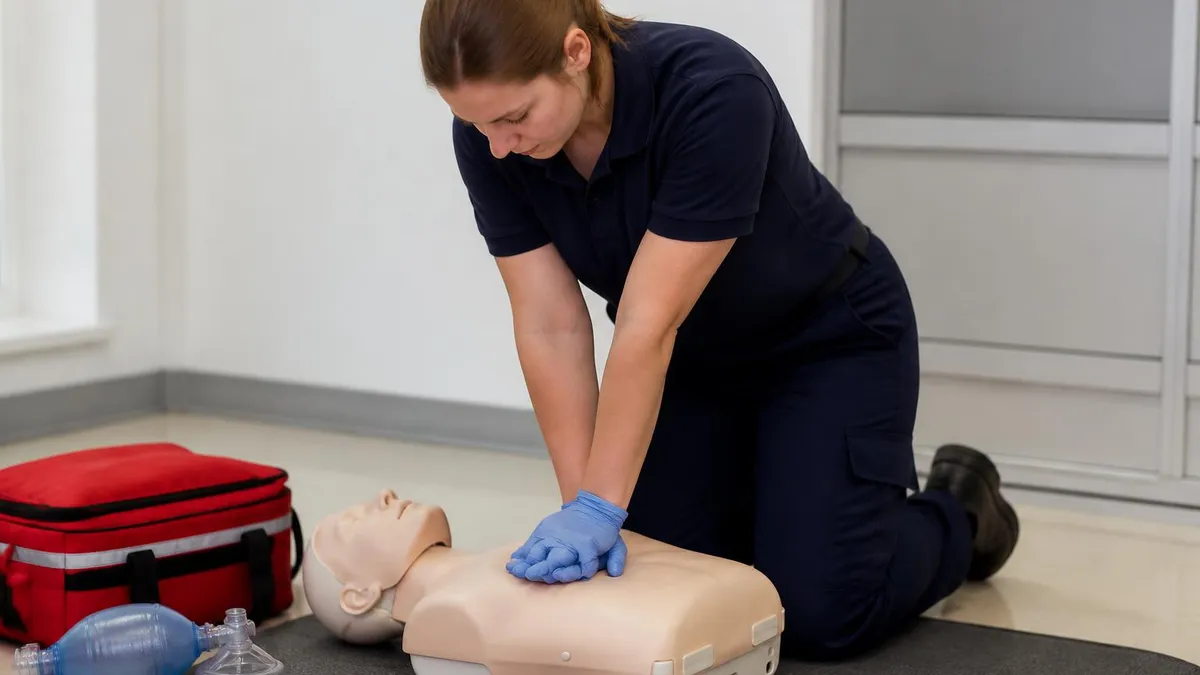
Pediatric BLS Algorithm: Complete 2026 Guide for Healthcare Providers
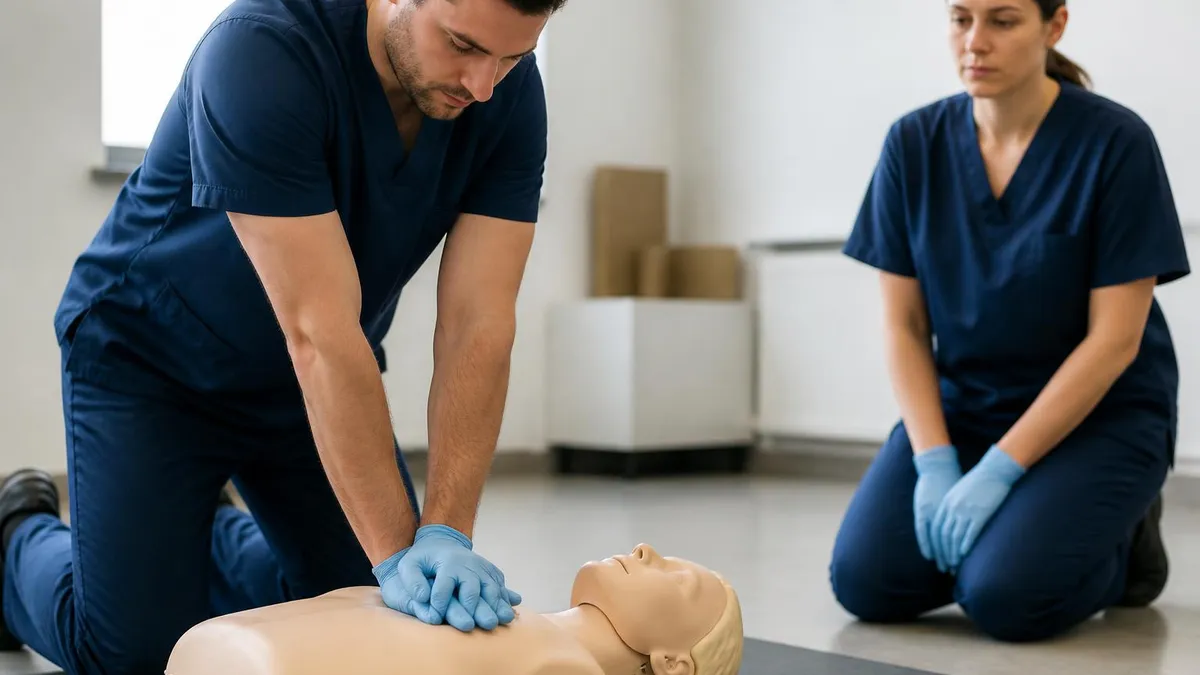
How Long Does BLS Certification Last? Complete 2026 Renewal Guide
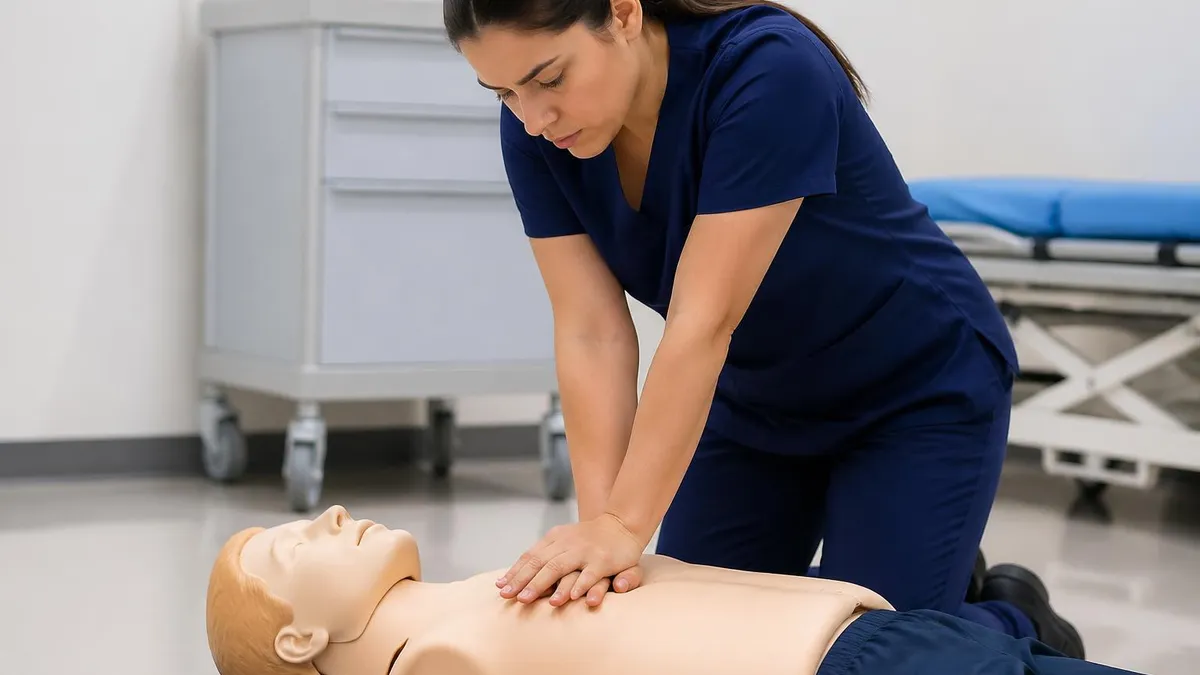
American Heart Association BLS: Certification, Renewal, Cost & What to Expect
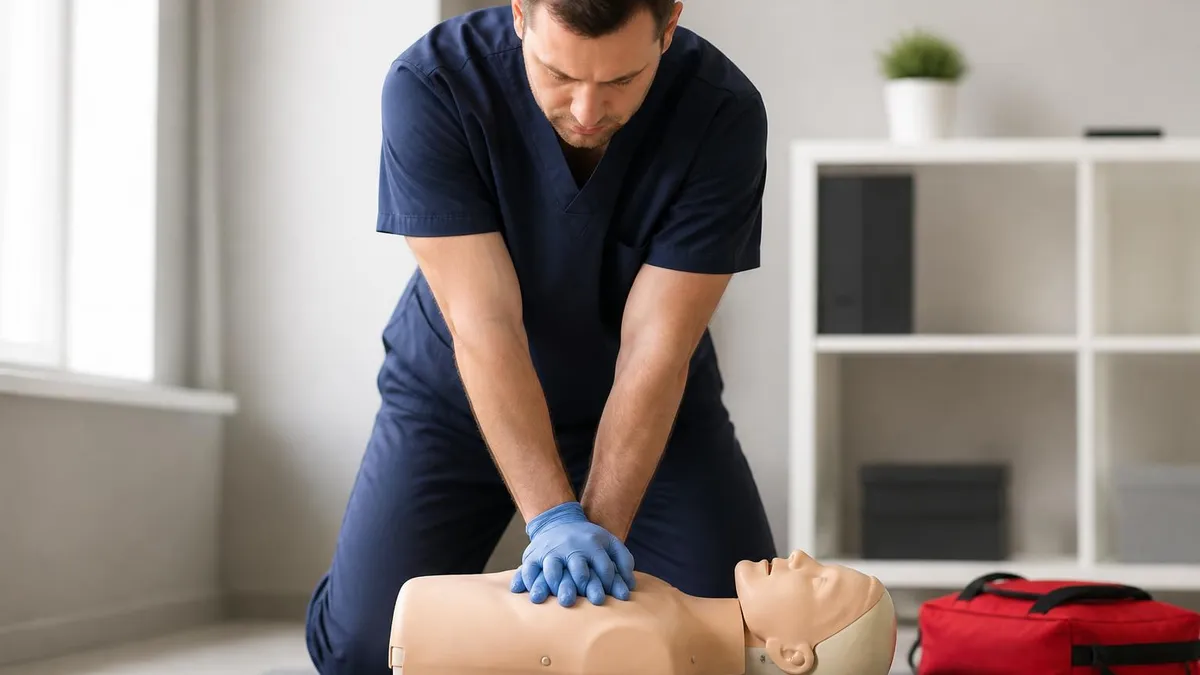
Online BLS Renewal: Complete 2026 Guide to Recertifying Your Basic Life Support Card
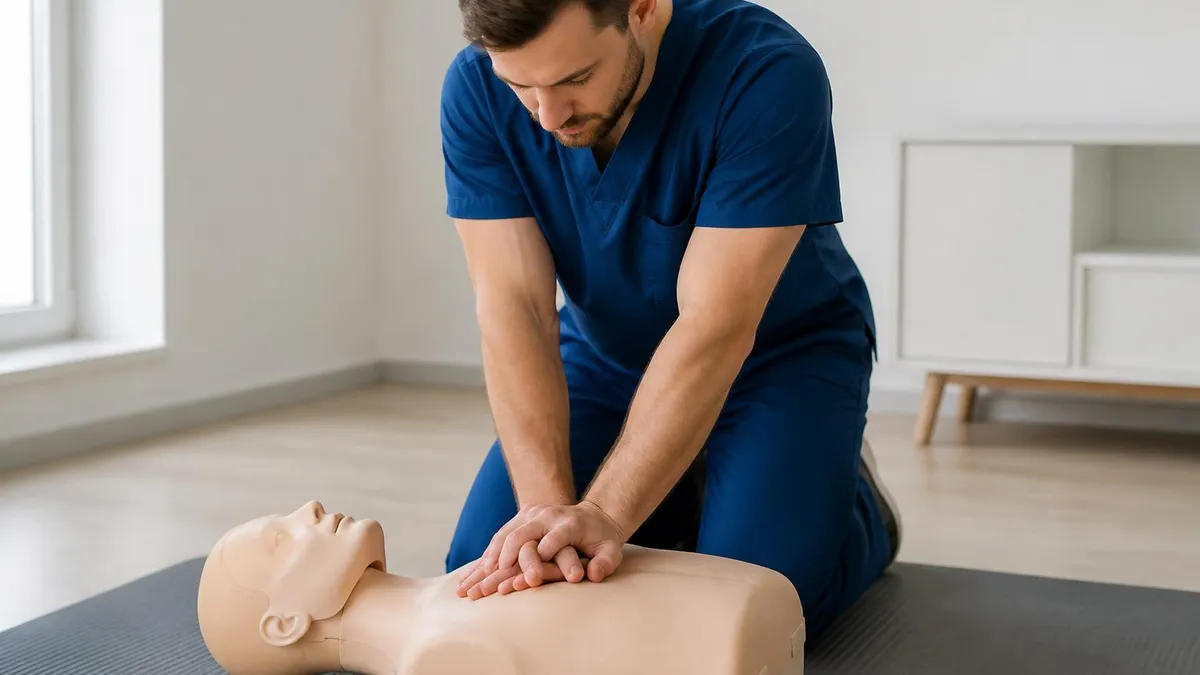
BLS vs ALS: Complete Comparison of Basic and Advanced Life Support
About the Author

Registered Nurse & Healthcare Educator
Johns Hopkins University School of NursingDr. Sarah Mitchell is a board-certified registered nurse with over 15 years of clinical and academic experience. She completed her PhD in Nursing Science at Johns Hopkins University and has taught NCLEX preparation and clinical skills courses for nursing students across the United States. Her research focuses on evidence-based exam preparation strategies for healthcare certification candidates.
Join the Discussion
Connect with other students preparing for this exam. Share tips, ask questions, and get advice from people who have been there.
View discussion (8 replies)