
CPR and BLS Certification Online: Complete 2026 October Guide to Training, Exams & Renewal
Learn what a BLS certification is, how to get CPR and BLS certification online, AHA & Red Cross exam prep tips, and renewal steps for 2026 October. 🧠
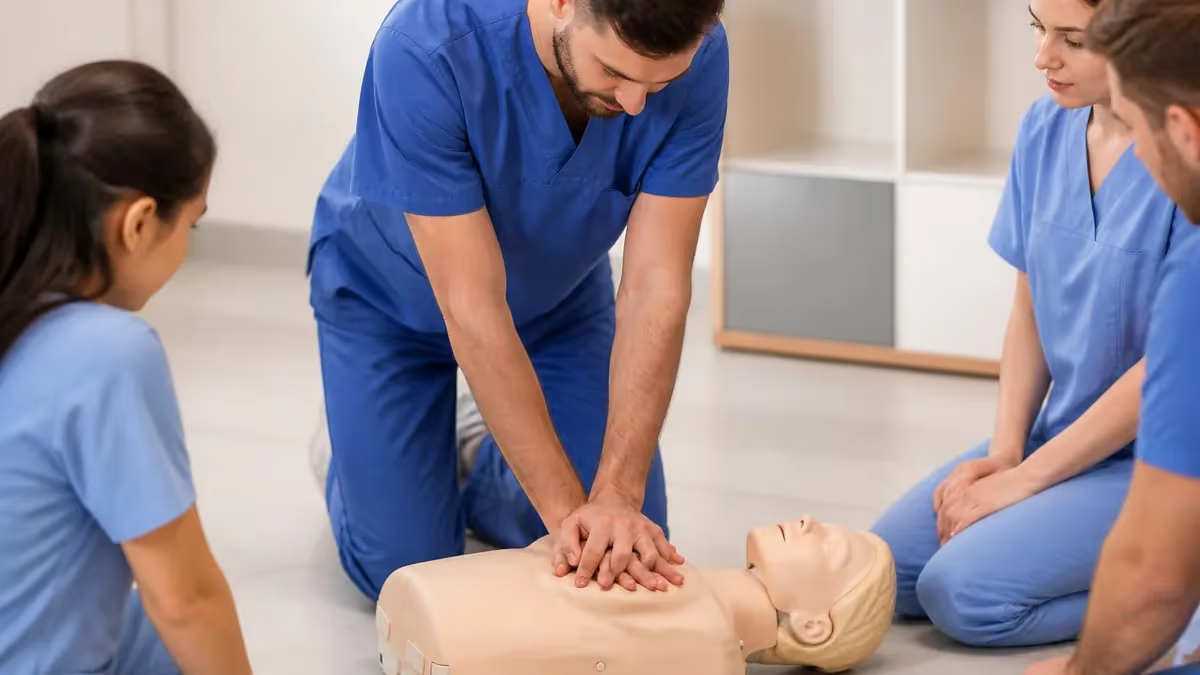
If you are researching CPR and BLS certification online, you are joining thousands of healthcare professionals and first responders who need validated life-saving credentials each year. Understanding what is a BLS certification begins with recognizing that Basic Life Support training covers chest compressions, rescue breathing, and automated external defibrillator use for adults, children, and infants. Whether you are a nurse, paramedic, medical student, or workplace safety coordinator, earning this certification proves you can respond effectively during cardiac arrest and other life-threatening emergencies in any clinical or community setting across the country.
Many candidates wonder what does BLS stand for, and the answer is straightforward: Basic Life Support. This term describes a specific level of medical care that focuses on maintaining airway patency, supporting breathing, and sustaining circulation without advanced equipment or medications. BLS training sits at the foundation of the emergency care continuum, providing the essential skills that every healthcare provider must master before progressing to Advanced Cardiovascular Life Support or Pediatric Advanced Life Support certifications offered through major nationally recognized training organizations.
One of the most common questions candidates ask is whether is basic life support the same as cpr. While CPR—cardiopulmonary resuscitation—is a core component of BLS training, the BLS curriculum extends well beyond standard CPR techniques. BLS courses include team-based resuscitation dynamics, recognition of stroke and heart attack symptoms, choking relief for all age groups, and proper use of bag-valve masks in healthcare settings. This broader scope is why healthcare employers specifically require BLS certification rather than basic CPR-only credentials from their clinical staff.
The demand for online BLS certification has grown dramatically in recent years, driven by flexible scheduling needs and the proven effectiveness of blended learning formats. Major credentialing organizations including the American Heart Association and the American Red Cross now offer online BLS courses that combine self-paced digital modules with in-person or virtual skills assessments. These hybrid programs allow busy healthcare workers to complete the didactic portion from home while still demonstrating hands-on competency through supervised skills testing sessions at authorized evaluation centers.
Choosing the right certification provider is a critical decision that affects your career trajectory and employer acceptance. The basic life support exam American Heart Association administers remains the gold standard in many hospital systems and clinical environments nationwide. However, the American Red Cross basic life support program also carries strong recognition across healthcare settings, government agencies, and educational institutions. Understanding the differences between these providers, their course formats, exam structures, and renewal policies helps you make an informed choice aligned with your specific professional requirements.
This comprehensive guide walks you through everything you need to know about obtaining and maintaining your BLS certification online in 2026. From understanding eligibility requirements and course formats to mastering exam content and navigating the renewal process, each section addresses the practical questions that certification candidates face daily. Whether you are pursuing your initial credential or completing a basic life support renewal class, the information here will help you prepare confidently and choose the right path for your career goals.
Throughout this article, you will find practice quiz links, study checklists, and comparison resources designed to maximize your exam readiness. The BLS certification landscape continues to evolve with updated guidelines, new online platforms, and changing employer expectations, so staying current with the latest requirements ensures your credentials remain valid and recognized. Use this guide as your central reference point as you navigate the certification process from initial research through successful completion and ongoing renewal cycles.
BLS Certification by the Numbers
Key Facts at a Glance
| Item | Value | Details |
|---|---|---|
| Course Duration | 4-5 hrs | Average time for initial BLS certification |
| Typical Course Cost | $75-$125 | Varies by provider and format |
| Certification Validity | 2 Years | Standard renewal cycle for all providers |

BLS Certification Requirements & Training Pathways
BLS certification is open to healthcare providers, first responders, students, and laypersons. No prior medical training is required for initial certification, though healthcare provider courses assume familiarity with basic medical terminology and emergency response concepts.
Complete the self-paced online learning component covering CPR theory, AED operation, airway management, and team dynamics. Most platforms allow you to pause and resume modules across multiple study sessions over a flexible enrollment period.
Attend an in-person or approved remote skills evaluation where a certified instructor assesses your hands-on CPR technique, AED usage, bag-valve mask ventilation, and choking relief performance on adult, child, and infant manikins during timed scenarios.
Pass the cognitive exam consisting of multiple-choice questions covering BLS algorithms, compression parameters, ventilation ratios, special situations, and team communication protocols. A minimum score of eighty-four percent is typically required for certification.
Upon successful completion of both skills and written components, receive your BLS provider card valid for two years. Digital credentials are available immediately through online portals, with physical cards mailed within two to four weeks from the certifying organization.
The aha basic life support exam tests your knowledge across several critical domains that directly impact patient outcomes during cardiac emergencies. Understanding the exam structure helps you focus your study efforts on the areas that carry the most weight during testing. The written portion typically consists of twenty-five to thirty multiple-choice questions covering high-quality CPR technique, AED usage, rescue breathing protocols, and team dynamics during resuscitation scenarios. Most candidates find that systematic preparation with practice questions significantly improves their confidence and first-attempt pass rates.
When preparing for the basic life support exam American Heart Association administers, start by reviewing the current BLS Provider Manual thoroughly and methodically. The manual outlines the latest evidence-based guidelines including updated compression depths, ventilation ratios, and the chain of survival sequence. Pay particular attention to the differences between adult, child, and infant resuscitation protocols, as exam questions frequently test your ability to distinguish age-specific techniques. Understanding why certain ratios change based on the number of rescuers present is another commonly tested concept you must master.
Basic life support for healthcare providers requires demonstrating competency in both cognitive knowledge and psychomotor skills during the certification process. The skills assessment portion evaluates your ability to perform high-quality chest compressions at the correct rate and depth, deliver appropriate ventilations using a bag-valve mask, operate an AED correctly during simulated scenarios, and manage choking emergencies across all age groups. Examiners watch for proper hand placement, adequate chest recoil, minimal interruptions in compressions, and effective team communication throughout each testing station.
If you are wondering how long does bls certification last, the standard validity period is two years from the date of issue for both AHA and Red Cross credentials. This means you will need to complete a renewal course before your card expires to maintain continuous certification status. Many employers require active BLS certification as a condition of employment, and allowing your credential to lapse can create significant complications with human resources departments, credentialing committees, and state licensing boards that verify your active certification status regularly.
The online components of BLS certification courses have become increasingly sophisticated, incorporating interactive video scenarios, branching decision trees, and real-time knowledge checks that reinforce learning throughout each module. These digital elements replace traditional classroom lectures while maintaining the educational rigor that credentialing organizations require for validated provider credentials. Most online BLS courses take between two and four hours to complete and allow you to pause and resume at your convenience, making them ideal for healthcare workers managing demanding shift schedules and continuing education requirements.
Skills testing for online BLS courses typically occurs at authorized testing centers, simulation labs, or approved healthcare facilities where trained instructors evaluate your hands-on performance against standardized criteria. Some programs now offer remote skills verification through video conferencing platforms where an instructor watches you perform techniques on a manikin at home. However, not all employers accept remotely verified skills sessions, so confirming your workplace requirements before enrolling in any specific program format prevents potential issues with credential acceptance afterward.
Study groups and peer practice sessions provide valuable supplemental preparation beyond individual coursework for BLS certification candidates. Practicing compression techniques with a partner allows you to receive real-time feedback on your rate, depth, and recoil quality that self-study alone cannot replicate. Many successful BLS candidates report that combining online didactic modules with hands-on practice sessions using personal manikins produces the best exam outcomes. Investing in a quality practice manikin and feedback device can pay dividends across multiple certification cycles throughout your entire healthcare career.
BLS Practice Test Questions
Prepare for the BLS - Basic Life Support exam with our free practice test modules. Each quiz covers key topics to help you pass on your first try.
BLS High-Quality CPR & Provider Skills
BLS Exam Questions covering BLS High-Quality CPR & Provider Skills. Master BLS Test concepts for certification prep.
BLS Special Situations & Scenarios
Free BLS Practice Test featuring BLS Special Situations & Scenarios. Improve your BLS Exam score with mock test prep.
BLS Adult, Child & Infant Resuscitation
BLS Mock Exam on Adult, Child & Infant Resuscitation. BLS Study Guide questions to pass on your first try.
BLS Airway Management & Ventilation
BLS Test Prep for Airway Management & Ventilation. Practice BLS Quiz questions and boost your score.
BLS Automated External Defibrillator (AED)...
BLS Questions and Answers on Automated External Defibrillator (AED) Use. Free BLS practice for exam readiness.
BLS Certification: Cardiac Arrest
BLS Mock Test covering Certification: Cardiac Arrest. Online BLS Test practice with instant feedback.
BLS Certification: Choking
Free BLS Quiz on Certification: Choking. BLS Exam prep questions with detailed explanations.
BLS Certification: Respiratory Arrest
BLS Practice Questions for Certification: Respiratory Arrest. Build confidence for your BLS certification exam.
BLS Chain of Survival
BLS Test Online for Chain of Survival. Free practice with instant results and feedback.
BLS CPR Techniques & Procedures
BLS Study Material on CPR Techniques & Procedures. Prepare effectively with real exam-style questions.
BLS Legal & Ethical Considerations
Free BLS Test covering Legal & Ethical Considerations. Practice and track your BLS exam readiness.
BLS Post-Resuscitation Care
BLS Exam Questions covering Post-Resuscitation Care. Master BLS Test concepts for certification prep.
Is BLS the Same as CPR? Comparing Certification Providers
The American Heart Association BLS Provider course remains the most widely recognized certification in hospital systems, emergency departments, and clinical practices across the United States. The AHA curriculum follows the latest International Liaison Committee on Resuscitation guidelines and covers high-quality CPR for adults, children, and infants, AED operation, team-based resuscitation dynamics, and relief of foreign body airway obstruction using current evidence-based clinical protocols and algorithms.
AHA BLS certification requires completing either a classroom-based or blended learning course followed by a skills test and written examination. The HeartCode BLS online module pairs with an in-person skills session at an authorized training center. Course costs typically range from seventy-five to one hundred twenty-five dollars depending on location and format selected. The AHA provider card is valid for two years, and renewal courses are available in both traditional classroom and online blended formats for continued credential maintenance and professional development.
Is BLS and CPR the Same? Online vs Traditional Certification
- +Complete coursework on your own schedule from home or any location with internet access
- +Lower overall cost compared to traditional classroom-only courses at many training centers
- +Self-paced modules allow you to revisit difficult concepts as many times as needed
- +Interactive digital scenarios reinforce decision-making skills through realistic simulations
- +Immediate access to digital study materials, practice quizzes, and supplemental resources
- +Reduced travel time and expenses since didactic portions are completed entirely online
- −Skills verification still requires in-person attendance at an authorized testing location
- −Limited real-time interaction with instructors during the online learning modules
- −Self-discipline required to complete modules without classroom structure and accountability
- −Some employers do not accept certain online or remotely verified certification formats
- −Technical issues with internet connectivity can interrupt learning progress during modules
- −Hands-on practice opportunities are limited until the scheduled skills assessment session

BLS Certification Exam Day Checklist
- ✓Review the complete BLS algorithm sequence including scene safety, pulse check, and compression-ventilation ratios
- ✓Practice adult chest compressions at two to two point four inches depth and one hundred to one hundred twenty per minute rate
- ✓Master the differences between single-rescuer and two-rescuer CPR ratios for all age groups
- ✓Review AED pad placement for adults, children, and infants including anterior-posterior positioning guidelines
- ✓Practice bag-valve mask ventilation technique with proper seal, head tilt, and visible chest rise confirmation
- ✓Study choking relief protocols for conscious and unconscious victims across adult, child, and infant patients
- ✓Review team communication phrases including closed-loop communication and constructive intervention techniques
- ✓Prepare your valid photo identification and course completion documentation for exam check-in procedures
- ✓Wear comfortable clothing that allows unrestricted kneeling, arm movement, and floor-level positioning during skills stations
- ✓Confirm your testing center location, parking availability, and arrival time at least twenty-four hours before your exam
The 84% First-Attempt Pass Rate Means Preparation Matters
While the majority of candidates pass their BLS certification exam on the first attempt, the sixteen percent failure rate underscores the importance of thorough preparation. Candidates who complete at least three full-length practice exams and log a minimum of two hours of hands-on manikin practice before testing day report significantly higher confidence levels and exam scores. Do not rely solely on the online course modules—supplement with dedicated practice question sessions and physical skills rehearsal for best results.
Preparing for your BLS certification exam requires a structured study approach that addresses both the theoretical knowledge and practical skills components comprehensively. Begin your preparation at least two to three weeks before your scheduled exam date to allow adequate time for content review, practice question completion, and hands-on technique rehearsal with manikins or practice partners. Creating a detailed study timeline that allocates specific days to different content areas prevents last-minute cramming and ensures you cover all testable domains with sufficient depth and repetition for long-term retention.
High-quality CPR remains the cornerstone of every BLS certification exam, and understanding the specific parameters that define quality is absolutely essential for success on both written and practical components. For adult patients, compressions should reach a depth of at least two inches but no more than two point four inches, delivered at a rate of one hundred to one hundred twenty compressions per minute consistently. Full chest recoil between compressions allows the heart to refill with blood, and interruptions in compressions should be limited to fewer than ten seconds whenever clinically possible during resuscitation efforts.
The chain of survival concept appears frequently on BLS exams and represents the sequential steps that maximize a cardiac arrest patient's chance of neurologically intact survival. For adults in out-of-hospital settings, the chain includes early recognition and activation of emergency services, early high-quality CPR, rapid defibrillation, advanced resuscitation by emergency medical services personnel, and post-cardiac arrest care including targeted temperature management. Understanding how each link strengthens the overall chain and where delays most critically reduce survival probability helps you answer complex scenario-based questions accurately.
Team dynamics and communication represent an increasingly important component of BLS training and testing that many candidates unfortunately underestimate during their preparation period. Effective team-based resuscitation requires clear role assignments, closed-loop communication, mutual respect among all team members, and constructive intervention when errors are observed during the resuscitation effort. Practice scenarios often test whether you can function as both a team leader directing resuscitation efforts and a team member executing specific assigned tasks under direction from others on the team.
Special situations tested on BLS exams include drowning victims, pregnant patients, patients with suspected opioid overdose, and victims of electrocution or traumatic injury requiring immediate intervention. Each scenario requires specific modifications to standard CPR protocols that you must know thoroughly before exam day. For drowning victims, rescue breathing takes priority because the primary problem is respiratory failure rather than primary cardiac dysfunction. For suspected opioid overdoses, naloxone administration is now incorporated into current BLS protocols alongside standard CPR, reflecting the evolving public health landscape and clinical guidelines.
AED operation questions appear on every BLS certification exam and test your understanding of proper pad placement, safety clearing procedures, and troubleshooting common issues encountered during real emergencies. You should know that AED pads must not be placed directly over medication patches, implanted pacemaker devices, or excessive chest hair that could prevent proper adhesion and signal analysis. For pediatric patients under eight years old, child-sized pads with a dose attenuator should be used when available, though adult pads with anterior-posterior placement can substitute if pediatric pads are not accessible.
Practice exams and comprehensive question banks provide the most effective method for identifying knowledge gaps and building test-taking confidence well before your actual certification exam date. Working through hundreds of practice questions exposes you to the question formats, answer choice structures, and clinical scenarios that closely mirror real exam content from both AHA and Red Cross providers. Time yourself during practice sessions to develop the pacing skills needed to complete all questions within the allotted testing period without rushing through complex scenario-based items that require careful clinical reasoning and analysis.
Your BLS certification expires exactly two years from the issue date printed on your provider card. Most employers require active, unexpired certification at all times and may restrict clinical duties or suspend employment privileges if your credential lapses. Begin the renewal process at least sixty days before your expiration date to ensure adequate time for course completion and card processing. Set calendar reminders at ninety and sixty days before expiration to avoid last-minute scheduling difficulties.
The BLS certification renewal process is designed to verify that previously certified providers have maintained their knowledge and skills at the level required for effective emergency response in clinical settings. Whether your current credential was issued by the American Heart Association or the American Red Cross, understanding the renewal timeline, course options, and documentation requirements well in advance of your expiration date prevents stressful last-minute scheduling and potential gaps in your active certification status. Most renewal courses can be completed in approximately half the time required for initial certification programs.
If you are curious about how long does basic life support certification last, the standard answer is two years from the date printed on your provider card. However, some employers and state licensing boards require renewal earlier or impose additional continuing education requirements beyond the standard BLS recertification course alone. Checking your specific workplace policies and state regulations ensures you build adequate renewal timeline cushion into your professional development calendar and avoid any surprises when credentialing committees review your documentation during scheduled reappointment cycles throughout the year.
Online BLS renewal courses follow a similar blended format to initial certification programs, combining self-paced digital learning modules with a skills verification component at an authorized testing location. The online portion typically takes one to two hours and covers updated guidelines, protocol changes, and knowledge refresher content based on the latest evidence. Many renewal programs emphasize the specific changes implemented since your last certification cycle, ensuring you stay current with evolving evidence-based practices and updated algorithms that may affect your clinical performance during real emergencies.
Timing your renewal strategically can save both money and scheduling headaches over the course of your healthcare career. Most certification organizations allow renewal up to sixty days before your expiration date without affecting your renewal timeline, meaning your new two-year certification period begins from your original expiration date rather than the date you completed the renewal course. This generous policy encourages early renewal and eliminates the penalty of losing certification time when you complete your renewal course ahead of the deadline for maximum scheduling flexibility.
Group renewal sessions offer significant cost savings and scheduling convenience for healthcare facilities that need to recertify multiple staff members simultaneously during scheduled training periods. Many hospitals, clinics, and emergency services departments arrange on-site renewal courses that allow entire teams to recertify together during scheduled training days without disrupting patient care schedules. These group sessions often include negotiated pricing, customized scheduling around shift patterns, and the added benefit of team-based practice that reinforces the collaborative resuscitation skills emphasized throughout current BLS guidelines and certification standards.
Maintaining comprehensive documentation of your BLS certification history becomes increasingly important as you progress through your healthcare career and accumulate multiple credentials. Keep digital copies of all provider cards, course completion certificates, and continuing education records in a secure, easily accessible location such as a cloud storage folder or professional credentials management application. Many certification organizations now offer digital credential verification through online portals and mobile applications that allow employers to confirm your certification status electronically without requiring physical card presentation.
Cross-certification between AHA and Red Cross BLS programs is generally straightforward, as both organizations recognize the fundamental equivalency of each other's BLS training programs and certification standards. If your employer requires a specific provider's certification, you can typically switch during your renewal cycle without completing a full initial certification course from scratch. However, verifying acceptance with your specific employer before making any provider changes ensures seamless credential continuity and prevents potential delays in your professional credentialing or state licensing renewal processes that could affect your employment status.
Maximizing your chances of passing the BLS certification exam on your first attempt requires combining effective study strategies with deliberate practice techniques throughout your preparation period. Start by identifying your weakest content areas through diagnostic practice tests, then allocate proportionally more study time to those specific topics where you scored lowest. Many candidates find that they are confident with adult CPR protocols but struggle with infant resuscitation differences, pediatric compression depth requirements, or the nuances of team communication during multi-rescuer scenarios that frequently appear on certification exams.
Hands-on practice with a quality feedback manikin provides irreplaceable preparation for the skills assessment portion of your BLS certification exam. If purchasing a personal manikin is not feasible, contact local fire departments, community colleges, or Red Cross chapters that may offer open practice sessions to the public. Focus your physical practice on achieving consistent compression depth between two and two point four inches for adult manikins, maintaining the correct rate of one hundred to one hundred twenty compressions per minute throughout each cycle, and allowing complete chest recoil between each individual compression.
Memorizing the BLS algorithm sequence is essential for both the written exam and practical skills stations at your certification testing appointment. The universal BLS algorithm begins with scene safety assessment, followed by checking responsiveness, activating the emergency response system, checking for a pulse and breathing simultaneously for no more than ten seconds, and then initiating CPR with compressions if no pulse is detected within that assessment window. For healthcare providers, the compression-to-ventilation ratio is thirty to two for single-rescuer scenarios and fifteen to two for two-rescuer infant CPR situations.
Video review of BLS technique demonstrations provides powerful visual reinforcement that complements reading and hands-on practice sessions effectively. The American Heart Association and American Red Cross both offer free instructional videos covering proper hand placement, compression technique, bag-valve mask ventilation, and AED operation procedures on their official websites. Watching these videos repeatedly while mentally rehearsing each step builds the muscle memory and procedural fluency needed to perform confidently under the pressure of a timed skills evaluation at your certification testing center.
Study groups and peer accountability partnerships significantly improve exam preparation outcomes for many BLS certification candidates across all experience levels. Partnering with colleagues who are also preparing for certification creates valuable opportunities for mutual quizzing, technique feedback, and shared resource discovery that solo study cannot replicate. Schedule regular study sessions that alternate between content review and hands-on practice to maintain engagement and prevent burnout during your preparation period. Many successful candidates report that teaching concepts to study partners deepens their own understanding substantially.
On exam day, arrive at your testing location well-rested and at least fifteen minutes early to complete all check-in procedures without feeling rushed or anxious. Bring a valid photo identification, your course completion documentation if applicable, and wear comfortable clothing that allows unrestricted movement during skills testing stations where you will kneel on the floor. During the written exam, read each question completely before selecting your answer, eliminate obviously incorrect options first, and manage your time carefully to ensure you can review any flagged questions before submitting your responses.
After successfully obtaining your BLS certification, maintain your skills through regular practice and continuing education activities throughout the entire two-year certification period between renewals. Many healthcare facilities offer quarterly skills refresher sessions and annual mock code exercises that keep your resuscitation abilities sharp between formal certification cycles. Staying engaged with BLS content through practice quizzes, guideline updates, professional development conferences, and peer training activities ensures your certification represents genuine clinical competency rather than simply a card awaiting the next renewal deadline in your credentials file.
Sample BLS - Basic Life Support Practice Questions
Try these questions from our free BLS - Basic Life Support practice tests. The correct answer and an explanation follow each question.
A bystander with no CPR training is present at a cardiac arrest scene. The BEST use of this person is to:
- A. Ask them to leave to reduce confusion
- B. Have them perform chest compressions immediately
- C. Assign them a simple task such as calling 911 or retrieving the AED
- D. Allow them to observe so they can learn
Answer: C. Assign them a simple task such as calling 911 or retrieving the AED
Untrained bystanders can perform simple tasks like calling EMS or fetching equipment, freeing trained rescuers for clinical tasks.
How often should rescuers switch roles during two-rescuer CPR?
- A. Every 5 minutes
- B. Every 1 minute
- C. Every 2 minutes
- D. Only when exhausted
Answer: C. Every 2 minutes
During two-rescuer CPR, rescuers should switch roles (compressor and ventilating rescuer) approximately every 2 minutes, or after 5 cycles of 30:2 compressions and breaths. This regular rotation helps prevent rescuer fatigue, ensuring that high-quality chest compressions are maintained without significant interruptions, which is vital for patient survival.
What should be done immediately after delivering a shock with an AED?
- A. Wait for AED analysis
- B. Check for a pulse
- C. Resume CPR
- D. Deliver another shock
Answer: C. Resume CPR
Immediately after delivering a shock with an AED, the rescuer should resume chest compressions without delay. There should be no pause to check for a pulse or rhythm, as early resumption of compressions is critical to maintain blood flow to the brain and heart. The AED will re-analyze the rhythm after two minutes of CPR.
What compression depth is recommended for infant CPR?
- A. At least 3 inches
- B. At least 2 inches
- C. At least 1.5 inches (approximately one-third the anterior-posterior chest depth)
- D. At least 1 inch
Answer: C. At least 1.5 inches (approximately one-third the anterior-posterior chest depth)
For infants, compressions should be at least one-third the anterior-posterior diameter of the chest, approximately 1.5 inches.
BLS Questions and Answers
Pediatric BLS Algorithm: Complete 2026 Guide for Healthcare Providers
American Heart Association BLS: Certification, Renewal, Cost & What to Expect
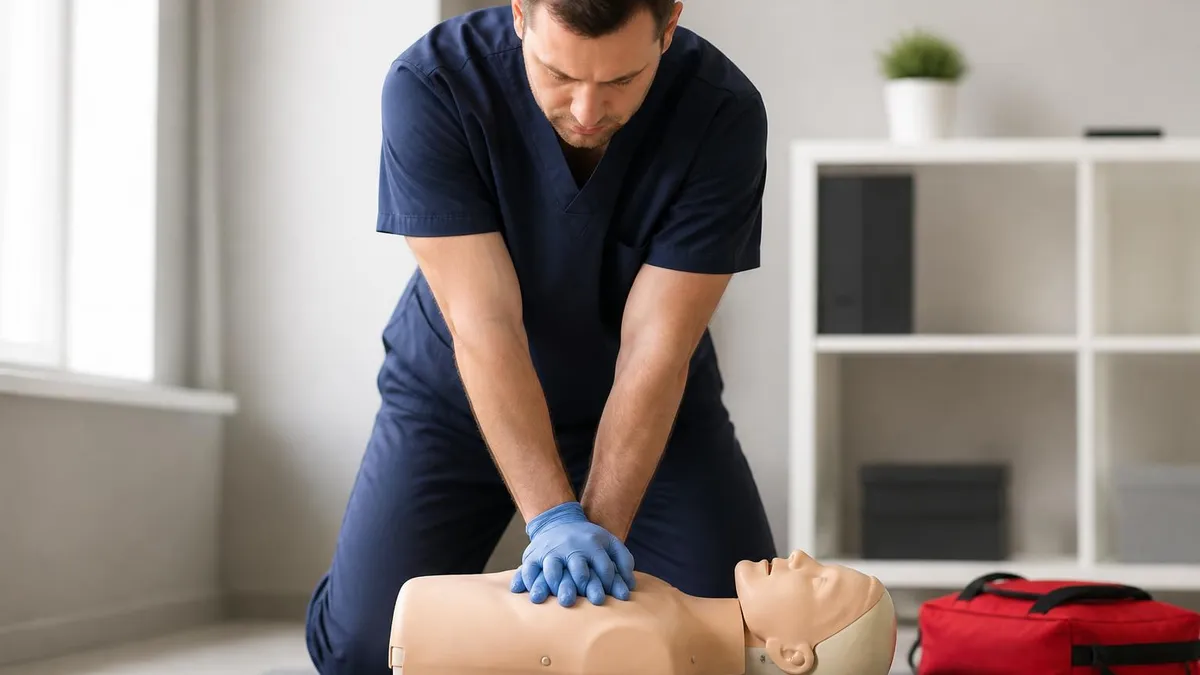
Online BLS Renewal: Complete 2026 Guide to Recertifying Your Basic Life Support Card
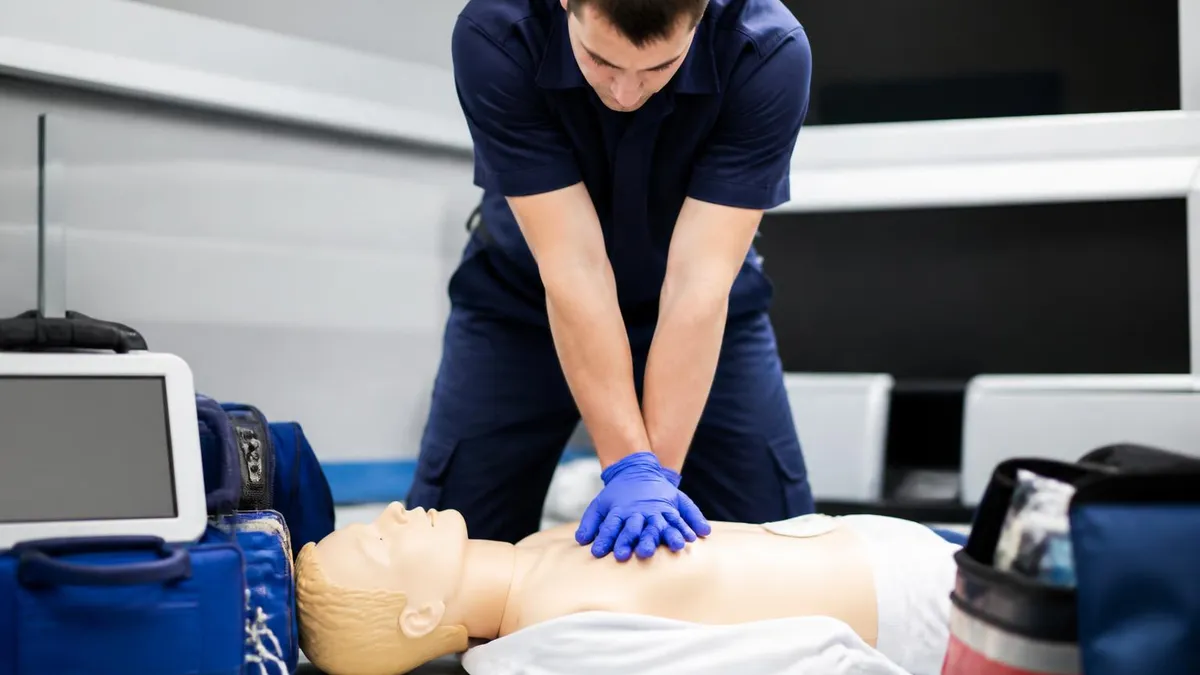
Are CPR and BLS the Same? Complete 2026 Guide to Differences, Certification & Training
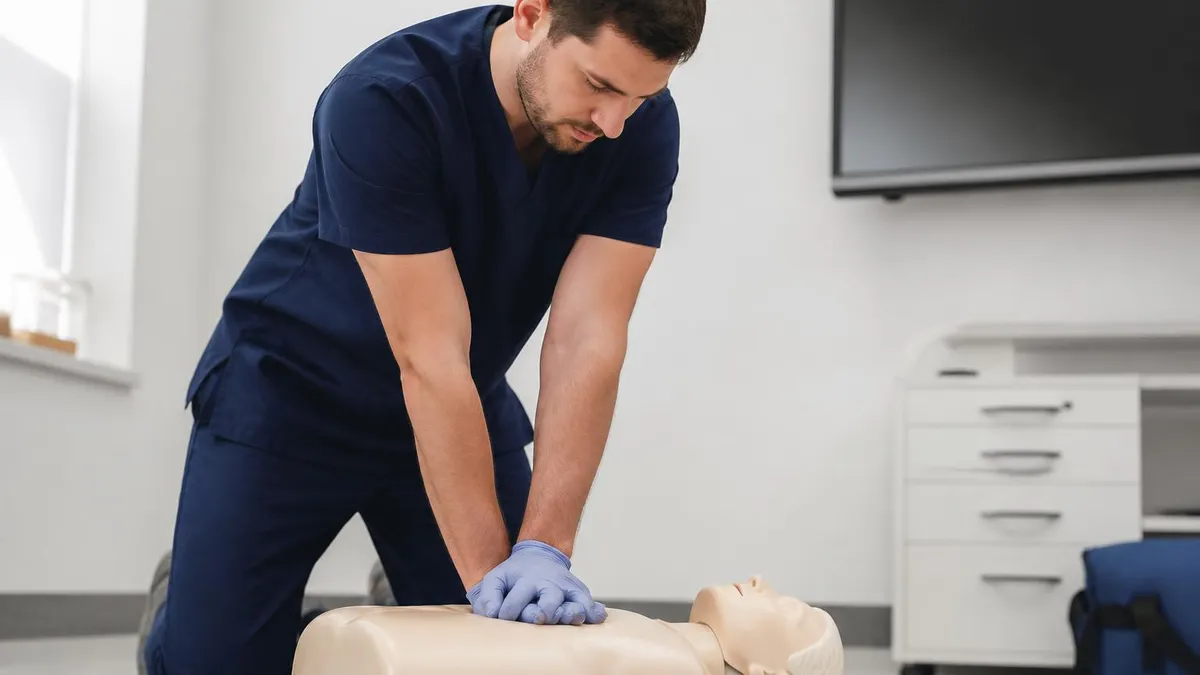
How to Renew BLS Certification: Complete 2026 Guide to Recertifying Your Card
About the Author

Registered Nurse & Healthcare Educator
Johns Hopkins University School of NursingDr. Sarah Mitchell is a board-certified registered nurse with over 15 years of clinical and academic experience. She completed her PhD in Nursing Science at Johns Hopkins University and has taught NCLEX preparation and clinical skills courses for nursing students across the United States. Her research focuses on evidence-based exam preparation strategies for healthcare certification candidates.
Join the Discussion
Connect with other students preparing for this exam. Share tips, ask questions, and get advice from people who have been there.
View discussion (8 replies)