
BLS Certification Near Me: Complete 2026 Guide to Finding Classes and Getting Certified
Learn what is a BLS certification, find BLS certification near me, ❓ compare AHA vs Red Cross courses, and prepare for your basic life support exam in 2026.
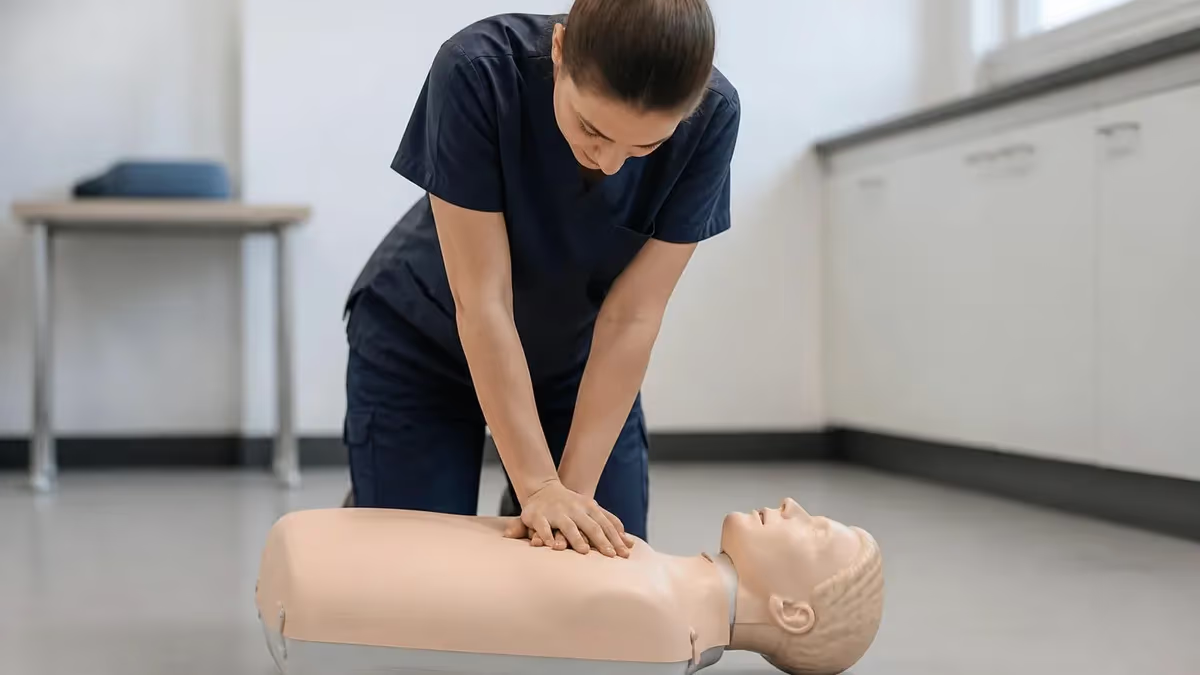
Searching for BLS certification near me is the first step many healthcare professionals and aspiring responders take when they need to earn or renew basic life support credentials. Understanding what is a BLS certification helps you determine whether this training aligns with your career goals and workplace requirements. BLS certification equips you with critical skills needed to respond to cardiac emergencies, respiratory failures, and other life-threatening situations that demand immediate intervention before advanced medical help arrives on scene.
So what does BLS stand for in the medical field? BLS stands for Basic Life Support, a standardized set of emergency response protocols designed to maintain circulation and oxygenation during cardiac arrest or respiratory failure. Unlike general first aid training, BLS focuses specifically on high-quality chest compressions, rescue breathing, and automated external defibrillator usage. Healthcare providers across every clinical setting are required to maintain active BLS certification, making it one of the most widely held emergency medical credentials in the United States.
A common question among newcomers is whether is basic life support the same as cpr, and the answer involves important clinical distinctions. While CPR is a core component of BLS training, basic life support encompasses a broader range of lifesaving skills beyond cardiopulmonary resuscitation alone. BLS courses cover multi-rescuer coordination, bag-valve-mask ventilation, choking relief for all age groups, and team-based resuscitation dynamics that go well beyond single-rescuer techniques designed for laypersons.
Basic life support for healthcare providers represents the professional-level course that most employers and licensing boards require for clinical practice. This provider-level certification goes beyond layperson CPR to include advanced airway management techniques, two-rescuer CPR protocols, and integration with emergency medical services systems. Nurses, physicians, paramedics, dentists, physical therapists, and respiratory therapists all benefit from maintaining current BLS provider credentials throughout their careers in healthcare settings.
The basic life support exam American Heart Association administers has become the gold standard for BLS certification across the United States. The AHA BLS Provider course includes both a skills evaluation and a written knowledge assessment covering cardiac arrest recognition, high-quality CPR parameters, AED protocols, and relief of foreign-body airway obstruction. The aha basic life support exam requires passing both components to earn your two-year provider certification card recognized by virtually all healthcare employers nationwide.
When searching for BLS certification near me, you will encounter multiple training providers, course formats, and pricing structures. The two most recognized certifying organizations are the American Heart Association and the American Red Cross, though other accredited providers also offer legitimate BLS training. In-person classes typically run four to five hours with hands-on manikin practice, while blended learning options combine online coursework with a shorter in-person skills verification session at an authorized training center.
Throughout this guide, we cover everything about finding quality BLS training near your location, understanding course requirements, preparing for the certification exam, and maintaining credentials through timely renewal. Whether you are a nursing student completing clinical prerequisites, a practicing paramedic keeping certifications current, or a fitness instructor expanding your emergency response capabilities, this resource provides the detailed step-by-step guidance you need to successfully earn your BLS certification and advance your career goals.
BLS Certification by the Numbers
Key Facts at a Glance
| Item | Value | Details |
|---|---|---|
| Written Exam Questions | 25 | AHA BLS Provider exam |
| Minimum Passing Score | 84% | AHA written assessment |
| Certification Validity | 2 Years | Both AHA and Red Cross |

How to Find BLS Certification Near Me
Compare American Heart Association, American Red Cross, and independent training centers in your area. Verify each provider holds current authorization to issue BLS certification cards. Use the AHA Course Connector or Red Cross website to search by zip code.
Decide between full in-person classroom training, blended learning with online modules plus in-person skills verification, or employer-based group training. Consider your schedule, learning style, and budget when selecting the format that fits your needs.
Sign up for your preferred course and begin reviewing study materials including the official BLS provider manual. Watch demonstration videos and take practice tests to assess your baseline knowledge and identify topics needing additional review before class.
Attend class and practice high-quality CPR on adult, child, and infant manikins. Learn proper AED operation, bag-valve-mask ventilation, and team-based resuscitation protocols. Maximize repetitions to build the muscle memory essential for passing the evaluation.
Complete the written knowledge assessment with a minimum eighty-four percent score and demonstrate competency during hands-on skills evaluation. Upon successful completion, receive your BLS provider certification card valid for two years from the date of issue.
Finding the right BLS course requires careful evaluation of several factors beyond simply locating the nearest classroom. The aha basic life support exam content remains consistent across authorized training centers, but instruction quality, class sizes, scheduling flexibility, and overall learning environment can vary significantly between providers. Start your search by visiting the American Heart Association website and using their course connector tool, which lets you filter results by zip code, date, and course format to find options that match your schedule and location preferences.
The american red cross basic life support course offers an alternative certification pathway that many healthcare professionals find equally valuable. Red Cross BLS training covers the same core competencies as the AHA version, including high-quality CPR for all age groups, AED usage, and team-based resuscitation. Red Cross BLS courses are accepted by most healthcare employers, although some institutions specifically require AHA certification. Always verify your employer's preferred certifying organization before registering for any course to avoid costly duplication of training efforts.
Blended learning has become increasingly popular for BLS certification, combining online didactic content with a focused hands-on skills session. The online portion typically takes two to three hours and covers the cognitive knowledge base including the cardiac arrest chain of survival, compression-to-ventilation ratios, and special situations like opioid overdose response. After completing the online modules and passing the knowledge assessment, you schedule an in-person skills session lasting one to two hours where an instructor evaluates your hands-on competency with manikins and equipment.
Cost is another critical factor when choosing a BLS certification course near you. Prices typically range from forty-five dollars to ninety dollars depending on the provider, geographic location, and whether the course includes materials or requires separate textbook purchase. Community colleges and hospital-affiliated training centers often offer competitive pricing, while independent training sites may charge premium rates for smaller class sizes or weekend scheduling. Some employers reimburse BLS certification costs, so check with your human resources department before paying out of pocket for your training.
The hands-on skills evaluation is the portion of BLS training many students find most challenging, yet it represents the most valuable learning opportunity in the entire course. During the skills test, you demonstrate proper hand placement and compression depth on adult, child, and infant manikins. Instructors evaluate your compression rate, which should fall between one hundred and one hundred twenty compressions per minute, and verify that you achieve adequate chest recoil between compressions without leaning on the patient's chest between cycles.
Group classes provide the collaborative learning environment that best simulates real-world emergency response scenarios you will encounter professionally. Working alongside other students lets you practice multi-rescuer CPR, coordinate team roles including compressor, ventilator, and AED operator, and experience the communication dynamics essential to effective resuscitation. Most BLS instructors incorporate realistic scenarios challenging students to apply skills under time pressure, assess patient responsiveness, and make rapid intervention decisions in dynamic emergency situations.
When evaluating BLS training centers near you, look for facilities maintaining current equipment including feedback-enabled manikins that display compression depth and rate in real time. Quality training centers limit class sizes to ensure each student receives adequate practice time and individualized instructor feedback. Read online reviews from previous students, verify the training center holds current authorization from their certifying organization, and confirm the course completion card will be recognized by your employer or educational institution before committing to enrollment.
BLS Practice Test Questions
Prepare for the BLS - Basic Life Support exam with our free practice test modules. Each quiz covers key topics to help you pass on your first try.
BLS High-Quality CPR & Provider Skills
BLS Exam Questions covering BLS High-Quality CPR & Provider Skills. Master BLS Test concepts for certification prep.
BLS Special Situations & Scenarios
Free BLS Practice Test featuring BLS Special Situations & Scenarios. Improve your BLS Exam score with mock test prep.
BLS Adult, Child & Infant Resuscitation
BLS Mock Exam on Adult, Child & Infant Resuscitation. BLS Study Guide questions to pass on your first try.
BLS Airway Management & Ventilation
BLS Test Prep for Airway Management & Ventilation. Practice BLS Quiz questions and boost your score.
BLS Automated External Defibrillator (AED)...
BLS Questions and Answers on Automated External Defibrillator (AED) Use. Free BLS practice for exam readiness.
BLS Certification: Cardiac Arrest
BLS Mock Test covering Certification: Cardiac Arrest. Online BLS Test practice with instant feedback.
BLS Certification: Choking
Free BLS Quiz on Certification: Choking. BLS Exam prep questions with detailed explanations.
BLS Certification: Respiratory Arrest
BLS Practice Questions for Certification: Respiratory Arrest. Build confidence for your BLS certification exam.
BLS Chain of Survival
BLS Test Online for Chain of Survival. Free practice with instant results and feedback.
BLS CPR Techniques & Procedures
BLS Study Material on CPR Techniques & Procedures. Prepare effectively with real exam-style questions.
BLS Legal & Ethical Considerations
Free BLS Test covering Legal & Ethical Considerations. Practice and track your BLS exam readiness.
BLS Post-Resuscitation Care
BLS Exam Questions covering Post-Resuscitation Care. Master BLS Test concepts for certification prep.
Is BLS the Same as CPR? Comparing Certification Pathways
The American Heart Association BLS Provider course remains the most widely recognized certification pathway for healthcare professionals across the United States. This comprehensive program follows the latest AHA Guidelines for CPR and Emergency Cardiovascular Care, covering single-rescuer and multi-rescuer CPR for adults, children, and infants. The full classroom course runs approximately four and a half hours and includes both a written knowledge exam and a thorough hands-on skills evaluation component with manikins.
The AHA written exam consists of twenty-five multiple-choice questions with a minimum passing score of eighty-four percent. Students who do not pass on the first attempt receive one remediation opportunity. The skills evaluation requires demonstration of high-quality CPR on adult, child, and infant manikins, proper AED usage, and bag-valve-mask ventilation technique. Upon successful completion, participants receive a two-year certification card recognized by virtually all healthcare employers and licensing boards nationwide.

In-Person vs Online BLS Certification Training
- +Full hands-on practice time with manikins and AED trainers throughout the entire class
- +Immediate instructor feedback on compression depth, rate, and overall technique quality
- +Collaborative multi-rescuer scenarios simulating realistic emergency response team dynamics
- +Higher first-attempt pass rates on skills evaluations due to extended guided practice
- +Networking opportunities with fellow healthcare professionals and potential career connections
- +Structured learning environment minimizing distractions and maintaining focused engagement
- −Fixed class schedules that may conflict with work shifts or personal obligations
- −Higher total time commitment of four to five hours for the complete classroom session
- −Travel required to reach the training center adds time and transportation costs
- −Larger class sizes at some facilities may reduce individual practice time per student
- −Limited availability during peak enrollment periods especially before academic deadlines
- −No ability to pause and review material at your own pace during instruction
BLS Certification Preparation Checklist
- ✓Verify your employer's required certifying organization before registering for any BLS course.
- ✓Search for AHA or Red Cross authorized training centers within reasonable driving distance.
- ✓Compare course formats and choose between classroom, blended learning, or employer-based training.
- ✓Purchase or download the official BLS provider manual and read it thoroughly before class.
- ✓Complete at least three full-length BLS practice tests and score above ninety percent consistently.
- ✓Memorize compression rates, depths, and ventilation ratios for adult, child, and infant patients.
- ✓Review the AED operation sequence including pad placement, rhythm analysis, and shock delivery.
- ✓Practice head-tilt chin-lift technique and bag-valve-mask ventilation positioning before class day.
- ✓Bring a valid photo ID and any required prerequisite documentation to your training session.
- ✓Arrive fifteen minutes early to settle in and confirm registration and payment information.
Practice Tests Dramatically Improve Pass Rates
Students who complete at least three full-length BLS practice exams before their certification course pass the written assessment on their first attempt at rates exceeding ninety-five percent. Practice tests reveal knowledge gaps in specific areas like compression parameters, ventilation ratios, and special situations, giving you targeted review opportunities. Combine practice testing with hands-on manikin practice to build both cognitive knowledge and physical muscle memory simultaneously.
Preparing for your BLS certification exam requires a strategic approach combining thorough knowledge review with extensive hands-on practice. The written portion tests your understanding of cardiac arrest recognition, proper compression parameters, ventilation ratios, and the systematic approach to emergency response outlined in the chain of survival. Begin preparation by thoroughly reviewing the official BLS provider manual, paying particular attention to algorithm flowcharts that guide decision-making during adult, child, and infant cardiac arrest scenarios requiring immediate intervention.
Understanding specific numerical parameters tested on the BLS exam is critical for achieving a passing score on the written assessment. For adult CPR, compressions should be delivered at a rate of one hundred to one hundred twenty per minute with a depth of at least two inches but no more than two point four inches. The compression-to-ventilation ratio for single-rescuer CPR is thirty to two for all age groups, while two-rescuer CPR uses a fifteen-to-two ratio specifically for children and infants requiring resuscitation efforts.
High-quality CPR remains the central focus of every BLS certification exam, and understanding what constitutes high quality versus inadequate chest compressions makes the difference between passing and failing. High-quality CPR requires pushing hard enough for adequate depth, pushing fast enough for proper rate, allowing complete chest recoil between each compression, minimizing interruptions to ten seconds or fewer during transitions, and avoiding excessive ventilation that can impede venous return and reduce cardiac output during ongoing resuscitation efforts in the field.
The AED section evaluates your ability to properly apply and operate an automated external defibrillator during a cardiac arrest scenario under time pressure. Key concepts include powering on the device immediately, properly placing electrode pads on the patient's bare dry chest, ensuring nobody touches the patient during rhythm analysis and shock delivery, and resuming CPR immediately after a shock without delay. For children between one and eight years old, pediatric dose attenuator pads should be used whenever they are available at the scene.
Special situations frequently appear on BLS exams and represent areas where many students lose critical points. These scenarios include drowning victims where rescue breaths should be prioritized before compressions, suspected opioid overdose requiring naloxone administration when available, pregnant patients requiring left lateral uterine displacement during CPR, hypothermic patients who may need modified resuscitation protocols, and patients with implanted devices like pacemakers that require adjusted pad placement. Reviewing these special situations thoroughly before your exam significantly improves your overall chances of passing.
Practice tests offer one of the most effective preparation strategies because they familiarize you with the question format and help identify knowledge gaps before the actual assessment. Taking multiple practice exams under timed conditions simulates the testing environment and reduces anxiety on exam day. Focus review on questions you answer incorrectly, trace each wrong answer back to the relevant section of your study materials, and retake the practice test until you consistently score above ninety percent across all topic areas covered on the certification exam.
Team dynamics and communication represent another significant BLS component many students underestimate during preparation. The exam evaluates understanding of closed-loop communication, where the team leader gives a clear order, the team member repeats it back, and the leader confirms understanding. You should understand role assignments during multi-rescuer resuscitation including compressor, airway manager, AED operator, and timer. Constructive intervention protocols allow any team member to respectfully identify and correct performance issues during ongoing resuscitation efforts without disrupting team coordination.
Allowing your BLS certification to lapse can result in immediate suspension of clinical privileges, reassignment to non-patient-care duties, or employment termination at many healthcare facilities. Nursing and medical students with expired BLS credentials may be barred from required clinical rotations, potentially delaying graduation. Set calendar reminders at ninety, sixty, and thirty days before your expiration date to ensure you complete renewal on time.
Understanding how long does basic life support certification last is essential for maintaining compliance with employer requirements and professional licensing standards. Both AHA and Red Cross BLS certifications are valid for exactly two years from the date of issue. Planning your renewal well in advance prevents gaps in certification that could affect your employment status, clinical privileges, or eligibility for professional licensing examinations that require current BLS documentation as a prerequisite for candidates.
The basic life support renewal class is designed for healthcare professionals holding current or recently expired BLS certification who need to update credentials efficiently. Renewal courses are shorter than initial certification classes, typically running two to three hours compared to four or five hours for first-time students. These abbreviated courses focus on reviewing updated guidelines, practicing skills to maintain competency, and completing required written and hands-on assessments. Renewal courses are available in both full classroom and convenient blended learning formats near most locations.
Several factors influence when and where you should renew your BLS certification to ensure an uninterrupted credentialing process. If your employer requires a specific certifying organization, ensure your renewal course comes from that same organization to maintain credential continuity. Some healthcare systems run internal renewal programs providing training at no cost during scheduled work hours. If your employer does not offer this benefit, you will need to find an external training center and schedule personal time to complete the renewal process.
The renewal process mirrors the initial certification assessment in terms of skills and knowledge evaluated. You still need to demonstrate high-quality CPR on adult, child, and infant manikins, perform proper AED operation, and pass a written knowledge assessment. However, renewal courses spend less time on introductory instruction and more time on skills practice and evaluation. Updated guidelines or protocol changes since your last certification are highlighted during renewal to ensure your knowledge and clinical skills remain completely current.
Online BLS renewal options have expanded significantly and now represent a convenient alternative for busy healthcare professionals managing demanding schedules. The blended renewal format lets you complete the cognitive portion online at your own pace, typically requiring ninety minutes to two hours. After passing the online assessment, you schedule a brief in-person skills session lasting approximately forty-five minutes to one hour. This format reduces total time commitment and provides scheduling flexibility that traditional classroom renewals simply cannot match for working professionals.
Tracking multiple healthcare certifications simultaneously requires an organized approach to prevent any credentials from expiring unexpectedly. Create a digital calendar with renewal reminders set at ninety days, sixty days, and thirty days before each certification expiration date. Many healthcare professionals maintain BLS alongside ACLS, PALS, and other specialty certifications, each with different renewal cycles. Some training centers offer combination courses or bundled renewal packages allowing you to update multiple certifications during a single visit, saving both time and money on maintaining your professional credentials.
Successful BLS certification starts with choosing the right preparation strategy for your learning style and schedule constraints. Visual learners should focus on watching demonstration videos of proper CPR technique and AED operation before attending class. Kinesthetic learners benefit most from obtaining a CPR practice manikin for home use, which builds muscle memory for proper hand placement, compression depth, and consistent rhythm. Auditory learners should consider studying with a partner who can quiz them verbally on key protocols and sequences.
Time management during your BLS certification course directly impacts your success on both the skills evaluation and written exam. Arrive early enough to settle in, review materials, and mentally prepare for the intensive training session ahead. During class, volunteer to practice skills first whenever the instructor asks for participants, as this maximizes your hands-on practice time and allows you to receive early feedback that you can incorporate throughout remaining exercises. Avoid phone distractions to maintain full focus on instruction.
Physical preparation for BLS training is an often overlooked factor that can significantly affect your performance during the skills evaluation. Performing proper chest compressions for multiple cycles requires considerable upper body endurance, and students who fatigue quickly may not achieve the compression depth or rate required to pass. In the weeks before your course, practice push-ups and planks to build core and upper body strength needed to sustain high-quality compressions throughout the entire evaluation period.
Understanding common mistakes that cause students to fail the BLS skills evaluation helps you avoid these pitfalls during your own assessment. The most frequent errors include insufficient compression depth, failing to allow complete chest recoil between compressions, excessive interruptions during CPR transitions, improper head-tilt chin-lift technique during ventilation, and forgetting to check scene safety before approaching the patient. Practice each skill component individually until you perform it correctly without conscious thought, then integrate everything into complete scenarios.
The written exam requires more than simple memorization of numbers and ratios. Questions are often presented in scenario-based formats requiring you to apply knowledge to specific clinical situations. Rather than simply asking the compression rate for adult CPR, a question might describe a scenario where you find an unresponsive adult and ask you to identify the correct sequence of actions. Practice answering scenario-based questions to develop the critical thinking skills needed for exam success on your first attempt.
After earning your BLS certification, maintaining skills between renewal cycles is just as important as initial training. Studies show CPR performance declines significantly within three to six months after training, meaning skills demonstrated on certification day may deteriorate well before your two-year credential expires. Many healthcare facilities address this through quarterly skills refreshers, simulation-based training exercises, and mock code scenarios that keep resuscitation skills sharp and ready for real emergency situations.
Building confidence in your BLS skills extends beyond the classroom into daily professional practice. Familiarize yourself with emergency response equipment at your workplace, including AED locations, emergency medication kits, and communication systems for activating rapid response teams. Participate in facility-based emergency drills whenever possible, and debrief with your team after real cardiac arrest events to identify improvements. This continuous learning mindset transforms BLS certification from a checkbox requirement into genuine lifesaving capability that protects patients every day.
Sample BLS - Basic Life Support Practice Questions
Try these questions from our free BLS - Basic Life Support practice tests. The correct answer and an explanation follow each question.
A rescuer is performing high-quality CPR on an adult. Which finding indicates compressions are adequate?
- A. Capillary refill of 3 seconds
- B. Visible chest rise with each compression
- C. Chest recoils fully between compressions
- D. Patient's color returns to normal
Answer: C. Chest recoils fully between compressions
Full chest recoil between compressions allows the heart to refill with blood, which is a key indicator of high-quality CPR.
Which finding during rescue breathing indicates gastric inflation is occurring?
- A. The abdomen rises rather than the chest
- B. The patient's lips turn pink
- C. The bag-mask valve makes a clicking sound
- D. Oxygen saturation drops during ventilation
Answer: A. The abdomen rises rather than the chest
Visible abdominal rise instead of chest rise suggests air is entering the stomach, increasing aspiration risk.
Which finding would MOST strongly confirm that a victim is in cardiac arrest rather than unconscious from another cause?
- A. Pale or bluish skin color
- B. Absence of normal breathing and no detectable pulse
- C. Unresponsiveness to verbal stimulation
- D. Dilated pupils
Answer: B. Absence of normal breathing and no detectable pulse
The definitive signs of cardiac arrest are unresponsiveness combined with absence of normal breathing and absence of a detectable pulse.
Which finding on EEG is associated with poor neurological prognosis after cardiac arrest?
- A. Alpha pattern activity
- B. Burst suppression with identical bursts
- C. Continuous normal background
- D. Sleep-wake cycles present
Answer: B. Burst suppression with identical bursts
Burst suppression with identical (stereotyped) bursts is a malignant EEG pattern predictive of poor neurological outcome.
BLS Questions and Answers
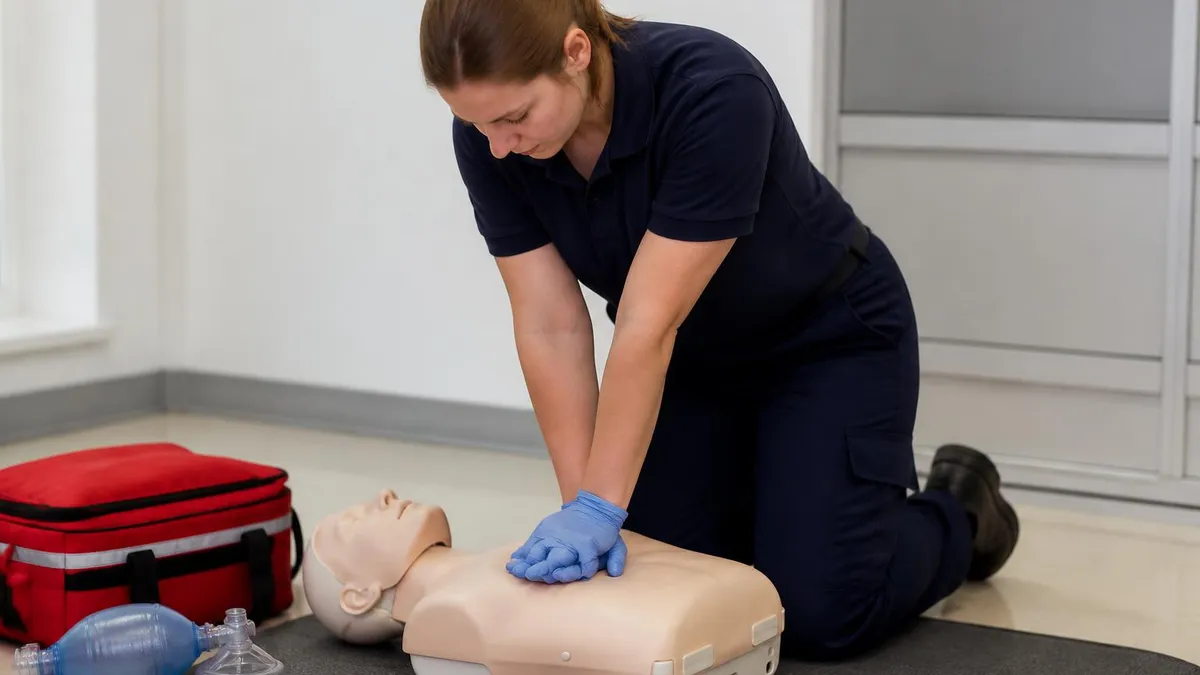
Pediatric BLS Algorithm: Complete 2026 Guide for Healthcare Providers
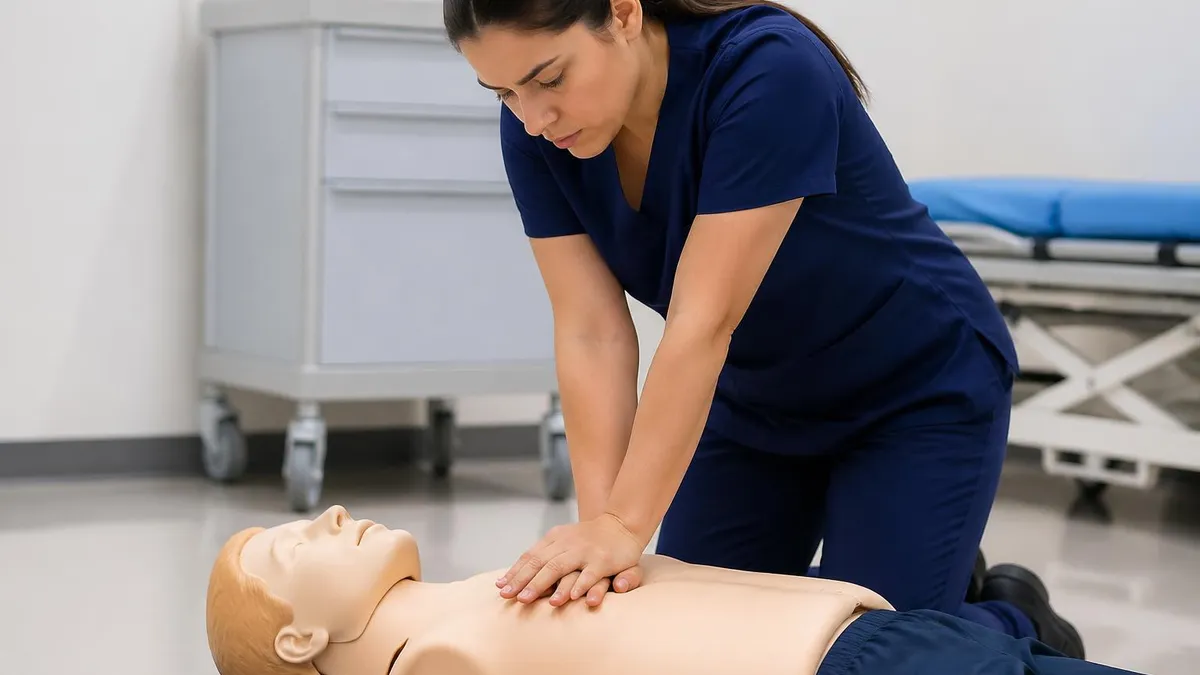
American Heart Association BLS: Certification, Renewal, Cost & What to Expect
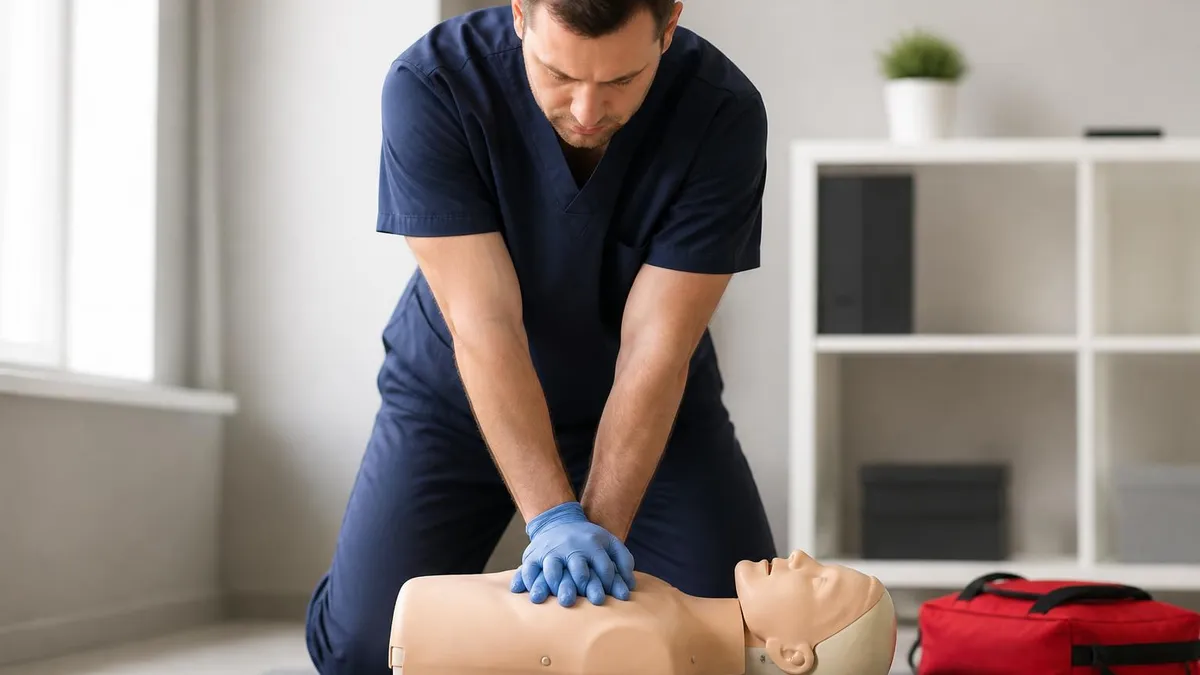
Online BLS Renewal: Complete 2026 Guide to Recertifying Your Basic Life Support Card
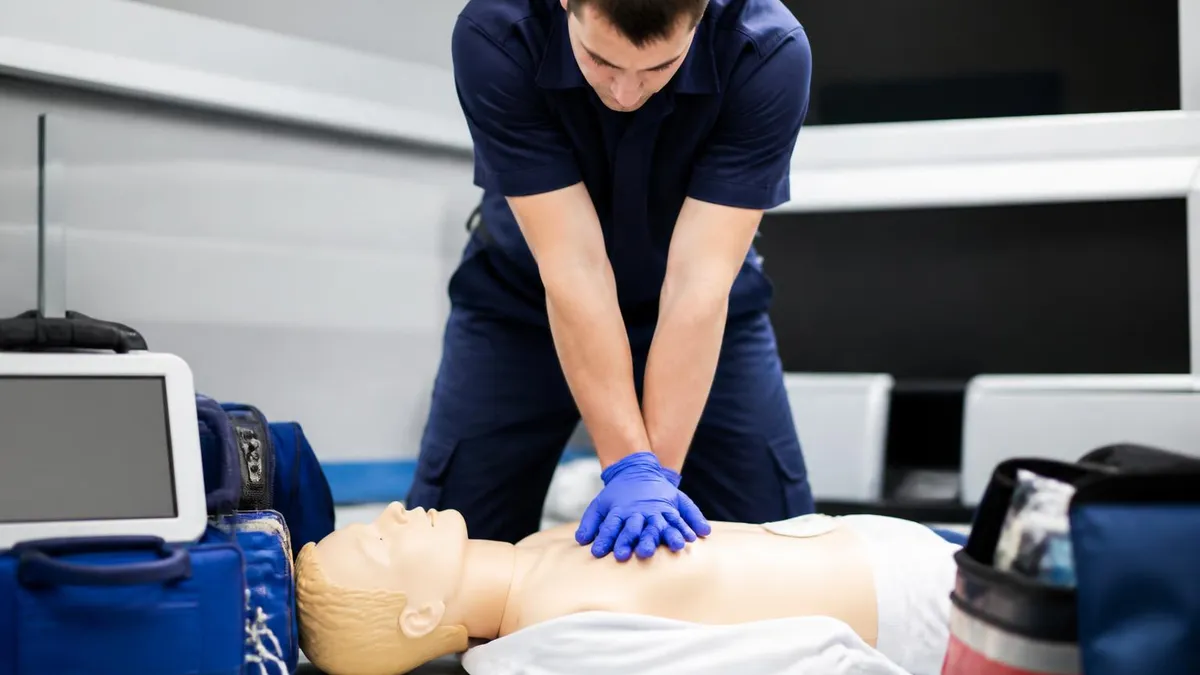
Are CPR and BLS the Same? Complete 2026 Guide to Differences, Certification & Training
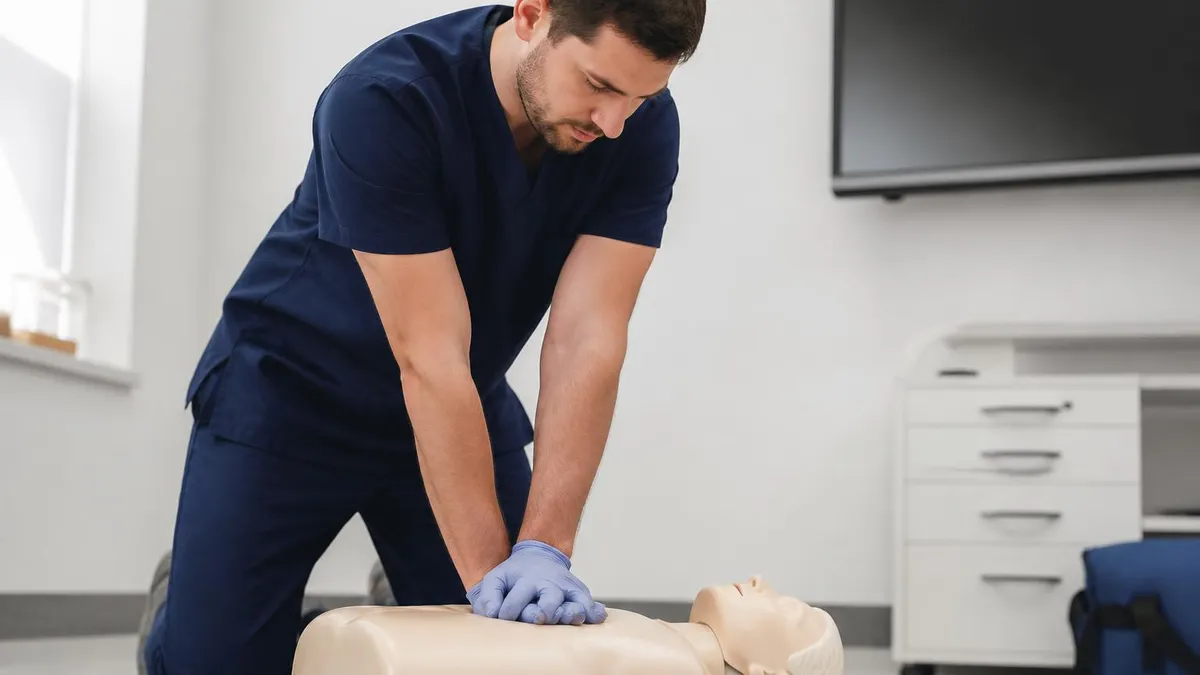
How to Renew BLS Certification: Complete 2026 Guide to Recertifying Your Card
About the Author

Registered Nurse & Healthcare Educator
Johns Hopkins University School of NursingDr. Sarah Mitchell is a board-certified registered nurse with over 15 years of clinical and academic experience. She completed her PhD in Nursing Science at Johns Hopkins University and has taught NCLEX preparation and clinical skills courses for nursing students across the United States. Her research focuses on evidence-based exam preparation strategies for healthcare certification candidates.
Join the Discussion
Connect with other students preparing for this exam. Share tips, ask questions, and get advice from people who have been there.
View discussion (8 replies)