
ACLS and PALS: Differences, Who Needs Both, and How to Get Certified
🔎 ACLS and PALS compared: course content, who needs both, cost, length, AHA renewal cycle, and how to certify in adult and pediatric resuscitation.
Two Certifications, Two Patient Populations
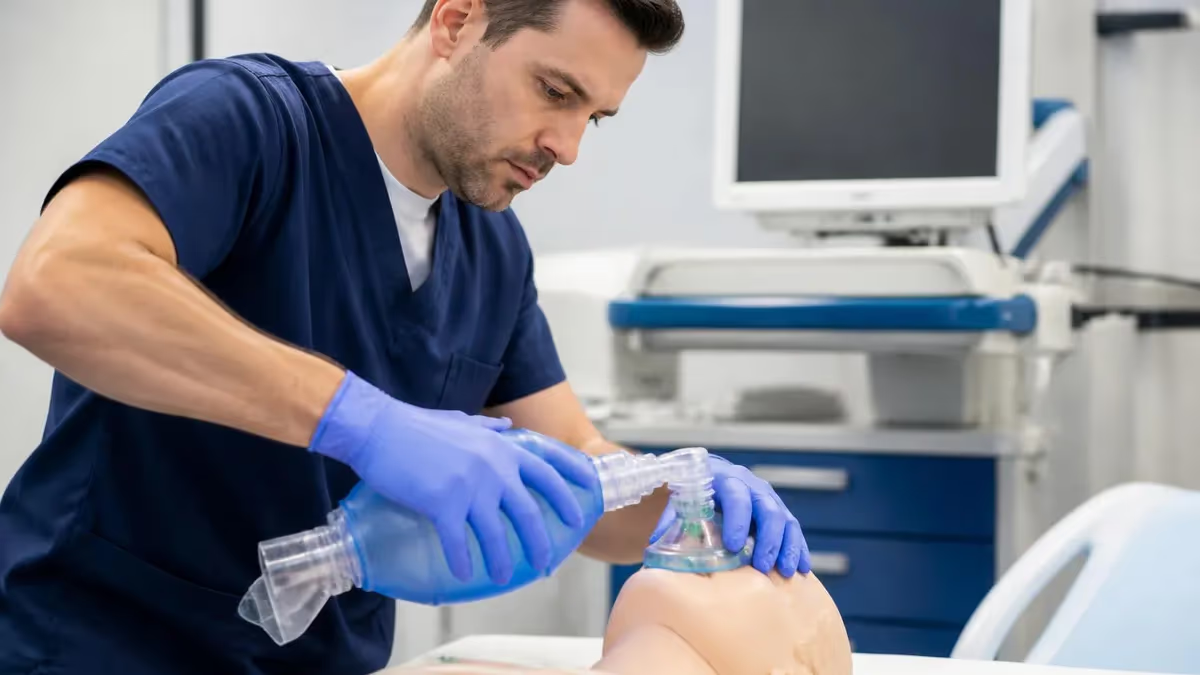
ACLS (Advanced Cardiovascular Life Support) covers adult cardiac arrest, arrhythmias, stroke, and ACS. PALS (Pediatric Advanced Life Support) covers pediatric resuscitation, shock, respiratory failure, and bradyarrhythmias in infants and children. Both are American Heart Association courses, both run roughly 12 to 14 hours initially, both cost between two hundred and three hundred dollars, and both are valid for two years. If you work in a mixed adult and pediatric setting — emergency department, transport, anesthesia, or a community hospital — you almost certainly need both cards.
ACLS and PALS: The Complete 2026 Comparison Guide
If you have spent any time in a hospital education office, you have probably been handed a list of required certifications longer than your scrub pocket. Two acronyms keep showing up next to each other: ACLS and PALS. They look similar, they both come from the American Heart Association, and they both involve simulated code scenarios with a manikin. That is roughly where the similarities end.
ACLS is built around adults in cardiac arrest. The algorithms assume a patient who weighs roughly seventy kilograms, whose heart is the most likely thing to fail first, and whose airway is comparatively straightforward. PALS flips every one of those assumptions. The patient is small, the airway is the most likely thing to fail first, and the weight changes everything from epinephrine doses to defibrillation joules per kilogram.
This guide walks through what each course actually contains, who genuinely needs both versus only one, and how to schedule them efficiently. We also cover where to take them without getting burned by an online-only provider whose card your hospital will reject.
If you already hold one and need to add the other, jump to the section on stacking the two into a single weekend. For a refresher on the adult side, our breakdown of the acls algorithm walks through every branch you will see in the megacode.
One detail that catches new providers off guard: PALS is not a watered-down version of ACLS. The course is genuinely different. Pediatric patients deteriorate through respiratory and shock pathways far more often than through primary cardiac arrest, so PALS spends a large chunk of class time on the Pediatric Assessment Triangle and recognizing compensated versus decompensated shock — content that has no real analogue in the adult curriculum.
The good news is that the test-taking strategy is similar. Both certifications use scenario-based megacode testing, both rely on a precourse self-assessment that you must pass before class, and both reward the same skill: confident recognition of a rhythm or clinical picture followed by the correct first action. If you have already passed one, you have already built the muscle memory you need to pass the other.
One more thing worth knowing before you sign up. Hospitals do not always tell you which card you need until orientation week. By that point you have already missed the chance to pre-schedule a combined course.
Ask the unit educator during your interview or onboarding paperwork. The answer takes thirty seconds and can save a wasted day off and several hundred dollars in re-booking fees if the wrong card shows up in your file.
Some hospitals will reimburse the cost of certification if you submit receipts within thirty days — confirm that policy too, because the deadlines are usually strict and rarely announced upfront. Reimbursement varies widely across systems and even across departments within the same hospital, so verify in writing if you can.
ACLS vs PALS vs Both — Which Card Do You Need?
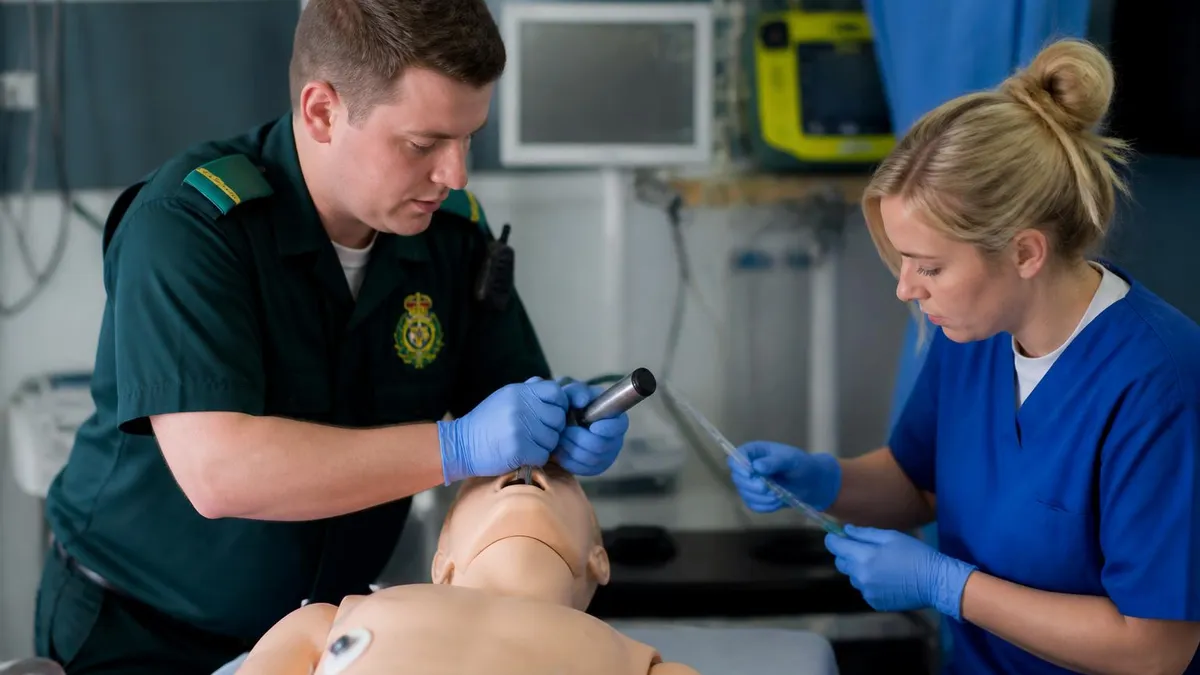
You need ACLS but not PALS if you work exclusively with adult patients aged 8 and older. Typical roles: adult ICU nurses, adult medical-surgical floors, adult cath lab and interventional radiology staff, adult-only emergency departments (rare — most ED's see at least some pediatric volume), adult oncology, and adult-only telemetry units. The course teaches adult cardiac arrest algorithms (VF/pVT, asystole, PEA), bradycardia and tachycardia management, acute coronary syndrome recognition, stroke workup including last-known-well timing, and post-cardiac arrest care including targeted temperature management.
5 Real Differences Between ACLS and PALS
- ACLS focus: Adults 8 years and older
- PALS focus: Infants through age 8 (some texts up to puberty)
- Why it matters: Drug doses and joule settings scale by weight in PALS
- ACLS assumes: Primary cardiac event (MI, arrhythmia)
- PALS assumes: Respiratory failure or shock progressing to arrest
- Clinical impact: Recognition triangle drives PALS scenarios
- ACLS uses: Primary survey (BLS) then ACLS secondary
- PALS uses: Pediatric Assessment Triangle (PAT)
- Why it matters: PAT is rapid, no-touch, used at first glance
- ACLS: Fixed adult doses (epi 1 mg, amio 300 mg)
- PALS: Weight-based (epi 0.01 mg/kg, amio 5 mg/kg)
- Tools used: Broselow tape, length-based color codes
- ACLS: 200 J biphasic (or per device)
- PALS: 2 J/kg first shock, 4 J/kg subsequent
- Equipment: Pediatric pads for under 10 kg or under 1 year
Take Both Certifications vs Take Only One
- +Career flexibility — float pool, travel nursing, and cross-training all require both cards
- +Single weekend completion saves a vacation day later
- +Aligned renewal cycle — renew both the same week every two years
- +Combined courses often discounted $50-$100 versus booking separately
- +Required for most ED, EMS, and anesthesia roles by default
- +Same precourse self-assessment habits apply to both — study efficiency
- −Higher upfront cost ($400-$500 combined vs $200-$300 single)
- −Two days of classroom time instead of one
- −Two precourse self-assessments to complete (each 84 percent or higher)
- −More material to retain — PALS algorithms differ from ACLS branches
- −If you work strictly adult or strictly pediatric, the unused card adds no value
- −Two CME or CE submissions to track for license renewal
Pros and Cons at a Glance
| Pros | Cons |
|---|---|
| Career flexibility — float pool, travel nursing, and cross-training all require both cards | Two days of classroom time instead of one |
| Single weekend completion saves a vacation day later | More material to retain — PALS algorithms differ from ACLS branches |
| Aligned renewal cycle — renew both the same week every two years | If you work strictly adult or strictly pediatric, the unused card adds no value |
| Required for most ED, EMS, and anesthesia roles by default | Two CME or CE submissions to track for license renewal |
What ACLS Actually Covers
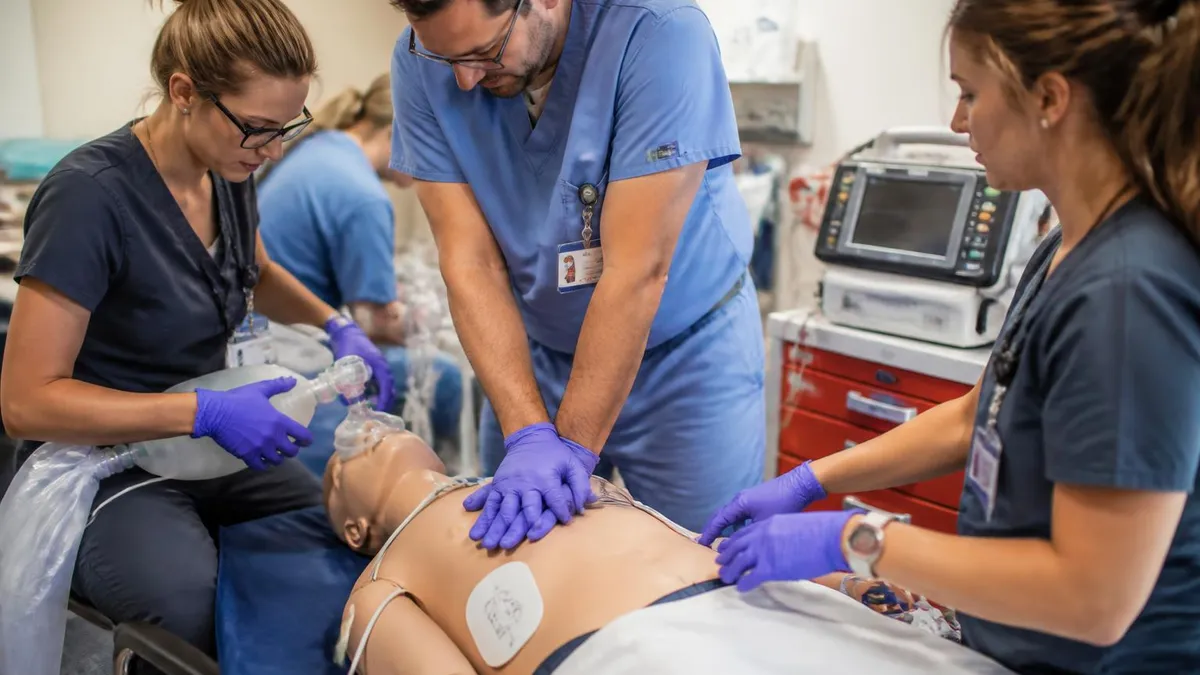
ACLS opens with the assumption that you already know BLS cold. The first hour of any AHA ACLS class is a BLS skills check. If you cannot run high-quality CPR with proper rate, depth, and recoil, the instructor will stop you and you will not pass.
From there the course moves into the systematic approach: primary survey, secondary survey, and the H's and T's. Those are the reversible causes — hypoxia, hypovolemia, hypothermia, hydrogen ion (acidosis), hyperkalemia, hypoglycemia, toxins, tamponade, tension pneumothorax, thrombosis pulmonary, and thrombosis coronary.
The algorithm core is four branches: VF/pulseless VT (shockable), asystole and PEA (non-shockable), bradycardia with a pulse, and tachycardia with a pulse. Each branch has its own decision points — atropine 1 mg IV push for symptomatic bradycardia, adenosine 6 mg rapid push for stable narrow-complex tachycardia, synchronized cardioversion for unstable tachy.
The megacode at the end of class drops you into a scenario, hands you a team, and watches you for about ten minutes. The grader is looking for clear rhythm interpretation, the correct first intervention, and the next step called out every two minutes during pulse and rhythm checks.
The course also covers acute coronary syndrome (12-lead recognition, MONA debate, door-to-balloon goals) and acute stroke (last known well, NIH stroke scale basics, the 4.5 hour tPA window). For full coverage of these topics, the aha acls reference page breaks down the official AHA guideline updates from 2020 and 2025. If you are looking for a quick refresher before class, our acls classes near me guide also includes a free precourse checklist.
What PALS Actually Covers
PALS opens differently. Instead of jumping straight into rhythm recognition, the first hour drills the Pediatric Assessment Triangle. You stand at the door of a simulation room and have ten seconds to call: is appearance abnormal? Is work of breathing abnormal? Is circulation to skin abnormal? Those three observations sort the patient into one of six categories — stable, respiratory distress, respiratory failure, shock, cardiopulmonary failure, or cardiopulmonary arrest. The category dictates the urgency and the first intervention.
From there PALS moves into respiratory emergencies (upper airway obstruction like croup or anaphylaxis, lower airway like asthma or bronchiolitis, lung tissue disease like pneumonia, and disordered control of breathing like seizure or toxic exposure). Shock follows with the four subtypes: hypovolemic (most common in pediatrics — diarrhea, blood loss), distributive (sepsis, anaphylaxis, neurogenic), cardiogenic (congenital lesions, cardiomyopathy, myocarditis), and obstructive (tension pneumothorax, cardiac tamponade, pulmonary embolism — rare in kids).
The arrhythmia section covers symptomatic bradycardia (most often hypoxia-driven in kids — fix the airway first, atropine and epi second), supraventricular tachycardia (vagal maneuvers, adenosine 0.1 mg/kg), and ventricular tachycardia (rare in pediatrics, often suggests an underlying long QT or congenital substrate). Cardiac arrest in pediatrics follows the same VF/pVT versus asystole/PEA split as adults but with weight-based dosing throughout.
How to Stack ACLS and PALS in One Weekend
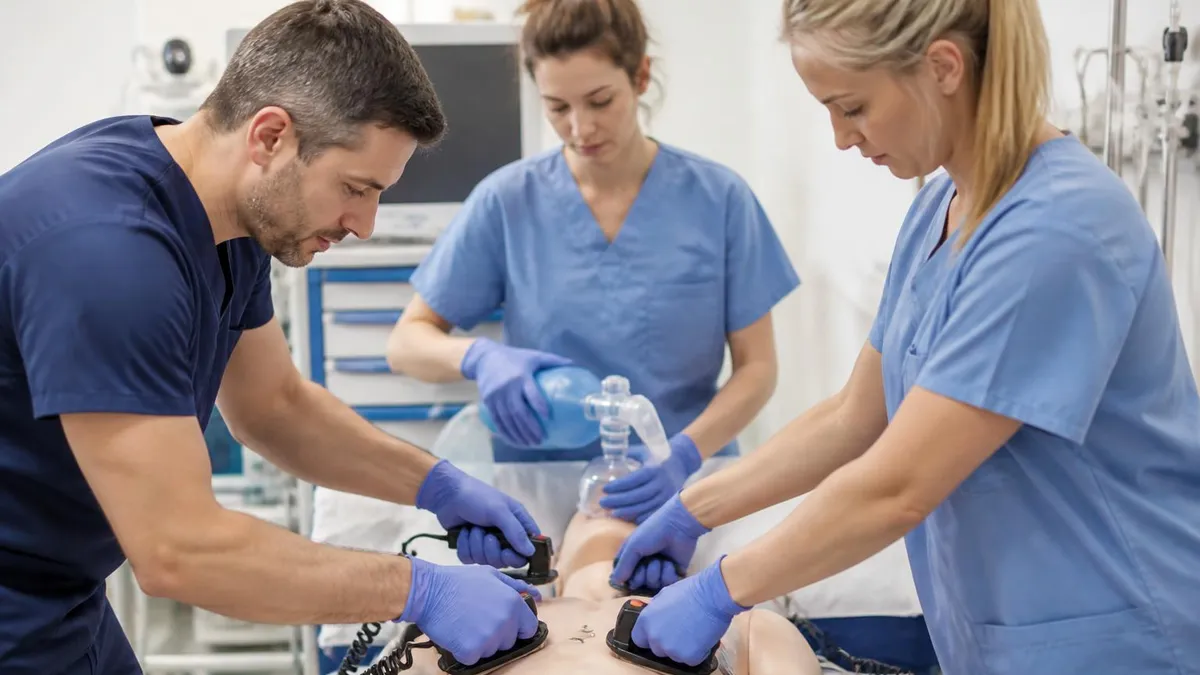
Many AHA Training Centers run combined ACLS plus PALS weekend courses. Friday is ACLS (eight to twelve hours), Saturday is PALS (eight to twelve hours), and you walk out Sunday with both cards. The advantages: one trip, one hotel night if you traveled, one round of precourse work compressed into one study block, and roughly a $50 to $100 discount versus booking separately.
The challenge is fatigue. Two megacode tests on consecutive days takes mental endurance. Some providers prefer to split — ACLS one weekend, PALS the next — to give algorithms time to settle.
Whichever you choose, complete both precourse self-assessments at least a week before class. The AHA requires 84 percent or higher on each, and you cannot enter class without proof. If you fail the precourse, retake it as many times as needed — each attempt is unlimited but drains study energy.
For renewal, the same logic applies. Schedule both renewals the same week every two years so your hospital education tracking stays aligned. Our acls renewal walkthrough covers the AHA renewal window (you have up to thirty days after expiration in some Training Centers, but check yours), online versus in-person options, and the HeartCode blended pathway that lets you do the cognitive portion at home.
ACLS and PALS Cost Breakdown 2026
Precourse Preparation Checklist for Both Cards
- ✓Complete ACLS precourse self-assessment online (84 percent or higher required)
- ✓Complete PALS precourse self-assessment online (84 percent or higher required)
- ✓Print both precourse passing certificates and bring to class
- ✓Review BLS skills — high-quality CPR is checked first thing both days
- ✓Memorize adult epi dose (1 mg IV push every 3-5 min) and pediatric (0.01 mg/kg)
- ✓Memorize adult defibrillation joules and pediatric 2 J/kg then 4 J/kg
- ✓Review H's and T's for ACLS reversible causes
- ✓Review Pediatric Assessment Triangle (appearance, work of breathing, circulation)
- ✓Bring photo ID, comfortable scrubs, and a pen
- ✓Eat a real breakfast — these are long days with megacode under pressure
- ✓Download the AHA Provider Manual app or bring printed pocket cards
- ✓Confirm your eCard email address is current — this is how cards are delivered
Key Numbers to Memorize for Both Exams
Common ACLS Prep Mistakes
The biggest mistake providers make on the ACLS side is over-studying drugs and under-studying rhythms. The megacode rarely asks you to recite epinephrine pharmacokinetics. It does ask you to look at a rhythm strip and say in three seconds whether you would shock, push epi, push atropine, or pace. If you cannot tell asystole from fine VF on the monitor, the right drug knowledge will not save your scenario.
Spend two-thirds of your prep time on rhythm strip recognition: VF (chaotic, no organized complexes), pulseless VT (wide, regular, fast, no pulse), asystole (flat line — always check a second lead), PEA (organized rhythm but no pulse), sinus brady (slow, P before every QRS), Mobitz Type I (PR lengthens then drops), Mobitz Type II (PR fixed, sudden drop — dangerous), and the SVT subtypes. The remaining third should cover drug doses and the H's and T's.
The second mistake is freezing as team leader. ACLS megacode tests your ability to delegate, not your ability to do everything yourself. Practice phrases out loud: "Compressions, switch in two minutes." "IV access, please." "Charge to 200 joules." "Push 1 mg epinephrine now and start the timer." Confidence on those lines is half the megacode pass rate.
A third mistake is ignoring the post-arrest portion. Return of spontaneous circulation is not the end of the scenario. Megacode instructors love to follow ROSC with a question about targeted temperature management, 12-lead interpretation, or blood pressure goals.
Know your post-arrest checklist cold. Confirm pulse and BP, secure airway if not already, optimize ventilation (aim for normal CO2, not hyperventilation), target temperature 32 to 36 degrees Celsius for 24 hours, and get a 12-lead to identify STEMI candidates for emergent cath.
Common PALS Prep Mistakes
On the PALS side, the trap is treating peds like miniature adults. The Pediatric Assessment Triangle is not just a checkbox — it is the entire framework. If a scenario opens with a toddler who has noisy breathing and is pale, your first response is not "start IV access." Your first response is "PAT shows abnormal work of breathing and circulation — this is respiratory failure with shock, call for backup, position the airway, prepare bag-mask ventilation."
The second mistake is panicking at weight-based math. PALS does not require you to do mental arithmetic on the fly. The Broselow tape and length-based color codes do the math for you. Know what tools are in the pediatric crash cart, know how to use the tape, and trust it. The course does not test mental math — it tests whether you reach for the right tool.
The third mistake is under-preparing for shock recognition. Pediatric shock often presents with compensated vital signs until very late. A child with sepsis can hold a normal blood pressure while perfusion is already failing. PALS scenarios will hide shock behind a near-normal heart rate and BP.
Look for delayed capillary refill, mottled skin, altered mental status, and weak peripheral pulses. For broader pediatric content, the pals algorithm page walks through every branch. To benchmark your readiness with timed questions, our acls practice test pdf includes a pediatric companion section.
A fourth pitfall is memorizing pediatric vital sign ranges without context. PALS will not ask you to recite a chart. It will give a vignette: a 4-year-old with HR 165, RR 38, BP 80/50, and ask whether the patient is compensating. Practice translating numbers to clinical pictures.
A heart rate of 165 in a 4-year-old is tachycardia and likely compensated shock until proven otherwise. Tools like PEWS (Pediatric Early Warning Score) help you operationalize this in real practice. Build a habit of saying out loud what you see — the verbalization step is what locks the pattern into long-term memory and what the megacode grader is listening for.
The fifth and most common pitfall on the PALS side is forgetting that respiratory failure is the most likely PALS scenario. ACLS providers walk in expecting a code, but the PALS megacode is more often a child in respiratory distress that you must rescue before they progress to arrest. The win condition is recognition and intervention upstream — not running a code that should have been prevented.

Where to Verify a Legitimate AHA Training Center
- ✓AHA Course Finder at heart.org — official lookup by ZIP code
- ✓Your own hospital education department — often discounted or free for employees
- ✓ProMed Certifications — alternate pathway accepted by many but not all hospitals
- ✓ACLS Medical Training — verify acceptance with your hospital onboarding office first
- ✓Pacific Medical Training — popular west-coast option, AHA-aligned
- ✓Avoid any provider issuing a card without an in-person skills check
Where to Take ACLS and PALS
The gold standard is an AHA Training Center. Use the AHA Course Finder at heart.org to search by ZIP code — every result is verified and the eCard will be accepted by any US hospital. Hospital education departments often run in-house classes for employees, sometimes free or heavily discounted. Outside the AHA, ProMed Certifications and ACLS Medical Training offer alternate pathways that are accepted by many but not all employers — verify with your specific hospital education office before booking.
Avoid online-only ACLS or PALS providers that promise a card in two hours with no skills check. The AHA requires hands-on skills validation, and a card without that step will be rejected at hospital onboarding.
The legitimate online option is the HeartCode blended model. You complete the cognitive portion online (usually 6-8 hours), then schedule an in-person skills session at a Training Center (typically 3-4 hours). The final card is identical to the all-classroom version. For a deeper dive into acls training formats, including HeartCode walkthroughs, see our dedicated training guide.
One last logistics tip: get on the email list of two or three local Training Centers. AHA classes fill weeks in advance, especially the combined ACLS plus PALS weekends. When a seat opens because someone cancels, the Training Center fires off a notification.
Travel nurses and per-diem clinicians who keep their cards current learn to scoop those last-minute seats. That is often how you get a same-month renewal when your card is about to expire. Build a relationship with one Training Center coordinator and they will often text or call you first when a seat opens.
Finally, save your eCard PDFs to a personal cloud folder the moment you receive them. Hospital education systems lose them constantly during credential audits. Your AHA eCard lookup at heart.org/cprandecc/find-a-class lets HR verify directly, but having the PDF saved cuts hours off recredentialing during a license renewal or job change.
Your 2-Year Renewal Cycle for ACLS and PALS
Day 1: Initial Certification Weekend
Year 1, Month 6: Quick Refresher
Year 1, Month 12: Halfway Check
Year 2, Month 18: Schedule Renewal
Year 2, Month 22: Precourse Prep
Year 2, Month 24: Renewal Weekend
ACLS Questions and Answers
Related ACLS Guides
ACLS Classes Near Me: How to Find AHA-Approved Courses Locally

ACLS Certification: How to Get Certified, Recertified & Stay Current

ACLS Renewal: Online vs In-Person, Cost, AHA Providers, and What to Do If Expired
ACLS Algorithm: Master Cardiac Arrest, Bradycardia, and Tachycardia Protocols
ACLS Precourse Self-Assessment Answers — Your Complete 2026 Study Resource
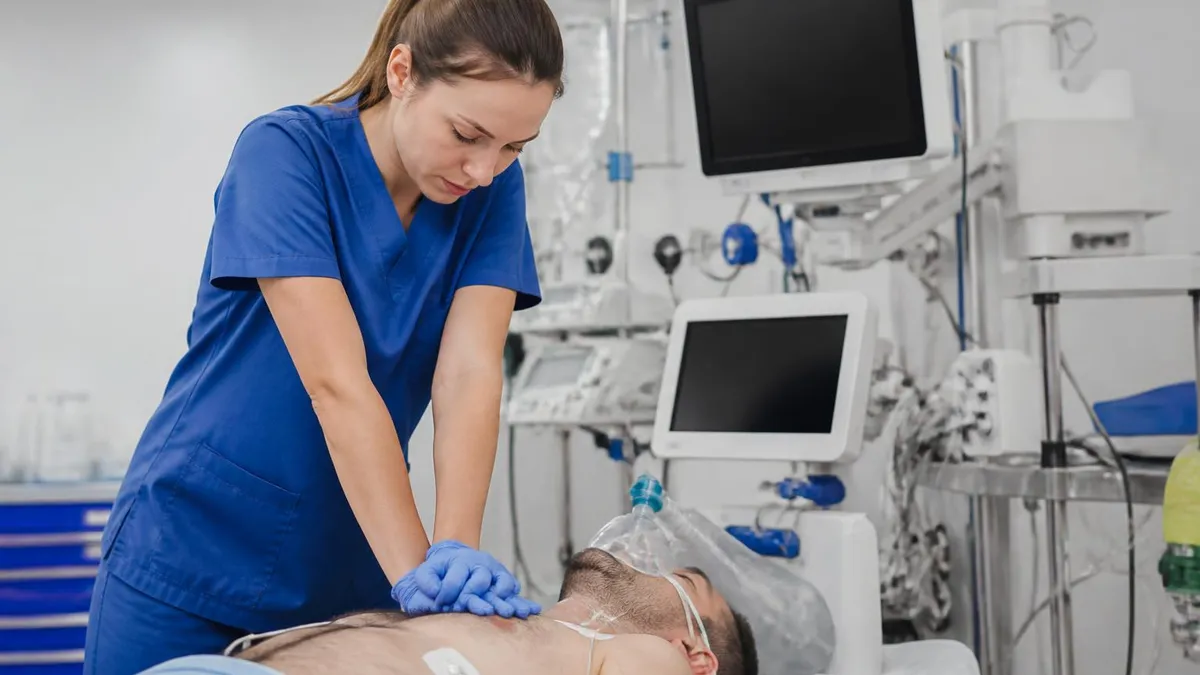
AHA ACLS: American Heart Association Advanced Cardiovascular Life Support Guide
About the Author

Registered Nurse & Healthcare Educator
Johns Hopkins University School of NursingDr. Sarah Mitchell is a board-certified registered nurse with over 15 years of clinical and academic experience. She completed her PhD in Nursing Science at Johns Hopkins University and has taught NCLEX preparation and clinical skills courses for nursing students across the United States. Her research focuses on evidence-based exam preparation strategies for healthcare certification candidates.
Join the Discussion
Connect with other students preparing for this exam. Share tips, ask questions, and get advice from people who have been there.
View discussion (8 replies)