
PALS Algorithm 2026 October: Every Branch, Drug & Dose Explained
🧠 PALS algorithm guide: cardiac arrest, bradycardia, tachycardia, septic shock branches with doses, energy levels and 2026 October updates for the exam.
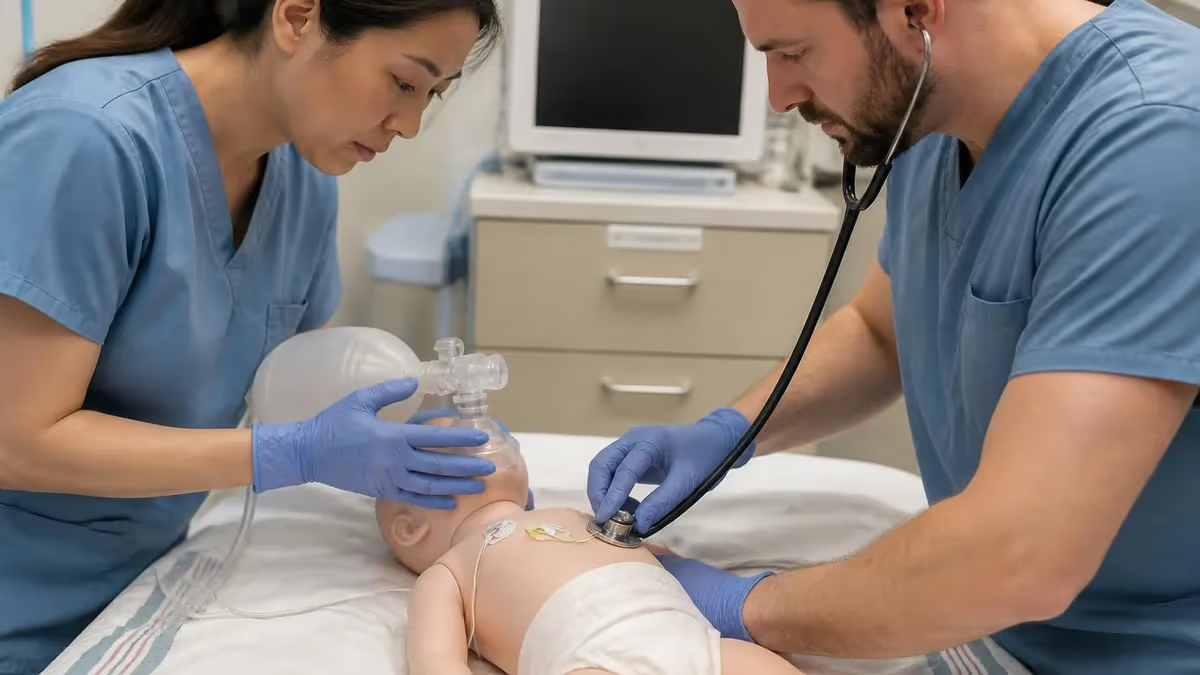
The PALS algorithm isn't one chart — it's a family of decision trees you'll need to recognize fast when a pediatric patient deteriorates. Whether you're prepping for your initial certification or your two-year renewal, the algorithms are the spine of the entire course. Get them down, and the rest of PALS starts to make sense. Miss them, and you'll struggle in the megacode.
Here's the thing nobody tells you when you first crack open the provider manual — you don't have to memorize every line. You need to understand the logic. Why do we shock VF before giving epi? Why does bradycardia with poor perfusion get CPR before atropine? Once the reasoning clicks, the steps stick.
What the PALS Algorithm Actually Is
The American Heart Association's pals algorithms pdf cover the structured response to a child in cardiac arrest, peri-arrest, shock, or respiratory failure. Each one is a flowchart — yes/no, do this, then that — built around the systematic approach: evaluate, identify, intervene, reevaluate. You'll see the same loop repeating across every scenario.
The current 2020 guidelines (still in force for the 2026 testing window) include eight core algorithms you should be able to recall under pressure:
- Pediatric BLS algorithm for healthcare providers
- Pediatric Cardiac Arrest algorithm
- Pediatric Bradycardia With a Pulse algorithm
- Pediatric Tachycardia With a Pulse algorithm
- Pediatric Post-Cardiac Arrest Care algorithm
- Pediatric Septic Shock algorithm
- Pediatric Systematic Approach algorithm
- Pediatric Cardiac Arrest in COVID-19 Suspected/Confirmed
You'll be tested on every one of them, but the two that come up most often in megacode? Cardiac arrest and bradycardia. Lock those down first.
The Systematic Approach Comes First
Before any algorithm kicks in, you start with the Pediatric Assessment Triangle — appearance, work of breathing, circulation. Thirty seconds, no equipment, just your eyes. Then you move to the primary assessment: ABCDE (Airway, Breathing, Circulation, Disability, Exposure). This isn't filler. The algorithms branch based on what you find here.
Skipping straight to "give epi" because the kid looks bad? That's how providers fail their megacode. Identify the problem first — respiratory distress versus failure, compensated versus decompensated shock — then pick the algorithm that matches.
Pediatric Cardiac Arrest Algorithm — Step by Step
Cardiac arrest in kids is usually respiratory in origin, not cardiac. That changes how you approach it. Adults arrest from VF; kids arrest from hypoxia. Most pediatric arrests start as bradycardia, slip into PEA or asystole, and only sometimes show a shockable rhythm.
The Two Branches You Need to Memorize
The cardiac arrest algorithm splits into two pathways the moment you check the rhythm:
Shockable (VF/pVT): Shock at 2 J/kg → resume CPR for 2 minutes → IV/IO access → check rhythm → shock at 4 J/kg → CPR + epinephrine 0.01 mg/kg every 3-5 minutes → consider amiodarone 5 mg/kg or lidocaine 1 mg/kg → treat reversible causes.
Non-shockable (asystole/PEA): CPR for 2 minutes → IV/IO access → epinephrine 0.01 mg/kg every 3-5 minutes → check rhythm → continue CPR → treat reversible causes.
The reversible causes? You probably know them as the H's and T's: Hypovolemia, Hypoxia, Hydrogen ion (acidosis), Hypo/hyperkalemia, Hypothermia, Tension pneumothorax, Tamponade, Toxins, Thrombosis (pulmonary or coronary). Skip these on your testing day and you'll lose points fast.
Bradycardia With a Pulse — The Algorithm That Trips People Up
Here's where a lot of candidates stumble. A child with a heart rate under 60 and signs of poor perfusion gets CPR — even with a pulse. Yes, you read that right. CPR for a kid with a pulse. The reasoning: at HR < 60 with poor perfusion, cardiac output is so low you're effectively in arrest physiology.
The sequence: support ABCs, give oxygen, attach monitor → if HR < 60 with poor perfusion despite oxygenation and ventilation, start CPR → epinephrine 0.01 mg/kg IV/IO → atropine 0.02 mg/kg only if increased vagal tone or AV block → consider transcutaneous pacing.
Atropine isn't first-line anymore for hypoxic bradycardia. Epi is. That's a common test trap — older nurses and medics sometimes default to atropine because that's what they trained on. The current algorithm has moved on.
Tachycardia With a Pulse — Narrow vs Wide
The tachycardia algorithm forks based on QRS width. Narrow complex (≤ 0.09 sec) is probably SVT or sinus tach. Wide complex (> 0.09 sec) is probably VT.
For SVT in a stable patient, try vagal maneuvers first — ice to the face works well in infants. If that fails, adenosine 0.1 mg/kg IV (max 6 mg) rapid push, followed by a saline flush. Second dose: 0.2 mg/kg (max 12 mg). For unstable SVT or VT with a pulse, go straight to synchronized cardioversion at 0.5-1 J/kg, escalating to 2 J/kg if needed.
The "stable versus unstable" call matters. Hypotension, altered mental status, signs of shock, acute heart failure — that's unstable. Don't waste time on adenosine when the kid needs the shock.
Common Pitfalls in the Tachycardia Branch
- Confusing sinus tach with SVT — sinus tach has a clear cause (fever, dehydration, pain) and a P wave; SVT is sudden, no P wave, rate often > 220 in infants
- Forgetting the saline flush after adenosine — half-life is seconds, so a slow push won't reach the heart
- Cardioverting an unstable tachycardia without sedation when time allows — yes, sedate if you can
Septic Shock — The Newest Algorithm Update
Septic shock got a meaningful overhaul in the 2020 guidelines. The big change: fluid resuscitation is now more cautious. Give 10-20 mL/kg boluses (down from 20 mL/kg blanket) and reassess between each. Watch for fluid overload, especially hepatomegaly or worsening work of breathing — kids decompensate fast when overloaded.
Sequence: recognize septic shock → broad-spectrum antibiotics within the first hour → IV/IO access → 10-20 mL/kg isotonic crystalloid → reassess after each bolus → if shock persists despite 40-60 mL/kg, start vasoactive infusion (epinephrine for cold shock, norepinephrine for warm shock) → consider hydrocortisone if fluid- and catecholamine-resistant.
"Cold shock" versus "warm shock" matters for the pressor choice. Cold = vasoconstricted, weak pulses, capillary refill > 2 sec, narrow pulse pressure → epinephrine. Warm = vasodilated, bounding pulses, flash refill, wide pulse pressure → norepinephrine. Get this wrong and you make the kid worse.
Post-Cardiac Arrest Care
Once you get ROSC (return of spontaneous circulation), the work isn't over — it's just changed. The post-arrest algorithm covers:
- Optimize ventilation and oxygenation — target SpO2 94-99%, PaCO2 35-45 mmHg, avoid hyperoxia
- Treat hypotension — fluid bolus + vasoactive infusion as needed, target MAP > 5th percentile for age
- Targeted Temperature Management — either 32-34°C or 36-37.5°C for at least 24 hours, then prevent fever
- Identify and treat the cause — 12-lead ECG, labs, imaging
You don't need to memorize every detail of TTM, but know the temperature targets and the duration. Test writers love asking about it.
How to Memorize PALS Algorithms Without Burning Out
Don't try to brute-force all eight in one sitting. That's a recipe for confusing branches. Instead, layer them:
- Day 1-2: Systematic Approach + BLS — the foundation
- Day 3-4: Cardiac Arrest (both branches) — the most-tested algorithm
- Day 5-6: Bradycardia + Tachycardia — the rhythm pair
- Day 7-8: Septic Shock + Post-Arrest Care — the recovery side
- Day 9-10: Mixed-scenario practice — megacode simulation
Drill the dosing as you go. Epi 0.01 mg/kg, amiodarone 5 mg/kg, adenosine 0.1 mg/kg first then 0.2 mg/kg, atropine 0.02 mg/kg minimum 0.1 mg. Defibrillation 2 J/kg → 4 J/kg → 4-10 J/kg. These numbers come up on every test.
Pair the algorithms with rhythm strips. You can recite the cardiac arrest algorithm perfectly and still freeze if you can't tell VF from VT or pulseless VT from regular VT. Spend twenty minutes a day looking at strips. Your brain needs to pattern-match before it can branch.
The PALS practice test on this site walks through realistic scenarios that mirror the megacode format — use it as a self-check after each layer. If you keep missing the same branch, that's a flag to slow down and reread the AHA manual section before moving on.
What Actually Shows Up on the PALS Exam
The written exam is 50 multiple-choice questions, 84% pass mark, closed-book. Roughly 60% of questions hit the algorithms directly — rhythm identification, dose, sequence, "what's next?" The other 40% covers team dynamics, BLS, the systematic approach, and pharmacology details.
The megacode is where algorithms come alive. You'll lead a simulated resuscitation, calling out steps, ordering meds, interpreting rhythms in real time. Instructors aren't just checking that you know the steps — they're checking that you can direct a team through them. Closed-loop communication, role assignments, summarizing every two minutes. If you've only memorized the chart, you'll fumble the team-leadership piece.
Practice running scenarios out loud. Even alone, in your kitchen. Sounds silly, works.
Algorithm Pitfalls That Trip Renewing Providers
If you're renewing rather than testing for the first time, watch for what's changed since your last cycle. The 2020 update brought several shifts that catch experienced providers off guard:
- Compression rate is now 100-120/min (previously "at least 100")
- Compression depth: at least one-third the AP diameter — about 1.5 inches in infants, 2 inches in children
- Septic shock fluid boluses are smaller and reassessed more often
- Endotracheal epi is no longer recommended as a routine route — use IV/IO
- For respiratory rate during CPR with advanced airway: 1 breath every 2-3 seconds (20-30/min)
These small changes add up. A provider who hasn't tested in four years can lose three or four points on outdated muscle memory alone.
Final Word
The PALS algorithm isn't a magic chart you memorize the night before. It's a thinking framework you internalize over a couple of weeks. Drill the logic, drill the doses, drill the rhythm strips, and run scenarios out loud. By exam day, the branches should feel automatic — because in a real arrest, you won't have time to think.
You've got this. Start with cardiac arrest, layer in bradycardia and tachycardia, then close out with shock and post-arrest care. Test the gaps with practice questions, and walk into your skills station knowing the algorithms aren't a hurdle — they're your tool.
About the Author

Registered Nurse & Healthcare Educator
Johns Hopkins University School of NursingDr. Sarah Mitchell is a board-certified registered nurse with over 15 years of clinical and academic experience. She completed her PhD in Nursing Science at Johns Hopkins University and has taught NCLEX preparation and clinical skills courses for nursing students across the United States. Her research focuses on evidence-based exam preparation strategies for healthcare certification candidates.
Join the Discussion
Connect with other students preparing for this exam. Share tips, ask questions, and get advice from people who have been there.
View discussion (8 replies)