
ACLS Renewal: Online vs In-Person, Cost, AHA Providers, and What to Do If Expired
ACLS renewal guide: 💡 when ACLS expires (2 yrs), online vs in-person options, AHA-approved providers, cost ($150-$400), and what to do if expired.
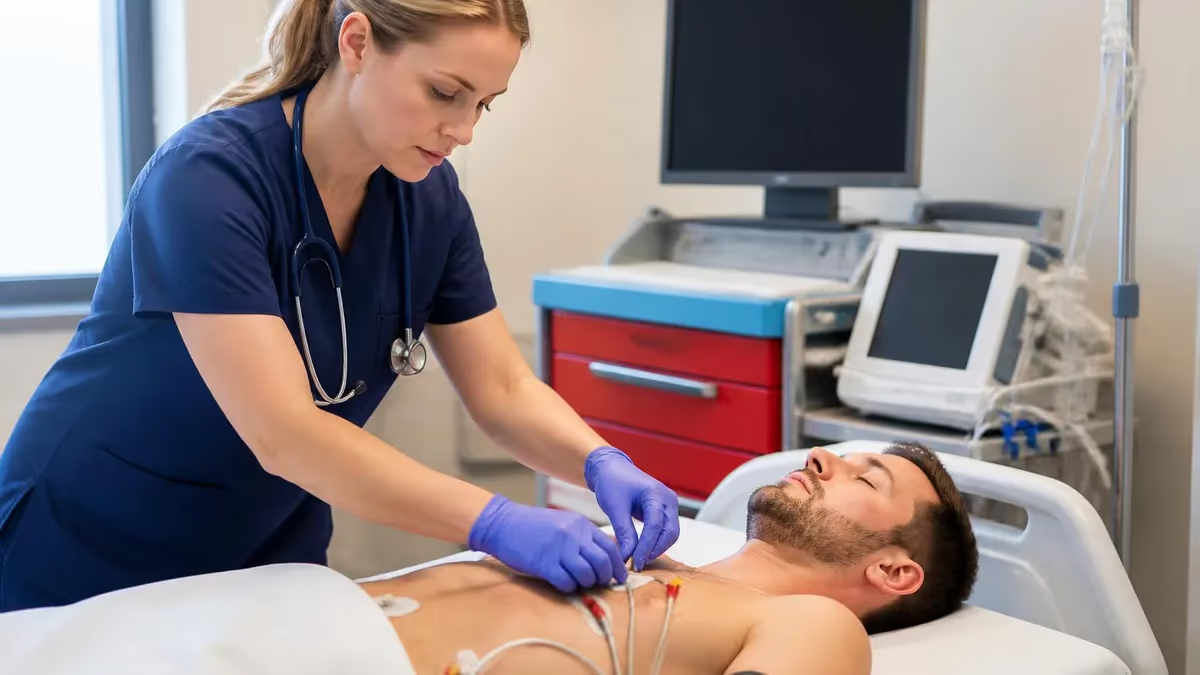
Your ACLS card has an expiration date, and that date sneaks up on most clinicians faster than they expect. ACLS renewal is the process of refreshing your Advanced Cardiovascular Life Support certification before the current card runs out, usually every two years. Miss the window, and you're looking at a longer, costlier full Provider course instead of a quick update.
This guide walks you through everything you need to know in 2026: when ACLS expires, the difference between online and in-person renewal, AHA-approved providers versus the cheaper online-only options, real cost ranges, what's covered, and exactly what to do if your card has already lapsed. Think of it as the conversation you wish your nurse educator had with you the day you first got certified. Let's dig in.
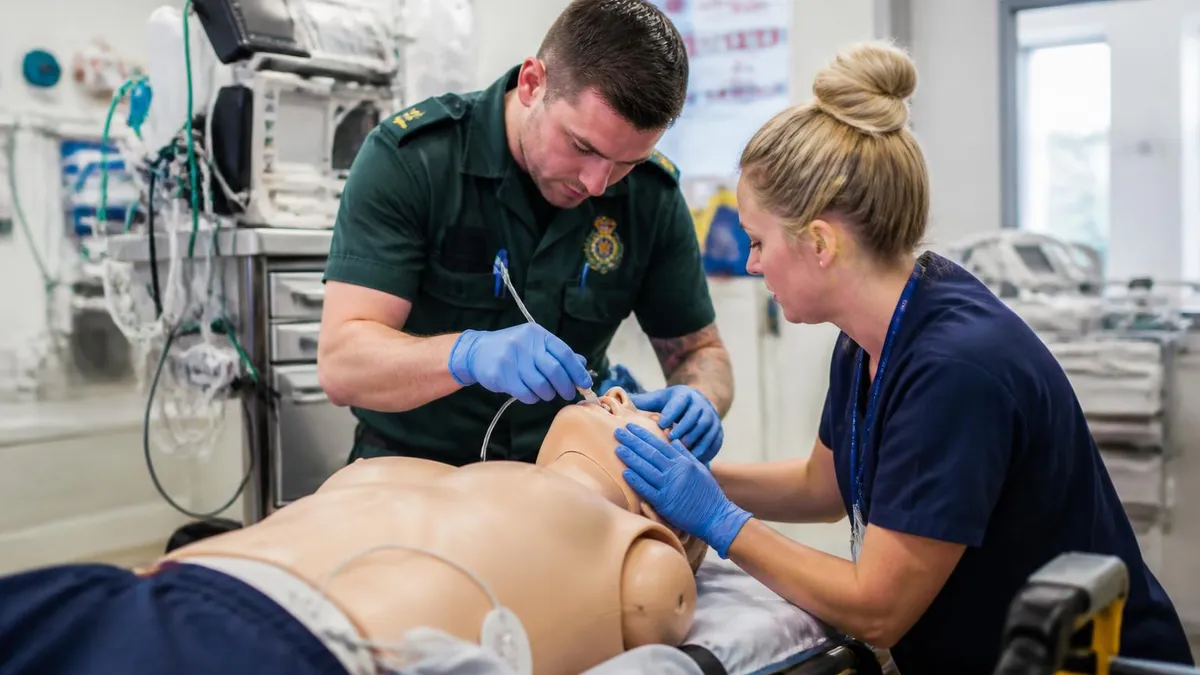
Quick answer: ACLS renewal must be completed every 2 years. The fastest legitimate path is HeartCode ACLS (AHA's blended online + skills option), costing $150-$300 and taking 3-5 hours total. If you let your card expire by more than 30 days, most AHA Training Centers will require you to take the full Provider course (8-10 hours, $250-$400). Always confirm your employer accepts your provider before you pay.
ACLS certification expires exactly 2 years from the issue date printed on your card. Most AHA eCards expire on the last day of the issue month, so a card issued January 15, 2024 expires January 31, 2026. That month-end grace built into the card is small, but it's there. The AHA stamps both dates on the digital card, and you can verify yours anytime by logging into your account at OnlineAHA.org.
Key Facts at a Glance
| Item | Value | Details |
|---|---|---|
| Standard ACLS card validity | 2 yrs | |
| Renewal cost range (US, 2026) | $150-$400 | |
| Total time depending on path | 3-10 hrs | |
| Typical grace before full retake | 30 days |
Renewal is required for most nurses working in ICU, ER, PACU, and interventional roles, plus paramedics, respiratory therapists, advanced practice providers, and physicians in emergency medicine, internal medicine, anesthesiology, and surgery. If your job description includes responding to adult cardiac codes, you almost certainly need to keep ACLS current. Many hospital systems also require it for cath lab nurses, transport teams, GI procedural nurses doing moderate sedation, and even some outpatient infusion centers where high-risk biologics are administered.
You've basically got two legitimate paths for renewal, plus a third scenario if your card already lapsed. The right choice depends on how you learn, what your employer accepts, and how much time you can carve out. Below is a side-by-side comparison so you can pick fast without second-guessing yourself for the next month.
HeartCode ACLS is the AHA's official blended option. You knock out the cognitive portion online at OnlineAHA.org (2-4 hours self-paced), then complete a hands-on skills session at an AHA Training Center or with a voice-assisted manikin (VAM). Total time is usually 3-5 hours, and the cost runs $150-$300.
This route is ideal if your schedule is unpredictable. You can pause, restart, and review modules as many times as you need. The eCard you receive is identical to the in-person version. Heads up: skills can't be completed entirely online. You'll still need to validate compressions, airway, and team-lead skills with a real instructor or AHA-approved manikin system.
Here's where many clinicians get tripped up: not every ACLS card is treated equally. Hospital credentialing offices and many employers explicitly require American Heart Association certification, and they'll reject other providers' cards even if those courses are cheaper and faster. The cost of a rejected card is huge — you'll pay twice and lose the time you spent on the first one. It's also a frustrating conversation to have with your manager when you've been counting on a new card to clear a credentialing audit.
AHA-Approved vs Non-AHA Providers
- Format: HeartCode ACLS blended OR in-person at AHA Training Center
- Where: OnlineAHA.org, hospitals, AHA Training Centers (search heart.org)
- Cost: $150-$350 typical
- Recognition: Accepted by all US hospitals and employers
- Format: 100% online, no skills check, instant eCard
- Examples: ProMed, NHCPS, online-only ACLSCertification.com variants
- Cost: $50-$150 typical
- Recognition: Mixed — many hospitals reject. ALWAYS verify with HR/credentialing FIRST
- Format: Online theory + in-person skills using AHA materials
- Examples: Local CPR training companies that are AHA Training Sites
- Cost: $175-$300
- Recognition: Accepted if the issuing site is a true AHA Training Site — verify the site code
Bottom line on providers: if there's any doubt, go AHA. The $50-$100 you'd save with a non-AHA online provider isn't worth the risk of an HR rejection two weeks before your hospital privileges renew.
Travel nurses get burned by this constantly because requirements can shift between contracts, and a card that worked at one hospital can be rejected at the next. Agency staff and per-diem clinicians who float between facilities have the strongest incentive to stick with AHA — one universal card avoids redoing renewals every time a placement changes. For a deeper look at the full curriculum and certification structure, our ACLS course overview breaks down every algorithm and skill station in detail.
Verify before you pay. Email your employer's credentialing office or nurse educator with the exact provider name and ask in writing whether the card will be accepted. Save that email. If you ever face a credentialing dispute, you'll want documentation that you confirmed acceptance before spending money or time on a course.
HeartCode ACLS is worth understanding in detail because it's the option most working clinicians end up choosing. The blended structure was designed by the AHA specifically to fit busy schedules without compromising the hands-on validation that makes ACLS meaningful. The cognitive piece happens whenever you can fit it in, and the skills piece happens fast once you're set up at a Training Center.
The online modules use realistic case simulations rather than passive lectures. You'll work through scenarios where you make decisions, hear the patient's response, and see the rhythm change based on what you ordered. It's surprisingly engaging compared to the older video-and-quiz format, and it forces you to actually think through algorithms instead of just recognizing the answers.
HeartCode ACLS Step-by-Step
- ✓Step 1: Register at OnlineAHA.org and pay the cognitive portion fee ($120-$175)
- ✓Step 2: Complete the online modules at your own pace (2-4 hrs total, can be split across days)
- ✓Step 3: Pass the online cognitive exam (84% required, retakes allowed)
- ✓Step 4: Schedule your hands-on skills session at an AHA Training Center OR use a voice-assisted manikin (VAM) at home if you have access
- ✓Step 5: Complete the skills session (30-60 minutes) — BLS skills, megacode, team dynamics
- ✓Step 6: Receive your AHA eCard via email within 1-3 business days
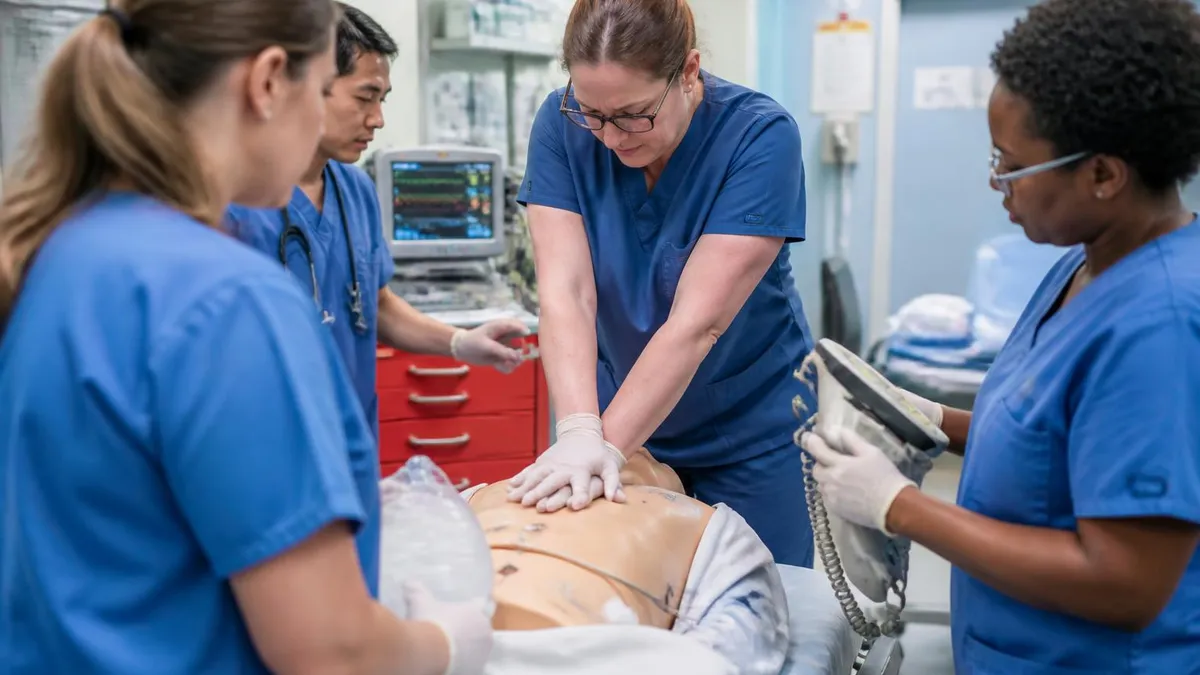
If you're going the in-person route instead, the day looks pretty different. You'll show up to a classroom, sit through a refresher on the 2020 CPR and ECC Guidelines, then move through stations covering rhythm recognition, airway management, pharmacology, and the core algorithms. The day usually ends with the megacode practical and the written exam. Bring caffeine and a snack. Most courses run from morning through mid-afternoon with a short lunch break, and the afternoon megacode is when fatigue tends to bite hardest.
Class sizes vary. AHA Training Centers typically cap renewal classes at 6-12 participants per instructor to keep the megacode rotations manageable. Larger hospital-based courses may run 15-20 students with multiple instructors and parallel skill stations. Smaller is usually better for hands-on learning, but bigger classes give you more peer scenarios to observe before your own turn comes up.
6 Months Before Expiration
90 Days Before
30 Days Before
Day of Expiration
30+ Days After Expiration
What actually gets covered in renewal? It's not a watered-down version of the original — every algorithm and skill is reviewed. The 2020 Guidelines remain the operating standard in 2026, with minor updates absorbed into the existing framework. If you've been clinically active and running codes, the material will feel familiar; if you've been away from bedside resuscitation for a while, plan extra prep time on rhythm strips and the bradycardia/tachycardia decision points.
Renewal courses also revisit team dynamics in more depth than many clinicians remember from their first certification. Closed-loop communication, role assignment, and the explicit practice of speaking up when you see a teammate making an error are baked into the megacode evaluation. Even experienced ICU nurses and senior residents sometimes lose points here because they default to silent execution instead of verbal closed-loop confirmation.
What's Covered in ACLS Renewal
- Guidelines version: 2020 CPR and ECC Guidelines (current as of 2026)
- BLS review: High-quality CPR, AED use, airway basics
- Rhythm recognition: V-fib, V-tach, asystole, PEA, bradycardia, tachycardia variants, sinus rhythms
- Pharmacology: Epinephrine, amiodarone, lidocaine, atropine, adenosine, dopamine
- Team dynamics: Closed-loop communication, ICAARE framework, team-lead role
- Cardiac arrest: Adult VF/pulseless VT and asystole/PEA pathways
- Bradycardia: Symptomatic bradycardia algorithm with atropine and pacing
- Tachycardia: Stable and unstable tachycardia, narrow vs wide complex
- Post-cardiac arrest: Targeted temperature management, hemodynamic optimization
- ACS and stroke: Initial assessment, fibrinolytic eligibility, transport decisions
Cost is the question everyone asks first. The 2026 figures below reflect typical US pricing and assume an AHA-approved course. Non-AHA online-only options can dip lower, but as we covered above, that savings can backfire if your employer rejects the card. Regional pricing varies too. Major metro areas tend to run on the higher end of each range, while community colleges in smaller cities can come in 20-30% cheaper than private CPR training companies. If you're flexible on timing, signing up for a weekday morning class often costs less than weekend or evening sessions, since the demand is lower.
ACLS Renewal Cost Breakdown
- HeartCode ACLS (online + skills): $150-$300 total
- In-person AHA renewal: $200-$350
- Full Provider course (if expired): $250-$400
- Skills check separately: $40-$75 at AHA Training Center
- ACLS Provider Manual eBook: $40-$60 (recommended)
- AHA eCard fee: Included in course price
Many hospitals will reimburse renewal costs or pay for it directly through the education department. Ask your manager or check the employee benefits portal before you swipe your own card. Travel nurses and per-diem staff often have to front the cost themselves, but it's a tax-deductible professional expense in most situations. Keep your receipt and the course completion certificate together in a single PDF — that's the easiest way to handle reimbursement requests or tax filings later.
Once you've earned a fresh card, it's smart to keep your other clinical credentials in mind too. Allied health professionals often stack certifications, and roles like CMA jobs or coding-focused careers tied to the CPC exam sometimes overlap with ACLS-credentialed environments. Even veterinary professionals taking the NAVLE exam sometimes hold human BLS or ACLS depending on their setting.
- +Self-paced — pause and resume anytime
- +Flexible schedule fits around shift work
- +No commute or travel time
- +Same eCard recognition as in-person version
- +Often $50-$100 cheaper than classroom
- +Can review difficult modules unlimited times
- −Requires self-discipline to actually finish
- −Skills component still must be done in person
- −Less interaction with instructors and peers
- −Some learners struggle without live coaching
- −Tech issues with the OnlineAHA platform can delay you
Now flip it. Some clinicians genuinely do better in a single-day classroom setting where everything's done in one push and there's no temptation to procrastinate the online modules. If you've ever opened a HeartCode account and let it sit untouched for three months, you already know which type of learner you are. There's no shame in choosing the path that matches your habits — the goal is a current card, not a moral victory.
- +Done in one day — no lingering homework
- +Hands-on practice with real instructors
- +Instant feedback on technique and decisions
- +Better for tactile and social learners
- +Networking with peers from other facilities
- +All testing finished in a single sitting
- −Requires a full day off work
- −Travel time to the AHA Training Center
- −Less schedule flexibility
- −Often $50-$150 more than HeartCode
- −If you fail megacode, retake scheduling can be slow
Showing up unprepared is the fastest way to fail your renewal. Megacode is the most common reason people need to retake, and it's almost always because they didn't review algorithms or didn't bring the right materials. Pack the night before. Treat it the way you'd prep for any clinical shift where the consequences of forgetting something are real.
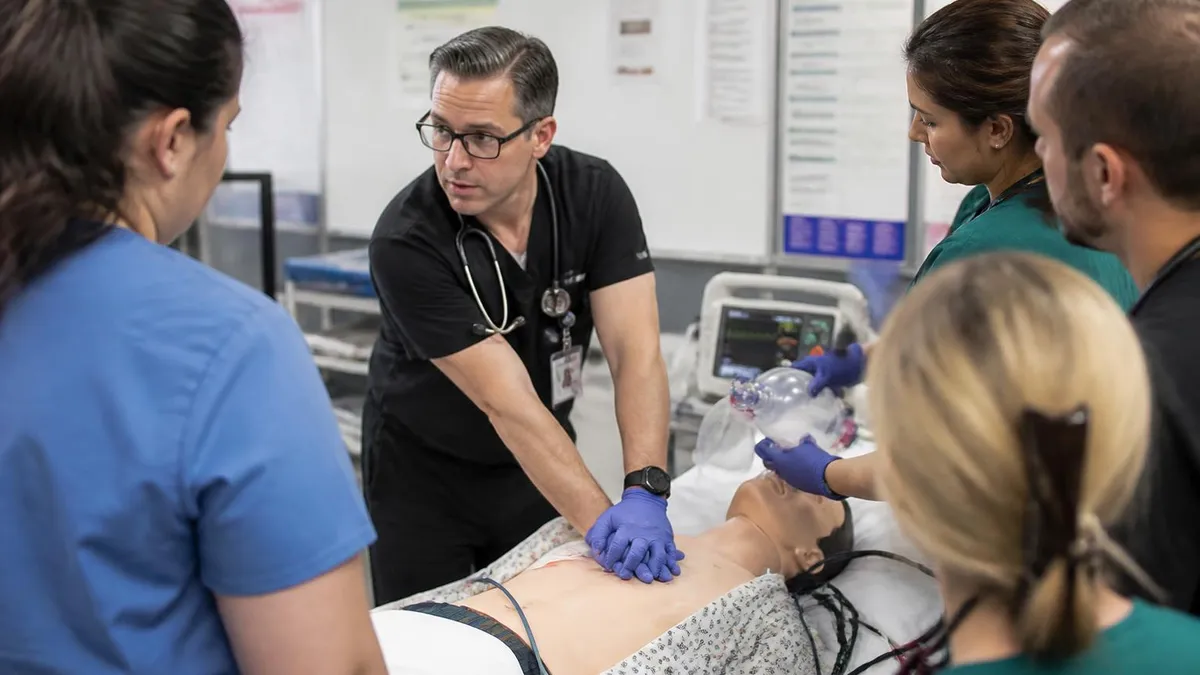
What to Bring to ACLS Renewal Class
- ✓Current ACLS card (the one you're renewing) — paper or digital
- ✓Government-issued photo ID for sign-in
- ✓2020 ACLS Provider Manual (bring or order from AHA — instructors expect it)
- ✓Comfortable clothing for compressions and floor work
- ✓Pen, notebook, snacks, and a water bottle
- ✓Your nursing or professional license number for course documentation
- ✓Pre-course self-assessment completion certificate (required by most centers)
Don't skip the pre-course self-assessment. The AHA requires you to complete it before in-person and HeartCode courses. Most instructors will ask for proof at sign-in, and some will turn you away if you don't have it. Allow 60-90 minutes to finish it, and do it the day before, not the morning of. The system timestamps your completion, so showing up with a screenshot from two minutes before class won't fly.
If you want to walk in confident rather than panicked, focus your prep on the highest-yield material. ACLS isn't trying to trick you — it tests whether you can run a code without freezing. The key is automaticity on a small set of drug doses, joule settings, and decision points. Memorize them cold, and the rest of the megacode becomes a logical sequence rather than a guessing game.
The free AHA Pocket Reference Card and the official ACLS app are both worth pulling up the week before your renewal. Both let you flip through algorithms, drug doses, and rhythm examples in spaced-repetition style during downtime. Twenty minutes a day for a week is genuinely enough to walk in feeling sharp, which is a much better headspace than cramming the night before and arriving exhausted.
High-Yield Drug Doses and Numbers
- Epinephrine (cardiac arrest): 1 mg IV/IO every 3-5 minutes
- Amiodarone (VF/pVT): 300 mg first dose, 150 mg second dose
- Lidocaine alternative: 1-1.5 mg/kg first dose, 0.5-0.75 mg/kg repeat
- Atropine (bradycardia): 1 mg IV every 3-5 min, max 3 mg
- Adenosine (SVT): 6 mg first, 12 mg second and third
- Defibrillation (biphasic): 120-200 J — follow device manufacturer recommendation
- Transcutaneous pacing rate: 60-80 bpm starting
The AHA eCard system replaced physical cards in 2018, and it's actually pretty handy once you know how it works. After your course, the instructor uploads your completion to the AHA database. Within 24-72 hours, you'll get an email from eCards@heart.org with a claim link. Click it, log in, and your card is in your account permanently — accessible by QR code, printable, and downloadable as a PDF.
Watch your spam folder. The eCard claim email frequently lands in spam or promotions tabs, and the claim link expires after a set number of days. If you don't see the email within 72 hours of completing your course, contact your instructor or the Training Center directly — they can resend or reissue the claim invitation.
Employers can verify any AHA eCard at ecards.heart.org by entering the card number or scanning the QR code. No more hunting for a paper card or worrying about losing it in your locker. If you ever need a duplicate, just log back into your AHA eCard account and download a fresh PDF. The card is tied to your AHA profile, not to a single device, so you can pull it up from any phone or laptop with your login.
Letting ACLS expire is more common than you'd think. Twelve-hour shifts, life chaos, and the AHA reminder landing in a spam folder all conspire against renewal. If your card is already expired, here's exactly what to do based on how late you are.
You may still qualify for the renewal/update course at your AHA Training Center's discretion. Call them directly — don't email — and ask if they'll grant a short grace period. Some will, some won't. If they will, you can stick with the shorter renewal format and avoid the full Provider course. Either way, don't perform ACLS-required tasks at work until your new card is in hand.
Common pitfalls to avoid as you plan your renewal — these are the mistakes that cost people time, money, or both. Most are obvious in retrospect but easy to miss when you're trying to squeeze a renewal in between night shifts and family obligations.
Common ACLS Renewal Pitfalls
- ✓Letting the card expire — by far the most expensive mistake
- ✓Choosing a non-AHA online-only provider that your employer later rejects
- ✓Skipping the AHA pre-course self-assessment
- ✓Forgetting to bring the current 2020 ACLS Provider Manual
- ✓Failing megacode because you didn't practice algorithms beforehand
- ✓Not pre-registering early — AHA Training Center classes fill 4-8 weeks ahead
- ✓Assuming your hospital will reimburse without confirming first
Where should you actually look for AHA-approved renewal courses? The options have grown a lot in the past few years, especially for blended learning. Start with the most reliable sources first and only branch out to private companies once you've confirmed they're true AHA Training Sites with a valid site code.
If you work in a hospital, your education department is almost always the easiest first stop. Many hospital systems run free or heavily subsidized ACLS renewal classes for staff several times a year, often on rotating weekends to accommodate shift workers. Your nurse educator can usually get you on a roster within a few weeks. Outside of hospital settings, community colleges with EMS or paramedic programs are the next most reliable option for AHA-approved courses at fair prices.
Where to Find AHA Renewal Courses
- OnlineAHA.org: Official AHA platform for HeartCode ACLS blended
- Hospital education department: Often free for staff — ask your nurse educator
- AHA Training Center search: Use heart.org/cpr to find local centers
- Community colleges: Many EMS programs host public AHA courses
- Private CPR training companies: Verify they're an AHA Training Site, not just AHA-aligned
- American Red Cross chapters: Some chapters host AHA-aligned courses (verify card type before paying)
For deeper context on the AHA's curriculum standards and how the program is structured nationally, our AHA ACLS overview covers the certification body, training standards, and how AHA materials integrate into the renewal experience. It's a useful read if you've never looked under the hood of how the AHA actually develops and updates the curriculum every five-year cycle. Understanding the why behind the algorithms tends to make them stick better than rote memorization, which pays off the next time you're standing at the head of a real bed instead of a manikin.
Career value note: ACLS isn't just a checkbox — it's a gateway credential. Many of the highest-paying nursing and provider roles list ACLS as a baseline requirement, and keeping the card current keeps your options open when a better job posting appears.
Staying current pays off well beyond just keeping your job. ACLS certification is a baseline expectation in many of the highest-paying nursing specialties — ICU, ER, PACU, interventional radiology, cath lab, transport teams. For paramedics, it's required at the state level in most jurisdictions. For physicians in emergency medicine, internal medicine, anesthesiology, surgery, and many subspecialties, it's part of credentialing.
Beyond the credentialing requirement, ACLS skills genuinely matter. A nurse or physician who can confidently lead a code, call out the right drug doses, and run the algorithm without hesitation is the kind of clinician hospitals fight to keep. That confidence comes from staying current and practicing the skills, not from cramming the night before. It also makes you the person colleagues look to in the first ten seconds of a code, which opens doors to charge nurse roles, rapid response teams, code blue committees, and clinical educator positions down the line.
ACLS Renewal Questions and Answers
One last piece of practical advice: set a recurring calendar reminder the day you receive your new eCard. Schedule one alert for 6 months before expiration and another for 90 days before. Future you will be grateful when the renewal email arrives and you've already got a plan instead of a panic. Bonus tip — set the reminders on a calendar your spouse, partner, or favorite coworker can also see, so someone else nudges you if you ignore your own alerts.
ACLS renewal isn't complicated, but it is time-sensitive. Pick the format that fits your learning style, confirm your provider is AHA-accepted by your employer, prep with the algorithms and high-yield drug doses, and book early. Do that, and you'll keep your card current, your privileges intact, and your skills sharp for the patients who'll need them most. Treat the renewal cycle like any other recurring professional obligation — license renewal, BLS, your annual TB test — and it stops being a fire drill every two years.
About the Author

Registered Nurse & Healthcare Educator
Johns Hopkins University School of NursingDr. Sarah Mitchell is a board-certified registered nurse with over 15 years of clinical and academic experience. She completed her PhD in Nursing Science at Johns Hopkins University and has taught NCLEX preparation and clinical skills courses for nursing students across the United States. Her research focuses on evidence-based exam preparation strategies for healthcare certification candidates.
Join the Discussion
Connect with other students preparing for this exam. Share tips, ask questions, and get advice from people who have been there.
View discussion (8 replies)