
ServSafe Study Guide PDF: Complete Certification Prep Hub for 2026 September
Master ServSafe certification with our complete study guide PDF. Practice tests, schedules, tips & more. 📚 Everything you need to pass in 2026 September.
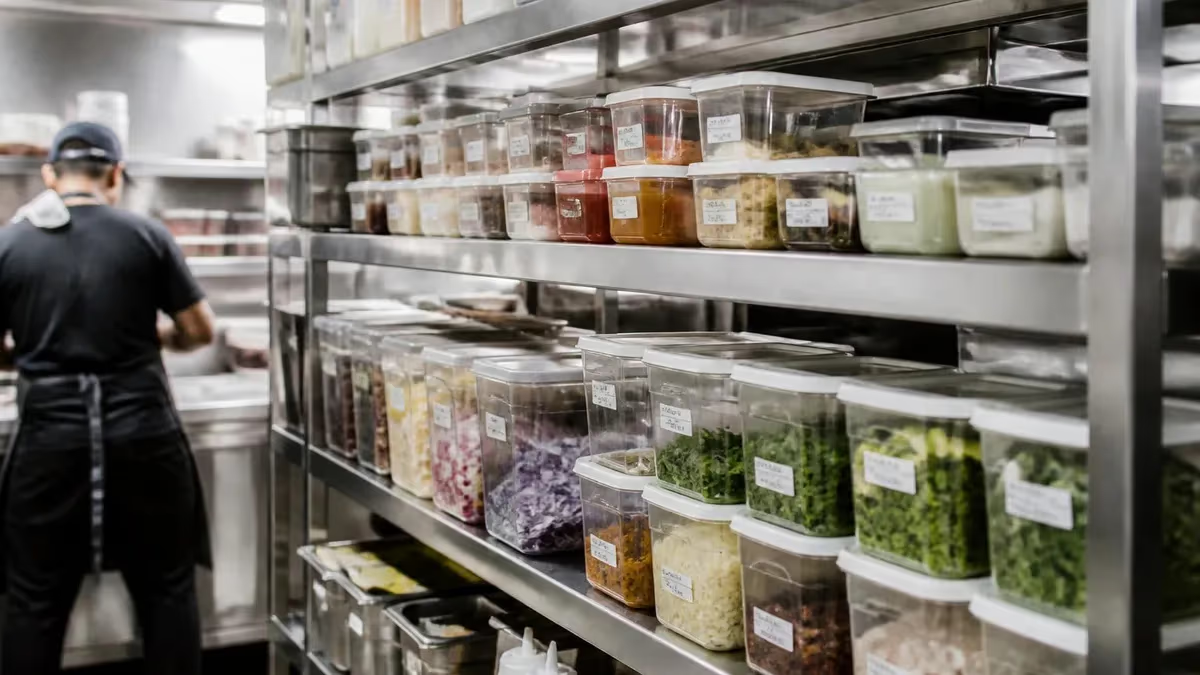
If you are searching for a servsafe study guide pdf, you have landed in the right place. The ServSafe certification program, administered by the National Restaurant Association Educational Foundation (NRAEF), is the gold standard for food safety training across the United States. Whether you are aiming for your ServSafe Manager credential or your ServSafe Food Handler card, having a structured, comprehensive study guide is the single most important tool in your preparation toolkit. This hub brings together every resource, strategy, and practice opportunity you need to pass your exam on the first attempt.
ServSafe certification is not just a professional checkbox — it is a legal requirement in many states and municipalities. Food establishments that employ ServSafe certified managers demonstrate a commitment to reducing foodborne illness outbreaks, which the CDC estimates affect 48 million Americans each year. When you earn your certification, you join a community of over five million food service professionals who have committed to the highest standards of food safety. Understanding the depth and breadth of what the program covers is the first step toward genuine mastery of the material.
The ServSafe Manager exam consists of 90 multiple-choice questions, of which 80 are scored and 10 are unscored pilot questions. You must answer at least 70percent of the scored questions correctly — meaning 56 of the 80 scored — to receive a passing score.
The exam covers nine core domains: The Importance of Food Safety, Forms of Contamination, The Safe Food Handler, The Flow of Food (a multi-part domain), Food Safety Management Systems, Safe Facilities and Pest Management, and Cleaning and Sanitizing. Each domain carries a different weight, and the Flow of Food sections together represent the largest share of exam content.
Many candidates underestimate how much detail the ServSafe program demands. This is not a test you can cram for in one evening. Concepts like Time-Temperature Control for Safety (TCS) foods, the Temperature Danger Zone (41°F to 135°F), proper cooling procedures (from 135°F to 70°F within two hours, then to 41°F within four additional hours), and cross-contamination prevention protocols require not just memorization but genuine understanding of the underlying food science. A well-structured servsafe study guide pdf approach gives you the framework to internalize these concepts rather than simply trying to recall isolated facts.
For those pursuing the what is servsafe certified credential at the managerial level, the exam is proctored and must be taken through an authorized ServSafe instructor or proctor. The Food Handler certification, by contrast, is often available as an online course with an online assessment. Both credentials have expiration dates — the Manager certificate is valid for five years, while the Food Handler card varies by jurisdiction but is often valid for two to three years. Knowing these timelines helps you plan your study schedule and renewal strategy well in advance.
A proper servsafe study guide pdf approach involves five key elements: reviewing the official ServSafe Manager Book, completing chapter review questions, taking full-length practice exams under timed conditions, identifying weak domains for targeted review, and then retesting yourself in those areas until you achieve consistent scores above 80 percent. This hub is organized to walk you through each of these phases with concrete guidance, proven strategies, and free practice opportunities that closely replicate the real exam experience.
Whether you are a line cook preparing for your first managerial role, a restaurant owner ensuring compliance, or a culinary school student building foundational credentials, this guide is designed to give you a clear, actionable path to ServSafe certification. The pages ahead cover exam structure, study schedules, domain-by-domain breakdowns, and the most common mistakes candidates make — so you can avoid them and walk into your exam day with full confidence.
ServSafe Certification by the Numbers
Key Facts at a Glance
| Item | Value | Details |
|---|---|---|
| Exam Questions | 90 | 80 scored + 10 unscored pilot questions |
| Passing Score | 70% | 56 of the 80 scored scored questions required |
| Manager Certificate Validity | 5 Years | Renewal required before expiration |
| Exam Domains | 9 | Covering all aspects of food safety management |

6-Week ServSafe Study Schedule
- ▸Read Chapter 1–2 of the ServSafe Manager Book (Importance of Food Safety, Forms of Contamination)
- ▸Complete all chapter review questions and score yourself
- ▸Memorize the Temperature Danger Zone: 41°F to 135°F
- ▸Study the major categories of biological, chemical, and physical hazards
- ▸Take one 20-question practice quiz on foodborne illnesses and allergens
- ▸Read Chapter 3–4 (The Safe Food Handler, The Flow of Food — An Introduction)
- ▸Study proper handwashing procedures: 20 seconds, correct steps, when required
- ▸Learn exclusion vs. restriction policies for ill food handlers
- ▸Review glove use, bare-hand contact rules, and nail/jewelry policies
- ▸Complete personal hygiene practice quiz and note missed questions
- ▸Read Chapters 5–7 (Purchasing, Receiving, Storage, and Preparation)
- ▸Memorize receiving temperature thresholds for meat, poultry, fish, and dairy
- ▸Study FIFO (First In, First Out) storage rotation principles
- ▸Learn minimum internal cooking temperatures for all major food categories
- ▸Practice 30 questions on receiving, storage, and cooking temperatures
- ▸Read Chapter 8–9 (The Flow of Food: Service and Facilities, Pest Management)
- ▸Master the two-stage cooling method with exact temperatures and time limits
- ▸Study hot holding (135°F+) and cold holding (41°F or below) requirements
- ▸Review proper date marking, FIFO for ready-to-eat foods (7-day rule at 41°F)
- ▸Take a 40-question timed practice exam covering flow of food topics
- ▸Read Chapters 10–12 (Food Safety Management Systems, Safe Facilities, Cleaning and Sanitizing)
- ▸Study the 7 HACCP principles and how to apply them in a food operation
- ▸Learn chemical sanitizer concentrations: chlorine (50–100 ppm), iodine (12.5–25 ppm), quats (200 ppm)
- ▸Review the 5-step cleaning and sanitizing process for food-contact surfaces
- ▸Complete a full 80-question timed practice exam and identify weak domains
- ▸Re-read sections where practice exam scores were below 75 percent
- ▸Complete two additional full-length 80-question practice exams under timed conditions
- ▸Use flashcards for all temperature thresholds, time limits, and chemical concentrations
- ▸Review the ServSafe Manager glossary and any bolded terms in the study guide
- ▸Confirm exam appointment details, bring required ID, and get a full night's rest before exam day
The ServSafe Manager Book is the official study guide for the certification exam, and understanding how it is organized will dramatically improve your study efficiency. The book is currently in its ninth edition, updated to reflect the latest FDA Food Code.
Each chapter corresponds directly to one or more exam domains, and each chapter ends with review questions that mirror the style and difficulty of actual exam questions. If you are using a servsafe study guide pdf approach, make sure your source material is from the current edition — older editions contain outdated temperature and regulatory information that will result in wrong answers on the current exam.
Domain weighting matters enormously when allocating your study time. The Flow of Food domains — covering purchasing, receiving, storage, preparation, cooking, cooling, reheating, and service — collectively represent the largest portion of the exam. These chapters contain the most numerical thresholds that candidates must memorize precisely.
For example, a seafood candidate must know that live shellfish must be received at 45°F or below (and cooled to 41°F within four hours), while shucked shellfish must be received at 45°F or below. Fish intended for consumption raw or undercooked must be frozen before service to destroy parasites — a fact that appears repeatedly in higher-difficulty exam questions.
Chapter 3, covering The Safe Food Handler, is deceptively important. Many candidates skim this section because it seems straightforward, but the exam tests nuanced scenarios: when must a food handler be restricted from working with food versus excluded entirely? The answer depends on the specific illness or symptom.
A food handler with a sore throat and fever must be restricted from working with food unless the operation serves a highly susceptible population, in which case exclusion is required. A food handler diagnosed with Norovirus, Salmonella Typhi, Shigella, Hepatitis A, or E. coli O157:H7 must be excluded from the operation entirely and may not return without medical clearance.
The HACCP (Hazard Analysis Critical Control Points) section represents one of the most conceptually dense parts of the study guide. Understanding the seven HACCP principles — Conduct a Hazard Analysis, Determine Critical Control Points, Establish Critical Limits, Establish Monitoring Procedures, Identify Corrective Actions, Verify the System Works, and Implement Record Keeping — requires more than memorization. You must be able to apply these principles to realistic operational scenarios. Practice questions in this domain often present a food service situation and ask which HACCP principle is being applied or violated, so understanding the logic behind each step is essential.
Cleaning and sanitizing is another domain where candidates frequently confuse terminology. Cleaning removes visible dirt and food residue; sanitizing reduces the number of pathogens to safe levels. Both steps must happen in the correct order and with the correct concentrations of chemical sanitizers.
The three approved chemical sanitizers are chlorine (bleach), iodine, and quaternary ammonium compounds (quats). Each has a specific concentration range, water temperature requirement, and contact time. The exam will test your ability to identify a sanitizer as too weak (below the minimum ppm) or potentially harmful to equipment (above the maximum ppm), so memorizing these ranges is non-negotiable.
For candidates using servsafe certification online free resources to supplement their paid study materials, the most effective approach is to use free practice tests to identify specific gaps, then return to the official study guide for targeted remediation. Free resources should never replace the official book — they are diagnostic tools, not primary learning materials. The official ServSafe Manager Book contains explanatory content, visual diagrams, and scenario-based examples that no practice test alone can replicate. Think of the official guide as building your knowledge and practice tests as measuring it.
One of the most overlooked sections of the study guide is the chapter on Food Safety Management Systems, which covers Active Managerial Control (AMC) and HACCP-based programs. AMC is a philosophy of food safety management that involves identifying and controlling the most common risk factors for foodborne illness — improper holding temperatures, inadequate cooking, contaminated equipment, food from unsafe sources, and poor personal hygiene. The exam frequently presents scenarios asking which AMC risk factor is at play, so understanding these five risk factors and their mitigations is a high-return study investment for any ServSafe candidate.
ServSafe Manager vs. Food Handler: Certification Prep Compared
The ServSafe Manager certification exam is a 90-question proctored assessment that demands a thorough understanding of all nine food safety domains. Preparation typically takes four to six weeks of structured study, averaging eight to twelve hours per week. Candidates should use the official eighth-edition ServSafe Manager Book as their primary resource, supplemented with at least three to five full-length practice exams taken under timed, test-like conditions. Focus extra attention on Flow of Food chapters, HACCP principles, and cleaning and sanitizing protocols — these domains collectively account for the majority of exam questions.
The Manager exam must be taken through an authorized ServSafe Instructor or Proctor, either in-person or online via a live remote proctoring service. The exam fee ranges from $36 to $70 depending on whether you purchase the exam voucher separately or bundled with a training course. Upon passing, your certificate is issued through NRAEF and is valid for five years. Many state and local health departments accept the ServSafe Manager certificate as satisfying the Certified Food Protection Manager (CFPM) requirement, making this credential one of the most widely recognized food safety certifications in the country.
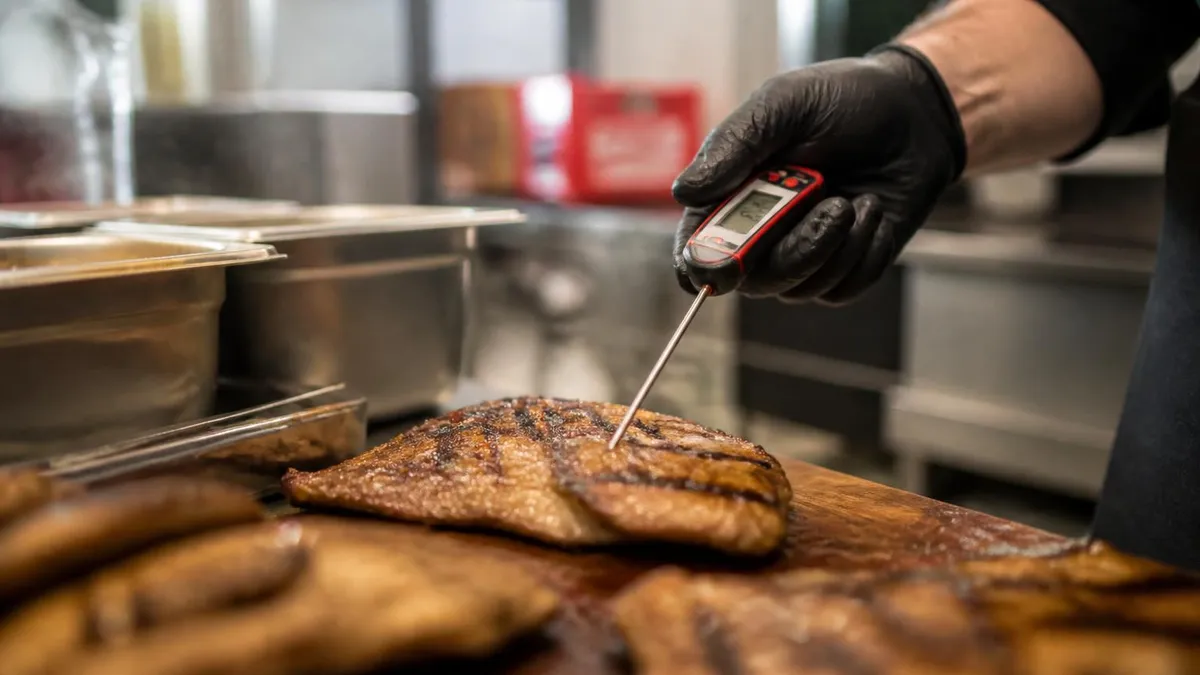
Official ServSafe Study Guide vs. Third-Party Prep Materials
- +Official book content is written by the same organization that writes the exam — content alignment is exact
- +Each chapter includes scenario-based review questions that directly match exam question style
- +The ninth edition reflects the most current FDA Food Code updates, including revised temperature regulations
- +Visual diagrams of temperature ranges, storage hierarchies, and sanitizer charts aid retention significantly
- +The official study guide qualifies as preparation for both the Manager and Food Handler exams
- +Purchasing the book bundle often includes an online exam voucher, reducing total certification cost
- −The official ServSafe Manager Book costs $75–$100 when purchased alone, which is a barrier for some candidates
- −The book is dense and text-heavy, making self-directed study difficult for visual or hands-on learners
- −No adaptive learning features — the book does not adjust based on your weak areas or learning pace
- −Third-party practice tests often include more questions and better explanations for wrong answers
- −The official online study tools are an additional cost on top of the book purchase
- −Physical copies can become outdated quickly when new FDA Food Code changes are issued
ServSafe Exam Day Readiness Checklist
- ✓Confirm your exam appointment date, time, and location at least 48 hours before the exam.
- ✓Bring a valid, government-issued photo ID that matches the name on your exam registration.
- ✓Review all temperature thresholds one final time — cooking, holding, cooling, receiving, and storage temps.
- ✓Memorize the three chemical sanitizer types and their correct concentration ranges in ppm.
- ✓Review the five Active Managerial Control (AMC) risk factors and their corresponding corrective actions.
- ✓Re-read the exclusion and restriction rules for the Big 6 pathogens: Norovirus, Salmonella Typhi, Shigella, Hepatitis A, E. coli O157:H7, and Nontyphoidal Salmonella.
- ✓Complete a final 40-question timed practice quiz the evening before to gauge your readiness.
- ✓Get at least seven to eight hours of sleep the night before — fatigue significantly impairs recall under exam conditions.
- ✓Arrive at the testing location 15 minutes early to complete check-in procedures without rushing.
- ✓During the exam, flag and skip questions you are unsure of, complete the rest, then return to flagged items.

The Two-Stage Cooling Method Is the Most Tested Concept
The two-stage cooling method appears in more exam questions than almost any other single concept. You must cool food from 135°F to 70°F within two hours, then from 70°F to 41°F within the next four hours — a total of six hours maximum. If the first stage takes longer than two hours, the food must be discarded. Methods like ice baths, blast chillers, and ice paddles all accelerate this process and are considered correct cooling techniques by ServSafe.
Understanding the high-yield topics for the ServSafe Manager exam means knowing where the exam writers allocate the most question density. Temperature-related questions are the single largest category of exam content, spanning cooking temperatures, receiving temperatures, holding temperatures, cooling procedures, and reheating requirements. If you can reliably recall every major temperature threshold in the ServSafe program — and there are roughly 20 distinct thresholds to memorize — you have addressed a substantial portion of the exam content before studying anything else.
Foodborne illness knowledge is the second highest-yield domain. The exam will present scenarios describing outbreak symptoms, onset times, and food vehicles to ask you to identify the causative pathogen. For example, sudden onset vomiting within one to six hours after eating, associated with rice dishes or starchy foods, points to Bacillus cereus.
Symptoms appearing 10 to 73 days after consuming contaminated ready-to-eat deli meats, soft cheeses, or smoked fish, particularly in pregnant women or immunocompromised individuals, suggests Listeria monocytogenes. Knowing the onset time, common symptoms, and typical food vehicles for the six major pathogens covered in the ServSafe program is essential for answering these scenario-based questions correctly.
Allergen management has grown in exam importance with each new edition of the study guide. The exam now regularly tests the eight major food allergens defined by the FDA: milk, eggs, fish, shellfish, tree nuts, peanuts, wheat, and soybeans. Sesame was added as a ninth major allergen in 2023 under the FASTER Act, and the current ServSafe ninth edition incorporates this addition. Questions may ask about the correct response when a guest reports an allergy, how to prevent allergen cross-contact during food preparation, or which foods contain hidden allergens (such as wheat in soy sauce or shellfish in Worcestershire sauce).
The pest management section is shorter than other chapters but appears reliably on the exam. Key concepts include the signs of a pest infestation (gnaw marks, droppings, nesting materials, grease tracks), the correct protocol when pests are discovered (contact a licensed pest control operator, remove contaminated food, seal entry points), and the requirements for working with a pest control operator under an integrated pest management (IPM) program. The exam will occasionally ask about specific pests — cockroaches, rodents, and flies — and their preferred harborage locations within a food service operation.
Water activity (aw) and pH are two scientific concepts that appear in the Food Safety Management Systems chapter and test whether candidates understand why certain foods are TCS (Time-Temperature Control for Safety) foods. TCS foods are those that support pathogen growth because they have a water activity above 0.85 and a pH between 4.6 and 7.5. Processed foods engineered with low water activity (like dried jerky) or high acidity (like pickles with a pH below 4.6) are not TCS foods and do not require time-temperature control. Understanding this logic helps candidates answer questions about food categorization without simply memorizing lists.
The ServSafe study guide also covers employee health policies, which food service managers are required to establish and enforce. These policies must address when employees should report illnesses to their manager, what symptoms require restriction versus exclusion, and how managers should handle situations involving highly susceptible populations (such as customers in hospitals, nursing homes, or childcare facilities). A food handler with jaundice must be reported to the regulatory authority — this specific rule appears in exam questions more frequently than candidates expect.
Physical hazards represent a smaller but consistently tested area of the contamination domain. Common physical hazards include metal shavings from can openers, bone fragments in ground meat, glass from broken equipment, and natural objects such as pits or shells. The exam distinguishes between physical hazards that are intentionally introduced (adulteration) versus those that result from poor equipment maintenance. Understanding the difference between a hazard and a defect helps candidates answer nuanced questions in this domain without second-guessing themselves on exam day.
The ServSafe Manager certification expires exactly five years from the date you passed your exam. Many food service professionals discover their certificate has lapsed only when a health inspection or new employer checks their credentials. You cannot renew online — you must retake and pass the full exam. Begin your renewal prep at least eight weeks before your expiration date to avoid any gap in your certified status.
After passing your ServSafe exam, the next steps involve obtaining and properly storing your certificate, understanding where and how your certification is recognized, and planning for renewal well before your credential expires. The NRAEF issues certificates within 3 to 4 weeks of exam completion when processed through an instructor, or more quickly when the exam is taken through online proctoring with electronic score reporting. It is critical to keep a digital and physical copy of your certificate in a safe location because replacement copies can take time to obtain and may require documentation of your original testing record.
Many candidates who use the servsafe manager online course pathway receive their exam results and certificate access through the ServSafe website. Logging into your account at servsafe.com allows you to view your certificate status, download a digital copy, and verify your credential information. If you completed your exam through an instructor-led class, your instructor submits your results to NRAEF on your behalf, and your certificate is mailed to the address on file. In either case, confirm that all your personal information on the certificate is spelled correctly, as errors can create complications during employer verification or health department inspections.
Employer verification of ServSafe credentials is common in the food service industry, particularly for managerial positions. Many large restaurant groups, hotel chains, and food retail operators require proof of current certification before extending a job offer. Health departments in states like California, Illinois, Texas, and Florida that mandate a certified food protection manager on every food establishment's staff use the ServSafe Manager certificate as an accepted credential. Understanding which specific credential your jurisdiction requires — ANSI-accredited CFPM certificates are the most broadly accepted — ensures you pursue the right level of certification from the start.
The ServSafe program also offers specialized certifications beyond the core Manager and Food Handler credentials. ServSafe Alcohol (Primary and Advanced) addresses responsible service of alcoholic beverages and is required in many states as part of responsible beverage service compliance. ServSafe Allergens is a standalone online course and assessment covering allergen awareness and management for food service professionals. These specialty credentials can be valuable additions to a food service manager's certification portfolio, particularly in operations that serve alcohol or cater to guests with dietary restrictions and allergies.
Continuing education in food safety does not end with passing the ServSafe exam. The FDA updates the Food Code every four years, and the ServSafe program revises its curriculum in response. Staying current with food safety developments — new pathogen research, updated temperature guidelines, revised allergen regulations — is an ongoing professional responsibility. Many food service professionals subscribe to industry publications, attend local health department training sessions, or complete periodic online refresher courses to maintain their knowledge currency between certification renewals.
The investment of time in earning and maintaining your ServSafe certification pays dividends that extend far beyond compliance. Research consistently shows that food establishments with ServSafe certified managers experience fewer foodborne illness outbreaks, lower rates of health inspection violations, and higher customer trust scores. For individual food service professionals, certification is associated with higher earning potential, faster advancement to supervisory roles, and greater employability across the industry. The credential signals to employers, regulators, and the public that you take food safety seriously — and that message has real career value.
If you are still deciding between studying independently or enrolling in an instructor-led course, consider this: instructor-led classes provide structured accountability, real-time question answering, and the opportunity to discuss complex scenarios with a certified ServSafe Instructor. Independent self-study through a servsafe study guide pdf approach offers flexibility and lower cost. The best approach depends on your learning style and schedule — many successful candidates combine both methods, using the official study guide for content mastery and instructor resources for clarification on difficult concepts.
Practical test-taking strategies make a measurable difference in ServSafe exam performance, especially for candidates who know the material but struggle with the specific phrasing of exam questions. The ServSafe exam uses scenario-based questions that describe a specific food service situation and ask you to identify the correct response or the violation present. These questions are designed to assess applied knowledge, not just recall — which is why reading the entire question carefully before evaluating any answer choices is the most important single test-taking habit you can develop.
When you encounter a question about the correct response to a food safety problem, the ServSafe exam almost always prefers the most proactive, conservative answer. If a question asks what a manager should do when a food handler reports feeling nauseous, the correct answer will involve restricting or excluding the employee from food handling duties — not just monitoring the situation or asking the employee to wash their hands more frequently. The ServSafe program is built on the principle that prevention is always preferred over reaction, and exam answer choices consistently reward candidates who select the most protective option.
For temperature-based questions, always check whether the question is asking about the minimum or maximum acceptable temperature — these are different values for different food categories and different points in the food handling process. For example, the minimum internal cooking temperature for poultry is 165°F for 15 seconds, while the minimum for ground beef is 155°F for 15 seconds, and whole muscle beef may be cooked to 145°F for 15 seconds with additional conditions. Reading the question carefully to identify the specific food and cooking method will prevent the most common temperature-question errors.
Time management during the exam is straightforward given that 90 questions must be answered in 2 hours — about 80 seconds per question. Most candidates complete the exam well within the allotted time. The strategy of flagging uncertain questions and returning to them at the end is effective because it prevents you from losing time on difficult questions while easier ones wait unanswered. When returning to flagged questions, trust your first instinct unless you recall specific information that clearly contradicts it — changing correct answers to incorrect ones is one of the most common exam-day errors.
After the exam, results are typically available immediately if you tested online. If you took a paper exam through an instructor, your instructor submits the results to NRAEF and you receive your score within a few days. A score of 70 or above on the raw score scale is generally equivalent to the 75 percent passing threshold.
If you do not pass, you are eligible to retake the exam; however, there is typically a 60-day waiting period before retesting, and you must pay the exam fee again. Use the score report to identify your weakest domains and focus your remedial study specifically on those areas before your retake attempt.
Building a consistent daily study habit is more effective than marathon weekend study sessions. Research on spaced repetition — a learning technique where you review material at increasing intervals over time — shows that information reviewed across multiple shorter sessions is retained significantly longer than information crammed in a single long session. For ServSafe preparation, this means reviewing your temperature thresholds every morning for five minutes, completing a 20-question practice quiz every other day, and doing a full 80-question timed exam at the end of each week. This rhythm builds durable knowledge rather than fragile short-term recall.
Finally, use your practice test results analytically, not emotionally. A 65 percent on a practice exam midway through your study schedule is not a cause for alarm — it is diagnostic data telling you exactly where to focus your next study session. Track which domains produce the most wrong answers, calculate your percentage correct in each domain, and use that data to allocate your remaining study hours where they will have the greatest impact on your final exam score. Candidates who approach preparation as a data-driven process consistently outperform those who study randomly without tracking their progress.
ServSafe Questions and Answers
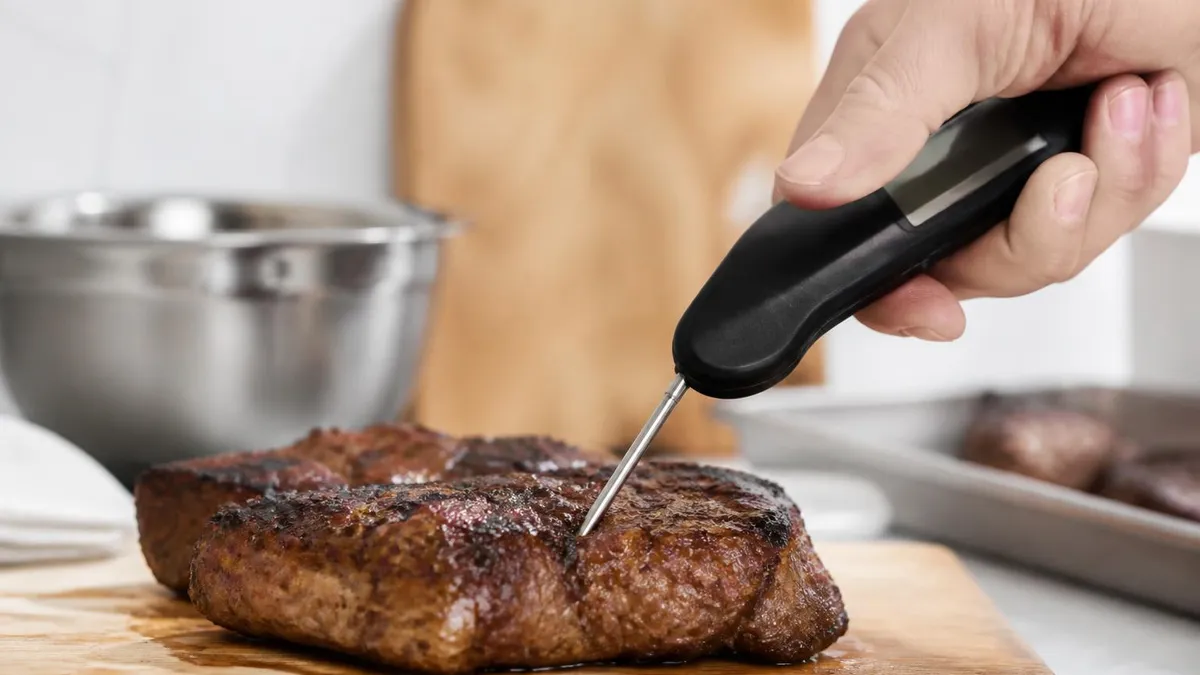
ServSafe Administrative — Complete Guide (2026)

ServSafe Website: Your Complete Guide to Certification, Training, and Food Safety Resources

How to Print Your ServSafe Certificate: Complete Step-by-Step Guide
ServSafe Certification Lookup: How to Verify, Find, and Renew Your Food Safety Credential in 2026
ServSafe Customer Service: How to Get Help With Certification, Testing, and Account Issues
About the Author

Registered Sanitarian & Food Safety Certification Expert
Cornell University College of Agriculture and Life SciencesThomas Wright is a Registered Sanitarian and HACCP-certified food safety professional with a Bachelor of Science in Food Science from Cornell University. He has 17 years of experience in food safety auditing, regulatory compliance, and foodservice management training. Thomas prepares food industry professionals for ServSafe Manager, HACCP certification, and state food handler examinations.
Join the Discussion
Connect with other students preparing for this exam. Share tips, ask questions, and get advice from people who have been there.
View discussion (7 replies)