
Passing Score for ServSafe Manager: What You Need to Know to Pass in 2026 September
What is the passing score for ServSafe Manager? 75% correct (56/75 questions). Get exam breakdown, study tips & practice tests. 🏆

The passing score for ServSafe Manager is 75%, meaning you must answer at least 56 out of 75 scored questions correctly on the exam. Understanding this threshold is the first step toward earning your ServSafe manager certification — one of the most recognized food safety credentials in the United States. Whether you work in a restaurant, cafeteria, hotel kitchen, or any food service operation, knowing exactly what the exam demands helps you focus your preparation time on the areas that matter most.
The ServSafe Manager exam is administered by the National Restaurant Association Educational Foundation (NRAEF) and is accepted as a food protection manager certification in nearly every U.S. state. The exam consists of 90 total questions, but only 75 of those questions are scored. The remaining 15 are unscored pretest questions that ServSafe uses to evaluate new items for future exam versions — and you won't know which ones they are, so you must treat every question as if it counts toward your final score.
Many candidates underestimate how comprehensive the ServSafe certification exam actually is. The test covers eight distinct domains of food safety knowledge, ranging from foodborne illness prevention and personal hygiene to proper cooking temperatures, HACCP principles, and facilities management. Each domain carries a different weight, which means strategic studying — not just general review — is what separates candidates who barely pass from those who score well above the 75% threshold and walk away confident in their knowledge.
One thing that surprises many first-time test-takers is the exam's emphasis on practical scenarios rather than simple memorization. You'll encounter questions that describe a kitchen situation and ask you to identify the correct food safety response. This means that rote memorization of definitions isn't enough — you need to understand the reasoning behind food safety protocols so you can apply them to novel situations under timed conditions. A solid servsafe food manager certification study plan accounts for both knowledge recall and applied reasoning.
Time management is another factor that affects many candidates. You have 2 hours to complete the 90-question exam, which works out to roughly 80 seconds per question. Most test-takers find this is adequate time if they are well-prepared, but it can feel rushed if you encounter several scenario-based questions back-to-back. Practicing under timed conditions using a quality ServSafe practice test is one of the best ways to build the mental stamina and pacing skills you need on exam day.
The good news is that the national first-time pass rate for the ServSafe Manager exam hovers around 54%, but candidates who follow a structured study schedule and use official practice materials consistently outperform that average. If you're reading this guide, you're already taking the right approach. The sections below break down exactly how the exam is structured, which domains to prioritize, how to build a winning study plan, and what to do if you need to retake the test. Let's get you to that 75% passing mark — and beyond.
It's also worth noting that the ServSafe food handler certification and the Manager certification are separate credentials with different exams, different passing requirements, and different levels of authority. The Manager exam is significantly more rigorous and is designed for individuals who are responsible for overseeing food safety in their establishment. If your employer or state requires manager-level certification, there is no substitute — you must sit for and pass the full 90-question proctored exam to earn the credential.
ServSafe Manager Exam by the Numbers
ServSafe Manager Exam Format
| Section | Questions | Time | Weight | Notes |
|---|---|---|---|---|
| Providing Safe Food | 11 | — | 15% | Foodborne illness causes, FAT TOM, high-risk populations |
| Forms of Contamination | 10 | — | 14% | Biological, chemical, physical hazards |
| Personal Hygiene | 9 | — | 12% | Handwashing, illness policies, hygienic practices |
| Flow of Food (Introduction & Purchasing/Receiving) | 9 | — | 12% | Purchasing standards, receiving temperatures, inspections |
| Flow of Food (Storage, Preparation, Cooking, Serving) | 14 | — | 19% | Largest weighted section; internal temps, cross-contamination |
| Food Safety Management Systems (HACCP) | 9 | — | 12% | 7 HACCP principles, crisis management, active managerial control |
| Safe Facilities & Pest Management | 7 | — | 9% | Equipment standards, pest prevention, facility design |
| Cleaning & Sanitizing | 6 | — | 7% | Chemical sanitizers, procedures, schedules |
| Total | 90 | 2 hours | 100% |
Understanding the domain weight distribution of the ServSafe Manager exam is arguably the single most important thing you can do to optimize your study time. With 19% of scored questions coming from the "Flow of Food" section covering storage, preparation, cooking, and serving, this is the area where you stand to gain or lose the most points. Mastering internal cooking temperatures, cooling procedures, and time-temperature abuse principles in this domain alone can make the difference between passing and failing.
The "Flow of Food" concept in ServSafe describes the complete journey that food takes through your operation — from the moment a shipment arrives at the receiving dock to the second a plate is served to a guest. Every step in that journey is an opportunity for contamination or temperature abuse, and the exam tests whether you can identify and prevent hazards at each stage.
Key knowledge points include proper receiving temperatures for different food categories, correct storage order in refrigerators (ready-to-eat food on top, raw poultry on the bottom), and the safe thawing methods approved by the FDA Food Code.
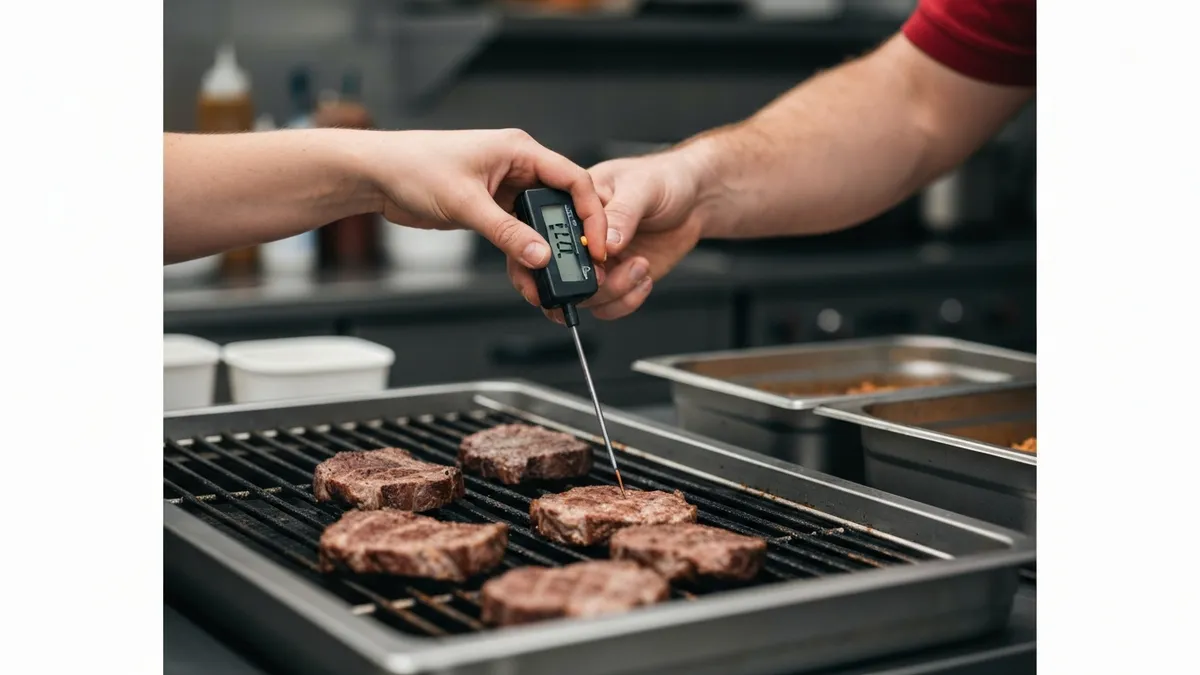
Cooking temperatures are a major focus of the exam and an area where precision matters. You need to memorize specific internal temperatures for various protein types: 165°F for poultry, stuffing, and reheated leftovers; 155°F for ground meat and mechanically tenderized beef; 145°F for whole-cut steaks, pork, veal, and lamb; and 135°F for commercially processed hot-held foods like hot dogs. These temperatures aren't arbitrary — they correspond to the thermal destruction points for specific pathogens, and the exam may ask you to explain the reasoning behind a given temperature requirement.
HACCP (Hazard Analysis and Critical Control Points) is another heavyweight topic that spans 12% of the exam. You'll need to know all seven HACCP principles in order: conduct a hazard analysis, identify critical control points, establish critical limits, establish monitoring procedures, establish corrective actions, verify the system works, and keep records. More importantly, you'll need to apply these principles to real kitchen scenarios. The exam might describe a food operation and ask you to identify where a critical control point exists or what corrective action should be taken when a critical limit is violated.
Personal hygiene questions tend to be more straightforward but carry enough weight at 12% that you shouldn't overlook them. The exam heavily emphasizes proper handwashing procedure (including the 20-second minimum with soap), when handwashing is required (after using the restroom, after handling raw meat, after sneezing, etc.), and what constitutes a reportable illness. Employees diagnosed with Norovirus, Salmonella Typhi, Shigella spp., Shiga toxin-producing E. coli, or Hepatitis A must be excluded from food handling — and the exam tests whether you know the difference between exclusion (not allowed in the facility) and restriction (allowed in non-food-contact roles).
The cleaning and sanitizing domain may only account for 7% of the exam, but it's an area where many candidates lose easy points due to confusion between the two concepts. Cleaning removes food and dirt from surfaces, while sanitizing reduces pathogens to safe levels. Both steps are necessary — you cannot effectively sanitize a surface that hasn't been cleaned first.
The exam also covers the three approved chemical sanitizers (chlorine, iodine, and quaternary ammonium compounds), their correct concentration ranges, and the factors that affect sanitizer effectiveness such as temperature, contact time, and pH. Reviewing the servsafe food protection manager certification study materials for this section is especially valuable because the concentration tables are frequently tested.
One study approach that many successful candidates use is to create a personal "high-stakes flashcard deck" focused exclusively on numbers: temperatures, time limits, concentration ranges, and percentages. The ServSafe Manager exam is number-heavy, and having those figures locked into memory frees up your cognitive bandwidth during the actual test to focus on the scenario-based questions that require deeper analysis. Combine this with weekly timed practice tests, and you'll build both the knowledge base and the test-taking stamina needed to clear the 75% passing threshold with room to spare.
ServSafe Manager Study Strategies by Learning Style
Visual learners should build a color-coded temperature chart and post it somewhere they'll see it daily. Create a flow-of-food diagram that maps every stage from receiving to serving, highlighting critical control points in red. Use the official ServSafe Manager textbook's charts and infographics as anchor points for your notes, and draw your own diagrams of proper refrigerator storage order — ready-to-eat on top, raw poultry on the bottom.
Flashcard apps like Anki or Quizlet are excellent tools for visual learners because they let you add color coding and images to each card. Create a dedicated deck for internal cooking temperatures, sanitizer concentration ranges, and HACCP principles. Seeing the same information repeatedly in a structured visual format builds the rapid recall you need when you're working through 90 questions under a 2-hour time limit on exam day.

Is the ServSafe Manager Certification Worth It?
- +Accepted by health departments in nearly every U.S. state as proof of food safety competency
- +Required by law for at least one person per food service establishment in many jurisdictions
- +Demonstrates professional credibility to employers and can lead to higher pay and promotions
- +Provides deep, practical food safety knowledge that directly reduces illness risk in your operation
- +5-year certification validity means you won't need to retake the exam frequently
- +Recognized by major national restaurant chains and institutional food service employers nationwide
- −Exam is challenging — national first-time pass rate is only around 54% for unprepared candidates
- −Exam and study materials carry a combined cost that can exceed $200 depending on your location
- −Requires significant study time — most candidates need 4-8 weeks of dedicated preparation
- −Certification must be renewed every 5 years, which involves another exam and additional fees
- −Does not replace state-specific food handler cards required for line-level employees
- −Proctored exam environment can be stressful for candidates with test anxiety or limited test-taking experience
Pre-Exam Prep Checklist for ServSafe Manager
- ✓Purchase or borrow the current edition of the official ServSafe Manager textbook and study guide.
- ✓Memorize all internal cooking temperatures for poultry, ground meats, whole-cut proteins, and reheated foods.
- ✓Learn the two-stage cooling method: 135°F to 70°F within 2 hours, then to 41°F within the next 4 hours.
- ✓Master the seven HACCP principles in correct order and be able to apply them to real scenarios.
- ✓Study the Big 6 foodborne pathogens (Norovirus, Hepatitis A, Salmonella Typhi, E. coli, Shigella, and Nontyphoidal Salmonella) including symptoms and associated foods.
- ✓Take at least three full-length timed ServSafe manager practice tests under exam conditions before your scheduled test date.
- ✓Review all practice test errors and create a targeted flashcard deck for your weak areas.
- ✓Confirm your exam location, check-in time, and required identification at least 48 hours before test day.
- ✓Prepare a "numbers cheat sheet" for last-day review covering temperatures, times, and sanitizer concentrations.
- ✓Get a full night of sleep before the exam and eat a meal beforehand to maintain focus during the 2-hour session.

Treat All 90 Questions as if They Count
The ServSafe Manager exam includes 15 unscored pretest questions mixed randomly throughout the 90-question test. You have no way to identify which questions are scored and which are not, so you must approach every single question with full effort. Don't try to guess which questions might be experimental — that mental energy is better spent carefully reading each scenario and selecting the best answer based on your preparation.
Even the most well-prepared candidates sometimes don't pass on their first attempt, and understanding the ServSafe retake policy is important if you find yourself in that situation. According to the National Restaurant Association Educational Foundation's policies, if you do not achieve the 75% passing score, you may retake the exam. However, you must wait at least 24 hours before scheduling a retake, and you are limited to a maximum of five exam attempts in any given 12-month period. There is typically an additional fee for each retake, so treating every attempt seriously is both financially and logistically important.
When candidates receive their score report after failing, it includes a breakdown by domain that shows their performance in each of the eight content areas. This breakdown is invaluable for planning your retake strategy. Rather than restudying everything from scratch, focus your efforts disproportionately on the domains where you scored below 75%. If your score report shows that you performed well on personal hygiene and cleaning but struggled with HACCP and the flow of food, those two domains should consume the majority of your retake preparation time.
One common mistake that candidates make when preparing for a retake is simply re-reading the textbook from cover to cover. Passive re-reading has limited value when you've already encountered the material once. Instead, prioritize active learning strategies: take additional practice tests to identify remaining gaps, write out scenario-based answers from memory, quiz yourself on specific number-based facts like temperatures and time limits, and if possible, find a study partner who can challenge you with verbal questions. The goal is to build stronger neural pathways for the material, not just to re-expose yourself to it.
For candidates who failed by a significant margin (below 60%), it may be worth considering whether the official ServSafe instructor-led course is a better path than self-study. The in-person course, typically one to two days long, includes hands-on demonstrations, group discussions, and a live instructor who can answer questions in real time. Many candidates find that the structured environment and immediate feedback loop of a classroom setting accelerates their understanding of complex topics like HACCP and time-temperature control far more than independent study can.
It's also worth investigating whether your state or local health department offers any supplementary food safety training resources. Many jurisdictions that require servsafe manager certification also provide free study guides, online modules, or practice exams tailored to local regulations. While the ServSafe exam itself is standardized nationally, knowing the regulatory context in which you'll be applying your certification can help you understand the real-world significance of the concepts being tested, which in turn makes the material easier to retain.
One underutilized resource for ServSafe retake candidates is the official ServSafe website, accessible through your state's food safety regulatory page. You can find information on authorized exam locations, proctor-verified testing sessions, and current exam pricing on the official platform. Checking the servsafe com resource page for your state often reveals local training providers who offer bundled exam-plus-course packages at discounted rates compared to purchasing each component separately.
Finally, don't overlook the mental and emotional dimensions of exam preparation, especially for retake candidates. Test anxiety is real and can cause even well-prepared individuals to underperform on exam day. Techniques like deep breathing exercises before the exam, positive visualization of a successful outcome, and practicing in simulated exam environments can all help reduce anxiety. Arriving early to the testing center, bringing required identification, and reviewing your "numbers cheat sheet" one final time in the parking lot are small rituals that many successful candidates credit with helping them feel calm and confident when they sit down to begin.
The ServSafe Manager exam allows a maximum of five attempts within any 12-month period. If you exhaust all five attempts without passing, you must wait until the 12-month window resets before testing again. Each retake requires an additional exam fee, so prepare thoroughly before each attempt to avoid unnecessary costs and delays in earning your certification.
Once you've passed the ServSafe Manager exam and received your official certificate, there are several important steps to take to activate and leverage your new credential. Your ServSafe Manager certification is valid for five years from the date of your exam, not the date you receive your certificate in the mail — so make sure you note that date and set a reminder to begin the recertification process well before the five-year mark. Letting your certification lapse can create compliance problems for your employer and require you to sit for the full exam again rather than a simplified renewal process.
Your employer will likely want a copy of your ServSafe Manager certificate for their records and to display in the establishment as required by many health departments. The NRAEF typically mails physical certificates within 4-6 weeks of passing, but you can access a digital version of your score report and certificate through your online account much sooner.
Some jurisdictions have a processing time requirement — meaning your certification doesn't take legal effect until it has been registered with the local health department — so check your specific state and county regulations to understand what steps you need to complete beyond simply passing the exam.
Employers in the food service industry increasingly view ServSafe certified managers as more valuable hires and promotion candidates. A food safety management certification demonstrates to leadership that you have the knowledge and commitment to protect customers, reduce liability, and maintain the health department scores that directly affect a business's reputation and bottom line. Many multi-unit restaurant operators require that all general managers and kitchen managers hold an active ServSafe Manager certification as a condition of employment, regardless of whether state law mandates it.
The financial investment in your certification also tends to pay off relatively quickly. Certified food protection managers often command higher hourly rates and are prioritized for salaried management positions. In competitive food service markets, having an active ServSafe certification certificate on your resume can differentiate you from otherwise equally qualified candidates who haven't yet pursued the credential. Some employers also offer reimbursement for exam and study materials costs, especially for employees who pass on their first attempt.
Beyond employment benefits, holding a ServSafe Manager certification gives you a practical framework for making better food safety decisions every day on the job. The concepts you mastered to pass the exam — proper cooling procedures, cross-contamination prevention, HACCP principles, employee illness policies — are not theoretical exercises. They are the daily tools of an effective food safety manager, and applying them consistently is what prevents the kinds of foodborne illness outbreaks that can shutter a restaurant, trigger lawsuits, and permanently damage a brand's reputation.
Knowing the servsafe manager passing score details and cost breakdown before you register helps you plan your study timeline and budget appropriately. Many candidates register, pay their fee, and then immediately begin intensive study — treating the financial commitment as a motivational anchor. Others prefer to study first and register only when they feel ready. Either approach can work, but be aware that exam seat availability at your preferred testing location can sometimes be limited, especially during peak season when many food service workers seek certification simultaneously.
The knowledge and credential you earn through the ServSafe Manager certification program represent a genuine investment in your professional identity and your ability to protect the people who eat the food you serve. The 75% passing score is achievable for any candidate who prepares systematically, uses quality practice materials, and approaches the exam with the same seriousness they bring to managing a real food operation. With the right preparation, you don't just pass — you build the expertise to be a genuinely excellent food safety manager for the rest of your career.
On the week of your ServSafe Manager exam, your preparation strategy should shift from broad learning to focused reinforcement. Stop introducing new material on the final two days before your test — at that point, your job is to consolidate what you already know, not to cram additional content. Use those final days to review your flashcards, take one more timed practice exam, and go over your error log to make sure your weakest areas have been addressed. Sleep and nutrition matter significantly for cognitive performance on exam day, so prioritize both.
During the actual exam, read every question stem carefully before looking at the answer choices. ServSafe questions are often phrased with subtle qualifiers like "first," "most likely," "best," or "immediately" that completely change which answer is correct. A question asking what a manager should do "first" when a food handler reports a sore throat with fever requires a different answer than one asking what the manager should do "after" confirming the diagnosis. Missing these qualifiers is one of the most common causes of avoidable errors on the ServSafe Manager exam.
The process of elimination is your best friend when you encounter a question you're uncertain about. On a four-option multiple choice exam, you can almost always eliminate at least one or two clearly wrong answers, which significantly improves your odds if you must make an educated guess. Look for answer choices that are too extreme ("always," "never"), that confuse two related concepts ("cleaning" vs. "sanitizing"), or that apply correct information to the wrong context. Eliminating those options narrows your decision to the one or two most plausible answers.
Scenario-based questions — which make up a large portion of the ServSafe Manager exam — reward candidates who have internalized the reasoning behind food safety rules rather than just memorized the rules themselves. When you encounter a scenario question, resist the urge to immediately scan the answer choices. Instead, read the scenario fully, identify what food safety principle is being tested, formulate your own answer in your head, and then look for the answer choice that most closely matches your reasoning. This approach consistently outperforms jumping to the answer choices first, where attractive-sounding distractors can lead you astray.
Pay special attention to questions involving the "Big 6" foodborne pathogens throughout the exam. Norovirus, Hepatitis A, Shigella, Shiga toxin-producing E. coli, Salmonella Typhi, and Nontyphoidal Salmonella appear across multiple domains — in questions about personal hygiene (which employees must be excluded), food safety management (what foods are high-risk vehicles), and even facilities (what cleaning and sanitizing protocols best reduce viral contamination). Knowing these pathogens thoroughly gives you a significant cross-domain advantage and can boost your score in several sections simultaneously.
If you finish the 90-question exam before the 2-hour time limit expires, use every remaining minute to review your answers. Start with questions you flagged as uncertain during your first pass, then do a second sweep to make sure you didn't misread any question stems. Statistically, the questions candidates get wrong on review are often ones where they changed a correct initial answer to an incorrect one based on second-guessing. Trust your preparation — if your gut tells you an answer is right and you can connect it to something you studied, it probably is right.
After exam day, regardless of outcome, take time to reflect on your preparation process. What study methods worked best? What topics remained unclear despite your best efforts? Which types of questions felt most comfortable and which felt most challenging?
This kind of meta-analysis not only helps you prepare for a potential retake but also builds the habit of continuous professional improvement that distinguishes truly exceptional food safety managers from those who simply hold a certificate. The ServSafe food handler certification ecosystem — including the Manager credential — is fundamentally about building a safer food system, and that mission extends well beyond any single exam score.
ServSafe Questions and Answers

ServSafe Cleaning Agents: Which Cleaning Agent Best Removes Baked-On Food?

ServSafe Manager Book 6th Edition: Complete Study Guide & Certification Prep Hub

ServSafe Illinois: Complete Guide to Food Handler & Manager Certification (2026)

ServSafe Certification Cost: Complete 2026 Pricing Guide for Food Handlers and Managers

ServSafe Food Manager Certification: Complete 2026 Study Guide, Exam Prep & Pass Strategy
About the Author

Registered Sanitarian & Food Safety Certification Expert
Cornell University College of Agriculture and Life SciencesThomas Wright is a Registered Sanitarian and HACCP-certified food safety professional with a Bachelor of Science in Food Science from Cornell University. He has 17 years of experience in food safety auditing, regulatory compliance, and foodservice management training. Thomas prepares food industry professionals for ServSafe Manager, HACCP certification, and state food handler examinations.
Join the Discussion
Connect with other students preparing for this exam. Share tips, ask questions, and get advice from people who have been there.
View discussion (7 replies)