
ServSafe Fridge Storage Order: Complete Guide to Refrigerator Food Safety 2026
Master the ServSafe fridge order for your certification exam. Learn correct refrigerator storage to prevent contamination. ✅ Ace your ServSafe practice test!

The servsafe fridge order is one of the most frequently tested concepts on the ServSafe certification exam, and for good reason — improper refrigerator storage is a leading cause of foodborne illness outbreaks in commercial kitchens across the United States. When food service professionals understand exactly how to arrange items inside a walk-in cooler or reach-in refrigerator, they dramatically reduce the risk of cross-contamination through dripping juices, raw proteins, and improperly covered containers. Mastering this topic is essential for anyone pursuing a ServSafe food handler or manager credential.
ServSafe, developed and administered by the National Restaurant Association Educational Foundation, sets the gold standard for food safety training in the United States. With over 110,000 monthly searches for ServSafe-related topics, it is clear that food service workers nationwide recognize the importance of this certification. Whether you are studying for the ServSafe manager exam or the more entry-level ServSafe food handler certification, the rules governing refrigerator storage order appear prominently in the curriculum and on practice exams alike. Understanding servsafe food protection manager certification requirements begins with foundational concepts like proper cold storage.
The core principle behind ServSafe's refrigerator storage guidelines is internal cooking temperature. Foods are stored from top to bottom in ascending order of their required minimum internal cooking temperature. This arrangement ensures that if juices from a higher-temperature food drip onto a lower shelf, they land on food that will be cooked to an equally high or higher temperature, killing any potential pathogens. This elegant system is both practical and scientifically sound, reducing the risk of cross-contamination without requiring elaborate equipment or complex procedures.
Ready-to-eat foods occupy the top shelves of the refrigerator because they require no cooking before consumption. These include items like deli meats, cooked leftovers, fruits, vegetables, and dairy products such as cheese and yogurt. Because these foods will not be heated to pathogen-killing temperatures before they reach a customer's plate, they must be protected from any possible contamination by raw proteins below. Even a tiny drop of raw chicken juice landing on a ready-to-eat salad could introduce dangerous bacteria like Salmonella or Campylobacter directly to the consumer.
Below ready-to-eat foods, the ServSafe guidelines place whole seafood, then whole cuts of beef and pork, followed by ground meats and ground fish, and finally whole and ground poultry at the very bottom. Each tier corresponds to a higher minimum internal cooking temperature: seafood at 145°F for 15 seconds, whole beef and pork at 145°F, ground meats at 155°F, and poultry at 165°F. The logic is straightforward — any drips from a lower shelf item landing on product stored above it would be inconsequential because the upper item will be cooked to a sufficient temperature to eliminate contamination.
Understanding this hierarchy is critical not only for passing the ServSafe manager practice test but also for day-to-day operations in any food service establishment. Health inspectors routinely check refrigerator storage during inspections, and violations can result in critical citations, fines, or even temporary closure. Food service managers who have earned their ServSafe manager certification are expected to train their staff on proper storage procedures and to maintain ongoing compliance with these standards. The consequences of getting this wrong extend far beyond a failed exam — they can mean real harm to real people.
This guide will walk you through every aspect of the ServSafe refrigerator storage order, from the underlying science to practical implementation tips for commercial kitchens. We will cover the exact top-to-bottom arrangement required by ServSafe, common mistakes that cause exam failure and real-world health violations, temperature requirements for each food category, and strategies to help you master this material before your ServSafe certification exam. Whether you are preparing for your first certification or refreshing your knowledge for recertification, this comprehensive resource will ensure you have everything you need to succeed.
- The ServSafe Food Handler assessment contains 40 questions. (National Restaurant Association / National Restaurant Association Solutions, LLC)
- The ServSafe Food Protection Manager examination contains 90 questions, comprising 80 scored questions and 10 unscored pilot questions. (National Restaurant Association / National Restaurant Association Solutions, LLC)
- The ServSafe Food Handler assessment has no time limit. (National Restaurant Association / National Restaurant Association Solutions, LLC)
- The standard ServSafe Food Handler passing score is at least 75%, although some jurisdictions have different requirements. (National Restaurant Association / National Restaurant Association Solutions, LLC)
- Passing the ServSafe Food Protection Manager examination requires at least 70%, equivalent to 56 correct answers out of 80 scored questions. (National Restaurant Association / National Restaurant Association Solutions, LLC)
- ServSafe charges $10 USD to mail a certificate directly to its recipient. (National Restaurant Association / National Restaurant Association Solutions, LLC)
- Scheduling a ServSafe Manager ProctorU examination less than 24 hours before the selected appointment incurs an additional $12 USD fee. (National Restaurant Association / National Restaurant Association Solutions, LLC)
- Each ServSafe Food Protection Manager retake requires purchasing a new examination. (National Restaurant Association / National Restaurant Association Solutions, LLC)
- ServSafe Food Protection Manager candidates may attempt the examination twice within 30 days, must wait 60 days after a second failed attempt, and may make no more than four attempts within 12 months. (National Restaurant Association / National Restaurant Association Solutions, LLC)
Facts verified Oct 15, 2026 against National Restaurant Association / National Restaurant Association Solutions, LLC. Dates that have passed are removed automatically.
ServSafe Exam at a Glance
| Item | Detail | Official source |
|---|---|---|
| Number of questions (ServSafe Food Handler) | 40 questions | National Restaurant Association / National Restaurant Association Solutions, LLC |
| Number of questions (ServSafe Food Protection Manager) | 90 questions: 80 scored and 10 unscored pilot questions | National Restaurant Association / National Restaurant Association Solutions, LLC |
| Time limit (ServSafe Food Handler) | No time limit | National Restaurant Association / National Restaurant Association Solutions, LLC |
| Passing score (ServSafe Food Handler) | 75%; jurisdiction-specific requirements may differ | National Restaurant Association / National Restaurant Association Solutions, LLC |
| Passing score (ServSafe Food Protection Manager) | 70%; at least 56 of 80 scored questions correct | National Restaurant Association / National Restaurant Association Solutions, LLC |
| Exam fee (ServSafe — mailed certificate) | $10 for a mailed certificate | National Restaurant Association / National Restaurant Association Solutions, LLC |
| Exam fee (ServSafe Manager — ProctorU Take It Now scheduling) | $12 extra for scheduling less than 24 hours ahead | National Restaurant Association / National Restaurant Association Solutions, LLC |
| Exam fee (ServSafe Manager — ProctorU Take It Soon scheduling) | $8 extra for scheduling 24–72 hours ahead | National Restaurant Association / National Restaurant Association Solutions, LLC |
| Retake fee (ServSafe Food Protection Manager) | A new examination purchase is required | National Restaurant Association / National Restaurant Association Solutions, LLC |
| Retake policy (ServSafe Food Protection Manager) | Two attempts within 30 days; 60-day wait after the second failure; maximum four attempts in 12 months | National Restaurant Association / National Restaurant Association Solutions, LLC |
| Validity (ServSafe Food Handler certificate) | 3 years; local or company rules may require earlier renewal | National Restaurant Association / National Restaurant Association Solutions, LLC |
| Validity (ServSafe Food Handler — started online course) | Complete within 60 days of starting | National Restaurant Association / National Restaurant Association Solutions, LLC |
| Validity (ServSafe Food Protection Manager certification) | 5 years; local requirements may differ | National Restaurant Association / National Restaurant Association Solutions, LLC |
| Validity (ServSafe Manager — started online course) | Complete within 90 days of starting | National Restaurant Association / National Restaurant Association Solutions, LLC |
| Validity (ServSafe online courses — unused access) | 1 year from purchase | National Restaurant Association / National Restaurant Association Solutions, LLC |
| Renewal (ServSafe Food Protection Manager) | Pass the certification examination again and meet local requirements | National Restaurant Association / National Restaurant Association Solutions, LLC |
| Delivery (ServSafe Food Handler — online assessment) | Online; no proctor required | National Restaurant Association / National Restaurant Association Solutions, LLC |
| Delivery (ServSafe Food Protection Manager) | Proctored examination; print and online options | National Restaurant Association / National Restaurant Association Solutions, LLC |
| Delivery (ServSafe Manager — online proctoring) | Remote online proctoring included | National Restaurant Association / National Restaurant Association Solutions, LLC |
| Delivery (ServSafe Manager — Pearson VUE testing center) | Online examination at a Pearson VUE testing center | National Restaurant Association / National Restaurant Association Solutions, LLC |
| Score release (ServSafe Manager — online examination) | Immediate pass/fail result | National Restaurant Association / National Restaurant Association Solutions, LLC |
Facts verified Oct 15, 2026 against National Restaurant Association / National Restaurant Association Solutions, LLC. Dates that have passed are removed automatically.
ServSafe Refrigerator Storage by the Numbers
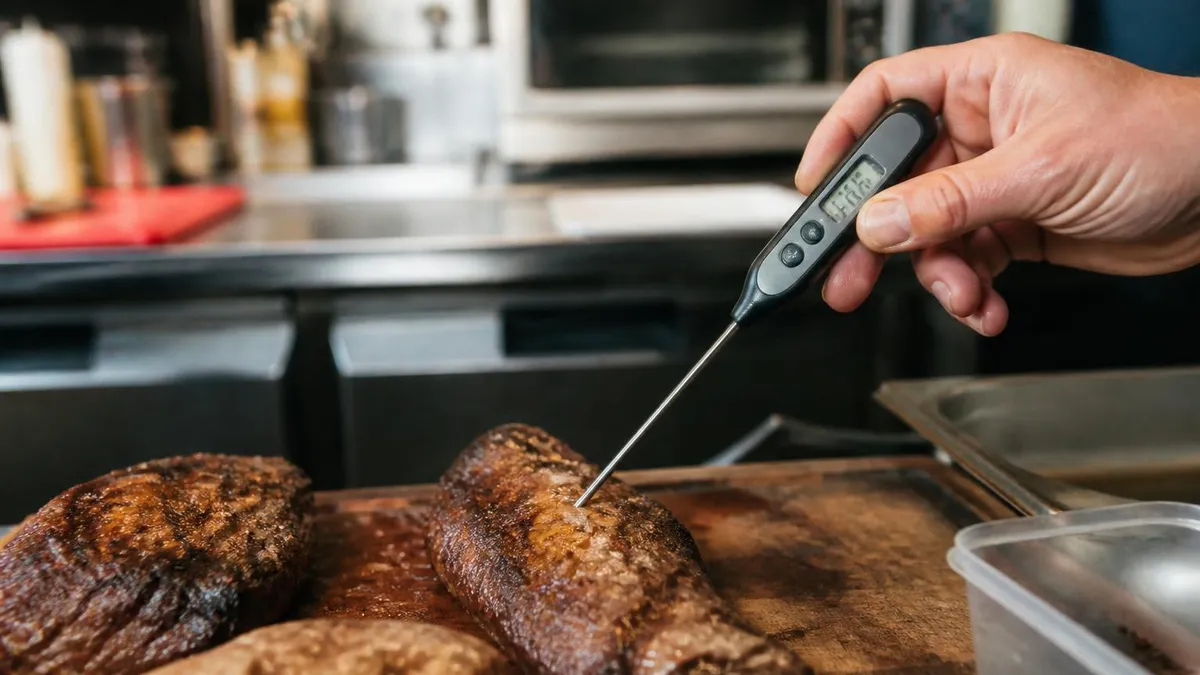
The Correct ServSafe Refrigerator Storage Order (Top to Bottom)
Cooked foods, deli meats, dairy, washed produce, and any item consumed without further cooking. No minimum internal temperature — must be protected from all raw protein drips. Store in covered containers or original packaging.
Raw whole fish, shellfish, and seafood products that require a minimum internal temperature of 145°F for 15 seconds. Must be stored below ready-to-eat foods but above all meat products to prevent higher-risk drip contamination.
Whole cuts of beef, pork, veal, and lamb requiring 145°F internal temperature. Steaks, roasts, chops, and similar intact muscle cuts belong here. Their drips are safer than ground or poultry products stored below.
All ground or mechanically tenderized meats including ground beef, pork sausage, and ground seafood. These require 155°F internal temperature. Grinding increases surface area, raising contamination risk — hence the lower shelf position.
Chicken, turkey, duck, and all poultry products go on the very bottom shelf. Poultry requires the highest minimum internal temperature of 165°F for 15 seconds. Any drips from this shelf landing on product below would be a major hazard.
Understanding the temperature science behind the ServSafe refrigerator storage order transforms memorization into genuine comprehension, and comprehension leads to both exam success and real-world competence. The system is built on a fundamental food safety principle: if raw protein A drips onto raw protein B, the only way to make that situation safe is to ensure that protein B will be cooked to a temperature at least as high as the temperature required for protein A. This means the higher the cooking temperature required, the lower the shelf it occupies in the refrigerator.
Whole cuts of seafood must reach a minimum internal temperature of 145°F for 15 seconds to be considered safe for consumption. This temperature kills common seafood-associated pathogens including Vibrio vulnificus, which is particularly dangerous in raw oysters and other shellfish, and certain strains of Salmonella. Because seafood requires this relatively moderate cooking temperature, it occupies shelf two in the ServSafe storage hierarchy — safely below ready-to-eat items that need no cooking at all, but above meats that require equal or higher temperatures.
Whole cuts of beef and pork also require an internal temperature of 145°F, placing them on the same temperature tier as whole seafood. However, ServSafe places whole beef and pork on shelf three, below seafood, based on the relative risk profiles of the pathogens associated with each. Ground beef and pork require a higher temperature of 155°F because the grinding process distributes any surface bacteria throughout the entire product. A whole steak may have bacteria only on its outer surface, which is easily destroyed by searing, but ground beef can harbor bacteria deep in the center of every patty.
Poultry holds the distinction of requiring the highest minimum internal cooking temperature of any common protein: 165°F for 15 seconds, with no exceptions. This temperature requirement applies to whole chickens, turkey breasts, ground turkey, duck, goose, and any other bird-derived protein. The reason for this improved standard is the prevalence of Salmonella and Campylobacter in raw poultry, pathogens that are among the most common causes of foodborne illness in the United States. For anyone studying toward their servsafe manager certification online, understanding this temperature hierarchy is non-negotiable exam knowledge.
The temperature requirements become critically important when you consider what happens in a busy commercial kitchen refrigerator. Packaging tears, containers spill, and condensation forms — all of which can cause liquid from one container to migrate to another.
ServSafe's storage order is designed as a failsafe: even in the worst-case scenario where raw chicken juice drips from the bottom shelf, it can only fall onto the floor or other raw poultry. It cannot reach the hamburger patties above it, the fish above those, or the ready-to-eat coleslaw at the top. This elegant, temperature-based hierarchy is a masterpiece of practical food safety engineering.
Commercial refrigerators must maintain a maximum temperature of 41°F or below to keep food out of the temperature danger zone, which ServSafe defines as 41°F to 135°F. Within this danger zone, bacteria can double in number every 20 minutes under ideal conditions. A single Salmonella bacterium can multiply to over one million organisms in just seven hours at room temperature. Maintaining proper refrigerator temperatures while also following correct storage order provides a two-layer defense against foodborne illness: cold temperatures suppress bacterial growth, and correct storage order prevents cross-contamination in the event that any growth does occur.
Walk-in coolers present unique challenges for storage order compliance because they often contain large quantities of food from multiple categories delivered simultaneously. ServSafe recommends organizing walk-in coolers with the same top-to-bottom hierarchy as reach-in units, using clearly labeled shelving zones for each food category. Many food service operations use color-coded labels or shelf dividers to reinforce the storage order visually for all staff members, regardless of their language proficiency or ServSafe training status. This systematic approach reduces reliance on individual memory and creates consistent, auditable food safety practices across an entire operation.
ServSafe Food Handler and Manager Storage Rules by Food Type
Ready-to-eat (RTE) foods must always occupy the top shelves of any commercial refrigerator. This category includes all cooked foods awaiting service, deli meats and cheeses, washed and cut produce, opened canned goods, and any product that will be served without additional cooking. ServSafe requires that RTE foods be stored in covered, labeled containers with a use-by date no more than seven days from preparation, assuming continuous refrigeration at or below 41°F. Bread, tortillas, and other bakery items also qualify as RTE and belong on upper shelves.
Cross-contamination of ready-to-eat foods is among the most dangerous situations in food service because there is no subsequent cooking step to destroy pathogens. A single drop of raw chicken juice on a prepared salad could deliver a lethal dose of Salmonella to a vulnerable customer. ServSafe food handler certification training emphasizes that RTE foods should be stored in clearly sealed containers, and any RTE food that has potentially been contaminated by a raw protein must be discarded immediately — there is no safe way to decontaminate it without cooking, which would change its nature as an RTE product.

Pros and Cons of the ServSafe Storage Order System
- +Dramatically reduces cross-contamination risk from dripping raw proteins in commercial refrigerators
- +Based on objective cooking temperature science rather than arbitrary rules, making it easy to remember and apply
- +Universally recognized standard used by health inspectors nationwide, ensuring compliance across all jurisdictions
- +Scales effectively from small reach-in units to large walk-in coolers without modification to the underlying principles
- +Can be taught quickly to staff at all education levels, including with visual color-coding systems
- +Directly correlates with ServSafe certification exam content, helping managers and handlers earn credentials faster
- −Requires consistent staff training and monitoring to maintain compliance in high-turnover kitchen environments
- −Large deliveries arriving simultaneously can temporarily disrupt organization if staff are not vigilant
- −Walk-in coolers with multiple users and shifting inventory can make strict tier maintenance challenging during peak hours
- −Some eggs and specialty proteins have ambiguous placement that can confuse less experienced food handlers
- −Visual inspection alone cannot confirm internal temperatures — thermometer verification still required for compliance
- −Local health codes may specify slightly different requirements that conflict with or add to the ServSafe baseline guidelines
Pros and Cons at a Glance
| Pros | Cons |
|---|---|
| Dramatically reduces cross-contamination risk from dripping raw proteins in commercial refrigerators | Requires consistent staff training and monitoring to maintain compliance in high-turnover kitchen environments |
| Based on objective cooking temperature science rather than arbitrary rules, making it easy to remember and apply | Large deliveries arriving simultaneously can temporarily disrupt organization if staff are not vigilant |
| Universally recognized standard used by health inspectors nationwide, ensuring compliance across all jurisdictions | Walk-in coolers with multiple users and shifting inventory can make strict tier maintenance challenging during peak hours |
| Scales effectively from small reach-in units to large walk-in coolers without modification to the underlying principles | Some eggs and specialty proteins have ambiguous placement that can confuse less experienced food handlers |
| Can be taught quickly to staff at all education levels, including with visual color-coding systems | Visual inspection alone cannot confirm internal temperatures — thermometer verification still required for compliance |
| Directly correlates with ServSafe certification exam content, helping managers and handlers earn credentials faster | Local health codes may specify slightly different requirements that conflict with or add to the ServSafe baseline guidelines |
ServSafe Refrigerator Storage Compliance Checklist
- ✓Store all ready-to-eat foods (cooked items, deli meats, dairy, washed produce) on the top shelves in covered, labeled containers.
- ✓Place whole seafood and fish on the shelf directly below ready-to-eat foods, in leak-proof trays or original sealed packaging.
- ✓Store whole intact cuts of beef and pork below seafood, ensuring containers are sealed to prevent any drip migration.
- ✓Keep all ground meats and ground fish below whole cuts of beef and pork, stored separately and clearly labeled.
- ✓Place all poultry products — including whole birds, parts, and ground poultry — on the very bottom shelf of the refrigerator.
- ✓Verify refrigerator temperature is at or below 41°F at the start of each shift using a calibrated thermometer.
- ✓Check all raw protein containers for signs of leakage or damage and replace compromised packaging immediately.
- ✓Label every prepared or opened product with the date of preparation and a use-by date no more than seven days out.
- ✓Never place uncovered raw proteins directly above ready-to-eat foods, even temporarily during storage reorganization.
- ✓Conduct a storage order audit at least once per shift in high-volume operations to correct any disorganization promptly.
Remember the Phrase: "Really Well-Done Ground Poultry"
Each word in the phrase corresponds to a shelf level from top to bottom: Ready-to-eat, Whole seafood, Whole beef/pork, Dround (ground) meats at 155°F, and Poultry at the bottom. This mnemonic is used by thousands of ServSafe certification candidates and consistently appears in food handler study guides. Once memorized, candidates report answering refrigerator storage order questions in under 10 seconds on the actual exam.
The most common mistakes on both the ServSafe manager certification exam and in real-world kitchens share a predictable pattern: candidates and employees focus on what seems convenient rather than what is scientifically correct. One of the most frequent errors is storing raw chicken on a middle shelf because that is where there happened to be space when the delivery arrived.
In a busy restaurant, especially during peak delivery periods, the temptation to put things away quickly can override proper storage training. This is precisely why ServSafe emphasizes that managers must build storage order compliance into their standard operating procedures, not just rely on employees remembering their training.
Another extremely common mistake is failing to distinguish between whole cuts and ground versions of the same protein. Many food handlers correctly place whole chicken below whole beef but then inadvertently place ground beef above whole chicken, not realizing that ground beef (155°F) must be stored below whole beef and pork (145°F) but above poultry.
This nuance trips up a surprising percentage of ServSafe practice test takers. The key to remembering this correctly is to focus entirely on the cooking temperature required, not the type of animal the protein comes from. A ground beef burger requires a higher cooking temperature than a beef ribeye steak, so the ground beef goes on a lower shelf.
Improperly stored ready-to-eat foods represent another major category of violation. Many food handlers assume that any food in a closed container on any shelf is adequately protected, but ServSafe is explicit: ready-to-eat foods must be stored above all raw proteins, regardless of how tightly they are sealed.
The concern is not only about direct contact — even aerosol contamination from poorly sealed raw protein containers can settle onto nearby surfaces and foods. In a health inspection, RTE foods stored at the same level as or below raw proteins will be cited as a critical violation even if the containers appear intact.
Temperature abuse during the storage process itself is often overlooked. Food handlers sometimes leave products outside the refrigerator for extended periods while reorganizing shelves or during deep cleaning. ServSafe requires that the total cumulative time a food item spends in the temperature danger zone (41°F to 135°F) not exceed four hours across its entire lifespan.
This means that even brief periods outside the refrigerator add up, and food that has already been partially temperature-abused before storage may have less than four hours of safety remaining when it finally goes into the cooler. Tracking time-temperature abuse requires discipline and, in many operations, written temperature logs.
Walk-in coolers present unique storage order challenges that exceed those of smaller reach-in units. In a walk-in, foods from multiple deliveries of various types may be stored on rolling racks or fixed shelving across a large space, making visual monitoring more difficult. ServSafe recommends that walk-in coolers be organized with clearly designated zones for each food category, ideally with posted signs or color-coded shelf labels.
Some operations further separate raw proteins from RTE foods using physical barriers or by placing them in entirely separate units when budget allows. Regular walk-in audits by the ServSafe-certified manager ensure that staff maintain compliance even during the busiest service periods.
Cross-contamination from improper storage is directly linked to some of the most severe foodborne illness outbreaks in U.S. food service history. The Centers for Disease Control and Prevention (CDC) estimates that 48 million Americans experience foodborne illness each year, resulting in 128,000 hospitalizations and 3,000 deaths.
While not all of these cases originate from improper refrigerator storage, a significant portion involve cross-contamination events that could have been prevented by following ServSafe storage order protocols. For food service managers pursuing their servsafe food manager certification, understanding the real-world stakes of these storage decisions underscores why this exam content matters beyond the test itself.
Finally, one subtly misunderstood aspect of ServSafe refrigerator storage involves the handling of leftovers and cooling protocols. Foods that have been cooked and are being rapidly cooled for later storage must pass through the temperature danger zone as quickly as possible — ServSafe requires cooling from 135°F to 70°F within two hours, and from 70°F to 41°F within an additional four hours.
Once properly cooled, these foods become ready-to-eat and must be stored on the upper shelves of the refrigerator, never near or below raw proteins. This means a batch of cooked chicken soup, once cooled and stored, must go to the top of the refrigerator — not next to the raw chicken thighs it was made from.
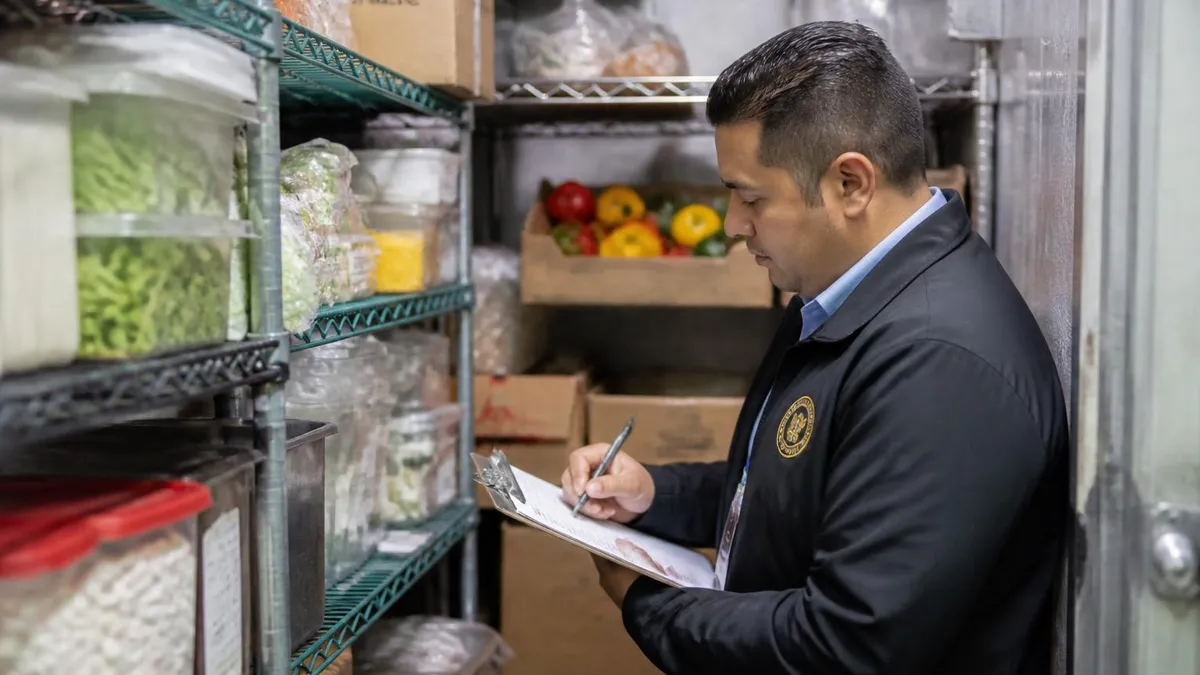
Many ServSafe candidates incorrectly assume that shell eggs belong on the top shelf with other dairy products. According to ServSafe guidelines, raw shell eggs must be stored below ready-to-eat foods and dairy items because they are a raw animal product requiring cooking to a minimum internal temperature. Placing shell eggs on top shelves is a critical violation that health inspectors frequently cite — and a question type that commonly appears on both the ServSafe food handler and manager certification exams.
Preparing effectively for the ServSafe refrigerator storage order questions on the certification exam requires more than simply memorizing the five-tier hierarchy. Exam questions on this topic are frequently written as scenario-based problems that describe a kitchen situation and ask you to identify what is wrong or what should be done differently.
For example, a question might describe a walk-in cooler where raw ground beef is stored on the shelf above raw salmon and ask whether this is correct. The answer is yes — ground beef (155°F) is correctly stored below whole seafood (145°F) in this scenario — but the question is designed to test whether you have truly internalized the temperature-based logic, not just memorized a list.
ServSafe practice tests are one of the most effective tools for mastering refrigerator storage order questions. By working through multiple scenario-based questions, you begin to recognize the patterns that exam writers use and develop the ability to apply the temperature hierarchy to novel situations you have not seen before.
Practice tests also help you identify your weak spots — many candidates find they are confident about the top and bottom of the storage order (RTE foods at top, poultry at bottom) but struggle with the middle tiers involving whole versus ground beef and pork. Targeted practice in these areas pays dividends on exam day.
The official ServSafe Manager textbook devotes considerable space to cold storage protocols, including detailed diagrams showing the correct refrigerator storage order. Studying these diagrams is particularly valuable for visual learners who benefit from seeing the spatial arrangement rather than reading a list. The textbook also includes sample questions at the end of each chapter that mirror the style of questions on the actual certification exam. Combining textbook study with online practice tests provides the most comprehensive preparation and is the approach recommended by ServSafe instructors nationwide.
Flashcards remain a time-tested study tool for the ServSafe fridge storage order, especially for the specific temperature values associated with each food category. Create one card per food type, listing the food on one side and its minimum internal cooking temperature and shelf position on the other. Review these cards daily in the weeks leading up to your exam, and quiz yourself not just on individual temperatures but on the relative ordering — which food is stored above or below each other type. This active recall practice strengthens memory far more effectively than passive re-reading of notes or textbook content.
Group study sessions can also enhance preparation for storage order questions, particularly for candidates who learn well through discussion and debate. Working through practice questions with colleagues allows you to hear different reasoning approaches and to catch errors in your own understanding before the exam. If one study partner is convinced that whole pork goes below ground beef, the ensuing discussion and fact-checking will cement the correct answer for everyone in the group far more effectively than any individual review session would. Many ServSafe certification training programs use this collaborative dynamic in their classroom instruction.
On exam day, approach refrigerator storage order questions by immediately identifying the food types mentioned in the question and assigning each a cooking temperature in your mind. Once you have the temperatures, the storage order follows automatically from the ServSafe principle that foods are stored from top to bottom in ascending order of required minimum cooking temperature.
This systematic approach eliminates guessing and transforms even complex multi-food-type scenario questions into straightforward comparisons of numbers. Candidates who approach these questions with a clear mental framework rather than trying to recall a memorized list consistently perform better on the ServSafe manager and food handler certification exams.
If you are preparing for recertification after five years, it is worth noting that the fundamental ServSafe refrigerator storage order has remained consistent across recent editions of the ServSafe textbook, though temperature requirements for certain foods have been updated over the years.
The most significant recent change was the reduction of the minimum internal temperature for whole cuts of pork from 160°F to 145°F (with a three-minute rest time), bringing it in line with whole beef. Candidates who were certified under older guidelines should review the current temperature requirements to ensure their knowledge reflects the most up-to-date what is servsafe standards before their recertification exam.
Putting ServSafe refrigerator storage knowledge into daily practice requires building systems and habits that function correctly even under the pressure and time constraints of a busy commercial kitchen. The most successful food service operations do not rely solely on employee memory or goodwill — they create physical systems that make correct storage order the path of least resistance. Clearly labeled shelves with color-coded zones, posted storage order diagrams inside each refrigerator door, and designated staging areas for incoming deliveries all contribute to consistent compliance without requiring constant supervision from the ServSafe-certified manager on duty.
Temperature monitoring is the essential companion to correct storage order. A refrigerator that is organized perfectly but running at 45°F provides false security — bacteria are multiplying even in the correctly arranged tiers. ServSafe recommends checking and logging refrigerator temperatures at the beginning of each service period using a calibrated food thermometer. Many modern walk-in coolers include digital temperature displays and alarm systems that alert managers if temperatures rise above safe thresholds, but these electronic systems should always be verified periodically with a physical thermometer to ensure calibration accuracy. Never assume a digital display is correct without independent verification.
Staff training on refrigerator storage order should be integrated into new employee onboarding from day one, not treated as an afterthought or a topic covered only during formal ServSafe certification courses. Practical, hands-on training in the actual refrigerators employees will use every day is far more effective than classroom instruction alone.
Have new hires physically arrange mock deliveries in the correct storage order under supervision before their first solo shift. This kinesthetic learning approach helps cement the storage hierarchy in muscle memory, making correct storage the instinctive response even during the rush of a busy delivery or the fatigue of a long service period.
Regular internal audits and corrective action plans are essential for maintaining long-term storage order compliance. ServSafe-certified managers should conduct unannounced spot checks of refrigerator storage order at least once per shift during high-volume periods, looking specifically for proteins stored on incorrect shelves, uncovered containers, missing date labels, and temperature readings outside the safe range. When violations are found, the corrective action should be immediate and educational — correct the storage issue right away and briefly explain to the responsible employee why the correct order matters. Punitive responses without education rarely improve long-term compliance.
Seasonal and menu changes can disrupt established storage habits by introducing new protein types or dramatically changing inventory volumes. A restaurant that rarely handles raw shellfish may suddenly receive large quantities of oysters for a holiday promotion, requiring staff to recall the correct shelf placement for a product they have not stored before.
Similarly, a barbecue concept may receive large shipments of whole pork shoulders alongside ground pork sausage, requiring staff to correctly differentiate between these products in the storage hierarchy. Proactive communication with kitchen staff before menu changes take effect gives them time to ask questions and practice correct storage procedures before the new products arrive.
For food service establishments that serve high-risk populations — including hospitals, care homes, schools, and childcare facilities — ServSafe refrigerator storage order compliance takes on even greater urgency. Individuals with compromised immune systems, the elderly, young children, and pregnant women face significantly improved risk from foodborne pathogens.
ServSafe food handler certification training emphasizes that establishments serving these populations must exercise heightened vigilance at every step of the food safety chain, from purchasing and receiving through storage, preparation, and service. The storage order hierarchy is not merely a regulatory requirement in these settings — it is a direct patient or client safety measure.
The long-term return on investment from rigorous ServSafe refrigerator storage compliance is substantial and measurable. Operations with documented food safety training programs and consistent compliance records face fewer health inspection violations, lower rates of foodborne illness complaints, reduced food waste from spoilage and contamination, and lower insurance premiums in some jurisdictions.
Most importantly, a reputation for food safety excellence is a genuine competitive advantage in an era when consumers increasingly research restaurant health inspection scores before choosing where to dine. Investing in ServSafe certification for your management team and thorough training for all food handlers pays dividends that far exceed the cost of the certification program itself.
For a fuller set of questions on this topic, see our servsafe alcohol certification resource.
For a fuller set of questions on this topic, see our servsafe food handler certificate resource.
For a fuller set of questions on this topic, see our servsafe certification lookup resource.
Sample ServSafe Food Safety Practice Questions
Try these questions from our free ServSafe Food Safety practice tests. The correct answer and an explanation follow each question.
A food handler needs to store a shipment of food in the walk-in cooler. From top to bottom, which of the following is the correct storage order to prevent cross-contamination?
- A. Fresh lettuce, raw salmon, raw ground beef, raw chicken breasts
- B. Raw chicken breasts, raw ground beef, raw salmon, fresh lettuce
- C. Raw salmon, fresh lettuce, raw chicken breasts, raw ground beef
- D. Fresh lettuce, raw chicken breasts, raw salmon, raw ground beef
Answer: A. Fresh lettuce, raw salmon, raw ground beef, raw chicken breasts
To prevent cross-contamination, food must be stored in the refrigerator based on the minimum internal cooking temperature. Ready-to-eat foods, like lettuce, are stored on the top. Below that are foods requiring progressively higher cooking temperatures, with poultry always on the bottom shelf because it requires the highest internal cooking temperature.
What training must a food safety manager ensure all food handlers receive?
- A. Only fire safety and evacuation
- B. Comprehensive food safety training covering hygiene, cross-contamination, temperature control, allergens, and cleaning
- C. Training is only required for managers
- D. Training is only needed at initial hire
Answer: B. Comprehensive food safety training covering hygiene, cross-contamination, temperature control, allergens, and cleaning
All food handlers need comprehensive, job-specific, and ongoing food safety training.
At what maximum temperature should a walk-in refrigerator be maintained for safe TCS food storage?
- A. 45°F (7°C)
- B. 41°F (5°C)
- C. 38°F (3°C)
- D. 50°F (10°C)
Answer: B. 41°F (5°C)
TCS foods must be stored at 41°F (5°C) or below to prevent bacterial growth and keep food out of the temperature danger zone.
According to ServSafe, which food should be stored on the BOTTOM shelf of a walk-in refrigerator?
- A. Whole cuts of beef
- B. Ready-to-eat foods
- C. Raw seafood
- D. Whole and ground poultry
Answer: D. Whole and ground poultry
Whole and ground poultry must be stored on the lowest shelf because it requires the highest internal cooking temperature (165°F), so any drips cannot contaminate foods with lower cooking temperatures.
ServSafe Questions and Answers
ServSafe Administrative — Complete Guide (2026)

ServSafe Cleaning Agents: Which Cleaning Agent Best Removes Baked-On Food?

Which Is an Example of Possible Chemical Contamination ServSafe: Complete Guide
What Is ServSafe Certification? Complete 2026 Guide to Food Safety Credentials

ServSafe Personal Hygiene: What Is the Step in Practicing Correct Personal Hygiene?
About the Author

Registered Sanitarian & Food Safety Certification Expert
Cornell University College of Agriculture and Life SciencesThomas Wright is a Registered Sanitarian and HACCP-certified food safety professional with a Bachelor of Science in Food Science from Cornell University. He has 17 years of experience in food safety auditing, regulatory compliance, and foodservice management training. Thomas prepares food industry professionals for ServSafe Manager, HACCP certification, and state food handler examinations.