
Used Forklift Buying Guide: Prices, Inspection, Costs 2026
Used forklift buying guide — 💯 real 2026 prices, 12-point inspection checklist, hour meter rules, and where to buy without getting burned.
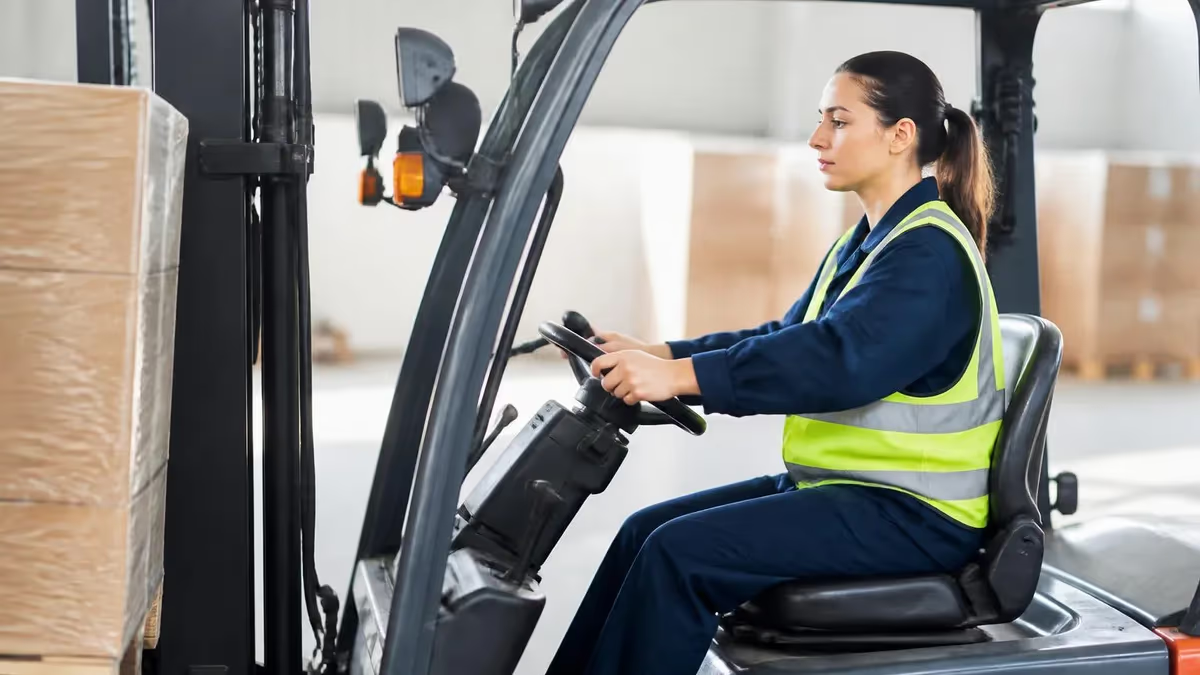
Buying a used forklift can save you thousands compared to new — sometimes 40-60% off the sticker price. But that bargain disappears fast if the truck has a cracked mast, a dying battery, or hidden hour-meter tampering. You need to know what you're looking at before you write a check. Practice with the free Forklift certification practice test on PracticeTestGeeks (7 questions with answer explanations).
This guide walks you through the real costs, the inspection checklist that pros use, what a used forklift should cost in 2026, and where to buy one without getting burned. Whether you run a warehouse, a small shop, or a construction site, the rules are the same — verify the hours, check the mast, test the hydraulics, and never skip a load test.
What a Used Forklift Actually Costs in 2026
Used forklift prices swing wildly. A 5-year-old 5,000 lb electric sit-down with 3,000 hours might list at $14,000 from a dealer — the same truck on a private sale could go for $9,000. The price depends on five things: hour meter reading, fuel type, age, lift capacity, and whether it comes with a warranty.
Here's the rough breakdown you'll see across the major used markets:
- Under 5,000 hours, dealer-reconditioned: $12,000 – $25,000 (electric or LPG, 4,000–6,000 lb capacity)
- 5,000 – 10,000 hours, working condition: $6,000 – $12,000 (most popular bracket)
- 10,000+ hours, mechanic's special: $2,500 – $6,000 (expect repairs)
- High-capacity (10,000+ lb) used: $18,000 – $40,000 depending on hours
- Rough terrain or telehandler used: $20,000 – $55,000
A new comparable forklift runs $30,000 – $55,000, so the savings on a solid used unit are real. That said, factor in $1,500 – $4,000 a year in maintenance on anything over 8,000 hours. Tires alone are $400 – $1,200 a set, and a replacement battery for an electric truck is $5,000 – $9,000.
- OSHA requires forklift operators to undergo a performance evaluation at least once every three years. (Occupational Safety and Health Administration (OSHA), U.S. Department of Labor; employers certify operators)
- Forklift operator certification under OSHA requires formal and practical training and an employer evaluation of the operator's workplace performance. (Occupational Safety and Health Administration (OSHA), U.S. Department of Labor; employers certify operators)
- For forklift operator certification, the employer must evaluate the operator's performance and determine that the operator can operate safely before workplace operation. (Occupational Safety and Health Administration (OSHA), U.S. Department of Labor; employers certify operators)
Facts verified Oct 15, 2026 against Occupational Safety and Health Administration (OSHA), U.S. Department of Labor; employers certify operators. Dates that have passed are removed automatically.
Forklift certification Certification Exam at a Glance
| Item | Detail | Official source |
|---|---|---|
| Renewal | Performance evaluation at least every three years | Occupational Safety and Health Administration (OSHA), U.S. Department of Labor; employers certify operators |
| Delivery | Formal instruction, practical training and workplace evaluation | Occupational Safety and Health Administration (OSHA), U.S. Department of Labor; employers certify operators |
| Eligibility | Training and demonstrated competence before workplace operation | Occupational Safety and Health Administration (OSHA), U.S. Department of Labor; employers certify operators |
Facts verified Oct 15, 2026 against Occupational Safety and Health Administration (OSHA), U.S. Department of Labor; employers certify operators. Dates that have passed are removed automatically.
Free Forklift certification Study Tools
Interactive Forklift certification resources on PracticeTestGeeks, free to start:
- Forklift certification flashcards — review key terms and concepts card by card
- Forklift certification study guide — topic-by-topic overview of what the exam covers
- Forklift certification cheat sheet — one-page printable summary for last-minute review
The 12-Point Used Forklift Inspection (Don't Skip Any)
Walk-around inspections separate $5,000 mistakes from $5,000 wins. Bring a flashlight, a multimeter, and an hour or two. If the seller rushes you, walk away — that's the biggest red flag of all.
Frame and Mast
Start at the front. Look at the mast channels — those vertical rails the forks ride on. Bent channels mean the truck got into a wreck, and replacing a mast is a $4,000+ job. Check the cross-members for welds that don't match the factory finish. Welded repairs aren't always bad, but they tell you the truck worked hard.
Forks Themselves
Run a tape measure along each fork. The heel — that 90-degree bend where the fork meets the carriage — should be at least 90% of its original thickness. OSHA says you scrap forks when wear hits 10%. Check for cracks at the heel with a flashlight at an angle. Hairline cracks here are catastrophic at full load.
Hour Meter and Service Records
Ask for the maintenance log. A truck with 8,000 hours and a stack of service receipts beats a truck with 4,000 hours and no paperwork — every time. If the hour meter reads suspiciously low for the wear you see on the seat, pedals, and steering wheel, the meter's been swapped or rolled back.
Tires
Cushion tires (smooth, solid) should have the factory wear line visible. Pneumatic tires need at least 1/4 inch of tread and no sidewall cracks. A full tire replacement on a 5,000 lb truck is $600 – $1,500.
Hydraulics
Cold-start the engine, then lift the forks to full height. Watch for drift — the forks shouldn't sink more than a half-inch over 30 seconds with a load on. Tilt the mast forward and back; jerky movement means worn cylinders or low fluid. Check the hydraulic reservoir for milky fluid (water contamination) or a burnt smell (overheated pump).
Battery (Electric Trucks)
The single biggest expense on a used electric. Ask for the battery's manufacture date — stamped on the case. A lead-acid forklift battery lasts 1,500 cycles or about 5–7 years. If the previous owner ran it hot and didn't water it regularly, you're buying a $7,000 replacement. Pop the cells, check the water level, and look for corrosion on the terminals. A solid forklift battery guide can help you understand what you're testing.
Engine and Fuel System (LPG, Diesel, Gas)
Cold-start it yourself. Listen for knocking, watch for blue or white smoke, and let it idle for 5 minutes. Blue smoke means oil burn (rings or valve seals). White smoke that doesn't clear means coolant in the cylinders — walk away. Check the radiator, hoses, and belts. A propane truck should have a clean, dry tank fitting with no green corrosion.
Brakes and Steering
Drive it. The brakes should stop the truck firmly without pulling left or right. The steering wheel shouldn't have more than an inch of play. Test the parking brake on a slight incline — a worn brake won't hold the truck.
Lights, Horn, Backup Alarm
OSHA requires all of these to work. If they're broken, the seller hasn't been maintaining the truck.
Overhead Guard and Seat Belt
The overhead guard should have no cracked welds. Seat belts must latch and retract. If either is damaged, OSHA won't let you legally put the truck in service until you fix it. Operators also need current forklift certification before they touch the controls — regardless of how clean the used truck looks.
Data Plate
Every forklift has a metal plate with the model, serial, capacity, and load center. If the plate is missing, painted over, or illegible, you can't legally operate the truck. Don't buy it.
Load Test
The single most important test. Bring a known weight — a pallet of bricks, a steel coil, whatever. Lift it to full height, tilt forward and back, drive it 50 feet, and lower it. A truck that strains, leaks, or drifts under load isn't worth fixing.

Sample Forklift certification Practice Questions
Try these questions from our free Forklift certification practice tests. The correct answer and an explanation follow each question.
Which document is typically used to record findings of a forklift pre-operation inspection?
- A. A daily inspection checklist
- B. The operator's paycheck stub
- C. The delivery invoice
- D. A weekly sales report
Answer: A. A daily inspection checklist
A daily inspection checklist documents that required items were checked and any defects found.
When should a forklift pre-operational inspection be performed?
- A. Weekly
- B. At the end of each shift
- C. Before each use
- D. Only when the forklift looks damaged
Answer: C. Before each use
OSHA and best safety practices dictate that a forklift pre-operational inspection must be performed before each shift or, if used continuously, before each use by a new operator. This ensures that the equipment is in safe working condition every time it is operated. Regular inspections minimize the risk of accidents due to unforeseen mechanical issues, promoting continuous safety.
The standard load center used to rate most forklift capacities is measured at:
- A. 12 inches from the face of the forks
- B. 24 inches from the face of the forks
- C. 36 inches from the mast
- D. The tip of the forks
Answer: B. 24 inches from the face of the forks
Most forklift capacities are rated at a 24-inch load center measured from the fork face.
If a forklift is found to have a defect during the pre-operation inspection, what is the required next step?
- A. The operator can make a minor repair if they feel qualified.
- B. The forklift must be tagged 'Out of Service' and the defect reported immediately.
- C. The forklift can be used for light-duty tasks until it is repaired.
- D. The inspection form should be submitted at the end of the day for maintenance to review.
Answer: B. The forklift must be tagged 'Out of Service' and the defect reported immediately.
OSHA regulations are clear: if an inspection reveals any condition that could adversely affect the safety of the vehicle, it must not be placed in service. The standard procedure is to tag the vehicle and report the issue to a supervisor or the maintenance department immediately.
Where to Buy a Used Forklift
You've got four real options, and each has trade-offs.
Authorized Dealers (Crown, Toyota, Hyster, Yale, Raymond)
Most expensive — but also the safest bet. Dealer-reconditioned trucks come with a 30-90 day warranty, fresh fluids, new wear parts, and a documented service history. You're paying for peace of mind. Browse forklift for sale listings at any dealer in your area, and don't be afraid to negotiate — most dealers have 10-15% pricing flexibility on used inventory.
Independent Used Equipment Dealers
These shops buy auction trucks, recondition them, and resell. Prices land 15-25% below authorized dealers. Quality varies wildly — some independents do real work, others just pressure-wash and put a coat of paint over rust. Visit the shop. Talk to their mechanic. Ask which auction the truck came from.
Online Marketplaces (MachineryTrader, IronPlanet, Equipment Trader)
Huge inventory, often hundreds of trucks of the model you want. Prices are competitive, but you're buying sight-unseen unless you fly out for an inspection. Use online listings to set your budget — then buy local so you can see the truck. For comparison, check forklifts for sale in your region.
Auctions (Ritchie Bros, Public Surplus, GovDeals)
Cheapest path — sometimes 50% below dealer pricing — and also the riskiest. You usually get one inspection day, no warranty, and no recourse if the truck dies in the parking lot. Government surplus auctions can be gold mines (cities and ports overhaul fleets every 5-7 years), but bring a mechanic. Pay the $300 for an expert inspection — it's the cheapest insurance you'll ever buy.
Red Flags That Mean Walk Away
Don't talk yourself into a bad truck. If you see any of these, leave.
- Fresh paint on the mast, frame, or counterweight. It hides cracks and rust. Real reconditioning doesn't repaint structural parts.
- Missing or illegible data plate. You can't legally operate it.
- Hydraulic leaks anywhere. Small drips become $2,000 cylinder rebuilds.
- Drift on the forks at idle. Worn lift cylinder seals.
- Blue or white exhaust smoke after 5 minutes of idle. Engine's tired.
- Bent mast channels or twisted forks. Wreck damage.
- No maintenance records. The truck has secrets.
- Pressure from the seller to decide today. They know something you don't.
Negotiating the Price
Used forklift sellers expect haggling. Come in 15-20% under asking with a list of specific issues you found. "The fork heels are worn 8%, the battery is 4 years old, and the seat belt retractor is broken — I'll give you $9,500" works better than "that's too much."
If you're buying multiple units, ask for fleet pricing. Three trucks at $9,000 each is $27,000, but three trucks bundled often runs $24,000 with delivery thrown in. Dealers love clearing inventory.
Always get a written bill of sale with the serial number, hour meter reading, and any warranty terms spelled out. Verbal promises evaporate when something breaks.
After You Buy
Day one, schedule an annual OSHA inspection — even if the seller did one recently, you want a baseline from your mechanic. Replace the engine oil and hydraulic filter, check the tire pressure, and run through the operator's manual. Make sure every operator on the truck has current forklift certification training — uncertified operators are the fastest way to lose your investment to a workplace accident.
A well-bought used forklift runs another 5,000 – 15,000 hours. That's 3-10 more years of work for a fraction of new-truck money. Take your time, inspect everything, and trust the data on the hour meter and the maintenance log over anything the seller tells you.
How this page was made: written with AI tools and published by Nathan Beja, founder of Practice Test Geeks, who is responsible for its content. Exam facts are checked against the official sources listed below. Not reviewed by a subject-matter expert. Editorial policy
Sources & references
Exam facts on this page (fees, format, dates, passing scores) are checked against these official sources; the date is our last check. Editorial policy
- osha.gov — Test delivery, eligibility, renewal · verified Oct 2026