
OSHA Forklift Certification Requirements: Complete 2026 September Guide to Training, Testing, and Compliance
🗨️ OSHA forklift certification requirements explained: training rules, testing, recertification, and compliance tips for operators and employers in 2026 September.
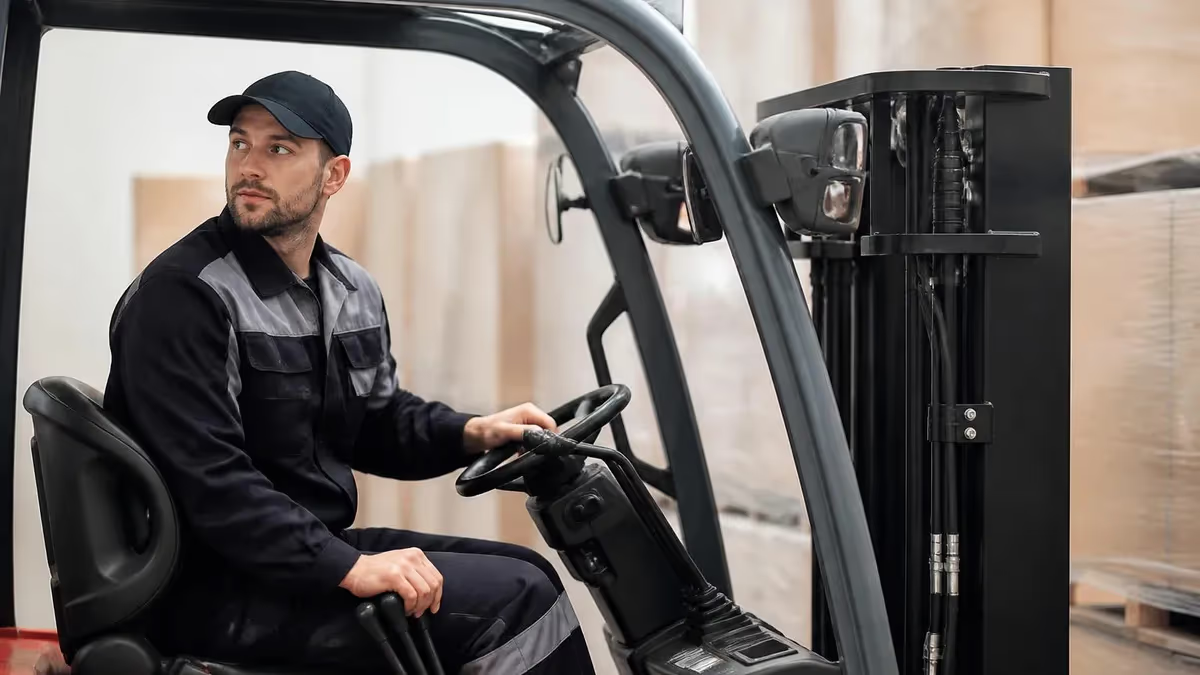
Understanding osha forklift certification requirements is the single most important step for anyone planning to operate a powered industrial truck in the United States. Whether you drive a sit-down counterbalance, a stand up forklift, a reach truck, or an electric forklift in a refrigerated warehouse, federal law 29 CFR 1910.178(l) requires that every operator complete formal training, hands-on evaluation, and employer certification before stepping onto the controls. Skipping any of those three pillars exposes both the worker and the company to citations, injuries, and avoidable lawsuits.
The Occupational Safety and Health Administration treats forklifts as one of the most dangerous pieces of equipment in general industry, and the data backs that up. Each year roughly 7,500 serious injuries and nearly 100 fatalities involve forklifts, and a large share occur because the operator was never properly trained or was certified on the wrong truck class. That is why OSHA requires training that is specific to both the equipment and the workplace, not a generic online video.
Certification is not a one-time event. Operators must be re-evaluated at least once every three years, and immediately after any accident, near-miss, observed unsafe operation, change in equipment, or change in workplace conditions. Employers are legally responsible for keeping written records of every training session, including the operator's name, the date of training, the date of evaluation, and the signature of the trainer who conducted the assessment.
The certification process applies to anyone who operates a powered industrial truck, regardless of how often they use it. Even maintenance technicians who occasionally move forklifts for repair, temporary workers from staffing agencies, and supervisors who hop on the controls to demonstrate a task must hold a valid certification. The rule covers all seven OSHA truck classes, from electric motor rider trucks through rough-terrain telehandlers used on construction sites.
Many employers also tie certification to insurance and rental contracts. Most companies that offer forklift rental near me services will not release a unit unless the customer can show current operator certification for the truck class being rented. The same applies when you lease a fleet long-term or purchase a forklift for sale from a major dealer — proof of operator certification is now a standard line item in the paperwork.
This guide walks through every requirement step by step: who needs to be certified, what the training must cover, how the evaluation works, how long credentials last, what records the employer must keep, and the common mistakes that lead to OSHA citations averaging $16,131 per serious violation in 2026. By the end you will know exactly how to build a compliant program, prepare for the written and practical exam, and keep operators safe day after day.
Use the table of contents to jump to the section you need, take a free practice quiz at any time, and check the FAQ at the bottom for the questions hiring managers and operators ask most often. Every detail here is aligned with the current federal standard and verified against 2026 OSHA enforcement guidance.
OSHA Forklift Certification by the Numbers

The Three Pillars of OSHA Forklift Certification
Classroom-style training covering OSHA rules, truck mechanics, stability, load handling, and workplace hazards. Delivered via lecture, video, written materials, or interactive computer-based modules with a knowledge check.
Hands-on demonstration and supervised practice on the exact truck class the operator will use. Trainees perform pre-shift inspection, maneuvering, stacking, and unloading under the eye of a qualified trainer.
A documented skills test where the trainer scores the operator on every required task. The operator may not work unsupervised until they pass this final evaluation and the employer signs the certification record.
Training must address site-specific hazards such as narrow aisles, ramps, dock plates, pedestrian traffic, hazardous atmospheres, and the actual loads handled at that facility — not just generic content.
The employer must keep a signed document showing operator name, training date, evaluation date, and trainer identity. Without this record, OSHA treats the operator as uncertified during an inspection.
A compliant OSHA training program has a specific anatomy, and skipping any component invalidates the certification. The standard requires that formal instruction come first, followed by hands-on practical training, followed by a documented evaluation. Each phase has a purpose: classroom material teaches the rules and theory, the practical phase builds muscle memory, and the evaluation proves the operator can apply both safely under real workplace conditions. A reputable forklift training provider will document each phase separately.
The trainer is a critical part of the equation. OSHA requires that whoever delivers the program possesses the knowledge, training, and experience to teach forklift operators and evaluate their competence. There is no federal trainer certification, but the trainer must be able to demonstrate proficiency themselves and must understand the equipment, the workplace, and the standard. In practice this means a senior operator, safety manager, or third-party trainer with verifiable credentials.
Formal instruction must cover truck-related topics such as operating instructions, controls, engine or motor operation, steering and maneuvering, visibility limitations, fork and attachment adaptation, vehicle capacity and stability, inspection and maintenance, refueling or recharging of batteries, and any operating limitations listed in the manufacturer's manual. Each topic must be tied to the specific type of truck the operator will use, since stand up forklifts, reach trucks, order pickers, and rough-terrain units all behave differently.
Workplace topics are equally important and often overlooked. The training must address surface conditions, types of loads handled, load manipulation and stacking, pedestrian traffic, narrow aisles and restricted areas, hazardous classified locations, ramps and sloped surfaces, closed environments where carbon monoxide may build up, and any unique hazards present at that specific job site. This is the section auditors examine most closely because generic online courses rarely cover it.
The practical phase is where most operators truly learn. Trainees perform pre-operation inspections, mount and dismount correctly, start and stop smoothly, steer in forward and reverse, position forks under loads, lift and lower at speed, travel with and without loads, navigate intersections, stack and unstack, and shut the truck down properly. Each task is observed and corrected in real time. A trainee who cannot complete a task safely must repeat that segment until they demonstrate competence.
The final evaluation is documented on a skills checklist that lists every required task. The trainer scores each item, notes any deficiencies, and signs the form. The operator also signs to acknowledge they completed the training and understood the content. The employer keeps the original on file for the duration of employment plus the duration required by state law — typically a minimum of three years, though many companies keep records permanently to defend against claims.
One detail that catches employers off guard: an operator certified on one truck class is not automatically qualified to drive another. A worker certified on a Class IV cushion-tire counterbalance must complete additional training before operating a Class II narrow-aisle reach truck or a Class VII rough-terrain telehandler. The supplemental training does not have to repeat the basics, but it must cover the unique characteristics, controls, and hazards of the new equipment.
Forklift certification Practice Test Questions
Prepare for the Forklift certification Certification exam with our free practice test modules. Each quiz covers key topics to help you pass on your first try.
Forklift certification Certification Forkl...
Forklift certification Exam Questions covering Certification Forklift certification Maintenance and Repairs. Master Forklift certification Test concepts for certification prep.
Forklift certification Certification Forkl...
Free Forklift certification Practice Test featuring Certification Forklift certification Maintenance and Repairs Questions and Answers. Improve your Forklift certification Exam score with mock test prep.
Forklift certification Certification Forkl...
Forklift certification Mock Exam on Certification Forklift certification Operator Training and Certification Requirements. Forklift certification Study Guide questions to pass on your first try.
Forklift certification Certification Forkl...
Forklift certification Test Prep for Certification Forklift certification Operator Training and Certification Requirements Questions and Answers. Practice Forklift certification Quiz questions and boost your score.
Forklift certification Load Handling and S...
Forklift certification Questions and Answers on Load Handling and Stability. Free Forklift certification practice for exam readiness.
Forklift certification OSHA Regulations an...
Forklift certification Mock Test covering OSHA Regulations and Compliance. Online Forklift certification Test practice with instant feedback.
Forklift certification Pre-Operation Inspe...
Free Forklift certification Quiz on Pre-Operation Inspections. Forklift certification Exam prep questions with detailed explanations.
Forklift certification Refueling and Recha...
Forklift certification Practice Questions for Refueling and Recharging Procedures. Build confidence for your Forklift certification certification exam.
Forklift certification Safe Driving and Ma...
Forklift certification Test Online for Safe Driving and Maneuvering. Free practice with instant results and feedback.
Forklift certification Workplace Hazard Id...
Forklift certification Study Material on Workplace Hazard Identification. Prepare effectively with real exam-style questions.
Forklift certification Forklift Instructions
Free Forklift certification Test covering Forklift Instructions. Practice and track your Forklift certification exam readiness.
Forklift certification Forklift MCQ
Forklift certification Exam Questions covering Forklift MCQ. Master Forklift certification Test concepts for certification prep.
Forklift certification Forklift Employer R...
Free Forklift certification Practice Test featuring Forklift Employer Responsibilities. Improve your Forklift certification Exam score with mock test prep.
Forklift certification Forklift Penalties ...
Forklift certification Mock Exam on Forklift Penalties for Non-Compliance. Forklift certification Study Guide questions to pass on your first try.
Required Forklift Training Topics by Category
OSHA-mandated truck topics include operating instructions, controls and instrumentation, engine or motor operation differences between propane and electric forklift units, steering geometry, braking distance, visibility limitations, and the role of attachments. Operators must understand how forks, side-shifters, clamps, and rotators change the truck's load center and capacity. Every trainee should be able to read and interpret the data plate on their assigned forklift before touching the controls.
Capacity and stability deserve special attention. Trainees must learn the stability triangle, how raising a load shifts the center of gravity, and why traveling with elevated forks is forbidden. Training also covers inspection routines, refueling for internal-combustion forklifts, and proper battery handling including charging, watering, and ventilation. Skip these basics and operators are likely to overload the truck or tip it during the first awkward maneuver.

In-House Training vs Third-Party Certification Providers
- +Lower per-operator cost when training large groups in-house
- +Schedule flexibility — train during slow shifts or new-hire onboarding
- +Workplace-specific content is easier to embed in daily operations
- +Trainers know the actual hazards, loads, and traffic patterns
- +Immediate retraining possible after incidents or near-misses
- +Builds internal safety culture and operator mentorship
- +No travel costs or lost productivity from off-site training
- −Requires a qualified internal trainer with verifiable credentials
- −Documentation burden falls entirely on the employer
- −Risk of outdated content if standards change and no one updates curriculum
- −Smaller employers may lack equipment variety for multi-class training
- −Internal trainers can feel pressure to pass struggling operators
- −Third-party providers carry insurance and defend their certifications in court
- −DIY programs are scrutinized harder during OSHA inspections
Employer OSHA Forklift Compliance Checklist
- ✓Verify every operator is at least 18 years old per Fair Labor Standards Act
- ✓Confirm formal instruction covers all required truck and workplace topics
- ✓Document hands-on practical training on the specific truck class used
- ✓Complete and sign a written performance evaluation for each operator
- ✓Store certification records including name, dates, and trainer signature
- ✓Schedule recertification evaluations no later than three years from last date
- ✓Reevaluate operators immediately after any accident or near-miss event
- ✓Provide refresher training when new equipment or attachments are introduced
- ✓Post the OSHA 1910.178 standard in a visible area for employee reference
- ✓Maintain daily pre-shift inspection logs for every powered industrial truck
- ✓Ensure damaged trucks are tagged out of service until repairs are completed
- ✓Audit training records annually to catch expired certifications before OSHA does
A certificate from a website is not the same as an OSHA certification
OSHA does not issue, approve, or accredit any forklift training provider. The employer is solely responsible for certifying the operator. An online course can cover the formal instruction portion, but the hands-on practical training and the in-person evaluation must still happen at your workplace, on your equipment, by your qualified trainer — or the certification is invalid.
Recertification is one of the most misunderstood parts of the standard. OSHA does not use the word expiration, but it does require that every operator be reevaluated at least once every three years. The clock starts from the date of the last successful evaluation, not from the hire date or the date formal instruction was completed. Employers who track only the training date often discover during an audit that operators have been working past the three-year mark for months without anyone noticing.
Beyond the three-year cycle, several events trigger immediate reevaluation. These include any forklift accident or near-miss, an observation that the operator is performing an unsafe maneuver, the operator being assigned a different type of truck, or a change in workplace conditions that could affect safe operation. Examples include warehouse reconfiguration, new product lines that change load characteristics, the introduction of mezzanines, or new pedestrian routes. The standard treats each of these as a reset event.
Refresher training is also required after a workplace inspection reveals that a certified operator lacks competence. This is more common than employers expect. A safety walkthrough may show a worker consistently traveling with elevated forks, ignoring horn use at intersections, or failing to perform pre-shift inspections. Any of these patterns obligates the employer to retrain that specific operator, document the refresher, and conduct a new evaluation before allowing unsupervised operation.
The refresher does not require repeating the entire formal instruction program. OSHA allows targeted retraining focused on the deficiency. If an operator failed to wear a seatbelt, the refresher might focus on operator restraints, tip-over physics, and the consequences of leaving the seat during operation. The evaluation that follows, however, must still confirm overall competence — not just the corrected behavior.
Documentation requirements during recertification mirror the initial process. The employer keeps a written record showing the operator's name, the date of the most recent evaluation, and the identity of the trainer or evaluator. Many companies issue a wallet card or badge for convenience, but the legal record is the signed evaluation form in the employer's files. Wallet cards alone do not satisfy the standard during an inspection.
When operators change employers, certifications generally do not transfer. The new employer is required to evaluate the operator on their specific equipment and in their specific workplace before allowing solo operation. Prior training records can shorten the process, since the formal instruction component may not need to be repeated, but the practical evaluation must occur at the new site. This protects both the worker and the employer from inherited gaps.
Temporary and contract workers are covered by the same rules. The host employer and the staffing agency share responsibility, and OSHA has been aggressive in citing both parties when a temporary forklift operator is found to be uncertified. Best practice is to require staffing agencies to deliver certified operators and then to conduct a brief site-specific evaluation before the worker drives a truck for the first time at the new facility.

If an operator's last evaluation date is more than three years old, they are legally uncertified — even if their initial training certificate is framed on the wall. Pull the records this week, identify anyone past the 36-month mark, and schedule reevaluations immediately. OSHA inspectors begin most forklift audits by asking for evaluation dates, not training dates.
OSHA penalties for forklift violations climbed again in 2026, with serious citations now averaging $16,131 each and willful or repeated violations reaching $161,323 per instance. The forklift standard, 29 CFR 1910.178, sits in the top ten most-cited general industry standards every year. The bulk of citations involve missing or expired certifications, inadequate training documentation, and failure to remove damaged trucks from service. None of these are accidents — they are paperwork failures that compound risk.
The most common citation is for operators who lack any documented training. Inspectors ask to see records for every worker observed on a forklift, and any gap becomes a separate violation. The second most common is incomplete documentation, where training occurred but the employer cannot produce a signed evaluation. The third is recertification gaps, where the three-year clock quietly expired while operations continued. Each is preventable with a simple tracking spreadsheet.
Beyond direct fines, OSHA citations carry indirect costs. Workers compensation premiums rise after a recordable forklift injury, insurance companies may cancel coverage entirely, and customers in regulated industries often require proof of safety compliance before signing supply contracts. A single citation can also trigger expanded inspections that uncover unrelated violations, multiplying the financial impact across the entire facility.
Civil liability is another concern. When an injured worker or pedestrian sues, the absence of OSHA-compliant certification is treated as evidence of employer negligence. Juries award significantly higher damages when training records are missing or fabricated. Forklift incidents now produce some of the largest workplace injury verdicts, with average settlements in the $1.5 to $4 million range for serious injuries and considerably more for fatalities involving uncertified operators.
Employers that purchase or use a forklift rental should be particularly careful. Rental contracts almost always shift responsibility for operator certification to the customer, and rental companies routinely cooperate with OSHA investigators by producing the contract showing who was responsible. The same applies to long-term forklift rentals — the lessee, not the lessor, is the OSHA-defined employer for certification purposes. Reviewing your forklift safety training program before signing any rental agreement protects you on both fronts.
To avoid the most expensive mistakes, establish a single owner for the certification program. Whether that is the safety manager, operations supervisor, or HR coordinator, one person should hold the master log, send renewal reminders, schedule evaluations, and audit records quarterly. Diffused responsibility is how three-year cycles get missed and how new hires slip onto forklifts before completing training. Centralized ownership prevents almost every common citation pattern.
Finally, treat near-misses as free training events. Every time a forklift clips a rack, drops a pallet, or startles a pedestrian, document the event, retrain the operator, and update the evaluation record. Companies with the lowest forklift incident rates are not lucky — they are obsessive about converting small mistakes into refresher opportunities before those mistakes become headline injuries or six-figure citations.
Preparing for the certification exam and the practical evaluation does not have to feel overwhelming if you break the process into manageable study blocks. Start with the OSHA standard itself — 29 CFR 1910.178 is freely available online, and reading it once gives you a clear mental map of every topic the written test can cover. Focus on the sections about training content, evaluation triggers, and operator responsibilities, since those generate the majority of test questions.
Next, build familiarity with the seven OSHA truck classes. Be able to recognize a Class I electric motor rider truck versus a Class II electric narrow-aisle truck versus a Class IV internal-combustion cushion-tire truck. Knowing the class drives every other decision, including which fuels are permitted indoors, which environments require explosion-proof equipment, and which attachments are appropriate. Many test questions present a scenario and ask you to choose the correct truck class.
Memorize the stability triangle until you can sketch it from memory. Most tip-over questions test whether you understand that the truck's center of gravity must stay inside the triangle formed by the two front wheels and the pivot point of the rear axle. When a load is raised or tilted forward, the center of gravity shifts. Many wrong answers on practice tests come from operators who never internalized this concept during initial training.
Practice the daily inspection routine until it becomes automatic. The OSHA pre-shift checklist includes tires, forks, mast, chains, hydraulics, brakes, steering, horn, lights, backup alarm, seatbelt, data plate, and fluid levels for internal-combustion trucks or battery condition for electric models. Many evaluators begin the practical exam by handing you a checklist and watching how you work through it. A confident, methodical inspection signals competence before you even start the engine.
Spend extra time on load handling and stacking. The practical evaluation almost always includes picking up a pallet, transporting it through a marked course, placing it on a rack at elevation, retrieving a second pallet, and returning to the start. Smooth, slow movements with the load tilted back and low to the ground earn high scores. Sudden braking, traveling with forks raised, or failing to use the horn at intersections will cost you points.
Take advantage of free practice questions and review the explanations, not just the right answers. Reading why the wrong choices are wrong reinforces the underlying principle and prepares you for variations the real test may use. Aim to score 90 percent or better on practice quizzes before sitting for the written portion, since most evaluators set the passing threshold at 80 percent and you want a comfortable buffer.
Finally, treat the evaluation as a conversation, not a trap. Ask the trainer to clarify anything you do not understand before performing a task. Trainers are required to ensure competence, and they would rather coach you to success than fail you. Walk the course before you drive it, picture each turn, and breathe. Operators who pass on the first attempt almost always describe the experience as straightforward — not because the test was easy, but because they prepared deliberately.
Forklift Questions and Answers
Forklift Tires: Complete Guide to Types, Sizing, Wear Patterns, and Replacement Costs
Forklift Operator Duties: Complete Guide to Daily Responsibilities, Safety Tasks, and Career Path for 2026
Forklift License Renewal: Complete Guide to Forklift License Expiry, OSHA Recertification, and Operator Requirements for 2026
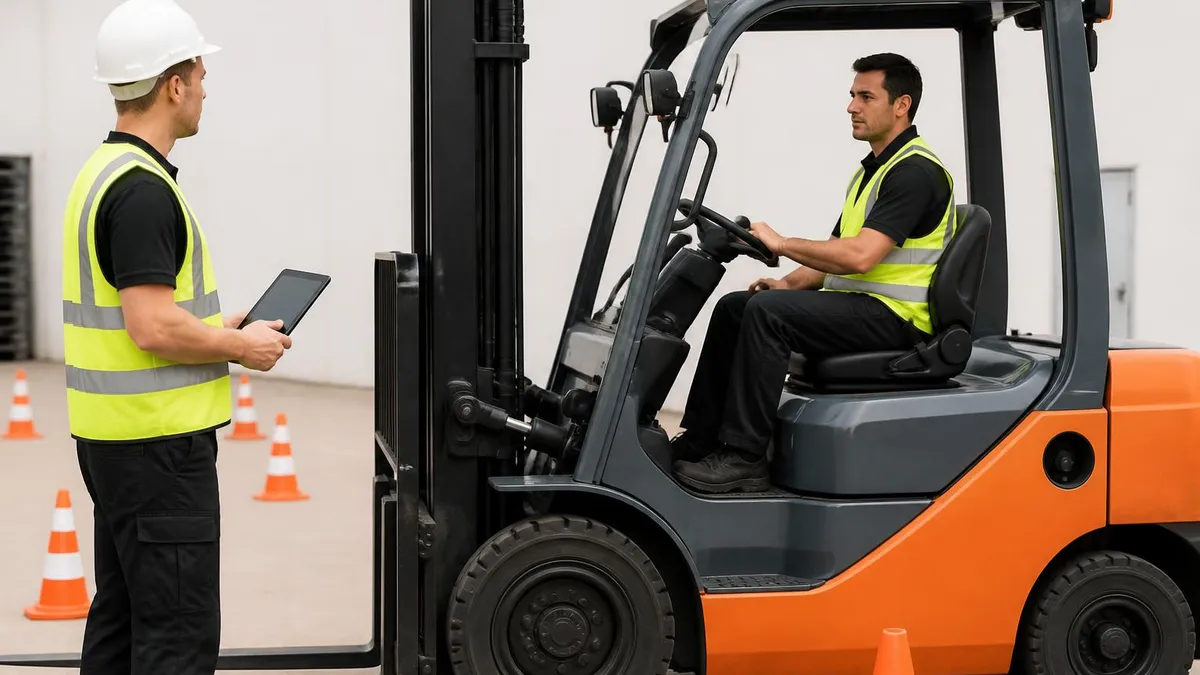
Forklift Safety Training: Complete OSHA Compliance Guide for Operators and Employers
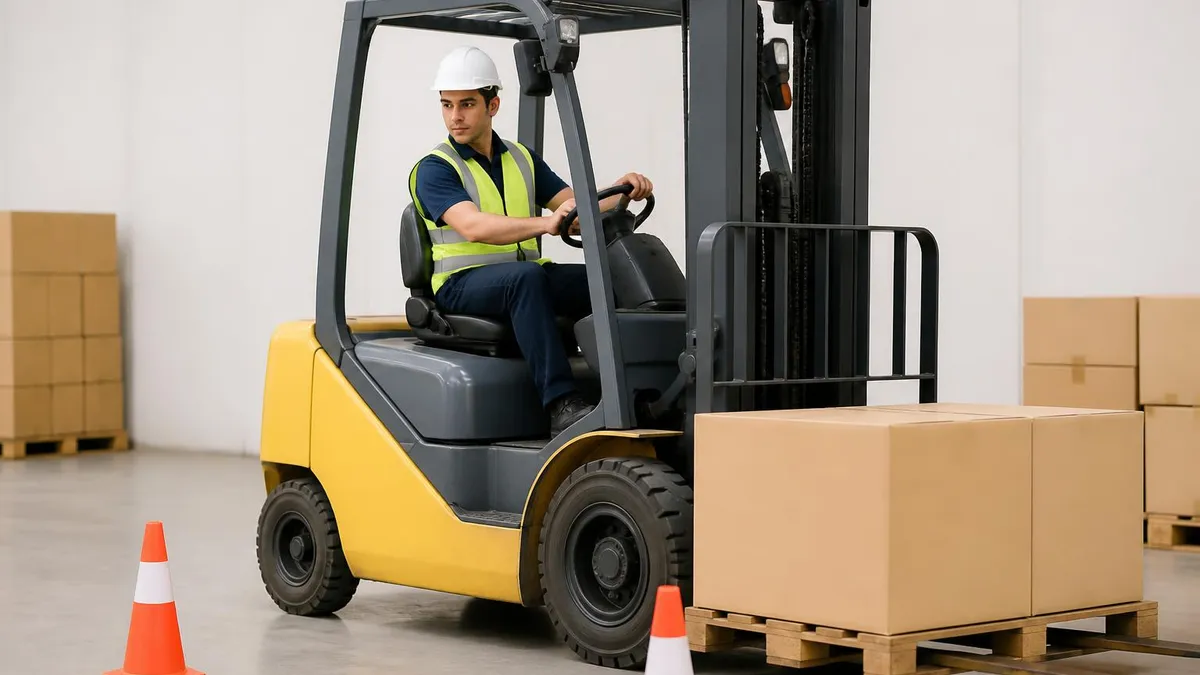
Forklift Repair Service: Complete Guide to Costs, Common Repairs, and Choosing the Right Technician
About the Author

Certified Crane Operator & Skilled Trades Exam Specialist
Ferris State UniversityRobert Martinez is a Journeyman Ironworker, NCCCO-certified crane operator, and forklift trainer with a Bachelor of Science in Construction Technology from Ferris State University. He has 21 years of ironworking, rigging, and heavy equipment operation experience across high-rise and industrial construction sites. Robert prepares candidates for crane operator, rigger, forklift, and skilled trades certification examinations.