
Forklift Training Course Near Me: Complete Guide to Finding Local OSHA-Certified Programs, Costs, and Schedules in 2026
📚 Find a forklift training course near me with OSHA-certified programs, costs from $75-$300, schedules, and tips to pass certification fast.
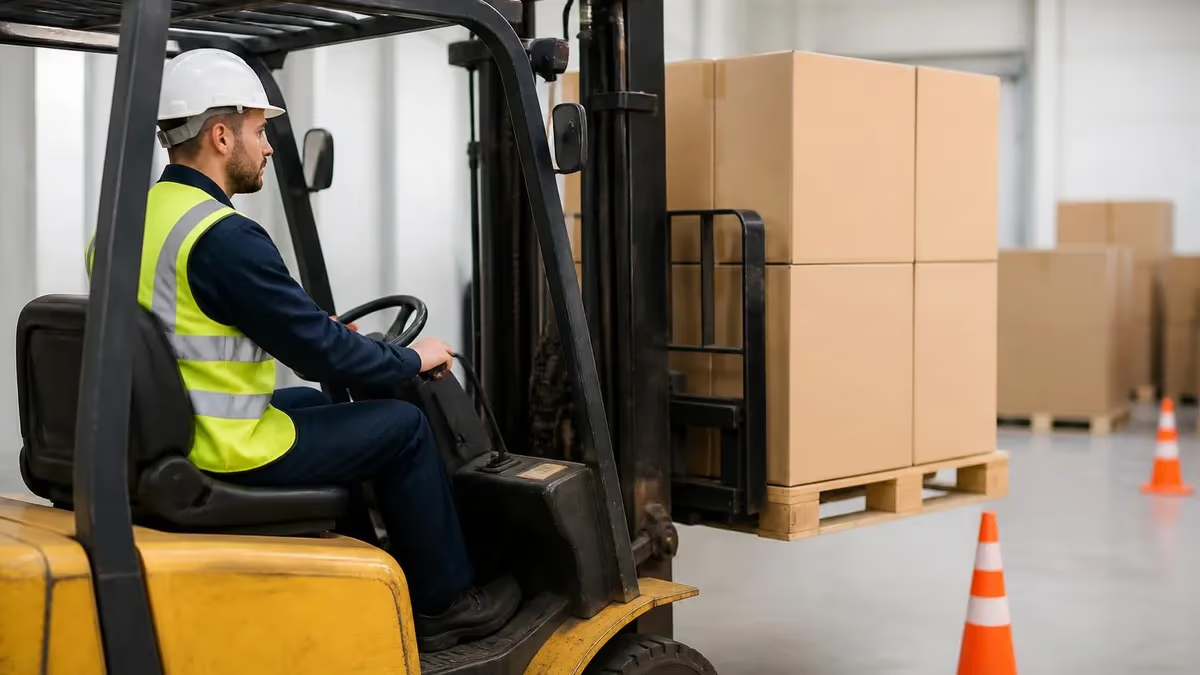
Searching for a forklift training course near me is the first concrete step toward a stable warehouse, distribution, or construction career in 2026. Whether you are a brand-new operator looking to land your first $19-per-hour job or an experienced driver pursuing OSHA recertification, local training centers, community colleges, and on-site employer programs all offer pathways that combine classroom theory, hands-on practical evaluation, and a federally recognized certification card valid for three years across all 50 states.
The demand for certified forklift operators has surged alongside the boom in e-commerce fulfillment, cold-storage logistics, and last-mile distribution. Amazon, Walmart, Costco, FedEx, UPS, Home Depot, and thousands of regional 3PLs actively recruit trained operators every week. A forklift training course near me typically takes one to three days to complete, costs between $75 and $300 for individuals, and prepares you to operate Class I electric forklifts, Class IV internal-combustion units, Class V cushion tire trucks, and Class VII rough-terrain machines.
OSHA standard 29 CFR 1910.178(l) requires every powered industrial truck operator in the United States to complete formal instruction, practical training on the specific equipment they will use, and a workplace evaluation before being authorized to drive a forklift unsupervised. Employers face fines of $16,131 per violation for using uncertified operators, which is why most warehouses will not even interview you without a current certification card, a clean driving record, and proof of completion from a recognized provider.
This guide walks you through exactly how to locate a reputable training program in your zip code, what to expect during the classroom and practical phases, how much you should budget, how to compare in-person courses against online hybrid options, and which questions to ask before paying any deposit. We also cover financing through workforce development boards, GI Bill benefits for veterans, and free employer-sponsored training that pays you while you learn the basics of operating stand up forklift equipment in a real warehouse environment.
You will also learn how to verify that a provider is OSHA-compliant, how to spot training mills that hand out worthless cards, and how to use your new certification to negotiate a starting wage at least 12% higher than minimum. By the end of this article, you will have a complete checklist of what to look for, a state-by-state cost breakdown, and a clear understanding of why investing one weekend in proper training pays back tenfold over your first year on the job.
Forklift training is not optional, it is not transferable between employers without re-evaluation, and it is not something you can fake with a printable PDF from a sketchy website. Read on to learn how to choose the right course, pass it on the first attempt, and start operating forklifts legally and safely within seven to fourteen days of enrollment.
Forklift Training Courses by the Numbers

Where to Find a Forklift Training Course Near Me
Nearly 1,100 community colleges nationwide offer continuing-education forklift programs ranging from $99 to $249. Weekend and evening sessions are common, and many provide payment plans for adult learners.
Companies like CertifyMe, ForkliftCertification.com, and National Forklift Foundation run dedicated classrooms in major metros. Expect $145 average tuition, two-day schedules, and same-day card issuance after passing.
Amazon, Walmart, Costco, Home Depot, FedEx Ground, and most 3PLs train new hires for free and pay $15-$22 per hour during the 8-16 hour onboarding. Certification belongs to the employer, however.
American Job Centers in all 50 states offer WIOA-funded grants covering 100% of tuition for displaced workers, veterans, and low-income adults. Apply through your state's CareerOneStop portal.
Toyota, Crown, Hyster-Yale, Raymond, and Komatsu dealers run authorized training at their service centers for $175-$295 per student, with optional advanced classes on telehandlers and reach trucks.
A genuine forklift training course near me must follow the curriculum mandated by OSHA 29 CFR 1910.178(l)(3), which breaks instruction into truck-related topics and workplace-related topics. Truck-related material covers operating instructions, controls, differences between cars and forklifts, engine or motor operation, steering and maneuvering, visibility, fork and attachment use, capacity, stability, inspection requirements, refueling or recharging, and operating limitations. Skipping any of these categories renders a certification invalid the moment an OSHA compliance officer arrives on site.
Workplace-related instruction focuses on surface conditions, composition of loads, load manipulation, pedestrian traffic, narrow aisles, hazardous locations, ramps and inclines, ventilation in enclosed areas, and any other unique conditions the trainee will encounter. Reputable instructors customize this segment based on whether you will be working in a freezer warehouse, a lumber yard, a paper mill, or a building-supply distribution center, because the hazards in each environment differ dramatically.
Classroom delivery typically lasts four to eight hours and uses a mix of video modules, instructor-led discussion, and printed handbooks. You will study load center calculations, the stability triangle, the data plate, fork positioning, and tip-over recovery procedures. Some programs integrate virtual-reality simulators that let you practice tight aisle maneuvers without risking damage to real used forklifts for sale on the lot, which has been shown to reduce first-week accident rates by 43% according to a 2024 Liberty Mutual study.
The practical evaluation is the segment that trips up most students. You will be required to perform a documented pre-shift inspection, mount and dismount the forklift correctly using three points of contact, drive a designated course forward and in reverse, retrieve a pallet from a high rack, stack it at floor level, and park the unit with forks tilted down and the parking brake engaged. Instructors score you on smoothness, awareness, communication, and compliance with horn-and-mirror protocols at every intersection.
Most courses end with a 30 to 50 question written exam covering OSHA regulations, the eight forklift classes, stability physics, battery and propane safety, and accident reporting requirements. A passing score is typically 80%, though some employer programs require 100% on safety-critical questions before issuing a card. If you fail, retake policies vary, with most providers offering one free retake within 30 days and charging $25 to $50 for additional attempts.
Upon successful completion, you receive a wallet-size certification card, a wall certificate suitable for posting in the break room, and a digital copy emailed for backup. The card lists your name, the date of training, the equipment classes you are certified to operate, the instructor's signature, and an expiration date exactly three years from issuance. Always keep the card on you while operating, because OSHA inspectors can request proof at any moment during a site visit.
One important caveat: certification is not portable between employers in the strictest sense. When you change jobs, the new employer must conduct a site-specific evaluation to confirm you can safely operate their particular equipment in their particular environment. This usually takes 30 to 90 minutes and does not require you to retake the full classroom course, provided your card has not expired.
Forklift certification Practice Test Questions
Prepare for the Forklift certification Certification exam with our free practice test modules. Each quiz covers key topics to help you pass on your first try.
Forklift certification Certification Forkl...
Forklift certification Exam Questions covering Certification Forklift certification Maintenance and Repairs. Master Forklift certification Test concepts for certification prep.
Forklift certification Certification Forkl...
Free Forklift certification Practice Test featuring Certification Forklift certification Maintenance and Repairs Questions and Answers. Improve your Forklift certification Exam score with mock test prep.
Forklift certification Certification Forkl...
Forklift certification Mock Exam on Certification Forklift certification Operator Training and Certification Requirements. Forklift certification Study Guide questions to pass on your first try.
Forklift certification Certification Forkl...
Forklift certification Test Prep for Certification Forklift certification Operator Training and Certification Requirements Questions and Answers. Practice Forklift certification Quiz questions and boost your score.
Forklift certification Load Handling and S...
Forklift certification Questions and Answers on Load Handling and Stability. Free Forklift certification practice for exam readiness.
Forklift certification OSHA Regulations an...
Forklift certification Mock Test covering OSHA Regulations and Compliance. Online Forklift certification Test practice with instant feedback.
Forklift certification Pre-Operation Inspe...
Free Forklift certification Quiz on Pre-Operation Inspections. Forklift certification Exam prep questions with detailed explanations.
Forklift certification Refueling and Recha...
Forklift certification Practice Questions for Refueling and Recharging Procedures. Build confidence for your Forklift certification certification exam.
Forklift certification Safe Driving and Ma...
Forklift certification Test Online for Safe Driving and Maneuvering. Free practice with instant results and feedback.
Forklift certification Workplace Hazard Id...
Forklift certification Study Material on Workplace Hazard Identification. Prepare effectively with real exam-style questions.
Forklift certification Forklift Instructions
Free Forklift certification Test covering Forklift Instructions. Practice and track your Forklift certification exam readiness.
Forklift certification Forklift MCQ
Forklift certification Exam Questions covering Forklift MCQ. Master Forklift certification Test concepts for certification prep.
Forklift certification Forklift Employer R...
Free Forklift certification Practice Test featuring Forklift Employer Responsibilities. Improve your Forklift certification Exam score with mock test prep.
Forklift certification Forklift Penalties ...
Forklift certification Mock Exam on Forklift Penalties for Non-Compliance. Forklift certification Study Guide questions to pass on your first try.
In-Person, Online, and Hybrid Forklift Training Options
Traditional in-person training remains the gold standard because it bundles classroom instruction, hands-on practical evaluation, and certification card issuance into a single one or two-day session. Most local providers operate Monday through Saturday with morning, afternoon, and weekend cohorts ranging from six to twenty students per class.
Expect to pay $145 to $300 per seat, depending on metro area and whether the program covers multiple equipment classes. The advantage is immediate certification: you walk out with a valid OSHA-compliant card the same day, ready to apply to warehouse jobs that often start the following Monday with full benefits.

Local In-Person Training vs Online-Only Courses
- +Same-day certification card issued upon passing
- +Hands-on practical evaluation satisfies OSHA fully
- +Direct instructor feedback on driving technique
- +Networking with peers and local employers
- +Access to multiple forklift classes in one course
- +Higher first-time pass rate (98% versus 84%)
- +Counts immediately toward employer hiring requirements
- −Higher upfront cost ($145-$300 versus $59-$99 online)
- −Fixed schedule requires time off from current job
- −Travel time and gas to physical training center
- −Class size may limit one-on-one instruction time
- −Weekend courses fill up quickly in busy markets
- −No flexibility to pause and resume video modules
Pros and Cons at a Glance
| Pros | Cons |
|---|---|
| Same-day certification card issued upon passing | Fixed schedule requires time off from current job |
| Hands-on practical evaluation satisfies OSHA fully | Travel time and gas to physical training center |
| Direct instructor feedback on driving technique | Class size may limit one-on-one instruction time |
| Networking with peers and local employers | Weekend courses fill up quickly in busy markets |
| Access to multiple forklift classes in one course | No flexibility to pause and resume video modules |
Pre-Enrollment Checklist for a Forklift Training Course Near Me
- ✓Verify the provider is OSHA-recognized and follows 29 CFR 1910.178(l) curriculum
- ✓Confirm the course includes both classroom theory and hands-on practical evaluation
- ✓Ask which equipment classes (I through VII) the certification will cover
- ✓Request to see the instructor's qualifications, including years of operating experience
- ✓Read online reviews on Google, Yelp, and BBB before paying any deposit
- ✓Compare total cost including retake fees, card replacement, and renewal pricing
- ✓Verify the certificate is portable and recognized by major employers in your area
- ✓Check whether the course offers job placement assistance after completion
- ✓Confirm class size is 20 students or fewer for adequate practical time
- ✓Ask if the provider offers free three-year renewal reminders by text or email
Watch for Card-Only Scams Charging $49.99
If a website offers a forklift certification card for $49.99 with no instructor contact, no practical evaluation, and instant PDF delivery, it is not OSHA-compliant. Employers verify training records, and operating with a fake card has resulted in immediate termination, fines, and personal liability in slip-and-fall lawsuits. Always pay for a real program with documented hands-on evaluation.
Budgeting for a forklift training course near me requires more than glancing at the headline tuition price. Individual learners typically pay $145 to $300 for a standard one to two-day program covering Class I, IV, and V equipment. Specialty certifications for narrow-aisle reach trucks, order pickers, and telehandlers add $75 to $150 each, while combined packages bundling four equipment classes run $325 to $495 with significant savings versus paying separately for each.
Geography matters enormously. Training in San Francisco, New York, Boston, and Seattle averages $245 because of higher real estate and instructor wages, while courses in Memphis, Birmingham, Oklahoma City, and Phoenix routinely come in under $145 for the identical curriculum. Online theory plus local practical hybrid programs split the difference at $125 to $185, making them attractive for budget-conscious students who still need full OSHA compliance.
Most students overlook financing options that can reduce out-of-pocket cost to zero. The Workforce Innovation and Opportunity Act funds tuition for dislocated workers, low-income adults, and youth aged 16-24 through American Job Centers in every state. Veterans can use Post-9/11 GI Bill benefits at approved providers, while Vocational Rehabilitation through the VA covers training for service-connected disabled veterans. State trade adjustment assistance programs help workers laid off due to foreign competition.
Employer-sponsored training remains the single best financial choice if you can secure a warehouse position before getting certified. Amazon's Career Choice program, Walmart's Live Better U, FedEx Ground's onboarding academy, UPS Teamsters apprenticeships, and the Home Depot Path to Pro initiative all train new hires at zero cost while paying $15.50 to $22.00 per hour during the certification process. The catch is that the certification typically belongs to the employer for two to twelve months before becoming portable.
Community colleges deserve a closer look because they often charge just $99 to $179 for non-credit continuing education, sometimes waiving fees entirely for students enrolled in degree programs. Pell Grant recipients pursuing logistics or supply chain associate degrees can fold forklift certification into broader financial aid packages. Many also partner with regional employers to guarantee interviews for graduates, which dramatically shortens the gap between certification and your first paycheck.
Don't forget tax deductions. If you are already employed and the training is required to maintain or improve skills for your current job, the IRS may treat course tuition as a deductible work-related education expense on Schedule A. Save your receipts, paystubs from the period, and a letter from your employer documenting that training was a condition of continued employment. Consult a tax professional, but the savings can recoup 12-22% of total cost depending on your bracket.
Finally, factor in the lifetime value of your certification. The average certified forklift operator in 2026 earns $19.47 per hour, or roughly $40,498 annually, with experienced operators in cold storage, hazmat, and specialized industrial environments commanding $26 to $34 hourly. A $200 course that unlocks $40,000 income within two weeks represents one of the strongest ROI training investments in the American economy today.

Forklift certification expires exactly three years from the issue date or sooner if you are involved in an accident, observed operating unsafely, assigned to a new equipment class, or moved to a different workplace. Operating with an expired card exposes you and your employer to $16,131 OSHA fines per violation, plus criminal liability if an accident occurs.
Once you hold a current certification card, the real work begins: turning that credential into a stable, well-paid career. Start by updating your resume to highlight the specific equipment classes you are authorized to operate (Class I electric rider, Class IV cushion tire, Class V pneumatic, Class VII rough terrain), your training provider, the certification expiration date, and any additional endorsements like hazmat or aerial work platform. Recruiters scan for these exact terms in applicant tracking systems.
Distribute applications strategically. Indeed, ZipRecruiter, and LinkedIn list 47,000+ open forklift positions in the United States as of early 2026, but the highest-paying roles come through direct submission to regional 3PLs, cold-storage operators, and lumber distributors that rarely post publicly. Drive past industrial parks in your area, write down company names, and visit each careers page weekly. Many small warehouses hire on the spot when a certified operator walks in with a current card.
Temporary staffing agencies like Aerotek, ProLogistix, and Integrity Staffing Solutions place certified operators within 48-72 hours and offer the fastest path to first paycheck. Pay starts at $16-$19 hourly with bonuses for second and third shift, and many agencies convert reliable temps to direct-hire roles within 90 days at higher wages and full benefits including medical, dental, 401(k) matching, and tuition reimbursement.
Pursue advanced endorsements within your first six months. Telehandler certification (rough terrain variable reach) commands $4-$7 hourly premium and is essential for construction, agriculture, and outdoor lumber yards. Order picker certification adds $2-$5 hourly and qualifies you for high-volume e-commerce fulfillment roles. Hazmat endorsement for sites handling flammable, corrosive, or reactive materials adds $3-$6 hourly and is in short supply nationwide, particularly for forklift truck operators working in chemical distribution and oil-and-gas logistics.
Document your hours and incidents carefully from day one. Keep a private logbook recording every shift, the equipment you operated, any near-misses, training received, and supervisors who can verify your performance. This record becomes invaluable when negotiating raises, transferring jobs, applying for trainer or supervisor roles, or defending yourself if an accident investigation occurs. A clean three-year operating record positions you for $25+ hourly lead operator and warehouse supervisor positions.
Network within the operator community. Join r/forklift on Reddit, follow industry pages on LinkedIn, attend MODEX and PROMAT trade shows when they come to your region, and connect with local Teamsters Local representatives if you are interested in unionized warehouse work that typically pays 15-25% above non-union rates with stronger benefits and grievance protection. Word-of-mouth referrals close more high-paying forklift jobs than any online application.
Plan your renewal at least 60 days before expiration. Set a calendar reminder for 34 months after your initial certification date, contact your original provider or a reputable local option, and budget $59-$99 for the renewal course, which is typically shorter than initial training because it focuses on refresher topics and a brief practical evaluation. Letting your card lapse forces you to retake the full course at full price and can interrupt your employment authorization.
Practical preparation tips separate students who pass on the first attempt from the 16% who must retake portions of the exam. Start by watching 60-90 minutes of OSHA-approved YouTube content from CertifyMe, the National Safety Council, or your training provider before day one of class. Familiarizing yourself with terminology like load center, fulcrum, stability triangle, mast tilt, lift cylinder, and tine spacing makes the classroom phase dramatically easier to absorb.
Dress appropriately for the practical evaluation. Wear closed-toe steel-toe boots (ASTM F2413 rated), long pants without dangling drawstrings, a fitted shirt, and bring safety glasses if the training center does not supply them. Many programs will refuse to let you on equipment without proper PPE, and showing up unprepared wastes your time and tuition. A high-visibility vest is appreciated but usually provided on site by the instructor.
Eat a light breakfast and arrive 20 minutes early. Forklift training requires sustained focus during four-hour classroom blocks, and low blood sugar leads to careless answers on the written exam. Avoid heavy caffeine that can make you jittery during precision maneuvering. Bring a notebook, a pen, your driver's license for identification, and your payment confirmation. Some courses also require a basic vision screening, so wear corrective lenses if needed.
During the written exam, read every question twice. OSHA-style questions often include double negatives or specific numeric thresholds like 10 mph operating speed, 12 inches above the floor while traveling, or 8 feet of pedestrian clearance. Trust the trainer's lecture material over your prior workplace habits, because experienced operators sometimes pick up bad practices that contradict the actual federal standard you are being tested on.
For the practical evaluation, narrate your actions out loud. Saying "checking mirrors, sounding horn, looking left, looking right, proceeding through intersection" demonstrates situational awareness even when you are nervous. Instructors grade communication and procedural compliance just as heavily as smooth driving. Mount and dismount slowly using three points of contact every single time, even when you feel rushed. One careless dismount can cost you the entire skills portion.
If you encounter equipment you have never used before, ask the instructor for a five-minute familiarization before being scored. Reputable trainers welcome the question because it shows you understand OSHA's requirement to be familiar with controls before operation. Practicing fork tilt, mast lift, side-shift, and reverse-with-mirror skills for ten minutes can transform a borderline pass into a confident demonstration that the instructor notes positively on your evaluation form for use with operators of telehandler forklift equipment.
Finally, sleep well the night before. Forklift training is physically active, mentally demanding, and unforgiving of fatigue. A rested student who arrives prepared with the right gear, basic terminology, and a humble attitude will pass on the first attempt 98% of the time at any reputable provider. Within seven to fourteen days of enrollment, you will hold a federally recognized certification, qualify for thousands of open positions, and earn at least $19 per hour starting wage in nearly every US metropolitan market.
Sample Forklift certification Practice Questions
Try these questions from our free Forklift certification practice tests. The correct answer and an explanation follow each question.
Who is responsible for ensuring that forklift operators are properly trained and certified?
- A. The forklift manufacturer
- B. The employer
- C. The employee operating the forklift
- D. The equipment supplier
Answer: B. The employer
OSHA regulations clearly state that the employer is ultimately responsible for ensuring that all forklift operators are properly trained, evaluated, and certified. This responsibility includes providing the necessary training, maintaining records, and ensuring that only qualified personnel operate powered industrial trucks. The employer bears the legal and ethical obligation for workplace safety and compliance.
OSHA training must include which of the following components?
- A. Only classroom lectures
- B. Formal instruction, practical training, and evaluation
- C. Only a written test
- D. Watching one video
Answer: B. Formal instruction, practical training, and evaluation
OSHA training combines formal instruction, hands-on practical training, and workplace evaluation.
A near-miss or accident involving a forklift triggers what OSHA requirement?
- A. No action needed
- B. Operator refresher training
- C. Immediate termination
- D. A one-time fine
Answer: B. Operator refresher training
An accident or near-miss requires the operator to receive refresher training.
What is the maximum OSHA penalty (as of recent adjustments) for a willful or repeated violation?
- A. Around $16,000
- B. Around $161,000
- C. Around $5,000
- D. Around $1,000,000
Answer: B. Around $161,000
Willful and repeated violations carry the highest OSHA penalties, adjusted annually for inflation to roughly $161,000 per violation.
Forklift Questions and Answers
Forklift Tires: Complete Guide to Types, Sizing, Wear Patterns, and Replacement Costs
Forklift Safety Training: Complete OSHA Compliance Guide for Operators and Employers
Forklift Repair Service: Complete Guide to Costs, Common Repairs, and Choosing the Right Technician
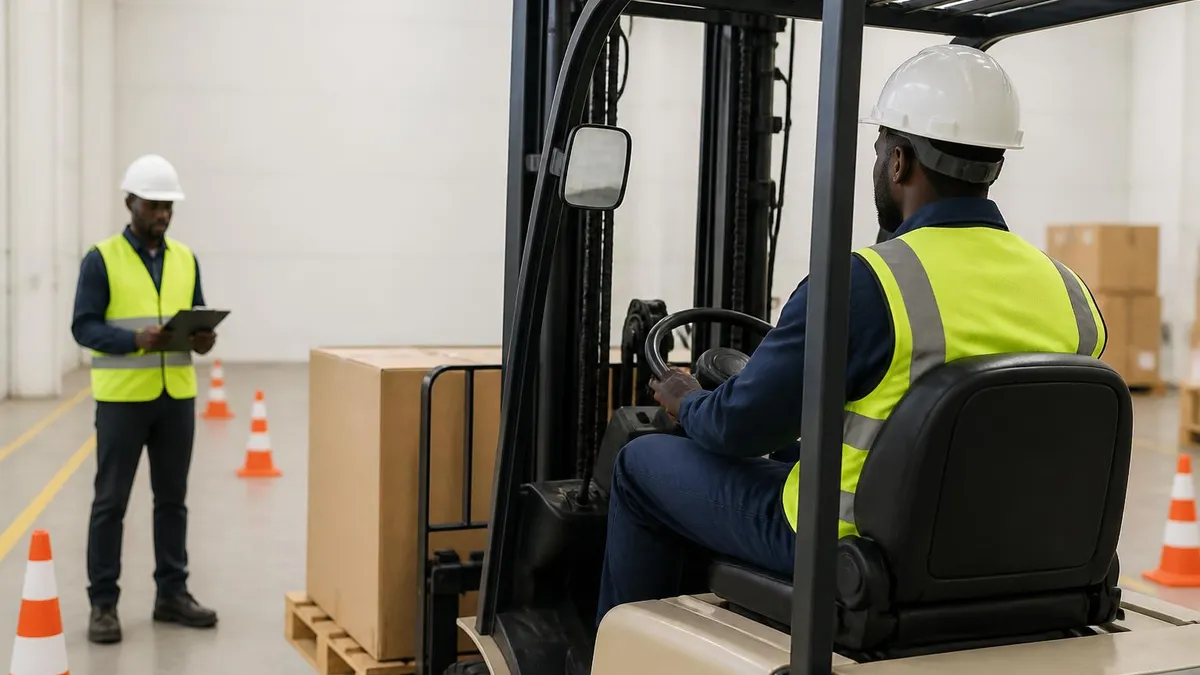
Forklift Certification by State: Complete 50-State Guide to OSHA-Compliant Operator Training, Costs, and Renewal Requirements
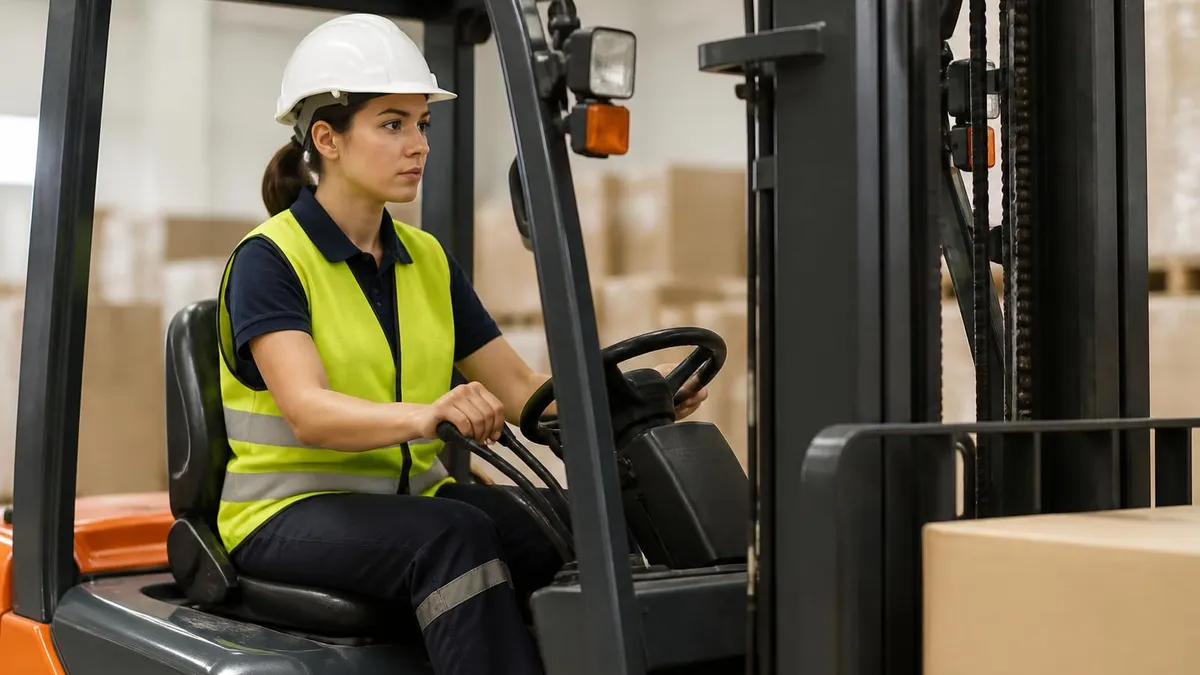
Forklift Price Guide 2026: New, Used, Rental, and Total Cost of Ownership Breakdown
How this page was made: written with AI tools. Exam facts are checked against the official sources listed below. Not reviewed by a subject-matter expert. Editorial policy
Sources & references
Exam facts on this page (fees, format, dates, passing scores) are checked against these official sources; the date is our last check. Editorial policy
- osha.gov — Test delivery, eligibility, renewal · verified Oct 2026