
Cosmetology School Requirements: Complete Guide to Enrollment, Hours, and Licensing in 2026 September
Cosmetology school requirements explained: 🟢 age, education, hours, costs, and state board rules. Complete 2026 September enrollment guide for aspiring stylists.
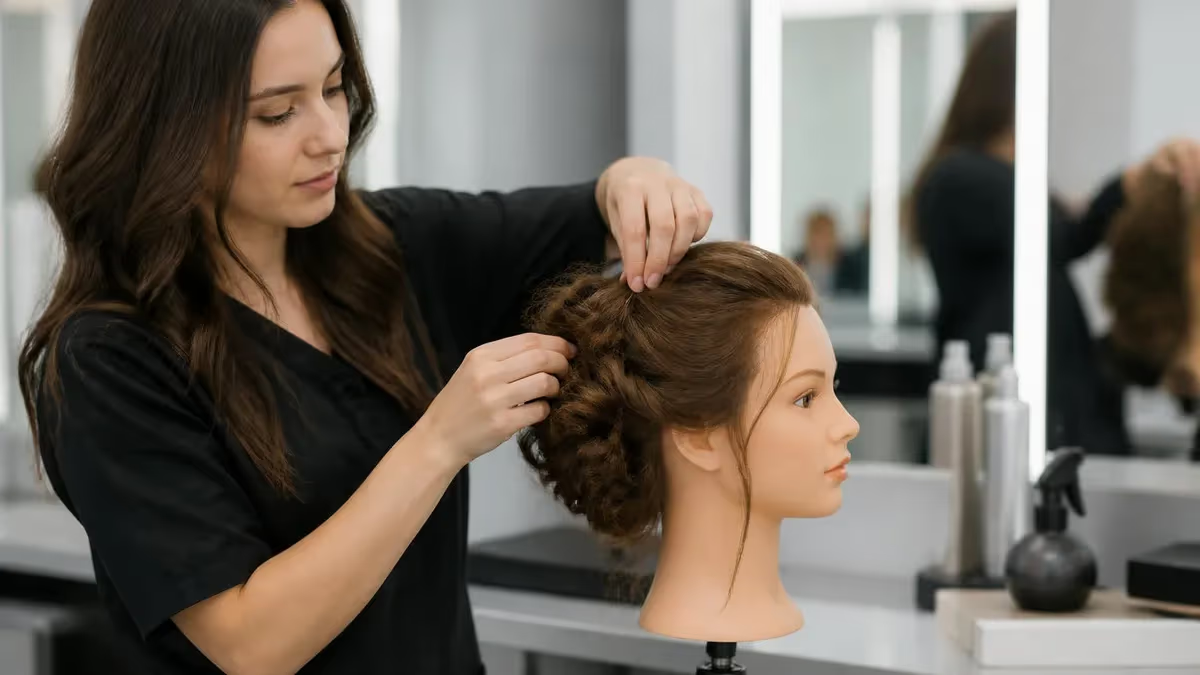
Understanding cosmetology school requirements is the first real step toward turning a passion for hair, skin, and nails into a licensed, paying career. Whether you're searching for a cosmetology school near me or comparing programs across state lines, the rules you must meet to enroll, attend, and graduate are surprisingly consistent at the federal level, but they diverge sharply when state boards take over. This guide walks through every prerequisite, hour count, document, and fee you'll encounter so you can plan your entry into the cosmetology cosmetologist profession with clarity and confidence in 2026.
Cosmetology, at its core, is the professional study and practice of beauty treatments, including haircutting, coloring, chemical texture services, skin care, nail care, and increasingly, business management. When prospective students ask what is cosmetology, they're really asking about a regulated trade that combines artistry with public-health responsibility. Because licensees work close to the skin and use chemicals, every state requires formal training before you can touch a paying client, and that training begins with meeting documented school admission requirements.
The typical applicant must be at least 16 or 17 years old, possess a high school diploma or GED equivalent, and submit proof of identity along with a completed application. Some states, including those overseen by the Ohio State Board of Cosmetology and the Arizona Board of Cosmetology, add specific requirements such as a background check, a state-issued application fee, or a physician's statement of health. These extras vary widely, which is why your first homework assignment is always reading your home state's published rules cover to cover.
Cosmetology colleges then layer their own admission steps on top of state minimums. Many require an in-person interview, a campus tour, and a financial-aid consultation before they'll formally accept you. Accredited programs participating in federal Title IV funding must also collect FAFSA documentation, transcripts, and proof of citizenship or eligible non-citizen status. While these steps feel bureaucratic, they exist to protect your investment by confirming the school can legally accept federal loans on your behalf.
Hour requirements form the structural backbone of every cosmetology program. The national range runs from 1,000 hours in states like Massachusetts and New York up to 1,600 or even 2,100 hours in others, with most settling between 1,500 and 1,600. To get a precise sense of how long is cosmetology school in your specific state, consult your board's published curriculum minimums rather than relying on national averages, which can mislead by hundreds of hours.
Costs scale roughly with hours and program prestige. A 1,500-hour program at a community college might run $6,500, while the same hour count at a private academy can exceed $20,000 once kits, books, and lab fees are included. Beyond tuition, students must budget for state board exam fees, initial licensure costs, and continuing education once they begin practicing. The investment is real, but so is the return, particularly in metropolitan markets where licensed stylists command booth rental rates of $200 to $400 weekly.
This article unpacks every requirement category in detail: admissions, hours, curriculum content, costs, licensure exams, and post-graduation renewal obligations. By the end, you'll know exactly what paperwork to gather, what questions to ask admissions officers, and how to compare programs apples-to-apples regardless of where you live or where you ultimately want to practice.
Cosmetology School Requirements by the Numbers
Core Admission Requirements Every School Verifies
Most states set the minimum at 16, though Arizona, Florida, and several others require 17. Schools verify with a state-issued ID, birth certificate, or passport. Underage applicants may need notarized parental consent forms before enrollment.
A high school diploma, GED, or HiSET certificate is mandatory at virtually every accredited program. Homeschool transcripts must be notarized in some states, and foreign diplomas typically require credential evaluation through services like WES or ECE.
Schools charge $25 to $150 for application processing. The application itself collects identification, education history, emergency contacts, and disclosure of any prior cosmetology coursework you wish to transfer in for partial credit.
States including Ohio, Texas, and Florida require fingerprint-based criminal background checks before enrollment or licensure. Felonies don't automatically disqualify you, but you must disclose them and may need a board hearing for clearance.
Some states and individual schools require a physical exam, immunization records (particularly Hepatitis B and tuberculosis screening), and a signed statement that no condition prevents safe practice of services on the public.
Hour requirements are where cosmetology school requirements get genuinely interesting because no two states agree. The federal government leaves cosmetology regulation entirely to states, so the Ohio State Board of Cosmetology mandates 1,500 hours while California requires 1,000, Texas requires 1,000, and Iowa historically required 2,100 before recent reforms. These differences matter because hours completed in one state may not transfer cleanly to another, particularly if you move mid-program.
The Arizona Board of Cosmetology requires 1,600 hours of training before a candidate can sit for the written and practical licensure exams. Those hours break down into theory instruction, supervised clinical practice on mannequins, and supervised practice on paying clients during the school's student-services floor period. Each of these components has its own minimum within the total, so simply clocking 1,600 hours doing one task won't satisfy the board.
Full-time students typically complete a 1,500-hour program in 11 to 13 months, attending classes roughly 30 to 35 hours per week. Part-time students stretch the same hour requirement across 18 to 24 months, attending evenings and weekends. Schools publish both schedules, but be honest about your stamina and finances before committing — students who burn out mid-program lose financial aid eligibility and rarely re-enroll successfully.
If you've wondered how much is cosmetology school when measured against the time invested, the answer is usually around $10 to $15 per training hour at community colleges and $15 to $25 per hour at private academies. That per-hour math is useful when comparing programs because some schools pad their listed hours with non-instructional time that doesn't count toward state board approval.
States also dictate how hours are distributed across subjects. A typical curriculum requires 200 to 300 hours on haircutting, 150 to 250 on chemical services, 100 to 200 on hair coloring, 75 to 150 on skin care, 60 to 100 on nail care, and 50 to 100 on safety, sanitation, and state law. Schools track these minutiae in your student record because the state board will audit them before approving your exam application.
Transfer hours from another state or another program are accepted at the discretion of your destination state board. Most boards require an official transcript, proof of school accreditation, and sometimes a credit-by-evaluation exam. Expect to lose 10% to 25% of your hours in translation, which is one reason many students who relocate mid-program choose to finish where they started rather than restart somewhere new.
Beyond the hour count, you must maintain satisfactory academic progress, meaning passing grades on theory exams and competency demonstrations. Schools that accept federal financial aid must enforce SAP standards including a minimum GPA (usually 2.0) and a maximum timeframe (usually 150% of program length). Falling behind on either metric jeopardizes your aid and your enrollment status simultaneously.
Cosmetology Practice Test Questions
Prepare for the Cosmetology Test exam with our free practice test modules. Each quiz covers key topics to help you pass on your first try.
Cosmetology Test Anatomy and Physiology
Cosmetology Exam Questions covering Test Anatomy and Physiology. Master Cosmetology Test concepts for certification prep.
Cosmetology Test Business and Career Manag...
Free Cosmetology Practice Test featuring Test Business and Career Management. Improve your Cosmetology Exam score with mock test prep.
Cosmetology Test Chemical Texture Services
Cosmetology Mock Exam on Test Chemical Texture Services. Cosmetology Study Guide questions to pass on your first try.
Cosmetology Test Haircolor and Lightening
Cosmetology Test Prep for Test Haircolor and Lightening. Practice Cosmetology Quiz questions and boost your score.
Cosmetology Test Haircutting and Styling
Cosmetology Questions and Answers on Test Haircutting and Styling. Free Cosmetology practice for exam readiness.
Cosmetology Test Infection Control and Safety
Cosmetology Mock Test covering Test Infection Control and Safety. Online Cosmetology Test practice with instant feedback.
Cosmetology Test Nail Care and Procedures
Free Cosmetology Quiz on Test Nail Care and Procedures. Cosmetology Exam prep questions with detailed explanations.
Cosmetology Test Nail Care and Services
Cosmetology Practice Questions for Test Nail Care and Services. Build confidence for your Cosmetology certification exam.
Cosmetology Test Principles of Skin Care
Cosmetology Test Online for Test Principles of Skin Care. Free practice with instant results and feedback.
Cosmetology Test Scientific Concepts
Cosmetology Study Material on Test Scientific Concepts. Prepare effectively with real exam-style questions.
Cosmetology Test Skincare and Services
Free Cosmetology Test covering Test Skincare and Services. Practice and track your Cosmetology exam readiness.
Cosmetology Test Wigs, Hair Extensions, an...
Cosmetology Exam Questions covering Test Wigs, Hair Extensions, and Hair Additions. Master Cosmetology Test concepts for certification prep.
Cosmetology Administrative Rules
Free Cosmetology Practice Test featuring Administrative Rules. Improve your Cosmetology Exam score with mock test prep.
Cosmetology On Hair & Scalp Properties
Cosmetology Mock Exam on On Hair & Scalp Properties. Cosmetology Study Guide questions to pass on your first try.
Cosmetology
Cosmetology Test Prep for Cosmetology. Practice Cosmetology Quiz questions and boost your score.
What Is Cosmetology Curriculum Like Day to Day?
Theory instruction occupies roughly one-third of your program and covers the science behind every service. You'll study trichology (the science of hair), dermatology basics, chemistry of pH and oxidation, electricity and light therapy fundamentals, infection control, and applicable state laws and rules. Theory is delivered through lecture, textbook reading from Milady or Pivot Point, and increasingly through video modules in hybrid programs.
Assessment in theory blocks is exam-heavy. Expect weekly chapter quizzes, mid-term comprehensive tests, and a final theory exam that mirrors the state board written test. Many schools require an 80% passing score on these internal exams before allowing you to advance to the clinic floor. This rigor is intentional — students who skate through theory routinely fail their licensing exam on the first attempt.
Traditional vs. Hybrid Cosmetology Programs
- +Hybrid programs let theory be completed online at your own pace, saving commute time
- +Lower total cost when online theory replaces some classroom seat time
- +Better fit for working parents and career changers with inflexible schedules
- +Recorded lectures allow review before exams and chemical service rotations
- +Most states now accept hybrid hours for licensure as long as the school is accredited
- +Hands-on lab and clinic hours remain in person, preserving skill development quality
- −Online theory requires strong self-discipline that not every student possesses
- −Reduced peer interaction can make networking with future colleagues harder
- −Some states cap the percentage of hours that can be earned online
- −Technology issues can disrupt learning and delay milestone exams
- −Hybrid programs may not qualify for the same federal aid in every state
- −Employers occasionally prefer traditional graduates for entry-level salon positions
Cosmetology School Enrollment Checklist
- ✓Verify you meet the minimum age requirement in your state (usually 16 or 17)
- ✓Gather proof of high school completion: diploma, GED, or HiSET certificate
- ✓Obtain a state-issued photo ID and certified birth certificate copy
- ✓Request official transcripts from your high school for school admissions
- ✓Complete a FAFSA application if you intend to use federal financial aid
- ✓Schedule and complete a campus tour and admissions interview
- ✓Submit fingerprints for the required state criminal background check
- ✓Pay the school application fee and tuition deposit to reserve your seat
- ✓Order your professional kit and required textbooks (often included in tuition)
- ✓Attend orientation and sign the enrollment agreement before your start date
Verify state board approval before paying tuition
Every cosmetology school you consider must hold current approval from your state board of cosmetology. Schools occasionally lose approval mid-year, and students enrolled at unapproved schools cannot apply hours toward licensure. Call your state board directly, ask for the school's current standing, and request the date of last inspection before signing any enrollment agreement.
The financial side of cosmetology school requirements deserves the same scrutiny you'd apply to any major purchase. Total cost ranges from about $6,500 at a low-cost community college to $25,000 or more at a private academy in a major metropolitan area. Within that range, you're paying for instructor quality, kit contents, clinic floor traffic, job placement support, and the institutional reputation that helps you land a first salon job after graduation.
Federal financial aid is the largest single source of funding for most students. Pell Grants cover up to $7,395 annually for the 2025-2026 award year for students who qualify based on Expected Family Contribution. Direct Subsidized and Unsubsidized Loans cover additional costs, with most cosmetology students taking on $8,000 to $15,000 in federal debt over the course of their program. Private loans should be a last resort because their rates and protections are inferior.
State-specific grants exist in many regions. The Arizona Promise Program covers tuition at participating institutions for Pell-eligible students, and similar programs operate in Tennessee, Oregon, and New York. Workforce development boards under WIOA (the Workforce Innovation and Opportunity Act) also fund retraining for displaced workers, and cosmetology routinely appears on their approved-program lists.
The kit cost surprises many new students. Professional shears, blow dryers, flat irons, color brushes, cape, mannequin heads, and chemical bottles can total $1,500 to $3,000 depending on quality. Some schools fold the kit into tuition, which qualifies it for financial aid coverage. Others sell it separately, requiring out-of-pocket payment that catches students unprepared.
If full-program enrollment seems financially out of reach, consider an online cosmetology school hybrid program that reduces commute costs, or a community college program with state-subsidized tuition. Some students also start with a related shorter credential — like an esthetician or nail technician license — and use earnings from that work to fund a later full cosmetology program.
Don't forget the post-graduation costs that schools rarely advertise. State board exam fees run $80 to $250, initial licensure fees add another $50 to $150, and most states require liability insurance once you're licensed, costing $150 to $300 annually. Cosmetology license renewal in most states happens every one to two years and ranges from $35 to $100 per cycle, plus mandatory continuing education in some states.
Job placement statistics published by your school must be taken seriously. Schools accredited by NACCAS must report graduation, licensure-pass, and placement rates annually. If a school refuses to share these numbers or reports rates below 60% on any metric, view that as a serious warning sign. Strong programs consistently report 70% or better across all three categories, and the very best exceed 85%.
Read your enrollment agreement line by line before signing. Common hidden costs include re-take fees for failed competency exams ($50-$200 each), graduation fees ($75-$300), late-payment penalties, and charges for additional clinic hours if you don't finish on schedule. Reputable schools disclose all fees upfront — opaque pricing is a serious warning sign about institutional ethics.
Licensure is the bridge between school and career, and it has its own set of requirements layered on top of the school's graduation criteria. Once you've completed your required hours and graduated, you must apply to your state board for permission to sit for the licensing examination. The application package typically includes proof of education hours, your school's certification of completion, the exam fee, fingerprints, and recent photo identification.
The licensing exam itself has two parts in most states: a written theory exam and a practical skills exam. The written portion is usually administered by PSI Services or the National-Interstate Council (NIC) and contains 100 to 110 multiple-choice questions covering theory, infection control, chemistry, anatomy, and state law. The practical portion requires you to perform a series of services on a mannequin or live model under timed conditions.
Pass rates vary by state and by school. The National-Interstate Council publishes aggregate data showing roughly 73% of first-time test-takers pass the written exam, but individual school rates range from below 50% to above 95%. When evaluating cosmetology colleges, ask for the most recent first-time pass rate and compare it to your state's overall average. A school consistently below the state average is leaving its students underprepared.
Reciprocity rules govern whether a license earned in one state allows you to work in another. The arizona state board of cosmetology grants reciprocity to applicants who hold a valid license in another state and can document equivalent training hours, plus pay a processing fee. Many states require additional written exams or supplemental hours when the training-hour requirement is significantly lower than the destination state's minimum.
Once licensed, you must maintain your credential through renewal and, in many states, continuing education. Florida requires 16 hours of CE every two years, Texas requires 4 hours annually on sanitation and safety, and Ohio requires 8 hours every two years. Cosmetology license renewal deadlines fall on your birthday or the anniversary of your initial licensure depending on the state — calendar these dates the moment you receive your first license.
Failing to renew on time has consequences ranging from late fees to license revocation. Most states allow a grace period of 30 to 90 days during which you can renew with a late fee. Beyond that window, you may need to reapply from scratch, repeat parts of the exam, or even retake school hours. Treating renewal as a routine, predictable task — set a calendar alert 60 days out — prevents these expensive headaches.
Career options after licensure span far more than salon employment. Licensed cosmetologists work as freelance event stylists, platform artists for product brands, salon owners, beauty educators, film and television professionals, and content creators. Each path has its own income trajectory, but all require the same baseline cosmetology school requirements and state licensure that you've spent the last year working to achieve.
Practical preparation tips can make the difference between a stressful school year and a manageable one. Start by setting up a dedicated study space at home, even if it's just a corner of a desk. Keep your Milady textbook, a notebook, your laptop, and a small mannequin head within arm's reach. Students who study at consistent times and locations consistently outperform peers who try to cram unpredictably between shifts.
Build a study routine that mirrors your eventual exam structure. Spend two to three evenings per week on theory review and one weekend session on hands-on practice with a mannequin. Use spaced-repetition flashcards for vocabulary-heavy topics like trichology, chemistry, and anatomy. Apps like Anki or Quizlet make this efficient, and many cosmetology educators publish pre-made decks aligned to the NIC exam blueprint.
Form a study group with two or three classmates whose work ethic matches yours. Group members can quiz each other on theory, critique each other's haircuts and color formulas, and trade practice models when family and friends run out. Be selective — a study group of five people who don't actually study together is worse than studying alone, because the meeting time replaces productive work.
Take care of your body during school. Cosmetology is physically demanding: long hours on your feet, repetitive arm motions, and exposure to chemicals. Invest in quality non-slip shoes, anti-fatigue floor mats for your station, and ergonomic shears that fit your hand. Develop a stretching routine for wrists, shoulders, and lower back. Injuries that derail your school progress can permanently shorten your future career.
Keep meticulous records of every service you complete in school. Most states require you to log each haircut, color, perm, facial, and manicure with date, client (or mannequin), and instructor signature. These records prove your hours met state board distribution requirements. Lost or incomplete logs can delay your exam application by months while the school reconstructs your service history.
Network actively with working professionals throughout your program. Attend local industry events, follow established stylists in your city on social media, and request informational interviews with salon owners you admire. Many job offers happen before graduation because owners want to lock in promising students. A graduate with a job waiting is far less stressed during state board exam preparation than one who's still searching.
Finally, treat the state board exam as a separate, focused challenge after graduation rather than something you can wing on momentum. Budget two to four weeks of dedicated review time between your last day of school and your exam date. Take at least three full-length practice exams under timed conditions, simulate the practical with a friend acting as examiner, and arrive at the test center rested, fed, and with all required documentation packed the night before.
Cosmetology Questions and Answers

Board of Barbering and Cosmetology: What State Boards Do
Cosmetology Practice Test: 350+ Free Questions and Answers
Cosmetology School Near Me: How to Find, Choose, and Enroll in the Right Program in 2026

Cosmetology Classes Online: How Hybrid Programs Work, Cost, and Whether They Lead to Licensure in 2026
Cosmetology Continuing Education: CE Hours by State Guide
About the Author
Licensed Cosmetologist & Beauty Licensing Exam Specialist
Paul Mitchell SchoolsMichelle Santos is a licensed cosmetologist with a Bachelor of Science in Esthetics and Salon Management from Paul Mitchell School. She has 16 years of salon industry experience and 8 years preparing students for state cosmetology board exams in theory, practical skills, and sanitation. She specializes in licensure preparation for cosmetologists, estheticians, and nail technicians.
Join the Discussion
Connect with other students preparing for this exam. Share tips, ask questions, and get advice from people who have been there.
View discussion (6 replies)