
ACLS Renewal Online: Complete 2026 September Guide to AHA Recertification, Formats, Timelines & Costs
ACLS renewal online 💓 AHA HeartCode formats, 2-year card validity, skills sessions, timelines, and what to do if your card lapses.
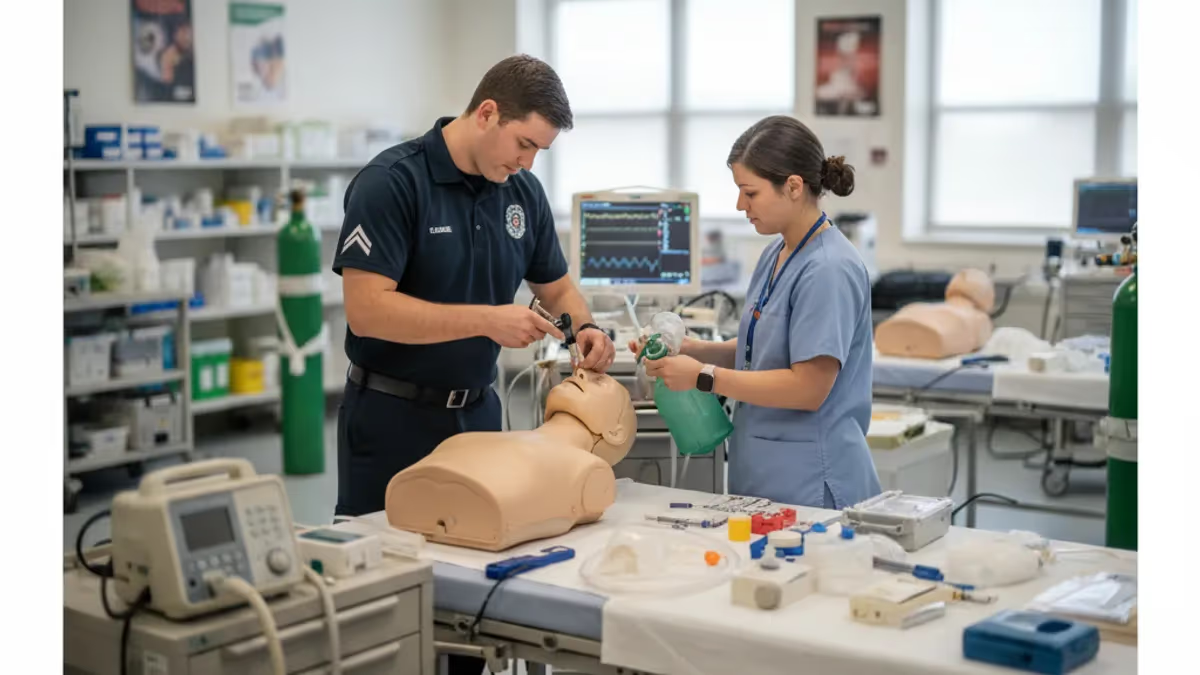
Your American Heart Association ACLS provider card is only good for two years, and once that clock starts running, the question every nurse, paramedic, and respiratory therapist eventually asks is whether ACLS renewal online is actually a legitimate option or just a shortcut that skips real skills practice. It's a fair question. The AHA does allow a genuine online path to recertification, but it isn't a single click-through quiz — it's a structured blended program built around HeartCode ACLS, and understanding exactly how the pieces fit together is what keeps your card valid without wasting a weekend.
This guide walks through how ACLS certification renewal actually works online, what the AHA requires versus what individual training centers add on top, how the timeline compares to an in-person refresher, and what to do if your card has already expired. We'll also cover cost ranges, the skills-verification step most people underestimate, and how the renewal course differs from the full initial provider course.
Renewal online applies to anyone who already holds an active or recently expired AHA ACLS card — ICU and ED nurses, paramedics, respiratory therapists, anesthesia staff, and physicians who need continuous certification for credentialing. Most of these providers also carry a current BLS card, since ACLS courses assume BLS-level CPR competency as a starting point rather than teaching it from scratch. If your BLS card has also lapsed, check with your training center about bundling both renewals in the same enrollment window.
It's also worth knowing that ACLS renewal and BLS renewal, while related, are tracked as separate certifications with independent expiration dates — renewing one doesn't automatically extend the other. Providers who hold both should check each card's date separately rather than assuming a single renewal covers everything.
ACLS Renewal Online by the Numbers

The two-year renewal cycle isn't arbitrary. Resuscitation science moves fast, and the AHA periodically updates its guidelines based on evidence reviewed by the International Liaison Committee on Resuscitation (ILCOR). Drug dosing, defibrillation sequencing, and post-arrest care recommendations have all shifted over past guideline cycles, so a card that never expired would eventually certify providers on outdated protocols. Renewal exists to make sure every active provider has touched the current algorithms recently, not just memorized a version from years ago.
For working clinicians, that means ACLS renewal near me searches spike every couple of years as hospitals push staff to recertify before their card lapses. Employers usually track expiration dates internally and flag providers 60-90 days out, but the responsibility to actually schedule the renewal still falls on the individual.
The guideline cycle itself follows evidence reviewed by ILCOR roughly every five years, with interim science updates published in between when new studies change a specific recommendation — drug timing during cardiac arrest and CPR quality metrics have both seen interim revisions in recent cycles. A lapsed card doesn't just risk a lecture from your manager; many hospitals and EMS agencies tie ACLS status directly to scope-of-practice privileges, meaning an expired card can pull you off certain assignments until it's renewed.
Grace-period policies also differ between EMS agencies and hospitals. Some EMS systems enforce a hard cutoff where a lapsed card immediately restricts patient-contact duties, while certain hospital departments allow a short administrative window to complete renewal paperwork already in progress. Neither approach is universal, so check your specific employer's policy manual rather than assuming the rules from a previous job still apply.
Online ACLS renewal runs through HeartCode ACLS, the AHA's official self-paced eLearning course. You work through interactive scenario-based modules covering the core ACLS algorithm sequences — cardiac arrest, bradycardia, tachycardia, and post-cardiac-arrest care — at your own pace, then complete a cognitive exam inside the platform. Most AHA Training Centers and authorized providers set a passing threshold around 70%, and the software lets you review missed concepts before retesting sections.
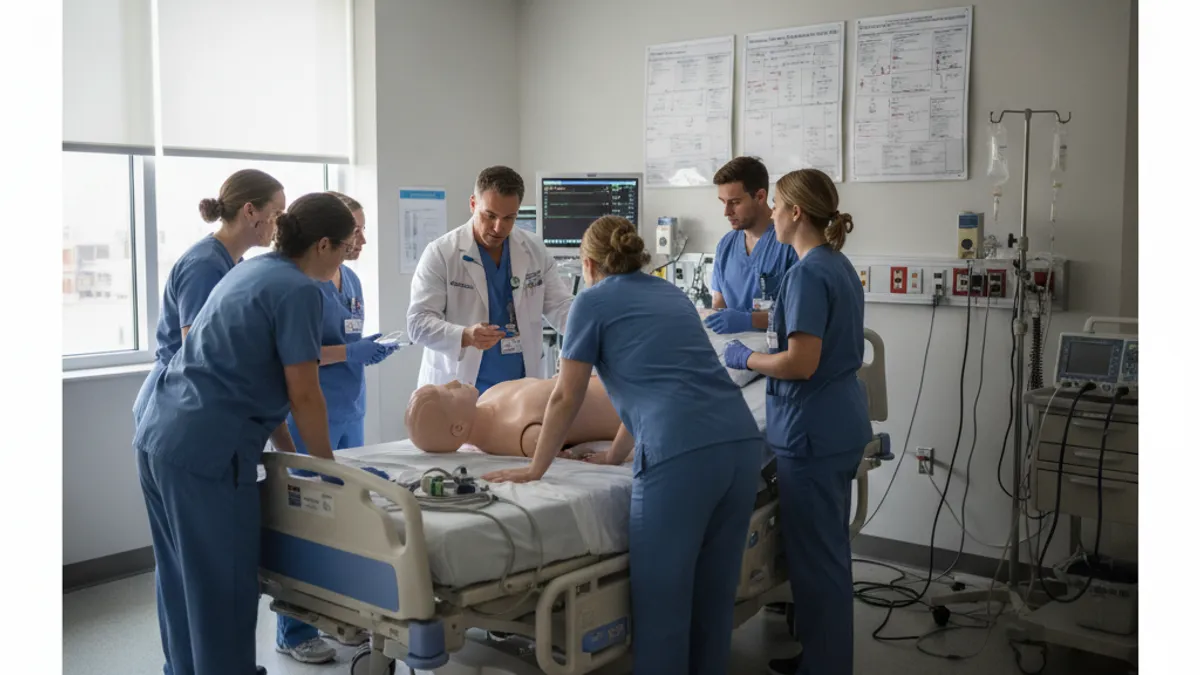
What surprises a lot of first-time renewers is that finishing the HeartCode eLearning module doesn't hand you a new card by itself. The AHA still requires a hands-on skills verification component — you have to demonstrate megacode team leadership, airway management, and CPR quality in front of an AHA Instructor before the card is issued. The eLearning piece replaces classroom lecture time, not the skills check.
Inside HeartCode, the modules are organized around the core algorithm families you'll be tested on in the skills session: cardiac arrest (VF/pulseless VT, PEA, and asystole), symptomatic bradycardia, stable and unstable tachycardia, and immediate post-cardiac-arrest care including targeted temperature management concepts. Each module uses branching, scenario-based decisions rather than static slides, so you're choosing next steps in a simulated code rather than just reading text, which is part of why the AHA counts it as equivalent to classroom instruction time.
Comparing the Renewal Formats
Some AHA Training Centers offer a Voice Assisted Manikin (VAM) option, letting you complete the skills-check portion at home or in an approved remote setting with a manikin that gives real-time feedback on compression rate and depth. This is the closest thing to a fully remote renewal, but it's only offered through specific authorized sites and isn't available everywhere.
Because VAM availability varies by region and training center, it's worth confirming with your provider before assuming this option applies to your renewal.
VAM sessions typically use a certified manikin connected to software that scores compression depth, rate, and recoil in real time, giving the AHA Instructor objective data to verify alongside your live performance.
Timing matters more than most people realize. Renewing before your card's official expiration date lets you take the shorter renewal course instead of the full initial provider course, which covers more material and takes longer. Most training centers and employers recommend starting the process 60-90 days before expiration, since scheduling an in-person skills session — even a short one — can take a few weeks depending on local availability.
If you're weighing ACLS renewal against a fresh certification because your card already lapsed, the practical difference is real: renewal courses assume you've held the certification recently and move faster through material you should already know, while the full course starts from the beginning regardless of your prior experience.
Most employers rely on the AHA's digital eCard system to track expiration dates, since eCards are verifiable online and show the exact issue and expiration date tied to your training center. Hospital credentialing offices typically pull this data directly rather than trusting a photo of a paper card, which is one more reason to keep your eCard login active and your contact email current with whichever training center issued your certification.
What You'll Need Before You Start
Have your existing ACLS card number ready; most renewal enrollments ask for it during registration. Confirm this with your specific training center ahead of time.
Create or log into an AHA-affiliated learner account through your Training Center's enrollment link. Confirm this with your specific training center ahead of time.
Set aside a few uninterrupted hours; the modules save progress but flow better completed in fewer sittings. Confirm this with your specific training center ahead of time.
Book your in-person or VAM skills check before or right after finishing the online modules, not weeks later. Confirm this with your specific training center ahead of time.
Pricing for ACLS renewal online isn't set centrally by the AHA — individual Training Centers and authorized providers set their own fees, which is why quotes vary depending on where you enroll. Hospital-affiliated training departments often subsidize renewal for staff, while independent training centers and third-party platforms charge separately for the eLearning access code and the in-person skills session, sometimes bundled and sometimes billed apart.
If cost comparison is your main concern, our dedicated ACLS renewal cost breakdown lays out the typical fee components — the eLearning license, the skills-session fee, and any card-processing charge — so you can see where your money actually goes before you commit to a provider.
If you're renewing through your employer, ask whether the hospital or EMS agency has a group account with a specific AHA Training Center — many negotiate discounted eLearning licenses or cover the fee entirely as part of continuing education budgets. If you're renewing independently, stick to training centers listed in the AHA's own directory; unauthorized resellers sometimes advertise cheaper HeartCode-branded courses that don't actually connect to an AHA-recognized skills session or card.
Group discounts sometimes extend to related certifications like AHA ACLS and PALS bundles. Many employers reimburse renewal fees as part of continuing education budgets, so it's worth checking with your manager or education department before paying out of pocket. Some AHA Training Centers also offer discounted pricing for group enrollments, students, or repeat renewers, and a handful of specialty programs bundle ACLS with BLS or PALS renewal at a reduced combined rate.
Online Renewal: Weighing the Trade-Offs
- +Self-paced scheduling around shift work
- +Shorter total classroom time than a full course
- +Immediate feedback on missed exam questions
- +Review material stays accessible during the course window
- +Works well for providers who renew on a predictable cycle
- +Some sites offer VAM to shrink in-person time further
- +Bundling with BLS renewal saves a second scheduling trip
- −Still requires a hands-on skills verification step
- −VAM availability is limited to specific authorized sites
- −Technical issues can interrupt a self-paced session
- −Not a substitute if your card has already fully lapsed at some centers
- −Scheduling the skills session can add lead time
- −Pricing varies widely by training center, with no fixed AHA rate
- −Requires a stable internet connection for the eLearning portion
Pros and Cons at a Glance
| Pros | Cons |
|---|---|
| Self-paced scheduling around shift work | Still requires a hands-on skills verification step |
| Shorter total classroom time than a full course | VAM availability is limited to specific authorized sites |
| Immediate feedback on missed exam questions | Technical issues can interrupt a self-paced session |
| Review material stays accessible during the course window | Not a substitute if your card has already fully lapsed at some centers |
| Works well for providers who renew on a predictable cycle | Scheduling the skills session can add lead time |
| Some sites offer VAM to shrink in-person time further | Pricing varies widely by training center, with no fixed AHA rate |
Providers who renew online routinely ask whether the aha acls algorithms covered in the renewal course differ from what a first-time provider learns. They don't — the same drug dosing, rhythm-recognition, and team-dynamics expectations apply whether you're a first-timer or a renewing provider. What changes is pacing: the renewal course assumes recent familiarity, so it moves through core concepts faster and spends more relative time on anything updated since your last card.
That's also why keeping current on the algorithms between renewal cycles helps. Providers who review rhythm strips and drug protocols periodically — rather than cramming everything in the final week before their card expires — consistently report an easier skills check, since megacode scenarios move quickly and don't pause for hesitation.
The skills session also evaluates team dynamics — closed-loop communication, clear role assignment, and constructive intervention when a team member makes an error — not just individual algorithm recall. Instructors watch how you lead or participate in a simulated megacode as a team, since real resuscitation events rarely go exactly as scripted and the AHA wants providers comfortable adapting under pressure, not just reciting steps from memory.
ACLS Renewal Online Checklist
- ✓Confirm your exact card expiration date
- ✓Choose an AHA-authorized training center or hospital program
- ✓Register for HeartCode ACLS eLearning
- ✓Complete all eLearning modules and the cognitive exam
- ✓Schedule your in-person or VAM skills session
- ✓Bring your current card number to the skills check
- ✓Pass the megacode and CPR-quality evaluation
- ✓Receive your updated 2-year AHA provider card
- ✓Save a digital copy of your new card immediately
- ✓Set a calendar reminder 90 days before the next expiration
- ✓Verify your training center is listed in the official AHA directory
A Renewal Timeline That Actually Works
90 Days Out
60 Days Out
Skills Session Day
Card Issuance
Confirm Authorization
Renew Before, Not After, Expiration
Renewing while your card is still active almost always means a shorter course than renewing after it lapses. Mark the expiration date the moment you receive a new card, not the week it's about to run out.
Staying Sharp Between Renewal Cycles
Short in-service drills that keep team dynamics and role assignment fresh between full renewals.
Manikin-based practice sessions many hospitals run so staff never go two full years without hands-on reps.
Periodic review of ECG strips keeps rhythm recognition sharp instead of fading between renewal cycles.
Quick peer quizzes on ACLS medication timing and dosing prevent last-minute cramming before your renewal exam.
Once a card fully lapses, some AHA Training Centers require the full initial provider course rather than the shorter renewal course. If you're within a few weeks of expiring, contact your training center immediately to confirm whether you still qualify for renewal pricing and format.
Confirm Your Training Center's Policy First
Policies vary: some AHA Training Centers allow a short grace period where renewal pricing still applies, while others require the full initial provider course. Some employers accept proof of active enrollment as a temporary bridge toward a credentialing deadline, but this isn't guaranteed — confirm directly with your training center and your education coordinator before enrolling in anything.
Pick the Format That Fits Your Schedule
Whether you renew with VAM, a blended skills session, or a traditional class, the two-year AHA cycle keeps providers sharp on current resuscitation science. Start early, confirm your training center is authorized, and treat the renewal as routine maintenance — not an emergency. If you'd rather review in a classroom setting, search acls classes near me to compare local options against the online path.
ACLS Questions and Answers

ACLS Renewal: Online vs In-Person, Cost, AHA Providers, and What to Do If Expired

ACLS Renewal Cost: Complete 2026 Price Guide for Recertification Fees, Online Options & Hidden Charges

ACLS Renewal Near Me: Find Local Recertification Classes, Costs & Online Options in 2026

ACLS Card Lookup: How to Verify, Find & Replace Your ACLS Certification in 2026

ACLS Guidelines 2026: Complete AHA Update on Algorithms, Drugs, CPR Quality & Post-Arrest Care
About the Author

Registered Nurse & Healthcare Educator
Johns Hopkins University School of NursingDr. Sarah Mitchell is a board-certified registered nurse with over 15 years of clinical and academic experience. She completed her PhD in Nursing Science at Johns Hopkins University and has taught NCLEX preparation and clinical skills courses for nursing students across the United States. Her research focuses on evidence-based exam preparation strategies for healthcare certification candidates.