
Paid Phlebotomy Training: Earn While You Learn in 2026 October
⏳ Paid phlebotomy training programs let you earn while learning. Compare hospital apprenticeships, employer-sponsored courses, and certification paths.
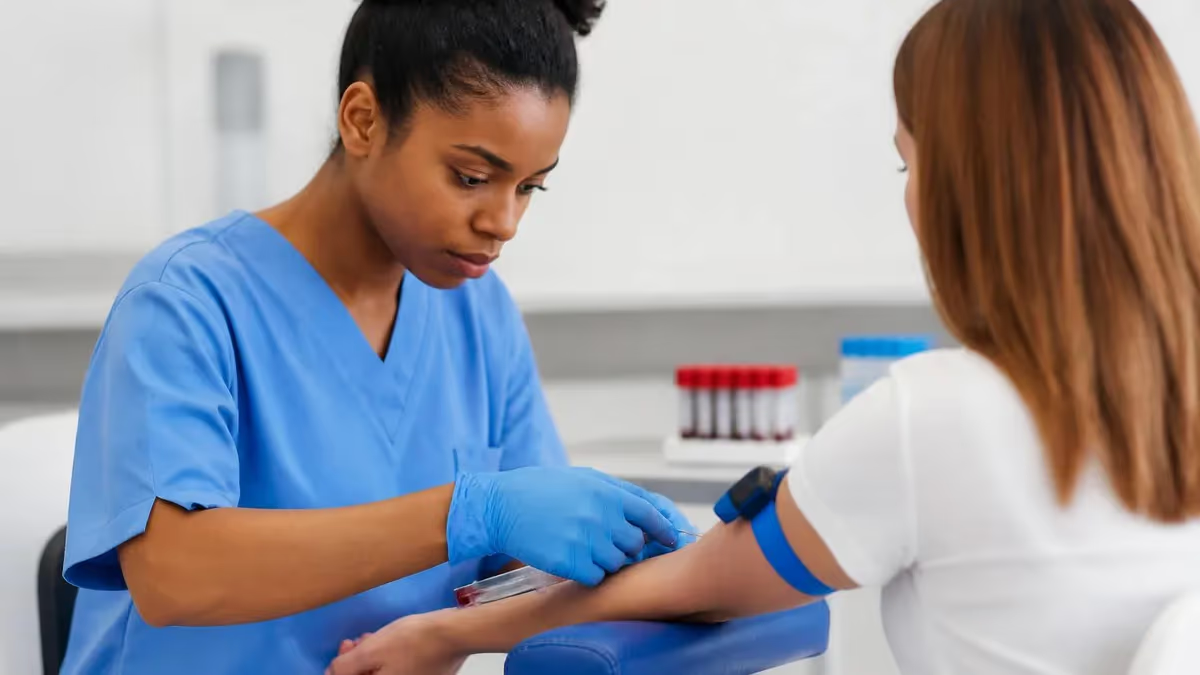
Paid phlebotomy training is one of the fastest, lowest-risk ways to enter healthcare in 2026, and it is reshaping how thousands of Americans launch a clinical career every year. Instead of paying $1,200 to $3,500 for a traditional certificate program, eligible candidates can join hospital apprenticeships, employer-sponsored academies, and union training pipelines that cover tuition, supplies, and even hourly wages while you learn. If you have searched for phlebotomy classes near me and felt sticker shock, this guide explains exactly how paid programs work and who qualifies.
The model is simple. A hospital system, reference lab, blood bank, or staffing agency identifies a hiring need, partners with a community college or in-house instructor, and pays trainees a starting wage of $14 to $22 per hour to complete classroom hours plus 100 to 120 clinical sticks. In return, you usually sign a one or two year commitment to work at that facility after passing your certification exam. Quest Diagnostics, Labcorp, the Red Cross, Kaiser Permanente, and HCA Healthcare all run versions of this pipeline.
The opportunity has expanded because the U.S. Bureau of Labor Statistics projects 8% job growth for phlebotomists through 2033, faster than the average for all occupations. Hospitals struggle to fill night shifts, weekend coverage, and pediatric draw stations, so they have moved upstream into the talent pool by paying people to train. If you can pass a background check, drug screen, and basic math assessment, you have a real shot at a no-cost path into a credentialed role.
This guide walks through every angle a working adult needs to evaluate paid programs. We cover apprenticeship structure, employer sponsorship contracts, workforce grants such as WIOA, military and veteran pipelines, and how to combine phlebotomy career training with national certification through NHA, ASCP, AMT, or NCCT. By the end, you will know which path matches your situation, what salary to expect after year one, and how to avoid programs that promise paid training but deliver something far less valuable.
You will also see the realistic timeline. Most paid programs run 8 to 16 weeks of combined didactic and clinical hours, followed by a 90 day probationary period at the sponsoring facility. During that window you complete supervised sticks, demonstrate competence on the order of draw, and sit for your certification exam at company expense. Trainees who complete the full pipeline typically clear $34,000 to $42,000 in their first 12 months, then climb to $44,000 to $52,000 by year three depending on shift differentials and metro area.
One quick framing note before we dive in. Paid phlebotomy training is not the same as a tuition reimbursement program, which makes you pay first and reimburses you later only if you stay. True paid training pays you from day one as a W-2 employee. The distinction matters because reimbursement programs have a 30% to 50% drop-off rate, while paid apprenticeships exceed 80% completion. Choose the structure that matches how much risk you can absorb financially, and the rest of this article will help you sort the rest.
If you are weighing this against a self-funded certificate or a longer degree, keep one number in mind: the median phlebotomy salary nationally sits at roughly $40,580 according to BLS, with top metros pushing past $52,000. That ceiling is reachable inside 18 months from a paid program, which makes the return on time-invested unusually strong compared with most healthcare entry points.
Related reading: paid phlebotomy training covers the next step in more detail.
Free Phlebotomy Study Tools
Interactive Phlebotomy resources on PracticeTestGeeks, free to start:
- Phlebotomy flashcards — review key terms and concepts card by card
- Phlebotomy study guide — topic-by-topic overview of what the exam covers
- Phlebotomy cheat sheet — one-page printable summary for last-minute review
Paid Phlebotomy Training by the Numbers
Key Facts at a Glance
| Item | Value | Details |
|---|---|---|
| Program Length | 8–16 wks | Classroom plus clinical |
| Required Sticks | 100+ | Live patient draws |
| Out-of-Pocket Cost | $0 | Employer-paid programs |

Five Types of Paid Phlebotomy Training Programs
Registered apprenticeships through the U.S. Department of Labor where a hospital hires you as a paid W-2 trainee, pays for classroom instruction, and guarantees a position after certification. Common at HCA, Kaiser, Cleveland Clinic, and academic medical centers.
Quest Diagnostics and Labcorp run multi-week academies that combine didactic training, simulation, and proctored clinical sticks at patient service centers. Pay during training averages $15 to $18 per hour with a one year service commitment.
The American Red Cross, Vitalant, and OneBlood train donor phlebotomists in 6 to 10 weeks at full pay. The scope is narrower than hospital phlebotomy but the entry barrier is the lowest and shifts are predictable.
State workforce boards fund tuition plus a weekly stipend through the Workforce Innovation and Opportunity Act. You attend an approved school free of charge, often with childcare and transportation support layered on top.
Active duty medics, corpsmen, and veterans can convert military training into civilian certification through programs like the VA's VET TEC and Army Credentialing Assistance, often with paid clinical externships at VA hospitals.
Hospital apprenticeships are the gold standard of paid phlebotomy training because they combine a real paycheck, structured curriculum, and a guaranteed position on the back end. The structure is regulated by the U.S. Department of Labor's Office of Apprenticeship, which means programs must document at least 144 hours of related technical instruction plus 2,000 hours of on-the-job learning, although phlebotomy-specific tracks are often condensed because the scope is narrower than nursing or surgical tech.
The typical hospital apprenticeship begins with a one to two week orientation covering HIPAA, OSHA bloodborne pathogen standards, and electronic health record systems like Epic or Cerner. From there you rotate between classroom sessions taught by a hospital educator and supervised draws in outpatient labs, inpatient floors, and the emergency department. Apprentices wear scrubs, badge in, and are paid for every hour including mandatory training, which makes the financial picture dramatically different from a self-funded certificate.
Wage progression follows a step schedule. Most programs start trainees at 70% of the journeyman phlebotomy technician salary for that facility, then bump to 80% after passing a midpoint competency, and 100% once you sit and pass your national certification exam. In a metro area where certified phlebotomists earn $22 per hour, that means apprentices begin around $15.40, climb to $17.60, and reach full scale typically within 12 to 14 months of starting.
The trade-off is the service commitment. Most hospital apprenticeships require you to remain employed at the sponsoring facility for 12 to 24 months after certification, and breaking that commitment triggers a prorated repayment clause covering tuition, exam fees, and sometimes a percentage of wages paid during training. Read the contract carefully. Reputable programs cap the clawback at $2,500 to $4,000 and waive it entirely if the hospital terminates you for non-disciplinary reasons such as a unit closure.
What makes these programs powerful is the wrap-around support. Apprentices get assigned a preceptor who reviews their stick log weekly, a program coordinator who tracks classroom progress, and access to a tuition account that pays for the certification exam, study materials, and sometimes commuter benefits. Many hospitals also pay for the background check, drug screen, immunizations, and basic life support certification, all of which would otherwise add $300 to $500 to your start-up cost.
Eligibility is broader than people assume. You generally need a high school diploma or GED, the ability to pass a 10-panel drug screen and federal background check, proof of immunizations including Hepatitis B and TB clearance, and a clean driving record only if the role includes mobile phlebotomy. SAT scores, college credits, and prior healthcare experience are not required. Hospitals care more about reliability, communication, and a demonstrated interest in patient care than academic pedigree.
To find these programs, start with the apprenticeship.gov database, your state's apprenticeship agency, and the careers pages of major health systems within commuting distance. Search terms like Phlebotomy Apprentice, Lab Assistant Trainee, and Patient Service Representative Trainee surface the right listings. Application cycles often open quarterly, with cohorts beginning in January, April, July, and October.

Phlebotomy Practice Test Questions
Prepare for the Phlebotomy Test exam with our free practice test modules. Each quiz covers key topics to help you pass on your first try.
Phlebotomy American Medical Certification ...
Phlebotomy Exam Questions covering American Medical Certification Association Phlebotomy. Master Phlebotomy Test concepts for certification prep.
Phlebotomy American Medical Technologists ...
Free Phlebotomy Practice Test featuring American Medical Technologists Phlebotomy. Improve your Phlebotomy Exam score with mock test prep.
Phlebotomy American Society for Clinical P...
Phlebotomy Mock Exam on American Society for Clinical Pathology Phlebotomy. Phlebotomy Study Guide questions to pass on your first try.
Phlebotomy Association of Phlebotomy Techn...
Phlebotomy Test Prep for Association of Phlebotomy Technicians. Practice Phlebotomy Quiz questions and boost your score.
Phlebotomy National Center for Competency ...
Phlebotomy Questions and Answers on National Center for Competency Testing Phlebotomy. Free Phlebotomy practice for exam readiness.
Phlebotomy National Healthcareer Associati...
Phlebotomy Mock Test covering National Healthcareer Association Phlebotomy. Online Phlebotomy Test practice with instant feedback.
Phlebotomy Order of Draw and Additives
Free Phlebotomy Quiz on Order of Draw and Additives. Phlebotomy Exam prep questions with detailed explanations.
Phlebotomy Legal and Ethics
Phlebotomy Practice Questions for Phlebotomy Legal and Ethics. Build confidence for your Phlebotomy certification exam.
Phlebotomy Safety and Infection Control
Phlebotomy Test Online for Safety and Infection Control. Free practice with instant results and feedback.
Phlebotomy Special Collection Procedures
Phlebotomy Study Material on Special Collection Procedures. Prepare effectively with real exam-style questions.
Phlebotomy Specimen Processing and Handling
Free Phlebotomy Test covering Specimen Processing and Handling. Practice and track your Phlebotomy exam readiness.
Phlebotomy Test Arterial Blood Gas Collection
Phlebotomy Exam Questions covering Test Arterial Blood Gas Collection. Master Phlebotomy Test concepts for certification prep.
Phlebotomy Test Capillary and Dermal Puncture
Free Phlebotomy Practice Test featuring Test Capillary and Dermal Puncture. Improve your Phlebotomy Exam score with mock test prep.
Phlebotomy Test Pediatric Blood Collection
Phlebotomy Mock Exam on Test Pediatric Blood Collection. Phlebotomy Study Guide questions to pass on your first try.
Phlebotomy Test Phlebotomy Anatomy and Phy...
Phlebotomy Test Prep for Test Phlebotomy Anatomy and Physiology. Practice Phlebotomy Quiz questions and boost your score.
Phlebotomy Test Phlebotomy Exam Simulation
Phlebotomy Questions and Answers on Test Phlebotomy Exam Simulation. Free Phlebotomy practice for exam readiness.
Phlebotomy Test Phlebotomy Patient Identif...
Phlebotomy Mock Test covering Test Phlebotomy Patient Identification and Communication. Online Phlebotomy Test practice with instant feedback.
Phlebotomy Test Point of Care Testing
Free Phlebotomy Quiz on Test Point of Care Testing. Phlebotomy Exam prep questions with detailed explanations.
Phlebotomy Training Specialists: Three Employer Sponsorship Models
Quest Diagnostics and Labcorp dominate the reference lab paid training space. Both companies run rolling cohorts at regional training hubs and pay trainees an hourly wage from day one. The curriculum focuses heavily on patient service center workflow, high-volume outpatient draws, pediatric and geriatric technique, and the integration of order entry with their proprietary lab information systems.
The advantage is scale. These programs hire hundreds per quarter nationwide, accept candidates with zero prior experience, and offer clear advancement into specimen processing, mobile phlebotomy, or supervisory roles. The trade-off is volume pressure. Patient service centers are productivity-driven, so expect to draw 40 to 70 patients per shift once you complete training, which is faster than most hospital outpatient environments.
Paid Training vs. Self-Funded Certificate Programs
- +Zero or near-zero out-of-pocket cost for tuition, books, and exam fees
- +Hourly wages from day one as a W-2 employee with benefits eligibility
- +Guaranteed clinical hours and live patient sticks built into the schedule
- +Direct pipeline to a job offer at the sponsoring facility after certification
- +Wrap-around support including childcare, transportation, and mentorship in many programs
- +Higher completion rates than self-funded programs due to financial stability
- −Service commitment of 12 to 24 months with prorated repayment if you leave early
- −Less flexibility in choosing your certifying body, since employer dictates NHA, ASCP, or AMT
- −Competitive application process with structured interviews and assessments
- −Geographic restriction to the sponsor's facilities for the duration of the contract
- −Slower wage growth in year one compared to immediately certified hires
- −Limited ability to explore specialty areas until the commitment period ends

Phlebotomy Certification Near Me: Application Readiness Checklist
- ✓Confirm you are at least 18 years old and have a high school diploma or GED
- ✓Gather official transcripts, government-issued ID, and Social Security card for the application packet
- ✓Complete a 10-panel drug screen and pass a federal background check
- ✓Document immunizations including Hepatitis B series, MMR, varicella, Tdap, and annual flu
- ✓Obtain a recent TB skin test or QuantiFERON Gold result within the last 12 months
- ✓Earn a current Basic Life Support certification through the American Heart Association
- ✓Prepare a healthcare-focused resume highlighting customer service and reliability experience
- ✓Write a one-page personal statement explaining why you want to enter phlebotomy
- ✓Practice for a structured behavioral interview covering teamwork and patient empathy scenarios
- ✓Identify three professional references with recent contact information
- ✓Verify reliable transportation to the training site and clinical rotations
- ✓Set aside the application fee, typically $0 to $50 depending on the program
Total compensation in year one can exceed $48,000
When you add training wages, tuition value, exam fees, supplies, immunization costs, and benefits eligibility, the true economic value of a paid phlebotomy apprenticeship in year one regularly exceeds $48,000 in metro areas. A self-funded certificate plus a delayed job start often nets less than $30,000 in the same window, which is the strongest argument for choosing the paid path when you qualify.
Once you understand the structure, the next decision is financial. Paid phlebotomy training contracts contain three numbers that matter more than the rest: your training wage, your post-certification wage, and the value of the clawback if you leave early. Treat the offer letter like a small loan agreement, because in legal terms that is exactly what a service commitment with repayment terms represents.
Training wages vary by metro and employer but cluster in a tight band. In 2026, expect $14 to $16 per hour in rural and small-metro markets, $16 to $19 in mid-size cities, and $19 to $22 in high-cost areas like Seattle, Boston, and the San Francisco Bay. California adds a layer of complexity because the state requires a CPT-1 license issued by the California Department of Public Health, and approved training programs must meet specific hour and curriculum requirements that often push the timeline closer to 16 weeks.
Post-certification wages jump meaningfully. The national median phlebotomy salary sits around $40,580, but certified hires at large hospital systems frequently start at $19 to $23 per hour with shift differentials of $2 to $4 for evenings, nights, and weekends. After three years, lead phlebotomists, mobile team members, and trainers can earn $26 to $32 per hour, which translates to roughly $54,000 to $66,000 annually with overtime.
The clawback structure is where smart candidates either protect themselves or get burned. A well-written agreement prorates the repayment monthly, caps the total at the documented cost of training, and includes hardship exceptions for medical leave, family caregiving, military deployment, and employer-initiated termination. A poorly written agreement bundles wages paid during training into the clawback, which can balloon a $3,500 obligation into a $15,000 problem if you leave at month four.
Negotiation is more possible than people realize. Many employers will adjust the commitment length, raise the starting wage by $0.50 to $1.50 per hour, or add a relocation stipend if you have prior healthcare experience, a competing offer, or specific availability for hard-to-staff shifts. Bring documentation of any prior CNA, EMT, or medical assistant experience, because every certification you already hold strengthens your use.
Benefits eligibility is the second hidden value layer. Apprentices in most hospital systems become benefits eligible at 30 hours per week, which unlocks medical, dental, vision, 403(b) matching, paid time off, tuition reimbursement for future degrees, and employee assistance programs. The fair-market value of a hospital benefits package adds $8,000 to $14,000 per year on top of stated wages, which is why total compensation matters far more than the headline hourly rate.
Finally, understand how the contract interacts with student aid and grants. WIOA, Pell, and state workforce grants typically stack with paid apprenticeships only when the funding is used for non-tuition expenses like transportation, dependent care, or required uniforms. Disclose all funding sources to your apprenticeship coordinator at the start, because retroactive disclosures can create tax and clawback complications you do not want to discover later.
True paid phlebotomy training never asks for tuition upfront. If a recruiter claims a program is paid but requires you to enroll in a $1,500 to $4,000 course first with reimbursement only after one year of service, that is a tuition reimbursement program, not paid training. Reimbursement programs have higher dropout rates and leave you holding the debt if life changes. Always confirm W-2 employment status and hourly wage from day one before signing anything.
Certification is the bridge between paid training and a full-scale phlebotomy career, and the choice of credentialing body matters more than most candidates realize. The five major national credentials are the NHA Certified Phlebotomy Technician (CPT), the ASCP Phlebotomy Technician (PBT), the AMT Registered Phlebotomy Technician (RPT), the NCCT National Certified Phlebotomy Technician, and the ASPT Registered Phlebotomy Technician. Each is recognized by employers, but acceptance varies by region, hospital system, and state licensing rules.
The ASCP PBT is widely considered the most rigorous credential, with a pass rate hovering around 70% and recognition at virtually every academic medical center. The NHA CPT is the most common in outpatient and reference lab settings because Pearson VUE testing centers are everywhere and continuing education is straightforward. AMT and NCCT credentials are strong regional players, particularly in the Midwest and South, and ASPT remains a respected option for technicians who want a phlebotomy-specific community.
Your paid training employer usually picks the credential for you, but you should still understand the trade-offs. If you plan to stay in the same metro for five-plus years, accept their choice and focus on passing. If you anticipate relocating or moving into specialty areas like donor phlebotomy or therapeutic services, supplement the employer-paid exam with a second credential within 18 months. The order of draw for phlebotomy and most clinical content overlap across exams, so the marginal study load is small.
Exam preparation during paid training is built into the schedule. Most employers carve out 8 to 16 hours of paid study time in the final two weeks of the program, provide a voucher worth $115 to $175 for the exam fee, and reimburse a second attempt if you score within a defined band on the first try. Take full advantage of this support, because it disappears the day you sign your post-certification employment letter.
The content tested is consistent across credentials. Expect heavy emphasis on safety and infection control, specimen collection by skin puncture and venipuncture, the order of draw and additive functions, special collections such as blood cultures and bleeding times, pre-analytical errors, and patient identification protocols. CLSI guidelines and OSHA bloodborne pathogen standards anchor the safety content, and the order of draw remains the single most frequently missed topic on every exam.
Beyond the entry-level credential, paid training graduates often pursue specialty add-ons within two to three years. Therapeutic phlebotomy training, which involves removing blood from patients with hemochromatosis or polycythemia, is offered through hospital education departments and adds $1 to $3 per hour to the base wage. Donor specialist certifications, mobile team leadership, and lab supervisor tracks open up after the initial service commitment ends.
If you are weighing whether to pursue certification at all, remember that 11 states currently require some form of phlebotomy licensure or certification including California, Nevada, Louisiana, Washington, and increasingly New York. Even in non-licensing states, certified phlebotomists earn 12% to 18% more on average than uncertified peers, and hospital systems rarely promote uncertified staff into lead or trainer roles. The certification investment pays for itself in well under a year for almost every candidate.
The final piece of the paid training equation is the practical playbook for the first 90 days on the job. This is when most washouts happen, and the candidates who thrive treat the probationary window as a structured performance evaluation rather than a relaxed onboarding period. Show up early, keep a written stick log, and ask your preceptor for direct feedback at the end of every shift instead of waiting for the formal review.
Master the order of draw before your first live patient. The standard CLSI sequence runs blood cultures, light blue citrate, red or gold serum tubes, green heparin, lavender EDTA, and gray fluoride oxalate. Mixing this up causes additive carryover that invalidates results, triggers redraws, and is the fastest way to lose preceptor trust. Quiz yourself daily during training, and never assume muscle memory has replaced verification.
Patient identification is the second non-negotiable. Use two identifiers, typically name and date of birth, and always check the wristband against the requisition before opening any tube. Mislabeled specimens are a never-event in most hospital systems and a near-automatic termination during the probationary period. Slow down on every patient, every time, especially when the unit is busy and shortcuts feel rational.
Patient communication separates good phlebotomists from great ones. Greet the patient by name, explain what you are about to do in plain language, warn them before the needle enters, and acknowledge any discomfort afterward. Pediatric patients, geriatric patients with thin skin, and oncology patients with fragile veins all require modified technique and a calmer pace. Patients remember the phlebotomist who treated them with dignity, and patient experience scores increasingly factor into raises and promotions.
Track your own metrics from day one. Document daily stick counts, first-attempt success rate, redraw frequency, and turnaround time. By month three you should be drawing at the unit standard, typically 95% first-attempt success on adult outpatient draws and 85% on inpatient floor draws where patients are sicker. If your numbers lag, ask for additional preceptor time before your supervisor flags the gap.
Use the paid education benefits aggressively. Most hospital systems offer free OSHA refreshers, infection control updates, and CLSI guideline workshops several times per year. Attend every relevant session, request copies of attendance certificates for your personnel file, and start a competency portfolio you can carry to future employers. The portfolio matters when you negotiate your post-certification wage and again when you apply for specialty roles.
Finally, plan your next move before your service commitment ends. Twelve to eighteen months in, identify whether you want to deepen as a senior phlebotomist, broaden into medical assisting or medical laboratory technician roles, or pivot toward nursing school using the tuition reimbursement benefits most hospital systems offer. Paid phlebotomy training is an exceptional launching pad, and the people who get the most out of it treat the first job as chapter one rather than the final destination.
Sample Phlebotomy Practice Questions
Try these questions from our free Phlebotomy practice tests. The correct answer and an explanation follow each question.
Which of the following represents a failure to adhere to the phlebotomy 'standard of care'?
- A. Informing the patient about the potential for bruising.
- B. Attempting to perform a venipuncture on a patient a third time after two unsuccessful attempts.
- C. Asking the patient to state their full name and date of birth.
- D. Disposing of the used needle in a sharps container immediately after use.
Answer: B. Attempting to perform a venipuncture on a patient a third time after two unsuccessful attempts.
The standard of care in phlebotomy, based on industry guidelines, generally recommends that a phlebotomist should not attempt a venipuncture on a patient more than twice. After two unsuccessful attempts, the phlebotomist should seek assistance from a more experienced colleague or notify the patient's nurse or physician. Continuing to attempt collection could cause unnecessary harm to the patient.
How should used phlebotomy needles be disposed of immediately after removal from the patient?
- A. Recap the needle using the two-handed technique and place in regular trash
- B. Place directly into an approved sharps container without recapping
- C. Bend or break the needle before disposal
- D. Place in a labeled biohazard bag for later transport to sharps disposal
Answer: B. Place directly into an approved sharps container without recapping
OSHA standards require immediate disposal of used needles into an approved sharps container without recapping, as recapping is the leading cause of needlestick injuries among healthcare workers.
What does SST stand for in phlebotomy, and which color is it typically associated with?
- A. Standard Serum Tube; red
- B. Serum Separator Tube; gold or tiger-top
- C. Sodium Sulfate Tube; green
- D. Sterile Specimen Tube; white
Answer: B. Serum Separator Tube; gold or tiger-top
SST stands for Serum Separator Tube; it contains a thixotropic gel and a clot activator, and after centrifugation the gel forms a barrier between serum and the clot for easy serum harvest.
While on an elevator at the hospital, a phlebotomist discusses a difficult draw they performed on a patient in the ICU, mentioning the patient's name and diagnosis. This action is a violation of which of the following?
- A. The Patient's Bill of Rights
- B. OSHA regulations
- C. The Joint Commission standards
- D. HIPAA
Answer: D. HIPAA
The Health Insurance Portability and Accountability Act (HIPAA) establishes national standards to protect individuals' medical records and other personal health information (PHI). Discussing a patient's name and diagnosis in a public area like an elevator is a clear violation of their right to privacy and confidentiality under HIPAA.
Phlebotomy Questions and Answers
Phlebotomy Exam 2026: Complete Certification Study Guide & Practice
Phlebotomy: Classes, Certification, Salary & Career Guide
Phlebotomy Certification Exam 2026: Complete Guide to NHA CPT, ASCP PBT, AMT, NCCT & ASPT
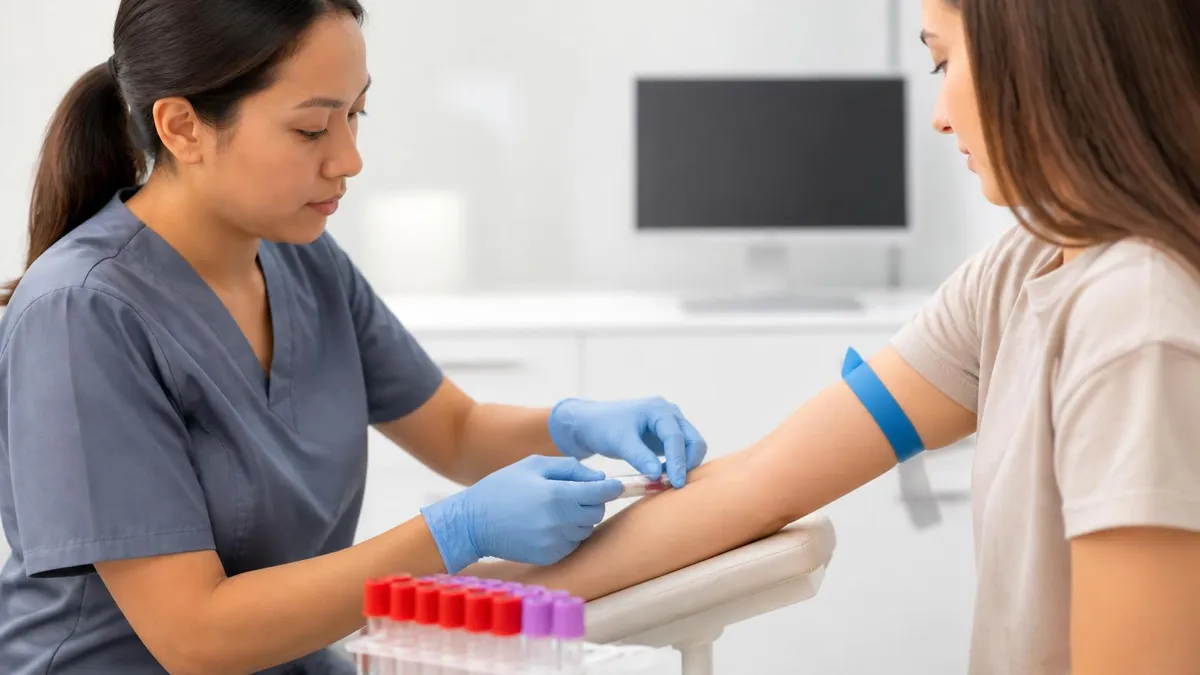
Phlebotomy Test 2026: Complete Practice Exam Prep Guide
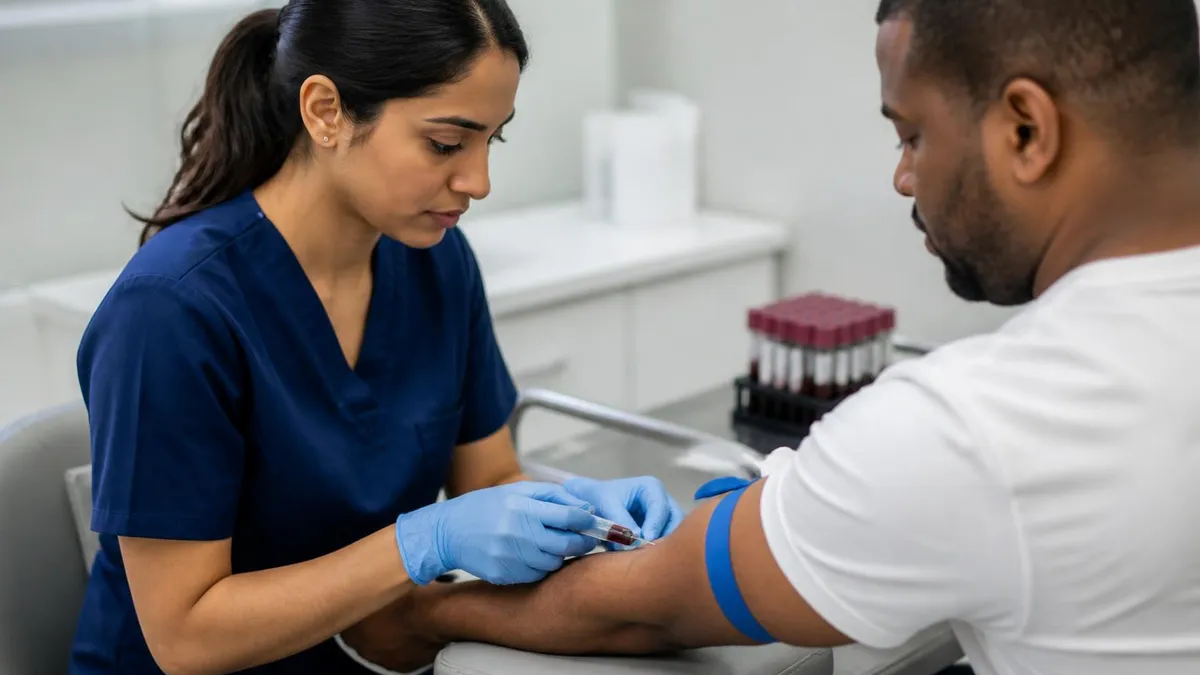
Phlebotomy Tube Colors: Complete Guide to the Order of Draw, Additives & Lab Tests
About the Author

Registered Nurse & Healthcare Educator
Johns Hopkins University School of NursingDr. Sarah Mitchell is a board-certified registered nurse with over 15 years of clinical and academic experience. She completed her PhD in Nursing Science at Johns Hopkins University and has taught NCLEX preparation and clinical skills courses for nursing students across the United States. Her research focuses on evidence-based exam preparation strategies for healthcare certification candidates.