
California Phlebotomy License: Complete CPT1 Certification Guide for 2026 October
California phlebotomy license guide: 🏆 CPT1 requirements, approved training, exam prep, fees, renewal, and career steps to become a certified phlebotomist.
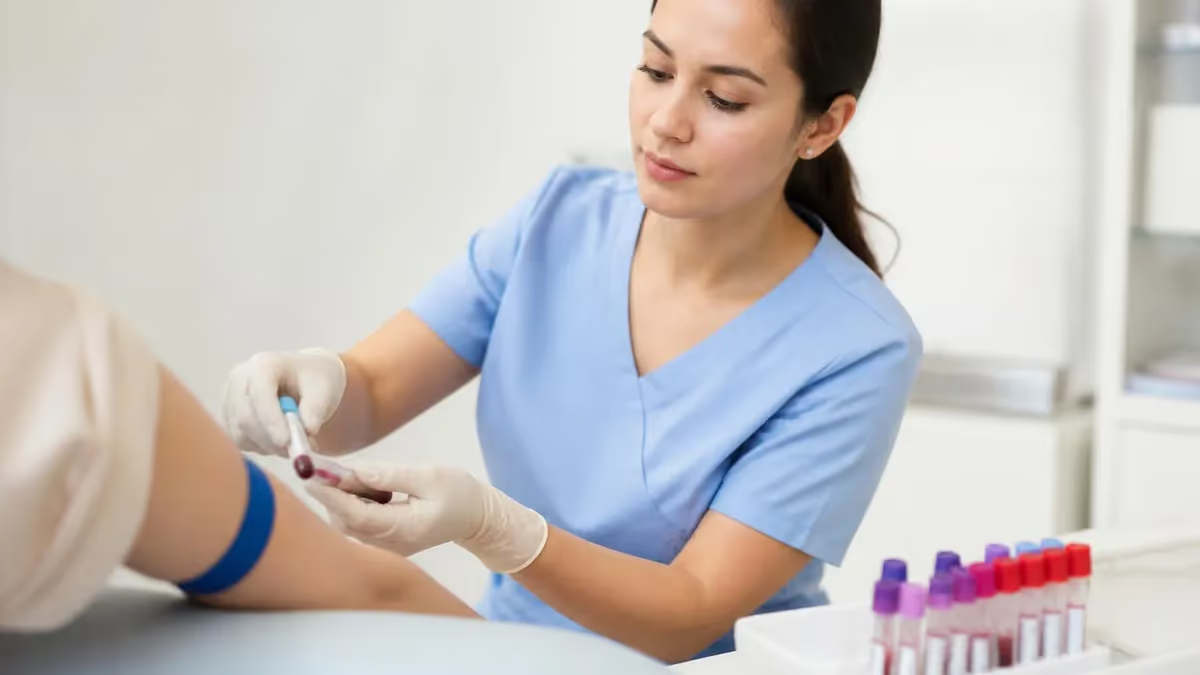
Earning a california phlebotomy license is one of the most regulated and rewarding pathways into clinical lab work in the United States. California is the only state that requires a state-issued certification before you can legally draw blood, which means the process is more structured than in any other state. If you have been searching for phlebotomy program near me options in Los Angeles, San Diego, Sacramento, or the Bay Area, you will quickly see that California Department of Public Health (CDPH) oversight shapes every classroom, externship, and exam in the state.
The credential most students pursue is the Certified Phlebotomy Technician I, commonly abbreviated as CPT1. This license lets you perform skin punctures and venipunctures in hospitals, reference laboratories, blood banks, and outpatient clinics. There is also a CPT2 license for arterial draws and a Limited Phlebotomy Technician (LPT) credential, but CPT1 is the standard entry-level title that most phlebotomy classes near me listings target for working adults.
To qualify for CPT1, California requires a high school diploma or GED, completion of a CDPH-approved training program with at least 40 didactic hours and 40 clinical hours, documentation of 50 successful venipunctures and 10 skin punctures, and a passing score on a nationally recognized phlebotomy certification exam. Once these are complete, you submit an application packet, fingerprints, and the licensing fee to CDPH for review.
California is strict because its labs serve more than 39 million people and process tens of millions of specimens each year. A poorly trained phlebotomy technician can cause hemolyzed samples, mislabeled tubes, nerve injuries, and delayed diagnoses. The CDPH framework exists to make sure every certified phlebotomy technician in the state has measurable clinical hours, supervised draws, and tested theoretical knowledge before touching a real patient.
This guide walks through every part of the licensing journey, from choosing approved phlebotomy training specialists to passing the national exam, applying to CDPH, landing your first job, and renewing every two years. You will also find salary ranges, cost breakdowns, common rejection reasons, and concrete study schedules so you can plan realistically rather than guessing.
If you are still asking what is phlebotomy at a basic level, it is the practice of collecting blood samples for diagnostic testing, transfusions, donations, or research. In California, the role goes far beyond sticking a needle. You will be expected to verify patient identity using two identifiers, follow the order of draw phlebotomy guidelines, handle hazardous waste under Cal/OSHA standards, and document every specimen in a laboratory information system.
By the end of this article you will know exactly which steps apply to you, what documents to gather, how much money to budget, and how long the entire process will take from your first class to your first paycheck as a certified phlebotomy technician in California.
California Phlebotomy License by the Numbers
Key Facts at a Glance
| Item | Value | Details |
|---|---|---|
| Typical Training Length | 4-6 months | Including externship |
| Minimum Program Hours | 80 hours | 40 didactic + 40 clinical |
| Required Live Sticks | 60 draws | 50 venous + 10 capillary |
| Renewal Cycle | 2 years | 6 CEUs required |

Step-by-Step Path to Your CPT1 License
Confirm Eligibility
Enroll in CDPH-Approved Training
Complete Required Sticks
Pass a National Exam
Submit CDPH Application
Start Working
Choosing the right school is the single most important decision in your licensing journey. California maintains an official list of CDPH-approved phlebotomy training specialists, and only programs on that list can sign your training certificate. Enrolling in an unapproved program, even an excellent one from another state, will get your CPT1 application rejected. Always cross-reference the school name with the current CDPH roster before you pay tuition or sign an enrollment contract for any program advertised as preparing you for the california phlebotomy license.
Approved programs fall into three broad categories. Community colleges like Cypress College, San Diego Mesa College, and Sacramento City College offer semester-length courses for under $1,500 including books. Private career schools such as Boston Reed, Phlebotomy Career Training, and Unitek College compress the same content into 4 to 12 weeks for $1,800 to $3,500. Hospital-based programs at Kaiser, Sharp, and Stanford are competitive but often free if you are already an employee in another role.
When you search phlebotomy courses near me, look beyond price. Ask each school about their pass rate on the national exam, their externship partners, class size, evening and weekend availability, and how quickly students complete the required 60 live sticks. A program that promises completion in two weeks may sound efficient but rarely provides enough clinical exposure for students to feel confident on day one of employment as a phlebotomy technician.
Pay close attention to the externship component. Strong programs place students at busy hospitals or reference labs where you will see pediatric, geriatric, and difficult-draw patients in a single shift. Weaker programs send students to low-volume clinics where they may go an entire day with only two or three draws, making the 60-stick minimum hard to reach within the program timeline. Ask for a list of current externship sites before enrolling.
If you plan to work while training, look for hybrid programs that deliver didactic hours online and reserve in-person time for skills lab and externship. California allows online didactic instruction as long as the clinical portion is hands-on and supervised. Many adult learners complete their phlebotomy practice test review modules at night and attend skills lab on weekends, finishing the entire program in four to six months while keeping a day job.
Financial aid is available at most community colleges and some private schools. Fill out the FAFSA early, ask about Workforce Innovation and Opportunity Act funding, and check whether your employer offers tuition reimbursement. Veterans can use GI Bill benefits at approved institutions, and CalWORKs participants may qualify for full coverage. Never finance a phlebotomy program with high-interest private loans because the salary range does not justify aggressive debt.
Finally, verify that your school issues a certificate listing the exact number of didactic hours, clinical hours, and observed draws. CDPH needs this specific language to process your application. Vague certificates that just say completed phlebotomy program without hour breakdowns are a common reason for delays and rejections at the state licensing office.
Phlebotomy Practice Test Questions
Prepare for the Phlebotomy Test exam with our free practice test modules. Each quiz covers key topics to help you pass on your first try.
Phlebotomy American Medical Certification ...
Phlebotomy Exam Questions covering American Medical Certification Association Phlebotomy. Master Phlebotomy Test concepts for certification prep.
Phlebotomy American Medical Technologists ...
Free Phlebotomy Practice Test featuring American Medical Technologists Phlebotomy. Improve your Phlebotomy Exam score with mock test prep.
Phlebotomy American Society for Clinical P...
Phlebotomy Mock Exam on American Society for Clinical Pathology Phlebotomy. Phlebotomy Study Guide questions to pass on your first try.
Phlebotomy Association of Phlebotomy Techn...
Phlebotomy Test Prep for Association of Phlebotomy Technicians. Practice Phlebotomy Quiz questions and boost your score.
Phlebotomy National Center for Competency ...
Phlebotomy Questions and Answers on National Center for Competency Testing Phlebotomy. Free Phlebotomy practice for exam readiness.
Phlebotomy National Healthcareer Associati...
Phlebotomy Mock Test covering National Healthcareer Association Phlebotomy. Online Phlebotomy Test practice with instant feedback.
Phlebotomy Order of Draw and Additives
Free Phlebotomy Quiz on Order of Draw and Additives. Phlebotomy Exam prep questions with detailed explanations.
Phlebotomy Legal and Ethics
Phlebotomy Practice Questions for Phlebotomy Legal and Ethics. Build confidence for your Phlebotomy certification exam.
Phlebotomy Safety and Infection Control
Phlebotomy Test Online for Safety and Infection Control. Free practice with instant results and feedback.
Phlebotomy Special Collection Procedures
Phlebotomy Study Material on Special Collection Procedures. Prepare effectively with real exam-style questions.
Phlebotomy Specimen Processing and Handling
Free Phlebotomy Test covering Specimen Processing and Handling. Practice and track your Phlebotomy exam readiness.
Phlebotomy Test Arterial Blood Gas Collection
Phlebotomy Exam Questions covering Test Arterial Blood Gas Collection. Master Phlebotomy Test concepts for certification prep.
Phlebotomy Test Capillary and Dermal Puncture
Free Phlebotomy Practice Test featuring Test Capillary and Dermal Puncture. Improve your Phlebotomy Exam score with mock test prep.
Phlebotomy Test Pediatric Blood Collection
Phlebotomy Mock Exam on Test Pediatric Blood Collection. Phlebotomy Study Guide questions to pass on your first try.
Phlebotomy Test Phlebotomy Anatomy and Phy...
Phlebotomy Test Prep for Test Phlebotomy Anatomy and Physiology. Practice Phlebotomy Quiz questions and boost your score.
Phlebotomy Test Phlebotomy Exam Simulation
Phlebotomy Questions and Answers on Test Phlebotomy Exam Simulation. Free Phlebotomy practice for exam readiness.
Phlebotomy Test Phlebotomy Patient Identif...
Phlebotomy Mock Test covering Test Phlebotomy Patient Identification and Communication. Online Phlebotomy Test practice with instant feedback.
Phlebotomy Test Point of Care Testing
Free Phlebotomy Quiz on Test Point of Care Testing. Phlebotomy Exam prep questions with detailed explanations.
Choosing Your Certified Phlebotomy Technician Exam
The National Healthcareer Association Certified Phlebotomy Technician exam is the most popular choice for California students because of its broad employer recognition and online proctoring option. It contains 100 scored questions plus 20 pretest items, runs two hours, and costs $117 as of 2026. The pass rate sits near 75 percent for first-time test takers from approved programs.
Content weights heavily on safety, compliance, and patient preparation, with substantial coverage of the order of draw phlebotomy sequence. NHA provides a detailed study outline, an online practice test, and printable flashcards through its PrepU portal. Scores are released immediately at PSI testing centers, and your digital certificate is emailed within 48 hours of passing.

Pros and Cons of Becoming Licensed in California
- +Highest average phlebotomy salary in the United States across metro areas
- +State-regulated training ensures uniform skill level among new graduates
- +Strong demand from hospitals, reference labs, and donation centers
- +Clear, documented pathway from training to employment in months not years
- +Credential transfers easily to other healthcare roles like medical assisting
- +Frequent overtime and shift differential opportunities at hospitals
- +License recognized nationally even though only California requires it
- −Application processing currently runs 8 to 12 weeks at CDPH
- −Total upfront cost of $1,800 to $3,500 plus exam and license fees
- −Live Scan fingerprinting required at additional cost of about $75
- −Renewal every two years with mandatory continuing education hours
- −Strict documentation requirements lead to common rejection of incomplete packets
- −Difficult-draw patients and pediatric units demand significant practice to master
- −Job market in some rural counties can be tight despite statewide demand
Complete CDPH Application Checklist
- ✓Completed CDPH Form 931 application signed in blue or black ink
- ✓Original training program completion certificate listing 40 didactic and 40 clinical hours
- ✓Documented log of 50 successful venipunctures and 10 skin punctures
- ✓Official national certification exam score report from NHA, ASCP, AMT, ACA, NCCT, or NCPT
- ✓Live Scan fingerprint clearance form from California Department of Justice
- ✓Copy of high school diploma, GED certificate, or higher academic transcript
- ✓Valid government-issued photo identification such as driver license or passport
- ✓$100 application fee payable by check or money order to CDPH
- ✓Self-addressed stamped envelope for license card return shipping
- ✓Photocopies of every document retained for personal records before mailing
Photocopy Everything Twice
CDPH receives thousands of applications each year and packets do get lost in the mail. Make two complete photocopies of every page before mailing, including your signed application and exam score sheet. Send the original packet by USPS Certified Mail with tracking so you can prove delivery date if your file goes silent past the 12 week processing window.
California consistently leads the nation in phlebotomy compensation. According to the May 2024 Bureau of Labor Statistics data, the mean annual phlebotomy salary in California is $48,720, with top performers in the Bay Area earning over $62,000 once shift differentials and overtime are included. Entry-level certified phlebotomy technician roles start around $22 per hour in metropolitan areas and $19 per hour in inland regions like Bakersfield and Fresno where the cost of living is lower.
The highest paying employers in California fall into four buckets. Major academic medical centers such as UCSF, Stanford Health, and UCLA pay $26 to $32 per hour for experienced phlebotomists. Large reference laboratories including Quest Diagnostics and LabCorp pay slightly less but offer predictable Monday through Friday schedules. Blood donation centers like Vitalant and the American Red Cross pay competitively and provide strong benefits. Hospital systems including Kaiser Permanente and Sutter Health offer union scales with steady raises.
Specialization can push compensation higher. A certified phlebotomy technician II with an arterial draw endorsement typically earns $2 to $4 more per hour than a standard CPT1. Therapeutic phlebotomy roles in hematology and oncology clinics often pay above the median because the technician manages complex patients with conditions like hereditary hemochromatosis and polycythemia vera. Pediatric phlebotomy at children hospitals also commands a premium because skilled pediatric stickers are scarce.
Career advancement opportunities are plentiful in California due to the size of the healthcare market. Many phlebotomists use the role as a launchpad into medical laboratory technician, registered nurse, or physician assistant careers. The clinical exposure, patient interaction, and HIPAA training are directly transferable. Some workers cross-train into specimen processing, point-of-care testing, or laboratory information system administration without leaving their first employer, building a career within a single hospital system.
The job outlook remains strong through 2032. BLS projects 8 percent growth nationally and California exceeds the national rate due to its aging population and expanding outpatient services. Aging baby boomers require more diagnostic testing, and the rise of home health and mobile phlebotomy services creates new niches. Companies like Getlabs, Iggbo, and Workpath are hiring California licensed phlebotomists for mobile draw services across the state at competitive rates with travel reimbursement.
To maximize your earnings, consider factors beyond base pay. Hospital phlebotomy roles often include night and weekend differentials of 10 to 25 percent, plus pension and 403b contributions. Reference lab roles trade base pay for predictable hours, paid time off, and educational reimbursement. Travel phlebotomy positions through agencies pay premium rates but require flexibility on location and shift. Research the full compensation picture, not just the hourly rate listed in the job posting.
To see how California compares with other states and explore the broader earnings landscape, review the detailed phlebotomy technician salary breakdown by region, certification level, and experience tier before committing to a specific employer or geographic area.

The top three reasons CDPH rejects CPT1 applications are missing externship hour breakdowns on training certificates, illegible or expired Live Scan results, and exam score reports older than five years. Double-check every date and signature before mailing. A single missing initial on the externship log can delay your license by two months and force a complete resubmission.
Your CPT1 license is valid for two years from the date of issue, and renewal is mandatory if you want to keep working as a certified phlebotomy technician in California. The renewal cycle requires you to complete a minimum of six continuing education units from CDPH-approved providers, pay a $100 renewal fee, and submit a renewal application before your current license expires. There is no grace period that lets you keep working past the expiration date, so plan ahead by at least 90 days.
Continuing education topics must directly relate to phlebotomy practice. Acceptable subjects include infection control updates, new equipment and safety devices, pediatric draw techniques, geriatric venipuncture challenges, specimen handling regulations, professional ethics, and HIPAA compliance. Webinars from your national certifying body usually qualify automatically. Local hospital in-service training often counts as well if the provider is on the approved list, so always confirm before paying for any course.
Free continuing education is widely available if you know where to look. Major vendors like BD, Greiner, and Sarstedt offer no-cost webinars on their newest products that count toward your hours. The California Society of Pathologists hosts free educational events throughout the year. Hospital employers typically provide more than enough internal CEUs to satisfy the requirement, and many union contracts cover external course fees if you work in unionized settings throughout the California healthcare system.
Keep careful records of every continuing education course. CDPH can audit your renewal at any time, and you must produce certificates of completion showing the date, provider name, topic, and hours awarded. Store digital copies in cloud storage and keep printed copies in a binder. Auditors typically request documentation within 30 days, and failure to produce it results in license suspension and possible disciplinary action that becomes part of your public record permanently.
If your license lapses, you have a limited window to reinstate without retesting. Within one year of expiration, you can pay a late fee and submit current CEU documentation to reinstate. Beyond one year, CDPH may require you to retake your national exam and complete refresher training. Beyond three years of inactivity, expect to repeat the full approved program and exam process from scratch. The penalties are significant, so renew on time every cycle.
Moving out of California does not require any action with CDPH because no other state mandates a state license for phlebotomy. Your national certification from NHA, ASCP, AMT, or another body carries over to all 49 other states. However, if you plan to return to California within three years, keep your CPT1 active through CEUs and renewal fees so you do not have to start over. The cost of maintaining the license is far lower than rebuilding it from zero.
Discipline matters in California. The state can suspend or revoke your license for documented patient harm, falsified records, drug or alcohol impairment on duty, criminal convictions, or fraudulent CEU claims. Maintain the same professional standards you learned in training, follow proper phlebotomy order of draw protocols every time, and document every incident accurately to protect both patients and your career long term.
Final preparation for the national exam and your first job deserves a deliberate strategy. Most students who fail the certification exam do so not from lack of knowledge but from poor test-taking habits. Build a study schedule that covers all six domains: safety and infection control, patient preparation, routine blood collection, special collections, processing, and laboratory operations. Spread your study across six to eight weeks rather than cramming in the final days before your scheduled test date.
Use multiple question banks because each certifying body writes items slightly differently. Working through 1,000 to 2,000 practice questions across NHA, ASCP, AMT, and ACA style banks exposes you to every angle the test makers can take on a given topic. Track which domains generate the most errors and double down on those weak spots. Most students discover their gaps are in additive interference, order of draw, and quality control rather than the venipuncture mechanics they practiced in lab.
Master the order of draw cold. Yellow blood culture bottles come first, followed by light blue sodium citrate, then red or gold serum tubes, then green heparin, then lavender EDTA, and finally gray sodium fluoride. Exam writers love trick questions where one wrong tube order would cause carryover contamination. Practice reciting the sequence backward and forward, naming each additive, additive action, and lab tests that depend on the integrity of that specific tube color.
Set up your testing day for success. Sleep at least seven hours the night before, eat a balanced breakfast, arrive at the testing center 30 minutes early, and bring two forms of identification. Computer-based exams allow scratch paper, so draw a quick order of draw cheat sheet during your tutorial minutes before the timer starts on real questions. This single trick saves precious seconds on every tube-related question you face during the timed examination.
For job hunting after licensure, apply broadly during the final weeks of your training rather than waiting for the CDPH card to arrive. Many California employers will conditionally hire you contingent on receiving the license. Hospitals, reference labs, and blood centers all have constant openings. Tailor your resume to highlight your live stick count, the diversity of patients seen during externship, and any electronic health record systems you used during clinical rotations like Epic or Cerner.
Network during your externship. Your preceptor and the lab manager at your clinical site are your first professional references and often your first job lead. Show up early, stay late, ask intelligent questions, and treat every draw like an audition. Many California phlebotomy careers begin with a direct hire from the externship site because the team already knows your work ethic, technique, and ability to handle difficult patients under realistic clinical pressure.
Once you start working, commit to continuous improvement. Track your difficult-draw success rate, learn the special protocols for blood bank specimens, and volunteer for pediatric and geriatric rotations. The phlebotomists who advance fastest in California are those who develop deep expertise quickly and become the go-to person for hard sticks, special collections, and training new staff. That reputation drives raises, promotions, and opportunities throughout your entire healthcare career.
Sample Phlebotomy Practice Questions
Try these questions from our free Phlebotomy practice tests. The correct answer and an explanation follow each question.
What certification does the American Medical Certification Association (AMCA) offer for phlebotomy professionals?
- A. Certified Clinical Laboratory Specialist (CCLS)
- B. Phlebotomy Technician Certification (PTC)**
- C. National Phlebotomy Certification (NPC)**
- D. Licensed Blood Collection Specialist (LBCS)**
Answer: B. Phlebotomy Technician Certification (PTC)**
The American Medical Certification Association (AMCA) offers the Phlebotomy Technician Certification (PTC) for individuals working in phlebotomy. This specific credential signifies that the holder has met AMCA's rigorous standards for competence in blood collection procedures and patient care. It is their distinct certification for phlebotomy professionals.
Which ASCP certification is specifically designed for phlebotomy technicians who have completed an accredited phlebotomy program?
- A. MLT(ASCP)
- B. PBT(ASCP)
- C. MLS(ASCP)
- D. CLSup(ASCP)
Answer: B. PBT(ASCP)
PBT(ASCP) stands for Phlebotomy Technician certified by the American Society for Clinical Pathology.
How many continuing education units (CEUs) must NHA-certified phlebotomy technicians complete before renewing their certification?
- A. 10 CEUs
- B. 15 CEUs
- C. 20 CEUs
- D. 25 CEUs
Answer: A. 10 CEUs
NHA CPT holders must complete 10 CEUs every two years to maintain their certification.
What is a primary eligibility requirement for the AMCA Phlebotomy Technician Certification exam?
- A. Completion of a formal phlebotomy training program
- B. Bachelor’s degree in a medical-related field
- C. One year of work experience in a non-medical role
- D. Supervisory experience in a clinical laboratory
Answer: A. Completion of a formal phlebotomy training program
To be eligible for the AMCA Phlebotomy Technician Certification exam, candidates must typically complete a formal phlebotomy training program. This requirement ensures they have received comprehensive instruction and practical experience in venipuncture techniques, safety protocols, and specimen handling. This foundational training is crucial for safe and effective practice.
Phlebotomy Questions and Answers
Phlebotomy Exam 2026: Complete Certification Study Guide & Practice
Phlebotomy: Classes, Certification, Salary & Career Guide
Phlebotomy Certification Exam 2026: Complete Guide to NHA CPT, ASCP PBT, AMT, NCCT & ASPT
Phlebotomy Test 2026: Complete Practice Exam Prep Guide
Phlebotomy Practice Exam: Free Questions, Format, and Scoring
About the Author

Registered Nurse & Healthcare Educator
Johns Hopkins University School of NursingDr. Sarah Mitchell is a board-certified registered nurse with over 15 years of clinical and academic experience. She completed her PhD in Nursing Science at Johns Hopkins University and has taught NCLEX preparation and clinical skills courses for nursing students across the United States. Her research focuses on evidence-based exam preparation strategies for healthcare certification candidates.