
Firefighter Paramedic: Dual-Role Career, Training & Salary Guide 2026 September
Firefighter paramedic salary $60K-$110K. Step-by-step dual-role pathway: EMT, fire academy, paramedic school, certifications, top cities hiring. ✏️
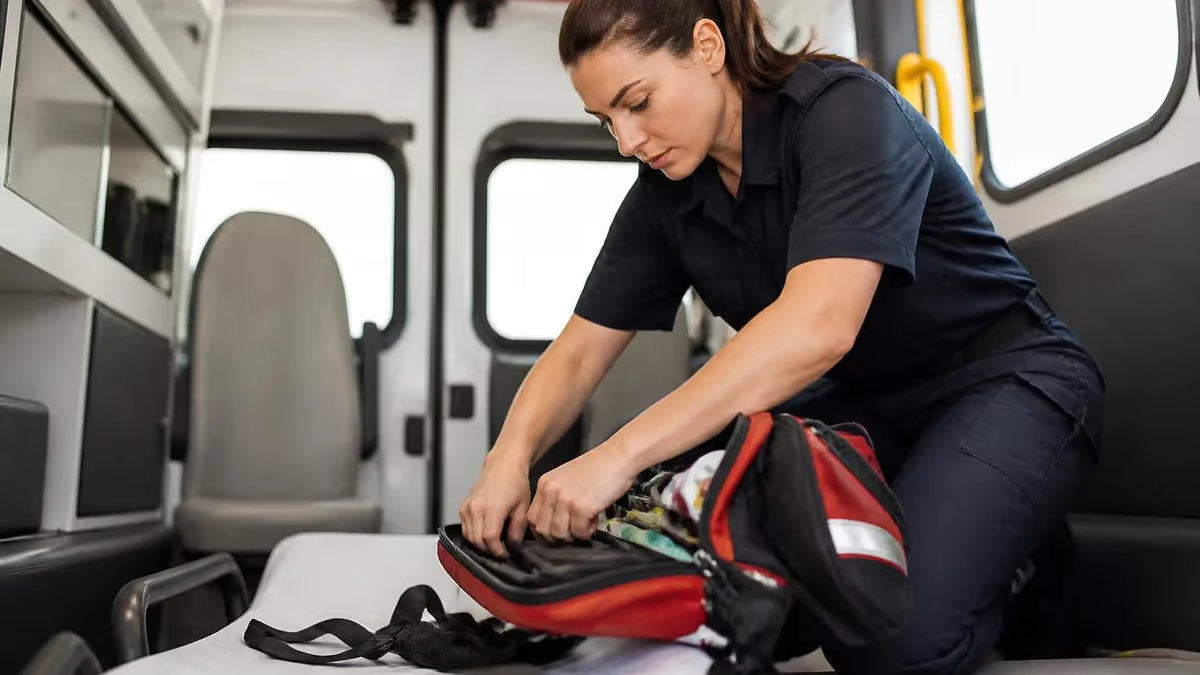
Dual-Role Emergency Responder
A firefighter paramedic is a cross-trained first responder who handles both fire suppression and advanced life support (ALS) medical calls from the same fire apparatus. Roughly 80% of modern fire department calls are EMS-related, which is why most large metro fire agencies now prefer or require paramedic certification for new hires. The dual role pays significantly more than a standalone paramedic position, typically $60,000 to $110,000+ with overtime, pension, and full benefits.
Firefighter Paramedic: Dual-Role Career, Training, and Salary Guide
The firefighter paramedic is one of the most demanding and best-paid jobs in emergency services. Unlike a standalone paramedic who responds to medical calls in an ambulance, a firefighter paramedic rides on a fire engine or rescue squad and switches between pulling a hoseline at a structure fire and starting an IV on a cardiac arrest patient — sometimes in the same shift. Cities love this model because one cross-trained crew can handle anything that gets dispatched, which saves the municipality from running parallel EMS and fire divisions.
If you are weighing the EMS side of the career against the fire side, start with the EMT vs paramedic comparison — it walks through the certification ladder that every dual-role candidate climbs. You can also read what is a paramedic for a deep dive on the clinical scope of practice. This guide focuses specifically on the firefighter paramedic track: how it differs from the standalone paramedic role, the order in which you complete certifications, what departments pay, and which agencies actively hire dual-certified candidates right now.
The dual-role pathway is not faster than becoming a single-discipline paramedic — it is longer. You complete every credential a regular paramedic earns, plus a full firefighter academy and IFSAC or Pro Board firefighter certifications. The payoff is a 40 to 70 percent salary premium, a 25-year pension in many states, and a clear promotion ladder into engineer, captain, and battalion chief positions. Standalone paramedics rarely see that kind of trajectory without leaving the field.
One thing to know up front: order of operations matters. Some departments hire firefighters first and pay for paramedic school, others require paramedic certification before they will look at your application, and a few run concurrent academies that produce a dual-certified hire in 18 to 24 months. The right sequence depends on where you live and which agencies you are targeting. The rest of this guide walks through the role, the training pipeline, the money, and the departments worth applying to.
What Does a Firefighter Paramedic Actually Do?
On any given 24-hour shift, a firefighter paramedic might run a dozen EMS calls and one structure fire — or, in a busy urban district, twenty EMS calls and zero fires. The job is medical work most of the time, with the hazardous, physically punishing fire side reserved for a smaller slice of the shift. Departments still require full firefighter certification because when the structure fire does happen, the same crew must be ready to mask up and make entry.
Typical EMS responsibilities mirror those of any ALS provider: airway management, IV access, 12-lead ECG interpretation, ACLS-level cardiac drugs, manual defibrillation, intraosseous access, advanced trauma care, and pediatric resuscitation under PALS protocols. Typical fire responsibilities include hose and ladder operations, search and rescue, ventilation, vehicle extrication, hazmat awareness response, and wildland or technical rescue depending on the agency's territory.

Firefighter Paramedic vs Standalone Paramedic — The Core Differences
- Employer: Fire department (municipal)
- Apparatus: Fire engine, rescue, ladder truck
- Schedule: 24/48 or 48/96 shift
- Salary range: $60K – $110K + OT
- Pension: Yes (typically 3% at 50–55)
- Training: Fire academy + paramedic + EMT
- Employer: Private EMS or hospital
- Apparatus: Ambulance only
- Schedule: 12-hr or 24-hr shifts
- Salary range: $35K – $70K
- Pension: Rare (401k typical)
- Training: EMT + paramedic only
Why Fire Departments Prefer Paramedics
The shift toward all-paramedic fire suppression crews is driven by economics and response time. When 80 percent of 911 calls are medical, running separate ambulance and fire divisions doubles the labor cost. Cross-training the fire crew lets the engine company arrive on scene in four to six minutes — usually faster than the transport ambulance — and start ALS care immediately. A patient in cardiac arrest gets defibrillation and epinephrine on the engine, then transfers to the ambulance for the ride to the hospital. That window matters: every minute without defibrillation in V-fib drops survival odds by roughly 10 percent.
Larger metros — Los Angeles County, Chicago, Phoenix, Boston, Miami-Dade, FDNY — staff most or all of their front-line apparatus with at least one paramedic. Some, like Seattle's Medic One, run dedicated paramedic engine companies. Smaller agencies that historically ran BLS engines are upgrading because the National Fire Protection Association (NFPA) and many state EMS bureaus now expect ALS-level response in urban service areas. For candidates, that means the dual-role job is growing while standalone EMS positions are shrinking in cities that have absorbed transport into the fire department.
How to Become a Firefighter Paramedic: The Step-by-Step Pathway
There is no single national route. The fastest legal path takes about 18 months; a more typical timeline runs three to four years from your first EMT class to your first day on shift as a dual-certified firefighter paramedic. The pathway below is the most common sequence in the United States. For a deeper certification-by-certification breakdown of the medical side, see the article on become a paramedic.
Most candidates start with EMT-Basic because it is the cheapest credential to test the waters. A four-month EMT course costs around $1,000 and gets you on a transport ambulance or as a firefighter recruit at a smaller department. From there, you can either go straight into a paramedic program or apply to fire departments that will hire you as a firefighter recruit, send you to fire academy, and pay for paramedic school after probation.
The order is not just bureaucratic — it changes how much debt you finish with. Agencies that pay for paramedic school can cover $10,000 to $18,000 of tuition, and you earn a firefighter salary the whole time. Self-paying for paramedic school first costs you out of pocket but qualifies you for departments that require the medic cert at the application stage. Research the agencies you want to work for before you choose the sequence.
Firefighter Paramedic Training Pathway
Step 1: EMT-Basic Certification
Step 2: Choose Your Order — Fire First or Medic First
Step 3: Paramedic Program (if going medic-first)
Step 4: Pass CPAT (Candidate Physical Ability Test)
Step 5: Fire Department Hiring Process
Step 6: Fire Academy
Step 7: Paramedic Academy (if employer-sponsored)
Step 8: Field Probation
Required Certifications and Licenses
The credential stack for a firefighter paramedic is longer than almost any other entry-level public-safety job. Every department has its own list, but the certifications below are universal across the United States. Most must be renewed on a two- to four-year cycle once you are on shift, and continuing education hours are tracked by the state EMS bureau and the fire training board.
Plan for ongoing testing throughout your career. The NREMT recertification cycle requires 60 hours of continuing education every two years; ACLS and PALS expire every two years and require an 8-hour recert class; firefighter certs renew on the agency's schedule. If you want to test your readiness for the medic side of the credentialing exam, our free paramedics exam practice tests cover the same content domains the NREMT-Paramedic exam tests on.
Hazmat awareness is a frequently overlooked credential. Federal OSHA rules require it for any firefighter responding to a hazardous-materials scene, and many states layer in a Hazmat Operations certification on top of awareness. Most academies bundle both during recruit training. Beyond the entry stack, a Class B CDL (with airbrake endorsement) is required by a growing list of agencies because fire apparatus exceeds 26,000 pounds GVWR. If your state issues a non-commercial firefighter exemption, check whether the cities you want to work in honor it.
The Physical Agility Test (CPAT)
The Candidate Physical Ability Test is the standardized fire department fitness exam used by most US agencies. It is run in a single sequence wearing a 50-pound weighted vest plus an additional 25 pounds on the stair-climb event to simulate hose load.
The eight events — stair climb, hose drag, equipment carry, ladder raise and extension, forcible entry, search, rescue drag, ceiling breach and pull — must be completed in 10 minutes 20 seconds with no rest stops. Cardio capacity is the limiting factor for most candidates, not raw strength. Most departments host CPAT prep sessions, and accredited testing centers across the country administer the official exam for around $150.
Train for CPAT the way firefighters actually work: short bursts of intense work followed by short rest, repeated for an hour. Stair-climbing with a weighted vest at a sustained 60 steps per minute is the foundation drill. Add high-repetition farmer carries, sledgehammer tire strikes, and dummy drags to round out the simulation. Most candidates who fail CPAT do not fail any one event — they fail the cumulative cardio load. Two months of dedicated training is the minimum for a recreationally fit candidate; out-of-shape applicants should plan for four to six months of structured preparation.

Required Certifications Checklist
- ✓NREMT-Paramedic (or state paramedic license)
- ✓EMT-Basic certification (held continuously)
- ✓IFSAC or Pro Board Firefighter I & II
- ✓Hazmat Awareness and Operations (NFPA 472)
- ✓ACLS (Advanced Cardiac Life Support)
- ✓PALS (Pediatric Advanced Life Support)
- ✓ITLS or PHTLS (trauma life support)
- ✓CPAT (Candidate Physical Ability Test) pass
- ✓State EMT/paramedic license (varies by state)
- ✓Class B or C CDL (required by some agencies)
- ✓Clean background check & drug screen
- ✓NFPA 1582 medical clearance
Firefighter Paramedic Salary — National Numbers
Firefighter Paramedic Salary by City and State
Pay swings hard by geography. The single biggest driver is whether the department is a paid municipal agency in a high cost-of-living metro versus a smaller career or combination department. California and the Pacific Northwest pay the most by a wide margin. Texas, Florida, and the Carolinas pay less in base salary but offer lower cost of living and aggressive overtime. The Midwest and Northeast vary widely city by city. For a category-wide salary perspective, our paramedic salary guide breaks the EMS-only numbers down by state.
Overtime is structural in this job. The 24/48 shift schedule produces a built-in 56-hour workweek, and federal Fair Labor Standards Act rules require overtime pay above 53 hours in a 7-day pay cycle for fire personnel. Many firefighter paramedics earn 25 to 40 percent of their total comp from OT alone. In high-cost departments like Los Angeles County or San Francisco, a fourth- or fifth-year firefighter paramedic regularly clears $150,000 in total compensation with no special assignment.
Paramedic premium pay is the other meaningful comp lever. Most departments add 5 to 15 percent on top of base salary for the paramedic credential, paid only while you are riding a paramedic-staffed apparatus. Some agencies pay a flat dollar stipend (typically $400 to $900 per pay period); others bake it into a higher pay step. Specialty assignments — hazmat technician, urban search and rescue, dive rescue, technical rope rescue — stack additional premiums on top, often 5 percent each. Stacked specialists in California departments routinely add 25 to 35 percent to base.
Top US Fire Departments Hiring Paramedics
The agencies below are large, actively hiring, and known for strong dual-role pipelines. Most run a paramedic-required or paramedic-preferred hiring track. Application windows open and close on different cycles, so set up email alerts on each department's recruiting page rather than waiting for an annual exam. Once you have decided where you want to apply, download our paramedic practice test PDF to drill the clinical knowledge that the entry exam and the academy clinical evaluations cover.
Top 5 Fire Departments Hiring Firefighter Paramedics
Los Angeles County Fire Department staffs over 175 stations and 4,800+ uniformed personnel across 58 cities. Starting firefighter paramedic salary is roughly $84,000 base, with total comp commonly reaching $120,000+ in year one with OT. LA County offers a sponsored paramedic program for incumbent firefighters — you can hire on as a firefighter-EMT and the department pays for paramedic school after probation. Pension: 3% at 55 under the CalPERS Safety formula. Application opens annually; competition is severe (often 5,000+ applicants for 100 academy slots).

Firefighter Paramedic Career — Honest Pros and Cons
- +Significantly higher pay than standalone paramedic — $60K to $110K+ base with strong overtime
- +Defined-benefit pension in most agencies (3% at 50 or 55 in many states)
- +Clear promotion ladder: firefighter → engineer → captain → battalion chief
- +24/48 or 48/96 shift schedule gives long blocks of off-duty time
- +Comprehensive health, dental, and disability benefits for the whole family
- +Job security — fire departments rarely lay off uniformed personnel
- +Strong union representation and structured grievance protections
- +Tuition reimbursement common for paramedic school and degree programs
- −Long training pipeline — 2 to 4 years from first EMT class to dual-cert shift work
- −High call volume in urban departments causes chronic sleep deprivation
- −Cumulative trauma exposure — PTSD rates run 20% in career firefighter paramedics
- −Cancer exposure higher than general population (carcinogens in fire smoke)
- −Physical injury risk (back, knee, shoulder) from heavy lifting on EMS calls
- −Mandatory overtime can wreck personal schedules during staffing shortages
- −Some departments still pay paramedic premium poorly relative to workload
- −Promotional exams are competitive and slow — captain promotion can take 12+ years
Shift Schedules, Pension, and Long-Term Compensation
The standard US fire department shift is 24 hours on duty followed by 48 hours off duty (24/48), giving you 10 days on duty per month. A handful of agencies — Boston Fire, Honolulu Fire, several California departments — run 48/96 schedules, where you work two consecutive 24-hour shifts and then have four days off. The 48/96 model is popular because it reduces commute days and gives a stretch of recovery time, but it concentrates fatigue into a longer window. Either schedule produces the FLSA-mandated overtime cycle that drives the OT premium.
Pension is where firefighter paramedic compensation pulls dramatically ahead of standalone EMS. Most state systems use a service formula like 3% per year of service, multiplied by final salary, capped between 75% and 90%. A firefighter paramedic who retires at 25 years receives a lifetime pension of about 75% of final base — typically $60,000 to $90,000 per year for life, indexed for inflation in some states. Standalone paramedics in private EMS almost never see anything close to this; they get a 401(k) match if they are lucky.
Career Progression: Engineer, Captain, Battalion Chief
The fire side of the job offers a defined promotional track. Most candidates start as a firefighter paramedic (or firefighter EMT-then-paramedic), then test for engineer or driver-operator after three to five years. Engineer roles add $5,000 to $12,000 to base salary and shift responsibility to apparatus operation and pump operations.
Captain comes next, usually 7 to 12 years in, and brings supervisory authority over a station and engine company plus a $15,000 to $25,000 raise. Battalion chief and above are administrative roles that take 15 to 25 years to reach. Each step requires testing — written exam, oral board, sometimes an assessment center — and competition is real, especially at captain rank and up.
Total Training Investment — What It Costs to Get Started
Becoming a Firefighter Paramedic in Illinois (and Other Key States)
State EMS rules add wrinkles to the national pathway. Illinois, for example, requires reciprocity through the Illinois Department of Public Health if you completed paramedic school out of state, and Chicago Fire only recognizes Illinois paramedic licenses for ambulance assignments. California requires a separate California Paramedic License through the EMS Authority on top of NREMT-Paramedic, plus county accreditation in whichever county you work. Florida runs its own state EMT and paramedic certification through the Department of Health.
The practical workflow if you are out of state: get NREMT-Paramedic first, then apply for reciprocity in the destination state, then apply to local departments. Some states require an additional state-specific written exam (Massachusetts and California both have one). If you are unsure where to start practicing for the clinical knowledge component, a wider set of free paramedics exam practice tests covers airway, cardiology, trauma, medical emergencies, and EMS operations — the same domains the NREMT exam draws from.
Mental Health, Burnout, and the Long Haul
Career longevity is the unspoken challenge of dual-role work. The combination of high call volume, sleep deprivation across 24-hour shifts, and repeated exposure to traumatic incidents (pediatric arrests, fatal motor vehicle collisions, structure fire fatalities) produces measurable burnout and PTSD rates higher than almost any civilian career. Best estimates from peer-reviewed studies put career-long PTSD prevalence at around 20 percent for urban firefighter paramedics — roughly four times the general population.
Successful long-career firefighter paramedics treat their mental health the same way they treat their physical fitness: deliberately. Most large agencies now offer free peer support teams, employer-paid counseling, and critical incident stress management debriefs after major calls. Use them. The culture has shifted in the past decade — admitting that a call affected you is no longer career-ending in most departments, and pretending otherwise burns careers out at year fifteen.
The biggest mistake candidates make is choosing the wrong order between fire academy and paramedic school. Some departments will not consider applicants without paramedic certification already in hand. Others specifically require firefighter certification first and refuse to hire paramedics they cannot send through their own academy. Before you spend a year and $15,000 on paramedic school, contact the recruiting officer at your top 3 target agencies and ask point-blank what credential they require at the application stage. The answer determines your training sequence. Getting this wrong can add 18 months and $20,000 to your timeline.
Paramedic Questions and Answers
Related Paramedic Career Guides




About the Author

Paramedic & Emergency Services Certification Trainer
George Washington UniversityCaptain Ryan O'Brien is a licensed paramedic and NREMT-certified emergency medical professional with a Bachelor of Science in Emergency Medical Services from George Washington University. He has 15 years of field experience as a paramedic and firefighter, and has coached hundreds of EMT and paramedic candidates through their NREMT written and psychomotor licensing examinations.
Join the Discussion
Connect with other students preparing for this exam. Share tips, ask questions, and get advice from people who have been there.
View discussion (7 replies)