
What Is a Paramedic? Role, Training, and Career Path Explained 2026 September
What is a paramedic? A licensed advanced pre-hospital provider who runs IVs, 🏆 drugs, intubation, and defibrillation. Full role, training, and salary guide.
Paramedic at a Glance

What Is a Paramedic? A Clear Definition
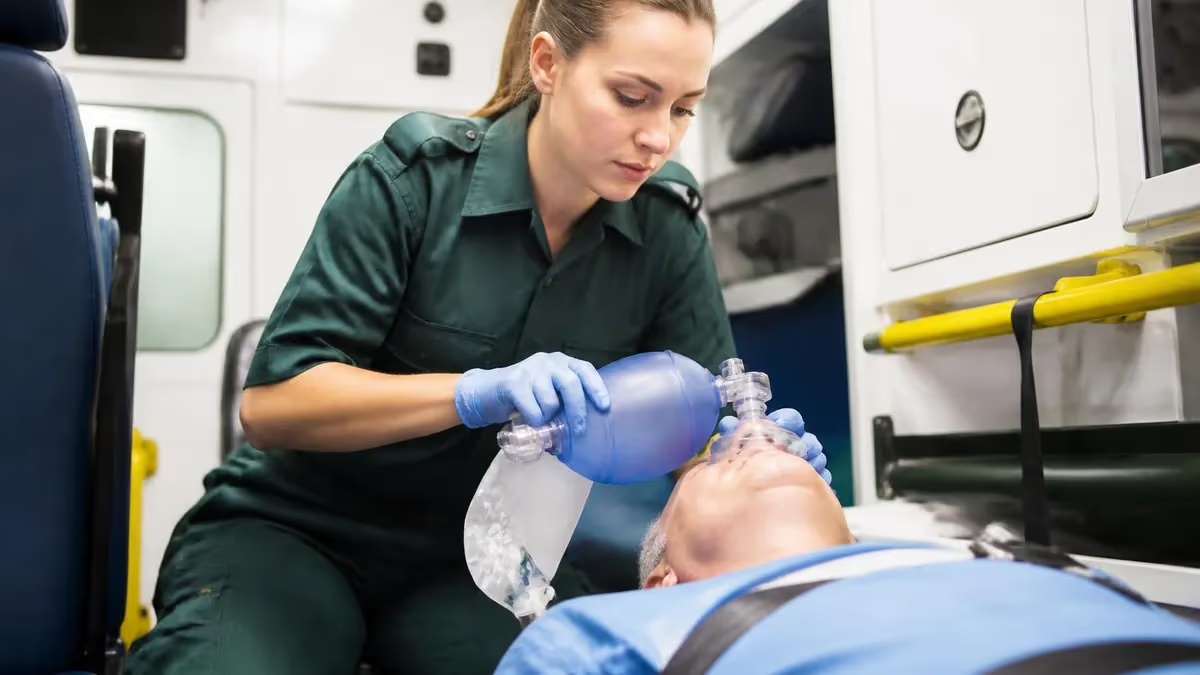
A paramedic is a licensed, advanced pre-hospital emergency medical provider who delivers Advanced Life Support (ALS) outside the hospital. When 911 goes out for a heart attack, a serious crash, or an overdose, the paramedic is usually the highest-trained clinician on scene. They can start IV lines, push cardiac drugs, intubate a patient who isn't breathing, run a 12-lead ECG, and make care decisions that, twenty years ago, only happened inside an ER.
That's the short answer. The longer answer is that the role sits between an EMT and a hospital nurse, with a scope of practice that's narrower than a nurse's but broader than most people imagine. Paramedics work under medical direction from a physician, follow written protocols, and bring the emergency room to the patient. They don't just drive ambulances. They run codes in living rooms, deliver babies in stairwells, and stabilize trauma patients before the helicopter lands.
If you're considering this career, the first stop is usually the paramedics exam route — passing the National Registry exam is the gateway to a state license. The paramedic salary picture varies a lot by state, agency, and shift type, but the role is in steady demand nationwide. Before you commit, it helps to understand exactly what the day-to-day looks like, what you can and can't do, and how the title differs from EMT or AEMT.
This guide walks through the full picture — definition, scope, training pathway, work settings, salary range, and career advancement — so you can decide whether this path fits the way you want to work.
What Do Paramedics Do? The Real Job Description
Paramedics respond to 911 emergencies and inter-facility transfers. The call types swing wildly across a single shift: chest pain at 8 a.m., a fender bender at 10, a diabetic emergency at noon, a psychiatric crisis at 2, a cardiac arrest at 4. Each call gets the same opening — scene safety, primary assessment, vitals, history — but the path branches fast based on what they find.
On a typical shift, a paramedic will assess patients head-to-toe, decide whether the problem is life-threatening, choose interventions from a protocol set, communicate with the receiving hospital, and document everything. They lift patients, comfort families, and sometimes deliver hard news on the worst day of someone's life. It's a job that demands clinical sharpness and emotional steadiness in roughly equal measure.
Scope of Practice: What a Paramedic Can Actually Do
Scope varies a little by state, but the federal NREMT scope is the baseline almost everywhere. A paramedic operates at the Advanced Life Support level, which means they bring tools an EMT simply can't carry. The difference matters when seconds count.
At the airway end, paramedics perform endotracheal intubation, place supraglottic airways like an i-gel, perform needle decompression for a tension pneumothorax, and in many systems run a surgical cricothyrotomy when a patient can't be intubated. They start peripheral IVs and intraosseous (IO) lines for fluid and medication access. They run a manual 12-lead ECG and interpret it on scene — STEMI calls get diverted directly to a cardiac cath lab, often skipping the ER entirely.
On the pharmacology side, paramedics carry and administer 30 to 50 medications depending on the system: epinephrine for cardiac arrest, amiodarone for unstable rhythms, midazolam for seizures, ketamine for severe agitation or pain, naloxone for opioid overdoses, dextrose for hypoglycemia, and a long list of others. They defibrillate, cardiovert, and pace patients in unstable rhythms. They can perform synchronized cardioversion, which an EMT can't. People often ask can paramedics intubate — yes, intubation is one of the defining paramedic skills, and it's tested heavily on the paramedics exam.
What they generally can't do: prescribe medications outside the protocol set, perform surgery, suture lacerations (with rare exceptions), or treat anything chronic. Paramedic care is acute, episodic, and tied to a transport decision. The job ends when the patient is handed off to the hospital team.
Paramedics Practice Test Questions
Prepare for the Paramedics Exam exam with our free practice test modules. Each quiz covers key topics to help you pass on your first try.
Paramedics Paramedic Exam EMT
Paramedics Exam Questions covering Paramedic Exam EMT. Master Paramedics Test concepts for certification prep.
Paramedics Airway, Respiration, and Ventil...
Free Paramedics Practice Test featuring Airway, Respiration, and Ventilation. Improve your Paramedics Exam score with mock test prep.
Paramedics Cardiology and Resuscitation
Paramedics Mock Exam on Cardiology and Resuscitation. Paramedics Study Guide questions to pass on your first try.
Paramedics EMS Operations and Safety
Paramedics Test Prep for EMS Operations and Safety. Practice Paramedics Quiz questions and boost your score.
Paramedics Exam Airway Management
Paramedics Questions and Answers on Exam Airway Management. Free Paramedics practice for exam readiness.
Paramedics Exam EMS Communications
Paramedics Mock Test covering Exam EMS Communications. Online Paramedics Test practice with instant feedback.
Paramedics Exam Major Incident Response
Free Paramedics Quiz on Exam Major Incident Response. Paramedics Exam prep questions with detailed explanations.
Paramedics Exam Pediatric Emergencies
Paramedics Practice Questions for Exam Pediatric Emergencies. Build confidence for your Paramedics certification exam.
Paramedics Exam Rescue Operations
Paramedics Test Online for Exam Rescue Operations. Free practice with instant results and feedback.
Paramedics Medical Emergencies and Obstetrics
Paramedics Study Material on Medical Emergencies and Obstetrics. Prepare effectively with real exam-style questions.
Paramedics Pharmacology and Medication Adm...
Free Paramedics Test covering Pharmacology and Medication Administration. Practice and track your Paramedics exam readiness.
Paramedics Trauma Assessment and Management
Paramedics Exam Questions covering Trauma Assessment and Management. Master Paramedics Test concepts for certification prep.
Paramedics Airway, Respiration & Ventilation
Free Paramedics Practice Test featuring Airway, Respiration & Ventilation. Improve your Paramedics Exam score with mock test prep.
Paramedics Cardiology & Resuscitation
Paramedics Mock Exam on Cardiology & Resuscitation. Paramedics Study Guide questions to pass on your first try.
Paramedics EMS Operations
Paramedics Test Prep for EMS Operations. Practice Paramedics Quiz questions and boost your score.
Paramedics Medical Emergencies
Paramedics Questions and Answers on Medical Emergencies. Free Paramedics practice for exam readiness.
Paramedic vs EMT vs AEMT: Side-by-Side
Emergency Medical Technician — the entry-level provider. Training runs 120 to 200 hours, ending in the NREMT-EMT exam. EMTs handle Basic Life Support: CPR, AED, oxygen, splinting, bleeding control, glucometry, and assisting with a patient's own prescribed medications. They cannot start IVs, push most drugs, or intubate. Most EMTs work on BLS ambulances, fire engines, or as the second provider on an ALS rig. Salary typically lands in the $30K–$45K range. The EMT vs paramedic comparison is the most common career question in EMS.
Where Do Paramedics Work?
The ambulance is the most visible workplace, but it's far from the only one. Paramedics show up in fire departments, hospitals, helicopters, oil rigs, factory floors, military units, cruise ships, and tactical police teams. The setting shapes the schedule, the pay, and the patient mix more than the certification itself does.
Most paramedics start their careers on a 911 ambulance, either with a municipal service, a private contractor like AMR or Falck, or a fire-based EMS system. From there, the paths fan out. Some move into hospital-based critical care transport. Some take to the air with HEMS programs.
Some go offshore for two-on, two-off oil and gas rotations that pay well but isolate you from family. The good news is the paramedics exam credential opens doors across every one of those settings — the license is the same. What changes is the protocol set, the dispatch criteria, and the truck (or aircraft) you climb into.
Common Work Settings at a Glance
Each setting has its own rhythm. Urban 911 paramedics run a high call volume — sometimes 12 to 18 calls in 24 hours — with a heavy mix of medical emergencies, overdoses, and trauma. Rural paramedics may run only 2 to 4 calls in a shift but cover huge geographic areas, sometimes transporting 90 minutes to the nearest hospital.
Flight paramedics see lower volume but much sicker patients, and the cabin work is technically demanding because the helicopter is loud, cramped, and moving. Industrial paramedics on remote sites often spend long stretches without a call and then handle a single major incident that defines their week.

Where Paramedics Work
Municipal or private services responding to emergency calls. The classic entry point and where most paramedics build experience.
- Call Volume: 8–18 per 24h shift
- Shift Length: 12 or 24 hours
- Typical Pay: $40K–$60K
Cross-trained firefighter paramedics on engines and ambulances. Strong benefits and pension structure in most municipalities.
- Schedule: 24/48 or 24/72
- Cross-Training: Fire + EMS
- Typical Pay: $55K–$85K + OT
Helicopter EMS. Critical care credential required. Lower call volume, higher acuity, harder skills, and a much longer credentialing path.
- Credential: FP-C or CCP-C
- Experience: 5+ years 911
- Typical Pay: $70K–$110K
Inter-facility transport teams moving ICU and step-down patients between facilities. Often based out of a hospital system.
- Patient Acuity: ICU-level
- Equipment: Ventilator, IV pumps, monitor
- Typical Pay: $55K–$80K
Oil rigs, mines, construction sites, factories. Long rotations away from home but premium pay and downtime between calls.
- Rotation: 14/14, 21/21, 28/28
- Setting: Remote / industrial
- Typical Pay: $80K–$130K
SWAT medics, federal agencies, military contracting. Tactical Combat Casualty Care training on top of paramedic license.
- Add-On Training: TCCC, TEMS
- Setting: Law enforcement / military
- Typical Pay: $60K–$120K
How to Become a Paramedic: Training Requirements
The training pathway is longer than most people expect. There's no shortcut — every state requires the NREMT paramedic certification (or a state equivalent), and you can't sit for the NREMT-Paramedic exam without completing an accredited program. The Committee on Accreditation of Educational Programs for the Emergency Medical Services Professions (CoAEMSP) accredits paramedic programs nationally, and that accreditation is a prerequisite for NREMT eligibility.
The standard sequence is EMT first, then paramedic. You complete an EMT-Basic course (120–200 hours), pass the NREMT-EMT exam, and work as an EMT for at least 6 months in most programs before applying to paramedic school. Paramedic programs themselves run 1,200 to 1,800 didactic and clinical hours, usually delivered over 12 to 24 months. Hospital clinicals total around 250 hours across emergency departments, ICUs, OR, OB, peds, and psych. A field internship — riding as the lead paramedic under preceptor supervision — typically runs 300+ hours and 60+ ALS contacts.
If you want a college credential along the way, an Associate of Applied Science (AAS) in Emergency Medical Services bundles the paramedic certificate with general education credits. AAS programs run 2 years full-time and make later credit transfer (to a BS in EMS Management, nursing, or PA school) much easier. Some agencies offer paid apprenticeship-style programs where you earn while you train; competition for those slots is fierce. The paramedics exam study guide covers what to expect on the NREMT cognitive exam plus the psychomotor skills evaluation.
Plan for the financial side honestly. Tuition for a private paramedic program runs $5,000 to $15,000. Community college programs are often cheaper but have waitlists. Add textbooks, uniforms, stethoscope, watch, boots, immunizations, background check, and exam fees, and the all-in cost lands around $7,000 to $20,000. Many students keep working as EMTs through paramedic school to offset the cost.
Is Being a Paramedic Right for You?
The job rewards specific personality types and punishes others. Look at both sides honestly before you sign up.
- +Real autonomy on scene — you make the call, then defend it
- +Variety: no two shifts look the same, and you're rarely bored
- +You see direct, immediate impact on people's worst days
- +Strong team culture — your partner becomes family fast
- +Multiple career paths: fire, flight, critical care, education
- +Schedule flexibility — 24/48 leaves big blocks of time off
- +Entry to the field is reachable without a 4-year degree
- +Skills transfer well to nursing, PA school, and medical school
- −Pay is mediocre for the responsibility, especially private services
- −Shift work wrecks sleep, social life, and long-term health
- −Exposure to trauma, death, and violence accumulates over time
- −Heavy lifting causes career-ending back injuries every year
- −Burnout is real — average career length is shorter than nursing
- −Documentation and call volume make 24-hour shifts brutal
- −Public misunderstanding of the role and limited recognition
- −Mental health support in EMS lags behind other public safety jobs
Pros and Cons at a Glance
| Pros | Cons |
|---|---|
| Real autonomy on scene — you make the call, then defend it | Pay is mediocre for the responsibility, especially private services |
| Variety: no two shifts look the same, and you're rarely bored | Shift work wrecks sleep, social life, and long-term health |
| You see direct, immediate impact on people's worst days | Exposure to trauma, death, and violence accumulates over time |
| Strong team culture — your partner becomes family fast | Heavy lifting causes career-ending back injuries every year |
| Multiple career paths: fire, flight, critical care, education | Burnout is real — average career length is shorter than nursing |
| Skills transfer well to nursing, PA school, and medical school | Public misunderstanding of the role and limited recognition |
Paramedic Salary, Hours, and Job Outlook
The paramedic salary spread is wide. The Bureau of Labor Statistics puts the median around $50,000 for EMTs and paramedics combined, but the paramedic-only number runs noticeably higher. Entry-level paramedics at private services often start in the mid-$30s, while experienced fire-based paramedics with overtime can clear $100,000. Flight paramedics with critical care credentials and offshore industrial paramedics frequently sit in the $80,000–$130,000 range, but those jobs require years of 911 experience first.
Geography is the single biggest factor. California fire-based paramedics earn significantly more than the national median, with some Bay Area departments paying $120,000+ base before overtime. Texas, Florida, and the Mountain West cluster around national averages. Rural agencies in lower cost-of-living states pay less in absolute terms but often come with manageable call volumes and shorter commutes. Compare three or four agencies in your area before committing — the gap between the highest and lowest payer in the same metro can be 40%.
Schedules and Hours
Paramedic schedules look strange to outsiders. 24-on/48-off is the most common fire-based model — you work one 24-hour shift, then take 48 hours off. Private EMS often runs 12-hour shifts, four days on followed by four off. Both models compress hours into chunks, leaving long stretches of free time but disrupting normal sleep rhythms. Overtime is plentiful in most systems, especially for paramedics willing to pick up extra shifts. The job outlook through 2032 sits at 5% growth nationwide, slightly above average, with stronger demand in fire-based EMS as municipalities expand ALS coverage.

What You'll Need to Start a Paramedic Career
- ✓High school diploma or GED — required by every accredited program
- ✓Current EMT-Basic certification with at least 6 months field experience
- ✓Healthcare provider CPR certification (AHA BLS, not lay-rescuer)
- ✓Up-to-date immunizations: Hep B series, MMR, Tdap, varicella, annual flu, TB screen
- ✓Clean criminal background check (most states bar felony convictions)
- ✓Valid driver's license with a clean record (ambulance operation requires it)
- ✓Physical ability to lift 125+ pounds repeatedly with a partner
- ✓Reliable transportation to clinical and internship sites — often 30–60 minutes away
- ✓Financial plan: tuition, books, fees, plus reduced work hours during clinicals
- ✓Realistic expectation that the program will consume 25–40 hours/week for 12–24 months
Paramedic Career Advancement
The paramedic license is a foundation, not a ceiling. Once you have a couple of years of 911 experience, doors open in directions that surprise new providers. Some paramedics climb the operational ladder — field training officer, supervisor, operations chief, EMS director. Others go clinical — critical care, flight, community paramedicine. A growing group uses paramedic experience as a launchpad into nursing, physician assistant programs, or medical school, where their patient assessment skills give them a real edge.
Specialty credentials build on the base license. The Critical Care Paramedic certification (CCP-C from IBSC, or FP-C for flight) requires several years of experience plus a tough cognitive exam. Community paramedicine and mobile integrated healthcare (MIH) programs train paramedics to manage chronic disease, post-discharge follow-up, and behavioral health in the field — a fundamentally different model from acute response. Tactical EMS (TEMS) and special operations paramedicine bring TCCC training and embedded work with law enforcement.
Education-wise, paramedic-to-RN bridge programs are widely available and typically run 12 to 18 months because paramedics can challenge most of the foundational nursing coursework. Paramedic-to-PA programs are rarer but exist, and several U.S. PA schools weight paramedic experience heavily in admissions. The paramedics exam credential is also recognized for advanced standing in many bachelor's-completion programs in EMS management or healthcare administration. Plan early — start tracking continuing education credits and clinical hours from day one, because every advanced credential requires a documented experience trail.
The most important shift in modern EMS is that paramedics no longer just transport patients to definitive care — they often start definitive care on scene. A STEMI patient gets a 12-lead ECG in the living room, drugs in the ambulance, and rolls directly into a cath lab. A cardiac arrest gets high-quality CPR, drugs, defibrillation, and advanced airway management before the hospital door opens. That shift is why paramedic education and the paramedics exam have become so demanding — the stakes on every scene are real.
Traits That Make a Great Paramedic
Technical skills get taught in school. The traits that separate a good paramedic from a great one are harder to learn, and they show up on day one of a field internship. Calmness under pressure is the obvious one — when everyone else is yelling, the paramedic is the person whose voice doesn't change. But that's just the surface. The harder traits are the ones nobody puts on a recruiting poster.
Strong pattern recognition matters more than memorization. Paramedics who do this well stop seeing individual symptoms and start seeing patterns — the sick versus not-sick instinct that develops after a few hundred patient contacts. Empathy that doesn't burn out is the second trait. The job exposes you to repeated trauma, and providers who don't build sustainable coping habits don't last. The third is intellectual honesty: the willingness to debrief a call, admit what went wrong, and adjust next time. The paramedics who get worse over time are the ones who stop questioning themselves.
Common Paramedic Certifications You'll Stack on Top
The NREMT-Paramedic is the base. From there, almost every working paramedic adds the same set of advanced certs in the first couple of years. ACLS (Advanced Cardiovascular Life Support) and PALS (Pediatric Advanced Life Support) are typically required for hire. PHTLS or ITLS (Pre-Hospital or International Trauma Life Support) covers field trauma. AMLS (Advanced Medical Life Support) covers complex medical cases. EPC (Emergency Pediatric Care) and NRP (Neonatal Resuscitation Program) round out the pediatric piece. Stacking these isn't optional in most ALS systems — they're expected.
If you searched paramedical definition or what is paramedical, note that the term has two distinct meanings depending on country. In the U.S., "paramedical" is mostly an umbrella adjective for allied health roles (paramedics, EMTs, technicians, therapists). In India, the Philippines, and parts of Europe, "paramedical" specifically refers to allied health programs broader than U.S. paramedicine — radiology techs, lab techs, physiotherapists, and similar roles all fall under "paramedical sciences." If you're researching a career, confirm which definition applies in your country and which credentialing body governs the role.
A Typical Day for a 911 Paramedic
No two shifts are identical, but the rhythm of a 24-hour 911 shift looks roughly the same in most urban systems. Crew check-in at 0700: narcotic count, equipment check, ambulance walk-around, fluid levels, oxygen, monitor batteries, intubation kit, drug bag, jump bag. Then dispatch posts you to a street corner or station. The first call usually drops within an hour — chest pain, falls, allergic reactions, the morning rush of medication-related issues.
The middle of the shift is unpredictable. You might catch a 30-minute lunch, or you might run six calls back-to-back with no break. Cardiac arrests cluster in the early morning and late afternoon. Trauma peaks in the evening, especially on weekends. By 0200, the calls slow but the ones you do catch tend to be sicker — strokes, GI bleeds, the patients who waited too long to call.
By 0600, you're hoping the radio stays quiet long enough to restock the truck before the next crew takes over. You end the shift with a stack of patient care reports to finish, sometimes hours after clock-out. Then 48 hours of sleep, family, gym, and side work before you do it again.
If this rhythm sounds like the right fit, the next step is straightforward: research accredited paramedic programs in your state, talk to working paramedics about their agencies, and start studying for the paramedics exam. The career is demanding, but for the right person it's one of the most directly meaningful jobs in healthcare.
Final Thoughts and Next Steps
So, what is a paramedic? At the simplest level: a licensed advanced pre-hospital provider who delivers emergency care wherever the patient happens to be. At a deeper level, it's a job that asks you to think clearly under pressure, lift heavy things at 3 a.m., and absorb a lot of difficult human experience without breaking. It pays modestly compared to the responsibility, but for the right person it's hard to imagine a career with more direct human impact per shift.
The training is real — 1,200 to 1,800 hours is a serious commitment, and the dropout rate in accredited programs runs 20 to 40% depending on the school. Plan the financial side, line up an EMT job to bridge the gap, and pick a program with strong clinical placement contracts. After certification, the first two years on a busy 911 unit will teach you more than any classroom. From there, pick your direction — fire, flight, critical care, education, or a clinical pivot to nursing or PA school.
If you want to test where your knowledge sits today, work through a few free practice questions on the paramedics exam page and the per-subject quizzes above. The paramedic practice test pdf is also a useful offline study resource if you're early in a program. Whatever the next step looks like for you, the answer to "what does a paramedic do" should now be clear: more than most people realize, and probably more than the job title suggests.
Paramedic Questions and Answers


About the Author
Paramedic & Emergency Services Certification Trainer
George Washington UniversityCaptain Ryan O'Brien is a licensed paramedic and NREMT-certified emergency medical professional with a Bachelor of Science in Emergency Medical Services from George Washington University. He has 15 years of field experience as a paramedic and firefighter, and has coached hundreds of EMT and paramedic candidates through their NREMT written and psychomotor licensing examinations.
Join the Discussion
Connect with other students preparing for this exam. Share tips, ask questions, and get advice from people who have been there.
View discussion (7 replies)