
NREMT Paramedic Practice Test: Free Questions, Cognitive & Psychomotor Exam Guide 2026 September
🗨️ NREMT paramedic practice test guide: 2,200+ free questions, cognitive CAT format, psychomotor stations, pass rates, and a 12-week study plan.
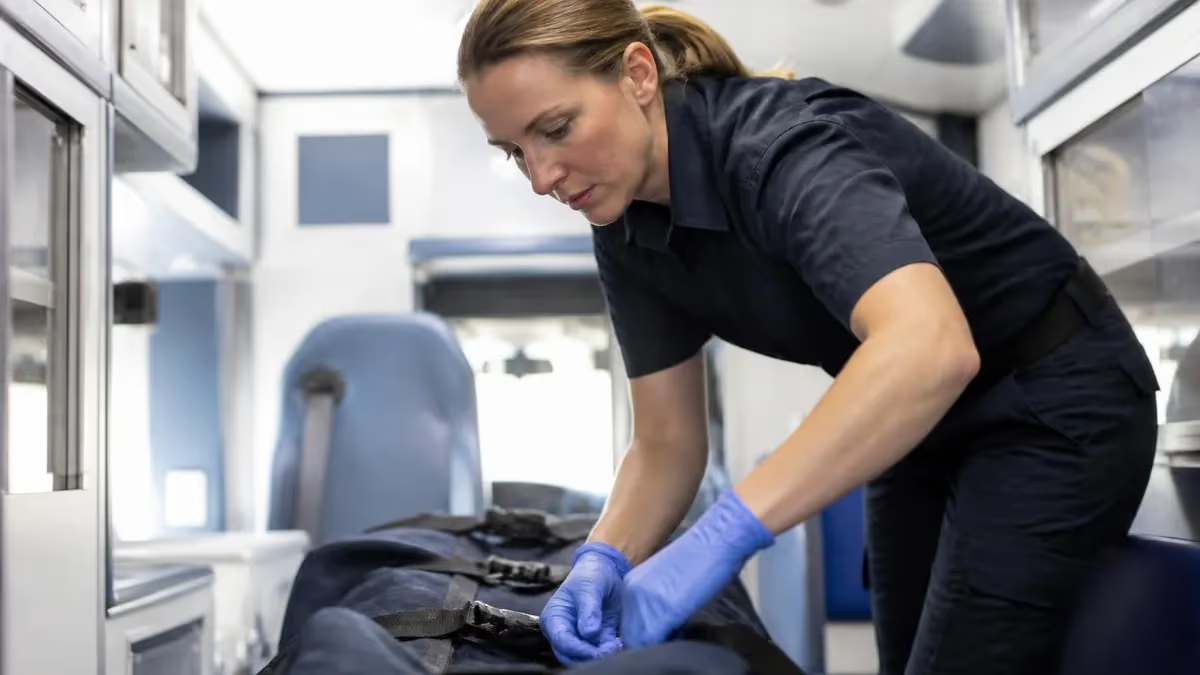
NREMT Paramedic Practice Test: Cognitive & Psychomotor Exam Mastery
The NREMT paramedic practice test is the single most predictive prep tool for the National Registry exam. Roughly 70–75% of first-time candidates pass the cognitive computer-adaptive test, but retake pass rates drop closer to 50%. Drilling 2,000+ scored questions before test day is what separates clean first-attempt passes from a costly retake cycle that drags on for months and chews through the $175 attempt fee each time.
This guide breaks down the full NREMT-Paramedic journey: the cognitive CAT format, the 12-station psychomotor exam, eligibility rules, the cost stack, and the highest-yield content areas to hammer in your final 30 days. Whether you just finished a CoAEMSP-accredited program or you're starting from scratch, the roadmap below is the same one our highest-scoring candidates used to walk into Pearson VUE confident.
If you want a low-stakes warm-up before paid prep, start with our free paramedic and our printable paramedic practice test PDF — both pull from the same content domains the NREMT actually tests.
Expect a deep mix of clinical scenarios, drug calculations, rhythm recognition, and protocol decisions. You will not see fluff or filler. Every question is targeted at a national job task analysis, which means low-yield trivia stays out and high-yield decisions stay in. That's good news if you study smart and bad news if you cram.
NREMT-Paramedic Exam by the Numbers
Key Facts at a Glance
| Item | Value | Details |
|---|---|---|
| Cognitive CAT questions | 80-150 | Adaptive — length varies |
| Cognitive time limit | 2.5 hrs | Plus tutorial + survey |
| Cognitive exam fee | $175 | Psychomotor $50-100/station |

What the NREMT-Paramedic Exam Actually Is
The NREMT-Paramedic is a two-part national certification exam administered by the National Registry of Emergency Medical Technicians. Part one is the cognitive computer-adaptive test (CAT) delivered through Pearson VUE testing centers. Part two is the psychomotor exam — 12 hands-on skill stations evaluated by trained examiners in person, usually at your training program or a state EMS office.
To sit for either part you must have graduated from a CoAEMSP-accredited paramedic program within the past two years, hold a current state-recognized BLS card (AHA, ARC, or equivalent), and complete all program-required clinical and field internship hours. Some states layer on extra rules: California requires a state CDL endorsement for ambulance drivers, Texas asks for fingerprinting, and Florida adds an HIV/AIDS course on top of the federal NREMT requirements.
Want to confirm program accreditation before you register? Our guide to paramedic program options lists all current CoAEMSP-accredited schools, costs, and length. If you're earlier in the career pipeline, see how to become a paramedic for the full pathway from EMT to medic.
The two-year graduation window matters. If you completed paramedic school more than two years ago and never tested, you'll need to repeat an entire refresher course or, in some cases, re-enroll. That's why most candidates schedule their first cognitive attempt within 90 days of program completion while every protocol, drug, and algorithm is still sharp.
How the Cognitive CAT Works (And Why It Feels Brutal)
The cognitive exam is computer-adaptive — the test engine selects each new question based on whether you got the previous one right. Start strong and the algorithm pushes you into harder territory; start weak and it serves easier items until it gathers enough data to assign a fail.
The exam ends as soon as the engine reaches 95% confidence in your ability estimate. That's why some candidates finish in 60 questions and others grind through the full 150 before the screen finally goes dark. Length alone tells you nothing about pass or fail — only the final result does.
Question types include traditional 4-option multiple choice plus multiple-response items (introduced 2024) where you pick all that apply. Drug calculations require mental math — no physical calculator is permitted, though the screen provides one. Plan on 90 seconds per question average; the exam is not a sprint, but lingering past three minutes on any single item usually signals a guess is coming.
One counterintuitive truth: if the test feels relentlessly difficult, you're probably passing. The CAT keeps probing your ceiling. Candidates who report "the questions got easier toward the end" often fail because the algorithm dropped them into the lower difficulty band. Trust the discomfort and stay disciplined on every item. The hardest questions in your test are not punishment — they are a signal that you are pushing the ceiling.
Practice tests that don't use adaptive logic are still useful, but they can't replicate the CAT's psychological pressure. Limmer's adaptive engine and a handful of newer banks now simulate calibrated difficulty scaling — worth investing in for at least two timed runs before test day.
Paramedics Practice Test Questions
Prepare for the Paramedics Exam exam with our free practice test modules. Each quiz covers key topics to help you pass on your first try.
Paramedics Paramedic Exam EMT
Paramedics Exam Questions covering Paramedic Exam EMT. Master Paramedics Test concepts for certification prep.
Paramedics Airway, Respiration, and Ventil...
Free Paramedics Practice Test featuring Airway, Respiration, and Ventilation. Improve your Paramedics Exam score with mock test prep.
Paramedics Cardiology and Resuscitation
Paramedics Mock Exam on Cardiology and Resuscitation. Paramedics Study Guide questions to pass on your first try.
Paramedics EMS Operations and Safety
Paramedics Test Prep for EMS Operations and Safety. Practice Paramedics Quiz questions and boost your score.
Paramedics Exam Airway Management
Paramedics Questions and Answers on Exam Airway Management. Free Paramedics practice for exam readiness.
Paramedics Exam EMS Communications
Paramedics Mock Test covering Exam EMS Communications. Online Paramedics Test practice with instant feedback.
Paramedics Exam Major Incident Response
Free Paramedics Quiz on Exam Major Incident Response. Paramedics Exam prep questions with detailed explanations.
Paramedics Exam Pediatric Emergencies
Paramedics Practice Questions for Exam Pediatric Emergencies. Build confidence for your Paramedics certification exam.
Paramedics Exam Rescue Operations
Paramedics Test Online for Exam Rescue Operations. Free practice with instant results and feedback.
Paramedics Medical Emergencies and Obstetrics
Paramedics Study Material on Medical Emergencies and Obstetrics. Prepare effectively with real exam-style questions.
Paramedics Pharmacology and Medication Adm...
Free Paramedics Test covering Pharmacology and Medication Administration. Practice and track your Paramedics exam readiness.
Paramedics Trauma Assessment and Management
Paramedics Exam Questions covering Trauma Assessment and Management. Master Paramedics Test concepts for certification prep.
Paramedics Airway, Respiration & Ventilation
Free Paramedics Practice Test featuring Airway, Respiration & Ventilation. Improve your Paramedics Exam score with mock test prep.
Paramedics Cardiology & Resuscitation
Paramedics Mock Exam on Cardiology & Resuscitation. Paramedics Study Guide questions to pass on your first try.
Paramedics EMS Operations
Paramedics Test Prep for EMS Operations. Practice Paramedics Quiz questions and boost your score.
Paramedics Medical Emergencies
Paramedics Questions and Answers on Medical Emergencies. Free Paramedics practice for exam readiness.
Cognitive vs Psychomotor vs Free vs Paid Prep
The cognitive CAT is a 2.5-hour Pearson VUE test of 80–150 questions covering five content domains. It costs $175 per attempt and you receive a pass/fail result, never a numerical score. Retakes require a 15-day waiting period and an additional $175 each time. After three failed attempts you must complete a 24-hour remediation course before reattempting.
Roughly 70–75% of first-time test takers pass the cognitive exam. By the third attempt, cumulative pass rate is around 90%, but each failure costs time, money, and confidence. The lesson: invest in adequate prep before your first sitting rather than racing to test day underprepared.
The Five Content Domains You Must Master
The NREMT cognitive paramedic test pulls from five content areas, and the weighting hasn't changed materially in years. Adult patients comprise 85% of questions and pediatrics 15% — but pediatric items are concentrated in airway and OB/peds emergencies, which is why every high scorer over-indexes on those topics. The five domains and approximate weighting are: Airway, Respiration, and Ventilation (18–22%), Cardiology and Resuscitation (22–28%), Trauma (14–18%), Medical/OB/Gyn (27–33%), and EMS Operations (10–14%).
Cardiology is the heaviest single domain and the most failed. Expect rhythm strips, ACLS algorithms, cardiac drug dosing, 12-lead interpretation, and resuscitation decision-making. Medical/OB/Gyn is the broadest — toxicology, endocrine emergencies, neurological emergencies, neonatal resuscitation, and gynecological emergencies all sit here. EMS Operations gets underprepped because candidates dismiss it as common sense; it's not. Triage methods, hazmat scene size-up, ambulance safety, and lift assists all generate questions.
If you want to know the precise depth required for each domain, our paramedics exam complete study guide maps every learning objective to NREMT test specifications.

5 High-Yield Study Areas to Drill
Pulseless arrest, bradycardia, tachycardia (stable and unstable), and post-arrest care algorithms appear on nearly every NREMT cognitive exam. Memorize drug doses, joule settings, and decision points cold.
BVM, supraglottic, ETT, and surgical airway decision trees. Know capnography waveforms, common ventilator alarms, and the difference between hypoxia and hypercapnia.
Age-specific normal vitals, the Pediatric Assessment Triangle (PAT), neonatal resuscitation steps, and pediatric drug calculations by weight (kg). This is where many candidates drop points.
Pre-eclampsia, eclampsia, placenta previa, abruption, shoulder dystocia, breech delivery, and cord prolapse. Limited questions but consistently high-yield because they appear on most exams.
Dopamine drips, epinephrine drips, lidocaine maintenance, and weight-based pediatric dosing. Practice without a calculator — the on-screen one is slow and tempts you to misread.
The 12-Week NREMT Paramedic Study Plan That Works
Eight to twelve weeks is the sweet spot for NREMT paramedic exam prep. Less than 8 weeks usually means rushing through content review; more than 12 weeks invites burnout and content fade. Candidates who pass on the first try almost universally follow a three-phase structure: content review (weeks 1–4), targeted practice (weeks 5–8), and timed comprehensive practice (weeks 9–12).
Phase one is textbook-driven. Re-read your paramedic textbook by chapter, taking notes on every algorithm, drug, and protocol. Phase two layers in your paid question bank — 50–100 questions per day, reviewing every rationale even on the ones you got right. Phase three is the hardest mental work: full-length 150-question timed sessions, simulating CAT conditions, twice per week. By the end of week 12 you should be scoring 80%+ on cold practice tests with no domain dipping below 75%.
If you're shorter on time, compress phases one and two and protect phase three. The single highest predictor of a first-time pass is the ability to score 80%+ on a cold 150-question simulated test in the final two weeks. Treat that benchmark as non-negotiable.
Track every weak domain in a spreadsheet. After each practice block, log your domain-level percentage. If cardiology drops below 75% in week 6, that's your week 7 priority. Targeted weakness drills beat random review every single time, and the spreadsheet keeps you honest about where the real gaps are versus where you only feel uneasy.
MedicTests vs Limmer vs JBLearning — Choose Your Bank
- +MedicTests: 2,500+ questions, deep rationales, $75/year — best value for volume
- +Limmer Education: Adaptive engine mirrors NREMT CAT mechanics most accurately
- +JBLearning Navigate: Tied to most paramedic textbooks — content matches your school
- +Pearson EMS Prep: Backed by Pearson VUE, the actual test administrator
- +Pacific Medical Training: Strong rationales, $89 flat fee, lifetime access
- +All paid banks include rationales — free banks usually don't
- −MedicTests UI feels dated and lacks adaptive difficulty scaling
- −Limmer is more expensive at the high tier ($150+) and the cheaper plan is light on volume
- −JBLearning depends on a textbook bundle — orphan purchases are clunky
- −Pearson EMS Prep has fewer questions than competitors despite the brand
- −Pacific Medical Training lacks the polish of MedicTests' dashboard
- −None of these banks fully replicate the psychomotor exam — that's hands-on only
Test-Day Strategy and What Pearson VUE Really Tests
Arrive at the Pearson VUE testing center 30 minutes early with two forms of ID — one government-issued photo ID and a backup signature card or credit card. Bring your Authorization to Test (ATT) letter printed or saved on your phone. No personal items are allowed in the testing room: phones, watches, hats, hoodies, and water bottles all get locked in a personal locker.
Inside the testing room you get a dry-erase board and marker for scratch math, a 15-minute tutorial that doesn't count against your 2.5 hours, and a post-test survey. Take a single 5-minute rest break around question 40 if you need it — but the clock does not stop. Most high scorers skip the break entirely to preserve mental focus.
One overlooked tactic: read every question stem twice before reading the options. NREMT questions are written to mislead readers who skim. The difference between "most appropriate" and "next best step" changes the correct answer entirely, and missing that distinction is the single most common reason candidates fail by a narrow margin.

NREMT Paramedic Test-Day Checklist
- ✓Government-issued photo ID (driver's license or passport)
- ✓Secondary ID with matching signature (credit card or signature card)
- ✓Printed or digital Authorization to Test (ATT) letter from NREMT.org
- ✓Arrival 30 minutes early to clear check-in and biometric scan
- ✓All personal items secured in Pearson VUE locker — no phones in testing room
- ✓Water and snack in locker for the post-test break, not during
- ✓Sleep 7+ hours the night before — no late-night cramming
- ✓Eat a protein-heavy breakfast 90 minutes before your test slot
- ✓Skip caffeine if it makes you jittery — the bathroom break clock is not paused
- ✓Review your top 5 weak content areas one last time the night before
Common Mistakes That Cost Candidates Their First Attempt
The most common reason candidates fail the NREMT cognitive paramedic test is not insufficient knowledge — it's uneven preparation. Candidates over-study cardiology because it feels glamorous and under-study OB/peds, EMS Operations, and toxicology because those topics feel boring. The cognitive CAT doesn't care about your preferences. It samples every domain proportionally, and if your weak area is the 30% medical/OB/Gyn domain, you can fail despite knowing ACLS perfectly.
The second-biggest mistake is treating the CAT like a paper test. Candidates rush early questions to "save time" — but the CAT calibrates within the first 30 items. Burn those by guessing and the algorithm parks you in the lower difficulty band for the rest of the exam, mathematically guaranteeing a fail. Slow down on the first 30 questions. The rest of the test follows from there.
The third mistake is skipping the psychomotor exam preparation entirely. Many candidates assume their program prepared them adequately, then fail two stations and pay $50–$100 each for retakes. Practice all 12 stations with a partner under timed conditions in the two weeks before the exam. Verbalize every step out loud as if a real examiner is grading you — silent technique runs feel productive but skip the most evaluated component.
A fourth, quieter mistake: relying on memory rather than active recall. Re-reading notes feels like studying but creates familiarity, not retrieval. Use flashcards, blank-page recall, and question banks that force your brain to pull data from cold storage. That's the same retrieval the NREMT will demand on test day, and practicing it directly is the fastest route to score gains.
If You're Not at 80% on Cold Practice Tests, Don't Schedule Yet
The strongest predictor of a first-attempt pass is consistent 80%+ performance on full-length 150-question simulated cognitive tests, taken cold (no review of recent questions). If you're sitting at 60–70%, push your exam date back two more weeks and double down on weak domains. The $175 retake fee plus 15-day wait costs more than two extra weeks of prep — every time.
Career and Salary Outcomes After NREMT Certification
Passing the NREMT-Paramedic opens the door to state licensure in all 46 states that recognize National Registry certification. Median paramedic salary nationwide sits around $46,000–$54,000 base, with overtime, holiday pay, and shift differentials commonly pushing total compensation to $60,000–$75,000. Flight paramedics, critical care paramedics, and firefighter-paramedics earn substantially more — frequently $80,000–$120,000 in metro areas with strong municipal contracts.
Certification also unlocks specialty tracks: critical care transport (CCP-C), tactical paramedic (TP-C), community paramedicine (CP-C), and flight paramedic (FP-C). Each requires additional certification exams but starts with NREMT-Paramedic as the foundation. Many medics also bridge to nursing via paramedic-to-RN programs, with our paramedic to rn bridge program guide covering accelerated 12–18 month pathways.
Geography matters more than candidates expect. A medic in rural Mississippi may pull $38,000 while one in San Francisco or Seattle clears $90,000 with the same certification and experience. High-cost metros, fire-based EMS systems, and unionized agencies offer the strongest compensation packages, while private ambulance services in rural counties typically anchor the lower end of the range.
For complete career outlook, salary by state, and advancement timelines, see our paramedics exam career salary guide.
If you fail the cognitive exam, you must wait 15 days before retaking. After three failed attempts you must complete a 24-hour NREMT-approved remediation course before any further attempts. The hard ceiling is 6 cognitive attempts — fail all six and you must repeat your entire paramedic education program. This is why first-attempt prep is non-negotiable.
Registration, Recertification, and Renewal Logistics
NREMT registration runs through the National Registry portal at NREMT.org. Create an account, request graduate verification from your program director (your program submits this electronically), pay the $175 cognitive fee, and you'll receive an Authorization to Test (ATT) email within 24–48 hours. The ATT is valid for 90 days, during which you can self-schedule a Pearson VUE seat. Cancel or reschedule with at least 24 hours' notice or you forfeit the fee.
Once certified, NREMT-Paramedic credentials must be renewed every two years through the National Continued Competency Program (NCCP). Renewal requires 60 hours of continuing education spread across national core, local/state, and individual components. Recertification costs $40 plus any state-specific fees. Letting your registration lapse forces you back through the full reentry process — avoid that at all costs.
Considering becoming a paramedic instructor or moving into supervisory roles? Your NREMT certification is the credential that unlocks all of it. For broader context on the role itself, read our overview of What Is a Paramedic.
Final Advice: How to Walk Into Pearson VUE Confident
The candidates who walk into Pearson VUE confident are not the ones with the most knowledge — they're the ones who have already simulated the exam so many times that test day feels like a regular Tuesday. Aim for at least six full-length 150-question timed practice sessions in the final three weeks. Each one should be cold, untimed-review-after, and tracked by domain so you can see where the points are leaking.
Pair that with hands-on psychomotor practice twice weekly with a partner, weight-based drug calc drills (no calculator), and one final 24-hour pre-test rest day with zero studying. Sleep, hydration, and protein matter on test day. So does showing up with the mindset that you have already earned this pass through your prep — not that you are trying to earn it during the exam itself.
If you're still building your test-taking confidence, run a final session with our free NREMT-style banks: airway, cardiology, trauma, and medical. Score 80%+ across all four and you're ready. Below are our most popular paramedic prep resources to round out your prep stack.
One last reminder: a paramedic certification is not the finish line, it's the starting credential. The medics who go on to fly, teach, supervise, or specialize all built their foundation on a clean NREMT pass. Take the prep seriously now and the rest of your career compounds from there.
Paramedic Questions and Answers
Paramedics Exam
Paramedics Exam: Complete Study Guide 2026
Paramedics Exam: Career Paths, Salary, and Requirements 2026
How to Become a Paramedic: Step-by-Step Career Pathway (2026)
Paramedic Program: How to Choose an Accredited Program (2026)

Paramedic Practice Test PDF (Free Printable 2026)
What Is a Paramedic? Role, Training, and Career Path Explained

EMT vs Paramedic: Which One Should You Choose?
Paramedics Practice Test Video Answers
About the Author
Paramedic & Emergency Services Certification Trainer
George Washington UniversityCaptain Ryan O'Brien is a licensed paramedic and NREMT-certified emergency medical professional with a Bachelor of Science in Emergency Medical Services from George Washington University. He has 15 years of field experience as a paramedic and firefighter, and has coached hundreds of EMT and paramedic candidates through their NREMT written and psychomotor licensing examinations.
Join the Discussion
Connect with other students preparing for this exam. Share tips, ask questions, and get advice from people who have been there.
View discussion (7 replies)