
Paramedic Jobs: Where Paramedics Work, Salary & How to Get Hired 2026 September
Paramedic jobs guide: ✍🏼 where paramedics work, salary by state, top hiring agencies (FDNY, LA County, AMR), application process and pay tiers.
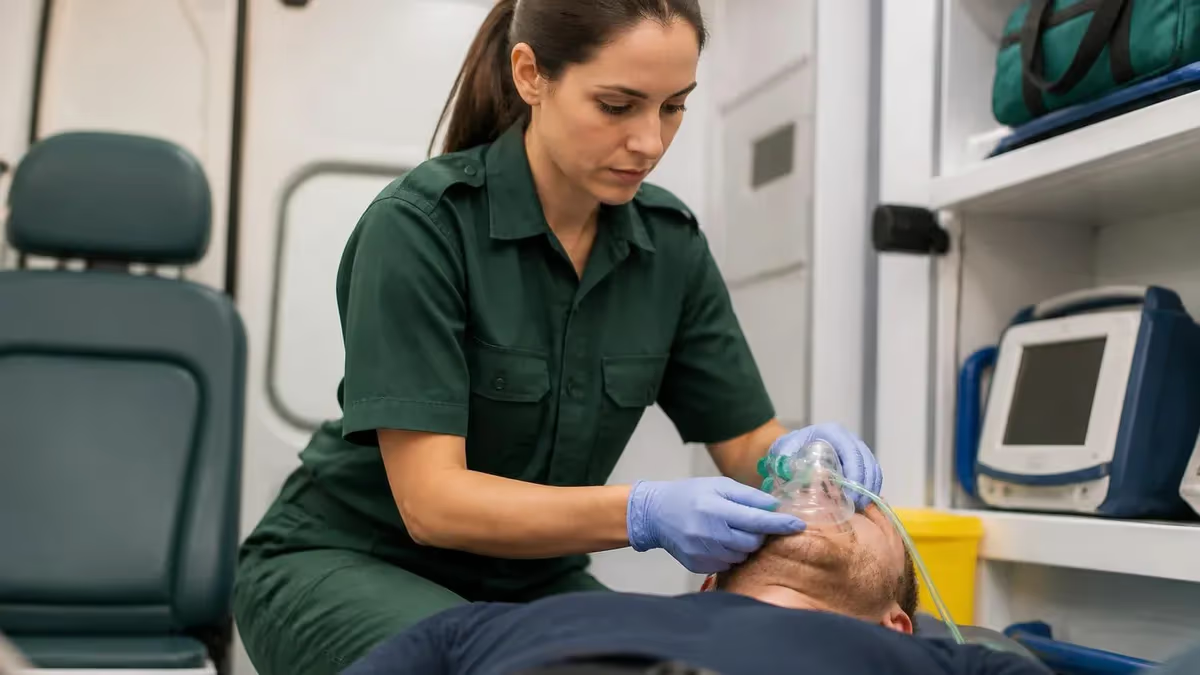
Paramedic Jobs: Where Paramedics Work, Salary & How to Get Hired
Paramedic jobs run from busy urban 911 systems to offshore oil rigs at $120,000 a year. Where you work shapes your paramedic pay, your shifts, your pension, and how fast you move up. Municipal and county EMS agencies hire the most paramedics. Fire-based EMS pays the best for entry-level applicants with both a firefighter and a paramedic license. Hospital, private, air medical, and industrial paramedic roles each have different pay scales, schedules, and physical demands.
This guide breaks down the ten main paramedic employer types in the United States. You will see real pay ranges from FDNY EMS, LA County Fire, AMR, Acadian Ambulance, and federal DoD contracts. You will also see the standard hiring pipeline (application, written exam, CPAT, background, polygraph, medical, oral board, academy), which states pay the highest paramedic salary, and which pay the lowest.
If you are still earning your cert, start with how to become a paramedic. Most agencies require NREMT-Paramedic certification plus state licensure before they will even review your file. Paramedic jobs are growing about 5% through 2032 according to BLS, with the biggest hiring booms in California, Texas, Florida, and the Northeast.
Pay varies wildly. A new private-ambulance paramedic in Mississippi may start at $14 an hour. A five-year FDNY paramedic with overtime clears $95,000. A flight paramedic on a HEMS contract earns $80,000 base plus flight pay. A DoD paramedic on a Middle East rotation can pull $140,000 with hazard pay and tax breaks. The job title is the same. The employer changes everything.
Use this guide as a map. Compare employer types side-by-side, look at the salary tiers and state averages, then run the application checklist before you submit anywhere. The right paramedic job is rarely the first one offered — it is the one that matches your goals for pay, schedule, and long-term retirement.
Why Employer Type Matters More Than Title
Two paramedics with identical certifications can earn double or triple each other's salary based on the agency they work for. A first-year private-ambulance paramedic in rural Mississippi will gross around $32,000. A first-year LA County fire-based paramedic with overtime can clear $95,000 in the same calendar year. That is a $63,000 gap on day one with the same NREMT card.
Employer type also dictates retirement, benefits, and physical demand. Municipal fire agencies offer pensions worth 75-90% of final salary at age 50-55 after 25 years. Private ambulance services offer 401(k) matches that rarely top 6%. Flight paramedic jobs come with high hourly pay but demanding 12 or 24-hour shifts and stricter weight and medical standards.
Quick Facts About Paramedic Employment
- National median pay: $53,180/yr (BLS 2024) — range $36K to $130K depending on employer
- Top-paying states: California ($80K), New York ($73K), Washington ($72K), Massachusetts ($71K), Alaska ($70K)
- Largest employers: Fire departments, county EMS, AMR, Falck, Acadian Ambulance, GMR
- Highest-paying roles: Offshore/maritime paramedic ($120K), flight paramedic ($95K), fire-based paramedic ($110K)
- Job outlook: +5% growth 2022-2032 (BLS), about 19,200 openings per year
Top 5 Paramedic Employer Types
- Pay range: $45K-$75K + pension
- Schedule: 12/24 or 24/48 shifts
- Stability: Most stable, government benefits
- Examples: FDNY EMS, NYC*EMS, Boston EMS
- Pay range: $60K-$110K + benefits
- Schedule: 24/48 (work 24, off 48)
- Requirements: Firefighter + paramedic certs
- Examples: LA County FD, Chicago FD, Phoenix FD
- Pay range: $35K-$65K (AMR largest)
- Schedule: 12-hr shifts, more transports
- Volume: Inter-facility + 911 contracts
- Examples: AMR, Falck, Acadian, GMR
- Pay range: $60K-$95K + flight pay
- Schedule: 12 or 24-hr shifts, on-call
- Requirements: 3-5 yrs experience + FP-C
- Examples: Air Methods, Med-Trans, REACH
- Pay range: $60K-$120K + hazard pay
- Schedule: 14/14 or 28/28 rotations
- Locations: Oil rigs, refineries, mines
- Examples: Tesla, Boeing, oil platforms

Quick Snapshot: Paramedic Job Market in 2026
The 2026 paramedic job market is hotter than it has been in two decades. Post-COVID burnout pushed roughly 12% of working paramedics out of the field, and replacement training takes 18-24 months. The result is a national shortage. Almost every major metro has open paramedic positions, and many small rural agencies are running 50-70% staffing levels.
Hiring standards have softened slightly, signing bonuses are common ($2,500 to $15,000), and travel paramedic rates have climbed. Aya Healthcare contracts at $50+ per hour are normal in California, Oregon, and Alaska. Some agencies waive the typical one-year experience requirement and hire new NREMT-certified paramedics directly into 911 positions.
If you are job hunting in 2026, you have use. Negotiate signing bonus, shift differentials, education reimbursement, and starting step on the pay scale. Most municipal HR departments will negotiate the starting step for paramedics with prior EMS experience, even if they will not budge on base pay.
Paramedic Salary Tiers Explained
Pay scales follow a predictable pattern. Private ambulance entry-level sits at the bottom because turnover is high and barriers to entry are low. Municipal and county 911 jobs sit in the middle because of pension and benefits. Fire-based EMS jobs sit higher because they combine two skill sets. Flight, offshore, and federal contracts sit at the top because of risk, specialty cert requirements, and physical demands.
Overtime can change the picture entirely. An LA County paramedic-firefighter on a 24/48 schedule who picks up 4 extra shifts per month can add $30,000-$50,000 in annual OT. FDNY EMS paramedics regularly clear six figures with overtime even though their base pay tops out around $75,000. Always look at total comp, not base pay, when comparing offers.
Paramedic Salary Tiers by Employer
How to Find Paramedic Jobs
Most paramedic openings post on three channels. The first is the agency or city HR portal — FDNY, LA County, Chicago FD, and Phoenix FD all run their own application cycles. The second is general job boards like Indeed and ZipRecruiter. The third is paramedic-specific boards like EMS1 Jobs, ParamedicFirst, and FlightWeb for air medical roles. Federal paramedic positions appear only on USAJobs.gov.
Set up alerts on all three channels. Municipal hiring cycles open once or twice a year, then close fast. Private ambulance companies hire year-round because turnover is higher. Flight paramedic jobs are the hardest to find — most are filled by internal promotion or word of mouth, so build relationships with current flight medics before you apply.
Where to Apply
Indeed and ZipRecruiter cover roughly 80% of US paramedic postings. EMS1 Jobs is the dedicated industry board and runs the cleanest filtering by state and certification level. Vivian Health and Travel Nurses & Allied list 13-week travel paramedic contracts paying $30-$50 per hour with stipends. FlightWeb is the gold standard for helicopter and fixed-wing roles. USAJobs lists federal DoD, VA, Indian Health Service, and Forest Service medic positions.
Top Hiring Agencies in 2026
Los Angeles County Fire, FDNY EMS, Chicago Fire, Phoenix Fire, Houston Fire, Boston EMS, NYC*EMS, and Atlanta Fire are the largest municipal employers. AMR (American Medical Response) is the largest private paramedic employer with operations in 40+ states. Falck, ProTransport-1, Acadian Ambulance, MedTrans, and Global Medical Response (GMR) round out the major private agencies.
Smaller and Niche Employers
Beyond the headline names, paramedics also work for hospital systems (Kaiser, HCA, Tenet, Sutter), university EMS programs, professional sports teams, theme parks, and large concert and event production companies.
Cruise lines (Carnival, Royal Caribbean, Norwegian) hire ship paramedics on six-month contracts paying $5,500 to $7,500 a month with room and board included. Tactical paramedics work for federal agencies including DEA, US Marshals, and ICE on SRT teams.
Some paramedics also serve as occupational health medics for construction megaprojects (Intel fabs, lithium mines, data center builds) at $35-$50 an hour with overtime. Smaller agencies often hire faster and pay less, but they offer specialty experience a 2,000-medic system rarely matches.
Paramedic Job Application Checklist
- ✓Current NREMT-Paramedic certification (verify on nremt.org)
- ✓State paramedic license for the state you are applying in
- ✓Valid driver license, often with EVOC (Emergency Vehicle Operator Course)
- ✓BLS, ACLS, PALS, ITLS or PHTLS certifications current
- ✓Resume with EMT/paramedic experience hours documented
- ✓Three professional references (preceptors, supervisors, instructors)
- ✓Sealed transcripts from paramedic program and any college credits
- ✓DD-214 if prior military (gives veteran preference points)
- ✓Clean driving record (most agencies require under 2 minor violations in 3 years)
- ✓Clean background — felonies and drug convictions usually disqualify

The Paramedic Hiring Process
Municipal fire and EMS agencies use a long structured hiring pipeline. Plan on 6 to 12 months from initial application to academy start date. Private ambulance services are faster — often 2 to 4 weeks from application to first shift. Federal DoD paramedic contracts run 60 to 90 days for background and medical clearance.
The standard fire-based EMS process includes a written exam (cognitive and EMS knowledge), the Candidate Physical Ability Test (CPAT) for fire-track roles, a psychological evaluation, a thorough background check including polygraph, a medical exam with drug test, and an oral interview board.
Successful candidates receive a conditional offer pending academy. Most fire departments run an 8-12 week new-hire academy followed by 6-12 months of field training with a designated Field Training Officer (FTO).
Resume and Application Tips
Lead your resume with active certifications (NREMT-P, state license, ACLS, PALS, ITLS or PHTLS). List call volume and patient acuity if you have measurable numbers — a 911 paramedic who runs 2,000+ calls a year looks very different from one running 400.
Quantify shifts as FTO, ride-along hours, and any specialty cert. Custom cover letters matter for municipal and federal applications. Generic cover letters work fine for private 911 because turnover demand outpaces selectivity. Veterans get hiring preference at every level of government EMS — federal, state, and most large city fire departments.
Pre-Hire Test Prep
Most municipal fire-based agencies use a standardized written exam (NTN FireTEAM, FCTC, or Ergometrics). Private 911 agencies often use a shorter knowledge check plus a scenario-based oral interview. Either way, working through an NREMT paramedic practice test bank before your written exam helps lock in airway, cardiology, pharmacology, and operations knowledge under timed conditions.
The oral board interview is usually the hardest stage to prepare for. Departments score communication skills, scenario judgment, ethics, and cultural fit. Practice answering scenario questions out loud before the board — common prompts include responding to a partner making an unsafe choice, dealing with an aggressive bystander, and de-escalating a hostile patient.
Paramedic Jobs Compared: Settings, Cities, Salary, Pathway
911 / Emergency Response: 70% of paramedic jobs. Fast pace, mixed call types, shift work. Municipal, county, fire-based, or private 911 contractors.
Inter-Facility / Critical Care Transport: Hospital to hospital transfers, often ICU-level patients on vents and drips. Requires CCP-C or FP-C cert for top pay. Slower pace, more clinical depth.
Industrial / On-Site: Oil refineries, manufacturing plants, large construction projects, film sets. Lower call volume, predictable hours, often single-medic posts.
Air Medical: Helicopter HEMS, fixed-wing long-distance. Highest acuity, requires FP-C certification and 3-5 years field experience minimum.
Paramedic Workforce Statistics
Specialty Certifications That Boost Paramedic Pay
Specialty certifications add real dollars to your hourly rate and unlock higher-pay roles. The Flight Paramedic Certified credential (FP-C from BCCTPC) is the gold standard for helicopter EMS and adds $2-$5 per hour. The Critical Care Paramedic credential (CCP-C, also BCCTPC) is required for most inter-facility critical care transport roles and adds $3-$6 per hour. The Tactical Paramedic Certified credential (TP-C) qualifies you for SWAT and law enforcement medical teams and adds $2-$4 per hour plus on-call stipends.
Other valuable adds: Neonatal Resuscitation Provider (NRP), Pediatric Education for Prehospital Providers (PEPP), Advanced Medical Life Support (AMLS), International Trauma Life Support (ITLS), and Wilderness EMT or Wilderness Paramedic for backcountry and SAR work.
None of these is cheap — most certs cost $500-$1,500 with continuing education hours. They pay back within 6-12 months for paramedics in busy systems. Hazmat Technician, Rope Rescue Technician, and Swift Water Rescue certifications add even more for fire-based paramedics on technical rescue teams.
Shift Schedules and Work-Life Balance
The 24/48 schedule is standard for fire-based EMS — you work 24 hours straight, then have 48 hours off. Over a month you work about 10 shifts and have 20 days off. Hospital-based paramedics typically work 12-hour shifts on a rotating pattern (three on, four off, four on, three off).
Private ambulance services run a mix of 8, 12, and 24-hour shifts depending on contract and region. Air medical is usually 12 or 24-hour shifts with mandatory crew rest periods. Rural EMS often runs 48/96 or even 72/96 — long shifts with stretches of downtime between calls.
Tactical and SWAT medics are usually on-call rather than shift-based, paid a retainer plus per-callout. Industrial paramedics at refineries or large factories work standard 12-hour shifts but with very low call volume.
Offshore paramedics commit to 14-day or 28-day rotations away from home, balanced by equal time off and high day rates. Sleep quality varies sharply by employer — fire-based 24/48 medics in slow rural systems may sleep most of the night, while urban 911 medics on the same schedule may run calls every two hours from dusk to dawn.

Fire-Based vs Hospital vs Private Paramedic Jobs
- +Fire-based: Highest pay ($60K-$110K), pension, 24/48 schedule means full days off
- +Fire-based: Strong career progression — paramedic to engineer to captain to chief
- +Hospital-based: Predictable 12-hr shifts, climate controlled, lower call acuity
- +Hospital-based: Easier transition to nursing or PA programs while working
- +Private 911: Fastest hiring, no firefighter certification needed
- +Private 911: Highest call volume — fastest way to build experience and skills
- −Fire-based: Requires firefighter academy + paramedic cert (12-24 months training)
- −Fire-based: Hiring is competitive — often 1,000 applicants for 30 spots
- −Hospital-based: Lower pay ceiling ($45K-$70K), less variety in patient types
- −Hospital-based: Limited in some states — only certain hospitals run paramedic programs
- −Private 911: Lowest pay tier ($35K-$55K entry), often no pension, weaker benefits
- −Private 911: High turnover, harder shifts, fewer protections than government jobs
Bridge Paths: Paramedic to RN, PA, or MD
Many paramedics move on after 5-10 years to higher-paying clinical roles. The paramedic-to-RN bridge takes 12-18 months and opens doors to ICU and emergency nursing at $80K-$130K. The PA route is longer (2-3 year Master's program) but pushes earnings to $110K-$150K.
The physician path (DO or MD) takes 7+ years of post-bachelor's training but ends with $250K-$450K earning potential. Your paramedic certification and field hours count as healthcare experience for nearly every advanced healthcare program.
Less common but valuable bridges: respiratory therapy (RRT, 2-year program, $75K-$95K), perfusionist (specialist training, $130K-$170K), anesthesiologist assistant, and physician assistant in emergency medicine. Some paramedics move into EMS management, becoming agency directors, operations chiefs, or quality improvement officers without leaving prehospital care.
Volunteer Paramedic and Travel Paramedic Jobs
Rural communities still rely heavily on volunteer paramedics. The pay is zero, but hours count toward NREMT recertification and look strong on a resume for new paramedics breaking into the field.
Travel paramedic jobs pay $30-$50 per hour including housing stipends on 13-week contracts. Trustaff, Aya Healthcare, and Vivian Health are the main travel paramedic agencies. Travel medics fill staffing shortages in hard-to-staff regions — the Mountain West, Alaska, and rural Appalachia have the highest travel paramedic rates.
Retirement and Pension by Paramedic Employer
Fire and municipal EMS paramedics typically retire after 25 years of service at age 50-55 with 75-90% of their final salary as a pension. This is the single biggest financial advantage of fire-based EMS. Private ambulance paramedics get a 401(k) with 3-6% employer match — generous compared to most service-sector jobs, but nothing like a pension.
Federal DoD and VA paramedics use the FERS system: roughly 50% of final salary at age 57 after 35 years, plus Social Security and a Thrift Savings Plan match. Over a 30-year career the pension gap between fire-based and private-sector paramedic jobs is often $1.5-$2 million in lifetime retirement value.
If pension is your priority, target fire-based EMS or municipal/county 911 systems early in your career. If take-home pay is your priority, target offshore industrial roles or stack specialty certs (FP-C plus CCP-C plus TP-C) on top of a busy 911 system. If schedule and family time matter most, hospital-based or industrial paramedic jobs with predictable 12-hour shifts beat the 24/48 grind.
Final Word: Build Your Paramedic Career on Purpose
Paramedic jobs reward planning. A new graduate who takes the first private 911 offer that comes along will earn a fine living, but they will trade away pension value, schedule flexibility, and specialty pay opportunities they could have captured by waiting six months for a municipal hire or stacking certs before their first interview.
Map your career in five-year blocks. Year 1-5: get hired, build call volume, earn ACLS/PALS/PHTLS. Year 5-10: specialty cert (FP-C, CCP-C, or TP-C), move to flight or critical care if pay matters. Year 10-15: management, education, or bridge to RN/PA. The paramedics who out-earn their peers by $30K-$50K a year usually planned three steps ahead, not one.
Paramedic Career Progression
Year 0: Earn Cert
Year 1-2: New Paramedic
Year 3-5: Experienced Medic
Year 5-7: FTO/Senior
Year 7-12: Supervisor
Year 12+: Chief/Director
Paramedic Questions and Answers
Related Paramedic Career Guides
What Is a Paramedic? Role, Training, and Career Path Explained
How to Become a Paramedic: Step-by-Step Career Pathway (2026)
Firefighter Paramedic: Dual-Role Career, Training & Salary Guide
Paramedic to RN Bridge Programs: 2026 Guide to Programs, Cost & Timeline
Paramedic Program: How to Choose an Accredited Program (2026)

Paramedic License: State Requirements, Renewal & Reciprocity (2026)
NREMT Paramedic Practice Test: Free Questions, Cognitive & Psychomotor Exam Guide 2026

Paramedics Exam: Career Paths, Salary, and Requirements 2026
About the Author

Paramedic & Emergency Services Certification Trainer
George Washington UniversityCaptain Ryan O'Brien is a licensed paramedic and NREMT-certified emergency medical professional with a Bachelor of Science in Emergency Medical Services from George Washington University. He has 15 years of field experience as a paramedic and firefighter, and has coached hundreds of EMT and paramedic candidates through their NREMT written and psychomotor licensing examinations.
Join the Discussion
Connect with other students preparing for this exam. Share tips, ask questions, and get advice from people who have been there.
View discussion (7 replies)