
Paramedic Program: How to Choose an Accredited Program (2026 September)
Compare paramedic programs: certificate, associate, bachelor's. Learn CoAEMSP accreditation, costs, NREMT pass rates, and how to pick the right school. 🧠
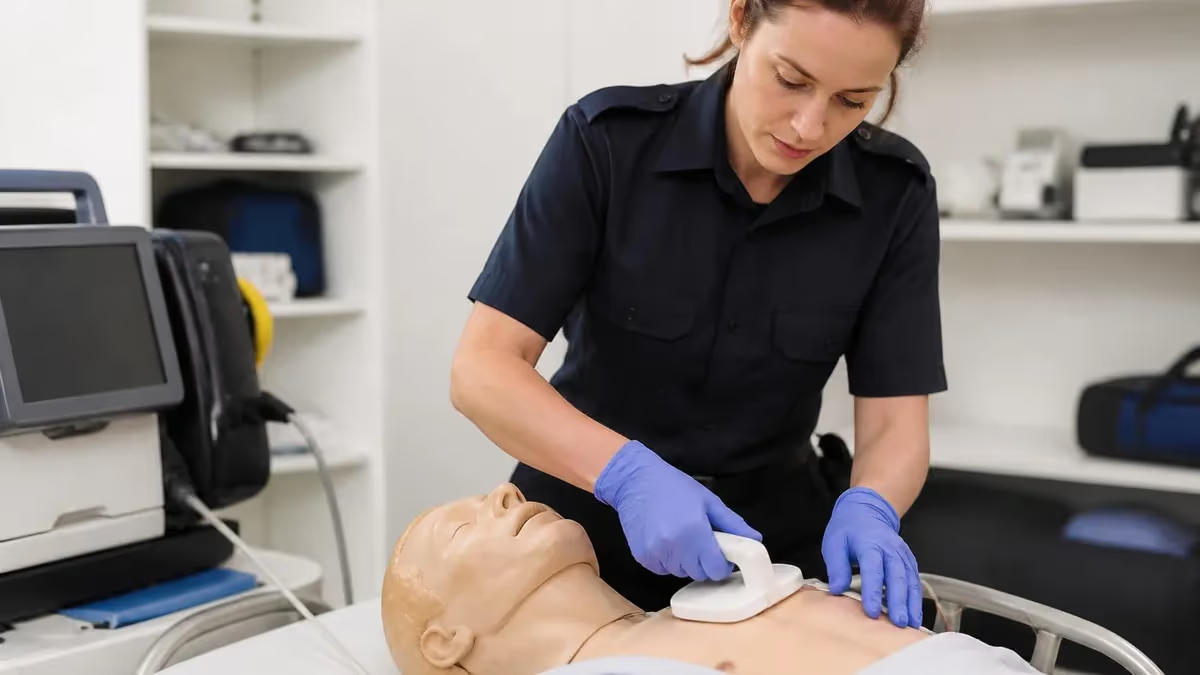
Paramedic Program: How to Choose an Accredited School in 2026
Picking the right paramedic program is the single biggest decision in your EMS career. The school you graduate from determines whether you can sit for the NREMT-Paramedic exam, how employable you are, how much debt you take on, and how confident you feel on your first ambulance call.
Not all programs are equal. A few hit 95% pass rates and place graduates into fire departments and hospital systems. Others lose accreditation and leave students unable to certify. The stakes are high, the up-front costs are real, and the time investment is measured in years rather than months.
This guide walks through every choice you face. You will compare certificate, associate, and bachelor's options. You will see how CoAEMSP accreditation works and why it is non-negotiable. You will learn realistic cost ranges from $3,000 community colleges to $50,000 university degrees, plus the 12 to 24 month timelines for each path. By the end you will know exactly which type of paramedic school fits your goals.
What a Paramedic Program Actually Teaches
Paramedic education is a structured medical program built on three pillars: didactic classroom hours, clinical rotations inside hospitals, and field internship hours on a working ambulance. The National EMS Education Standards require roughly 1,000 to 1,500 instructional hours, far above the 150 hours of paramedic schooling required for EMT.
You enter as a certified EMT and exit ready to run advanced life support calls solo. Classroom content covers anatomy, pharmacology, advanced cardiology, trauma, OB, pediatrics, and behavioral emergencies. Clinical rotations place you in emergency departments, ICUs, operating rooms, labor and delivery, pediatric units, and psychiatric wards. Field internship puts you on an ALS ambulance acting as team leader for a minimum number of patient contacts.
Strong programs use simulation labs that mirror real EMS calls. You will run cardiac arrests on high-fidelity manikins, manage simulated trauma scenes, and debrief mistakes with faculty. Skills practice runs throughout the program rather than being saved for the end. By graduation you should have hundreds of hours of repetition with airway tools, IV access, ECG interpretation, drug dosing, and patient assessment under stress.
No CoAEMSP Accreditation = No NREMT Eligibility
Since 2013, the NREMT only accepts paramedic candidates who graduate from a program accredited by the Committee on Accreditation of Educational Programs for the EMS Professions (CoAEMSP) under the umbrella of CAAHEP. If your school loses accreditation while you are enrolled, you cannot sit for the national exam. Always verify current status on the CoAEMSP database before paying tuition.
The Three-Phase Structure Every Accredited Program Must Follow
Phase one is didactic. Expect 400 to 600 classroom hours over four to six months, with skills labs running alongside lectures. You drill IV access, advanced airway, 12-lead ECG interpretation, drug calculations, and patient assessment under a preceptor's eye. Bring stamina. Most cohorts lose 10 to 20 percent of students in this phase, usually to pharmacology and cardiology rather than skills.
Phase two is clinical. Hospitals open their doors so you can manage real patients alongside ED physicians, OR anesthesiologists, ICU nurses, and labor and delivery teams. You will deliver babies, sedate trauma patients, and run codes. Phase three is field internship. Plan on 300 hours minimum on an ALS truck, with a paramedic preceptor watching every call.
You must act as team leader on a documented number of cardiac, respiratory, trauma, OB, peds, and psychiatric cases before you graduate. Strong programs guarantee high call volume to hit minimums on time. Competency is tested constantly throughout. Written exams cover every National EMS Education Standards module. Skills evaluations check IV placement, intubation, 12-lead acquisition, drug calculations, and full patient assessment under time pressure.
Choosing Between Community College, University, and Fire Academy
Most US paramedics graduate from community college programs. They are CoAEMSP accredited, affordable, and well-connected to local EMS agencies. Tuition runs $3,000 to $10,000 for residents, and many include built-in financial aid eligibility. The drawback is competition. Popular programs like Mt. SAC, Sacramento State, Sierra College, Saddleback, and Foothill receive 5 to 10 applicants per seat.
University programs cost more but offer the BSEMS pathway, research opportunities, and stronger pipelines into management and flight medicine. UCLA, Creighton, UMBC, Pittsburgh, and George Washington run nationally known degrees. Fire academy programs serve recruits already hired by a department: training is often paid in exchange for a service commitment. Hospital-based programs, run by health systems like Boston EMS, place you inside the medical culture you will work in.
Visit any program you are considering before you commit. Walk the skills lab. Look for current manikins, 12-lead monitors that match what local agencies use (Zoll or LifePak), and intubation trainers that show wear from heavy use. Ask to sit in on a lecture. Talk to current students about workload, faculty access, and how often medical direction meets with the cohort. A walk-through tells you more than any brochure.

Paramedic Program Types Compared
Certificate / Diploma Programs are the fastest and cheapest route. Run by community colleges, technical schools, and fire academies, they package 1,000 to 1,200 hours of training into 9 to 15 months of full-time study. You walk out with paramedic eligibility but no college degree. Typical cost: $3,000 to $15,000. Best for: EMTs who already work in the field and want to upgrade quickly, fire department recruits on a hiring timeline, and career changers who want to start earning fast.
The trade-off is portability. Certificates count toward state licensure but do not transfer easily into bachelor's programs if you decide later to chase a leadership role.
Top 5 Things to Verify Before Enrolling
- Check: coaemsp.org program database
- Status to accept: Initial or Continuing
- Red flag: Probation, Letter of Review, withdrawn
- Target: 80% or higher first attempt
- Source: Annual program report (public)
- Red flag: Below 70% or undisclosed
- Minimum: ED, ICU, OR, OB, peds, psych
- Field hours: 300+ ALS ambulance hours
- Red flag: Single hospital, no high-volume ALS
- Program director: Active paramedic + bachelor's
- Medical director: Board-certified EM physician
- Red flag: Director without recent field practice
- Ask for: Itemized cost including books, uniforms, fees
- Aid: FAFSA, GI Bill, employer sponsorship
- Red flag: No financial aid office or Title IV
Realistic Cost & Length: What You Will Actually Pay
The often-cited "paramedic school costs $5,000" is misleading. That figure covers tuition only at a community college and ignores books, uniforms, lab fees, malpractice insurance, and NREMT exam fees that add $1,500 to $3,000. Bachelor's programs run $20,000 to $50,000 once living expenses are included.
Plan for 9 to 15 months full-time for a certificate, 18 to 24 months for an associate, and 4 years for a bachelor's. Part-time and hybrid tracks stretch these timelines by 6 to 12 months. The opportunity cost of lost full-time wages during clinicals matters as much as tuition.
Funding sources stack well. FAFSA covers federal aid at degree-granting schools. The GI Bill funds approved certificate and degree programs. Many fire departments and ambulance services pay tuition in exchange for a 2 to 5 year work commitment. Hospital systems sponsor paramedic education when they need ALS staff. If a program is not Title IV eligible, you cannot use FAFSA, which is a quiet but major drawback of some technical schools.
Hidden Costs That Surprise Students
Beyond tuition, expect to spend $400 on textbooks, $200 to $500 on uniforms and stethoscope, $300 on a tablet or laptop if you do not have one, $150 to $300 on NREMT registration, $100 to $200 on state license, and $200 to $400 on certification cards (BLS, ACLS, PALS, ITLS or PHTLS). Add lost wages if you must cut to part-time work during clinicals.
Most programs run a financial aid orientation before the cohort starts. Attend it. Bring questions about repayment, deferment during clinicals, and emergency aid funds. Some community colleges offer book scholarships, transportation grants, or short-term loans that bridge between aid disbursements. Ignoring these often costs students more than tuition itself.
Community College vs University Paramedic Program
- +Community college: $3K-$10K tuition, accessible to working EMTs
- +Strong local EMS hiring pipelines and clinical placements
- +FAFSA eligible at most accredited campuses
- +Class schedules built around shift workers
- +Most US paramedics graduate from community colleges
- −University: $20K-$50K and 4 years for a BSEMS degree
- −Limited night/weekend cohorts at most universities
- −Competitive admission with 5-10 applicants per seat
- −University BSEMS often required for chief/director roles
- −Some community colleges lack research or leadership tracks

Paramedic Program Tuition Tiers
Paramedic Program by the Numbers
Key Facts at a Glance
| Item | Value | Details |
|---|---|---|
| Certificate length | 9-15 mo | |
| Didactic hours | 400-600 | |
| Clinical hours | 200-300 |
Admission Requirements You Need Before Applying
Every paramedic program requires current EMT certification before the first day of class. Most expect 6 to 12 months of field experience as an EMT, often verified with employer letters. Prerequisite coursework is increasingly common: anatomy and physiology, medical terminology, and basic algebra.
Background checks, drug screens, immunizations (Hep B, MMR, Tdap, COVID, annual flu), BLS provider, and sometimes ACLS or PALS are standard. Some competitive programs add entrance exams, written essays, or panel interviews. Start collecting these documents 60 days before the application deadline. Late immunization records and lapsed BLS cards are the most common reasons applications get pulled from the review pile.
If you plan to bridge later into nursing or medical careers, an associate or bachelor's program will save you years of remediation. Read about the full schooling needed to be a paramedic before you commit, and look at paramedic with bachelor's degree pathways if you anticipate a career pivot.
Writing a Strong Paramedic Program Application
Most programs accept candidates on a rolling basis until cohorts fill. Apply early. Personal statements should highlight EMT field hours, calls that taught you something specific, and why ALS interests you. Letters of recommendation from your supervising paramedic, an ED nurse, or a field training officer carry weight.
List every certification and continuing education hour. If your prerequisite GPA is borderline, retake one course over the summer to boost the average rather than gambling on a panel review. Several California community college programs use point systems that reward EMT experience, prerequisite grades, healthcare coursework, and volunteer hours.
Panel interviews favor candidates who can describe a tough call clearly, talk about their weaknesses without flinching, and explain why ALS interests them beyond a paycheck. Practice answers with another EMT before the interview date. Bring fresh copies of your transcripts, EMT card, immunization record, and a one-page resume. Small touches signal you take the program seriously.
Paramedic Program Pre-Application Checklist
- ✓Current state EMT certification (or NREMT-EMT)
- ✓6-12 months EMT field experience (recommended, sometimes required)
- ✓Prerequisite coursework: A&P, medical terminology, English composition
- ✓Current BLS provider card (AHA, ARC, or ASHI)
- ✓Up-to-date immunization records (Hep B, MMR, Tdap, flu, COVID)
- ✓Negative drug screen and clean background check
- ✓Valid driver's license and reliable transportation for clinicals
- ✓Health insurance proof and personal liability/malpractice coverage
- ✓High school diploma or GED for certificate, associate transcripts for BSEMS
- ✓FAFSA filed and financial aid letter or sponsor confirmation in hand

Typical Paramedic Program Timeline
Month 0: Apply
Months 1-3: Foundations
Months 4-6: Advanced Didactic
Months 7-9: Clinical Rotations
Months 10-12: Field Internship
Month 12-15: NREMT
How to Read a CoAEMSP Annual Report
Every accredited program submits an annual outcomes report to CoAEMSP, and the data is public. Three numbers tell you almost everything: NREMT cognitive pass rate (national threshold is 70%, good programs exceed 80%), retention rate (how many starters finished, anything under 65% raises questions), and positive placement rate (graduates employed in EMS, continuing education, or military within a year, threshold 70%).
A program meeting all three thresholds for three consecutive years earns Continuing Accreditation, the strongest status. If you see a program on "Letter of Review" or "Probationary" status, ask the director what corrective action plan is in place and when reaccreditation is expected. A program that loses accreditation mid-cohort leaves students stranded.
Online and Hybrid Paramedic Programs: What Actually Works
Fully online paramedic education does not exist in any accredited form. Federal and state regulators require hands-on clinical and field internship hours that cannot be replaced by simulation alone. What works is the hybrid model: didactic content delivered through a learning management system, weekend or monthly skills labs at a regional campus, and clinical/field hours arranged near your home.
Creighton EMS Education, FISDAP-affiliated schools, and several state colleges in Texas, California, and Florida run respected hybrid options. Before paying tuition, ask: Will the program contractually guarantee clinical sites within driving distance? Who handles preceptor approvals? What is the on-campus residency schedule? Without clear answers, you risk paying for a degree you cannot finish.
Accelerated Paramedic Programs: Faster, Harder, Riskier
Accelerated paramedic programs compress the same 1,000+ hours into 6 to 9 months by running 50 to 60 hour weeks. They suit candidates with strong EMT field experience, no outside job, and a clear hiring deadline. Failure rates run higher because cognitive load is brutal and there is no recovery time between modules.
If you choose an accelerated track, save six months of living expenses first, drop side commitments, and confirm preceptors can absorb your shortened clinical window. Ask the program director for the most recent cohort completion rate and the average study hours per week students reported. Going in eyes-open is the difference between graduating on schedule and washing out at week 12.
Paramedic Questions and Answers
Military, GI Bill, and State-Specific Pathways
Veterans and active-duty service members have unique advantages. Many programs grant credit for military medical training (68W, FMF Corpsman, USAF Aerospace Medical). The Post-9/11 GI Bill and Veterans Readiness & Employment (VR&E) cover tuition at approved schools. Apply through the VA's WEAMS database to confirm a program is approved before enrolling.
Some fire departments and ambulance services run apprenticeship-style programs registered with the Department of Labor, allowing GI Bill use for on-the-job training. Search the VA's apprenticeship list to find using gi bill for paramedic certificate options near you. The mix of monthly housing allowance and tuition coverage often makes paramedic school free or even net positive for veterans.
California requires graduation from a CoAEMSP program and California state license through EMSA. Texas, Florida, and New York follow similar models with state-specific paperwork. Some states (like California) maintain their own list of approved programs in addition to CoAEMSP, so check both. New York City paramedic candidates often go through FDNY EMS Academy or hospital-based programs like NYU and Mount Sinai.
paramedic schools near me queries should always be filtered by state license reciprocity if you plan to move. An NREMT-Paramedic certification transfers between states more easily than a state-only license. Most states recognize NREMT for initial licensure. A few (notably New York, North Carolina, and Wyoming) maintain state exams or extra paperwork.
Final Decision Framework
Pick a certificate if you have a fire department hire date. It is also right for experienced EMTs who want the cheapest path. Pick an associate if you are starting fresh and want long-term flexibility. For most candidates this is the right call. Pick a bachelor's if you target leadership, flight medicine, federal EMS, or plan to bridge into nursing or medical school.
Whatever you pick, verify CoAEMSP status, NREMT pass rate, and clinical sites first. Trust outcomes over reputation. A small community college program with a 90% NREMT pass rate and 85% positive placement beats a famous university with declining numbers. Talk to current students. Visit campus. Ask about clinical sites and faculty turnover.
Build a realistic budget covering 18 to 24 months. Many students underestimate this and run out of money during clinicals. Apply for FAFSA, scholarships from the National Association of EMTs, and union-sponsored funds early. Cohorts who exercise, study, and debrief tough shifts together survive at higher rates than students going it alone. Pick a program with a culture you can live inside for a year or two, not just a logo that looks good on a resume.
One more decision factor: how does the program handle remediation? Even strong students fail a module or skill check sometimes. Ask whether retake fees apply, how many attempts you get, and whether failure of a single station means restarting the entire program. Programs with clear, fair remediation policies graduate more students than rigid ones. Read the student handbook before signing the enrollment agreement.
Related Paramedic Career Guides
What Is a Paramedic? Role, Training, and Career Path Explained
How to Become a Paramedic: Step-by-Step Career Pathway (2026)
Firefighter Paramedic: Dual-Role Career, Training & Salary Guide
Paramedic to RN Bridge Programs: 2026 Guide to Programs, Cost & Timeline
Paramedics Exam: Career Paths, Salary, and Requirements 2026
Paramedics Exam: Complete Study Guide 2026
About the Author
Paramedic & Emergency Services Certification Trainer
George Washington UniversityCaptain Ryan O'Brien is a licensed paramedic and NREMT-certified emergency medical professional with a Bachelor of Science in Emergency Medical Services from George Washington University. He has 15 years of field experience as a paramedic and firefighter, and has coached hundreds of EMT and paramedic candidates through their NREMT written and psychomotor licensing examinations.
Join the Discussion
Connect with other students preparing for this exam. Share tips, ask questions, and get advice from people who have been there.
View discussion (7 replies)