
MUA Training Online: Your Complete Guide to Becoming a Makeup Artist
Find the best MUA training online & makeup artist near me options. Career paths, costs, certifications & tips. 🎯

If you have been searching for a makeup artist near me or wondering how to launch your own career in the beauty industry, you are not alone. Thousands of aspiring professionals discover each year that formal MUA training — whether through a local academy or a gold coast makeup artist course — is the fastest, most structured route to building real skill and industry credibility. Online programs have made this more accessible than ever, removing geographic barriers so that students across the United States can learn from world-class educators without relocating.
The demand for skilled makeup artists continues to climb across multiple sectors: bridal, editorial, film, television, theater, and social media content creation. The U.S. Bureau of Labor Statistics projects steady growth in the barbers, hairstylists, and cosmetologists category, and MUAs benefit from the same rising demand. Whether you want to work at a luxury department store counter, build a freelance clientele, or break into Hollywood productions, the right training program lays the foundation for every career milestone that follows.
Choosing between in-person and online MUA training is one of the first decisions you will face. Online programs offer flexibility, lower tuition, and the ability to revisit recorded lessons as many times as needed. However, hands-on practice remains irreplaceable — the best hybrid programs combine digital coursework with weekend intensives or mentored practice sessions. Understanding what to look for in a curriculum, what credentials actually matter to employers, and how to build your portfolio while still in school will save you months of guesswork and thousands of dollars in trial and error.
Many students wonder whether a certification from an online school carries the same weight as a diploma from a brick-and-mortar cosmetology college. The honest answer depends heavily on the certifying body, the school's industry reputation, and the specific career path you are pursuing. For freelance and editorial work, a strong portfolio and professional references often matter more than any piece of paper. For salon or department store employment, state licensing requirements may come into play, and it is essential to understand your state's specific rules before enrolling anywhere.
This guide covers everything you need to know about MUA training: program types, costs, curriculum expectations, certification pathways, and the practical steps that separate working professionals from hobbyists. We will also explore how makeup artist makeup artists at the top of the industry built their foundations, what the typical career trajectory looks like, and which practice resources — including free online quizzes — can sharpen your knowledge between hands-on sessions.
Whether you are a complete beginner picking up a brush for the first time or a self-taught artist looking to formalize your skills, this article will help you map a clear, actionable path forward. The beauty industry rewards those who invest in genuine training, maintain professional standards, and continuously update their technique as trends evolve. Let us break down exactly how to get there, step by professional step, so you can move from curious beginner to working makeup artist with confidence.
MUA Training & Career by the Numbers

Step-by-Step: How to Become a Certified Makeup Artist
Research State Licensing Requirements
Choose Your Training Format
Enroll and Complete Core Curriculum
Build Your Portfolio with Real Models
Sit for Certification Exam
Launch Your Career or Business
Understanding the true cost of MUA training requires looking beyond tuition. A basic online certificate course from a platform like Udemy or Skillshare may cost as little as $50 to $300, but these programs rarely provide industry-recognized credentials or structured feedback. Mid-tier programs from specialized makeup schools — both online academies and local institutions — typically run between $800 and $3,500 and include mentorship, curriculum depth, and a formal certificate upon completion. Full cosmetology school can exceed $15,000 once you factor in supplies, state board fees, and living expenses.
Supply costs are a significant and often underestimated part of your investment. A professional starter kit — brushes, palettes, primers, foundations in a full shade range, setting products, and hygiene supplies — can easily cost $500 to $1,200. Schools sometimes bundle kits with tuition; when they do not, you need to budget for these separately. As your career grows, you will replace and expand your kit continuously, so building good purchasing habits early — knowing which products perform professionally versus which are consumer-grade — saves money long-term.
Certification pathways vary widely by intended career direction. The National Interstate Council of State Boards of Cosmetology (NIC) administers exams accepted in most U.S. states for estheticians, whose scope of practice includes makeup application. The Professional Makeup Artist Certification (PMAC) and similar independent credentials signal competency to freelance clients and industry employers, even in states that do not require a license for makeup-only work. Understanding which credential best serves your specific goals — film, bridal, editorial, or retail — is worth a consultation with working professionals in your target niche before committing to a program.
Financial aid availability for MUA programs is more limited than for traditional college degrees, but options do exist. Accredited cosmetology schools may qualify for federal Title IV financial aid, including Pell Grants and subsidized loans. Vocational scholarships through organizations like the Professional Beauty Association and state-level workforce development grants can offset costs for qualifying students. Some employers — particularly department stores and salon chains — offer tuition reimbursement for employees who pursue formal training while working, making concurrent employment and study a viable strategy.
The return on investment timeline for MUA training depends heavily on your niche and hustle. A bridal artist with a fully booked weekend schedule in a major metropolitan market can earn $80,000 to $120,000 annually within three to five years of launching. Film and television artists with union membership through IATSE (International Alliance of Theatrical Stage Employees) earn standardized hourly rates that often exceed $45 to $75 per hour with full benefits. Editorial and runway artists trade lower day rates for prestige, portfolio value, and the industry connections that eventually unlock higher-paying commercial work.
Many aspiring makeup artist and beauty professionals underestimate the business education component of a successful MUA career. Knowing how to price your services, write a contract, manage client communications, handle deposits and cancellations, and track income for tax purposes is just as important as mastering a flawless cut crease. The best MUA training programs include at least a module on freelance business fundamentals; if yours does not, seek out business courses specifically designed for creative freelancers to fill that gap before you launch officially.
For those considering specialized niches, the training investment and earning potential shift considerably. Special effects and prosthetics training adds months and thousands of dollars to your education, but opens doors to film studios, haunted attractions, and medical simulation centers. Makeup artist wedding makeup — bridging bridal technique with on-set protocol — is among the most stable and high-earning freelance paths, particularly in markets with strong film production activity. Identifying your niche early and tailoring your training accordingly prevents the expensive mistake of broad generalist training that never fully qualifies you for any specific high-paying market.
Online vs. In-Person MUA Training: What Works Best for Makeup Artists
Online MUA training programs deliver curriculum through pre-recorded video lessons, live webinars, downloadable guides, and virtual instructor feedback. Top platforms include QC Makeup Academy, Makeup Artist School Online, and Cosmetology School virtual offerings. Students can study at their own pace, replay technique demonstrations repeatedly, and access global instructors whose in-person workshops would be prohibitively expensive or geographically inaccessible. Many programs cost 50 to 70 percent less than equivalent in-person options.
The primary limitation of fully online training is the absence of real-time hands-on correction. An instructor cannot physically adjust your brush angle or point out that your blending has a hard line when they can only see video submissions. The best online programs compensate by requiring students to film their own practice sessions, submit work for detailed written and video critique, and participate in live Q&A sessions. Pairing online coursework with regular practice on willing friends, family, or paid volunteer models bridges the theory-to-execution gap that purely digital learning cannot fully close.

Is Online MUA Training Worth It? Pros and Cons
- +Study at your own pace without quitting your current job or relocating
- +Significantly lower tuition compared to full-time in-person academies
- +Access world-class instructors and global curriculum regardless of your location
- +Replay technique demonstrations as many times as needed to master each skill
- +Many programs offer lifetime access to course materials for ongoing reference
- +Flexible scheduling allows you to practice and submit work around your existing commitments
- −No real-time hands-on correction when your technique has an error the camera misses
- −Self-motivation required — dropout rates are higher without class schedules and accountability
- −Some employers and state boards do not recognize non-accredited online certificates
- −Building a peer network and industry contacts requires more proactive effort without a classroom
- −Supply procurement is entirely your responsibility with no school-organized kit options
- −Portfolio building depends on your personal ability to find and manage your own models
Pros and Cons at a Glance
| Pros | Cons |
|---|---|
| Study at your own pace without quitting your current job or relocating | No real-time hands-on correction when your technique has an error the camera misses |
| Significantly lower tuition compared to full-time in-person academies | Self-motivation required — dropout rates are higher without class schedules and accountability |
| Access world-class instructors and global curriculum regardless of your location | Some employers and state boards do not recognize non-accredited online certificates |
| Replay technique demonstrations as many times as needed to master each skill | Building a peer network and industry contacts requires more proactive effort without a classroom |
| Many programs offer lifetime access to course materials for ongoing reference | Supply procurement is entirely your responsibility with no school-organized kit options |
| Flexible scheduling allows you to practice and submit work around your existing commitments | Portfolio building depends on your personal ability to find and manage your own models |
MUA Training Readiness Checklist: 10 Steps Before You Enroll
- ✓Research your state's cosmetology and esthetics licensing requirements before selecting a program.
- ✓Verify that your chosen school holds accreditation recognized by your state's licensing board.
- ✓Budget for supply kit costs ($500–$1,200) in addition to tuition before committing.
- ✓Identify your primary career niche — bridal, film, editorial, or retail — to choose the right curriculum focus.
- ✓Confirm whether the program includes hands-on practice components or is fully lecture-based.
- ✓Check graduate placement rates and read at least ten verified alumni reviews from the past two years.
- ✓Assess the instructor's active industry credentials — working professionals teach more current technique than retired educators.
- ✓Confirm the program's portfolio-building structure and whether it organizes model sessions or styled shoots.
- ✓Understand the certification or diploma awarded upon completion and its recognition by target employers.
- ✓Set up a dedicated practice space at home with proper lighting, mirrors, and a sanitation station before your first lesson.
Your Portfolio Matters More Than Your Diploma
In the freelance and editorial MUA world, clients and agencies consistently prioritize portfolio quality over certification credentials. A diverse portfolio of twenty or more professionally photographed looks — demonstrating range across bridal, editorial, corrective, and special occasion work — will open more doors than any certificate alone. Invest in professional photography shoots early, even if it means trading services with emerging photographers who also need portfolio content.
Building a sustainable career as a makeup artist requires a deliberate strategy that begins well before your training is complete. The most successful working artists share a common trait: they started marketing themselves and building professional relationships while still in school, not after graduation. Creating an Instagram portfolio account, engaging authentically in beauty industry communities, and assisting established artists on paid jobs as a kit assistant or second artist are all activities you can begin during training that pay dividends for years afterward.
The assisted model of career development — working under a senior artist before going fully independent — is one of the most underutilized pathways in the MUA industry. Assisting is typically unpaid or low-paid in the beginning, but the access it provides to professional sets, client interactions, supplier relationships, and workflow systems is worth far more than any formal class can replicate. Reach out proactively to working artists whose aesthetic you admire and offer to assist on weddings, film shoots, or commercial jobs. Most established artists welcome reliable, skilled assistants because demand frequently exceeds their personal capacity.
Niche specialization accelerates career growth more reliably than generalist positioning. The makeup artist makeup artists community is large and competitive at the generalist level, but specific niches — airbrush bridal, mature skin specialists, dark skin complexion experts, theatrical and drag transformation artists — command premium rates and attract client loyalty that generalists rarely achieve. Identifying an underserved niche in your local market and becoming the recognized specialist in that area builds a reputation that sustains your business through economic fluctuations that affect generalists more severely.
Social media strategy is non-negotiable for modern MUA careers. Instagram and TikTok are the primary discovery platforms for bridal and freelance clients, while LinkedIn matters increasingly for commercial and corporate event work. Your social content should demonstrate range, professionalism, and personality — behind-the-scenes process videos consistently outperform finished-look photos in algorithmic reach and engagement. Posting three to five times per week with consistent aesthetic and quality standards builds the follower base that translates to booking inquiries, especially when paired with strategic use of location-based hashtags that help local clients find you.
Continuing education is a career-long commitment for serious makeup artists near me who want to remain relevant as trends, products, and techniques evolve. Major beauty industry trade shows like IMATS (International Make-Up Association Trade Show), held annually in New York and Los Angeles, offer masterclasses taught by top industry professionals for a fraction of the cost of formal training programs. Product brand education — Temptu airbrush certification, MAC Pro training, Graftobian special effects workshops — expands your technical toolkit while providing brand-association credibility that resonates with specific client segments.
Pricing strategy is one of the most psychologically challenging aspects of launching a freelance MUA career. New artists consistently undercharge, partly from insecurity and partly from a misguided belief that low prices attract clients faster. In reality, premium pricing signals professional value and attracts clients who respect your work and treat the engagement professionally.
Research the going rates in your specific market — not national averages — and price within 15 to 20 percent of established local artists from your first paying gig. Build in annual price increases of 10 to 15 percent as you gain experience, expand your portfolio, and accumulate five-star reviews.
The drag artist makeup niche, while often associated purely with entertainment, has broader professional applications than many artists realize. The transformation techniques, color theory application, and theatrical exaggeration skills developed in drag-oriented training transfer directly to film and television work, theatrical productions, costume events, and Halloween special occasion bookings. Artists who explore drag artist makeup alongside their core training often find that the boundary-pushing creativity it demands improves their technical skills across every other specialty they work in.

In several U.S. states, including Tennessee, Virginia, and Arkansas, performing makeup services for compensation without a cosmetology or esthetics license is a legal violation that can result in fines and cease-and-desist orders. Before accepting your first paid client, verify your state's specific requirements at your state cosmetology board's official website. Licensing requirements change — what was true two years ago may not reflect current law in your jurisdiction.
The business infrastructure behind a professional MUA career is often the difference between a profitable enterprise and an expensive hobby. Every working makeup artist needs, at minimum, a professionally written service contract that covers scope of work, payment terms, cancellation and refund policy, travel fees, and liability limitations. Bridal contracts in particular must address multi-service bookings, trial session fees, and the consequences of day-of cancellations that leave you scrambling to fill a blocked date. Downloadable template contracts from professional associations can be customized for your market, but having an attorney review your final version is worth the modest investment.
Insurance is a non-negotiable professional requirement. General liability insurance for makeup artists — covering claims of skin reactions, injury on set, or property damage — costs approximately $300 to $600 annually through providers like FLIP (Food Liability Insurance Program) or specialty beauty industry insurers. Many venues, film productions, and corporate clients now require proof of insurance before they will book an independent contractor. Obtaining coverage before your first professional booking protects your personal assets and communicates that you operate as a serious professional rather than a casual hobbyist.
Client consultation protocol separates artists who build loyal repeat clientele from those who perpetually chase new bookings. A thorough pre-service consultation — covering skin type, sensitivities and allergies, reference images, event timeline, photography lighting conditions, and expected duration of wear — prevents the miscommunications that generate negative reviews and refund demands. For bridal clients, a trial session four to eight weeks before the wedding date allows both parties to refine the look before the high-stakes day, giving you a finished reference photo to work from and giving the client confidence in your ability.
The lori anne allison makeup artist story — she rose from independent beauty work to become one of the most recognized names in celebrity makeup — illustrates how persistence, a distinctive aesthetic, and strategic relationship-building compound over time into a nationally recognized career.
Most overnight success stories in the MUA world represent fifteen years of consistent work, continuous learning, and professional relationship investment that finally crossed a visibility threshold. The practical lesson is that early-career choices about who you assist, which shoots you invest in, and how you treat every client and collaborator lay the reputational foundation that either accelerates or limits your eventual ceiling.
Scaling beyond a solo practice requires a clear growth strategy. Some artists hire associate artists trained in their signature method and manage bookings as a small agency, multiplying their revenue without proportionally multiplying their own hours on set. Others pivot to education — developing online courses, hosting masterclasses, or teaching at academies — once their portfolio and reputation generate sufficient inbound interest. Product development, brand partnerships, and social media monetization are additional revenue channels that established artists increasingly integrate alongside their hands-on service work as a hedge against physical burnout and market fluctuations.
Finding the right makeup artists near me for inspiration, mentorship, or collaboration is easier than it has ever been. Local beauty industry Facebook groups, Instagram geotags on professional shoots in your city, and industry associations like the Makeup Artists & Hair Stylists Guild (IATSE Local 706) all provide access to the working professional community in your area. Attend local industry events, support other artists' work publicly on social media, and approach relationship-building with a genuine give-first mentality — the most valuable professional relationships in any creative field develop from mutual respect and reciprocal support, not transactional networking.
Ultimately, success as a makeup artist rewards those who combine excellent technical skill with business professionalism, continuous learning, and strategic career management. Training is the starting point, not the destination.
The artists who thrive long-term are those who treat every job as a portfolio opportunity, every client as a relationship worth nurturing, and every slow season as a chance to invest in the skills and systems that will define their next growth phase. The beauty industry is expansive, and there is genuine room at the professional level for every artist willing to put in the sustained work that improves craft into career.
Preparing for MUA certification exams requires a study strategy that balances theoretical knowledge with practical application review. The written components of most makeup artist certification exams cover sanitation and infection control, product chemistry and ingredient awareness, skin anatomy and physiology, color theory fundamentals, and professional ethics. Students who approach these topics systematically — using flashcards for terminology, practice quizzes for concept reinforcement, and timed mock exams to simulate test conditions — consistently outperform those who rely on passive reading alone.
Sanitation and infection control is the highest-weighted theoretical topic on most makeup artist written exams, and it is also the area most directly connected to client safety and professional liability. Understanding the differences between sanitization, disinfection, and sterilization; knowing which products and surfaces require each level of treatment; and being able to explain proper brush cleaning protocols, single-use applicator policies, and illness screening procedures before client contact are all tested knowledge areas that also reflect daily professional practice. Clients increasingly ask about sanitation practices before booking — your ability to articulate these protocols confidently builds trust and reduces cancellations.
Color theory mastery gives makeup artists a systematic framework for solving the color-matching and correction challenges that arise with every new client. Understanding undertones — cool, warm, and neutral — allows you to select foundation shades that disappear into the skin rather than sitting on top of it as an obvious mask. Complementary color relationships explain why orange-toned correctors neutralize under-eye darkness while green correctors cancel redness. Artists who internalize color theory rather than memorizing individual product recommendations develop a portable analytical toolkit that works regardless of which brands or products are available in a given kit or market.
Skin anatomy knowledge directly improves application technique. Understanding that the stratum corneum — the outermost skin layer — is primarily composed of dead, keratinized cells helps explain why proper skin prep, including exfoliation, hydration, and primer application, is so critical for flawless foundation adhesion and longevity. Knowing the location and function of sebaceous glands explains why oily skin types require different product formulations and application methods than dry skin types. This level of anatomical grounding improves your client consultations and distinguishes your professional communication from the surface-level technique advice that fills beauty tutorial content online.
Product formulation literacy — understanding the difference between water-based, silicone-based, oil-based, and powder formulations — allows you to make intelligent layering decisions that maximize wear time and minimize product interference. A common beginner mistake is layering a silicone-based primer under a water-based foundation, which causes pilling and patchy coverage within hours of application.
Understanding formulation compatibility prevents these technical failures and positions you to explain your product choices to clients who are themselves increasingly ingredient-aware. Clean beauty literacy — familiarity with commonly avoided ingredients and their alternatives — is an increasingly valuable fluency as a growing segment of the client market requests it explicitly.
The practical exam component of state cosmetology or esthetics board testing evaluates your hands-on technique under standardized, timed conditions that differ significantly from your normal workflow. Practicing under exam conditions — strict time limits, specific required steps performed in precise sequence, examiner observation — is essential preparation that many candidates skip.
Forming a small study group with peers from your program who practice performing required procedures on each other while timing and critiquing each step is one of the most effective and low-cost practical exam preparation strategies available. Many failed first attempts result not from skill deficiency but from procedural sequence errors that timed practice would have prevented.
After passing your certification exam, continuing education units (CEUs) keep your credentials active and your skills current. Most professional certifications require ten to twenty hours of documented continuing education annually, which can be fulfilled through industry trade shows, brand training events, online masterclasses, and professional association workshops. Treating CEU requirements as a floor rather than a ceiling — actively seeking out education beyond what is required — is the habit that separates artists who plateau at a competent professional level from those who continue developing toward mastery throughout their careers.
Sample MUA - Makeup Artist Practice Questions
Try these questions from our free MUA - Makeup Artist practice tests. The correct answer and an explanation follow each question.
Which product is NOT important when purchasing essential makeup for your kit?
- A. Anti-wrinkle skin cream
- B. Shimmer powder
- C. Shimmer cream
- D. Concealer palette
Answer: A. Anti-wrinkle skin cream
While skincare is important, an anti-wrinkle skin cream is generally not considered an essential makeup product for a basic professional makeup kit. Essential items focus on application, color, and coverage, such as shimmer powder, shimmer cream, and a concealer palette. Anti-wrinkle cream is a specialized skincare treatment, not a core makeup item for general application.
When applying foundation with an airbrush system, what PSI (pounds per square inch) range is typically recommended for makeup application?
- A. 5-10 PSI
- B. 15-25 PSI
- C. 30-40 PSI
- D. 50-60 PSI
Answer: B. 15-25 PSI
Airbrush makeup is typically applied at 15-25 PSI, which provides enough pressure for a fine, even mist without spattering.
Cream-based SFX makeup is typically sealed (set) using which method to make it sweat- and smear-resistant?
- A. Applying a layer of oil
- B. Setting with loose powder and a setting spray
- C. Layering more cream product
- D. Cooling with ice
Answer: B. Setting with loose powder and a setting spray
Cream SFX products are set with translucent powder followed by setting spray to lock them in place and prevent smearing.
Which four issues related to personal sanitation should makeup artists be aware of?
- A. Gloves are required, along with a clean, polished makeup case and no perfume or fake eyelashes.
- B. Fresh breath, no colored nail polish, hair out of the face, and no perfume.
- C. Keep your hair out of your face, avoid chewing gum or mints, and wear gloves at all times.
Answer: B. Fresh breath, no colored nail polish, hair out of the face, and no perfume.
Makeup artists must maintain strict personal sanitation to ensure client safety and comfort. Key issues include having fresh breath, avoiding strong perfumes that can cause allergies, keeping hair neatly out of the face, and refraining from colored nail polish which could chip or transfer. These practices contribute to a professional and hygienic service environment.
MUA Questions and Answers
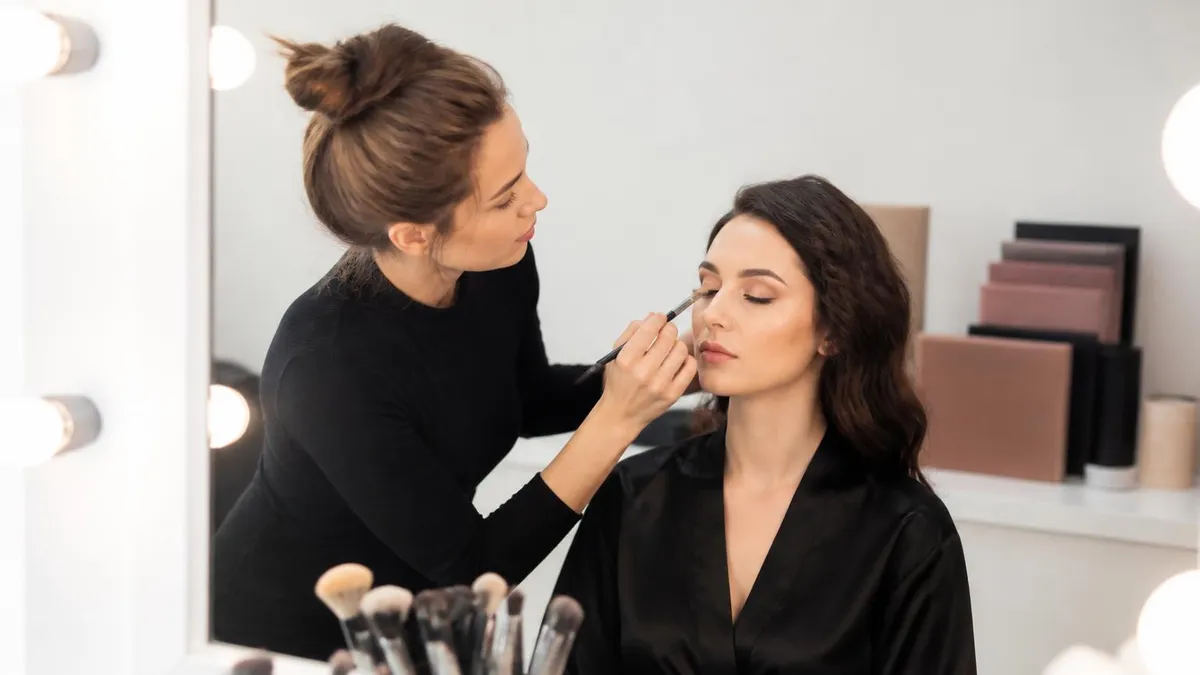
Celebrity Makeup Artist: How to Become One (2026 Career Guide)

Grinch Makeup Artist: How to Create the Perfect Holiday Character Look

Makeup Artist Long Island: Career Guide, Salaries & How to Get Started

Makeup Artist for Film: How to Break Into the Industry and Build a Career

Makeup Artist Names: Famous MUAs, Career Inspirations & How to Build Your Brand
About the Author
Licensed Cosmetologist & Beauty Licensing Exam Specialist
Paul Mitchell SchoolsMichelle Santos is a licensed cosmetologist with a Bachelor of Science in Esthetics and Salon Management from Paul Mitchell School. She has 16 years of salon industry experience and 8 years preparing students for state cosmetology board exams in theory, practical skills, and sanitation. She specializes in licensure preparation for cosmetologists, estheticians, and nail technicians.
Join the Discussion
Connect with other students preparing for this exam. Share tips, ask questions, and get advice from people who have been there.
View discussion (7 replies)