
Celebrity Makeup Artist: How to Build a High-Profile MUA Career 2026 September
Celebrity makeup artist career guide: training, agencies (The Wall Group), pay ($1,500-$15K/day), IATSE 706 union, kit, and the realistic path. 🟢
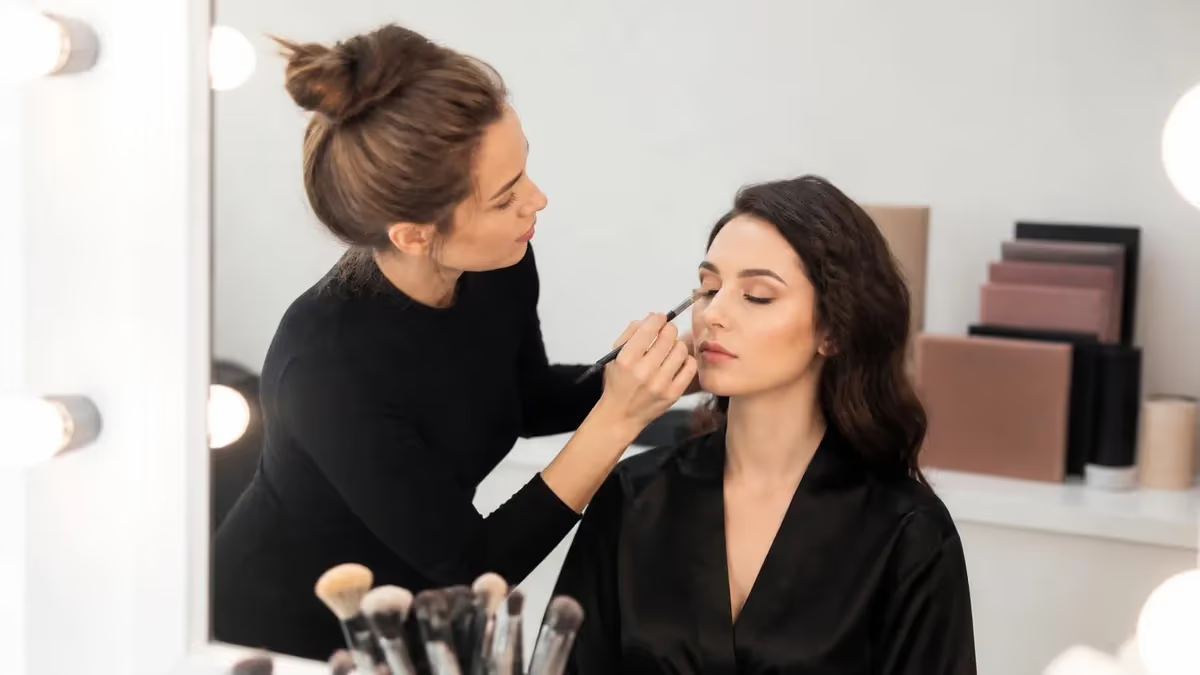
The fantasy is intoxicating. You watch the closing credits roll, the Oscar lights fade, and somewhere on screen sits the name of the person who painted the face that just made the world stop scrolling. Becoming a celebrity makeup artist looks, from the outside, like a cocktail of glamour and luck.
It is mostly neither. It is logistics, hand-cramps at 4 a.m. on a moving production trailer, and a kit that costs more than a used car. But it is also one of the most lucrative niches in the beauty industry, with top artists pulling $15,000 a day for the right campaign. Knowing how the path actually works separates the dreamers from the people who land their first Vogue credit by year five.
This guide pulls back the curtain. It walks through what "celebrity MUA" really means across red carpet, editorial, music video, and film/TV work. It maps the training options, the agency system, the realistic pay bands, the union question, the kit, and the social-media playbook.
We will also call out the misconceptions that keep aspiring artists stuck. Read it once, then come back to whichever section matches the move you are about to make. If you have not yet, take a swing at our MUA Color Theory practice test — color matching under stage and HD camera lighting is the foundation everything else sits on.
Celebrity MUA Pay & Career Snapshot

What "Celebrity Makeup Artist" Actually Means
The phrase covers four different jobs that share a kit and a clientele but pay, hire, and operate completely differently. You will not do all four equally well, and the artists who break through usually become known for one or two lanes first.
Red carpet is the most visible: pre-Oscars, Met Gala, premiere nights, awards season. It is fast (2-3 hours per face), high-pressure, and your work has to hold under flash photography for six straight hours. Rates run $1,500 to $5,000 per face for established artists, more if you are credited on the cover of Variety the next morning.
Editorial and campaigns are the prestige category. Think Vogue, W, Harper's Bazaar, and big-brand campaigns shot by photographers like Annie Leibovitz or Mert & Marcus. These shoots pay the best at the top tier and serve as the calling cards that book everything else. Brand partnerships layered on top can take a working artist from $200K to $1M+ annually.
Music videos and tours live between the two. You travel with the artist, work with strong colors and unusual finishes that read on camera, and often need to think about continuity across multiple looks in one day. Rates are typically $1,200-$3,500 a day plus per-diem and travel.
Film and television is the most stable lane but operates by different rules entirely. Productions over a certain budget hire through IATSE Local 706, the Make-Up Artists and Hair Stylists Guild. Pay is set by contract, hours are protected, and the benefits (health, pension) are real. The trade-off is structure — you are crew, not freelance talent.
The Short Answer
A celebrity makeup artist works the four lanes of red carpet, editorial/campaign, music video, and film/TV. Most start with state cosmetology or esthetician licensure, train at a specialized makeup school (Make-Up Designory, EI School of Professional Makeup, or Joe Blasco), build a portfolio through testing and fashion-week assistant work, sign with an agency (The Wall Group, Forward Artists, or Bryan Bantry Agency), and grow social media to pull direct talent bookings. Realistic day rates span $1,500-$15,000, with film/TV work requiring IATSE Local 706 union membership for productions over the contract threshold. Build-time to consistent A-list work is typically 7-12 years.
Training Paths That Actually Lead Somewhere
There is no single mandatory degree to become a celebrity makeup artist, but every working pro has assembled some combination of three credentials: state licensure, specialized makeup-school training, and real on-set hours. Skip any one of these and the path gets steeper, not impossible.
State licensure is the legal foundation. Most U.S. states require a cosmetology or esthetician license to apply makeup to paying clients, and the few states that don't (Connecticut, for example) still treat licensure as a credibility signal. Cosmetology runs 1,000-1,600 hours depending on the state; esthetician is shorter at 300-600 hours and often the smarter pick for makeup-focused artists. See our complete guide on how to become a makeup artist for state-by-state requirements.
Specialized makeup schools are where the celebrity track actually diverges from the salon track. The names every agency recognizes: Make-Up Designory (MUD) in Burbank and New York, with intensive programs in beauty, fashion, and character makeup; EI School of Professional Makeup in New York, known for editorial and fashion training; and Joe Blasco Makeup Artist Training in Los Angeles and Orlando, the industry standard for film and theatrical effects. Programs run 8-30 weeks and cost $8,000-$22,000. Cinema Makeup School and the Academy of Freelance Makeup (AOFM) are the next tier worth considering.
On-set hours are the part nobody can sell you. You get them by assisting working artists for free for 6-18 months, then for a paid rate of $200-$400 per day. Fashion week (NYFW, LFW, MFW, PFW) is the speed-dating event of the industry — backstage at Marc Jacobs or Dior, you can do 30 faces in three hours alongside artists you have never met. Two seasons of fashion week assisting is worth more than two years of solo bridal work for breaking into editorial. makeup artist training compare the cost-benefit of each route.
Top Makeup Schools by Specialty
- Locations: Burbank CA, New York
- Program length: 8-22 weeks
- Tuition: $9,000-$18,000
- Best for: Versatility & agency intros
- Location: New York
- Program length: 6-16 weeks
- Tuition: $8,500-$15,500
- Best for: Editorial portfolio building
- Locations: Los Angeles, Orlando
- Program length: 10-30 weeks
- Tuition: $11,000-$22,000
- Best for: Film/TV & Local 706 path
- Location: Los Angeles
- Program length: 6-48 weeks
- Tuition: $7,500-$25,000
- Best for: Effects-heavy productions
Building the Portfolio That Books Agencies
Agencies look at portfolios for under twenty seconds on first pass. Yours has to do two things in that window: prove you can light a face like a working editorial artist, and prove you have an aesthetic. Generic glam will not get you signed. A coherent point of view will.
The mechanism most beginners use to build is TFP — "Test for Print" or "Time for Print" — where photographer, MUA, hair, and model all work for free in exchange for usable images. Find collaborators on platforms like Model Mayhem or through Instagram outreach to early-career photographers shooting fashion. Aim for 4-6 strong tests per quarter in your first two years. The output target is 12-20 portfolio-grade images, not 200 phone shots.
Fashion-week assist work is the second accelerator. The lead artist on a designer's show (Pat McGrath at Valentino, Diane Kendal at Calvin Klein, Lucia Pieroni at Burberry) books a team of 15-40 assistants per show. You apply through a casting call or a direct DM 4-8 weeks out. Pay is usually $150-$400 for a long day. The portfolio asset you walk away with is the credit line — "Assisted Pat McGrath on Versace SS25" — and the backstage relationships that lead to your next test.
By year three, your book should show at least one published editorial in a credible magazine, at least one campaign or look-book, and a clear point of view. That is what an agency wants to see before they will take a meeting.
Inside the Four Lanes of Celebrity MUA Work
Typical day: Arrive at the client's home or hotel 3-4 hours before call. Hair runs in parallel. You have 90-120 minutes per face, the look has been mood-boarded with the publicist and stylist for weeks.
Pay range: $1,500-$5,000 per face. Top-tier artists for top-tier clients can hit $8,000-$10,000.
Skill emphasis: Long-wear formulas, HD-camera-resistant base, eye looks that read at distance, blotting and touch-up logistics from limo through step-and-repeat.
How you book it: Either the talent's agency calls your agency, or the celebrity messages you direct because you have done their last three events well.
Agencies: The Gatekeepers Worth Knowing
Once your portfolio is real, an agency is the multiplier. Agencies negotiate rates, take incoming calls from clients you would never reach directly, handle invoicing and travel, and (most importantly) lend their reputation to yours. The trade-off is a 15-25% commission on every job they book.
The major rooms working at the celebrity tier are The Wall Group (huge editorial and celebrity roster, offices in LA, NY, and Paris), Forward Artists (LA-based, strong on editorial and red carpet), Bryan Bantry Agency (NY, the legacy editorial room), Streeters (NY/London, fashion-forward and global), and Art Department (NY/LA, broad commercial and editorial mix). Below the top tier are excellent regional agencies — Cloutier Remix, Tracey Mattingly, and Opus Beauty — that often serve as the on-ramp to the bigger rooms.
Getting signed works in two ways. Cold submissions (PDF portfolio plus three references) succeed about 1 in 50 times for the top tier. Warm introductions from a photographer, stylist, or another artist on the agency roster succeed roughly 1 in 8 times. Plan to spend year three networking your way into a warm intro rather than burning energy on cold pitches.
Read agency contracts carefully. Standard terms: 15-25% commission on agency-booked work, often 10-15% on "direct" client work where you brought the relationship. Most agencies want exclusivity in a market; some accept multi-market splits if your career spans LA and NY. The agency does not pay you — they invoice the client, deduct commission, and pass you net.
Once you have a real portfolio and any agency interest, stop working for free for established brands or celebrities. TFP is for portfolio building with peers, not for big brands or A-list talent who can afford to pay. A free job for an A-list publicist sets the rate going forward and damages your standing with other artists on the agency roster who priced the same work at $3,000. When in doubt, refer the gig back to your agency and let them quote it.
Real Pay Numbers (Not the Instagram Version)
Pay in this industry is wildly bimodal. Half the working MUAs on agency rosters in LA and NY take home under $80K a year. The top 5% clear $400K-$1M+. The difference is rarely talent at the kit — it is reputation, agency placement, brand-partnership income, and time in the game.
A realistic floor for an agency-signed artist with 3-5 years of experience: $300-$600 per day on commercial work, 60-120 booked days a year, $25K-$60K gross. The middle tier — 5-10 years in, regular editorial credits, a brand or two pulling in retainer fees — sits at $80K-$200K. The top tier — 10+ years, recognizable name, ongoing celebrity clients, a brand ambassador deal — clears $400K and up. Our deeper breakdown on makeup artist salary shows the math for each segment.
Brand partnerships are the asymmetric upside. When MAC partners with a well-known MUA for a Master Class series, or Pat McGrath Labs signs a global ambassador, those deals can be $250K-$3M+ multi-year. They are concentrated at the top, and they only happen when your name carries weight beyond the freelance pool. The same goes for masterclasses ($800-$1,500 per seat, 30-60 seats, 1-3 days) and digital education products.
Year-1 Celebrity-Track Action Plan
- ✓Get state-licensed (esthetician is the fastest legal path for makeup-focused work)
- ✓Enroll in one specialized makeup school (MUD, EI, or Joe Blasco depending on lane)
- ✓Buy a professional starter kit that covers 30+ shade ranges and a credible brush set ($2,500-$5,000)
- ✓Build a 12-20 image portfolio through TFP with 4-6 photographers you trust
- ✓Sign up for fashion-week assistant casting calls 8-10 weeks before NYFW, LFW, MFW, PFW
- ✓Pick a city and commit (LA, NY, London, Paris, Miami) — celebrity work is geographic
- ✓Open a business entity (LLC or S-Corp), liability insurance, and a basic invoicing system
- ✓Set up an Instagram, TikTok, and one-page website with portfolio, contact, and rate-card request form
- ✓Identify 3 target agencies and the artists already on their rosters whose careers most match yours
- ✓Set a 30-month timeline to your first agency meeting (not 6 months — patience compounds in this field)

The Social-Media Engine
Twenty years ago you broke through by getting one of fifty editors at major magazines to notice your test prints. Today the test print runs through your phone, and the engine that distributes it (Instagram, TikTok, sometimes YouTube long-form) is just as important as the kit itself.
The rule of three for a celebrity-track MUA: show the face, show the technique, show the lifestyle. Face shots — finished looks under good lighting — are what booking agents screenshot. Technique videos — 30-60 second tutorials on a specific skill (color correction, eyeliner geometry, contour fades) — drive saves and follows. Behind-the-scenes content — kit organization, set glimpses, travel — humanizes the brand and is what celebrity publicists DM about.
A working benchmark: 10K followers gets you taken seriously for press pitches, 50K opens brand-partnership conversations, 100K is when major beauty brands start offering retainer ambassador roles, 500K+ is industry-recognizable. These numbers are loose, and the quality of who follows you matters more than the count — 30K followers that include the right editors and publicists outperforms 300K of random viewers.
Post 3-5 times a week, not daily. Three high-quality posts beat ten low-effort posts every time, and burnout from over-posting kills more careers than slow growth. Reply to DMs within 48 hours when they come from credentialed accounts. Tag everyone on every shoot — photographer, hair, stylist, model, brand — and you become the artist who is generous with credit, which the industry remembers.
Freelance Agency Track vs IATSE 706 Union Track
- +Freelance: Higher day-rate ceiling on the right campaigns ($5K-$15K/day vs $650-$1,200/day union)
- +Freelance: Total schedule control — you choose which jobs and which weeks you work
- +Freelance: Brand partnerships and masterclass income only happen if you are the named artist on the credit, which is much easier outside the union system
- +Union (Local 706): Stable, predictable work weeks (3-12 weeks per production) with guaranteed overtime
- +Union: Real benefits — health insurance, pension contributions, paid bereavement and sick days
- +Union: Clear progression ladder from Trainee → Journeyman → Department Head with set rates
- −Freelance: No safety net — no health insurance, no pension, no paid leave
- −Freelance: Income is volatile; lean quarters of $5K and peak quarters of $80K in the same year are normal
- −Freelance: You manage taxes, invoicing, kit insurance, and chase payments that go 60-90 days past due
- −Union: Day rate is contract-set — even an Oscar-winning DH MUA earns the same hourly as a journeyman peer
- −Union: 30-day-out-of-365 work-hour requirements just to qualify, then more to maintain eligibility
- −Union: Brand and editorial work is harder to keep credited — productions often credit the department, not you personally
IATSE Local 706 and the Kit That Wins Jobs
If film and television is on your radar, Local 706 of IATSE — the Make-Up Artists and Hair Stylists Guild — is non-negotiable for any production shooting in Los Angeles above the contract budget threshold (currently most studio features and prestige episodic TV). Membership comes after meeting the hour requirement (typically 30 days within the prior calendar year on a qualifying non-union production, then a roster placement test).
The benefits are concrete: 401(k) and pension contributions paid by the production, full health coverage, MPI (Motion Picture Industry) benefits, and the legal protection of contract-set hours and overtime. The trade-off is gatekeeping — without 706, you simply will not be hired on most studio productions. For artists committed to film, the union is the lock and key. makeup artist jobs covers the union and non-union landscapes side by side.
The professional kit is the second non-negotiable. A working celebrity MUA carries 40-80 foundations across shade and undertone, 5-15 concealer ranges, a heavy color-correction palette, 30+ lipsticks, 20+ eye palettes, and the brushes to use them. Brands that show up in every working artist's roller: Pat McGrath Labs, MAC Pro, Charlotte Tilbury, Danessa Myricks Beauty, Make Up For Ever, NARS, Hourglass, Westman Atelier, Tom Ford, Armani Luminous Silk, and Cle de Peau Beaute concealer. SFX-leaning artists also carry RCMA, Ben Nye, Kryolan, Skin Illustrator, and Premiere Products SuperMatte.
Replacement value sits at $8K-$25K. Insurance against loss, damage, and theft is essential — kit-specific policies through Hill & Usher or Heffernan run $400-$900 a year for $15K of coverage.
Misconceptions That Stall Careers
The most damaging belief in this industry is that celebrity work is a meritocracy of skill. It is not. Skill is the entry ticket, but the artists who break through combine skill with ferocious networking, geographic commitment to LA or NY, and a willingness to assist for years before being the named artist on a credit.
Another myth: you need a viral moment. The opposite is closer to true — most A-list MUAs broke through quietly, through one editor at Allure recommending them for a campaign, or one stylist passing their name to a publicist. Slow, relationship-based growth is the dominant pattern. A viral video can get you 500K followers; it cannot get you signed by The Wall Group.
A third myth: kit brands matter to clients. They don't. No actor has ever asked which foundation is on the brush. Clients care about how you make them look, how kind you are at 4 a.m., and whether the look survives until they walk the carpet. Kit brands matter to you for performance reasons, not as status.
Finally: the celebrity-MUA career is not winner-take-all. There is enormous middle-class work — bridal-plus-editorial, regional commercial, beauty-brand consulting — that pays $80K-$150K a year without ever requiring a Met Gala credit. If the dream is a sustainable creative living, you do not need the A-list ladder; you need the agency tier below it. Many artists are happier there. Our full career-path overview shows where the lanes split.
MUA Questions and Answers
About the Author
Licensed Cosmetologist & Beauty Licensing Exam Specialist
Paul Mitchell SchoolsMichelle Santos is a licensed cosmetologist with a Bachelor of Science in Esthetics and Salon Management from Paul Mitchell School. She has 16 years of salon industry experience and 8 years preparing students for state cosmetology board exams in theory, practical skills, and sanitation. She specializes in licensure preparation for cosmetologists, estheticians, and nail technicians.
Join the Discussion
Connect with other students preparing for this exam. Share tips, ask questions, and get advice from people who have been there.
View discussion (7 replies)