
Makeup Artist Jobs: Real Pay, Training Paths, How to Get Hired 2026 September
Real makeup artist jobs: bridal, retail, film, editorial. Pay ranges, training paths, and how to land your first booking. Honest career guide. 🔎
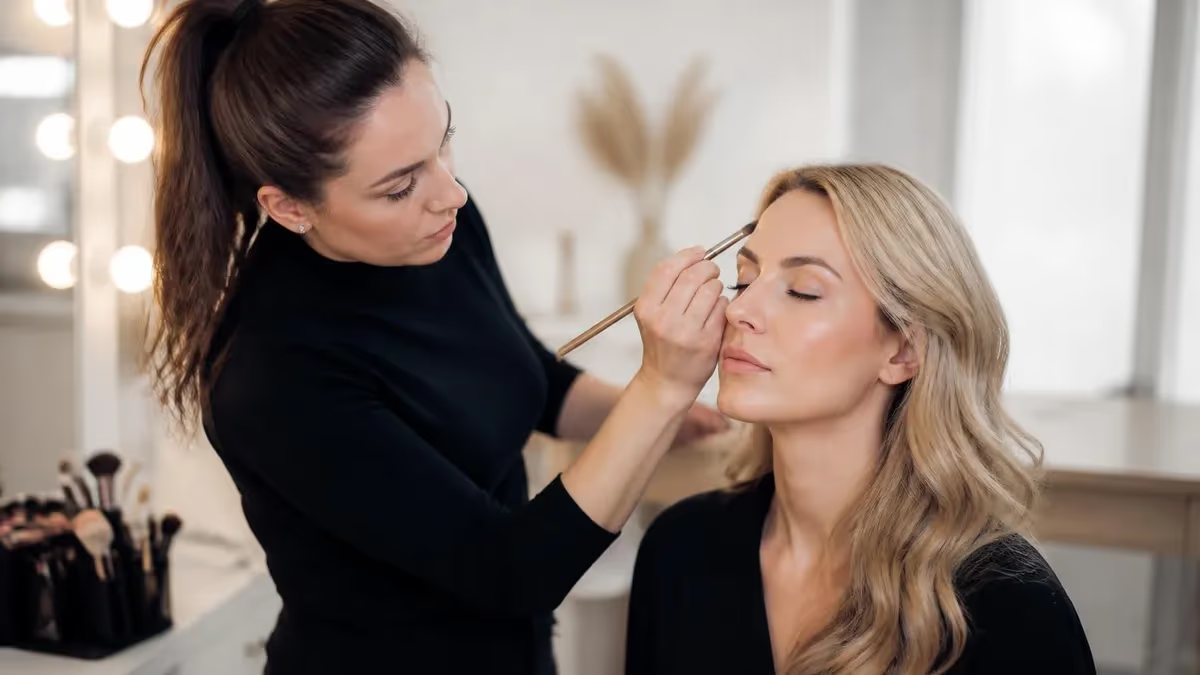
Looking for makeup artist jobs? You picked a fun and growing field. Beauty work spans bridal suites, film sets, MAC counters, theater wings, even mortuaries — and each setting pays differently, demands different skills, and rewards different personalities. The U.S. Bureau of Labor Statistics tracks roughly 4,800 specialty makeup artists in theater and performing arts alone, with median pay near $48,000. Add freelance bridal, retail beauty advisors, special-effects pros, and the broader cosmetology umbrella and the actual workforce is far larger — closer to 90,000 working artists nationwide.
This guide walks through real makeup artist jobs. Where they hide, what they pay, how to land one. You will find paths that need formal cosmetology school, paths that need only a strong portfolio, and a handful of niche specialties most beginners never consider. Salary ranges come from BLS, Glassdoor, and current job board postings as of this year — not outdated 2018 numbers floating around old blogs.
By the time you finish reading, you should know which makeup career fits your goals, what training the job actually requires, and the next concrete step to take this week. No fluff. Just the working knowledge that gets you hired.

Makeup Artist Jobs by the Numbers
Those numbers tell only part of the story. The labor market for makeup artists is also less centralized than people assume — fewer than 12% of working MUAs hold a traditional W-2 job. The rest piece together income from freelance bookings, contracts, and side income. Tax planning matters from day one.
Those numbers tell only part of the story. A freelance bridal artist in Manhattan or San Francisco bills $250 to $450 per bride and books 40+ weddings a year — that lands well above the BLS median. A counter artist at Sephora starts around $17 hourly plus commission. Special-effects work on a unionized film set (IATSE Local 706) pays $52+ per hour with health and pension. The same job title can mean wildly different paychecks depending on city, niche, and union status.
One thing to know upfront: most states require a cosmetology or esthetician license for any work that touches skin commercially. A few states (notably Louisiana and Florida) carve out makeup-artist-only licenses with shorter training. Theatrical and film work often falls outside state cosmetology rules because it is considered performance, not personal service. Always check your state board before booking paid clients.
Beauty influencers on Instagram give the impression that everyone is doing celebrity red-carpet work. The truth — most working makeup artists earn the bulk of their income from weddings, retail counters, MAC employee programs, photography sessions, and the occasional corporate event. Celebrity gigs exist but they go to artists with 10+ years experience and strong union connections. Plan accordingly.
Let me break the jobs into categories. Each demands a different mix of skill, licensing, and personality. Read all four — sometimes the path you dismiss at first is the one that fits your life.
Bridal and freelance event work is where most independent artists earn their living. Pay per face runs $150 to $450 in major metros, less in small markets. You build a portfolio from real weddings (or styled shoots if you are starting out), and you hustle for bookings through Instagram, The Knot, WeddingWire, and word-of-mouth referrals. Weekends are non-negotiable. Saturdays in summer can mean three brides in one day, alarm at 4:30 AM, last touch-up at 11 PM. Income is real but spiky — December and January are slow, May through October are wild.
Retail counter and freelance MAC pro work pays a steady hourly wage plus commission. You learn fast because you do 8 to 15 faces a day. The training MAC and Sephora offer is genuinely good — many famous artists started at counters. The downside is retail hours, holiday weekends, and sales targets that follow you home.
Film, TV, and theater work sits behind the heaviest gatekeeping. Union membership through IATSE Local 706 (West Coast) or 798 (East Coast) requires accumulated paid days on non-union shoots, recommendations, and a skills test. Pay is excellent once you are in — $400 to $700 per 10-hour day plus pension. Special-effects work pays even better but demands separate training in prosthetics, airbrushing, and sometimes mold-making.
Editorial and commercial photography is the glamorous-looking sister of bridal — magazine spreads, advertising, lookbooks, beauty campaigns. Pay ranges from $0 (test shoots that build portfolio) to $2,500+ per day for established artists with agency representation. Day rates with major brands like Dior or Estée Lauder can hit $5,000 but those bookings go to agency-repped artists with massive portfolios.
Four Job Paths Compared
Solo or small team. Set your own rates. Typical pay runs $150-$450 per face in mid-size metros and $400-$700 in major cities like NYC, LA, or Miami. You need a reliable car, a full pro kit (15+ foundations, 30+ brushes), and weekend availability May through October. Best for self-starters who enjoy running a small business as much as doing makeup. Build through The Knot, WeddingWire, Instagram, and venue referrals. Most freelancers hit profitability in year 2.
Hourly wage plus commission. Steady paycheck, structured training, generous employee discounts (40-60% off product). Pay $14-$22/hr plus 5-15% commission on sales. Best entry-level path with built-in mentorship from senior artists. Brands offer ongoing education, master classes, and product launches. Downsides — sales targets, holiday retail hours, and a ceiling around $50K without moving into management.
IATSE Local 706 (West Coast) or 798 (East Coast). Pay $400-$700 per 10-hour day plus pension and health benefits. Long hours, location travel, and demanding directors are baseline. Best for artists who love production craft — character makeup, period work, continuity tracking. Breaking in requires accumulated non-union paid days, references from working union artists, and passing a skills test. Most artists need 5+ years before joining the union.
Project-based, often through artist agencies (TRP, Wilhelmina Artists, The Wall Group). Pay ranges from $0 (test shoots to build book) up to $5,000 per day for top-tier artists working with major beauty brands. Slow build — most editorial artists work bridal or commercial to pay bills while their editorial book matures. Ceiling is highest of any path but the climb takes 7-10 years. Best for artists with strong creative vision and serious patience.

Before going further, a quick note on geography. Where you live changes everything about makeup artist jobs. New York and Los Angeles have the deepest pools — film, editorial, fashion week, bridal, theater, runway, celebrity work. They also have hundreds of artists competing for every gig.
Mid-size markets like Atlanta, Nashville, Austin, Denver, Phoenix, Charlotte, and Minneapolis often pay surprisingly well per booking and have less competition. The bridal market in particular thrives in cities with growing wedding venue scenes. Rural areas struggle for steady work — if you live an hour outside any metro, plan to drive for clients or build a niche that travels (workshop teaching, mobile bridal at venues).
Climate also matters more than people realize. Humid markets (Miami, Houston, New Orleans, anywhere in the Southeast in summer) demand totally different products and techniques than dry markets (Denver, Phoenix, LA). Setting sprays, primers, and foundation formulas that crush it in Seattle will slide right off a bride's face in August Atlanta. Build your kit for the conditions you actually work in, not the kit a Los Angeles YouTuber recommends.
How you train matters less than people think. I have met union film artists who never spent a day in cosmetology school and bridal artists with two-year esthetician licenses who still book at $250 a face. What does matter is your portfolio, your reliability, and your ability to read a client.
That said — formal training shortcuts the hardest part of the learning curve. Cosmetology school takes 1,000 to 1,600 hours depending on state and runs $6,000 to $20,000 at private schools, far less at community colleges. The license lets you legally touch skin, do lash extensions, do brows, and offer skin services — all of which expand your bridal package and revenue. Esthetician programs are shorter (600 hours) and license you for skin care, makeup, and waxing but not hair. Many bridal artists choose esthetician over full cosmetology because the bridal market does not care about haircutting credentials.
The MUA-only license route (where it exists) takes 30 to 300 hours and costs $400 to $3,000. Faster. Cheaper. Limited scope — you cannot do hair, lashes, or skin treatments. For pure makeup work it is the lean path.
Training Path Comparison
Pick the path that matches your end goal. Want to own a beauty studio with hair, brows, and bridal trials? Cosmetology. Want to focus on weddings and add skincare for income smoothing? Esthetician. Want only film and editorial work? Skip licensing, build portfolio, and network like your career depends on it (it does).
One trap to avoid — the $40,000 "makeup academy" programs that promise celebrity careers. Most are not state-accredited, give no license, and teach what you can learn from YouTube in a weekend. If a school cannot point to specific working alumni and a real licensing pathway, run.
Several online "professional makeup certifications" sell for $2,000-$5,000 and have zero legal value. They cannot license you for paid skin contact in any state. They are useful only as elective training. Before paying tuition, confirm the school is accredited by NACCAS or your state cosmetology board and that graduates pass the state licensing exam at 75%+ rates.
Let me cover what a real first year looks like for a freelance bridal makeup artist. Because most online guides skip this part.
Month one through three — you assist established artists for free or low pay. You watch how they handle the mother of the bride who hates contouring. You learn how to time a wedding party so the bride is finished 30 minutes before photos, not 30 seconds after. You build a kit slowly — primer, foundation in 12 shades, concealer in 10, brushes, lashes, setting spray, a reliable backup of everything because Murphy's Law runs weddings.
Month four through six — you offer styled shoots for free in exchange for high-quality photos. You build an Instagram feed with consistent lighting, real before-and-afters, and a clear sense of your style (soft glam? clean glow? full beat?). You start charging $75 to $150 per face for friends, friends-of-friends, and small events.
Month seven through twelve — your first paid weddings come in at $200 to $300 per face. You learn that contracts matter, that deposits prevent ghost-bookings, and that your favorite foundation breaks down on a humid August Saturday in Houston. You raise rates twice. By month 12 you are booking 2 to 4 weddings a month at $250+ per face and your second year will double income.
Year two is where most artists quit their day jobs. The brides from year one refer their friends. The styled shoots from year one rank you on Google. Your kit is paid off. Your processes are dialed in. You are tired but excited.

First-Year Action Checklist
- ✓Pick your training path (cosmetology school, esthetician program, MUA-only license, or self-taught route) based on your end goal and state licensing rules
- ✓Buy your foundational pro kit — 12 foundation shades across light/medium/deep tones, 10 concealer shades, 30 quality brushes, primer, setting spray, false lashes, and a sturdy travel case
- ✓Complete 5+ styled shoots with professional photographers (free, in exchange for high-resolution images you can use for portfolio and Instagram)
- ✓Launch Instagram and TikTok with consistent before-and-after content (3 posts per week minimum, lighting matched, captions optimized for search)
- ✓Assist 3+ established bridal or film artists on real jobs to learn the business side — pricing, contracts, timing, client management, and kit logistics
- ✓Get your business license, EIN from the IRS, and liability insurance ($300/year through the Professional Photographers of America or similar)
- ✓Book and complete your first 5 paid weddings or events at $150-$250 per face to build reviews, testimonials, and case studies
- ✓Raise rates to $250-$350 per face once your calendar is 50%+ booked, add trial sessions at $125, and start tracking which referral channels work best
Now let me talk about money — the part most beauty blogs skip because it makes them sound unglamorous. Most working makeup artists do not earn six figures. The ones who do hustle hard, work weekends, and run their craft like a real business. Here is honest math.
A bridal artist in a mid-size city (Nashville, Charlotte, Sacramento) charging $275 per bride, doing 3 brides on a Saturday during peak season (May-October), and 1 bride per Saturday in off-season earns roughly $35,000 to $48,000 net after kit replenishment and self-employment tax. Add weekday senior portraits, headshots, and small events and you reach $55,000 to $65,000. Add airbrush services, lash add-ons, or trials at $125 each and you cross $75,000 in year three or four.
A counter artist at MAC earning $18 hourly plus 10% commission on $25,000 monthly sales earns roughly $42,000 a year with paid time off, health insurance, and 60% employee discount on product. Less excitement, more stability. Many artists work counter part-time while building freelance.
Union film artists in Los Angeles or New York hit $90,000 to $140,000 in busy years on TV series with strong overtime. Lean years (between shows, during industry strikes) drop to $40,000 to $60,000. Pension and health benefits make union work the safest long-term play if you can break in.
Freelance Bridal vs. Counter Employment
- +Freelance: set your own rates and schedule
- +Freelance: ceiling is much higher with hustle
- +Freelance: no boss, no sales targets, no holiday retail hours
- +Counter: steady weekly paycheck and health insurance
- +Counter: brand training and ongoing education are free
- −Freelance: zero paid time off, sick days, or retirement
- −Freelance: kit, gas, insurance, and taxes eat 30%+ of revenue
- −Freelance: slow Decembers and Januarys hit cash flow hard
- −Counter: sales pressure and weekend hours during holidays
- −Counter: pay ceiling is real — most counter artists cap at $50,000
Pros and Cons at a Glance
| Pros | Cons |
|---|---|
| Freelance: set your own rates and schedule | Freelance: zero paid time off, sick days, or retirement |
| Freelance: ceiling is much higher with hustle | Freelance: slow Decembers and Januarys hit cash flow hard |
| Freelance: no boss, no sales targets, no holiday retail hours | Counter: sales pressure and weekend hours during holidays |
One more income angle worth covering — corporate and brand ambassador work. Companies like Sephora, Ulta, MAC, and Estée Lauder hire freelance educators to run pro events, training sessions, and product launches. Day rates run $400 to $1,200 plus travel. These gigs come through agency representation (TRP, Wilhelmina Artists, Bumble & Bumble Pro Network) or direct relationships with brand reps. Counter artists often graduate into this work after 3-5 years of strong sales performance.
For most artists the smart play is to do both for two years — counter job for benefits and steady income, freelance bridal on weekends to build portfolio and clientele. When freelance income clears 60% of counter income for three months running, you are ready to go full-time.
One more thing to mention — the certification debate. Beauty Instagram is full of "certified makeup artist" badges from online courses. They look impressive but they have no legal standing. State licensing is what lets you work commercially. A certificate from QC Makeup Academy or Bobbi Brown Pro Artist Workshop is genuine continuing education and shows on your resume — but it is not a substitute for state licensing where the law requires it.
If you want to work in film or theater specifically, look at the IMDb credits of artists you admire and trace where they trained. Many came up through the Joe Blasco school, Cinema Makeup School, or apprenticed under union artists. Theater MFAs from Yale or NYU also place graduates into Broadway and regional theater work but cost $80,000+ in tuition.
MUA Questions and Answers
So — what is your next step? If makeup artist jobs sound like the right fit, pick one path this week. Cosmetology school if you want the full salon offering. Esthetician if you want bridal plus skincare. MUA-only if your state offers it and you only want event or photo work. Skip licensing entirely if you are gunning for film and theater and willing to grind the portfolio route.
Then commit to 90 days of action. Buy a foundational kit. Shoot 5 styled portfolios. Assist a working artist on 3 jobs. Launch Instagram with consistent content. By month four you will know whether this career is what you imagined — and you will have a real portfolio either way.
The beauty industry rewards consistency more than talent. Average artists who post 3x weekly, respond to inquiries in under 2 hours, and treat brides like family book more weddings than brilliant artists with chaotic businesses. If you can do the basics relentlessly, you can build a real career.
One last thing — keep learning. The pigments, brushes, and techniques that win today will be replaced by something new in three years. Top artists allocate 5% of revenue to continuing education each year. Workshops, advanced courses, working with mentors. The craft is endless, which is part of what makes this work fun.
A few niches to keep on your radar as you grow. Mortuary cosmetology sits in funeral homes and pays $35,000-$55,000 with steady hours, no weekends, and a recession-proof client base. It needs a strong stomach but no glamour pressure. Many cosmetologists drift in late-career for the schedule.
Permanent makeup (microblading, lip blush, powder brows) needs separate certification — 100-200 hours of training plus a state tattoo license in most states. Artists who specialize charge $400-$800 per session and book 6-12 clients a week. The math is excellent. Airbrush and HD makeup for high-definition video adds $50-$150 per booking once you own a compressor and learn the technique. Most film artists carry airbrush gear now because 4K cameras punish traditional foundation application.
Then there are the adjacent income streams that established artists layer on. Teaching workshops at $200-$400 per student. Affiliate programs with brands you already use (Beautyblender, Charlotte Tilbury, Fenty pro-discount programs). Selling preset packs or training videos online once your social audience hits 50K. Consulting for beauty brands on color matching and product development. None of these are core jobs but they smooth income and stretch your craft. Most six-figure artists draw from 3 or 4 revenue lines, not just one.
Finally — health and longevity. Standing all day at counters, hunching over chairs at weddings, breathing pigment dust at film sets. The job is harder on bodies than people expect. Plan for a good massage budget, decent shoes (Hoka and Brooks are favorites among bridal artists), and rotation between physically taxing jobs.
Many artists hit a wall around year 10 if they never adjusted their workflow. The ones who last 30+ years build smart habits early. Talk to senior artists in your market about how they protect their backs, hands, and eyes. That knowledge does not show up in any school curriculum but it determines whether you are still booking weddings at 55.
About the Author
Licensed Cosmetologist & Beauty Licensing Exam Specialist
Paul Mitchell SchoolsMichelle Santos is a licensed cosmetologist with a Bachelor of Science in Esthetics and Salon Management from Paul Mitchell School. She has 16 years of salon industry experience and 8 years preparing students for state cosmetology board exams in theory, practical skills, and sanitation. She specializes in licensure preparation for cosmetologists, estheticians, and nail technicians.
Join the Discussion
Connect with other students preparing for this exam. Share tips, ask questions, and get advice from people who have been there.
View discussion (7 replies)