
Celebrity Makeup Artist: How to Become One (2026 September Career Guide)
How to become a celebrity makeup artist in 2026 September: 💡 career path, agencies, day rates, Instagram + TikTok strategy, top MUAs to learn from, gear and training.
Celebrity Makeup Artist: How to Become One (2026 Career Guide)
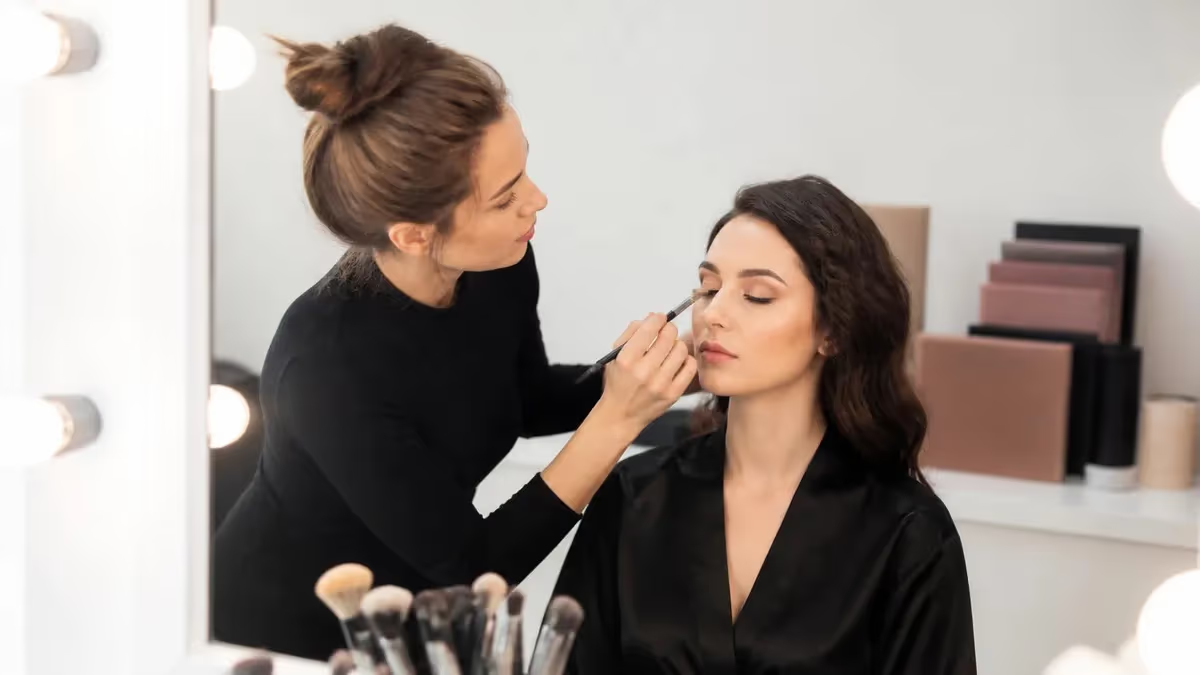
A celebrity makeup artist works one-on-one with actors, musicians, influencers, athletes, and models for red carpets, photo shoots, music videos, film and TV sets, magazine covers, brand campaigns, and personal events. It is the most visible tier of the makeup industry, and also the most competitive. The names you see tagged on Hailey Bieber, Kim Kardashian, Beyoncé, Selena Gomez, and Zendaya - Mary Phillips, Mario Dedivanovic, Sir John, Hung Vanngo, Patrick Ta - took roughly seven to twelve years to land their first A-list client. None of them started there.
The path runs from beauty counter or freelance bridal work to assisting an established artist, then a few editorial bookings, then a first commercial campaign, then - if Instagram and TikTok cooperate - a referral to a manager, a stylist, or a publicist who hires you for a real client. The work pays well at the top. Mid-tier celebrity artists charge $500 to $2,000 per day. A-list artists charge $1,500 to $15,000 per day, and the ones with brand deals frequently earn $250,000 to over $1 million a year before they touch a single face for hire.
This guide walks through what celebrity MUAs actually do, who the most influential ones are right now, how to break in, the certifications and licenses that matter (and the ones that don't), what agencies represent the top tier, and what your first five years should realistically look like. If you are still earlier in the journey, start with how to become a makeup artist and the broader makeup artist career overview. To see what local working artists earn, the makeup artist near me guide breaks down freelance day rates by region.
What a Celebrity Makeup Artist Actually Does
The day-to-day is split between three buckets: press days (a single client doing back-to-back interviews, photo shoots, and appearances over six to fourteen hours), event days (red carpets, premieres, music video shoots, awards shows), and editorial or commercial bookings (magazine covers, brand campaigns, lookbooks). On press days you do one face, then refresh it five or six times as the client switches outfits.
On a red carpet day you build the look, ride to the event with the client, and stand by for touch-ups. On film and TV bookings you may be the head MUA for a department of three to six artists working hair, body, and special effects.
What This Career Actually Looks Like
- Years to A-list: 5 to 10 on average. Mary Phillips assisted for 8 years before Hailey Bieber.
- Top US hubs: Los Angeles, New York, Atlanta, Miami. London and Paris for fashion.
- Day rate range: $500 mid-tier · $1,500-$5,000 working celebrity · $5,000-$15,000+ A-list with brand deal.
- Real income driver: Brand ambassadorships, not direct makeup fees. Mario Dedivanovic, Patrick Ta, and Pat McGrath earn most of their income from their own product lines.
- No specific celebrity cert exists. Portfolio, references, and Instagram following matter more than any certificate.
Top Celebrity Makeup Artists to Study in 2026
If you want to work at this level you need to know who already is. Watch their Instagram stories, dissect their reels frame by frame, and copy the lighting, the lash placement, the foundation finish until your portfolio looks like theirs. The eight names below are the ones agency reps, stylists, and publicists name when they are asked for references in 2026.
Mary Phillips
Hailey Bieber's main MUA and the architect of the "latte makeup" and "strawberry girl" trends that defined 2024-2026. Known for soft contour, bronzed lid wash, and slightly overlined lip. She also works with Jennifer Lopez and Kendall Jenner. Her under-eye contour technique alone has been recreated by every TikTok artist in the last two years.
Patrick Ta
Kim Kardashian, Gigi Hadid, Camila Mendes. Known for radiant chest and shoulder highlighting and a glossy lip that became his Patrick Ta Beauty signature. Started at MAC counter in Phoenix.
Mario Dedivanovic
Kim Kardashian's long-time MUA, founder of Makeup By Mario. Defined the contour-heavy Kardashian look from 2009 onward and still runs the most influential masterclasses in the industry at $1,000 to $2,500 per seat.
Sir John
Beyoncé's primary MUA for over a decade. Works heavily in fashion and editorial. Pretty Little Thing and L'Oréal Paris global ambassador. Known for sculpted bronze finishes that read well on Black and brown skin under stage lighting.
Pat McGrath
Not technically a celebrity MUA - she runs the makeup for most major fashion shows globally - but Pat McGrath Labs is the most respected brand in artist makeup and she still does select editorial work with celebrities like Naomi Campbell and FKA Twigs. Her masterclasses sell out at $2,000 plus.
Hung Vanngo
Selena Gomez, Bella Hadid, Emily Ratajkowski. Vietnamese-Canadian artist known for a clean, glowing skin finish with a strong graphic eye when needed. Vogue covers regularly.
Jamie Greenberg
Kaley Cuoco, Rashida Jones. Known for soft, photo-ready skin with restrained color. Her work is a good study if you want to do clean, awards-show-ready beauty without trend chasing.
Vanessa Cox
Margot Robbie, Sofia Boutella, Rosie Huntington-Whiteley. UK-based, fashion-focused, with a sharp eyeliner and luminous skin signature. Works heavily for British Vogue and editorial.
Beyond these eight, watch Nikki DeRoest (Rosie Huntington-Whiteley), Katey Denno (Amanda Seyfried), Carolina Gonzalez (Lady Gaga), and Nina Park - all of whom are landing more A-list work in 2026. Many search trends point to MUA meaning as a starting point for the industry vocabulary you will hear repeatedly: head MUA, key, second, third, day rate, kit fee, agent split, kit damage, on-camera, off-camera, beauty shot, and continuity check.
One pattern these artists share: they did not chase trends, they set them. Mary Phillips invented latte makeup before TikTok named it. Patrick Ta invented the body-highlight Met Gala look before brands copied it. The lesson for someone five years into the work: develop a signature technique you can demonstrate in a 15-second video and repeat on different faces. Editors and stylists hire MUAs they associate with a specific finish, not generalists who can do anything.
Celebrity MUA Career Snapshot
The most common path: beauty counter (MAC, Sephora, Bobbi Brown) for 1-2 years → freelance bridal and event work for income → assist an established MUA unpaid or for a kit fee → first paid editorial booking → first commercial campaign → first low-tier influencer client → first working actor or musician → agency representation → first A-list client.
Typical timeline: 5-10 years from counter to A-list. There are exceptions - mostly artists who went viral on TikTok in 2021-2023 and skipped the assisting stage - but planning around an exception is poor strategy.
How to Actually Break Into Celebrity Work
There is no single audition or test. The five real entry routes are all relationship-driven, and most working celebrity MUAs used more than one of them simultaneously over their first three to five years. The closer you are to a major media market - Los Angeles, New York, Atlanta, Miami - the faster these routes work, because most of the people who can hire you live and shoot there.
1. Instagram and TikTok consistency
This is the single most important shift in the industry since 2021. Mary Phillips, Patrick Ta, and Katie Jane Hughes all attribute substantial bookings to social content. The rule: post three to five times per week, every week, for at least two years. Show technique - eyeliner placement, contour shapes, lash band cutting - not just finished looks. Use trending audio. Tag every product. Reply to every DM from a stylist, publicist, or agent within 24 hours.
2. Assisting established MUAs
Cold-DM five to ten working celebrity MUAs at your tier (not the A-list ones) offering free assist days. Show up early, never speak unless spoken to, clean brushes constantly, and bring backup supplies they did not ask for. Two solid years of assisting builds the references that agency reps will call.
3. Up-and-coming influencer work
The 50,000-500,000 follower influencer tier hires MUAs constantly for shoots, paid posts, and events. Rates are modest ($150-$500/day) but the content gets seen by stylists. Several Mary Phillips clients came through influencer crossovers.
4. Photographer collaborations
Email five fashion or beauty photographers in your city offering to MUA test shoots for free in exchange for retouched images for your portfolio. One test shoot a month for a year builds an editorial book that agency reps will look at.
5. Fashion Week assistant work
Pat McGrath, Diane Kendal, and Tom Pecheux hire 50-100 assistants per fashion week in NY, London, Milan, and Paris. Apply through their agency websites two months ahead. Pay is minimal but you will work on 30 to 80 model faces in three days and meet half the industry.
5 Real Ways to Break Into Celebrity MUA Work
- Frequency: 3-5 posts/week, 2+ years
- Focus: Technique reels, not finished faces
- Why it works: Stylists and publicists scout here first
- Pay: Free to $250/day kit fee
- Duration: 1-2 years minimum
- Outcome: References agencies will call
- Tier: 50K-500K follower clients
- Rate: $150-$500/day
- Why it works: Stylists see the content
- Pay: Free, get retouched images
- Frequency: 1+ shoot/month for 12 months
- Outcome: Editorial portfolio book
- Where: NY, London, Milan, Paris
- Pay: $150-$400/day, 3-5 days
- Apply through: Pat McGrath, Diane Kendal agencies
Training, Licenses, and Certifications
There is no "celebrity makeup artist certification" - anyone telling you otherwise is selling something. What does matter: your state license (in some states), the schools that produce working alumni, and a small set of master classes that are genuine resume credentials.
State licensing
Some US states (California, Texas, Florida, New York under specific circumstances) require an esthetics or cosmetology license to perform makeup professionally on paying clients. Esthetics typically takes 600 hours (about six months) and costs $4,000 to $12,000. Cosmetology is 1,500 hours and $10,000 to $25,000. Check your specific state board before enrolling in either. The broader makeup artist certification guide has state-by-state requirements and breakdown.
Schools that produce working celebrity MUAs
Make-Up Designory (MUD) in Burbank and New York is the most cited. Its Master Makeup Artistry program is 600 hours, $14,000-$18,000, with strong working alumni placement. Make Up For Ever Academy in NY and LA is the second-most cited. Cinema Makeup School in LA is the strongest pick if you want to lean into film and TV through IATSE Local 706. The Joe Blasco Makeup Artist Training Center in LA and Orlando produces strong special-effects-leaning alumni.
Master classes that count as resume credentials
Mario Dedivanovic's MasterClass series, Pat McGrath's selected workshops, Wayne Goss's online courses, and Vanessa Cox's London classes. Each costs $300 to $2,500. Listing two or three of these on your portfolio site is meaningful to agency reps. None of them replace a school - they supplement it.
Practice tests for industry knowledge
You can prepare for state board exams and validate your foundational knowledge of color theory, sanitation, and product chemistry with our makeup artist practice test pdf. It is a free printable used by candidates preparing for state board licensing.

Celebrity MUA Income at a Glance (2026)
Celebrity MUA vs Bridal MUA: Which Career Is Right For You?
- +Celebrity: $1,500-$15,000+ day rates at the top tier vs $400-$1,500 bridal day rates
- +Celebrity: Brand ambassadorships frequently $250K-$1M+/year - bridal has no parallel revenue stream
- +Celebrity: Portfolio appears on Vogue, Elle, magazine covers - massive visibility
- +Celebrity: Travel paid for, often international, often first class
- +Celebrity: Press credits open doors to brand collaborations and your own product line
- −Bridal: Predictable booking calendar 6-18 months out vs celebrity's chaotic 24-hour notice gigs
- −Bridal: Local market, no relocation required - celebrity requires LA/NY/ATL/Miami residence
- −Bridal: 5-15 years shorter ramp to consistent six-figure income
- −Bridal: Family-friendly hours - celebrity is nights, weekends, holidays, 14-hour days
- −Bridal: No agent commission (you keep 100%) vs 15-25% agency cut on celebrity work
What Celebrity MUAs Get Paid For Each Type of Job
Income mix matters more than headline day rate. A working celebrity MUA at the $2,000-$3,000/day tier earns most of their gross income across roughly the following split: 35% red carpet and press days, 25% editorial and commercial shoots, 20% film and TV bookings, 10% master classes and brand consulting, 10% miscellaneous (private events, lessons, weddings for celebrity clients). At the A-list tier, brand ambassadorships often eclipse 60% of total income and direct makeup work becomes a smaller piece.
Red carpet and press days
Standard rate is $2,000 to $5,000 for major events (Oscars, Met Gala, Cannes), $1,000 to $2,500 for mid-tier red carpets. The fee covers prep time, on-site time, and touch-ups through the after-party. Stylist and publicist confirms booking 7-21 days ahead; client confirms 24-48 hours ahead.
Editorial shoots
Magazines pay $500-$1,500/day for standard editorial. Vogue, Harper's Bazaar, Elle, and Vanity Fair pay $1,500-$3,500/day for cover work. Editorial rarely covers the bills - artists do it for the portfolio and for the agency-rep visibility.
Commercial campaigns
Print and digital campaigns pay $5,000 to $15,000/day. Add usage fees: a 12-month buy-out for a global beauty campaign adds $20,000 to $80,000. Brand campaigns are where mid-tier celebrity MUAs make rent.
Film and TV
IATSE Local 706 (the Hollywood union for MUAs) sets minimums at roughly $3,500-$5,000/week for head MUA, $2,500-$3,500/week for second/key, plus pension and health contributions. A theatrical film run is typically 8-16 weeks. Residuals on union TV pay a small recurring royalty for every domestic and international rerun.
Brand ambassador deals
The real money. Mary Phillips, Patrick Ta, Mario Dedivanovic, and Sir John each hold ambassador roles paying $250,000 to over $1 million per year per brand. These deals require minimum follower counts (typically 500K+ on Instagram) plus a steady editorial and red carpet presence with the brand's products visibly in use on named celebrities.
Many of the top earners run their own product lines now - Pat McGrath Labs, Patrick Ta Beauty, Makeup By Mario - which is the natural endgame for an MUA who has built enough personal brand to monetize a product range. Launching a line typically requires $2M-$8M in startup capital plus a celebrity-investor partner, and the artist remains the public face of the brand for marketing.
Private events and lessons
A surprising revenue stream: private one-on-one lessons with high-net-worth clients pay $1,500-$5,000 per session in LA and NY, often booked through stylists. Wedding and event one-offs for celebrity clients pay $5,000-$25,000 (much higher than standard wedding makeup artist work) because they include travel, on-call standby, and full event-day coverage.
Income Tier Breakdown
5-Year Celebrity MUA Career Timeline
Year 1: Foundation
Year 2: Assist & Test
Year 3: First Paid Bookings
Year 4: Build Roster
Year 5: Agency + A-list shot
Building Your Celebrity MUA Portfolio
Agency reps and stylists evaluate portfolios in about ninety seconds. Yours needs to be lean, recent, and unmistakably professional. The site should be a clean Squarespace, Format, or custom portfolio with no more than 30 images total, split across four to five categories.
What goes in: editorial (10-12 images, clean fashion-style shots with strong lighting, retouched by the photographer), beauty (6-8 close-up faces on solid backgrounds showing eyeliner, lip, and skin work), commercial (4-6 polished, brand-aligned images suitable for product packaging or campaign use), behind-the-scenes (3-4 shots of you working on a face), and red carpet or magazine tear sheets (3-4 images once you have them, with your name in the caption).
What does NOT go in: wedding clients (separate site if you still take them), friends and family, heavily filtered Instagram shots, school work, anything older than 18 months, and anything where the photographer has not approved use - this is the single most common way newer artists burn bridges in fashion. Image standards: every image at 2,400 pixels wide minimum, sharp focus, color-corrected, retouched by the photographer. Update the portfolio every 60-90 days and remove anything that no longer represents your current ceiling.
Include a clean about page, a one-paragraph artist statement, a recent press list, master class credentials, agency rep contact if signed, and a direct email for unrepresented inquiries. Make the contact email professional (firstnamelastname@yourdomain.com) - never a Gmail address with numbers in it. Agency reps will Google you the moment they like your portfolio; clean up old work and personal accounts before they look.
Celebrity MUA Portfolio Checklist
- ✓10-12 editorial images, retouched by the photographer, last 18 months
- ✓6-8 close-up beauty shots showing eyeliner, lip, and skin technique
- ✓4-6 polished commercial-style images suitable for brand use
- ✓3-4 behind-the-scenes shots of you working (show focus, brushes, kit)
- ✓3-4 magazine or media credits with your name in the caption
- ✓Domain on Squarespace, Format, or custom portfolio - never just Instagram
- ✓Photographer permission documented (email or DM) for every image
- ✓Image sizes 2,400px wide minimum, sharp, color-corrected
- ✓No school work, friends-and-family shots, or wedding clients
- ✓Updated every 60-90 days - never let it go stale past 3 months
- ✓Instagram and TikTok links visible in header with current follower counts
- ✓Contact email plus agency rep contact (if signed) on every page
A working celebrity MUA's kit is worth $10,000 to $30,000 retail and travels in two to four hard cases (Zuca, Yazmo, or custom). A-list artists keep separate kits for press, red carpet, film/TV, and editorial. Dominant brands: Pat McGrath Labs, Charlotte Tilbury, Dior, Chanel, Hourglass, Westman Atelier, MAC Pro, Make Up For Ever. Beautyblender plus custom brushes (Wayne Goss, Pat McGrath, Hakuhodo) in nearly every kit.
- Foundation library (30-50 SKUs): $1,500-$2,500 - biggest line item, must color-match any skin tone in seconds
- Eyeshadow library (Pat McGrath, Natasha Denona, MUFE, MAC): $800-$1,500
- Brushes (Wayne Goss, Pat McGrath, Hakuhodo, Rae Morris): $600-$1,500
- Skin prep (Tatcha, Barbara Sturm, Augustinus Bader, 111Skin): $500-$1,500 - the 2026 celebrity MUA differentiator
- Concealer + cream/powder contour for all tones: $800-$1,500
- Lashes (strips, individuals, glue): $300-$500
- Mascara exception: Top artists use $9-$14 Maybelline or L'Oréal - formula outperforms luxury
MUA Questions and Answers
Related MUA Career Reading

How to Become a Makeup Artist: Certification, Licensing & Career Path
Makeup Artist Career: Salary, Jobs & How to Get Started
Makeup Artist Jobs: Real Pay, Training Paths, How to Get Hired
Makeup Artist Near Me: How to Find (or Become) a Local MUA
Wedding Makeup Artist 2026: Pay, Bookings, and How to Become One
MUA Meaning: What Does MUA Stand For?
About the Author
Licensed Cosmetologist & Beauty Licensing Exam Specialist
Paul Mitchell SchoolsMichelle Santos is a licensed cosmetologist with a Bachelor of Science in Esthetics and Salon Management from Paul Mitchell School. She has 16 years of salon industry experience and 8 years preparing students for state cosmetology board exams in theory, practical skills, and sanitation. She specializes in licensure preparation for cosmetologists, estheticians, and nail technicians.
Join the Discussion
Connect with other students preparing for this exam. Share tips, ask questions, and get advice from people who have been there.
View discussion (7 replies)