
Makeup Artist Cost: What You Pay for Pro MUA Services in 2026 October
Makeup artist cost guide: real prices for bridal, event, editorial & drag MUA services, plus tipping, travel fees, and how to budget. 🗨️
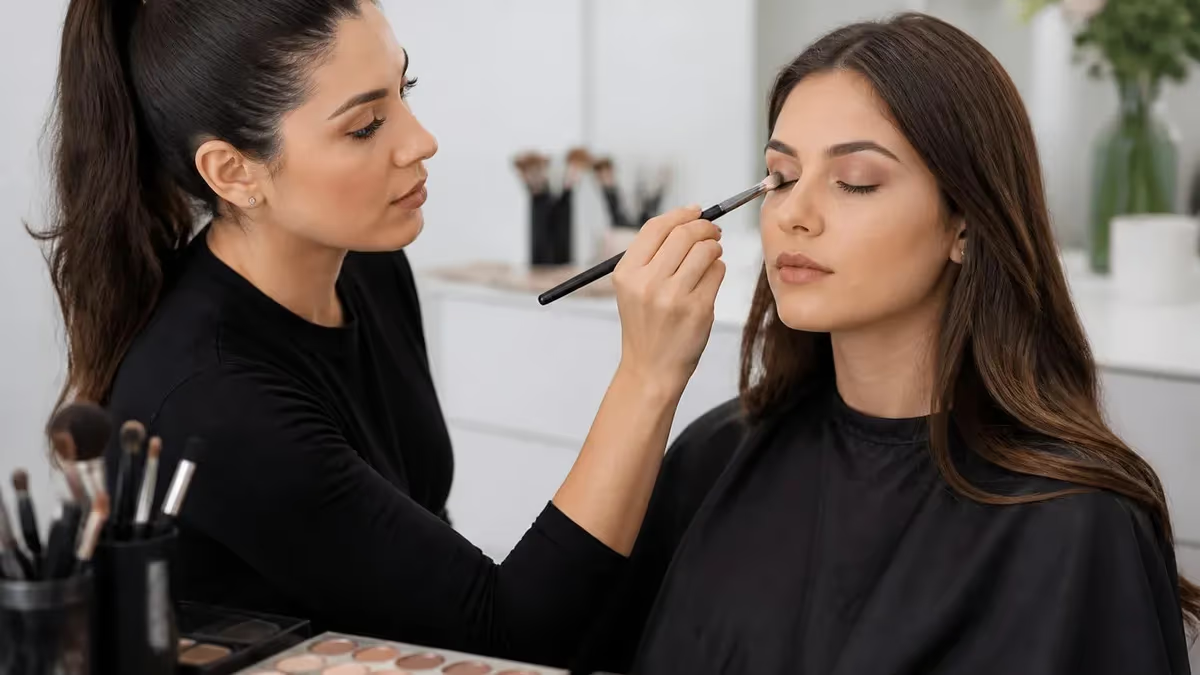
Understanding the real makeup artist cost in 2026 means moving past the vague "it depends" answer that fills most search results and looking at the actual line items that show up on a professional MUA's invoice. Whether you are booking for a wedding, a corporate headshot day, a quinceañera, or a drag performance, the price you pay reflects training, kit investment, travel, and the artist's tier in the local market. This guide breaks every figure down so you know exactly where your dollars go.
Across the United States, a single application from a licensed professional ranges from about $75 for a basic event look in a smaller market to $450 or more for a celebrity-tier makeup artist and hair package in New York or Los Angeles. Bridal trials, airbrush upgrades, false-lash application, and on-location travel each carry their own fees, and most reputable artists publish clear price sheets rather than negotiating on the spot. Knowing the standard structure protects you from surprise charges.
The biggest cost drivers are experience level, product cost, and time on site. A newly certified MUA who finished training six months ago will charge less than an artist with ten years of editorial credits, but both should still cover sanitation, premium foundations, and a written contract. When you compare quotes, you are not just comparing dollar figures — you are comparing the hours of practice, the brand of pigments, and the insurance coverage behind every brushstroke.
Geography matters more than most clients realize. The same look that runs $150 in Tulsa might cost $325 in Manhattan, simply because studio rent, parking fees, and licensing requirements push the artist's overhead higher. Destination weddings and out-of-state bookings add per-diem charges, gas mileage at the IRS federal rate, and sometimes hotel nights. Always ask for an itemized estimate before you sign so the travel line does not double your final invoice.
This article walks you through every category of professional makeup pricing, including average rates by service type, regional differences, what to tip, how to spot a fair quote versus an inflated one, and the red flags that point to an unlicensed operator. We also cover what aspiring artists themselves should charge as they move from assistant to lead, because pricing fairly is one of the hardest parts of launching a career in this industry.
By the end, you will be able to read any MUA proposal with confidence, ask the right follow-up questions, and budget realistically for the look you want. We will also point you toward free practice questions and certification resources if you are studying for the licensing exam yourself. Cost transparency benefits everyone — clients get the look they paid for, and artists build the long-term reputation that lets them raise rates without losing bookings.
Makeup Artist Cost by the Numbers
Average MUA Prices by Service Type
The biggest single factor in any makeup artist cost is experience tier, and it shows up clearly when you compare quotes from three different artists in the same zip code. A first-year MUA might charge $90 for a full face, a mid-career artist with five years of weddings books at $175, and a top-tier editorial artist will list $325 as their minimum. Each is fair for the value delivered, and the gap reflects portfolio depth, repeat clientele, and the speed an experienced artist brings to a tight wedding-morning timeline.
Product cost is the next major driver. Professional-grade foundations from brands like Danessa Myricks, Pat McGrath, Make Up For Ever, and Westman Atelier cost the artist between $44 and $128 per bottle, and a working kit easily exceeds $8,000 in retail value. When a client searches "makeup artist near me" and clicks the lowest bid, they may be paying for drugstore products that fade in two hours under photo lights — a false economy when reapplication or photo retouching costs more than the savings.
Time on site is billed in 60- to 90-minute increments per face, plus a 30-minute setup and a 15-minute breakdown. For a wedding party of six, that means the artist arrives by 7 a.m. for a 2 p.m. ceremony, blocks the entire morning, and cannot accept any other booking that day. The flat per-face fee already absorbs this opportunity cost, which is why splitting a booking with another couple rarely saves money the way clients hope.
Travel adds real dollars. Most contracts include a 20- or 25-mile radius from the artist's studio at no charge, after which mileage runs at the IRS federal reimbursement rate — currently $0.70 per mile in 2026 — plus parking, tolls, and a per-stop fee for multi-location days. Hotel stays for early-morning destination weddings add $150 to $300 per night, and the artist usually books the room themselves to guarantee proximity.
Sanitation and PPE costs are quietly built into every quote. Disposable mascara wands, single-use lip applicators, alcohol spray, brush cleaner, and palette barriers add up to roughly $4 per client served — small individually, but a line item the state board of cosmetology requires licensed artists to carry. Unlicensed bargain artists often skip this category entirely, which is one of the easiest ways to spot a quote that is too cheap to be safe.
Finally, liability insurance and licensing fees affect price. A licensed cosmetologist or esthetician carries $1 million general liability coverage that runs $185 to $400 per year, plus continuing education hours and state renewal fees every two years. These overhead expenses get amortized across every booking, which is why a fully licensed and insured artist with a brick-and-mortar studio prices 20% to 30% above someone working unlicensed out of their car.
MUA Practice Test Questions
Prepare for the MUA - Makeup Artist exam with our free practice test modules. Each quiz covers key topics to help you pass on your first try.
MUA Makeup Artist MCQ
MUA Exam Questions covering Makeup Artist MCQ. Master MUA Test concepts for certification prep.
MUA Makeup Artist
Free MUA Practice Test featuring Makeup Artist. Improve your MUA Exam score with mock test prep.
MUA Professional Makeup Artist
MUA Mock Exam on Professional Makeup Artist. MUA Study Guide questions to pass on your first try.
MUA Bridal & Special Occasion Makeup
MUA Test Prep for Bridal & Special Occasion Makeup. Practice MUA Quiz questions and boost your score.
MUA Color Theory & Skin Tone Analysis
MUA Questions and Answers on Color Theory & Skin Tone Analysis. Free MUA practice for exam readiness.
MUA Product Knowledge & Cosmetic Ingredients
MUA Mock Test covering Product Knowledge & Cosmetic Ingredients. Online MUA Test practice with instant feedback.
Makeup Artist Wedding Makeup, Event, and Editorial Pricing
A complete makeup artist wedding makeup package in 2026 averages $300 nationwide, but breaks into three components: a $75 to $125 trial six to eight weeks before the wedding, a $200 to $350 day-of application for the bride, and $125 to $175 per additional party member. Most contracts require a 25% non-refundable retainer to hold the date, with the balance due 30 days before the event.
Premium bridal artists add airbrush foundation for $50, individual lash clusters for $40, and a touch-up bag with the bride's exact shades for $35. On-site stays for a second look after the ceremony run $125 per hour. Always ask whether the trial fee is credited toward the day-of total — about 60% of artists offer this, and it can save $100 over the course of the booking.
Hiring a Pro MUA vs. Doing Your Own Makeup
- +Camera-ready finish that holds up under flash and direct sunlight for 8+ hours
- +Access to a $5,000+ professional kit you would never buy for one event
- +Skin-prep and color-matching expertise that prevents the dreaded foundation line
- +Stress relief on the morning of a major event — no last-minute eyeliner panic
- +Licensed sanitation that protects against pinkeye, cold sores, and contact dermatitis
- +Photo-tested techniques that read beautifully in both natural and artificial light
- −Cost of $150 to $450 per face that adds up quickly for a full bridal party
- −Booking lead time of 6 to 12 months for top artists in popular wedding seasons
- −Travel fees, parking, and per-diems add 15% to 25% to the base rate
- −Trial appointments require a separate weekend afternoon, often weeks in advance
- −Some artists require minimum-spend contracts of $600 or more for bridal bookings
- −Cancellation policies typically retain 25% to 50% of the deposit if you postpone
Before You Book: Makeup Artist Cost Checklist
- ✓Confirm the artist holds a current cosmetology or esthetician license in your state
- ✓Request an itemized quote separating service, travel, gratuity, and product upgrades
- ✓Read the cancellation, postponement, and weather-rescheduling clauses in full
- ✓Ask whether the trial fee is credited toward the day-of bridal total
- ✓Verify the artist carries at least $1 million in general liability insurance
- ✓Check that airbrush, lashes, and touch-up kit are included or priced separately
- ✓Get the morning-of arrival time and finish-by guarantee in writing
- ✓Confirm payment methods accepted and whether a credit-card surcharge applies
- ✓Review the artist's portfolio for skin tones and eye shapes similar to yours
- ✓Read at least 10 recent reviews on Google, The Knot, or WeddingWire
Never compare quotes by base rate alone
Two artists quoting $200 for a bridal service may differ by $150 once you add travel, trial, lashes, and the touch-up kit. Always request a flat all-in number for the exact services you need so the comparison is apples-to-apples before you commit.
Regional pricing differences create the widest spread in any makeup artist cost survey. The same level of certification and experience can command $135 in a mid-size Midwest market like Indianapolis or Columbus and $295 in coastal hubs like Boston, Miami, and San Diego. The driver is not just the artist's preference — it is the cost of studio space, the median household income of the client base, and the supply of competing pros in a given metro area.
New York City, Los Angeles, San Francisco, and Washington D.C. consistently rank as the four most expensive markets for professional makeup services, with bridal day-of rates starting at $325 and climbing past $600 for celebrity-credentialed artists. Studio rent in Manhattan alone runs $85 to $140 per square foot annually, and a 250-square-foot studio absorbs roughly $28,000 a year in overhead that must be priced into every booking the artist accepts.
Resort and destination markets like Aspen, Maui, Jackson Hole, and Napa Valley charge a premium tied to seasonal demand. A wedding in Aspen during peak summer or holiday weeks can push a single application to $400 even for mid-career artists, because the available pool of licensed pros is small and demand is concentrated in 14 high-traffic weekends. If you want to understand how a destination market like this prices its artist makeup artist talent, those local guides break the math down by season.
Southern markets like Atlanta, Nashville, Charleston, and Austin sit in the middle tier — bridal services run $225 to $325, with full bridal-party packages averaging $1,400 for the bride plus four party members. These cities have grown rapidly in wedding tourism over the past five years, which has pulled prices upward by 18% compared to 2021 but kept them well below the coastal hubs.
Smaller markets and rural counties typically price 30% to 45% below the national average, with single applications starting at $75 and bridal day-of running $135 to $185. The trade-off is a smaller selection of artists, shorter portfolios, and longer travel from the nearest licensed pro. Many couples in these regions either drive to a regional metro for the trial or pay travel premiums to bring an artist from the nearest big city for the wedding day.
Online directories like The Knot, WeddingWire, and Yelp publish median local prices that are surprisingly accurate when filtered by zip code, but they exclude the celebrity tier entirely. For high-end inquiries, ask three artists who have shot for Vogue, Brides, or Martha Stewart Weddings and average the three quotes to find the realistic top-of-market figure for your area. The spread between artists narrows the more specific you get about the look you actually want.

A quote that comes in 40% below local market average almost always signals an unlicensed operator, sub-par products, or a no-show risk. Verify state board licensing through your state cosmetology website before you wire a deposit — recovering a lost retainer is nearly impossible without a contract from a licensed business.
Getting a fair quote starts with knowing the median price in your zip code and then asking each artist three identical questions: what is included in the base rate, what triggers an upcharge, and what is your policy on travel and overtime. When all three artists answer the same questions in writing, the comparison becomes mechanical — you are no longer guessing whether one quote is hiding fees or whether another is bundling extras you do not need. This is also the moment to verify any continuing-education credentials the artist mentions.
Always ask for the contract before paying a deposit. A professional MUA contract specifies arrival time, finish-by guarantee, retainer amount, cancellation tiers, and the exact services included. If an artist refuses to send a contract or asks for full payment up front, walk away. Reputable artists across every price tier — including the highest, like lori anne allison makeup artist caliber editorial pros — operate on standard industry contracts because they protect both sides equally.
Tipping is expected but not always automatic. The standard 15% to 20% gratuity on the pre-tax subtotal applies to bridal and event work, while editorial day rates rarely include a tip because the production budget already covers the agreed fee. For groups, you can either tip the lead artist who then splits with assistants, or tip each artist individually with cash envelopes handed out at the end of service. Cash is preferred but Venmo and Zelle are widely accepted.
Trial appointments are where most pricing surprises get caught. During the trial, the artist confirms your skin type, lash preference, color match, and timing — all of which can shift the final invoice up or down. If you discover during the trial that you want airbrush instead of traditional application, get the new total in writing that day rather than waiting for an awkward conversation on the wedding morning. Adjustments made early stay friendly; adjustments made on the day cost more.
Bundling services with a hair stylist often saves money. About 40% of bridal MUAs work in an artist makeup artist duo with a hairstylist, and the bundled package typically runs 10% to 15% below booking each professional separately. The bundle also simplifies logistics — one arrival time, one contract, one point of contact for the wedding planner. Ask whether your artist offers a hair-and-makeup combo before you start interviewing stylists individually.
Finally, do not be afraid to negotiate on the scope rather than the rate. A reputable artist will almost never lower their per-face price, but they will frequently waive a trial fee, comp the touch-up kit, or extend the travel radius if you are booking a large party or a midweek date. Negotiating on what is included keeps the artist's hourly rate intact and gives you real savings — both sides win, and the working relationship stays positive through the lead-up to the event.
Practical budgeting starts six to nine months before any major event when you have time to interview three to five artists, compare itemized quotes, and lock in your top choice before they book out for the season. Wedding artists in popular metros routinely fill their May, June, September, and October weekends 12 months ahead, so the earlier you reach out the more selection you have at every price tier. Start a simple spreadsheet that tracks each artist's base rate, travel fee, lash policy, and cancellation terms.
For non-wedding events, lead time is shorter but still meaningful. A senior prom booking made eight weeks ahead typically locks in the artist's standard $125 to $175 rate, while a same-week booking can trigger a 25% rush fee if the artist has to rearrange other appointments. Corporate headshot days, podcast appearances, and on-camera interviews should be booked at least three weeks ahead so the artist has time to confirm wardrobe, lighting setup, and any product allergies you mention during intake.
Build a 10% contingency into your makeup budget for the unexpected — a last-minute airbrush upgrade, an extra party member, an added second look for the reception, or a tip increase if service exceeds expectations. The most common budget overrun on bridal day is the surprise addition of the mother of the bride or a junior bridesmaid who decides at the trial that she also wants professional makeup. Plan for two extra faces and you will rarely be over budget.
If you are paying cash, ask whether the artist offers a small discount for avoiding credit-card processing fees. Most independent MUAs absorb a 2.9% to 3.4% Stripe or Square fee on card payments, and many will pass 2% of that back to clients who pay by check, Zelle, or cash. Over a $1,500 bridal package, that is $30 saved with zero impact on service quality. Never pay by gift card, wire transfer, or any method that lacks dispute protection.
When the day arrives, prep your face the night before exactly as the artist instructed: clean skin, no heavy moisturizer, no self-tanner applied within 48 hours, and any sheet masks or treatments completed 24 hours prior. Arriving with prepped skin can shave 10 minutes off your appointment, which matters when six bridesmaids are waiting their turn. Tip envelopes prepared the night before remove one more stressor from the wedding morning checklist.
After the event, post a detailed review with photos within two weeks. Reviews are the single biggest driver of new bookings for independent MUAs, and a thoughtful 5-star review with three or four image attachments is more valuable to the artist than the tip you left. Tagging the artist on Instagram and granting permission to use your photos in their portfolio is another no-cost gift that working artists genuinely appreciate and remember when you book again in the future.
For aspiring MUAs reading this guide, the pricing structure above is the floor you should aim for as you finish certification and begin assisting established artists. Set your initial rates 20% to 30% below the regional median, raise prices every six months as your portfolio fills, and stop accepting any work below your studio minimum once your weekend calendar is consistently booked four to six weeks ahead. Sustainable pricing is what keeps a makeup career profitable for decades, not just for the first busy season.
Sample MUA - Makeup Artist Practice Questions
Try these questions from our free MUA - Makeup Artist practice tests. The correct answer and an explanation follow each question.
In professional settings, what is the purpose of completing a client intake form or consultation before a makeup application?
- A. To determine the makeup artist's skill level
- B. To document allergies, skin conditions, and preferences to ensure a safe and satisfactory service
- C. To set the price of the service
- D. To decide which products will be purchased
Answer: B. To document allergies, skin conditions, and preferences to ensure a safe and satisfactory service
A client intake form documents allergies, skin sensitivities, medical conditions, and preferences to protect both the client and the artist legally and professionally.
What is the Fitzpatrick Scale used for in the makeup industry?
- A. Measuring the intensity of eyeshadow pigment
- B. Classifying skin types by their response to UV light exposure
- C. Rating the coverage level of foundations
- D. Determining the correct undertone for a client
Answer: B. Classifying skin types by their response to UV light exposure
The Fitzpatrick Scale classifies skin into six types based on how it responds to sun exposure, which helps artists understand skin sensitivity and burning risk.
The Fitzpatrick scale is used in makeup to classify what?
- A. Eye color depth
- B. Skin phototype and sun sensitivity
- C. Hair porosity
- D. Lip pigmentation level
Answer: B. Skin phototype and sun sensitivity
The Fitzpatrick scale classifies human skin color and its response to UV light, guiding product selection.
In professional makeup, what does 'baking' refer to?
- A. Warming foundation with a heat tool before application
- B. Applying heavy concealer under UV light to set it
- C. Setting damp concealer with loose powder and letting it sit before dusting off
- D. Mixing foundation with a setting spray before application
Answer: C. Setting damp concealer with loose powder and letting it sit before dusting off
Baking involves applying translucent powder over concealer, letting body heat set it for 5-10 minutes, then dusting away excess for a crease-free finish.
MUA Questions and Answers

How to Become a Makeup Artist: Certification, Licensing & Career Path
Makeup Artist Certification
Makeup Artist Certification Practice Test PDF (Free Printable 2026)
Aspen Makeup Artist Guide: How to Book, Train, and Work in Aspen, Colorado
Makeup Artist Salary 2026: Real Pay by Setting, City & Specialty
About the Author
Licensed Cosmetologist & Beauty Licensing Exam Specialist
Paul Mitchell SchoolsMichelle Santos is a licensed cosmetologist with a Bachelor of Science in Esthetics and Salon Management from Paul Mitchell School. She has 16 years of salon industry experience and 8 years preparing students for state cosmetology board exams in theory, practical skills, and sanitation. She specializes in licensure preparation for cosmetologists, estheticians, and nail technicians.
Join the Discussion
Connect with other students preparing for this exam. Share tips, ask questions, and get advice from people who have been there.
View discussion (7 replies)