
HVAC System Cleaning: The Complete Guide to Duct Cleaning, Coil Maintenance, and Indoor Air Quality
Learn everything about HVAC system cleaning — ✍🏼 ducts, coils, filters, and more. Improve air quality, cut energy bills, and extend equipment life.
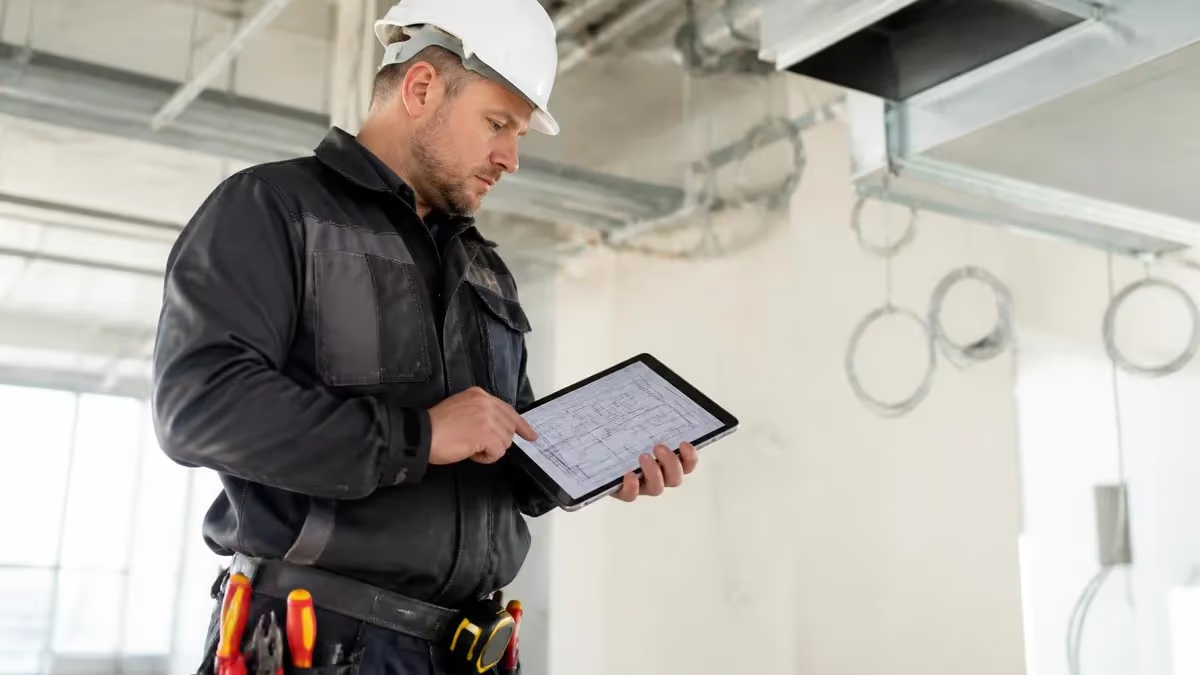
Proper hvac system cleaning is one of the most impactful yet frequently overlooked aspects of home and building maintenance. Over time, heating and cooling systems accumulate dust, pollen, mold spores, pet dander, and other contaminants inside ducts, on coils, and across blower components. This buildup forces your equipment to work harder, raises energy bills, and degrades indoor air quality for everyone breathing that recirculated air every single day. Practice with the free HVAC practice test on PracticeTestGeeks (35 questions with answer explanations).
Most HVAC professionals recommend a comprehensive system cleaning every three to five years under normal operating conditions, though households with pets, smokers, recent renovations, or residents with respiratory conditions should consider scheduling service more frequently — sometimes annually. Understanding what a full cleaning involves, how much it costs, and what results to expect helps homeowners and building managers make confident, well-informed decisions rather than falling victim to low-ball scams or unnecessary upsells from unscrupulous contractors.
The scope of a legitimate HVAC system cleaning extends well beyond the ducts alone. A complete service includes the supply and return air ducts, all registers and grilles, the air handling unit, blower motor and housing, heat exchanger surfaces, cooling coils, drain pans, and in some cases the air filter housing and plenum. Each of these components plays a role in overall system performance, and leaving one dirty while cleaning the others limits the benefit you receive from the service investment.
Indoor air quality has become a mainstream health concern, and rightly so. The EPA estimates that indoor air can be two to five times more polluted than outdoor air in most American cities, and people spend approximately 90 percent of their time indoors. Dirty HVAC systems act as reservoirs and distribution networks for biological contaminants, and regular cleaning is one of the most direct interventions available to improve what you and your family breathe each day across every season.
Energy efficiency is the second major driver behind HVAC system cleaning decisions. A layer of dust just 0.042 inches thick on a heat exchanger surface can reduce its heat transfer efficiency by over 21 percent, according to industry research. Dirty evaporator coils create similar performance penalties on the cooling side. When equipment efficiency drops, runtimes increase, utility bills climb, and mechanical components wear faster — all of which translate into real dollars lost over the life of the system.
This guide walks through every dimension of HVAC system cleaning: why it matters, what certified technicians actually do during a professional service visit, how to evaluate quotes and contractors, what DIY maintenance you can safely perform between professional visits, and what red flags to watch for in the marketplace. Whether you manage a single-family home or a commercial building with hundreds of zones, the principles of clean system operation apply universally and the payoffs are consistently substantial.
Understanding the difference between legitimate duct cleaning services and fraudulent low-price operators is critical before you pick up the phone. The industry has a documented history of bait-and-switch tactics where advertised prices of $49 or $99 explode into thousands of dollars once a crew arrives at your home. Armed with accurate knowledge about what cleaning actually entails, how long it takes, and what it realistically costs, you will be positioned to hire the right contractor at a fair price and verify that the work was completed correctly before writing any check.
Free HVAC Study Tools
Interactive HVAC resources on PracticeTestGeeks, free to start:
- HVAC EPA 608 Refrigerant Certification — 35 questions with instant scoring and answer explanations
- HVAC flashcards — review key terms and concepts card by card
- HVAC study guide — topic-by-topic overview of what the exam covers
- HVAC cheat sheet — one-page printable summary for last-minute review
HVAC System Cleaning by the Numbers
What a Professional HVAC System Cleaning Covers
Inspection and Assessment
Duct System Cleaning
Air Handler and Blower Cleaning
Evaporator and Condenser Coil Service
Drain Pan and Condensate Line Clearing
Post-Cleaning Verification
A professional HVAC system cleaning performed to NADCA (National Air Duct Cleaners Association) standards involves far more labor and equipment than many homeowners expect. The process typically takes three to eight hours for a residential system depending on home size, system age, degree of contamination, and the number of zones or air handlers. Rushed jobs completed in under two hours for a full-sized home almost always cut corners that undermine the value of the investment you are making.
The negative air pressure method — sometimes called the source removal method — is the industry gold standard recognized by NADCA and the EPA. Technicians connect a powerful vacuum unit to the duct system, creating negative pressure that prevents dislodged debris from escaping into living spaces during the cleaning process. Without this containment step, aggressive agitation can actually worsen indoor air quality temporarily by sending decades of accumulated dust into rooms through gaps in ductwork or around registers.
Agitation tools are what actually remove contamination from duct walls rather than simply disturbing it. Rotating brushes matched to duct diameter scrub sheet metal surfaces while air-powered whips and skipper balls create turbulence that breaks loose fibrous deposits. For flexible ductwork — the corrugated plastic tubing common in modern residential construction — softer agitation tools must be used to avoid tearing the duct liner, which would create an even larger problem requiring duct replacement rather than just cleaning.
Sanitizing and deodorizing treatments are optional add-on services that follow the mechanical cleaning phase. EPA-registered biocides and antimicrobial treatments applied to duct surfaces can inhibit future mold and bacterial growth, though the evidence supporting their long-term effectiveness is mixed. NADCA's position is that sanitizers are only appropriate after thorough source removal cleaning and only when visible microbial contamination has been confirmed — not as a substitute for proper mechanical cleaning or as a standard add-on sold to every customer.
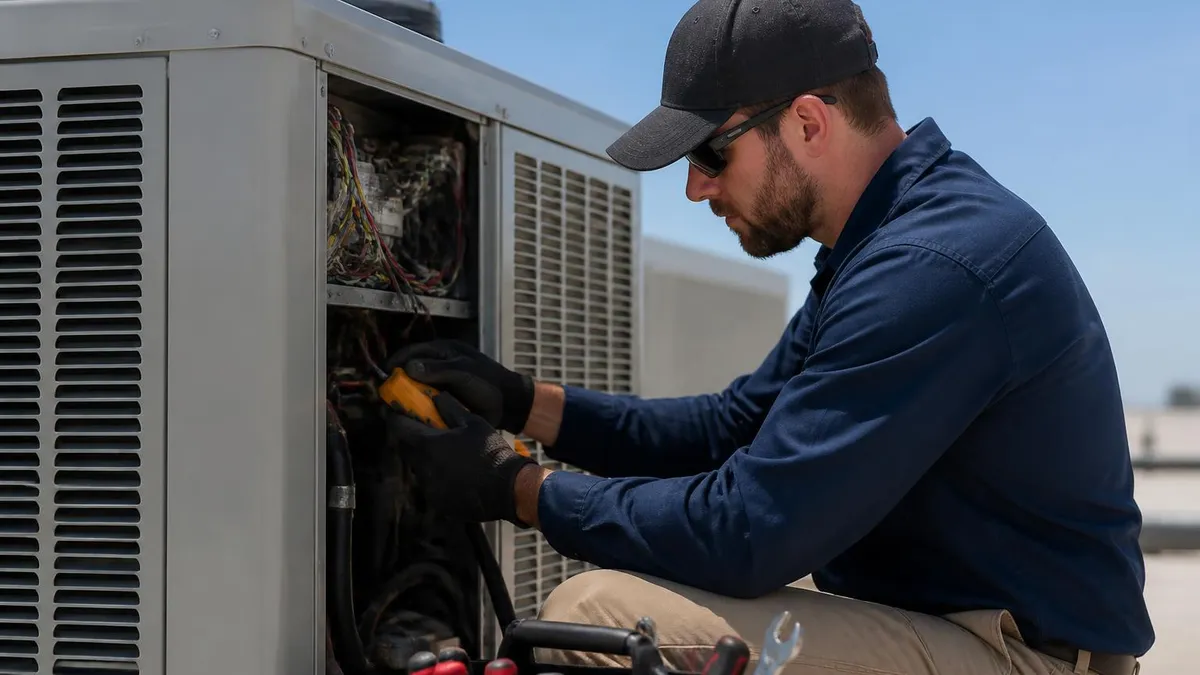
Coil cleaning deserves special attention because it directly determines your system's ability to cool and heat efficiently. Evaporator coils sit inside the air handler in the return air stream, which means every bit of dust and debris that slips past your air filter eventually lands on the coil fins. Over time this creates a felt-like insulating layer that dramatically reduces heat transfer. Studies by ASHRAE, the engineering society that sets HVAC standards, document efficiency losses of 5 to 40 percent depending on coil contamination severity, with corresponding increases in energy consumption and compressor wear.
The blower wheel is another frequently neglected component that a thorough cleaning service must address. This component moves all the air through your entire system, and even moderate buildup on its curved blades reduces both airflow volume and static pressure. Reduced airflow means inadequate temperature delivery to rooms farthest from the air handler, short cycling caused by overheating heat exchangers, and accelerated wear on the blower motor itself. Many homeowners who complain about uneven temperatures or high energy bills discover that a dirty blower wheel was the primary culprit all along.
Documentation matters when hiring an HVAC cleaning contractor. Before and after photos taken inside ducts, at the air handler, and of coil surfaces give you objective evidence that work was performed and completed. Reputable contractors willingly provide this documentation because it protects them from unfair complaints while giving customers confidence in the service received. If a contractor refuses to show you inspection results or before-and-after evidence of a cleaning scope that includes your coils and blower, that is a meaningful warning sign about the quality and completeness of their work.
HVAC Practice Test Questions
Prepare for the HVAC - Heating Ventilation and Air Conditioning exam with our free practice test modules. Each quiz covers key topics to help you pass on your first try.
HVAC Air Conditioning
HVAC Exam Questions covering Air Conditioning. Master HVAC Test concepts for certification prep.
HVAC Code Compliance
Free HVAC Practice Test featuring Code Compliance. Improve your HVAC Exam score with mock test prep.
HVAC Electrical Controls
HVAC Test Prep for Electrical Controls. Practice HVAC Quiz questions and boost your score.
HVAC Energy Efficiency
HVAC Questions and Answers on Energy Efficiency. Free HVAC practice for exam readiness.
HVAC Heating Systems
HVAC Mock Test covering Heating Systems. Online HVAC Test practice with instant feedback.
HVAC Load Calculations
Free HVAC Quiz on HVAC Load Calculations. HVAC Exam prep questions with detailed explanations.
HVAC Tools and Equipment
HVAC Practice Questions for HVAC Tools and Equipment. Build confidence for your HVAC certification exam.
HVAC Refrigeration
HVAC Test Online for Refrigeration. Free practice with instant results and feedback.
HVAC Safety Practices
HVAC Study Material on Safety Practices. Prepare effectively with real exam-style questions.
HVAC System Design
Free HVAC Test covering System Design. Practice and track your HVAC exam readiness.
HVAC Thermodynamics
HVAC Exam Questions covering Thermodynamics. Master HVAC Test concepts for certification prep.
HVAC Cleaning Methods: Which Approach Is Right for Your System?
The source removal method is the NADCA-endorsed gold standard for residential and commercial duct cleaning. Technicians attach a high-powered vacuum — either truck-mounted or portable with HEPA filtration — directly to the duct system to create sustained negative pressure. This containment environment allows agitation tools including rotary brushes, air whips, and compressed air nozzles to dislodge contamination from duct walls while the vacuum simultaneously extracts dislodged debris before it can re-enter living spaces.
Source removal is the only method that physically removes contamination rather than redistributing it. Independent studies commissioned by NADCA consistently show that properly executed source removal cleaning reduces particulate levels inside ductwork by 85 to 95 percent. The limitation of this method is cost and time — a thorough source removal cleaning requires multiple access points cut into the duct system and several hours of skilled labor, which is why legitimate services cost several hundred dollars rather than the $49 advertised by disreputable operators.
Professional HVAC Cleaning: Benefits and Drawbacks
- +Removes years of accumulated dust, allergens, and biological contaminants that degrade indoor air quality
- +Restores equipment efficiency and reduces energy consumption by cleaning coils, blower, and heat exchanger surfaces
- +Extends system lifespan by reducing strain on motors, compressors, and heat exchangers caused by restricted airflow
- +Identifies hidden problems like mold growth, pest intrusion, disconnected ducts, or damaged insulation during inspection
- +Reduces HVAC odors caused by mold, bacteria, and dust accumulation in the duct system and drain pan
- +Provides documented evidence of system condition through inspection photos and post-service reports
- −Significant upfront cost ranging from $300 to over $1,000 for a thorough residential cleaning
- −Industry has a well-documented history of scams and bait-and-switch pricing that requires vigilant contractor vetting
- −Benefits may be limited for newer systems or homes where regular filter maintenance has kept contamination minimal
- −Access panel cuts required for thorough duct cleaning must be properly resealed to prevent air leaks and efficiency losses
- −Improper agitation technique on flexible ductwork can cause tears or liner separation requiring duct repair or replacement
- −Sanitizing chemical treatments add cost and may have limited long-term effectiveness without addressing root causes of contamination
Pros and Cons at a Glance
| Pros | Cons |
|---|---|
| Removes years of accumulated dust, allergens, and biological contaminants that degrade indoor air quality | Industry has a well-documented history of scams and bait-and-switch pricing that requires vigilant contractor vetting |
| Restores equipment efficiency and reduces energy consumption by cleaning coils, blower, and heat exchanger surfaces | Benefits may be limited for newer systems or homes where regular filter maintenance has kept contamination minimal |
| Extends system lifespan by reducing strain on motors, compressors, and heat exchangers caused by restricted airflow | Access panel cuts required for thorough duct cleaning must be properly resealed to prevent air leaks and efficiency losses |
| Identifies hidden problems like mold growth, pest intrusion, disconnected ducts, or damaged insulation during inspection | Improper agitation technique on flexible ductwork can cause tears or liner separation requiring duct repair or replacement |
| Reduces HVAC odors caused by mold, bacteria, and dust accumulation in the duct system and drain pan | Sanitizing chemical treatments add cost and may have limited long-term effectiveness without addressing root causes of contamination |
HVAC System Cleaning Preparation Checklist
- ✓Verify the contractor holds current NADCA certification or equivalent professional credentials before scheduling.
- ✓Request an itemized written quote specifying every component to be cleaned including coils, blower, and drain pan.
- ✓Ask for before-and-after photographs taken inside ducts and at the air handler as standard documentation.
- ✓Clear two to three feet of workspace around all supply and return registers throughout the home before the crew arrives.
- ✓Move pets to a secure area and inform all household members that work will be in progress for three to eight hours.
- ✓Locate and provide access to the main electrical disconnect for the air handler to help safe service.
- ✓Confirm the contractor uses HEPA-filtered vacuum equipment to prevent dislodged debris from re-entering living spaces.
- ✓Replace your air filter immediately after cleaning is complete to protect freshly cleaned system components.
- ✓Ask the technician to show you the blower wheel and coil surfaces before reassembly so you can see the cleaning results.
- ✓Get a written service report documenting all components cleaned, any issues found, and recommendations for follow-up.
The $49 Cleaning Scam Is Still Widespread
The NADCA and Federal Trade Commission have both issued consumer warnings about fraudulent HVAC cleaning offers priced at $49 to $99. A legitimate whole-system cleaning covering ducts, coils, and the air handler for a standard home requires $300 to $1,000 in labor and equipment. If an advertised price seems impossibly low, it almost certainly is — these operations profit by upselling unnecessary treatments or performing no meaningful cleaning at all.
Understanding realistic HVAC system cleaning costs is essential before requesting quotes, because the range is genuinely wide and driven by multiple legitimate variables. For a typical single-family home between 1,500 and 2,500 square feet with a single HVAC system, expect to pay between $300 and $700 for a comprehensive cleaning that includes ducts, coils, blower, and drain pan. Larger homes, two-story layouts requiring extensive duct runs, homes with multiple air handlers, or systems with heavy contamination from years of neglect can push total costs to $1,000 or beyond.
The number of vents and registers is one primary cost driver because each access point requires time to clean, seal temporarily during negative pressure work, and restore after service completion. Most contractors price residential jobs using a base rate plus a per-vent fee, which typically ranges from $25 to $50 per register or supply diffuser. A 2,000 square foot home might have 20 to 30 supply registers and 5 to 10 return grilles, so vent count alone can swing the total price by several hundred dollars between smaller and larger homes.
Geographic location substantially affects HVAC cleaning prices just as it affects all home service costs. Metropolitan areas in the Northeast, Pacific Coast, and parts of the Mountain West generally see higher labor rates than rural areas in the Southeast and Midwest.
In cities like New York, Boston, San Francisco, and Seattle, expect to pay at the upper end of standard price ranges or beyond. Markets in areas like rural Ohio, Alabama, or Wyoming will trend toward the lower end. Always get three competing quotes within your local market rather than relying on national averages that may not reflect what you will actually pay.
Coil cleaning is frequently priced as a separate line item from duct cleaning because it requires different chemicals, tools, and more technical labor than duct vacuuming. Expect to pay an additional $75 to $200 for evaporator coil cleaning depending on coil size, access difficulty, and contamination level. Condenser coil cleaning on the outdoor unit is typically simpler to access and may be included in a full-system package or priced at $50 to $150 as a standalone. Both coils together represent some of the highest ROI cleaning work in terms of efficiency gains per dollar spent.
Sanitizing and antimicrobial treatment add-ons typically cost $100 to $300 extra depending on duct volume and the specific product used. As discussed in the methods section, these treatments are only appropriate and effective when applied after thorough mechanical source removal — they are not substitutes for physical cleaning. If a contractor leads with sanitizing as their primary offering or promotes it heavily before confirming their mechanical cleaning process, treat this as a warning sign that their core cleaning methodology may be inadequate.
Commercial HVAC cleaning costs are calculated differently from residential projects, typically using square footage, number of air handling units, linear feet of ductwork, or some combination of these metrics. Small commercial buildings under 5,000 square feet might pay $1,500 to $4,000 while larger facilities with complex air distribution systems, multiple air handlers, and energy recovery ventilators can reach $10,000 to $30,000 or more for a comprehensive cleaning. Commercial clients should require NADCA ACR (Assessment, Cleaning, and Restoration) standard compliance and detailed scope documentation before awarding any contract.
Financing and service agreements can help manage the upfront cost of professional cleaning. Many established HVAC contractors offer maintenance agreements that bundle annual preventive maintenance visits — which include filter changes, refrigerant checks, electrical inspections, and coil cleaning — with a cleaning service every three to five years at a predictable monthly cost. These programs typically provide better ongoing system care and earlier detection of developing problems than the break-fix approach of calling for service only when something fails, often at the least convenient and most expensive time possible.
Prices advertised below $150 for a whole-home cleaning are almost always bait-and-switch. Other warning signs include contractors who cannot provide NADCA certification, who refuse to show you their equipment before starting, who quote only by phone without an in-person or camera assessment, or who pressure you to decide immediately to lock in a special price. Always verify credentials independently at NADCA.com before work begins.
The debate between DIY maintenance and professional HVAC system cleaning resolves clearly when you distinguish between what homeowners can safely accomplish versus what requires specialized equipment and trained technicians. A homeowner with basic mechanical aptitude and the right supplies can meaningfully extend the interval between professional cleanings by performing consistent filter changes, register cleaning, coil surface spraying with no-rinse coil cleaner from a hardware store, and condensate drain flushing. None of these DIY activities replaces a professional source removal cleaning, but they reduce the rate at which systems accumulate problematic levels of contamination.
Filter selection is the highest-use DIY decision in HVAC system maintenance. The air filter is your system's primary defense against dust and debris entering ducts, coils, and the blower housing. A MERV 8 pleated filter captures approximately 70 percent of particles in the 3-10 micron range — the size range that includes most dust mite debris, mold spores, and pet dander — compared to roughly 20 percent for a basic fiberglass panel filter. Upgrading filter quality is a $5 to $20 investment per replacement that demonstrably reduces contamination accumulation inside the system between professional service visits.
Coil access for DIY cleaning varies significantly by system design. Many residential systems have evaporator coils behind an access panel that a homeowner can open with a screwdriver. Applying a no-rinse foaming coil cleaner, allowing it to dwell for the manufacturer-specified time, and letting the condensate drain carry away the dissolved debris is a legitimate maintenance task that most manufacturers and many HVAC professionals endorse as part of annual owner maintenance.
However, if you observe visible mold on coil surfaces, structural damage to fins, or refrigerant oil residue indicating a leak, call a professional rather than attempting DIY remediation of these more serious conditions.
UV germicidal lights represent a preventive technology worth considering as part of a comprehensive IAQ strategy. Installed in the air handler near the evaporator coil, these lights emit UV-C radiation that continuously disrupts the DNA of microorganisms — killing mold, bacteria, and viruses before they can establish colonies on coil surfaces or spread through the duct system.
Studies in healthcare facilities and occupied buildings consistently show that properly installed UV systems reduce microbial contamination on coil surfaces, improve coil efficiency over time, and reduce biological odors. Installation costs range from $200 to $800 depending on unit quality and labor, with annual bulb replacement running $30 to $80.
Air quality monitors are increasingly affordable and useful tools for homeowners managing IAQ. Devices measuring PM2.5 (fine particulate matter), CO2, humidity, and VOCs are available from $50 to $300 and provide continuous objective data about your home's air quality. Using a monitor before and after an HVAC cleaning gives you empirical evidence of the cleaning's impact on particle levels in your living spaces, and ongoing monitoring alerts you when air quality begins degrading again — a useful signal that a cleaning or filter change may be due before your scheduled service interval arrives.
Seasonal cleaning tasks align well with system changeovers in spring and fall. Before cooling season begins in late spring, check that the condensate drain line flows freely, clean or replace the filter, inspect and wipe down accessible registers, and clear vegetation from around the outdoor condensing unit.
Before heating season in fall, inspect the heat exchanger for visible cracks or discoloration (a safety concern requiring immediate professional evaluation), check combustion air pathways, and verify that the blower access area is clean and unobstructed. These biannual walkthroughs catch developing problems early and keep your system in the best possible condition between professional service visits.
The frequency of professional cleaning should be calibrated to your specific household conditions rather than applied as a universal rule. A home with two large dogs, a resident with asthma, recent whole-house renovation work, and an older system with fiberglass duct liner may legitimately need professional attention every 18 to 24 months.
A newer home with no pets, high-quality air filtration, and consistent owner maintenance may be genuinely fine at the five-year end of the recommended range. The best approach is to have a trusted contractor perform a camera inspection every few years and let what they find guide the cleaning schedule rather than defaulting to either extreme of the recommendation spectrum.
For HVAC technicians and aspiring professionals, system cleaning knowledge is a core competency tested on licensing exams and required in virtually every service environment. Understanding the physics of why dirty coils lose efficiency, how blower wheel imbalance from debris accumulation creates bearing wear, and what biological conditions in drain pans produce the IAQ problems that drive customer cleaning requests — this applied knowledge distinguishes skilled technicians from those who merely perform tasks by rote. Exam preparation in this area rewards study of both the mechanical and biological dimensions of system contamination.
The NADCA ACR standard is the technical document governing professional duct cleaning practice, and familiarity with its requirements is valuable for both technicians performing cleaning work and building managers evaluating contractor proposals. ACR stands for Assessment, Cleaning, and Restoration, and the standard defines inspection protocols, cleanliness verification methods, acceptable agitation and vacuum equipment specifications, and documentation requirements. Contractors certified to ACR standards must demonstrate that post-cleaning particulate levels inside ductwork meet defined thresholds, providing an objective performance benchmark rather than relying solely on visual inspection.
Coil cleaning chemistry deserves focused study for anyone preparing for HVAC certification exams or looking to expand their service capabilities. Acidic coil cleaners are used on aluminum fins to remove mineral scale and oxidation buildup in hard water areas, while alkaline cleaners are better suited for removing grease and biological films in commercial kitchen applications. pH-neutral foaming cleaners have become popular for residential use because they are effective on most organic soils, safe for most coil materials, and simple to apply without rinsing.
Understanding which cleaner chemistry is appropriate for different contamination types and coil materials prevents damage and ensures effective results.
Airflow measurement is an important verification skill following any HVAC cleaning. Technicians who measure system airflow in CFM at the air handler before and after cleaning can quantify the performance improvement and document it for the customer. A dirty blower wheel or coil might cause a system designed to deliver 1,200 CFM to produce only 800 to 900 CFM — a 25 to 33 percent reduction that directly explains comfort complaints and improved energy consumption. Post-cleaning airflow measurement that confirms return to design specifications gives both the technician and the customer objective confidence that the work achieved its intended outcome.
Occupant communication during the cleaning process matters for professional service quality. Residents should be informed that the cleaning process may temporarily disturb accumulated particulates even with proper containment, that access panels will be opened and closed throughout the day, and that normal system operation should resume within a few hours of completion. Some particularly sensitive individuals may benefit from spending the service day outside the home, particularly if visible mold growth was identified during the initial inspection. Setting accurate expectations beforehand prevents complaints and builds the customer relationship that generates referrals and repeat business over time.
Continuing education in HVAC cleaning technology keeps technicians current with evolving best practices and emerging tools. Robotic duct cleaning systems capable of navigating complex duct geometries, video inspection cameras with push-through capabilities for small flex duct branches, and air quality monitoring equipment that generates verifiable pre- and post-cleaning reports are all technology areas seeing rapid development. NADCA and other industry associations offer continuing education credits and advanced certification programs that signal professional commitment to technical excellence in a market where the quality gap between reputable contractors and low-quality operators is substantial and consequential for customers.
Building owners and facilities managers benefit from understanding how HVAC cleaning fits into a broader preventive maintenance program. Clean systems consume less energy, require fewer emergency service calls, support better indoor air quality for occupants, and last longer before requiring replacement — all of which are measurable financial benefits that justify the investment in regular professional service.
Tracking energy consumption data before and after cleaning service provides the objective ROI documentation that facilities budgets often require for recurring maintenance line items. In commercial settings, the combination of energy savings, reduced sick day rates associated with better IAQ, and extended equipment life can produce payback periods as short as one to three years on professional cleaning investments.
Sample HVAC Practice Questions
Try these questions from our free HVAC practice tests. The correct answer and an explanation follow each question.
When designing refrigerant piping for a split system with the outdoor unit above the indoor unit, what special design consideration is required?
- A. Increasing the liquid line diameter by 50%
- B. Adding oil traps in the suction line riser at regular intervals
- C. Using only vertical suction line runs
- D. Insulating the liquid line to prevent subcooling loss
Answer: B. Adding oil traps in the suction line riser at regular intervals
When the compressor is above the evaporator, suction line risers need oil traps (P-traps) at the bottom and at every 20 feet of vertical rise to return lubricating oil to the compressor.
A duct system tested at 1.0 inch WC positive pressure is classified under SMACNA as what pressure class?
- A. 1-inch WC (low pressure)
- B. 2-inch WC (medium pressure)
- C. 3-inch WC (high pressure)
- D. 0.5-inch WC (very low pressure)
Answer: A. 1-inch WC (low pressure)
SMACNA classifies duct systems tested at 1.0 inch WC as the 1-inch pressure class, requiring specific gauge and reinforcement standards.
In a forced-air system, what is the recommended maximum air velocity in main supply ducts to minimize noise?
- A. 400–600 FPM
- B. 700–900 FPM
- C. 1,000–1,200 FPM
- D. 1,500–2,000 FPM
Answer: B. 700–900 FPM
Main supply ducts are typically designed for 700–900 FPM to balance noise control with efficient air delivery.
What is the primary advantage of a radial duct system over an extended plenum system?
- A. Lower material cost for large commercial buildings
- B. Each branch run is roughly equal length, improving airflow balance
- C. Easier to install fire dampers throughout the system
- D. Allows higher air velocities without noise problems
Answer: B. Each branch run is roughly equal length, improving airflow balance
In a radial (spider) system, individual ducts run directly from a central plenum to each register, creating equal-length runs that naturally balance airflow without extensive damper adjustment.
HVAC Questions and Answers
HVAC Sales: The Complete Guide to Selling Heating and Cooling Systems, Building Customer Trust, and Closing More Deals
HVAC Air Duct Sealing: The Complete Homeowner and Contractor Guide to Sealing Ductwork for Efficiency, Comfort, and Indoor Air Quality
HVAC Solutions: The Complete Guide to Heating, Cooling, and Indoor Air Quality Systems for Homes and Buildings

Commercial HVAC Repair: Systems, Costs, and Service Strategies
HVAC Apprenticeship Programs: Your Complete Guide to Starting a Hands-On Career in Heating, Ventilation, and Air Conditioning
How this page was made: written with AI tools. We have not yet matched this exam's facts to an official source, so confirm fees, dates and rules with the exam body. Not reviewed by a subject-matter expert. Editorial policy