
24 Hour HVAC Repair Near Me: Emergency Service Guide and What to Expect
24 hour HVAC repair near me: how emergency service works, what it costs, response times, red flags, and how to find a trusted local technician fast. 🔎
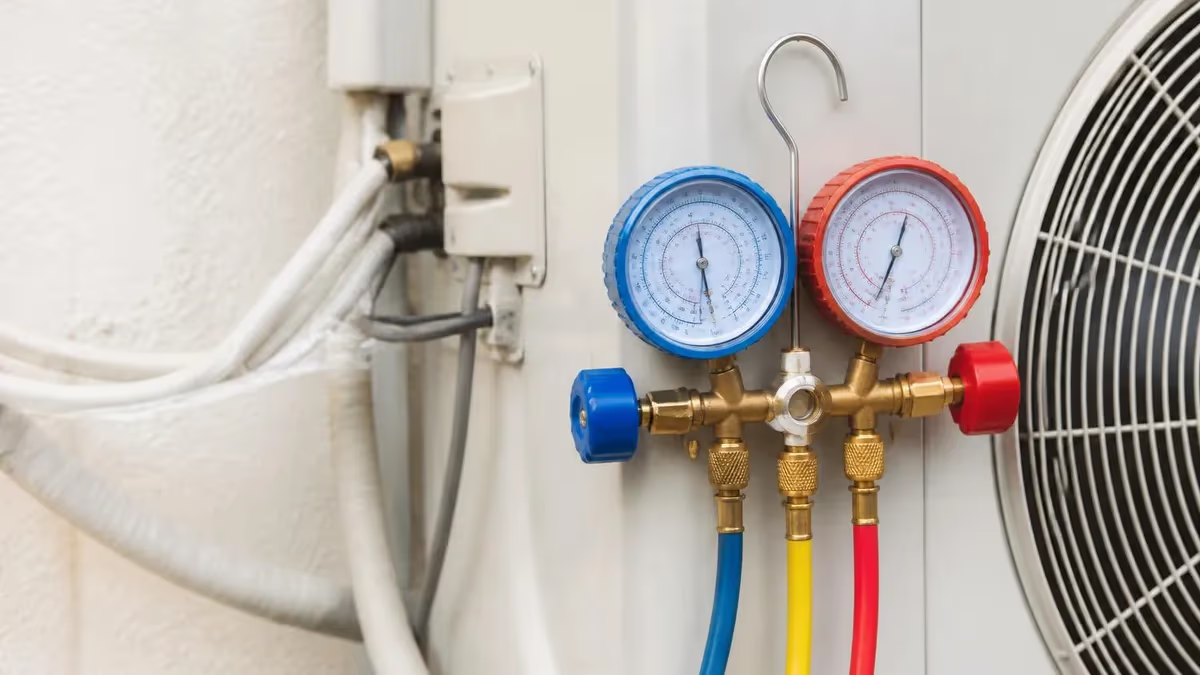
Searching for 24 hour hvac repair near me usually happens at the worst possible moment: a furnace dies at 2 a.m. during a January cold snap, a heat pump freezes solid on a humid August night, or a condensate line clogs and floods a hallway closet. Knowing how emergency HVAC service actually works before you need it puts you in control. You will understand response times, after-hours pricing, what technicians can fix on the spot, and how to spot a contractor who is padding the bill versus one who is genuinely solving the problem fast.
This guide walks through every step of the hvac emergency repair mc lean process, from the first phone call to the final invoice. We cover how dispatchers triage calls, why some companies show up within an hour while others take a full day, and what a reasonable after-hours diagnostic fee looks like in 2026. You will also learn how to describe symptoms clearly so the technician arrives with the right parts in the truck instead of having to leave for a supply house at midnight.
Beyond the immediate fix, we look at how repair calls connect to longer-term decisions. A failed compressor on a sixteen-year-old condenser is a different conversation than a tripped capacitor on a four-year-old unit, and a good technician will frame the options without pressuring you. If your system is borderline, read our companion guide on HVAC installation cost alongside this article so you can weigh a $1,200 repair against a $9,000 replacement with real numbers.
We also tackle the search problem itself. Typing 24 hour hvac repair near me into Google returns dozens of listings, half of which are national lead-gen sites that forward your call to whichever contractor pays the most. Learning to identify local, licensed companies with real technicians on staff prevents the most common nightmare scenario: a $39 service-call ad that turns into a $2,400 invoice with vague line items.
Whether the issue is no heat, no cool, strange noises, burning smells, water leaks, or a thermostat that refuses to respond, the playbook is similar. Confirm safety first, gather information, screen the contractor, agree on diagnostic costs in writing, and approve repairs only after you see the failed part and understand the warranty. The sections below break each of those steps into concrete actions you can take tonight.
By the end, you will know what to do in the first five minutes of a breakdown, what questions separate a real emergency technician from a sales rep, and how to keep your home safe while you wait. Save this page or send the checklist to anyone who handles household repairs so the next 2 a.m. failure is a thirty-minute inconvenience instead of a full-day disaster.
24 Hour HVAC Repair by the Numbers

What Happens From Call to Repair
Initial Call and Triage
Dispatch and ETA
On-Site Diagnosis
Repair Authorization
Repair and System Test
Documentation and Follow-Up
Emergency HVAC pricing has three layers and understanding each one keeps you from overpaying. The first layer is the service-call or diagnostic fee, which covers the technician's drive time, after-hours premium, and initial troubleshooting. In 2026, expect $150 to $250 in most metro markets during weekday evenings, climbing to $250 to $350 on weekends, holidays, or overnight. Many companies waive or credit this fee toward repairs over a certain threshold, so always ask before booking whether the diagnostic applies to the final bill.
The second layer is parts. A run capacitor runs $25 wholesale but installed emergency replacement costs $180 to $320 because the price includes warranty, truck stock, and after-hours markup. A blower motor ranges from $450 to $900 installed, an igniter $280 to $450, a control board $500 to $900, and a TXV or compressor anywhere from $900 to $3,500. Demand to see the failed part before it leaves the property. If the technician refuses, that is a strong signal to pause and get a second opinion.
The third layer is labor, which is sometimes bundled into flat-rate pricing and sometimes itemized hourly. Flat-rate is now the industry norm because it removes the incentive for a tech to work slowly. Hourly emergency rates run $140 to $220 per hour with a one or two hour minimum. Either model is fine as long as it is disclosed up front. Be cautious of companies that refuse to quote a number until they arrive and inspect — that is often a setup for inflated diagnostics.
Refrigerant is the most-abused line item on summer emergency invoices. R-410A costs $50 to $90 per pound at the supply house in 2026, but charged customer prices range from $90 all the way up to $180 per pound. A two-pound top-off should not cost $600. More importantly, if the technician adds refrigerant without finding and fixing the leak, you are paying to release chemicals into the atmosphere and will be back in the same situation within weeks.
Membership or maintenance-plan customers often pay 10 to 20 percent less on emergency repairs and skip to the front of the queue. If you call a company you have used before for tune-ups, mention it. If you are shopping cold, ask whether enrolling on the spot saves money on tonight's repair; sometimes it pays for itself in the first visit.
Watch for surprise fees buried in the small print: fuel surcharges, environmental disposal fees on refrigerant, after-hours premiums on top of after-hours diagnostic fees (double dipping), and trip charges for parts runs. A clean invoice shows diagnostic, parts with model numbers, labor, tax, and total. Anything labeled "shop fee" or "miscellaneous" deserves a question before you sign. For deeper context on what your system should look like long-term, our guide on HVAC units covers sizing, types, and lifespans that affect repair-versus-replace math.
Finally, ask about payment terms. Most emergency repairs under $1,500 are charged on the spot. Larger jobs often qualify for 0 percent same-as-cash financing through the contractor's lender, which is useful if a compressor failure is steering you toward a partial replacement. Avoid putting an emergency repair on a high-interest card without exploring those options first.
HVAC Practice Test Questions
Prepare for the HVAC - Heating Ventilation and Air Conditioning exam with our free practice test modules. Each quiz covers key topics to help you pass on your first try.
HVAC Air Conditioning
HVAC Exam Questions covering Air Conditioning. Master HVAC Test concepts for certification prep.
HVAC Code Compliance
Free HVAC Practice Test featuring Code Compliance. Improve your HVAC Exam score with mock test prep.
HVAC Electrical Controls
HVAC Test Prep for Electrical Controls. Practice HVAC Quiz questions and boost your score.
HVAC Energy Efficiency
HVAC Questions and Answers on Energy Efficiency. Free HVAC practice for exam readiness.
HVAC Heating Systems
HVAC Mock Test covering Heating Systems. Online HVAC Test practice with instant feedback.
HVAC Load Calculations
Free HVAC Quiz on HVAC Load Calculations. HVAC Exam prep questions with detailed explanations.
HVAC Tools and Equipment
HVAC Practice Questions for HVAC Tools and Equipment. Build confidence for your HVAC certification exam.
HVAC Refrigeration
HVAC Test Online for Refrigeration. Free practice with instant results and feedback.
HVAC Safety Practices
HVAC Study Material on Safety Practices. Prepare effectively with real exam-style questions.
HVAC System Design
Free HVAC Test covering System Design. Practice and track your HVAC exam readiness.
HVAC Thermodynamics
HVAC Exam Questions covering Thermodynamics. Master HVAC Test concepts for certification prep.
Common Emergency HVAC Repairs Near Me
The most common summer emergency is a system that runs but blows warm air. Nine times out of ten the cause is a failed run or start capacitor, a tripped high-pressure switch from a dirty condenser coil, or a contactor with pitted points. These are 30 to 60 minute repairs and the parts are stocked on every service truck. Expect $220 to $420 all-in for a capacitor swap on a typical residential condenser.
Less common but more expensive: a failed compressor, a refrigerant leak at the schrader valve or line set, or a stuck reversing valve on a heat pump. A leak search adds 45 to 90 minutes and runs $200 to $400 on top of the repair. If the leak is in the evaporator coil and the system uses phased-out refrigerant, the technician will likely walk you through replacement options because a sealed coil repair rarely makes economic sense on older equipment.
Calling 24 Hour HVAC Repair vs Waiting Until Morning
- +Restores heat or cooling immediately, protecting vulnerable household members
- +Prevents secondary damage like frozen pipes, water damage, or ceiling collapse
- +Stops compressor short-cycling that can destroy a $2,500 component overnight
- +Locks in warranty timelines that require prompt failure reporting
- +Technicians arrive with stocked trucks so most repairs finish same visit
- +Provides documentation for insurance claims on weather-related failures
- −After-hours diagnostic fees are 50 to 100 percent higher than business hours
- −Parts selection is limited to what is on the truck, not full warehouse stock
- −Wait times stretch to 4 to 12 hours during heat waves and cold snaps
- −Some companies upcharge refrigerant and labor on emergency calls
- −Permits and code inspections cannot happen until normal business days
- −Pressure-sale tactics for full system replacement are more common late at night
Pros and Cons at a Glance
| Pros | Cons |
|---|---|
| Restores heat or cooling immediately, protecting vulnerable household members | Parts selection is limited to what is on the truck, not full warehouse stock |
| Prevents secondary damage like frozen pipes, water damage, or ceiling collapse | Some companies upcharge refrigerant and labor on emergency calls |
| Locks in warranty timelines that require prompt failure reporting | Permits and code inspections cannot happen until normal business days |
| Technicians arrive with stocked trucks so most repairs finish same visit | Pressure-sale tactics for full system replacement are more common late at night |
Pre-Call Checklist Before Dialing 24 Hour HVAC Repair
- ✓Confirm the thermostat is set to the correct mode and the batteries are fresh
- ✓Check that the breaker for the indoor and outdoor units has not tripped
- ✓Replace or remove a clogged air filter that may be choking airflow
- ✓Look for ice on the indoor coil or outdoor unit and let it thaw if present
- ✓Verify the outdoor disconnect and any service switches are in the on position
- ✓Note the system brand, model number, and approximate age from the data plate
- ✓Write down exact symptoms: noises, smells, error codes, when it started
- ✓Take photos of any visible water, soot, or damage for the technician
- ✓Clear access to the indoor unit, attic hatch, or outdoor pad before arrival
- ✓Have your maintenance records and previous repair invoices ready to share
A fresh air filter and a tripped-breaker check solve 1 in 5 emergency calls
Before paying a $250 diagnostic fee, spend three minutes verifying the basics. A severely clogged filter restricts airflow until the evaporator freezes or the furnace overheats and locks out. A tripped breaker from a brief power surge mimics a dead system. Reset the breaker once; if it trips again immediately, stop and call — that points to a real electrical fault.
Vetting a 24 hour HVAC contractor in the middle of a breakdown is hard, but a few quick checks separate professional companies from fly-by-night operations. Start with the state license. Every legitimate HVAC contractor in the United States carries either a mechanical contractor license, an HVAC contractor license, or works under a master tradesperson's license depending on the state. Ask for the license number and look it up on the state board's website while you wait for the truck. Unlicensed work voids manufacturer warranties and creates liability if a gas leak or fire occurs later.
Insurance is the second non-negotiable. The contractor should carry general liability of at least $1 million and workers' compensation for every technician on the truck. Reputable companies email a certificate of insurance on request within minutes. If a dispatcher hesitates or claims the owner has the paperwork at home, that is a warning sign. An uninsured technician who gets hurt on your property becomes your homeowner's policy problem.
Look at reviews with skepticism. A perfect five-star rating across hundreds of reviews often signals filtering or paid review schemes. The most trustworthy profile is 4.3 to 4.8 stars with detailed responses to the negative reviews. Read three or four one-star reviews carefully — patterns like surprise charges, no-shows, or aggressive replacement pitches reveal the company's culture better than any marketing page. Cross-reference Google, Yelp, the Better Business Bureau, and Nextdoor for the same business.
NATE certification, EPA Section 608 certification for refrigerant handling, and manufacturer training credentials (Carrier Factory Authorized, Trane Comfort Specialist, Lennox Premier) all indicate ongoing technical education. They are not magic, but they correlate with techs who diagnose accurately on the first visit instead of replacing parts by trial and error.
Ask the dispatcher three direct questions: What is your after-hours diagnostic fee and is it credited to repairs? Will the technician provide a written estimate before any work begins? What warranty do you offer on parts and labor? Clean, immediate answers are a good sign. Vague responses or pressure to commit before the truck rolls usually predicts a problematic invoice.
Be cautious with lead-generation websites that aggregate "local" contractors. Many of the top sponsored results for 24 hour hvac repair near me are national platforms that sell your phone number to whichever contractor bid highest that day. The result is a stranger with no accountability to your community. Whenever possible, call the company directly after confirming it operates from a physical local address with a real review history. If you are also thinking about regular tune-ups to reduce future emergencies, our overview of HVAC servicing shows what a real maintenance visit should include.
Finally, trust your instincts at the door. A professional technician arrives in a marked truck, in uniform, with a photo ID, and introduces themselves by name. They explain what they are testing before touching the system, and they answer questions without defensiveness. If something feels off — high-pressure quotes, refusal to show failed parts, urgency to replace the entire system tonight — pause, pay the diagnostic fee, and get a second opinion in the morning.

Burning electrical odor, smoke from any vent or unit, sparking at the disconnect, or a gas smell near the furnace are not wait-until-morning issues. Shut the system off at the breaker, evacuate if you smell gas, and call the utility before HVAC. Running a damaged system even briefly can turn a $400 repair into a structure fire or carbon monoxide event.
Once the technician has diagnosed the problem, the hardest decision is whether to repair or replace. The rule of thumb is the 5,000 rule: multiply the age of the unit by the repair cost. If the result is over $5,000, lean toward replacement. A $1,500 compressor on a 12-year-old condenser ($18,000) clearly favors replacement; a $400 capacitor on a 5-year-old unit ($2,000) is an obvious repair. Most decisions fall somewhere in between and depend on refrigerant type, efficiency, and how much longer you plan to stay in the home.
Refrigerant type matters more than ever in 2026. Systems using R-22, fully phased out, are expensive to recharge and parts are scarce. R-410A is still serviceable but being phased down. Newer A2L refrigerants like R-454B and R-32 require updated equipment and trained technicians. If your failed system uses R-22, almost any major repair pushes you toward replacement; if it uses R-410A and is under ten years old, repair usually wins.
Efficiency is the second variable. A new 16 SEER2 system can cut cooling costs 30 to 45 percent compared to a 13 SEER unit from 2008. If your electric bill spikes every summer, the operating-cost savings on a new system can recover several thousand dollars over a ten-year horizon, narrowing the gap between repair and replacement when you do total-cost-of-ownership math.
Think about how the failure affects the rest of the system. A failed compressor in a heat pump means new refrigerant, possibly a new line set if contamination is suspected, and a recommissioning charge. By the time you add those, you are 60 percent of the way to a full outdoor-unit replacement. Some contractors offer a credit toward replacement if you decline the major repair and proceed with new equipment within 30 days — ask explicitly.
Timing affects pricing. Replacing a system in October or March, when demand is low, is consistently cheaper than during a July heat wave or January cold snap. If the emergency repair will get you through the season and your unit is otherwise borderline, paying $800 to limp through and replacing in shoulder season can save $1,500 to $3,000 versus an emergency replacement. Get written quotes for both paths and let the math decide.
Permits, code upgrades, and disposal are often forgotten in repair-versus-replace comparisons. A replacement typically requires a mechanical permit, may trigger duct upgrades to current code, and includes proper recovery and disposal of old refrigerant. Those costs are real and legitimate, but they should appear as line items, not hidden inside a vague "installation" charge. For a full picture of replacement budgeting, see our detailed HVAC duct installation guide if your decision also involves ductwork modifications.
The bottom line: never make a replacement decision at 11 p.m. under pressure. Authorize the emergency repair that restores comfort and safety, get a written quote for replacement on the spot, then sleep on it and gather two more bids in the morning. Any contractor who refuses to leave you a copy of their estimate, or who threatens that the price will not be honored tomorrow, is telling you exactly what kind of company they are.
Once the immediate crisis passes, a few habits dramatically reduce the chance of another emergency call. Change filters on a real schedule based on filter type and household conditions: a 1-inch pleated filter every 60 to 90 days, a 4-inch media filter every 6 to 12 months, more often if you have pets or run construction nearby. A blocked filter is the single most common root cause of frozen coils, overheated furnaces, and tripped limit switches that masquerade as major failures.
Keep the outdoor condenser clear. Two feet of clearance on all sides, no fence panels or shrubs crowding airflow, and a gentle hose-down of the coil fins twice a year prevents the high-pressure trips that knock systems out during heat waves. Avoid pressure washers — they bend the soft aluminum fins and reduce heat transfer permanently. A soft brush, low-pressure water, and patience are all you need.
Schedule annual maintenance in spring for cooling systems and fall for heating systems. A proper tune-up runs $90 to $180 and includes refrigerant pressure checks, electrical inspection, capacitor testing, combustion analysis on gas furnaces, and coil cleaning. The cost pays back the first time a technician catches a weak capacitor or pitted contactor before it strands you in 95-hvac emergency repair mc lean. Most companies offer prepaid annual plans bundling spring and fall visits at a discount.
Install a smart thermostat with leak and freeze alerts if your system supports it. Modern thermostats detect short-cycling, log runtime, and notify you when something is off long before it becomes an emergency. Some integrate with utility demand-response programs that pay you to ease load during peak hours, offsetting the cost of the device within a year or two.
Document everything. Keep a folder — physical or digital — with the install date, model and serial numbers, every service invoice, filter sizes, and refrigerant type. When you call a technician, having that information ready cuts diagnostic time in half and protects warranty claims that require documented maintenance history. Manufacturers routinely deny compressor warranty claims because the homeowner cannot prove annual service.
Plan for the lifecycle. Air conditioners and heat pumps last 12 to 18 years; furnaces 15 to 25; boilers 20 to 30. When your equipment crosses the 75 percent mark of typical life, start budgeting for replacement and gathering quotes during shoulder seasons rather than waiting for the failure. A planned replacement is consistently 15 to 25 percent cheaper than an emergency one, and you get to choose the equipment carefully instead of accepting whatever the truck has available.
Finally, build a relationship with one local contractor before the emergency hits. The customers who get the fastest response, the best pricing, and the most honest advice are the ones whose names are already in the dispatch system. A $130 spring tune-up is the cheapest insurance policy you can buy against a $500 after-hours diagnostic on the first 95-degree day of summer.
Sample HVAC Practice Questions
Try these questions from our free HVAC practice tests. The correct answer and an explanation follow each question.
A condensate drain line is clogged on a high-efficiency furnace. What symptom would you expect?
- A. Yellow burner flame
- B. Unit shuts down on pressure switch lockout
- C. Tripped high-limit switch
- D. Loud banging at startup
Answer: B. Unit shuts down on pressure switch lockout
A clogged condensate drain causes water to back up and block the pressure switch port, causing the furnace to lockout on a pressure switch fault.
What is the difference between 'air changes per hour' (ACH) and 'cubic feet per minute' (CFM)?
- A. ACH and CFM are the same measurement expressed differently
- B. ACH measures how many times per hour the entire room volume is exchanged; CFM measures volumetric flow rate
- C. ACH measures outdoor air only; CFM measures total supply air
- D. ACH applies to exhaust systems; CFM applies to supply systems
Answer: B. ACH measures how many times per hour the entire room volume is exchanged; CFM measures volumetric flow rate
ACH represents how many complete room volume exchanges occur per hour. CFM is an absolute volumetric flow rate. ACH = (CFM × 60) ÷ Room Volume (cubic feet).
What is 'system-dependent' recovery equipment and what is its primary limitation?
- A. Equipment that uses its own motor/compressor; limited to 150 lbs systems
- B. Equipment that uses the appliance's own compressor; limited to systems with 15 lbs or less of refrigerant
- C. Equipment dependent on line voltage; cannot be used on three-phase systems
- D. Equipment relying on gravity flow; limited to refrigerant type
Answer: B. Equipment that uses the appliance's own compressor; limited to systems with 15 lbs or less of refrigerant
System-dependent (passive) recovery equipment uses the appliance's own compressor or system pressure to transfer refrigerant to the recovery cylinder and can only be used on appliances containing 15 lbs or less of refrigerant.
During a service call, a technician measures 240V at a condenser but the unit does not start. The capacitor tests good. What should be checked next?
- A. Thermostat wiring
- B. Contactor contacts
- C. Refrigerant charge
- D. Condenser fan blade
Answer: B. Contactor contacts
Burned or pitted contactor contacts may not pass current even when the contactor coil pulls in, preventing the compressor and fan from starting.
HVAC Questions and Answers


About the Author

NATE Certified HVAC Technician & Licensing Exam Trainer
Universal Technical InstituteMike Johnson is a NATE-certified HVAC technician and EPA 608 universal-certified refrigerant handler with a Bachelor of Science in HVAC/R Technology. He has 19 years of commercial and residential HVAC installation and service experience and specializes in preparing technicians for NATE certification, EPA 608, A2L refrigerant safety, and state HVAC contractor licensing examinations.