
HVAC Servicing: What's Included, Schedule and Cost Guide 2026 October
⏳ HVAC servicing guide — annual maintenance checklist, seasonal tune-ups, DIY vs professional, costs, service contracts, and how to choose a technician.
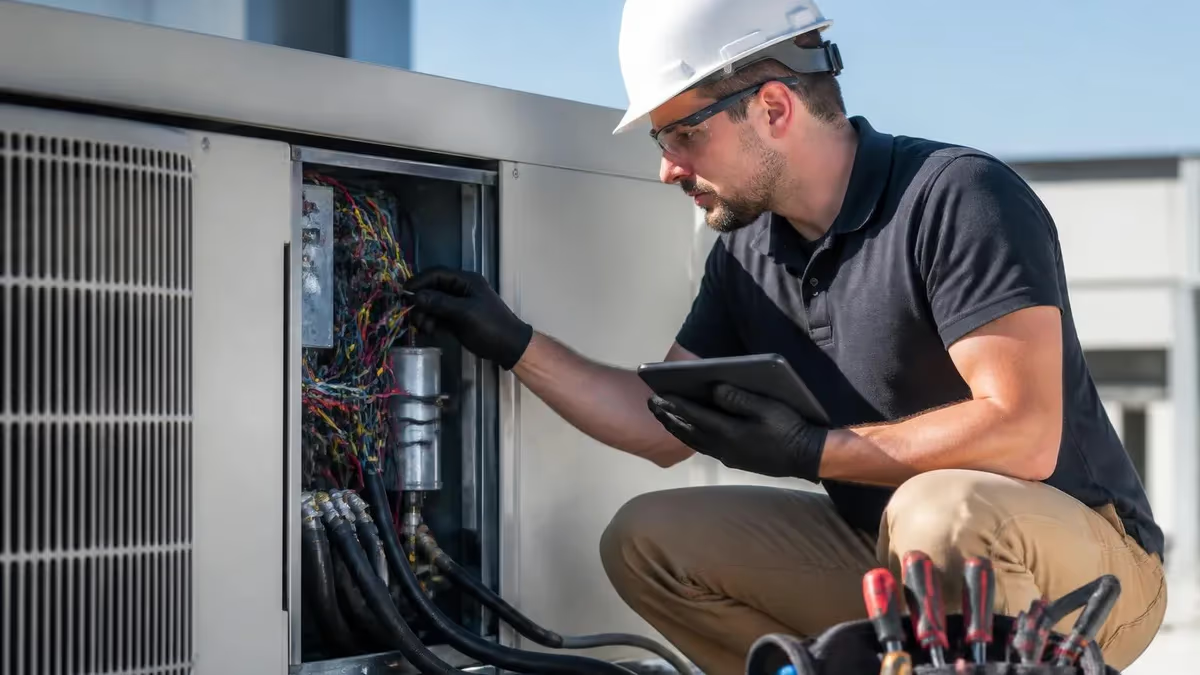
HVAC servicing is the regular maintenance that keeps a home heating, ventilation and air-conditioning system running efficiently and reliably for its full design life. A well-serviced central air-conditioning system lasts 15 to 20 years; a well-serviced furnace or heat pump lasts 15 to 25 years. Skipping maintenance does not break the system immediately, but it accelerates wear, lowers efficiency by 10% to 30%, increases the risk of mid-summer or mid-winter breakdowns, and shortens equipment life by years. The math nearly always favors regular servicing over neglect.
The standard maintenance schedule for residential HVAC is two visits per year — one in spring to prepare the cooling system for summer, and one in fall to prepare the heating system for winter. A typical visit takes 60 to 90 minutes per system and costs $75 to $200 per visit at hourly rates, or $150 to $300 per year on a maintenance contract bundling both seasonal visits with priority service for any breakdowns. Newer systems may go 18 to 24 months between visits without obvious problems; older systems often need annual attention to stay reliable.
What gets done during a service visit is concrete. The technician inspects and cleans the outdoor condenser coil and indoor evaporator coil, checks refrigerant charge against the manufacturer's specification, verifies electrical connections are tight and not corroded, lubricates motor bearings where specified, clears the condensate drain line of algae and debris, replaces the air filter, tests the safety controls and limits, measures temperature differential across the coils, and reviews the system's operation under load. The thermostat is verified to function correctly with all programmed schedules.
This guide explains what HVAC servicing actually involves, how often you should schedule it, the difference between owner-DIY tasks and professional-only work, when to call for emergency service rather than wait for a routine visit, the typical costs and what they should buy you, the service contract options and how to evaluate them, and how to find and select a qualified technician without falling for the common HVAC service scams that target homeowners every cooling and heating season.
HVAC servicing in 30 seconds
Schedule professional HVAC servicing twice per year — spring for cooling, fall for heating. Each visit costs $75 to $200 in hourly rates or bundle both into a $150 to $300 annual maintenance contract. The technician cleans coils, checks refrigerant, tightens electrical connections, clears the condensate drain, replaces filters and tests controls. Add monthly DIY filter checks. Choose a NATE-certified, licensed, insured contractor. Avoid scams — get written estimates and second opinions on big repairs.
Spring servicing focuses on the air-conditioning side of the system. The technician shuts off power, removes the outer condenser cabinet panels and uses a coil cleaner with a garden hose to wash dirt, pollen and debris off the outdoor coil. Inside the home, the indoor evaporator coil is inspected and cleaned if accessible. Refrigerant pressure is measured against manufacturer charts and topped up if low (a low charge usually indicates a leak that needs separate attention). The blower motor and capacitor are tested electrically.
Fall servicing focuses on the heating side. For gas furnaces, the technician inspects the heat exchanger for cracks, cleans the burner and pilot or igniter, tests the gas pressure, verifies safety switches operate correctly and confirms the flue draft is adequate. For heat pumps, the same coil cleaning applies as in spring plus a defrost cycle test. For oil furnaces, the burner nozzle is replaced annually and combustion is tested with a flue-gas analyzer. Programmable thermostat schedules are verified for the heating season.
The condensate drain deserves special attention because clogged drains cause real damage. Cooling produces condensation; a clogged drain line backs water up into the air handler, where it can drip onto floors, ceiling drywall or wood framing. Many service visits include flushing the drain line with vinegar or a pump-and-vacuum cleaning. Adding a condensate drain pan with a float switch (about $75 in parts) is a cheap insurance policy against drain-related water damage.
Filter replacement is the single most important DIY task between professional visits. Standard 1-inch filters should be replaced every 1 to 3 months depending on filter rating and household conditions (more frequent in homes with pets, smokers or extensive remodeling). Higher-rated MERV 8 to 13 filters last longer (3 to 6 months) but restrict airflow more, requiring sized capacity. Pleated filters last longer than flat fiberglass filters. Set a calendar reminder and check the filter monthly until you know how often yours needs changing.
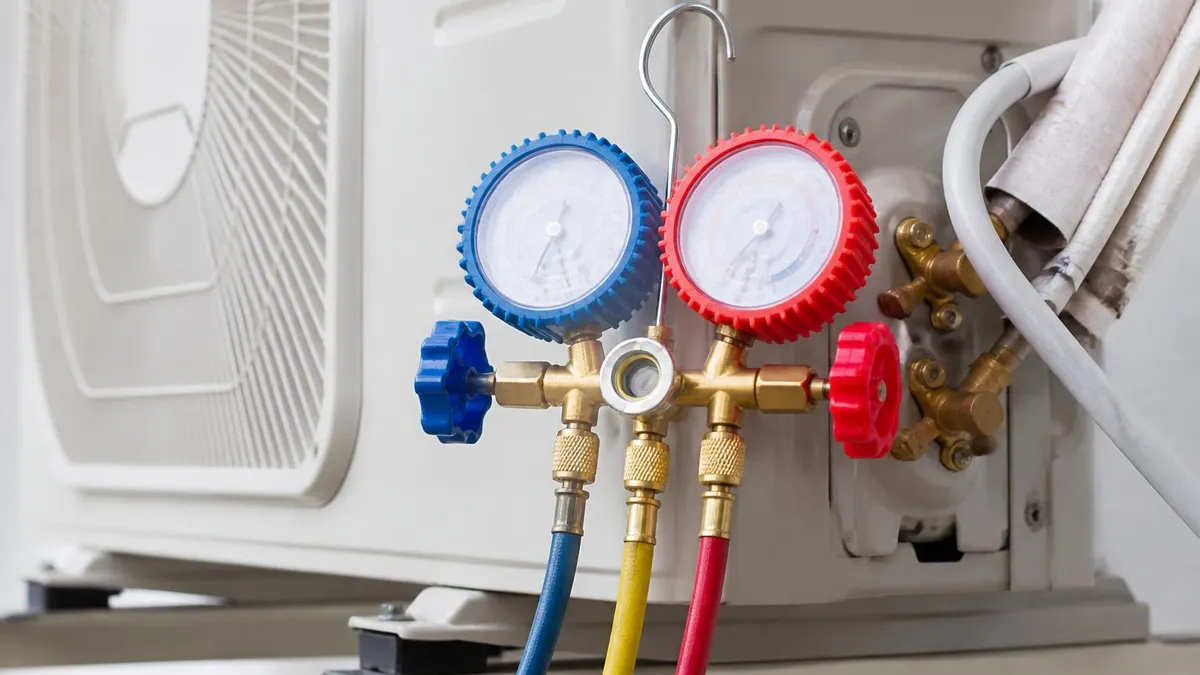
What HVAC servicing covers
Outdoor condenser coil and indoor evaporator coil inspected and cleaned. Dirt, pollen and debris reduce heat transfer efficiency by 10% to 30% on neglected coils. Cleaning with manufacturer-approved cleaners and a controlled water rinse restores efficiency. Severely fouled coils may require chemical treatment beyond standard cleaning.
Refrigerant charge measured against manufacturer specifications. Low charge indicates a leak that requires separate diagnostic and repair. Adding refrigerant without finding the leak is a stopgap; the leak will recur. Modern systems use R-410A or R-32 refrigerants with specific tools and certifications required for handling.
Capacitors tested for correct microfarad values; aging capacitors are the single most common AC failure point. Contactor connections tightened and inspected for arcing. Wire connections checked for corrosion and looseness. Fuses and breaker amperage verified. Motor amp draws measured and compared to nameplate ratings.
Condensate drain line flushed of algae and debris to prevent water backup damage. Float switches and overflow safety devices tested. Heat exchanger inspected for cracks (gas furnace). Combustion analysis run on gas and oil systems. Carbon monoxide spillage checked at all combustion appliance vents and burners.
The list of work a homeowner can do safely without specialized training is shorter than many DIY enthusiasts realize. Replacing the air filter is fully DIY. Trimming vegetation back from the outdoor unit (recommended 2-foot clearance on all sides) is fully DIY. Cleaning leaves and debris off the top of the outdoor unit is fully DIY. Setting and adjusting the thermostat is DIY. Beyond these basic tasks, work involving refrigerant, electrical components, gas lines, heat exchangers or sealed combustion systems should be done by a licensed technician.
Refrigerant work specifically requires an EPA Section 608 certification under the Clean Air Act. Adding refrigerant, repairing leaks, recovering refrigerant during system replacement and installing or removing systems all require the technician to be 608 certified, with appropriate sub-certifications (Type II for high-pressure systems used in residential AC). Refrigerant tools and certifications are not realistic for a DIY homeowner, and improperly handled refrigerant violates federal law.
Gas furnace work likewise requires licensing in most states. Gas piping, burner adjustments, heat exchanger inspections and combustion analysis all involve safety risks that warrant professional attention. The classic DIY mistake is troubleshooting a flame-rectification problem on a gas furnace and ignoring a small heat exchanger crack that is leaking carbon monoxide into the home. The professional inspection identifies these hazards; the DIYer often does not.
Electrical work in the HVAC system is also typically professional territory. Capacitor replacement looks simple but involves stored electrical charge that can deliver a serious shock to anyone who does not know how to safely discharge the capacitor first. Contactor replacement, motor replacement, control board replacement and similar tasks all involve voltage that demands professional handling. Save DIY for the safe surface tasks and call a technician for anything that involves opening service panels.
Service schedule by season
Cooling system tune-up. Outdoor condenser coil cleaning, indoor evaporator coil inspection, refrigerant charge verification, capacitor and contactor testing, condensate drain flushing, blower motor amp draw, thermostat schedule update for cooling season. Best time to schedule is before the first heat wave; technicians get backed up once outdoor temperatures hit 85°F+.
Knowing when to call for service rather than wait for the next scheduled visit saves real money. Symptoms that warrant a service call include the system not cooling or heating despite running, ice forming on the indoor evaporator coil or refrigerant lines, water pooling around the air handler, unusual sounds (grinding, screeching, pops, hissing) during operation, burning smells, persistent musty smells suggesting mold, dramatic increases in utility bills without weather changes, and frequent breaker trips on the HVAC circuits.
Some symptoms are urgent and warrant emergency service. The smell of natural gas indicates a leak — leave the home immediately and call the utility's emergency line, then the HVAC technician. The smell of burning insulation or smoke from the furnace means turn off the system at the breaker and call right away. Carbon monoxide alarms triggering means leave the home, call 911 and do not return until the source is identified and repaired. These scenarios are rare but real; treat them as the emergencies they are.
For lower-urgency symptoms, schedule service within a few days rather than waiting weeks. A frozen evaporator coil that does not thaw within 24 hours of turning off the system means there is an underlying problem — usually low refrigerant or a dirty filter — that needs diagnosis. Frequent short cycling (the system turns on and off rapidly) typically indicates a thermostat issue, low refrigerant or oversized equipment. Each of these is a problem that wastes energy and stresses components until corrected.
For the seasonal performance issues many homeowners notice, the right response is to schedule the next maintenance visit and ask the technician to investigate the specific symptom during the visit. "It seems to take longer to cool the house this year" or "The bedroom upstairs never feels comfortable" are diagnostic conversations that benefit from a technician walking through the system. Without that conversation, the technician treats the visit as routine and may not investigate the underlying issue you noticed.
Three patterns target homeowners. Cracked heat exchanger panic: a technician claims the heat exchanger is cracked and the entire furnace must be replaced. Always get a second opinion before agreeing to a major replacement; some furnaces are condemned that have decades of life left. Refrigerant top-up without leak investigation: paying $200 to add refrigerant without addressing the leak is paying twice — once now and again next year. Aggressive maintenance plans with auto-renew clauses and deep cancellation fees. Always read the contract.
Service contract pricing in 2026 typically runs $150 to $300 per year for residential plans covering both spring and fall tune-ups plus priority emergency dispatch and discounts on repair work. Premium plans ($300 to $600 per year) add additional benefits like waived diagnostic fees, deeper repair discounts and sometimes a dedicated technician. The math on basic plans is favorable for most homeowners — two professional visits at $100 each is $200, plus the priority dispatch on emergencies has real value during summer heat waves.
Read the contract carefully before signing. Watch for auto-renewal clauses that require written cancellation 60 to 90 days before expiration. Watch for tiered exclusions where certain repairs are excluded from the discount even though they appear to be in scope. Watch for transferability — does the contract follow you if you sell the home, or does it terminate at sale. Watch for refund policies if you cancel mid-term. The big-name HVAC companies generally have fair contracts; small operators sometimes do not.
The cost of individual repair work outside of a maintenance contract varies widely. A new capacitor for a residential AC runs $150 to $300 installed. A new contactor runs $150 to $250 installed. A blower motor replacement runs $400 to $800. Refrigerant leak repair runs $300 to $1,500 depending on location and whether components need replacement. Compressor replacement runs $1,500 to $3,000. Full AC system replacement runs $4,000 to $9,000 for a typical residential 3-ton unit. Get multiple bids on anything above $1,000.
The replacement-versus-repair calculation depends on the system age and the cost of the proposed repair. A repair under $500 on a 5-year-old system is almost always worth doing. A $2,000 repair on a 15-year-old system at the end of its design life often justifies replacement instead, especially with current high-efficiency models offering 30% to 40% energy savings over older systems. The rule of thumb: multiply the repair cost by the system age in years; if the result exceeds $5,000, replacement is usually the better call.
Choose an HVAC servicing company checklist
- ✓Verify state HVAC contractor license is current
- ✓Confirm general liability insurance ($1M+) and workers comp
- ✓Look for NATE-certified technicians on staff
- ✓Confirm EPA Section 608 certification for refrigerant work
- ✓Check Better Business Bureau rating and online reviews
- ✓Get three quotes for any major repair or replacement
- ✓Read maintenance contract terms carefully before signing
- ✓Confirm parts warranty (typically 5 to 10 years on major components)
- ✓Confirm labor warranty (typically 1 year minimum)
NATE (North American Technician Excellence) certification is the leading credential for individual HVAC technicians. NATE-certified technicians have passed standardized exams covering specific equipment types and troubleshooting techniques. The certification does not replace state licensing (which is mandatory for contractors and most technicians) but signals additional knowledge and ongoing professional development. Asking whether the technicians at a service company are NATE-certified is a fair filter when choosing among options.
Other relevant credentials include EPA Section 608 (mandatory for anyone handling refrigerant), state HVAC contractor license (mandatory in nearly every state), and manufacturer-specific factory training (Trane, Carrier, Lennox, Goodman and others). For warranty repairs on equipment under manufacturer warranty, using a factory-authorized contractor is sometimes required to keep the warranty intact. Check your equipment manuals or the manufacturer's website for the authorized contractor list.
Reviews on Google, Angi (formerly Angie's List), HomeAdvisor and the Better Business Bureau provide a useful but imperfect picture of contractor quality. Filter for recent reviews (within the past 12 to 18 months) and read the medium-rated reviews, which often have more useful detail than the 5-star or 1-star extremes. A contractor with 90% positive reviews and a few thoughtful negative ones is usually a better bet than a contractor with 100% glowing reviews and signs of fake review patterns.
Word-of-mouth referrals from neighbors are still one of the best ways to find a reliable HVAC contractor. Ask neighbors with similar-vintage homes who they use for HVAC servicing and what their experience has been. The local contractor who has serviced 50 homes on your block over 10 years has more reliable performance data than any online review platform can provide. Local Facebook neighborhood groups and Nextdoor are good channels for these informal referrals.
For homeowners with multiple heating and cooling systems (separate equipment for upstairs and downstairs, or different wings of the home), service costs scale with the number of systems. Each system needs its own maintenance visit; many contractors give a small discount when servicing multiple systems on the same visit. Annual servicing for a two-system home typically runs $250 to $500, or $300 to $600 on a maintenance contract covering both systems through the same provider.
For homes with mini-split or ductless systems, the maintenance approach is similar but with some specifics. Mini-splits do not have ductwork to clean, but the indoor head units have washable filters that need monthly cleaning by the homeowner plus deeper professional cleaning every 1 to 2 years. The outdoor units need the same coil cleaning and refrigerant verification as central system condensers. Mini-split servicing typically runs $100 to $200 per indoor head per visit.
HVAC servicing quick reference
When to call for service
System runs but does not produce conditioned air at the registers. Check the thermostat first to confirm it is set correctly. Check the filter for severe blockage. If both check out, call for service — most likely refrigerant issue, blower problem or major component failure.
Ice on the indoor evaporator coil or refrigerant lines indicates a problem — usually low refrigerant or restricted airflow from a dirty filter. Turn off the system, replace the filter, wait 24 hours for thawing, then test. If freezing recurs, schedule service within a few days; do not run a frozen system.
Grinding, screeching, pops, banging or persistent hissing during operation are not normal. Each sound type indicates different problems — a screech is often a blower bearing; a hiss often a refrigerant leak; a pop often electrical. Document what you hear, when it happens, and call for service.
Sudden increase in energy use without weather changes signals system inefficiency. Possible causes include refrigerant leaks, dirty coils, failed motor capacitors, ductwork leakage or thermostat problems. A diagnostic visit usually identifies the cause within 30 minutes; addressing it pays back through reduced bills the following month.
For new homeowners taking over a home with existing HVAC equipment, the smart move is to schedule a one-time servicing visit shortly after moving in. The technician inspects the system, confirms it is operating safely, identifies any deferred maintenance needs and provides a baseline assessment of equipment condition and remaining service life. This sets up a relationship with a local contractor and establishes a documentation trail in case warranty claims or insurance issues arise later.
For homeowners doing major renovations, alert your HVAC contractor early. Construction dust is the enemy of HVAC equipment — it loads up filters, fouls coils and embeds in motors and ductwork. Plan for a deep cleaning service after major remodeling work. Adding rooms or significantly changing the home layout may require ductwork modifications or even an upgraded system if the existing equipment cannot handle the new load. Get a load calculation rather than just adding ducts to existing equipment.
HVAC: Pros and Cons
- +HVAC credential is recognized by employers and industry professionals
- +Higher earning potential compared to non-credentialed peers
- +Expanded career opportunities and professional advancement
- +Structured learning path builds comprehensive knowledge
- +Professional development that stays current with industry standards
- −Preparation requires significant time and study commitment
- −Associated costs for exams, materials, and renewal fees
- −Continuing education needed to maintain credentials
- −Competition for advanced positions can be challenging
- −Requirements and standards may vary by state or region
Pros and Cons at a Glance
| Pros | Cons |
|---|---|
| HVAC credential is recognized by employers and industry professionals | Preparation requires significant time and study commitment |
| Higher earning potential compared to non-credentialed peers | Associated costs for exams, materials, and renewal fees |
| Expanded career opportunities and professional advancement | Continuing education needed to maintain credentials |
| Structured learning path builds comprehensive knowledge | Competition for advanced positions can be challenging |
| Professional development that stays current with industry standards | Requirements and standards may vary by state or region |
Sample HVAC Practice Questions
Try these questions from our free HVAC practice tests. The correct answer and an explanation follow each question.
What is a 'fire damper' and what is its function in HVAC ductwork?
- A. A motorized damper that controls airflow to a zone for comfort control
- B. A passive device installed where ductwork penetrates fire-rated barriers, designed to close automatically when exposed to heat to prevent fire from spreading through ductwork
- C. A damper that reduces noise from the air handler by restricting airflow velocity
- D. A balancing damper installed to equalize airflow between duct branches
Answer: B. A passive device installed where ductwork penetrates fire-rated barriers, designed to close automatically when exposed to heat to prevent fire from spreading through ductwork
Fire dampers are passive safety devices installed at penetrations of fire-rated walls, floors, and ceilings. They contain a fusible link that melts at elevated temperatures (typically 165°F), releasing a spring-loaded blade that closes to stop fire and hot gases from passing through the duct opening.
In a commercial HVAC system, what does 'DOAS' stand for and what is its primary purpose?
- A. Dual Output Air System — splits heating and cooling
- B. Dedicated Outdoor Air System — provides ventilation air separately from sensible cooling
- C. Direct Outdoor Air Supply — bypasses air handlers in summer
- D. Distributed Output Air System — serves multiple zones from one unit
Answer: B. Dedicated Outdoor Air System — provides ventilation air separately from sensible cooling
A DOAS handles ventilation (outdoor air) requirements separately, allowing zone equipment to focus on sensible load control.
In commercial HVAC, what is a 'cooling tower' and what process does it use to reject heat?
- A. A tall air handler that provides cooling to upper floors
- B. A heat rejection device that cools condenser water by evaporating a portion of the water into the air stream
- C. A refrigerant condenser mounted on the building's cooling tower
- D. A thermal storage vessel that holds chilled water
Answer: B. A heat rejection device that cools condenser water by evaporating a portion of the water into the air stream
A cooling tower rejects heat from the chiller's condenser water to the atmosphere through evaporative cooling—a small percentage of the circulating water evaporates, removing heat at approximately 1,000 BTU per pound of water evaporated.
According to the International Mechanical Code, what is required when a condensate drain line from an HVAC unit is routed to a floor drain?
- A. Check valve
- B. Air gap
- C. Backflow preventer with atmospheric vent
- D. Trap primer
Answer: B. Air gap
An air gap is required when connecting a condensate drain to a sanitary drain to prevent contamination of the condensate by sewer gases or backflow.
HVAC Questions and Answers
About the Author

NATE Certified HVAC Technician & Licensing Exam Trainer
Universal Technical InstituteMike Johnson is a NATE-certified HVAC technician and EPA 608 universal-certified refrigerant handler with a Bachelor of Science in HVAC/R Technology. He has 19 years of commercial and residential HVAC installation and service experience and specializes in preparing technicians for NATE certification, EPA 608, A2L refrigerant safety, and state HVAC contractor licensing examinations.