
HVAC Business Insurance: Complete Guide to Coverage, Costs, and Protecting Your HVAC Company
Everything HVAC contractors need to know about business insurance — coverage types, costs, requirements, and how to protect your company. ✍🏼
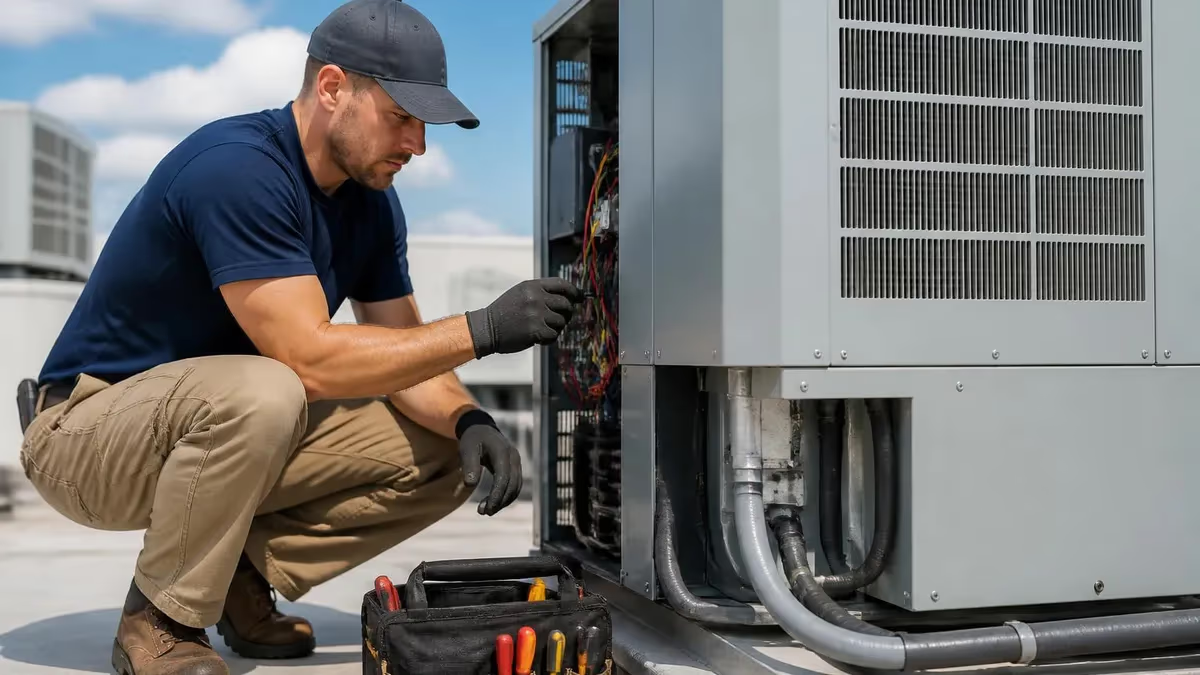
HVAC business insurance is one of the most critical investments any heating, ventilation, and air conditioning contractor can make. Whether you are a solo technician running service calls out of a single van or the owner of a multi-crew commercial HVAC company, the financial risks of operating without proper coverage are enormous. A single lawsuit from a customer claiming property damage, a workplace injury to one of your employees, or a vehicle accident involving your company truck can easily result in costs exceeding hundreds of thousands of dollars — expenses that uninsured businesses must pay entirely out of pocket.
The HVAC trade carries unique risks that many other service businesses do not face. Technicians routinely work with high-voltage electrical systems, pressurized refrigerant lines, natural gas connections, and heavy rooftop equipment. They enter private homes and commercial facilities, often working in tight mechanical rooms, crawlspaces, and on improved platforms. Any one of these work environments can give rise to injury, property damage, or professional liability claims that could financially devastate a business that lacks adequate insurance protection.
Beyond the risk management aspect, HVAC business insurance is increasingly required just to operate legally and competitively. Most state licensing boards require proof of general liability insurance before they will issue or renew a contractor's license. Property managers, general contractors, and commercial clients almost universally require certificates of insurance before allowing any HVAC work to begin. Without the right policies in place, you simply cannot bid on many of the most profitable jobs available in today's market.
Understanding the full landscape of coverage options is equally important as having insurance at all. A bare-bones general liability policy may satisfy a licensing requirement but still leave your business exposed to significant gaps — for example, it may not cover employee injuries, vehicle accidents, or claims arising from faulty workmanship discovered months after a job is completed. Building the right insurance portfolio means understanding what each type of policy covers, where the limits apply, and how different policies work together to provide comprehensive protection.
Costs for HVAC business insurance vary considerably based on factors like company size, annual revenue, number of employees, the types of jobs you take on, and your claims history. A sole proprietor focusing on residential service and maintenance work will pay very different premiums than a contractor running ten crews doing commercial new construction. Knowing the typical ranges and the factors that influence your rate can help you shop effectively and avoid overpaying for coverage you do not need or, conversely, underinsuring in areas of real exposure.
This guide covers everything HVAC business owners need to know: which policies are essential versus optional, realistic cost ranges for each coverage type, how to meet common insurance requirements from customers and licensing bodies, and practical steps for evaluating and purchasing the right insurance program. Whether you are just starting your HVAC business or reassessing your coverage after years in operation, understanding hvac business insurance fundamentals will help you make smarter decisions that protect both your livelihood and your customers.
As you build or review your insurance program, remember that insurance is not a one-time purchase — it is an ongoing part of running your business. Revenue growth, adding employees, buying new vehicles, or expanding into commercial work all create new exposures that your existing policies may not cover. Annual reviews with a knowledgeable commercial insurance broker are a smart practice for any growing HVAC company that wants to stay adequately protected and competitively positioned.
What changed for HVAC - Heating Ventilation and Air Conditioning in 2026
- MoneyGeek 2026: General liability averages $379/month ($4,550/year) for $1M per occurrence / $2M aggregate (source)
- MoneyGeek 2026: Commercial auto $432/month ($5,184/year) on average; solo service van $1,200–$2,500/year (source)
- MoneyGeek 2026: Workers' compensation $310/month ($3,724/year) for crews under five; rates $3–$12 per $100 payroll by state (source)
- GritInsurance 2026: Solo operator total $3,000–$5,000/year; 5-person crew $8,000–$15,000/year; pollution liability $600–$1,800 (source)
- Utah H100 rule effective April 20, 2026: qualifiers need RMGA cert, pass Business & Law and H100 exams, 2-year W-2 verified HVAC experience (source)
- Utah: fingerprint background check requirement begins January 1, 2027 for HVAC contractors (source)
- Maryland HVACR: Master/Master Restricted/Limited contractors must carry $300,000 personal liability + $100,000 property damage ($400,000 combined/occurrence) (source)
Last verified: 2026-10-14 against MoneyGeek, GritInsurance, Utah DOPL, Maryland Department of Labor.
- General Liability (Solo): $500–$1,500/year for $1M/$2M coverage
- General Liability (Established): $379/month average ($4,550/year) for $1M/$2M limits
- Commercial Auto: $432/month average ($5,184/year); $1,200–$2,500/year for single service van
- Workers' Compensation: $310/month ($3,724/year) for crews under 5; $3–$12 per $100 payroll by state
- Total Bundle (5-person crew): $8,000–$15,000/year for GL + workers comp + auto + tools
- Pollution Liability: $600–$1,800/year; recommended for refrigeration work
- Umbrella Coverage: $500–$1,500/year for $1M additional above base limits
- State Requirement: 87% of states require contractor insurance for licensing or registration
Verified against: MoneyGeek, GritInsurance, and licensing board sources (2026).
HVAC Business Insurance by the Numbers
Essential Insurance Policies for HVAC Contractors
Covers third-party bodily injury and property damage claims arising from your operations. This is the foundational policy for any HVAC business and is required by most state licensing boards and commercial clients before work can begin.
Pays for medical expenses and lost wages when an employee is injured on the job. Required in nearly every state for businesses with employees. HVAC work carries above-average injury risk due to electrical hazards, heavy lifting, and improved work surfaces.
Covers vehicles used for business purposes, including service vans and trucks. Personal auto policies explicitly exclude business use, leaving company vehicles unprotected without a separate commercial auto policy covering liability and physical damage.
Protects against claims that your work or advice caused financial harm to a client. Especially important for HVAC contractors who design, specify, or recommend systems, as design errors or performance shortfalls can lead to expensive disputes.
Reimburses the cost of stolen or damaged tools and equipment. HVAC technicians carry thousands of dollars in specialized diagnostic and service equipment. Standard business policies often exclude tools below a minimum value threshold.
The cost of HVAC business insurance depends on a wide range of factors, and understanding what drives your premiums is the first step toward getting competitive quotes. Insurers evaluate your business primarily on the size and nature of your operations. Annual payroll is one of the most significant rating factors for both general liability and workers' compensation policies, since higher payroll typically correlates with more field activity and proportionally greater exposure to claims. A company with a $500,000 annual payroll will pay substantially more than one with $100,000 in payroll, even if both are doing similar work.
The type of work you perform also significantly influences your rates. Residential service and maintenance work is generally considered lower risk than commercial new construction or industrial HVAC installation. Contractors who work on refrigeration systems for food storage, medical facilities, or data centers face higher professional liability exposure and may need specialized coverage that costs more than standard policies. If your company does any work involving natural gas lines, high-voltage commercial electrical systems, or industrial process cooling, insurers will rate those activities separately and typically at higher premiums.
For a sole proprietor or very small HVAC company focused on residential service work, a basic general liability policy typically runs between $500 and $1,500 per year for $1 million in per-occurrence coverage and $2 million aggregate. Workers' compensation rates for HVAC trades average between $8 and $18 per $100 of payroll, reflecting the improved injury risk of the trade compared to office workers but lower risk than roofing or structural steel. Commercial auto insurance for a single service van usually runs $1,200 to $2,500 annually depending on the driver's record, vehicle value, and territory.
Mid-size HVAC companies with multiple crews, annual revenues between $1 million and $5 million, and a mix of commercial and residential work should expect to pay considerably more. Total insurance costs in this range often run between $15,000 and $40,000 per year when you add up general liability, workers' comp, commercial auto for a fleet of vehicles, and any additional specialty coverages. These figures can vary significantly based on your state, your claims history, and how your broker structures and markets your program.
Claims history is one of the most powerful factors affecting your insurance costs. A clean loss history — meaning few or no claims over the past three to five years — qualifies you for preferred pricing and broader coverage terms. A history of frequent small claims or a single large liability claim can make your business difficult to insure in standard markets and may force you into higher-cost specialty insurers.
This is why risk management practices — things like thorough written job documentation, signed contracts, employee safety training, and vehicle policies — are not just good business practices but also direct drivers of your insurance costs over time.
Bundle discounts are often available when you place multiple policies with the same insurer. A Business Owner's Policy (BOP) combines general liability and commercial property insurance into a single package at a reduced rate compared to buying each separately. Many insurers offer BOP programs specifically designed for contractors that include additional coverages like contractors' tools and equipment, business interruption insurance, and hired and non-owned auto liability at discounted bundled rates.
Shopping your insurance program annually or every two years is a sound practice for HVAC business owners. The commercial insurance market is cyclical — rates rise and fall based on industry-wide loss trends and market capacity. Even if you have been with the same insurer for years, getting competing quotes regularly ensures you are paying a fair market rate and that your coverage terms are keeping up with your business's growth and changing risk profile.
HVAC Practice Test Questions
Prepare for the HVAC - Heating Ventilation and Air Conditioning exam with our free practice test modules. Each quiz covers key topics to help you pass on your first try.
HVAC Air Conditioning
HVAC Exam Questions covering Air Conditioning. Master HVAC Test concepts for certification prep.
HVAC Code Compliance
Free HVAC Practice Test featuring Code Compliance. Improve your HVAC Exam score with mock test prep.
HVAC Electrical Controls
HVAC Test Prep for Electrical Controls. Practice HVAC Quiz questions and boost your score.
HVAC Energy Efficiency
HVAC Questions and Answers on Energy Efficiency. Free HVAC practice for exam readiness.
HVAC Heating Systems
HVAC Mock Test covering Heating Systems. Online HVAC Test practice with instant feedback.
HVAC Load Calculations
Free HVAC Quiz on HVAC Load Calculations. HVAC Exam prep questions with detailed explanations.
HVAC Tools and Equipment
HVAC Practice Questions for HVAC Tools and Equipment. Build confidence for your HVAC certification exam.
HVAC Refrigeration
HVAC Test Online for Refrigeration. Free practice with instant results and feedback.
HVAC Safety Practices
HVAC Study Material on Safety Practices. Prepare effectively with real exam-style questions.
HVAC System Design
Free HVAC Test covering System Design. Practice and track your HVAC exam readiness.
HVAC Thermodynamics
HVAC Exam Questions covering Thermodynamics. Master HVAC Test concepts for certification prep.
HVAC Business Insurance Policy Details
General liability insurance is the cornerstone of any HVAC contractor's insurance program. It covers bodily injury and property damage claims made by third parties — meaning customers, bystanders, or property owners who suffer harm as a result of your operations. For HVAC contractors, typical covered claims include a technician accidentally flooding a basement while replacing a water heater, a refrigerant leak that damages a commercial client's inventory, or a customer tripping over equipment left in a hallway during a service call.
Most policies are written on an occurrence basis, meaning they cover claims arising from incidents that happen during the policy period regardless of when the claim is actually filed. Standard limits for HVAC contractors are $1 million per occurrence and $2 million aggregate, though larger commercial contractors often carry $2 million per occurrence or higher. Many policies can be extended with an umbrella or excess liability policy that adds $1 million to $5 million in coverage above the primary limits at relatively modest additional premium cost.
HVAC Business Insurance: Benefits vs. Challenges
- +Protects business assets from potentially catastrophic liability claims
- +Required by most state licensing boards and commercial clients
- +Workers' comp reduces legal exposure and employee medical costs after injuries
- +Builds customer confidence and professional credibility
- +Enables bidding on larger commercial and government contracts
- +Insurance premiums are a fully deductible business expense
- −Annual premium costs can be significant, especially for multi-crew operations
- −Filing claims can lead to premium increases at renewal
- −Policy exclusions can leave unexpected gaps in coverage
- −Workers' comp audits can result in additional premium charges after year-end
- −Navigating policy terms and coverage comparisons is time-consuming
- −High-risk specialties like refrigeration or industrial work command much higher rates
Pros and Cons at a Glance
| Pros | Cons |
|---|---|
| Protects business assets from potentially catastrophic liability claims | Annual premium costs can be significant, especially for multi-crew operations |
| Required by most state licensing boards and commercial clients | Filing claims can lead to premium increases at renewal |
| Workers' comp reduces legal exposure and employee medical costs after injuries | Policy exclusions can leave unexpected gaps in coverage |
| Builds customer confidence and professional credibility | Workers' comp audits can result in additional premium charges after year-end |
| Enables bidding on larger commercial and government contracts | Navigating policy terms and coverage comparisons is time-consuming |
| Insurance premiums are a fully deductible business expense | High-risk specialties like refrigeration or industrial work command much higher rates |
HVAC Contractor Insurance Checklist
- ✓Obtain a general liability policy with at least $1M per occurrence and $2M aggregate limits.
- ✓Purchase workers' compensation insurance before hiring your first employee.
- ✓Insure all company vehicles under a commercial auto policy — never rely on personal auto for business use.
- ✓Add hired and non-owned auto coverage if technicians ever drive personal vehicles on company business.
- ✓Carry professional liability (errors and omissions) insurance if you design, specify, or recommend HVAC systems.
- ✓Insure tools and equipment valued above your policy's minimum threshold with a separate inland marine policy.
- ✓Review your certificate of insurance requirements before submitting bids on commercial or government projects.
- ✓Request additional insured endorsements as required by general contractors and property managers.
- ✓Maintain organized records of all policies, certificates, and endorsements in an accessible file.
- ✓Schedule an annual policy review with your broker to account for changes in payroll, vehicles, or scope of work.
A Certificate of Insurance Is Not the Same as Coverage
Many HVAC contractors hand over certificates of insurance without fully understanding what their policy actually covers. A certificate simply confirms a policy exists — it does not guarantee that the specific job, activity, or type of claim will be covered. Always review your policy's exclusions with your broker before starting a new type of work or accepting a contract with unusual insurance requirements.
Common coverage gaps in HVAC business insurance programs are responsible for some of the most painful financial surprises contractors experience. One of the most frequent is the faulty workmanship exclusion found in standard general liability policies. This exclusion means that if your installation work fails — a system you installed leaks refrigerant, a duct connection pulls free and causes moisture damage, or a gas line connection you made leaks — the cost to repair your own work is excluded.
General liability covers damage your work causes to other property, but not the cost to fix the defective work itself. Contractors who want coverage for their own workmanship need to look for policies with a completed operations extension or consider a performance bond.
Another frequently overlooked gap involves employee vs. subcontractor status. Many HVAC companies use independent subcontractors to handle overflow work or specialty tasks like sheet metal fabrication or refrigeration work. If a subcontractor is injured on your job site or causes damage to a customer's property, your general liability policy may not respond if the subcontractor lacks their own insurance. Best practice is to require all subcontractors to carry their own general liability and workers' comp coverage and to collect certificates of insurance naming your company as an additional insured before any work begins.
Pollution liability is another gap that catches HVAC contractors off guard. Standard general liability policies contain a total pollution exclusion that can apply to refrigerant releases, combustion byproducts, and even carbon monoxide incidents. If a refrigerant leak from a system you serviced damages a commercial client's inventory or causes a tenant to become ill, your standard GL policy may deny the claim under the pollution exclusion. Contractors who work on commercial refrigeration systems, large chillers, or industrial HVAC should seriously consider adding a separate contractors pollution liability policy or endorsement.
Data breach and cyber liability is an emerging gap for HVAC companies that store customer information digitally or use smart home and building automation systems. If your company collects customer payment information, stores job records with personal identifying information, or connects to customers' building automation systems, you have cyber liability exposure. A ransomware attack that encrypts your customer database or a breach that exposes customer credit card information can result in both direct financial losses and notification and remediation costs that standard business insurance does not cover.
Employment practices liability insurance (EPLI) is another coverage that HVAC business owners frequently overlook until they face a claim. As soon as you have employees, you are exposed to claims of wrongful termination, discrimination, harassment, and wage and hour violations. These claims are far more common than most small business owners realize — employment-related lawsuits consistently rank among the top three causes of loss for small and mid-size businesses in the United States. EPLI premiums are modest for small companies but the protection is significant.
Umbrella or excess liability insurance is one of the most cost-effective ways to increase your overall protection. For a relatively small additional premium — often $500 to $1,500 per year for $1 million in additional coverage — an umbrella policy extends your limits above your general liability, commercial auto, and employers' liability coverage. Given that a single serious bodily injury claim or major property damage event can easily exhaust a $1 million general liability limit, an umbrella policy is a smart investment for any HVAC contractor doing commercial work or running multiple crews.
Finally, business interruption insurance is a coverage that many contractors do not even know exists but can be critically important. If your shop or office is damaged by fire, a storm, or vandalism and your business cannot operate normally, business interruption insurance covers continuing expenses like payroll, rent, and loan payments while your income is disrupted. For HVAC companies that depend on physical facilities for equipment storage, fleet parking, and office operations, a prolonged shutdown without business interruption coverage can be as financially devastating as a major liability claim.

In most states, operating an HVAC business with employees and no workers' compensation insurance is not just risky — it is illegal. State labor departments can issue stop-work orders, suspend your contractor's license, and assess significant fines for each day you operated without coverage. Even a brief lapse during renewal can create legal exposure, so always set up automatic renewal reminders well before your policy expiration date.
Choosing the right insurance provider for your HVAC business involves more than comparing premium quotes. The financial strength and claims-paying reputation of the insurer matters enormously — a policy from an insurer that disputes every claim or takes six months to respond is worth far less than the same coverage from a carrier known for fast, fair claims handling. Check insurer ratings from A.M. Best, which grades insurance companies on financial stability. Look for carriers rated A- or better, and be cautious about placing coverage with unrated or low-rated insurers, no matter how attractive the premium appears.
Working with a broker who specializes in contractor or HVAC industry insurance is a significant advantage. A specialist broker understands the specific exposures HVAC contractors face, knows which insurers have appetite for your type of work, and can identify coverage gaps that a generalist agent might miss. They can also help you navigate complex certificate requirements from general contractors, negotiate policy terms, and advocate for you in the event of a claim dispute. The broker's commission is built into the premium, so using a specialist costs you nothing extra and typically results in better coverage at a competitive price.
When evaluating quotes, do not compare premiums alone — compare the actual policy terms side by side. Look at the per-occurrence and aggregate limits, the scope of the completed operations coverage, whether there is a subcontractor warranty exclusion, what the policy says about professional services, and what exclusions apply. Two policies with identical premiums can have dramatically different coverage terms. Ask each broker to provide a coverage summary highlighting these key terms alongside their quote so you can make a true apples-to-apples comparison.
Industry associations like the Air Conditioning Contractors of America (ACCA) and various state HVAC contractor associations often have negotiated group insurance programs available to members. These programs use the buying power of many contractors to offer competitive rates and coverage tailored to the industry. Membership-based programs also often include additional benefits like risk management resources, safety training materials, and access to legal consultation that can add real value beyond the insurance coverage itself.
Your state's workers' compensation assigned risk pool is an option of last resort if you cannot obtain coverage in the voluntary market due to a poor loss history or a specialty risk that standard insurers decline to write. Assigned risk programs guarantee that every eligible employer can obtain workers' comp coverage, but they typically charge higher rates than voluntary market policies. If you find yourself in the assigned risk pool, focus on building a clean loss record over the next few years to become eligible for voluntary market coverage at more competitive rates.
Document all insurance requirements before accepting a new commercial contract or bid opportunity. Many general contractors, property managers, and institutional clients have specific requirements that go beyond standard policy limits — they may require additional insured status with primary and non-contributory language, waiver of subrogation endorsements, or specific minimum limits for professional liability or umbrella coverage.
Failing to meet these requirements can result in your certificate being rejected and your work being halted until compliant coverage is in place. Review requirements with your broker well before a contract is signed so there is time to adjust your coverage without rush premiums or gaps.
Finally, keep your broker informed about significant changes in your business as they happen — not just at renewal time. Adding a new type of service, hiring additional employees, purchasing new vehicles, or winning a large commercial contract all change your risk profile and may affect your coverage in ways that are not immediately obvious. A proactive relationship with a specialist broker is one of the most valuable tools an HVAC business owner has for managing insurance costs and ensuring the business is always properly protected as it grows and evolves.
Practical risk management — the daily habits and processes that reduce the likelihood and severity of insurance claims — is arguably as important as having the right policies in place. For HVAC contractors, the most effective risk management practices begin with thorough written documentation on every job. Before starting any work, document the existing condition of the customer's equipment, property, and any pre-existing damage with photographs. This documentation is invaluable if a customer later claims that damage discovered after your visit was caused by your team's work.
Written contracts and change orders are another cornerstone of HVAC risk management. A clear written contract that specifies the exact scope of work, the equipment being installed, the warranty terms, and the payment schedule sets expectations and provides a legal foundation if a dispute arises. Change orders for any work added beyond the original scope should be signed by the customer before the additional work begins. Verbal agreements about additional work are notoriously difficult to prove and frequently become the basis of payment disputes and liability claims.
Employee training in both technical skills and safety practices directly reduces your workers' compensation claims and the likelihood of property damage on customer sites. Regular safety meetings, toolbox talks, and training on the proper use of personal protective equipment cost relatively little and can dramatically reduce injury frequency. Equally important is training employees on customer service standards — how to treat a customer's home or business, how to communicate about issues discovered during a service call, and how to document and photograph their work before and after completion.
Fleet safety programs are increasingly important for HVAC businesses as commercial auto insurance costs have risen sharply in recent years. Telematics devices that monitor driver behavior — speed, hard braking, and phone use — can qualify your company for premium discounts and also give you actionable data to coach drivers who engage in risky behaviors. Establishing written vehicle use policies, conducting regular MVR (motor vehicle record) checks on all employees who drive company vehicles, and requiring immediate reporting of any accident regardless of severity are all practices that reduce both accidents and the cost of insuring your fleet.
Subcontractor management is a risk area that many growing HVAC companies handle poorly until they experience a painful claim. Develop a standard subcontractor qualification process that requires proof of insurance, a signed subcontractor agreement that includes indemnification language, and collection of certificates of insurance before any work begins. Store these certificates in a tracking system that alerts you before they expire — a subcontractor whose policy lapses mid-project leaves your business exposed for anything that happens after the expiration date.
When a claim does occur — and over a long enough career, virtually every HVAC contractor will have at least one — your response in the immediate aftermath matters enormously. Report the incident to your insurance carrier promptly, even if you are not sure it will result in a claim. Late reporting can be grounds for denial of coverage.
Preserve all evidence, document the scene thoroughly, gather witness statements, and cooperate fully with your insurer's investigation. Do not admit fault or make any promises to the injured party or their representatives before consulting with your insurer and, if needed, a coverage attorney.
Building a culture of safety and accountability within your HVAC company ultimately pays dividends that extend far beyond lower insurance premiums. Customers notice and appreciate contractors whose teams are professional, careful, and respectful of their property. A reputation for high-quality, damage-free work generates referrals, repeat business, and the kind of customer relationships that sustain a business through market downturns. The investment in training, documentation, and risk management practices that protect you from insurance claims is the same investment that builds a company customers trust and recommend.
Sample HVAC Practice Questions
Try these questions from our free HVAC practice tests. The correct answer and an explanation follow each question.
A technician is troubleshooting a hydronic system where one zone heats adequately but a second zone produces no heat despite the circulator running. What should be checked first?
- A. Boiler firing rate and aquastat setpoint
- B. Zone valve operation and thermostat signal to the valve
- C. Expansion tank pre-charge pressure
- D. System fill pressure at the boiler gauge
Answer: B. Zone valve operation and thermostat signal to the valve
When one zone works and another does not, the most likely cause is a failed zone valve that is not opening, or no electrical signal from the thermostat commanding the valve to open.
What is 'fault detection and diagnostics' (FDD) in commercial HVAC systems?
- A. A manual inspection protocol performed by service technicians quarterly
- B. Automated software algorithms that continuously analyze sensor data from HVAC equipment to identify faults, degraded performance, and equipment failures before they cause major problems
- C. The process of diagnosing refrigerant leaks using electronic leak detectors
- D. A building code requirement for documenting HVAC failures and repairs
Answer: B. Automated software algorithms that continuously analyze sensor data from HVAC equipment to identify faults, degraded performance, and equipment failures before they cause major problems
FDD systems use continuous monitoring of temperature, pressure, flow, and power data from HVAC equipment, comparing actual performance to expected performance models to automatically identify faults and alert operators.
Which action is most effective at reducing volatile organic compounds (VOCs) introduced by new building materials during initial occupancy?
- A. Installing UV-C lamps in the ductwork
- B. Conducting a flush-out with 100% outdoor air at maximum ventilation rates before occupancy
- C. Adding a MERV 16 mechanical filter
- D. Sealing all duct joints with mastic
Answer: B. Conducting a flush-out with 100% outdoor air at maximum ventilation rates before occupancy
A pre-occupancy flush-out using maximum outdoor air flow rates purges VOCs off-gassed by new materials before building occupants are exposed.
Under EPA 608, what must be included on the label of a refrigerant recovery cylinder?
- A. Only the type of refrigerant recovered
- B. Refrigerant type, whether it is mixed with other refrigerants, and whether it contains contaminants
- C. The technician's EPA certification number only
- D. The date of recovery and system brand
Answer: B. Refrigerant type, whether it is mixed with other refrigerants, and whether it contains contaminants
Recovery cylinder labels must identify the refrigerant type, disclose if it has been mixed with other refrigerants, and indicate whether it contains contaminants.
HVAC Questions and Answers
HVAC Sales: The Complete Guide to Selling Heating and Cooling Systems, Building Customer Trust, and Closing More Deals

HVAC Air Duct Sealing: The Complete Homeowner and Contractor Guide to Sealing Ductwork for Efficiency, Comfort, and Indoor Air Quality

HVAC Solutions: The Complete Guide to Heating, Cooling, and Indoor Air Quality Systems for Homes and Buildings

Commercial HVAC Repair: Systems, Costs, and Service Strategies
HVAC Apprenticeship Programs: Your Complete Guide to Starting a Hands-On Career in Heating, Ventilation, and Air Conditioning
About the Author

NATE Certified HVAC Technician & Licensing Exam Trainer
Universal Technical InstituteMike Johnson is a NATE-certified HVAC technician and EPA 608 universal-certified refrigerant handler with a Bachelor of Science in HVAC/R Technology. He has 19 years of commercial and residential HVAC installation and service experience and specializes in preparing technicians for NATE certification, EPA 608, A2L refrigerant safety, and state HVAC contractor licensing examinations.