
Trane HVAC Units and Top HVAC Brands: A Complete Guide to Choosing the Right Heating and Cooling System
Compare Trane HVAC units and top brands. Learn efficiency ratings, 🎯 costs, warranties, and how to choose the best heating and cooling system for your home.
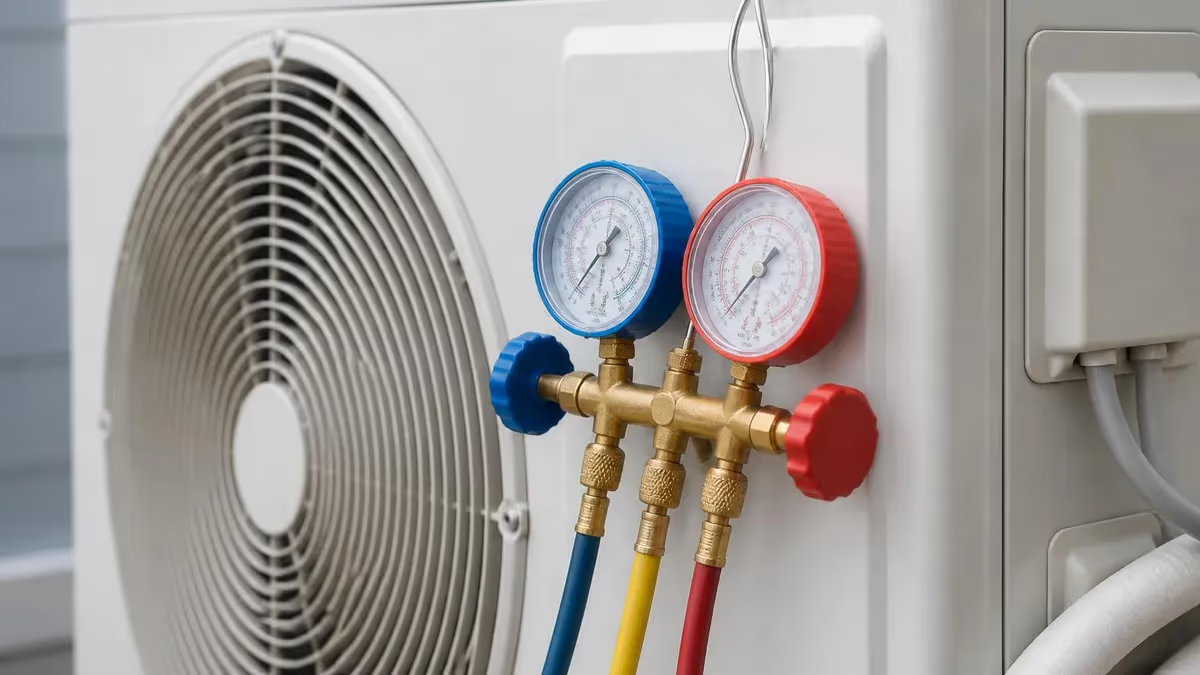
When it comes to heating and cooling your home, choosing the right equipment is one of the most consequential decisions you'll make as a homeowner. Trane HVAC units have long been considered an industry benchmark, known for their durability, energy efficiency, and wide range of residential and commercial products. Whether you're replacing an aging system, building a new home, or upgrading to a high-efficiency unit, understanding the leading HVAC brands and what differentiates them can save you thousands of dollars over the life of your system and ensure year-round comfort in any climate. Practice with the free HVAC practice test on PracticeTestGeeks (35 questions with answer explanations).
The HVAC industry in the United States is dominated by a handful of major manufacturers, each offering product lines that range from entry-level builder-grade equipment to premium variable-speed systems with smart-home integration. Trane, Carrier, Lennox, Rheem, Goodman, American Standard, and York are among the most recognized names, and each brand carries distinct strengths, price points, and warranty structures. Knowing the differences between these manufacturers helps homeowners and contractors make informed purchasing decisions that align with budget and performance expectations.
Energy efficiency has become a central concern for HVAC buyers in recent years, driven by rising electricity costs, new federal minimum SEER2 regulations that took effect in 2023, and growing interest in reducing carbon footprints. Modern high-efficiency systems can deliver SEER2 ratings above 20, meaning they produce more cooling output per unit of electrical energy consumed compared to older equipment rated at 13 or 14 SEER. Upgrading from a 10-year-old system to a top-tier unit can reduce annual cooling costs by 40 percent or more in hot climates.
Installation quality is just as important as the brand you select. Even the most advanced Trane unit will underperform if it is improperly sized, charged with the wrong refrigerant level, or connected to leaky ductwork. HVAC technicians who understand the relationship between equipment specifications and real-world performance are essential partners in the buying process. Many contractors are factory-authorized by specific brands, giving them access to specialized training, technical support, and warranty registration tools that independent dealers may not have.
For anyone studying for an HVAC certification or licensing exam, familiarity with major brands is not just commercially useful — it is tested material. Exams often include questions about equipment ratings, refrigerant compatibility, and installation standards that apply specifically to residential split systems, packaged units, and heat pumps from mainstream manufacturers. Understanding brand-specific features like Trane's Comfort-R mode, variable refrigerant flow systems, or two-stage compressor operation can directly improve exam performance.
Exploring hvac brand units and the competitive landscape helps both technicians and consumers understand what drives pricing, what warranties actually cover, and which product tiers make sense for different climates and budgets. This guide covers the top HVAC manufacturers, how to compare units across efficiency and cost metrics, the pros and cons of leading brands, and practical tips for making the right choice for any application.
Whether you are a homeowner researching your first major HVAC purchase, a new technician learning the product landscape, or a seasoned professional brushing up on the latest equipment releases, this comprehensive overview of HVAC brands and unit types will provide the grounding you need. Read on to discover which brands lead each product category, how to decode efficiency ratings, and what to look for in a warranty before signing any installation contract.
Free HVAC Study Tools
Interactive HVAC resources on PracticeTestGeeks, free to start:
- HVAC EPA 608 Refrigerant Certification — 35 questions with instant scoring and answer explanations
- HVAC flashcards — review key terms and concepts card by card
- HVAC study guide — topic-by-topic overview of what the exam covers
- HVAC cheat sheet — one-page printable summary for last-minute review
HVAC Brand Units by the Numbers
Top HVAC Brands and What Makes Them Stand Out
Owned by Trane Technologies, Trane is renowned for exceptional build quality and reliability. Their XR and XV series heat pumps and air conditioners are frequently ranked among the most durable in independent studies, with a reputation for lasting 18-20 years with regular maintenance.
Carrier invented modern air conditioning and remains a top-tier brand with strong commercial and residential lines. Their Infinity series offers some of the highest efficiency ratings available, with smart controls and variable-speed compressors that adapt precisely to load conditions.
Lennox leads the industry in peak efficiency, with units like the XC25 air conditioner reaching up to 26 SEER. They are a preferred brand for homeowners seeking maximum energy savings, though their units typically carry a premium price and require Lennox-certified technicians for best results.
Goodman, now a subsidiary of Daikin, offers some of the best value in the HVAC market. Their units are competitively priced, widely available, and backed by solid warranties. They are a popular choice for budget-conscious homeowners and builders seeking reliable performance at lower upfront cost.
Rheem and its commercial sister brand Ruud offer well-rounded product lines with strong after-sales support. Known for their heat pump technology and Prestige series variable-speed systems, Rheem units balance efficiency and affordability and are widely distributed through major home improvement retailers.
Understanding HVAC efficiency ratings is essential for comparing units across different brands and making a purchase decision that will pay off over the long term. The Seasonal Energy Efficiency Ratio, now updated to SEER2 under new Department of Energy testing protocols, measures how much cooling a system delivers per watt of electricity consumed over an entire cooling season.
Higher numbers always mean lower operating costs, but the relationship is not linear — moving from a 14 SEER2 to an 18 SEER2 unit saves considerably more per year than moving from 18 to 22 SEER2 because of diminishing returns at higher efficiency levels.
For heating performance, the Heating Seasonal Performance Factor (HSPF2) applies to heat pumps and works similarly to SEER2 — a higher number indicates greater efficiency. Gas furnaces are rated by Annual Fuel Utilization Efficiency (AFUE), expressed as a percentage of fuel energy converted to heat. Standard furnaces achieve 80 percent AFUE, meaning 20 percent of the fuel is lost through exhaust, while high-efficiency condensing furnaces reach 96 to 98 percent AFUE by capturing latent heat from combustion gases. Trane, Carrier, and Lennox all offer condensing furnaces in this top-efficiency tier.
The new SEER2 standard, which replaced the original SEER rating in January 2023, uses a higher external static pressure in testing to better reflect real-world ducted system conditions. As a result, SEER2 ratings are typically about 4 to 5 percent lower than the equivalent old SEER rating for the same equipment. A system rated at 16 SEER under the old standard might be rated at approximately 15.2 SEER2 under the new protocol. When comparing older and newer equipment specifications, it is important to confirm which standard is being cited to avoid comparing apples and oranges.
Federal minimum efficiency requirements vary by climate region. Homes in the Southeast and Southwest United States must meet a 15 SEER2 minimum for air conditioners as of 2023, while the Northern region minimum is 13.4 SEER2. These regulations are designed to reduce national energy consumption and push the market toward more efficient equipment, but they also mean that older builder-grade systems sold just a few years ago may no longer meet current code if they need replacement. HVAC technicians must stay current on these regional minimums to advise customers correctly.
Variable-speed compressors represent the most significant efficiency advance in residential HVAC over the past decade. Unlike single-stage units that run at full capacity until the thermostat setpoint is reached, variable-speed systems modulate their output continuously — running at 30 to 40 percent capacity on mild days and ramping up only when outdoor temperatures are extreme.
This dramatically reduces energy consumption because the compressor is not constantly cycling on and off, and it also improves humidity control because air spends more time moving over the evaporator coil. Most major brands now offer variable-speed options: Trane's XV20i, Carrier's Infinity 26, and Lennox's XC25 are flagship examples.
Two-stage compressors offer a middle ground between single-stage and fully variable-speed operation, running at either a low stage (around 70 percent capacity) or a high stage (100 percent). They cost less than variable-speed units while still delivering better comfort and efficiency than basic single-stage equipment. For most climates and most homeowners, a two-stage system from a reliable brand like Trane, Rheem, or American Standard provides an excellent balance of upfront investment and long-term operating savings without the complexity and maintenance costs associated with the most advanced inverter-driven compressors.
Matching the efficiency tier to your climate, home size, and usage patterns is critical. A 26 SEER2 system in a mild Pacific Northwest climate may never achieve the energy savings needed to justify its premium over a 16 SEER2 unit because the equipment simply does not run enough hours per year.
In contrast, that same 26 SEER2 system installed in Phoenix or Miami, where cooling loads exceed 2,500 hours annually, can generate substantial savings. Consulting with a qualified contractor who pulls a Manual J load calculation before recommending equipment ensures that the efficiency rating you pay for actually translates into real-world performance improvements.
HVAC Practice Test Questions
Prepare for the HVAC - Heating Ventilation and Air Conditioning exam with our free practice test modules. Each quiz covers key topics to help you pass on your first try.
HVAC Air Conditioning
HVAC Exam Questions covering Air Conditioning. Master HVAC Test concepts for certification prep.
HVAC Code Compliance
Free HVAC Practice Test featuring Code Compliance. Improve your HVAC Exam score with mock test prep.
HVAC Electrical Controls
HVAC Test Prep for Electrical Controls. Practice HVAC Quiz questions and boost your score.
HVAC Energy Efficiency
HVAC Questions and Answers on Energy Efficiency. Free HVAC practice for exam readiness.
HVAC Heating Systems
HVAC Mock Test covering Heating Systems. Online HVAC Test practice with instant feedback.
HVAC Load Calculations
Free HVAC Quiz on HVAC Load Calculations. HVAC Exam prep questions with detailed explanations.
HVAC Tools and Equipment
HVAC Practice Questions for HVAC Tools and Equipment. Build confidence for your HVAC certification exam.
HVAC Refrigeration
HVAC Test Online for Refrigeration. Free practice with instant results and feedback.
HVAC Safety Practices
HVAC Study Material on Safety Practices. Prepare effectively with real exam-style questions.
HVAC System Design
Free HVAC Test covering System Design. Practice and track your HVAC exam readiness.
HVAC Thermodynamics
HVAC Exam Questions covering Thermodynamics. Master HVAC Test concepts for certification prep.
HVAC Brand Tiers: Premium, Mid-Range, and Budget Lines
Premium HVAC brands — including Trane, Carrier Infinity, and Lennox Elite — are engineered for maximum efficiency, longevity, and comfort control. These units typically feature variable-speed compressors, communicating thermostats, advanced filtration options, and noise-reduction technology. Trane's TruComfort variable speed system, for example, automatically adjusts to maintain temperature within half a degree of the setpoint while operating at whisper-quiet sound levels below 58 decibels. Carrier's Infinity system uses proprietary ABCD communicating technology to allow the indoor and outdoor units to share real-time operating data and self-diagnose issues.
The upfront cost for premium equipment typically ranges from $7,000 to $12,000 installed, but the long-term operating savings and comfort improvements often justify this investment for homeowners in extreme climates or those planning to stay in their home for 10 or more years. Lennox's XC25 air conditioner holds the highest efficiency rating of any residential unit currently on the market at up to 26 SEER, and Carrier's Infinity 26 matches it at 26 SEER in favorable conditions. These systems also tend to carry the most comprehensive warranties — typically 10 years on parts and sometimes a lifetime limited warranty on the heat exchanger in premium furnaces.

Trane HVAC Units: Pros and Cons
- +Industry-leading build quality and component durability, with systems frequently lasting 18 to 20 years
- +Wide product range from entry-level XR series to top-tier XV variable-speed systems covering all efficiency tiers
- +Excellent dealer network with factory-authorized technicians available in virtually every US market
- +TruComfort variable-speed technology delivers precise temperature control within 0.5°F of setpoint
- +Strong warranty terms including 10-year limited warranty on parts when registered within 60 days of installation
- +Trane CleanEffects air filtration option is among the most effective whole-home filtration systems available
- −Premium pricing — Trane units typically cost 15 to 25 percent more upfront than comparable Goodman or Rheem equipment
- −Repairs can be more expensive because Trane uses proprietary components that are not universally stocked by all distributors
- −Some entry-level XB models offer only modest efficiency improvements over competing budget brands at a higher price point
- −Dealer exclusivity means fewer bidding options in some markets, potentially reducing competitive pricing pressure
- −Warranty registration is required within 60 days of installation — missing this window reduces coverage significantly
- −Smart thermostat integration is primarily optimized for Trane's own Nexia ecosystem, limiting compatibility with some third-party systems
Pros and Cons at a Glance
| Pros | Cons |
|---|---|
| Wide product range from entry-level XR series to top-tier XV variable-speed systems covering all efficiency tiers | Repairs can be more expensive because Trane uses proprietary components that are not universally stocked by all distributors |
| Excellent dealer network with factory-authorized technicians available in virtually every US market | Some entry-level XB models offer only modest efficiency improvements over competing budget brands at a higher price point |
| Trane CleanEffects air filtration option is among the most effective whole-home filtration systems available | Dealer exclusivity means fewer bidding options in some markets, potentially reducing competitive pricing pressure |
HVAC Brand Unit Buying Checklist: 10 Steps Before You Sign
- ✓Verify the contractor performs a Manual J load calculation before recommending any equipment size.
- ✓Confirm the SEER2 rating meets or exceeds the federal minimum for your climate region.
- ✓Compare at least three bids from contractors representing different brands before committing.
- ✓Check that the proposed unit uses a refrigerant compatible with current and future regulations (R-410A phase-out is underway; R-454B and R-32 are emerging alternatives).
- ✓Review the full warranty terms: confirm parts, compressor, and labor coverage periods separately.
- ✓Register the new equipment within the required window (often 60 days) to activate the extended warranty.
- ✓Ask the contractor about manufacturer rebates and utility company efficiency incentive programs available in your area.
- ✓Confirm the contractor is factory-authorized by the brand they are installing for warranty service eligibility.
- ✓Inspect existing ductwork for leaks before installation — new high-efficiency equipment on leaky ducts will underperform significantly.
- ✓Request a written commissioning report showing refrigerant charge, airflow measurements, and thermostat calibration after installation.
Installation Quality Often Matters More Than Brand
Studies by the California Energy Commission found that up to 50 percent of installed HVAC systems have significant performance deficiencies due to poor installation practices — including incorrect refrigerant charge, improper airflow, and oversized equipment — regardless of brand. A properly installed Goodman unit will consistently outperform a poorly installed Trane. Always prioritize contractor quality and verify they follow ACCA Quality Installation standards.
Understanding the true cost of owning an HVAC system requires looking beyond the initial installation price to factor in operating costs, maintenance expenses, and expected lifespan. A premium Trane XV20i heat pump installed for $11,000 may appear far more expensive than a $5,000 Goodman single-stage system, but when you calculate the annual energy savings from its significantly higher efficiency rating — often $400 to $700 per year in a hot climate — the payback period can be as short as eight to ten years. After that point, the premium system is generating net savings compared to the budget alternative.
Warranty structures vary significantly between brands and are an important factor in total cost of ownership. Most major manufacturers offer a standard five-year parts warranty that automatically applies to equipment sold by any licensed contractor. However, to access the full extended warranty — typically ten years on parts and compressor — the unit must be registered by a licensed contractor within a defined window after installation, often 60 days.
Trane and Carrier both offer ten-year extended warranties under this model. Lennox offers a five-year or ten-year extended warranty depending on the product tier, and some premium Lennox products include a lifetime heat exchanger warranty.
Labor warranty is entirely separate from manufacturer parts coverage and is negotiated directly with your installing contractor. Most reputable HVAC companies offer one to two years of labor warranty, meaning they will return to repair any workmanship-related issues at no charge within that period.
Some premium contractors offer extended labor coverage of three to five years for an additional fee. When comparing bids from different contractors, always confirm what labor warranty is included, since a contractor offering a slightly higher price with a two-year labor warranty may represent better overall value than a lower-bid contractor with only a ninety-day workmanship guarantee.
Maintenance contracts, sometimes called service agreements or preventive maintenance plans, add another layer to total ownership cost. These annual agreements, typically priced between $150 and $350 per year, include one or two professional tune-ups annually plus priority scheduling for emergency service calls. They often include modest discounts on repairs and parts as well.
For homeowners who want to protect a significant equipment investment and ensure manufacturer warranty requirements (many of which specify annual maintenance) are met, a maintenance contract with a reputable local contractor is a prudent expense that can pay for itself by catching small issues before they become expensive failures.
The federal 25C tax credit, extended and expanded under the Inflation Reduction Act of 2022, provides a significant financial incentive for purchasing qualifying high-efficiency HVAC equipment. Homeowners can claim a credit of up to 30 percent of the cost of qualifying heat pumps, heat pump water heaters, and high-efficiency air conditioners and furnaces, capped at $600 for most equipment or $2,000 for heat pumps.
To qualify, equipment must meet specific efficiency thresholds — for split-system central air conditioners, that currently means an EER2 of at least 12 and a SEER2 of at least 16. Many Trane, Carrier, and Lennox premium models qualify, and your contractor should be able to confirm eligibility and provide the documentation needed to claim the credit at tax time.
State and local utility rebates stack on top of the federal credit in many markets and can further reduce the effective cost of a premium HVAC system. Southern California Edison, for example, has offered rebates of $200 to $800 for qualifying heat pumps, while some Texas utilities provide similar incentives.
Energy efficiency financing programs through the Property Assessed Clean Energy (PACE) program allow homeowners in participating states to finance HVAC upgrades through their property tax bill, spreading the cost over five to twenty-five years with interest rates that are often competitive with home equity products. Asking your contractor about all available incentives before finalizing your equipment selection is a critical step that many homeowners skip to their financial detriment.
For rental property owners and commercial building managers, the economics of HVAC brand selection shift somewhat. Operating cost and reliability matter enormously because a system failure means discomfort for tenants and potential lease violations in states with habitability requirements. Many property managers favor mid-tier brands like Rheem or American Standard that offer a strong balance of durability, parts availability, and cost-effective replacement components.
Commercial applications also introduce packaged unit configurations, rooftop units, variable refrigerant flow systems, and chiller-based systems that are specific to larger buildings — product categories where brands like Daikin, Mitsubishi Electric, and Trane Commercial have strong specializations that differ from their residential product lines.

The EPA is phasing out R-410A refrigerant under the AIM Act, with production and import caps already in effect. New HVAC equipment manufactured after January 1, 2025 must use lower global warming potential refrigerants such as R-454B or R-32. If you are purchasing a new system, confirm it uses the new-generation refrigerant — not R-410A — to avoid future servicing complications and rising refrigerant costs as R-410A supplies tighten over the coming years.
Selecting the right HVAC brand ultimately comes down to aligning three variables: your budget, your climate, and your contractor's expertise and brand authorization. No single brand is objectively best for every situation, and much of the online brand debate misses this fundamental point. A Trane XV20i is an exceptional machine, but it requires a skilled contractor who understands variable-speed system commissioning, communicating controls, and the nuances of matched system design to deliver on its promise. In the hands of an inexperienced technician, that same premium unit can develop problems that a well-installed Goodman would never encounter.
Climate zone should drive your efficiency tier decision more than any other factor. Homeowners in climate zones 1 through 3 — covering Florida, the Gulf Coast, and the desert Southwest — have the most to gain from high-efficiency equipment because their systems run for thousands of hours each year. The additional cost of moving from a 16 SEER2 to a 20 SEER2 system can be recovered in as little as five to seven years in these markets.
In contrast, homeowners in zones 6 and 7 — the northern tier of the continental US and Alaska — run their air conditioning for comparatively few hours and should focus their efficiency investments on heating equipment, where heat pumps with cold-climate specifications or high-AFUE condensing furnaces provide the most meaningful savings.
Heat pump technology deserves special attention in the current market because it serves as both a heating and cooling system, offering compelling efficiency advantages over separate furnace and air conditioner combinations in most climates. Modern variable-speed heat pumps from Trane, Carrier, and Mitsubishi Electric operate effectively in outdoor temperatures as low as minus 13 degrees Fahrenheit, shattering the old assumption that heat pumps were impractical in cold climates. The Trane XR15 and XV20i heat pumps, Carrier's Greenspeed Intelligence series, and Bosch's IDS 2.0 are all strong performers that qualify for the federal tax credit and many utility rebates.
Zoning systems add another dimension to HVAC brand selection. Multi-zone ductless mini-split systems, dominated by Japanese and Korean brands including Mitsubishi Electric, Daikin, LG, and Samsung, allow different rooms or areas to be cooled and heated independently without ductwork. These systems are particularly valuable in homes with additions, sunrooms, attic conversions, or other spaces that are difficult to condition through a central forced-air system.
While Mitsubishi and Daikin are the premium leaders in this segment, their products are installed by specially trained technicians under dealer certification programs that require significant training investment — a consideration for homeowners evaluating their local service options.
For HVAC professionals studying for EPA 608 certification, state licensing exams, or NATE certification, understanding the equipment landscape covered in this guide is directly applicable to test questions. Efficiency rating calculations, refrigerant identification by application, compressor types and their operating characteristics, and warranty structures are all topics that appear on professional certification exams. The practical knowledge gained from understanding why Trane uses a specific compressor design, how communicating controls differ from conventional wiring, or why equipment must be matched by manufacturer for warranty purposes translates directly to better exam performance and better field work.
Ultimately, the best HVAC brand for any given project is the one whose equipment best fits the load requirements, whose local dealer network provides the strongest installation and service support, and whose pricing aligns with the homeowner's budget and payback expectations. Trane's reputation for durability and the breadth of their product line makes them a defensible choice in virtually any residential application.
Carrier's innovation leadership in efficiency and smart controls makes them equally compelling for technology-forward buyers. And value-focused buyers willing to invest in good installation and maintenance will find that Goodman or Rheem delivers excellent long-term performance at a significantly lower entry cost.
Comparing options carefully before committing — gathering multiple bids, verifying contractor authorization, confirming warranty terms, and calculating the fully loaded cost of ownership — is the single highest-use action any homeowner or facilities manager can take. The HVAC market rewards informed buyers, and the information in this guide provides the foundation needed to navigate that process with confidence regardless of which brand ultimately earns your business.
For HVAC technicians and students preparing for certification exams, a deep familiarity with major brand equipment is more than commercially useful — it forms the practical foundation of questions appearing throughout EPA, NATE, and state licensing exams. Examiners regularly include scenarios drawn from real equipment specifications, refrigerant requirements, and installation standards that differ between product categories and efficiency tiers. Being able to identify the operating characteristics of a variable-speed heat pump versus a single-stage air conditioner, or knowing how to interpret a manufacturer's rating plate, translates directly into correct answers under test conditions.
NATE certification, the most widely recognized professional credential in the US HVAC industry, includes knowledge of equipment operation across major systems categories. The Core certification requires understanding of electricity fundamentals, refrigeration principles, and safety procedures that apply to all brands.
Specialty areas including Air Conditioning, Heat Pumps, Gas Heating, and Air Distribution each require more detailed knowledge of how specific equipment types from mainstream manufacturers operate, are serviced, and are commissioned. Candidates who have hands-on exposure to equipment from multiple brands — Trane, Carrier, Lennox, Rheem, and others — consistently score higher because they can draw on specific examples when abstract concepts are tested.
EPA Section 608 certification, required for any technician who handles refrigerants, tests knowledge of refrigerant properties, recovery procedures, and leak detection methods that are applied to equipment from every manufacturer. Understanding which refrigerant types are used in which equipment categories, the global warming potential implications of different refrigerant choices, and the regulatory requirements for handling and reclaiming refrigerants are all tested domains.
The ongoing transition away from R-410A toward lower-GWP alternatives like R-454B and R-32 has made refrigerant knowledge even more important in recent exam cycles, and candidates who understand why these transitions are happening — not just that they are happening — answer the more nuanced exam questions more confidently.
State contractor licensing exams, which are required to legally install and service HVAC equipment in most US states, add another layer of tested knowledge that encompasses business law, insurance requirements, and the mechanical and electrical codes governing HVAC installation.
The International Mechanical Code and International Fuel Gas Code, which are adopted by most states with local amendments, specify clearance requirements, venting standards, refrigerant handling procedures, and equipment installation practices that apply regardless of which brand is being installed. Familiarity with these standards — not just with the manufacturer's installation instructions — is what separates technicians who pass licensing exams from those who struggle.
Practice tests remain one of the most effective preparation strategies for HVAC certification exams because they expose candidates to the specific question formats, terminology, and reasoning patterns used by examiners. Unlike simply reading study materials, practice testing forces active recall and reveals knowledge gaps before they become exam mistakes.
Candidates who complete ten or more full-length practice tests before their exam date consistently outperform those who rely solely on reading or classroom instruction. The immediate feedback loop of practice testing — seeing which questions you missed and understanding why — is particularly valuable for the numerical and scenario-based questions that require applying knowledge rather than simply recognizing memorized facts.
Time management is a practical skill that practice testing also develops. Many HVAC certification exams, particularly state contractor licensing exams, are time-limited and include enough questions that candidates cannot afford to spend extended time on any single item.
Developing the instinct to recognize question types, apply the right framework quickly, and move on when stuck — returning to flagged questions if time allows — is a skill that only develops through repeated timed practice. Students who have worked through large banks of practice questions under realistic time conditions walk into the exam room with a measurable advantage over those who are experiencing timed conditions for the first time on exam day.
Integrating brand knowledge with code knowledge and technical principles creates the kind of multi-dimensional understanding that top-scoring HVAC exam candidates demonstrate.
Knowing that a specific Trane model uses a two-speed compressor, and connecting that to how two-speed systems are handled in refrigerant recovery scenarios under EPA 608, or how their electrical control wiring differs from single-stage equipment under NATE Air Conditioning certification, creates durable knowledge that is both practically useful in the field and systematically retrievable on exams. This integrated approach — understanding the why behind every what — is the hallmark of both excellent HVAC technicians and excellent HVAC exam scores.
Sample HVAC Practice Questions
Try these questions from our free HVAC practice tests. The correct answer and an explanation follow each question.
What is the primary function of an expansion tank in a closed-loop hydronic heating system?
- A. To increase system water pressure
- B. To accommodate the volume increase of water as it heats and expands
- C. To filter debris from the water
- D. To balance flow between multiple zones
Answer: B. To accommodate the volume increase of water as it heats and expands
As water heats it expands in volume. The expansion tank absorbs this expanded volume, preventing excessive pressure buildup.
In a commercial VAV system, when zone cooling demand drops to minimum, the VAV box may switch to reheat mode. What is the energy concern with this operation?
- A. Reheating previously cooled air wastes both cooling and heating energy simultaneously
- B. Reheat coils increase duct static pressure, overloading the AHU fan
- C. The zone thermostat loses calibration during reheat cycles
- D. Condensate drain lines can freeze during reheat operation
Answer: A. Reheating previously cooled air wastes both cooling and heating energy simultaneously
Reheat systems cool air centrally and then heat it locally at the VAV box, consuming both cooling energy (chiller) and heating energy (boiler or electric coil) at the same time — an inherently wasteful process.
In a series-loop one-pipe hydronic system, what happens to the water temperature as it progresses through successive terminal units?
- A. Temperature remains constant throughout the loop
- B. Temperature gradually decreases with each successive unit
- C. Temperature increases due to compression
- D. Temperature fluctuates randomly
Answer: B. Temperature gradually decreases with each successive unit
In a series loop, each terminal unit extracts heat from the same water stream, so the water temperature drops progressively from the first to the last unit in the circuit.
A two-pipe direct-return hydronic system has uneven heating across zones. What is the most likely cause?
- A. Boiler water temperature set too low
- B. Hydraulic imbalance — zones closest to the pump receive more flow than distant zones
- C. Defective aquastat failing to open remote zone valves
- D. Incorrect pipe insulation type on the supply header
Answer: B. Hydraulic imbalance — zones closest to the pump receive more flow than distant zones
In a direct-return system, the first zone has the shortest circuit and least resistance, causing it to receive disproportionate flow; balancing valves or a reverse-return layout corrects this.
HVAC Questions and Answers
HVAC Sales: The Complete Guide to Selling Heating and Cooling Systems, Building Customer Trust, and Closing More Deals
HVAC Air Duct Sealing: The Complete Homeowner and Contractor Guide to Sealing Ductwork for Efficiency, Comfort, and Indoor Air Quality
HVAC Solutions: The Complete Guide to Heating, Cooling, and Indoor Air Quality Systems for Homes and Buildings

Commercial HVAC Repair: Systems, Costs, and Service Strategies
HVAC Apprenticeship Programs: Your Complete Guide to Starting a Hands-On Career in Heating, Ventilation, and Air Conditioning
How this page was made: written with AI tools and published by Nathan Beja, founder of Practice Test Geeks, who is responsible for its content. We have not yet matched this exam's facts to an official source, so confirm fees, dates and rules with the exam body. Not reviewed by a subject-matter expert. Editorial policy