
Ham Radio vs Walkie Talkie: Understanding the Difference Between Ham Radio and Walkie Talkie
Learn the difference between ham radio and walkie talkie — frequencies, range, licensing & equipment explained. ✅ Get started today.

The difference between ham radio and walkie talkie is one of the most common questions beginners ask before deciding which path to take in two-way radio communication. On the surface, both devices let you talk wirelessly — but they are built on entirely different frameworks of technology, regulation, and capability.
Ham radios, also called amateur radios, operate across a vast spectrum of ham radio frequencies allocated by the FCC, covering everything from HF bands that bounce signals off the ionosphere to VHF and UHF repeater networks that extend local range dramatically. Walkie-talkies, by contrast, are consumer-grade devices limited to narrow FRS or GMRS channels with no flexibility.
One of the most important distinctions is legal: to operate a ham radio, you must hold a valid ham radio license issued by the FCC. This credential requires passing the ham radio license test, a 35-question exam covering electronics theory, regulations, and operating procedures. Walkie-talkies on FRS channels require no license at all, which makes them appealing for casual users — but that simplicity comes at the cost of power, range, and versatility. Understanding this regulatory divide is the first step in choosing the right tool for your communication needs.
Ham radios open doors that walkie-talkies simply cannot. With the right ham radio equipment, a licensed amateur can communicate across continents, link into worldwide repeater networks, experiment with digital modes, and even bounce signals off the moon. The depth of capability is extraordinary compared to the fixed, low-power world of consumer walkie-talkies. A handheld ham radio running just five watts on a VHF repeater can easily cover an entire metropolitan region — something no standard walkie-talkie can match.
Walkie-talkies are not without merit. For family outings, short-range job sites, or emergency kits where simplicity matters above all else, a pair of FRS radios gets the job done without any study or paperwork. They are inexpensive, widely available, and require zero technical knowledge to operate. But anyone who finds themselves wanting more range, more channels, more capability, or the ability to communicate during wide-scale disasters will quickly hit the ceiling of what consumer radios can offer.
The ham radio community is also a vastly different world socially and technically. Licensed amateurs participate in emergency communication networks (ARES and RACES), provide communications support for public events, operate high-altitude balloon experiments, and engage in contesting competitions that test operating skill. Ham radio prep resources — including practice exams, study guides, and video courses — make earning a license more accessible than ever. The Technician class exam, the entry-level credential, requires no prior experience and is within reach of most motivated learners in four to six weeks of study.
Ham radio bands are organized into distinct allocations, each with its own propagation characteristics. VHF (144–148 MHz) and UHF (420–450 MHz) bands are where most new Technician licensees start, using local repeaters to extend range. HF bands below 30 MHz allow global communication but require a General or Extra class license for full privileges. Walkie-talkies, by comparison, are locked to a handful of FRS channels between 462 and 467 MHz — a sliver of spectrum with no ability to adjust power above 2 watts or connect to repeaters.
This article explores every major dimension of the ham radio vs walkie-talkie comparison: licensing, range, equipment, frequencies, costs, and practical use cases. Whether you are a curious beginner, a prepper building a communications plan, or an outdoor enthusiast looking to stay connected in the backcountry, understanding these differences will help you make an informed decision — and show you why so many people ultimately choose to pursue their ham radio license.
Ham Radio vs Walkie Talkie by the Numbers

Key Differences Between Ham Radio and Walkie Talkie
Ham radio operators must pass the FCC Technician exam and hold a valid license. FRS walkie-talkies require zero licensing. GMRS walkie-talkies require a simple FCC license with no exam — just a fee.
Ham radios can legally transmit up to 1,500 watts and connect through repeaters for regional coverage. FRS walkie-talkies cap at 2 watts with no repeater access, limiting real-world range to 1–2 miles in typical terrain.
Licensed ham operators access dozens of bands from 1.8 MHz to 1.3 GHz and beyond. Walkie-talkies are restricted to pre-programmed FRS channels between 462–467 MHz with no ability to change frequencies.
Ham radio equipment ranges from simple handheld radios to sophisticated base stations with external antennas, amplifiers, and digital interfaces. Walkie-talkies are plug-and-play consumer devices requiring no setup or technical knowledge.
Ham radio connects you to a global community of experimenters, emergency communicators, and contest operators. Walkie-talkies serve casual short-range communication for families, hikers, and job sites with no community infrastructure.
The ham radio license is the gateway to everything the amateur radio service has to offer, and understanding how it works is essential for anyone comparing ham radios to walkie-talkies. The FCC administers three license classes: Technician, General, and Amateur Extra. The Technician class is the entry point and grants full privileges on all VHF and UHF amateur bands — the same bands used by most handheld ham radios and local repeater networks. Earning this credential requires passing a 35-question multiple-choice exam at an authorized exam session, with a passing score of 74 percent or higher (26 correct answers).
The ham radio license test covers five broad topic areas: FCC rules and regulations, operating procedures, radio wave propagation, electrical principles, and station equipment. None of these topics requires an engineering background to master. Most first-time test takers report studying for four to eight weeks using free online resources, practice exams, and the official question pool published by the NCVEC.
The question pool rotates every four years, so it is important to use current study materials that reflect the active exam cycle. Online platforms offering ham radio prep have made this process dramatically more efficient than it was a decade ago.
Once you pass the Technician exam, the FCC issues your license within a few days via the Universal Licensing System (ULS). You can look up your call sign online as soon as it appears in the database — typically within 48 to 72 hours of your exam session. The license is valid for ten years and can be renewed online at no charge beyond the $15 application fee introduced in 2022. Your call sign is your unique identifier on the air, and using it correctly is both a legal requirement and a point of pride within the amateur radio community.
Walkie-talkie users on FRS frequencies operate under Part 95 of the FCC rules, which authorize unlicensed use of FRS radios by any person. The FCC intentionally designed FRS as a no-barrier consumer service, limiting power to 2 watts and prohibiting external antennas or repeater connections to prevent interference across the shared channel plan. GMRS, a step above FRS, allows up to 50 watts and repeater access but requires a $35 license fee (no exam required) that covers an entire family. Even this modest upgrade highlights the gap between consumer radio services and the full amateur radio service.
One often-overlooked benefit of obtaining a ham radio license is the emergency communications framework it unlocks. ARES (Amateur Radio Emergency Service) and RACES (Radio Amateur Civil Emergency Service) are volunteer organizations that deploy licensed hams during disasters when commercial infrastructure fails.
After major hurricanes, earthquakes, and wildfires, licensed amateurs have provided critical voice and data links for emergency managers, hospitals, and relief organizations. No walkie-talkie user — regardless of equipment quality — can participate in these coordinated networks without a license and proper training. You can learn more about operating on the go through the hro ham radio outlet mobile operating guide.
The Technician license also serves as a foundation for upgrading to higher license classes. General class licensees unlock HF privileges that allow communication on the 40-meter, 15-meter, and 10-meter bands — frequencies capable of spanning continents under the right conditions. Amateur Extra, the highest class, provides access to all amateur frequencies and is recognized as a mark of serious technical achievement. Many hams begin with a Technician license for local VHF/UHF work and upgrade within a year or two as their interest in HF propagation and long-distance communication grows.
Studying for the ham radio license test also teaches you skills that make you a better, safer operator. You learn how to identify interference, understand antenna polarization, calculate power and resistance using Ohm's law, and recognize the regulations that protect amateur spectrum from abuse. These are not abstract concepts — they directly inform decisions you will make every time you key up a microphone. A walkie-talkie user never needs to think about any of this, which explains both the simplicity of consumer radios and their fundamental limitations compared to the amateur radio service.
Ham Radio Frequencies vs Walkie-Talkie Channels
The 2-meter band (144–148 MHz) is the most popular starting point for Technician licensees. It supports strong local coverage through a nationwide network of repeaters — automated relay stations typically located on hilltops or tall buildings that receive your signal and retransmit it at higher power. A modest 5-watt handheld radio hitting a well-placed repeater can cover an entire metropolitan area, reaching operators tens of miles away with clear, reliable audio quality.
The 70-centimeter band (420–450 MHz) is the second most common Technician-class band and works exceptionally well for urban environments where VHF signals sometimes struggle to penetrate buildings. Many dual-band handheld radios cover both the 2-meter and 70-centimeter bands simultaneously, making them extremely versatile for new licensees. Both bands also support digital voice modes like DMR and Fusion, which link repeaters worldwide through internet gateways — effectively giving a handheld radio global reach for under $30 in radio costs.

Ham Radio vs Walkie-Talkie: Pros and Cons
- +Ham radio offers vastly greater range through repeaters and HF sky-wave propagation
- +Licensed operators access hundreds of frequencies across dozens of bands
- +Ham radio equipment supports digital modes, satellites, and emergency networks
- +The amateur community provides training, mentorship, and organized events
- +A ham radio license never needs re-testing — just a simple renewal every 10 years
- +Ham radios can communicate during disasters when cell and internet infrastructure fails
- −Ham radio requires passing the Technician license exam before transmitting
- −Entry-level ham radio equipment costs more than basic FRS walkie-talkies
- −Ham radios have a steeper learning curve for programming channels and repeaters
- −Operating rules and regulations add complexity that casual users may find unnecessary
- −Quality ham radio antennas require installation planning and sometimes permits
- −Walkie-talkies are simpler, cheaper, and require zero study or paperwork for basic use
Ham Radio License: Step-by-Step Getting Started Checklist
- ✓Download the current Technician question pool from the ARRL or NCVEC website.
- ✓Use a free online practice exam platform to take timed full-length mock tests daily.
- ✓Study FCC Part 97 rules covering station identification, power limits, and band privileges.
- ✓Learn Ohm's law and basic electronics formulas — these appear on every exam.
- ✓Find a local exam session through the ARRL exam search tool or a local ham radio club.
- ✓Register with the FCC FRN (FCC Registration Number) system before your exam date.
- ✓Bring two forms of ID and the $15 exam fee (cash or check at most VE sessions).
- ✓After passing, monitor the FCC ULS database for your call sign (typically 48–72 hours).
- ✓Program your first handheld radio with local repeater frequencies from repeaterbook.com.
- ✓Check into a local repeater net to introduce yourself and connect with the community.
The Technician License Unlocks More Than You Think
Most beginners assume the ham radio license is only for long-distance HF operation — but Technician class immediately grants full privileges on all VHF and UHF amateur bands, including the 2-meter and 70-centimeter bands used by local repeater networks. On day one of holding your license, you can communicate regionally, join emergency communication groups, and access worldwide digital voice networks through internet-linked repeaters. The barrier to entry is a single 35-question exam, not years of study.
Ham radio equipment spans an enormous range of complexity, capability, and price — and understanding the landscape helps new operators make smarter buying decisions before and after earning a license. At the entry level, dual-band handheld transceivers (HTs) like the Baofeng UV-5R sell for under $30 and cover both the 2-meter and 70-centimeter bands. While these radios are controversial among experienced operators for their variable frequency accuracy and broad receiver coverage, they serve as practical learning tools for new Technician licensees who want to start listening and experimenting without a large investment.
Mid-range handheld radios from established manufacturers like Yaesu, Kenwood, and Icom offer significantly better build quality, audio clarity, receiver selectivity, and waterproofing. The Yaesu FT-65R and Kenwood TH-D74A represent different tiers of the same basic product category — a single-operator portable radio for VHF/UHF use. These radios typically cost between $80 and $400, and they support features like APRS (Automatic Packet Reporting System), which allows operators to transmit their GPS location over the ham radio network — a feature that has no equivalent in the consumer walkie-talkie world.
Mobile ham radios install in vehicles and draw power from the car's electrical system, allowing output power of 50 watts or more on VHF/UHF bands. A 50-watt mobile radio with a properly mounted ham radio antenna dramatically outperforms any handheld radio for coverage. Mobile installations are popular among operators who commute long distances and want to stay connected to regional repeater networks, or who participate in public service events like marathon communications where vehicle-based stations provide backbone coverage.
Base station ham radio equipment represents the pinnacle of capability for most amateur operators. A modern all-band HF/VHF/UHF transceiver from Icom, Yaesu, or Kenwood can cover every amateur band from 1.8 MHz to 450 MHz in a single box, with output power up to 100 watts and advanced digital signal processing for pulling weak signals out of noise. Paired with a directional beam antenna on a roof-mounted mast, a base station operator can work stations on every inhabited continent during favorable propagation conditions — a capability that places ham radio in an entirely different universe from consumer walkie-talkies.
The ham radio antenna is one of the most important — and most underappreciated — components of any amateur station. A mediocre radio with an excellent antenna will consistently outperform an excellent radio with a poor antenna. For VHF/UHF work, a simple vertical antenna mounted at height provides significant improvement over the rubber duck antennas included with handheld radios.
For HF, wire antennas like the classic dipole can be built for under $20 in materials and strung between trees or attached to a house with minimal permanent modification. Antenna theory is one of the topics covered on the Technician exam, and understanding it pays dividends immediately in on-air performance.
Digital modes have transformed ham radio in the past decade. Software like WSJT-X enables FT8, a weak-signal digital mode that can complete valid contacts at signal levels 15 dB below what human hearing can detect.
A 5-watt HF station using FT8 during good propagation can work stations on every continent in a single afternoon — not because the radio is powerful, but because the digital protocol extracts usable information from signals that would otherwise be lost in noise. No walkie-talkie supports anything comparable; their audio-only, fixed-channel design precludes the kind of software-defined flexibility that makes modern ham radio so technically fascinating.
For operators interested in emergency preparedness, ham radio equipment selection should emphasize portability, battery operation, and multi-band capability. A dual-band handheld radio with a high-capacity battery pack and a portable roll-up J-pole antenna represents an excellent go-kit that fits in a small backpack and provides regional VHF/UHF coverage for days on a single charge. Some operators also include a small HF transceiver like the Xiegu G90 or Yaesu FT-818 for situations requiring long-distance communication when local infrastructure is compromised — scenarios where having a ham radio license becomes genuinely critical to safety and coordination.
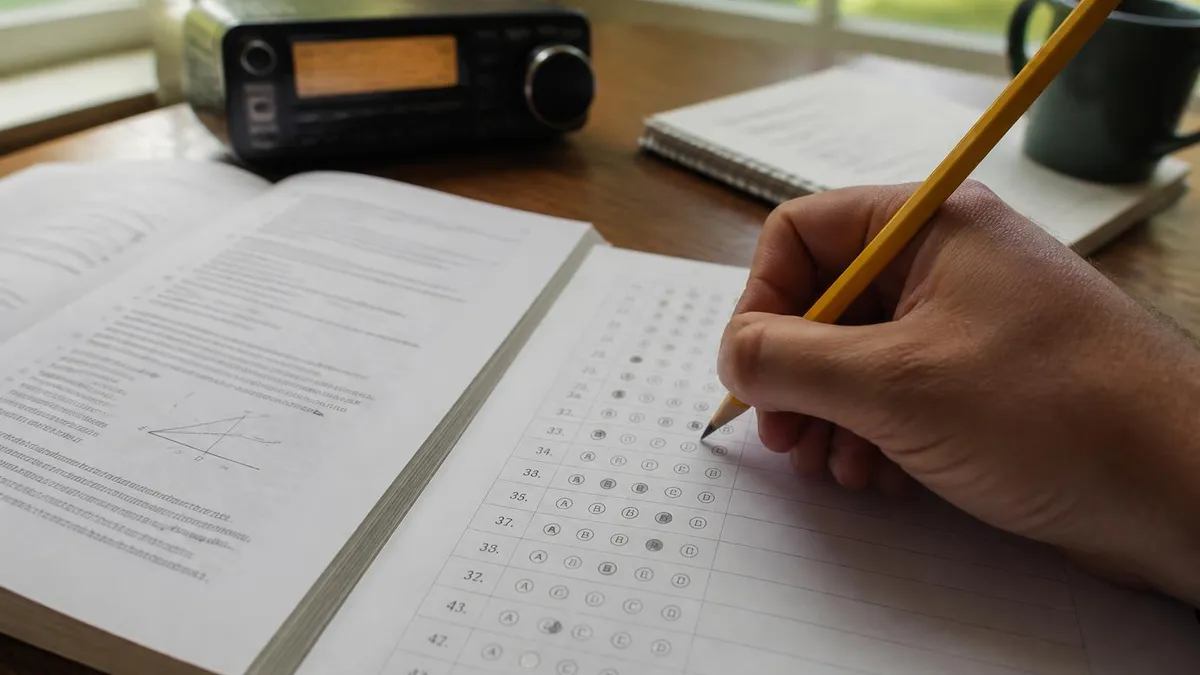
Transmitting on amateur radio frequencies without a valid FCC license is a federal violation under Part 97 of the FCC rules and can result in fines, equipment confiscation, and criminal penalties. Unlike FRS walkie-talkies — which anyone may use without a license — ham radio frequencies are exclusively reserved for licensed operators. You may listen and study on any frequency without a license, but you must hold a current Technician, General, or Extra class license before keying up any microphone on ham radio bands.
Getting your ham radio license in 2025 is more straightforward than at any point in the hobby's history. Online exam sessions, introduced widely during the COVID-19 pandemic, are now a permanent fixture — meaning you no longer need to travel to a local club session to take your test.
Organizations like ARRL VEC, W5YI, and numerous independent exam groups offer remote proctored exams via video conferencing platforms. You sit at home with a government-issued ID and a clear webcam view of your face and exam environment, and volunteer examiners (VEs) supervise the session remotely. Results are typically processed within 24 to 48 hours.
Ham radio prep materials are abundant, free, and high quality. The ARRL Technician License Manual is the gold standard printed study guide, covering every topic in the question pool with clear explanations and diagrams. Online, websites like HamStudy.org and QRZ.com offer free practice exams that randomly draw from the official question pool, track your progress by topic, and flag weak areas for additional review. Video courses on YouTube — including comprehensive playlists specifically targeting the Technician exam — walk through every concept visually, making abstract ideas like antenna resonance and impedance matching much more approachable for visual learners.
The question of when to schedule your exam is simpler than most beginners expect. When you consistently score 80 percent or higher on full 35-question practice exams across multiple attempts, you are ready to sit for the actual test. Most people reach this threshold in four to six weeks of daily 30-minute study sessions. Some highly motivated individuals pass after a weekend of intensive preparation. The exam is not designed to be a barrier — it is designed to verify that you have enough foundational knowledge to operate a radio station responsibly without causing harmful interference to other users.
One historically famous example of ham radio's unexpected reach is the reagan weinberger achille lauro conversation ham radio incident, in which political leaders reportedly used amateur radio channels for sensitive communication during a 1985 hostage crisis. While the full technical details of that situation remain debated, the story illustrates how amateur radio frequencies have been woven into real-world events at the highest levels — a reminder that ham radio is not merely a hobby but a communication infrastructure with genuine historical and practical significance.
After earning your Technician license, joining a local amateur radio club dramatically accelerates your learning curve. Clubs host monthly meetings, on-air nets, field days, public service events, and informal elmering sessions where experienced operators mentor newcomers. The ARRL maintains a club finder tool on its website, and most metropolitan areas have multiple active clubs representing different interests — contesting, emergency communications, DXing, satellite work, and more. The social dimension of amateur radio is one of its most underappreciated benefits, especially compared to the solitary experience of using a walkie-talkie on a family camping trip.
Once licensed, many operators discover that their initial equipment purchase serves them for years. A quality dual-band handheld radio purchased after passing the Technician exam can serve as your primary radio for local VHF/UHF work, emergency preparedness, and public service events. As your interests evolve, you can add a mobile radio for vehicle installation, upgrade to an HF transceiver after earning a General license, or experiment with dedicated digital mode interfaces. The modular, upgradeable nature of ham radio equipment is a significant advantage over consumer walkie-talkies, which offer no upgrade path and no community of practice to support your growth.
The ham radio license is not the finish line — it is the starting line. Everything that follows: choosing equipment, programming repeaters, making your first contact, joining a net, experimenting with digital modes, building an antenna from scratch — becomes possible only because you took the time to study, sit the exam, and earn the credential.
For anyone who has ever felt frustrated by the limitations of a walkie-talkie and wondered what lies beyond those 22 channels and 2 watts, the answer is the entire electromagnetic spectrum of the amateur radio service, waiting to be explored with a license in hand and a radio keyed up.
When preparing for the ham radio license test, understanding how the exam is structured helps you allocate study time efficiently. The 35 questions on the Technician exam are drawn from a published pool of 412 questions, organized into 10 subelements labeled T1 through T0.
Each subelement covers a distinct topic: T1 covers FCC rules, T2 covers operating procedures, T3 covers radio wave propagation, T4 covers amateur radio practices, T5 covers electrical principles, T6 covers circuit components, T7 covers station equipment, T8 covers modes and operating, T9 covers antennas and feed lines, and T0 covers RF safety. Knowing the structure lets you identify weak areas and focus practice time where it matters most.
RF safety — subelement T0 — surprises many first-time test takers because it involves calculating safe exposure distances and understanding maximum permissible exposure (MPE) limits.
The FCC requires amateur stations to conduct a routine RF safety evaluation under certain power and frequency conditions, and Technician exam questions test whether you understand the basic principles: distance from antenna reduces exposure, lower frequencies have different MPE limits than higher frequencies, and directional antennas focus power in ways that affect exposure calculations. These concepts are not difficult, but they require deliberate study since most people have no prior exposure to RF safety before preparing for the exam.
Antenna and feed line questions (subelement T9) are among the most practical on the exam. You will encounter questions about dipole antenna length formulas (468 divided by frequency in MHz gives approximate length in feet for a half-wave dipole), antenna polarization, coaxial cable types, and SWR (standing wave ratio). SWR measures how well an antenna is matched to the transmitter — a perfect match is 1:1, while high SWR wastes power and can damage equipment.
Understanding these relationships helps you not just pass the exam but make real-world decisions about antenna selection and installation once you are licensed and on the air.
Many aspiring ham operators worry about the electronics and math portions of the Technician exam, but the mathematical requirements are genuinely modest. You need to be able to apply Ohm's law (V = IR), calculate power (P = IV), work with decibels at a basic level, and perform simple frequency and wavelength conversions.
A calculator is permitted at most exam sessions, and the formulas themselves are not hidden — the question pool makes clear exactly what calculations you need to be able to perform. Most test takers find that working through 20 or 30 practice problems in each math-heavy area is sufficient to build the fluency needed for exam day.
Beyond the exam, understanding ham radio bands is essential for getting on the air productively as a new Technician. Most new licensees start on 2 meters using a local repeater directory to find active repeaters in their area. Repeaterbook.com lists thousands of repeaters nationwide with their input and output frequencies, PL (CTCSS) tones required to access them, and operational status.
Programming a repeater into a handheld radio correctly — including the correct offset direction and tone — is a rite of passage for every new ham, and online tutorials and local elmer guidance make the process manageable even for operators who have never programmed a radio before.
The andy's ham radio linux iso resource and similar community-built tools reflect the DIY spirit that has always characterized amateur radio. Hams have historically been at the forefront of technical innovation precisely because the license allows experimentation that no consumer radio service permits.
Building your own antenna, writing software to decode digital signals, experimenting with weak-signal propagation, and designing custom interface circuits are all legal and encouraged under Part 97. This culture of hands-on technical exploration is one of the deepest differences between ham radio and the plug-and-play world of consumer walkie-talkies — and one of the most compelling reasons to earn a license and join the community.
As you progress in your ham radio journey, upgrading from Technician to General class opens HF privileges that make long-distance communication on 40 meters, 15 meters, and 10 meters available to you. The General exam uses the same 35-question format as Technician but draws from a different question pool emphasizing HF operating practices, additional regulations, and expanded propagation concepts.
Most Technician licensees who stay active in the hobby upgrade to General within one to two years. Amateur Extra, the final upgrade, requires passing an even more challenging 50-question exam but rewards successful candidates with privileges on every amateur frequency the FCC allocates — plus the prestige of holding the highest class of amateur radio license.
Ham Radio Technician Questions and Answers

How Far Can Ham Radio Reach? Complete Guide to Ham Radio Range, Frequencies, and Getting Your License

Ham Radio Mobile: Complete Guide to Getting Your Ham Radio License and Operating on the Go
Ham Radio License Renewal: How to Keep Your Technician License Active, Avoid the Grace Period, and Renew Through the FCC
Ham Radio Technician
Ham Radio Transceiver Guide: Choosing Your First Radio for the Technician License
About the Author

Educational Psychologist & Academic Test Preparation Expert
Columbia University Teachers CollegeDr. Lisa Patel holds a Doctorate in Education from Columbia University Teachers College and has spent 17 years researching standardized test design and academic assessment. She has developed preparation programs for SAT, ACT, GRE, LSAT, UCAT, and numerous professional licensing exams, helping students of all backgrounds achieve their target scores.
Join the Discussion
Connect with other students preparing for this exam. Share tips, ask questions, and get advice from people who have been there.
View discussion (3 replies)