
Ham Radio Clubs Near Me: How to Find Local Amateur Radio Groups in 2026 October
Find ham radio clubs near me with our 2026 October guide. 📚 Locate local amateur radio groups, exam sessions, mentors, and gear advice to earn your ham radio
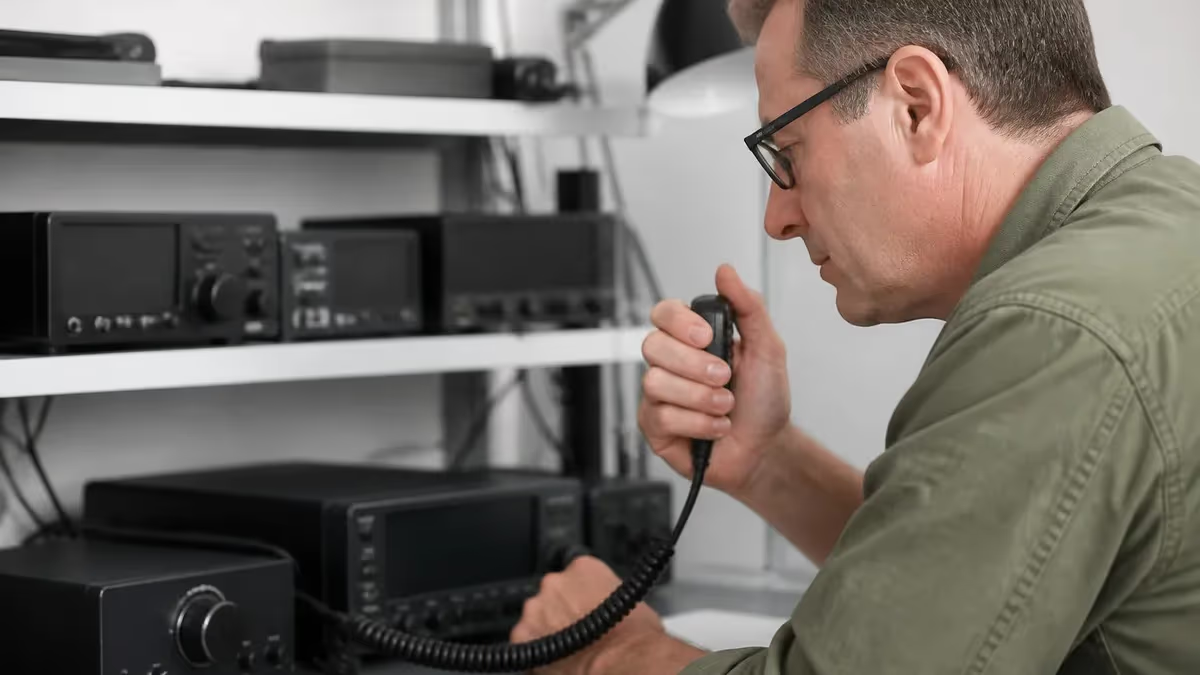
If you have been searching for ham radio clubs near me, you are already taking the most important step toward earning your ham radio license and joining one of the most welcoming technical hobbies in the United States. Local clubs are where curious beginners turn into licensed operators, where teenagers learn soldering next to retired engineers, and where storm spotters coordinate emergency communications when cell towers fail. They are the unsung backbone of amateur radio in every state.
A ham radio club is a chartered or informal group of licensed and aspiring operators who meet regularly to share knowledge, run on-air nets, host exam sessions, and operate special events. Most clubs in the United States are affiliated with the American Radio Relay League (ARRL), which lists more than 2,000 active affiliated clubs nationwide. Whether you live in Manhattan, rural Montana, or the suburbs of Atlanta, there is almost certainly a group within a 30-mile drive of your home.
Why do clubs matter so much? Because passing the Technician exam, choosing your first radio, and putting up your first antenna are infinitely easier when you have mentors guiding you. Clubs let you handle real equipment before you spend a dollar, test antennas before you climb a mast, and ask the awkward questions that YouTube tutorials never quite answer. Members frequently lend study materials, host classes, and even sponsor the modest $15 testing fee for new candidates who need help.
Local clubs also unlock the social side of the hobby. You will find weekly breakfast meetups, parking-lot tailgate sales, Field Day cookouts every June, and contesting weekends where members operate from mountaintops. Some clubs specialize in DXing (working distant countries), others in public service, digital modes, satellite operation, or building antennas from scratch. The diversity means that whatever drew you to ham radio, a nearby club already has people obsessed with it.
This guide will show you exactly how to find ham radio clubs near you, what to expect at your first meeting, how clubs accelerate your path to your first license, and how to evaluate which club fits your goals. We will cover ARRL search tools, online directories, repeater listings, Facebook groups, and the secret weapon most newcomers overlook: simply showing up at a Volunteer Examiner (VE) test session, where club members run the exams.
By the end, you will have a concrete checklist to identify the right club, contact information templates, questions to ask before joining, and a clear roadmap for going from outsider to active member within 60 days. Whether your goal is rag-chewing on 2 meters, chasing satellites, or being the neighborhood emergency coordinator, your local club is the launchpad — and finding it is far easier than you think.
A quick note on terminology: "ham radio" and "amateur radio" mean the same thing. The nickname "ham" dates back to 19th-century telegraphy slang and stuck for over a century. Anyone you meet at a club will use both terms interchangeably, so do not stress about which one to say. Just walk in, introduce yourself, and you will be welcomed in minutes.
Ham Radio Clubs in the U.S. by the Numbers
Five Reliable Ways to Find Ham Radio Clubs Near You
Visit arrl.org/find-a-club and enter your ZIP code. The official directory lists every affiliated club within a chosen radius, including meeting location, website, and primary contact email.
Sites like RepeaterBook.com show which clubs own the local 2-meter and 70-cm repeaters in your county. The repeater trustee is usually the club president or an officer.
Search Facebook for your city plus 'amateur radio' or 'ham radio'. Most modern clubs maintain an active group with meeting reminders, photos, and beginner-friendly Q&A threads.
Use arrl.org/find-an-amateur-radio-license-exam-in-your-area to find a nearby exam. Whoever administers it is almost always part of a local club and will invite you to join.
Regional swap meets like Dayton Hamvention or Orlando HamCation feature hundreds of club tables. Even local monthly tailgates surface clubs you may never have found online.
So you found a club — what actually happens when you walk through the door? Understanding club activities helps you pick one that matches your interests and decide how much time you want to invest. The vast majority of clubs in the United States hold a single monthly business meeting, plus optional weekly on-air nets and quarterly hands-on events. Most meetings run 90 minutes and end before 9 p.m., making them easy to attend after work.
A typical meeting opens with a roll call, treasurer's report, and committee updates. The middle 30-40 minutes are reserved for a program: a technical presentation, a demo of a new mode like FT8 or DMR, or a guest speaker from a nearby ham radio outlet store or a regional emergency-management agency. Programs are gold for newcomers — you absorb concepts in an hour that would take weeks of solo study to piece together from forums and YouTube videos.
Beyond meetings, clubs run on-air nets. A net is a scheduled gathering on a specific frequency, usually a local repeater, where members check in by callsign. Newcomers are openly welcomed — you do not even need a license to listen. Many clubs run a dedicated "new ham" or "technician" net once a week where licensed members coach beginners on operating procedure, signal reports, and phonetics in a no-pressure environment.
The crown jewel of the club calendar is Field Day, held the fourth weekend of June. Thousands of clubs across the country set up portable stations in parks and fields, operate for 24 straight hours on emergency power, and rack up contacts. Field Day is the single best event for prospective hams to attend because every facet of the hobby — HF, VHF, digital, satellite, antennas — is on display in one place, and licensed operators will literally hand you a microphone to make your first contacts under their supervision.
Clubs also coordinate public service events. From parade communications and bicycle race safety nets to staffing the Boston Marathon, hams provide reliable radio coverage that organizers cannot afford to hire commercially. Helping at a local 5K is the fastest way to build operating experience, meet senior members one-on-one, and contribute something meaningful while still studying for your exam.
Finally, clubs are educational engines. Most run free or low-cost Technician licensing classes once or twice a year, often as a six-week Tuesday-night program leading directly to a VE exam session in week six. Pass rates from these classes routinely top 90 percent because instructors know the question pool inside out and tailor instruction to the typical pain points: Ohm's law, RF safety, and Part 97 rules.
Some clubs go further with specialized subgroups — antenna-building workshops, contest training, kit-building nights, and youth outreach programs that get teenagers on the air through schools and Scout troops. If you have a niche interest, ask. The chance that someone in the club already shares it is surprisingly high.

Ham Radio Technician Practice Test Questions
Prepare for the Ham Radio Technician Test exam with our free practice test modules. Each quiz covers key topics to help you pass on your first try.
Ham Radio Technician Antennas & Feedlines
Ham Radio Technician Exam Questions covering Antennas & Feedlines. Master Ham Radio Technician Test concepts for certification prep.
Ham Radio Technician Basic Electronics & C...
Free Ham Radio Technician Practice Test featuring Basic Electronics & Circuitry. Improve your Ham Radio Technician Exam score with mock test prep.
Ham Radio Technician Equipment & Tools Usage
Ham Radio Technician Mock Exam on Equipment & Tools Usage. Ham Radio Technician Study Guide questions to pass on your first try.
Ham Radio Technician Amateur
Ham Radio Technician Test Prep for Amateur. Practice Ham Radio Technician Quiz questions and boost your score.
Ham Radio Technician General
Ham Radio Technician Questions and Answers on General. Free Ham Radio Technician practice for exam readiness.
Ham Radio Technician III
Ham Radio Technician Mock Test covering III. Online Ham Radio Technician Test practice with instant feedback.
Ham Radio Technician II
Free Ham Radio Technician Quiz on II. Ham Radio Technician Exam prep questions with detailed explanations.
Ham Radio Technician I
Ham Radio Technician Practice Questions for I. Build confidence for your Ham Radio Technician certification exam.
Ham Radio Technician License
Ham Radio Technician Test Online for License. Free practice with instant results and feedback.
Ham Radio Technician Licensing Regulations...
Ham Radio Technician Study Material on Licensing Regulations & Standards. Prepare effectively with real exam-style questions.
Ham Radio Technician Operating Procedures ...
Free Ham Radio Technician Test covering Operating Procedures & Etiquette. Practice and track your Ham Radio Technician exam readiness.
Ham Radio Technician Radio Wave Propagatio...
Ham Radio Technician Exam Questions covering Radio Wave Propagation & Modulation. Master Ham Radio Technician Test concepts for certification prep.
Ham Radio Technician Safety Procedures & R...
Free Ham Radio Technician Practice Test featuring Safety Procedures & Risk Management. Improve your Ham Radio Technician Exam score with mock test prep.
Club Specialties: Matching Ham Radio Bands and Activities to Your Interests
General-interest clubs are the most common type and the best starting point for most newcomers. They cover everything from voice operation on the popular 2-meter and 70-centimeter ham radio bands to introductory HF, digital modes, and public service. Meetings tend to be social, with a mix of teens and retirees.
Expect monthly programs that rotate across topics: antenna basics one month, an introduction to FT8 the next, then a guest speaker on emergency communications. If you are still figuring out what you love about the hobby, a general club gives you exposure to all of it before you specialize.
Joining a Local Ham Radio Club: Benefits vs. Trade-offs
- +Free or low-cost mentorship from experienced operators
- +Access to club station equipment without buying your own
- +On-site VE exam sessions, often at a discount
- +Built-in study groups for the Technician question pool
- +Hands-on antenna-building and soldering workshops
- +Discounted group buys on cables, connectors, and radios
- +Instant network for emergency communications training
- −Most meetings are evenings on weekdays, awkward for shift workers
- −Some clubs skew older and may be slow to adopt digital modes
- −Annual dues, club station fees, and event costs add up
- −Personality clashes occasionally divide smaller clubs
- −Driving distances can be 30-60 minutes in rural areas
- −Volunteer-run, so quality varies wildly from club to club
Pros and Cons at a Glance
| Pros | Cons |
|---|---|
| Free or low-cost mentorship from experienced operators | Most meetings are evenings on weekdays, awkward for shift workers |
| Access to club station equipment without buying your own | Some clubs skew older and may be slow to adopt digital modes |
| On-site VE exam sessions, often at a discount | Annual dues, club station fees, and event costs add up |
| Built-in study groups for the Technician question pool | Personality clashes occasionally divide smaller clubs |
| Hands-on antenna-building and soldering workshops | Volunteer-run, so quality varies wildly from club to club |

Your First Ham Radio Club Meeting Checklist
- ✓Email or message the club president 48 hours before to confirm meeting time and location
- ✓Arrive 15 minutes early to introduce yourself before the gavel drops
- ✓Bring a notebook, a pen, and a fully charged smartphone for note-taking
- ✓Wear a name tag with your first name written large — callsign optional if unlicensed
- ✓Have your goal ready in one sentence: 'I want to pass the Technician exam this fall'
- ✓Ask which member is the club's designated Elmer (mentor) for newcomers
- ✓Pick up a copy of the club newsletter or scan the QR code for their groups.io list
- ✓Listen quietly during the business portion; questions are welcomed in the social half
- ✓Stay for the after-meeting coffee — that is where friendships actually form
- ✓Send a thank-you email within 24 hours to the person who welcomed you
Show up unlicensed — they want you there
You do not need a callsign to attend a ham radio club meeting. In fact, clubs prioritize unlicensed visitors because growing the hobby is part of their charter. Many will pair you with a mentor on the spot, lend you study materials, and even sponsor your $15 exam fee. Walking in without a license is the right move, not a barrier.
Local clubs are the single greatest accelerator for earning your Technician license. The FCC exam covers 35 questions drawn from a public pool of about 400, and while self-study works, students who learn alongside club mentors pass at dramatically higher rates. A 2024 ARRL membership survey found that learners attending club-run classes pass on their first attempt 92 percent of the time, compared with roughly 74 percent for solo study using only books or apps.
That gap exists because clubs translate dense exam material into concrete demonstrations. When a club instructor explains SWR, she does not just recite a formula — she fires up an analyzer, sweeps a real ham radios antenna, and shows you the dip on a screen. Suddenly the question on standing wave ratio in the pool stops being abstract and starts being a memory of last Tuesday's demonstration. That experiential layer is precisely what clubs deliver and what books cannot.
Most clubs run formal Technician classes once or twice a year, typically a 6-to-8-week program meeting one weeknight for two hours. Classes follow either the ARRL Ham Radio License Manual or the W5YI Technician guide and culminate in a Saturday-morning VE exam session. Tuition is usually free for ARRL members or $20-30 to cover the book. Bring a calculator and a notebook — instructors will assign homework problems and review them at the start of each session.
Beyond classes, clubs host VE sessions on a regular schedule, often the first Saturday of each month. A team of three or more accredited Volunteer Examiners administers the test, grades it on the spot, and submits paperwork to the FCC. You typically walk out knowing whether you passed; your callsign appears in the ULS database within 7 to 10 business days. The current FCC application fee is $35, plus the VE team's $15 session fee.
If you cannot attend a class, clubs still help. Many run informal study groups where members work through practice questions together. Sites like HamStudy.org and the ARRL question pool are widely used in these sessions, and members will explain not just the right answer but why the wrong answers are wrong — a deeper understanding that protects against tricky distractors on exam day.
Clubs also organize Volunteer Examiner upgrades. Once you pass Technician, you can sit for General and then Amateur Extra the same day at no extra charge in many sessions. This makes it possible to walk in unlicensed at 9 a.m. and walk out a General-class operator by lunchtime, especially common at large hamfests and during ARRL-coordinated test sessions.
Finally, clubs are your bridge from passing the exam to actually operating. A new license is exciting but intimidating — you suddenly have transmit privileges and no idea what to say on the air. Club nets, parking-lot lessons with a handheld radio, and Field Day mentorship turn that fear into confidence within weeks. The club fills the gap that the FCC test never addresses: how to be a competent, courteous operator on the bands.
A small minority of clubs operate as informal sales channels for specific dealers or import radios. Legitimate clubs offer balanced gear advice based on member experience, not commission. If your first meeting feels like a sales pitch for a single brand, visit two more clubs before committing dues — you deserve unbiased mentorship.
Not every club is the right fit, and that is fine. With more than 2,000 ARRL-affiliated clubs and hundreds of independent groups in the U.S., you have real choice. The goal is not to find the biggest or oldest club — it is to find the one whose culture, schedule, and specialties align with what you want from the hobby. Visit at least two before paying dues so you can compare.
Start by listing your three primary goals. Are you driven by emergency communications? Look for an ARES-active club. Fascinated by DXing or contesting? Find a club with HF capability and members holding DXCC awards. Interested in homebrewing antennas and kits? Seek out a club that runs a builder's night or has a 3D printer in the shack. Goals plus location narrow your candidate list quickly.
Evaluate the club's communication infrastructure during your first visit. Does it maintain an active groups.io list, a working repeater, a current website with a meeting calendar, and a newsletter? Clubs that invest in communication tend to invest in their members. Conversely, a club whose website was last updated in 2019 may be coasting on inertia, with attendance falling and meetings reduced to social rehashing rather than active programming.
Consider demographics. A healthy club has members across age ranges, multiple women and men, and a steady flow of new licensees. Clubs heavily weighted toward one age group can still be wonderful, but you will have more long-term relationships in a diverse group. Visit on a Field Day or public service event to see who actually shows up — meeting attendance and event attendance are very different metrics.
Ask about Elmering culture. "Elmer" is the ham radio term for a mentor, and the strongest clubs assign one to every newcomer. Ask: Who would my Elmer be? How often do you meet outside the formal program? Will I have access to club equipment to practice with before buying my own radio? Strong clubs answer these questions with names and concrete examples. Weaker clubs deflect.
Look at the club station. If the club owns a shack with a working ham radio frequencies setup spanning HF, VHF, and UHF, you have a free playground to learn on before investing thousands in your own gear. Some clubs have spectacular stations donated by estates of silent keys; others have nothing. Both can be great clubs, but a strong shack is a major value-add for newcomers on a budget.
Finally, trust your gut. The right club feels welcoming within the first 10 minutes. Members make eye contact, introduce themselves, and ask about your goals rather than monologuing about theirs. If a meeting feels cliquey, cold, or focused entirely on internal politics, thank everyone and try the next one. Your time and dues are scarce — spend them where you are valued.
You have located clubs, visited a meeting, and identified one that feels like home. What now? The next 60 days determine whether you become a peripheral attendee or a contributing member, and the difference is mostly social. Active members report exponentially more value from their dues — exam help, gear loans, antenna-raising parties — because clubs reward visibility and reciprocity. Here is the practical roadmap for going from new visitor to known member quickly.
In your first 14 days, join the club's email list or groups.io community and post a short introduction with your name, location, current license status, and one specific goal. Mention your interests — satellites, digital, emergency communications — so members can route you to the right people. Volunteer for one small task: bringing snacks to the next meeting, helping set up chairs, or photographing the program. Tiny contributions stick in members' memories.
Begin attending the club's weekly net even if you only listen. Once licensed, check in by callsign every week. Nets are the most consistent way to be heard by 20-40 club members at once, and net control operators specifically appreciate new voices because they keep the net interesting. Within a month of checking in regularly, you will start being greeted by name at meetings — the goal of the entire integration process.
Sign up for the next hands-on event, whether that is Field Day in June, Winter Field Day in January, or a public service event in your county. These multi-hour shared experiences forge friendships faster than any number of meetings. Bring a handheld even if you do not yet have a license — most events have unlicensed roles like logging, runner, or food coordinator that get you embedded with the operators.
Take the club's Technician class if you have not yet passed. Even if you self-studied successfully, audit it to deepen your understanding of the ham radio license exam material and to bond with classmates who will be your cohort for years. Many lifelong friendships in amateur radio trace back to a six-week licensing class taken together at age 15 or age 65.
Pay your dues promptly and pick up the club's branded shirt, hat, or callsign badge. These tiny signals of commitment matter; veterans notice who shows up wearing the club logo at hamfests. Within six months, consider standing for a small role: librarian, webmaster, social media coordinator. Even introverts can contribute behind-the-scenes work that builds reputation without requiring extroversion.
Finally, give back to the next wave. Within a year of joining, you will know enough to mentor someone newer than you. The Elmer culture survives because each generation pays it forward. When the next nervous visitor walks in asking about ham radio clubs near me, you become the friendly face who answers their questions — closing the loop that someone started by welcoming you.
Sample Ham Radio Technician Test Practice Questions
Try these questions from our free Ham Radio Technician Test practice tests. The correct answer and an explanation follow each question.
An amateur radio operator wants to help during a community disaster. Which FCC authorization allows amateur radio operators to communicate on behalf of non-amateur entities during emergencies?
- A. Emergency Use License (EUL)
- B. Third-party traffic provisions and Part 97 emergency rules
- C. Special Temporary Authority (STA) only
- D. No authorization exists — amateurs may not act on behalf of others
Answer: B. Third-party traffic provisions and Part 97 emergency rules
Part 97 emergency provisions and third-party traffic rules allow amateurs to pass communications on behalf of others during emergencies.
How soon can you transmit on amateur radio bands after passing the test for your first amateur radio license?
- A. As soon as you receive your license in the mail from FCC
- B. Immediately on receiving your Certificate of Successful Completion of Examination (CSCE)
- C. As soon as your operator/station license grant appears on the ARRL website
- D. As soon as your operator/station license grant appears in the FCC's license database
Answer: D. As soon as your operator/station license grant appears in the FCC's license database
Explanation: As soon as your identity and call sign show in the ULS database of the FCC, you are eligible to operate a transmitter on an amateur service frequency after passing the test necessary for your first amateur radio license.
What is the FCC's Part 97 in relation to amateur radio?
- A. The international treaty governing amateur radio
- B. The FCC rules that govern amateur radio service in the US
- C. The ARRL's code of ethics for operators
- D. The technical standards for radio equipment manufacturing
Answer: B. The FCC rules that govern amateur radio service in the US
FCC Part 97 is the section of the Code of Federal Regulations that contains all rules governing the amateur radio service.
What is a 'vanity call sign' in the U.S. amateur radio system?
- A. A call sign automatically assigned by the FCC based on license class
- B. A specific call sign requested by an amateur, subject to FCC availability and rules
- C. A temporary call sign used during special events
- D. A call sign assigned to club stations only
Answer: B. A specific call sign requested by an amateur, subject to FCC availability and rules
A vanity call sign is a specific call sign that an amateur may request from the FCC, provided it is available and the applicant meets eligibility rules.
Ham Radio Technician Questions and Answers
About the Author

Educational Psychologist & Academic Test Preparation Expert
Columbia University Teachers CollegeDr. Lisa Patel holds a Doctorate in Education from Columbia University Teachers College and has spent 17 years researching standardized test design and academic assessment. She has developed preparation programs for SAT, ACT, GRE, LSAT, UCAT, and numerous professional licensing exams, helping students of all backgrounds achieve their target scores.
Join the Discussion
Connect with other students preparing for this exam. Share tips, ask questions, and get advice from people who have been there.
View discussion (3 replies)